World Food Books' programme is largely produced on Kulin Nation land. We acknowledge the Wurundjeri people of the Kulin Nation as the first and continuing custodians of this land, and pay respect to their Elders past, present, and emerging.
World Food Books is an arts and special interests bookshop in Naarm / Melbourne. Founded in 2010, World Food Books is devoted to the presentation of a rotating, hand-selection of international art, design, literary and counterculture publications with an emphasis on the anti-traditional, the experimental, the avant-garde, the heretic, the marginal.
Presenting new titles alongside rare and out-of-print books, catalogues and journals spanning the fields of modern and contemporary art, design, photography, illustration, film, literature, poetry, cultural theory, philosophy, sexuality, popular and underground culture in its many radical forms, World Food Books wishes to encourage adventurous, thoughtful and open-minded reading, looking, writing, and exchange of publishing and ideas, both current and historical.
As well as our bookshop, located in Melbourne's historical Nicholas Building, all of our inventory is available internationally via our online mail-order service.
World Food Books semi-regularly co-ordinates "Occasions", a programme of exhibits and events at the bookshop and in partnership with other hosts (such as museums and art galleries) that develop out of the activities, relationships and content of the bookshop itself.
World Food Books
The Nicholas Building
37 Swanston Street
Room 5, Level 6
Melbourne 3000
Australia
SHOP HOURS:
Thu–Fri 12–6, Sat 12–5
WEB-SHOP OPEN 24/7
World Food Books
Postal Address:
PO Box 435
Flinders Lane
Victoria 8009
Australia
Art
Theory / Essay
Architecture / Interior
Graphic Design / Typography
Photography
Fashion
Eros
LGBTQ+
Fiction / Poetry
Weird / Speculative / Science Fiction / Horror
Transgressive / Visceral / Abject
Symbolism / Decadence / Fin de siècle
Film / Video
Painting
Sculpture / Installation
Performance / Dance / Theater
Drawing
Sound / Music
Curatorial
Group Shows / Collections
Periodicals
Out-of-print / Rare
Posters / Ephemera / Discs
Signed Books
World Food Books Gift Voucher
World Food Book Bag
Australian Art
Australian Fiction
Australian Science Fiction / Speculative Fiction
Australian Poetry
Australian Photography
Japanese Photography
Conceptual Art
Minimal Art
Dada
'Pataphysics / Oulipo
Fluxus
Concrete Poetry
Pop Art
Surrealism
Arte Povera
Arte Informale / Haute Pâte / Tachism
Nouveau Réalisme / Zero / Kinetic
Situationism / Lettrism
Collage / Mail Art / Xerox Art
Art Brut / Folk / Visionary / Fantastic
Illustration / Graphic Art / Bandes Dessinées
Furniture
Italian Radical Design / Postmodernism
Textiles
Ceramics / Glass
Counterculture
Protest / Revolt
Philosophy
Psychoanalysis
Anthropology
Anarchism
Socialism / Anarchism / Communism / Capitalism
Literary Theory / Semiotics / Language
Feminism / Women's Studies
Gender Studies / Sexuality
Anthropology
Fetishism / BDSM
Drugs / Psychedelia
Crime / Violence
Animal Rights / Veganism
Occult / Esoterica
Ecology / Earth / Alternative Living
Whole Earth / Crafts
All prices in AUD (Australian dollars)
Pick-Ups
Pick-up orders can be collected in our bookshop during opening hours after order date. Please collect any Pick-up orders within 2 weeks of ordering as we have limited storage space. Orders will be released back into stock if not collected within this time. No refunds can be made for pick-ups left un-collected. If you cannot make it in to the bookshop in this time-frame, please choose postage option.
Return Policy
All sales are final. We do accept returns (for refund or exchange) for items received in error. All our orders are packed with special care using heavy-duty padding and cardboard book-mailers or bubble mailers (for smaller books), using reinforcement where required. We cannot take responsibility for any lost, stolen or damaged parcels.
Insurance
Should you wish to insure your package, please email us directly after placing your order and we can organise this at a small extra expense. Although all standard/express tracked packages are very safe and dependable, we cannot take responsibility for any lost, stolen or damaged parcels. We recommend insurance on valuable orders.
Interested in selling your old books, catalogues, journals, magazines, comics, fanzines, ephemera? We are always looking for interesting, unusual and out-of-print books to buy. We only buy books in our fields of interest and specialty, and that we feel we can resell.
We base these prices on desirability, market value, in-print prices, condition and our current stock levels. We offer cash, store credit, and can take stock on consignment. All
about 25% of the price we expect to get when we sell them, or 30% in store credit. We base these prices on desirability, market value, in-print prices, condition and our current stock levels.
Sell your books any day of the week. You can drop them off and return later. If you have a lot of books, we can visit your Sydney home.
We buy books that we feel we can resell. We offer about 25 % of the price we expect to get when we sell them, or 30% in store credit. We base these prices on desirability, market value, in-print prices, condition and our current stock levels.
Philadelphia Wireman
03 August - 01 September, 2018
World Food Books is proud to announce our next Occasion, the first presentation of sculptures by Philadelphia Wireman in Australia.
The Philadelphia Wireman sculptures were found abandoned in an alley off Philadelphia’s South Street on trash night in 1982. Their discovery in a rapidly-changing neighbourhood undergoing extensive renovation, compounded with the failure of all attempts to locate the artist, suggests that the works may have been discarded after the maker’s death. Dubbed the "Philadelphia Wireman" during the first exhibition of this work, in 1985, the maker’s name, age, ethnicity, and even gender remain uncertain. The entire collection totals approximately 1200 pieces, all intricately bound together with tightly-wound heavy-gauge wire (along with a few small, abstract marker drawings, reminiscent both of Mark Tobey and J.B. Murry). The dense construction of the work, despite a modest range of scale and materials, is singularly obsessive and disciplined in design: a wire armature or exoskeleton firmly binds a bricolage of found objects including plastic, glass, food packaging, umbrella parts, tape, rubber, batteries, pens, leather, reflectors, nuts and bolts, nails, foil, coins, toys, watches, eyeglasses, tools, and jewellery.
Heavy with associations—anthropomorphic, zoomorphic, and socio-cultural responses to wrapped detritus—the totemic sculptures by Philadelphia Wireman have been discussed in the context of work created to fulfil the shamanistic needs of alternative religions in American culture. Curators, collectors, and critics have variously compared certain pieces to sculpture from Classical antiquity, Native American medicine bundles, African-American memory jugs, and African fetish objects. Reflecting the artist’s prolific and incredibly focused scavenging impulse, and despite—or perhaps enhanced by—their anonymity, these enigmatic objects function as urban artefacts and arbiters of power, though their origin and purpose is unknown. Philadelphia Wireman, whatever their identity, possessed an astonishing ability to isolate and communicate the concepts of power and energy through the selection and transformation of ordinary materials. Over the course of the past two decades, this collection has come to be regarded as an important discovery in the field of self-taught art and vernacular art.
Presented in collaboration with Fleisher-Ollman Gallery, Philadelphia, and Robert Heald, Wellington.
Susan Te Kahurangi King
02 February - 10 March, 2018
Susan Te Kahurangi King (24 February 1951 - ) has been a confident and prolific artist since she was a young child, drawing with readily available materials - pencils, ballpoint pens and felt-tip markers, on whatever paper is at hand. Between the ages of four and six Susan slowly ceased verbal communication. Her grandparents William and Myrtle Murphy had developed a special bond with Susan so they took on caring responsibilities for extended periods. Myrtle began informally archiving her work, carefully collecting and storing the drawings and compiling scrapbooks. No drawing was insignificant; every scrap of paper was kept. The King family are now the custodians of a vast collection containing over 7000 individual works, from tiny scraps of paper through to 5 meter long rolls.
The scrapbooks and diaries reveal Myrtle to be a woman of great patience and compassion, seeking to understand a child who was not always behaving as expected. She encouraged Susan to be observant, to explore her environment and absorb all the sights and sounds. Myrtle would show Susan’s drawings to friends and people in her community that she had dealings with, such as shopkeepers and postal workers, but this was not simply a case of a grandmother’s bias. She recognised that Susan had developed a sophisticated and unique visual language and sincerely believed that her art deserved serious attention.
This was an unorthodox attitude for the time. To provide some context, Jean Dubuffet coined the term Art Brut in 1945 to describe work created by self-taught artists – specifically residents of psychiatric institutions and those he considered to be visionaries or eccentrics. In 1972 Roger Cardinal extended this concept by adopting the term Outsider Art to describe work made by non-academically trained artists operating outside of mainstream art networks through choice or circumstance. Susan was born in Te Aroha, New Zealand in 1951, far from the artistic hubs of Paris and London that Dubuffet and Cardinal operated in. That Myrtle fêted Susan as a self-taught artist who deserved to be taken seriously shows how progressive her attitudes were.
Susan’s parents Doug and Dawn were also progressive. Over the years they had consulted numerous health practitioners about Susan’s condition, as the medical establishment could not provide an explanation as to why she had lapsed into silence. Dawn educated herself in the field of homeopathy and went on to treat all twelve of her children using these principles – basing prescriptions on her observations of their physical, mental and emotional state.
Doug was a linguist with an interest in philosophy who devoted what little spare time he had to studying Maori language and culture. To some extent their willingness to explore the fringes of the mainstream made them outsiders too but it was their commitment to living with integrity and their respect for individuality that ensured Susan’s creativity was always encouraged.
Even though Susan’s family supported her artistic pursuits, some staff in schools and hospitals saw it as an impediment to her assimilation into the community and discouraged it in a variety of ways. Her family was not always aware of this and therefore did not fully understand why Susan stopped drawing in the early 1990s. However, rather than dwell on the challenges that Susan faced in pursuit of her artistic practice, they prefer to highlight her achievements. In 2008 Susan began drawing again in earnest, after an almost 20 year interruption, and her work is now shown in galleries around the world.
Susan grew up without television and has been heavily influenced by the comics she read as a child. She is absolutely fearless in the appropriation of recognizable characters, such as Donald Duck and Mickey Mouse, in her work. She twists their limbs, contorts their faces, compresses them together, blends them into complex patterned backgrounds - always imbuing them with an incredible energy. Although Susan often used pop culture characters in her work they are not naive or childlike. These are drawings by a brilliant self-taught artist who has been creating exceptional work for decades without an audience in mind.
Mladen Stilinović
"Various Works 1986 - 1999"
02 February 16 - September 10, 2016
Various works 1986 - 1999, from two houses, from the collections of John Nixon, Sue Cramer, Kerrie Poliness, Peter Haffenden and Phoebe Haffenden.
Including: Geometry of Cakes (various shelves), 1993; Poor People’s Law (black and white plate), 1993; White Absence (glasses, ruler, set square, silver spoon, silver ladel with skin photograph and wooden cubes), 1990-1996; Exploitation of the Dead (grey and red star painting, wooden painting, black spoon with red table, red plate), 1984-1990; Money and Zeros (zero tie, paintings made for friends in Australia (Sue, John, Kerrie), numbers painting), 1991-1992; Words - Slogans (various t-shirts) - “they talk about the death of art...help! someone is trying to kill me”, “my sweet little lamb”, “work is a disease - Karl Marx”; Various artist books, catalogues, monographs, videos; Poster from exhibition Insulting Anarchy; "Circular" Croatian - Australian edition; Artist book by Vlado Martek (Dostoyevsky); more.
Thanks to Mladen Stilinović and Branka Stipančić.
Jonathan Walker
Always Will Need To Wear Winter Shirt Blue + Ochre Small Check Pattern
21 August - 21 September, 2015
Untitled
I am not a great reader of poetry but I always return to the work of Melbourne poet, Vincent Buckley (1925- 1988). Perhaps I find his most tantalising piece to be not a finished poem but a fragment left on a scrap of paper discovered on his desk after the poet’s death.
The poetry gathers like oil
In the word-core, and spreads
It has its music meet,
Its music is in movement.
This fragment is more the shell left behind from a volatile thought than a finished poem. I find the last two lines honest but awkward whereas the first two lines work like an arrow. Most likely he could not find a resolution so it was left. Still, in its present form, it remains an eloquent testimony to the ultimate failure of a medium to express mobile thought and sensation, in Buckley’s case, through verbal language. It’s an important matter because this is something all artists have to deal with regardless of the medium.
I have never written a poem, however, I am forever copying fragments from books on paper scraps in a vain effort to fix certain notions in my head. At first, they function as bookmarks that are sometimes returned to when I open the book. But before long, as they accumulate, they fall out littering the table interspersed with A4 photocopies, bills, books and medications.
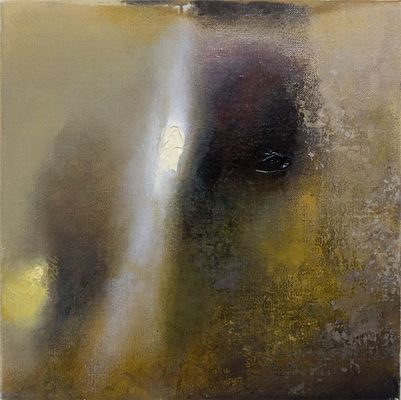
To return to Buckley’s fragment, the first two lines very much evoke how I paint nowadays. As you age, detail diminishes and patches of light become more luminous and float. I feel the most honest way of dealing with this is by smearing the oil paint on the canvas with the fingers and working close-up, blind. Only if the patches coalesce into an approaching image can the work gain a life.
-
Jonathan Walker was born in Melbourne, Australia and brought up on a dairy farm in Gippsland. In the 1970’s he studied painting at RMIT and won the Harold Wright Scholarship to the British Museum, London. During the 1980’s he exhibited at Pinacotheca Gallery, Richmond and had work shown at the NGV and Heidi City Art Gallery. Over the same period he designed the cover for the “Epigenesi” LP by Giancarlo Toniutti, Italy and conducted a mail exchange work with Achim Wollscheid, Germany. The work with artists through the post resulted in an article published in the bicentenary issue of Art and Australia 1988. He showed in artist run spaces such as WestSpace in the 90’s and 2000’s, and until 2012, taught painting at Victoria University, which is where we (Colleen Ahern and Lisa Radford) as organisers of the exhibition, among many others, had the privilege of being his student.
Walker’s knowledge was imparted to students through the careful selection of music, literature, and artists found in books that he himself had ordered for the library. Walker’s strategy was the generosity of sharing his vast knowledge with references specific to each student and their context.
Walker’s paintings share a similar focus and intimacy.
This exhibition presents a small selection of recent paintings alongside a publication that includes Walker’s writing. Observational and analytical, Walker’s work is a type of material notation — the time of day, colour and how it is blended, the both specific and fleeting location of a reflection on lino or the question of whether a chair leg should be included in a painting.
Please join us on Friday August 21 between 6-8pm to celebrate the opening of the exhibition.
Curated by Colleen Ahern and Lisa Radford.
B. Wurtz
Curated by Nic Tammens
March 26 - April 4, 2015
B.Wurtz works from a basement studio in his home on Manhattan’s Lower East Side.
This local fact is attested to by the plastic shopping bags and newsprint circulars that appear in his work. As formal objects, they don’t make loud claims about their origins but nonetheless transmit street addresses and places of business from the bottom of this long thin island. Like plenty of artists, Wurtz is affected by what is local and what is consumed. His work is underpinned by this ethic. It often speaks from a neighborhood or reads like the contents of a hamper:
“BLACK PLUMS $1.29 lb.”
“Food Bazaar”
“USDA Whole Pork Shoulder Picnic 99c lb.”
“RITE AID Pharmacy, with us it’s personal.”
“H. Brickman & Sons.”
“Sweet Yams 59c lb."
Most of the work in this exhibition was made while the artist was in residence at Dieu Donne, a workshop dedicated to paper craft in Midtown. Here Wurtz fabricated assemblages with paper and objects that are relatively lightweight, with the intention that they would be easily transportable to Australia. This consideration isn’t absolute in Wurtz’s work, but was prescriptive for making the current exhibition light and cheap. Packed in two boxes, these works were sent from a USPS post office on the Lower East Side and delivered to North Melbourne by Australia Post.
Wurtz appears courtesy of Metro Pictures, New York.
Thanks to Rob Halverson, Joshua Petherick, Sari de Mallory, Matt Hinkley, Helen Johnson, Fayen d'Evie, Ask Kilmartin, Lisa Radon, Ellena Savage, Yale Union, and "Elizabeth".
John Nixon
"Archive"
December 15 - January 20, 2014
The presentation of John Nixon's archive offered a rare showcase of this extensive collection of the artist's own publications, catalogues, posters, ephemera, editions and more, from the mid 1980s onwards, alongside a selection of his artworks.
Organized by John Nixon, Joshua Petherick and Matt Hinkley.
<a href=http://wfb.public-office.info/artist/john-nixon>All titles by John Nixon
"Habitat"
at Minerva, Sydney (organised by Joshua Petherick and Matt Hinkley)
November 15 - December 20, 2014
Lupo Borgonovo, Janet Burchill & Jennifer McCamley,
Lewis Fidock, HR Giger, Piero Gilardi, Veit Laurent Kurz,
Cinzia Ruggeri, Michael E. Smith, Lucie Stahl, Daniel Weil, Wols
Press Release:
“...It contained seven objects. The slender fluted bone, surely formed for flight, surely from the wing of some large bird. Three archaic circuitboards, faced with mazes of gold. A smooth white sphere of baked clay. An age-blackened fragment of lace. A fingerlength segment of what she assumed was bone from a human wrist, grayish white, inset smoothly with the silicon shaft of a small instrument that must once have ridden flush with the surface of the skin - but the thing’s face was seared and blackened.”
William Gibson, “Count Zero”, 1986
"Autumn Projects Archive"
Curated by Liza Vasiliou
March 6 - March 15, 2014
World Food Books, in conjunction with the Virgin Australia Melbourne Fashion Festival 2014, presented the Autumn Projects archive, consisting of a selection of early examples in Australian fashion with a particular interest in collecting designers and labels from the period beginning in the 1980’s, who significantly influenced the discourse of Australian Fashion.
Curated by Liza Vasiliou, the exhibition provided a unique opportunity to view pieces by designers Anthea Crawford, Barbara Vandenberg, Geoff Liddell and labels CR Australia, Covers, Jag along with early experimental collage pieces by Prue Acton and Sally Browne’s ‘Fragments’ collection, suspended throughout the functioning World Food Books shop in Melbourne.
H.B. Peace
presented by CENTRE FOR STYLE
November 14, 2013
"Hey Blinky, you say chic, I say same"
Anon 2013
H.B. Peace is a clothing collaboration between great friends Blake Barns and Hugh Egan Westland. Their pieces explore the divergences between 'character’ and ‘personality’ in garments....etc
Special Thanks to Joshua Petherick and Matt Hinkley of WFB and Gillian Mears
and a Very Special Thank you to Audrey Thomas Hayes for her shoe collaboration.
Janet Burchill & Jennifer McCamley
"Aesthetic Suicide"
May 10 - June 8, 2013
The first of our occasional exhibitions in the World Food Books office/shop space in Melbourne, "Aesthetic Suicide" presented a body of new and older works together by artists Janet Burchill & Jennifer McCamley, including videos, prints, a wall work, and publications.
During shop open hours videos played every hour, on the hour.
2017, English
Hardcover, 168 pages, 21 x 24 cm
Published by
Yale University Press / New Haven
$69.00 - Out of stock
A new look at the art of one of the most charming and idiosyncratic personalities of early 20th-century New York Florine Stettheimer (1871-1944) was a New York original: a society lady who hosted an avant-garde salon in her Manhattan home, a bohemian and a flapper, a poet, a theater designer, and above all an influential painter with a sharp satirical wit. Stettheimer collaborated with Gertrude Stein and Virgil Thomson, befriended (and took French lessons from) Marcel Duchamp, and was a member of Alfred Stieglitz and Georgia O'Keeffe's artistic and intellectual circle.
Beautifully illustrated with 150 color images, including the majority of the artist's extant paintings, as well as drawings, theater designs, and ephemera, this volume also highlights Stettheimer's poetry and gives her a long overdue critical reassessment. The essays published here-as well as a roundtable discussion by seven leading contemporary female artists and curator Jens Hoffmann-overturn the traditional perception of Stettheimer as an artist of mere novelties. Her work is linked not only to American modernism and the New York bohemian scene before World War II but also to a range of art practices active today.
Flamboyant and epicurean, she was an astute documenter of New York and parodist of her social milieu; her highly decorative scenes borrowed from Surrealism and contributed to the beginnings of a feminist aesthetic.
2016, English
Softcover, 74 pages, 20.3 x 25.4 cm
Published by
David Zwirner Books / New York
$68.00 - Out of stock
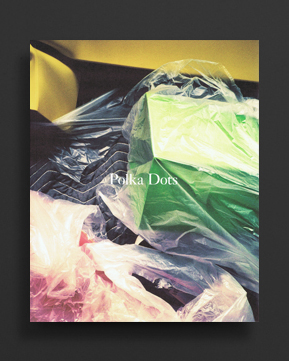
Built around a series of photographs by Andreas Laszlo Konrath taken over the course of multiple visits to Carol Bove’s studio in Brooklyn, this catalogue offers a behind-the-scenes look into her practice. Through the photographs, the reader experiences not only the development of her most recent body of sculptures—referred to by the artist as “collage sculptures”—but also the materials and conditions that contribute to their creation. They are constructed from square steel tubing that has been crushed and shaped at the studio, found scrap metals, and shallow, highly polished discs. Painted in vivid colors, the sculptures appear lightweight and improvisational despite their heavy materiality. In addition to Konrath’s rich and intimate photographs, also included are images of individual works shown silhouetted out of their original context, an attempt by the artist to draw the viewer away from typical ways of experiencing sculpture.
Created by the artist in close collaboration with designer Joseph Logan and published on the occasion of her eponymous show at David Zwirner, New York, in November 2016, Polka Dots features an essay by Johanna Burton that charts Bove’s fascination with process and commitment to disrupting traditional ways of seeing. A chronology provides a summary of Bove’s exhibitions and installations in major museums and private institutions around the world, offering a thorough resource for those interested in the artist’s development across time.
Text by Johanna Burton. Photography by Andreas Laszlo Konrath
2017, English
Softcover (saddle-stitch w. acrylic book cover), 384 pages, 26 cm x 20 cm
Published by
MUMA / Victoria
$44.00 - Out of stock
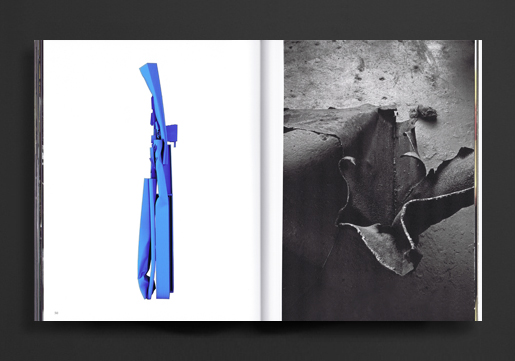
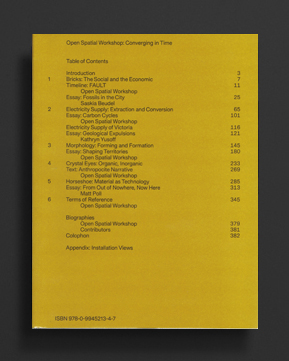
Open Spatial Workshop: Converging in Time was published on the occasion of the first major museum exhibition by Open Spatial Workshop (comprising artists Terri Bird, Bianca Hester and Scott Mitchell). The exhibition is part of MUMA's much anticipated annual survey exhibition series that presents the practices of Australia's most exciting and innovative mid-career artists. Converging in Time continues OSW's sculptural investigation into the forces of material formation. Drawing on earth sciences research and studies of the Anthropocene, this major book explores the relationship between the mineral make-up of a site and the societies they produce and sustain.
Designed by Paul Mylecharane and Ziga Testen
Artists: Open Spatial Workshop (comprising of Terri Bird, Bianca Hester and Scott Mitchell)
Text: Open Spatial Workshop, Saskia Beudel, Kathryn Yusoff, Matt Poll
2017, English
Softcover, 226 pages, 16.5 x 24 cm
Published by
Sternberg Press / Berlin
Thyssen-Bornemisza Art Contemporary / Vienna
$74.00 $15.00 - Out of stock
Edited by Daniela Zyman, Cory Scozzari
Contributions by Armen Avanessian, Daniel Garza-Usabiaga, Carl Michael von Hausswolff, Anke Hennig, Chus Martínez, Eva Wilson, Daniela Zyman
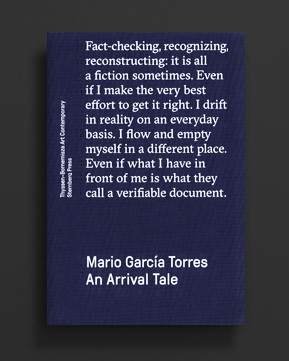
Appropriation, storytelling, reenactment, and reportage are some of the strategies that Mario García Torres deploys to highlight the limitations of factual evidence and the agency of historical records and objects. An Arrival Tale detaches the Mexican artist’s works in the TBA21 collection from their original contexts and offers them as a collection of narratives and artistic experiments open for reinscription in order to address the conditions and urgencies of our contemporary societies. It examines the space of arrival as a complicated and disjointed nexus between departure, displacement, and return.
This publication follows the eponymous exhibition at TBA21 – Augarten. While conceived in relation to the exhibition, this book is not a documentation, but rather the start of a journey that expands, explores, complicates, and undoes the thematic threads of spatial disjunction, recollection, asynchronicity, fictionality, and the politics of visibility.
Copublished with Thyssen-Bornemisza Art Contemporary, Vienna
Design by Studio Folder
2016, English / German
Softcover, 140 pages, 16.5 x 23.5 cm
Published by
Sternberg Press / Berlin
$49.00 $15.00 - Out of stock
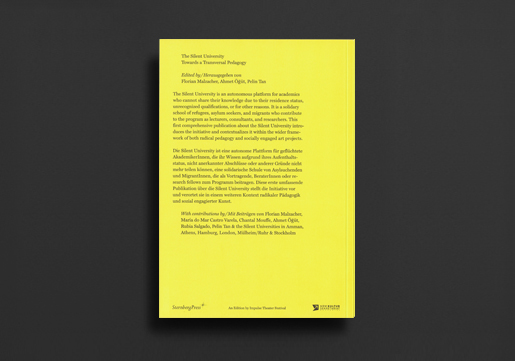
Edited by Florian Malzacher, Ahmet Öğüt, Pelin Tan
With contributions by Florian Malzacher, María do Mar Castro Varela, Chantal Mouffe, Ahmet Öğüt, Rubia Salgado, Pelin Tan, and the Silent Universities in Amman, Athens, Hamburg, London, Mülheim/Ruhr, and Stockholm
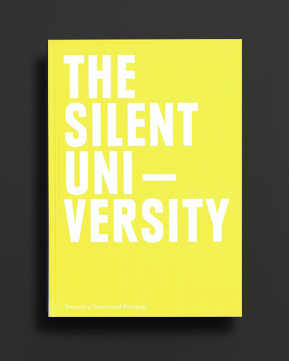
The Silent University, initiated by artist Ahmet Öğüt in 2012, is an autonomous platform for academics who cannot share their knowledge due to their status of residence, because their degrees are not recognized or regaining access to academia is blocked for other reasons. It is a solidary school by refugees, asylum seekers and migrants who contribute to the program as lecturers, consultants and researchers.
The Silent University proposes a new institution outside of the restrictions of existing universities, migration laws and the other bureaucratic or juridical obstacles many migrants face. At the same time it mimics the idea of exiting universities, using their representational logics by developing alternative structures of pedagogy beyond border politics, race/ethnicity and normative education.
This first comprehensive publication about the Silent University introduces the initiative and contextualizes it in the wider framework of both radical pedagogy and socially engaged art projects. In addition, all current branches of the Silent University—in Amman, Athens, Hamburg, London, Mülheim/Ruhr, and Stockholm—describe their very different achievements as well as their struggles and failures.
The book contextualizes this initiative within a broader picture of migration policies, critical pedagogy, artistic involvement and institutional engagement. It also hopes to be an introduction for all those who might want to get involved in the Silent University—as contributors, lecturers, students in the existing branches, or by initiating new SUs wherever they are needed: a need which is becoming urgent in more and more cities and countries all around the world.
This book is published as an edition of Impulse Theater Festival, which initiated the foundation of Silent University Ruhr in Mülheim in June 2015.
Design by Fons Hickmann m23
1982, German
Hardcover (limited ed. Laminate cover), 260 pages, 24 x 33.5 cm
1st Edition, Out of print title / Used*,
Published by
Werkbund / Bremen
$350.00 - Out of stock
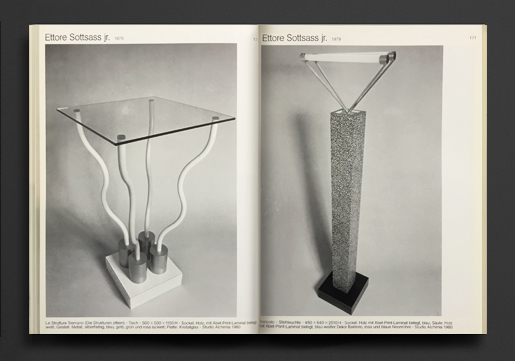
Beautiful over-sized book published on the occasion of a special exhibition in Lower Saxony and Bremen in 1982 entitled "Provokationen. Design Aus Italien : Ein Mythos Geht Neue Wege".
Published more broadly as a softcover book in 1982, here is one of the very limited edition hardcover versions, produced in collaboration between the designers Andrea Branzi, Paola Navone, Mario Radice, Ettore Sottsass Jr. and Superstudio with Firma Abet Laminati in Turin, especially for the exhibition. Each of the limited hardcover copies is sandwiched between two pieces of actual laminate panels designed by the designers and produced by Abet Laminati.
This particular copy features the work of Superstudio (front cover laminate) and Paola Navone (back cover laminate).
A very collectable copy of an incredible, scarce, heavy Italian design book!
Handsomely designed and profusely illustrated throughout with large black and white examples of the work of Enzo Mari, Sergio Asti, Gae Aulenti, Andrea Branzi, Superstudio, Achille and Piergiacomo Castiglioni, Marco Zanuso, Roberto Arioli, Ettore Sottsass Jr., Emma Schweinberger Gismondi, Angelo Mangiarotti, Mario Bellini, Gio Ponti, Martine Bendin, Daniela Puppa, Antonia Astori de Ponti, Franco Mirenzi, Joe Colombo, Ennio Lucini, Elio Martinelli, Sottsass Associates, Alessandro Mendini, Franco Raggi, Studio Alchimia, Gaetano Pesce, Franco Mello, Guido Drocco, Studio 65, UFO, Jonathan De Pas, Donato D'Urbino, Paolo Lomazzi, Aldo Rossi, Vico Magistretti, Achille Castiglioni, Sergio De Michiel, Paolo Nava, Mario Dell'Orto, Antonio Citterio, Anrea Bellosi, Richard Sapper, Bruno Munari, Anna Castelli Ferrieri, Giulietto Cacciari, Man Ray, Gigi Sabadin, Antonia Astori de Ponte, Mario Ceroli, Lucchino Oltrona Visconti, Michele De Lucchi, Michael Graves, Paolo Portoghesi, Stanley Tigerman, Oscar Tusquets, Robert Venturi, Kuzumasa Yamashita, and more.
And also the work of Gerrit Rietveld, Giuseppe Terragni, Alvar Aalto, Eileen Gray, Sonja Delaunay, Marcel Breuer, Karl Josef Jucker, Charles Rennie Mackintosh, Josef Hoffman in their original, influential forms, and their re-inventions by Alessandro Mendini and co.
1986, English / Italian
Softcover, 173 pages, 22 x 24 cm
1st edition, Out of print title / used*,
Published by
Electa / Milan
$180.00 - Out of stock
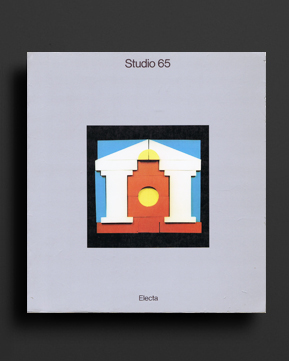
The incredible, rarely seen Electa Studio 65 monograph!
In 1965 Studio 65 was founded by Franco Audrito and Piero Gatti, architecture and art students in Turin, at a time in Italy covering the 1960s and 1970s, where radical design groups were establishing an opposition to the pure functionalism of the International Style of design. Their ironic adaptation of classical elements predates the historicist designs of such 1980s postmodernists as Robert Venturi and Michael Graves in America and Hans Hollein, Ricardo Bofill, and Aldo Rossi in Europe, and it also takes note of pop art developments of the period in ways which in turn influenced visual artists of the time.
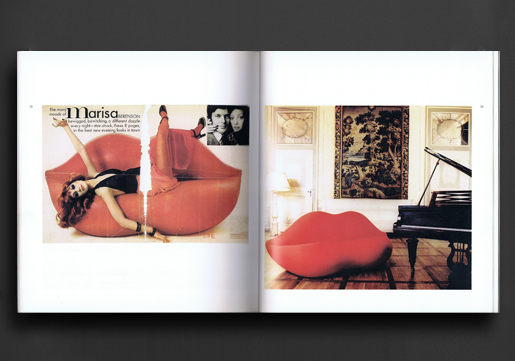
This valuable book encompasses their entire history of work, all densely illustrated in colour and black and white throughout with texts in both Italian and English discussing each project. Includes all their work across furniture design (including their iconic polyurethane foam pieces for Gufram, such as "Bocca" and "Capitello"), interior design, architecture, exhibition design, and much more. From designing discotheques to children's playgrounds, much of the content in this book is undocumented elsewhere in print.
Alongside a complete biographical history, interviews and essays, this great book visually captures Studio 65's place at the forefront of Italy's radical anti-design movement, transforming furniture, jewellery, accessories, and even architecture itself into objects of fantasy.
First and only edition.
1990, English / Japanese
Hardcover (w. dust-jacket), 96 pages, 24.5 x 31 cm
1st Edition, Out of print title / Used*,
Published by
Yamagiwa Art Foundation / Japan
$120.00 - Out of stock
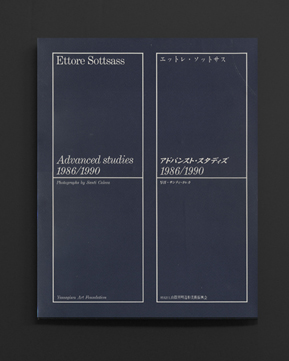
Scarce, beautifully designed hardcover book from 1990, published by the Yamagiwa Art Foundation in Japan to accompany the exhibition "Ettore Sottsass: Lighting Is Architecture".
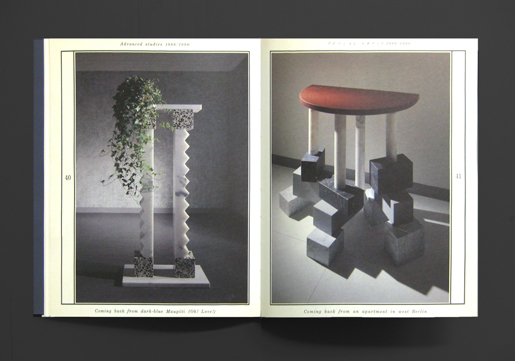
More than a simple catalogue of the exhibition, this book highlights a selection of Italian designer Ettore Sottsass' recent works from around this time (1986-1990), including furniture, glassware and lighting, much of which we've never seen documented before. All the objects are gloriously photographed in full-colour by Santi Caleca, alongside reproductions of Sottsass' product sketches and thoughtfully commissioned writings by Hyogo Konagaya, Riichi Miyake, Shiro Kuramata, Arata Isozaki, Martin Filler, and three texts by Sottsass himself.
This is a copy of the first printing and is in near new condition!
Italian designer Ettore Sottsass is celebrated intemationally for his contribution to architecture, industrial and furniture design, ceramics, jewellery, crafts, graphic design, and photography. In 1981 he founded the Memphis group, and through its startling, eclectic and irreverent aesthetic he dominated furniture and interior style for over a decade. Almost every area of modern design displays his influence.
1987, French
Softcover, 96 pages, 17 x 19 cm
1st edition, Out of print title / used*,
Published by
Rivages / Paris
$45.00 - Out of stock
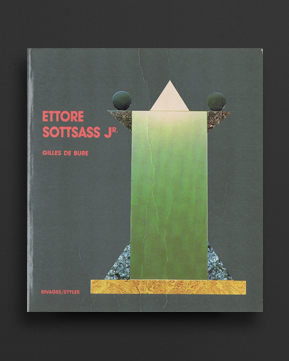
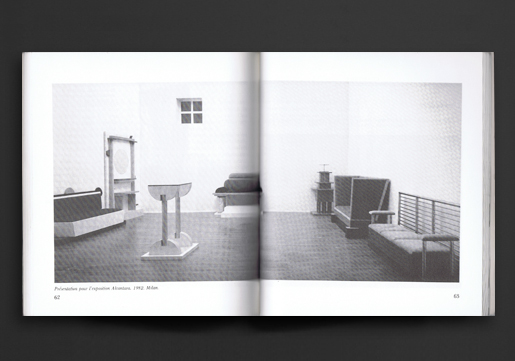
Small French monograph on the life and work of Italian designer and architect, Ettore Sottsass. First Edition. Illustrated throughout in black and white and colour with his work across furniture, glass, ceramic, jewellery, lighting, interior and architectural projects. Ettore Sottsass (14 September 1917 – 31 December 2007) was a founder of the highly influential Memphis group and Sottsass Associati, as well as designer with Alchimia, Alessi, Olivetti, Arredoluce, Poltronova, Fiorucci, Esprit, Knoll, and many others. All texts in French.
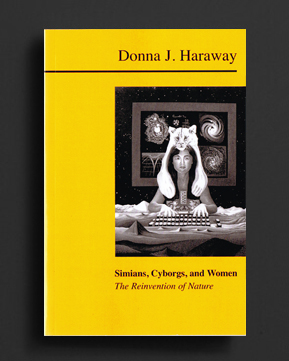
1996, English
Softcover, 290 pages, 15.4 x 23 cm
2nd ed.,
Published by
Free Association Books / London
$50.00 - Out of stock
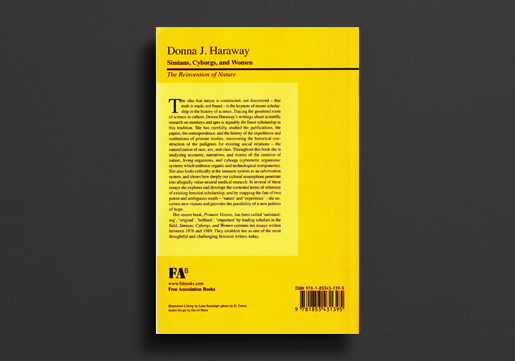
Simians, Cyborgs and Women is a powerful collection of ten essays written between 1978 and 1989. Although on the surface, simians, cyborgs and women may seem an odd threesome, Haraway describes their profound link as "creatures" which have had a great destabilizing place in Western evolutionary technology and biology.
Throughout this book, Haraway analyzes accounts, narratives, and stories of the creation of nature, living organisms, and cyborgs. At once a social reality and a science fiction, the cyborg--a hybrid of organism and machine--represents transgressed boundaries and intense fusions of the nature/culture split. By providing an escape from rigid dualisms, the cyborg exists in a post-gender world, and as such holds immense possibilities for modern feminists. Haraway's recent book, Primate Visions, has been called "outstanding," "original," and "brilliant," by leading scholars in the field.
First published in 1991.
2016, English
Hardcover, 96 pages, 20.5 cm x 29 cm
Published by
MACK / London
$86.00 - In stock -
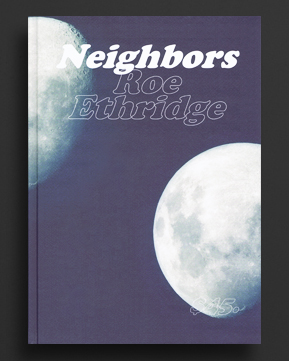
Coinciding with Roe Ethridge's first solo museum exhibition in North America, Neighbors presents more than 15 years of the American artist's photographs, which typically and wryly collapse distinctions between commercial, conceptual and personal uses of photography. Divided into three "chapters", the central section spans the American photographer’s entire oeuvre, from his early self-published projects to his most recent work, bookended by two almost inscrutable series in his signature deadpan style: family snapshots of grey, rural beach scenes, and images of farm animals – turkey, pigs, goats – to conclude. Rendering the mundane peculiar, hilarious even, Neighbors haphazardly traces the evolution of Ethridge’s attempt to bombard his viewers with a heady mixture of imagery, subverting the stylistic tropes of each genre as it relishes in the oddities of image-making and viewing. Included in the book is an essay by Kevin Moore, the curator of Ethridge’s mid-career survey Roe Ethridge: Nearest Neighbor, which leads the 2016 FotoFocus Biennial at the Contemporary Arts Center in Cincinnati, Ohio. The title of the exhibition refers to the photographic term “nearest neighbor”, a type of sampling used when resizing a digital image.
2017, English
Softcover (staple-bound), 8 pages, 21 x 28 cm
Published by
Canyon Rats / Los Angeles
Maccarone / New York
$10.00 - In stock -
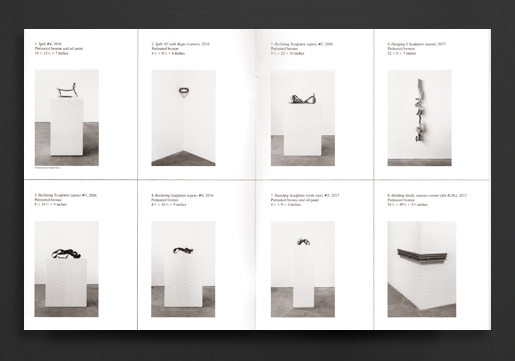
Catalogue of works published to accompany the solo exhibition "New Work", by artist Ricky Swallow at Maccarone, New York, March 3 – April 22, 2017.
Swallow’s sculptural output transmutes utilitarian materials into permanent amalgamated forms via methodology of display and alchemical transformation. Leather, rope, cardboard, and wood rendered into bronze-casted sculpture capture Swallow’s initial studio gestures (splitting, attaching, hanging, torquing, twisting, bracing, soaking) and dictate how his materials are set in form.
Swallow’s objects are born of two locations. In the foundry his original materials, burned out during the casting process, leave one-off frozen genesis movements in bronze. The works are later patinated in silver or black both calling attention to the antecedent material while beguiling its lineage. These resultant sculptural forms eschew Modernist aesthetics as well as typographic form, but suggest a default abstraction inherent to the kinetic processes that began in Swallow’s studio.
Dimpled leather, looped rope, and precarious assemblages become formal studies of levity, grace and precision. Several works stand and coil up from plinths seemingly driven by their own inert tension and humble intimacy. Larger industrial corner works, integrating spheres, suggest a structural punctuation to the architecture. With choreographic prowess, several works conform to and dictate the corners and passages of the exhibition itself, producing an operational agency all their own, appearing as if needed for support but more possessing of a confrontational spatial relationship. “New Work” expands Swallow’s translation of an object, form, and material into an alternative preserved kinetic state, continuing an inquiry with both humor and criticality on the arbitrary hierarchies that exist within the stories of objects.
Ricky Swallow (b. 1974, Australia) has been the subject of solo and two-person exhibitions at venues worldwide, including The Huntington Art Gallery, San Marino, California, with Lesley Vance, (2011); Douglas Hyde Gallery, Dublin (2007); Kunsthalle Vienna (2007); Yokohama Museum of Art (2007); MoMA PS1, Long Island City, New York (2006); Australian Pavilion, 2005 Venice Biennale; University of California Berkeley Art Museum and Pacific Film Archive (2001); and the Museum of Contemporary Art, Sydney (2001). Group exhibitions include Made in L.A. 2014, Hammer Museum, Los Angeles; 2014 Whitney Biennial, Whitney Museum of American Art, New York; Quiz: Sur une idee de Robert Stadler, Ensemble Poirel–Nancy, Paris (2014); David Roberts Collection, 10 Ways To Look At The Past, National Gallery of Victoria, Melbourne (2013); Sculptors Drawing, Aspen Art Museum, Colorado (2010); Red Eye: Los Angeles Artists from the Rubell Family Collection, Miami (2007). Swallow lives and works in Los Angeles.
1970, English
Softcover, 98 pages, 20 x 25 cm
1st Edition, Out of print title / used / average
Published by
Whitney Museum of American Art / New York
$35.00 $20.00 - In stock -
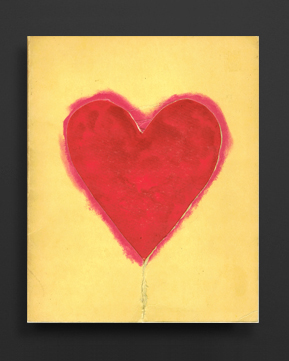
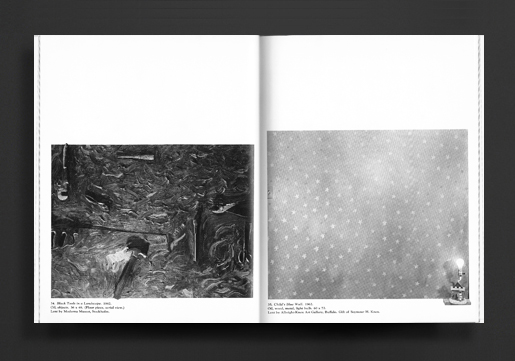
Jim Dine exhibition catalogue for a show that ran February 27 through April 19, 1970 at the Whitney, New York. Heavily illustrated, mostly black and white and some colour, with Dine's works, alongside introductory essay by John Gordon, an artist statement, bio, bibliography, and exhibition history, wrapped in die-cut heart cover.
Jim Dine (born June 16, 1935) is an American pop artist. He is sometimes considered to be a part of the Neo-Dada movement, first earning attention in the art world with his Happenings, alongside peers such as Claes Oldenburg, Allan Kaprow, John Cage, etc. in the late 1950s/early 1960s. In 1962 Dine's work was included, along with Roy Lichtenstein, Andy Warhol, Robert Dowd, Phillip Hefferton, Joe Goode, Edward Ruscha, and Wayne Thiebaud, in the historically important and ground-breaking New Painting of Common Objects, curated by Walter Hopps at the Norton Simon Museum. This exhibition is historically considered one of the first "Pop Art" exhibitions in America. These painters started a movement, in a time of social unrest, which shocked America and the art world. The Pop Art movement fundamentally altered the nature of modern art.
2005, English
Softcover, 335 pages, 22.5 x 16 cm
2005 edition, Out of print title / used*,
Published by
D.A.P. / New York
$95.00 - Out of stock
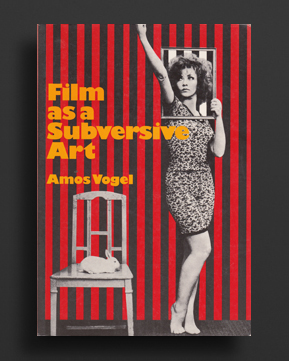
The now scarce 2005 reprint edition of one of the greatest books on film. A classic returns! The original edition of Amos Vogel's seminal book, Film as a Subversive Art was first published in 1974, and has been out of print since 1987. According to Vogel--founder of Cinema 16, North America's legendary film society--the book details the "accelerating worldwide trend toward a more liberated cinema, in which subjects and forms hitherto considered unthinkable or forbidden are boldly explored."
So ahead of his time was Vogel that the ideas that he penned some 30 years ago are still relevant today, and readily accessible in this classic volume. Accompanied by over 300 rare film stills, Film as a Subversive Art analyzes how aesthetic, sexual and ideological subversives use one of the most powerful art forms of our day to exchange or manipulate our conscious and unconscious, demystify visual taboos, destroy dated cinematic forms, and undermine existing value systems and institutions. This subversion of form, as well as of content, is placed within the context of the contemporary world view of science, philosophy, and modern art, and is illuminated by a detailed examination of over 500 films, including many banned, rarely seen, or never released works.
This 2005 edition, published by D.A.P./C.T. Editions, also quickly went out of print and it has not been available since.
Includes Luis Buñuel, Dusan Makavejev, Luis Buñuel, Stan Brakhage, Bruce Connor, Roman Polanski, Vera Chytilova, Alfred Hitchcock, Carolee Schneemann, Peter Watkins, Tony Conrad, Jonas Mekas, Andrei Tarkovsky, Marcel Duchamp, Robert Bresson, Luchino Visconti, Chris Marker, Federico Fellini, Rainer Werner Fassbinder, Kate Millett, John Cassavettes, Shuji Terayama, William Klein, Russ Meyers, Louis Malle, Woody Allen, Yoko Ono, Michelangelo Antonioni, Agnes Varda, Walerian Borowczyk, Andy Warhol, Ingmar Bergman, Jacques Rivette, Sergei M. Eisenstein, Ingmar Bergman, Lindsay Anderson, Roberto Rossellini, Marguerite Duras, Charlie Chaplin, Paul Morrissey, Joseph Losey, Otto Muehl, Hans Richter, Fritz Lang, Jean Genet, Kenneth Anger, Maya Deren, Jean-Luc Godard, Frans Zwartjes, Arrabal, Jack Smith, Stan Vanderbeek, Werner Herzog, Morgan Fisher, Jean Renior, Michael Snow, Robert Frank, Jan Svankmajer, Sam Peckinpah, Paul Sharits, Akira Kurosawa, Yoko Ono, Orson Welles, Frederick Wiseman, Ken Jacobs, Martin Scorcese, Jean Cocteau, Manuel Octavio Gomez, Stanley Kubrick, Norman McLaren, Albert Maysles and David Maysles, to name only a few of the hundreds of film-makers whose works are featured in this essential film book.
2001, Finnish / Swedish / English
Softcover, 192 pages, 21 x 25 cm
1st Edition, Out of print title / Used*,
Published by
Marimekko Oyj
$85.00 - Out of stock
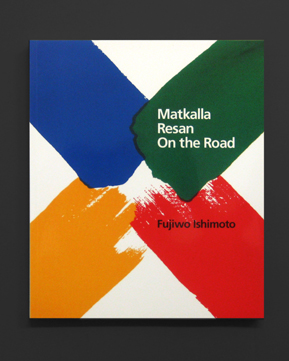
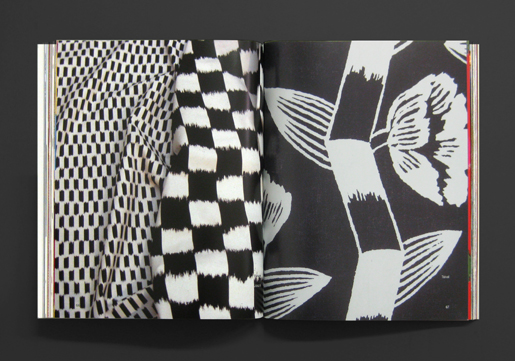
Published on the occasion of textile and ceramic designer Fujiwo Ishimoto's exhibition On the Road at the Amos Anderson Art Museum, Helsinki, 23 August - 7 October 2001.
Ishimoto moved to Finland from Japan in 1970 and has lived there ever since. He first worked for the company Decembre, set up by Ristomatti Ratia, son of Marimekko's founders Armi and Viljo Ratia. Ishimoto switched over to Marimekko in 1974. His highly personal style gave Marimekko a boost during the 1970s and 1980s with more mature and abstract designs than the playful 1960s styles which first had made Marimekko famous. Inspired by traditional Asian art and culture but also by Finnish traditions and nature, Ishimoto has continued to reinvent himself.
In total, he has made over 300 designs for Marimekko. Besides his work for Marimekko, he also creates unique ceramic works and was recently the subject of a large retrospective exhibition in Helsinki, of which this (now very rare) book is the accompanying publication. It is the most in-depth look at the work of Fujiwo Ishimoto to date.
2016, English
Softcover, 20 pages, 15 x 20 cm
Published by
Neon Parc / Melbourne
$8.00 - Out of stock
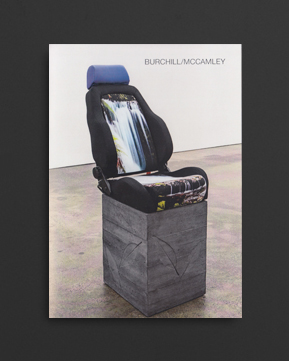
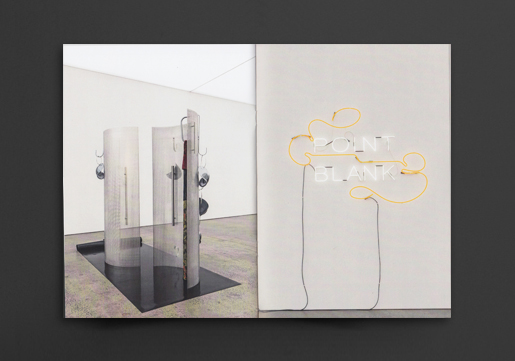
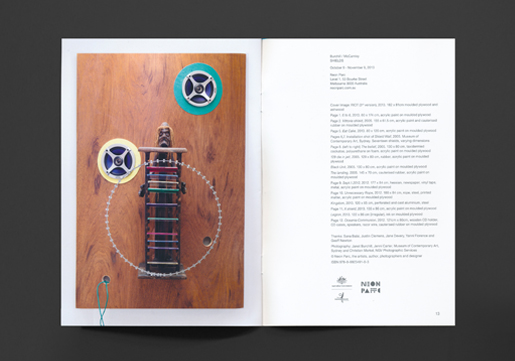
Catalogue produced on the occasion of the exhibition "Burchill/McCamley" at Neon Parc, February 13-April 9, 2016 by Melbourne artists Janet Burchill and Jennifer McCamley. Features full-colour documentation of the exhibition installation and individual works, alongside an essay by Helen Hughes.
Design by Yanni Florence
2013, English
Softcover, 14 pages, 21 x 14.8 cm
Published by
Neon Parc / Melbourne
$8.00 - Out of stock
Catalogue produced on the occasion of 'Shields' at Neon Parc, an exhibition of new works by Janet Burchill and Jennifer McCamley with a text by Justin Clemens.
2015, English
Softcover, 128 pages, 24 x 33 cm
Published by
FRAC Champagne-Ardenne / Reims
Sternberg Press / Berlin
$74.00 $30.00 - Out of stock
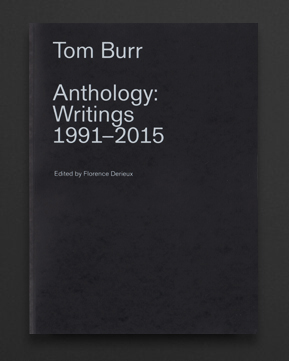
Since the late 1980s, Tom Burr has been reusing appropriation strategies in his art. Not confined to his photographic and sculptural works, they also lend momentum to many of his writings. The artist has created assemblages of personal writings and sources, differing in nature and style, which he has used as both conceptual and aesthetic materials in his oeuvre. Thus, Burr extends his art praxis into the field of writing, and vice versa; art and language cannot be dissociated from each other. At times, the text precedes and anticipates the work; at others, it emanates and results from it; in most instances, it is an integral part of it. Words constitute the work.
Thirty-seven texts—works, poems, autobiographical texts, and portraits—have been compiled for the first time in this publication. Written over a period of twenty-four years, they are presented chronologically, enabling us to fully appreciate the conceptual and visual coherence and richness of Burr’s writings.
Copublished with the FRAC Champagne-Ardenne
Design by Gavillet & Rust
1988, Japanese
Softcover, 200 pages, 24 x 25 cm
1st edition, Out of print title / used*,
Published by
Museum of Modern Art / Kamakura
$90.00 - Out of stock
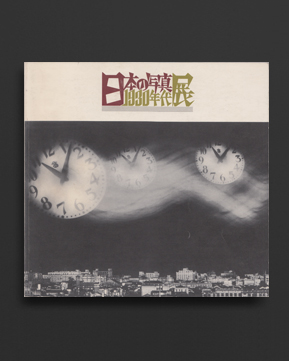
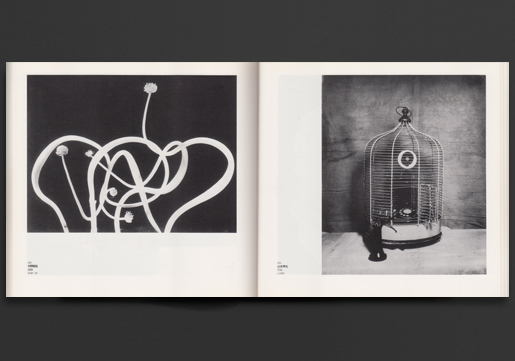
Rare 1988 catalogue of exhibition "Japanese Photography in 1930s", Sep. 10 - Oct. 30, 1988 at the Museum of Modern Art, Kamakura.
Lavishly illustrated (just under 350 colour and black and white photo reproductions) catalogue surveying the incredible and diverse modern and avant-garde photographic work to come out of Japan during the 1930s (and early 1940s), including the work of Jun Watanabe, Ei-Q, Manshichi Sakamoto, Iwata Nakayama, Kiyoshi Koishi, Masaki Yamaguchi, Hiroshi Hamaya, Shoji Ueda, Hisashi Hisano, Wataru Takahashi, Keiichiro Goto, Kansuke Yamamoto, Tsugio Tajima, Minoru Sakata, Koro Honjo, Sutezo Otono, Kametaro Kawasaki, Bizan Ueda, Nakaji Yasui, Yoshio Tarui, Toshinobu Yano, Kiyoshi Koishi, Kiyoshi Nishiyama, Ori Umesaka, Roso Fukuhara, Shinzo Fukuhara, Yasuzo Nojima, Mitsugi Arima...
A very valuable volume for anyone interested in modern photography.
Comes with printed ad for exhibition inserted.
2010, English
Softcover, 280 pages, 28.7 x 22 x 2.5 cm
1st edition, Out of print title / As New,
Published by
Hatje Cantz / Berlin
Moderna Museet / Stockholm
$90.00 - Out of stock
ext by Iris Müller-Westermann, Jo Applin, Lucy R. Lippard, Benjamin Meyer-Krahmer.
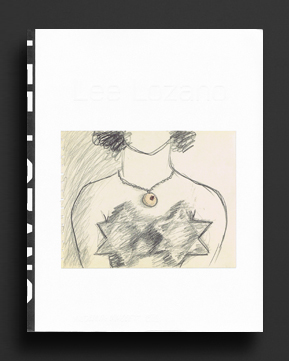
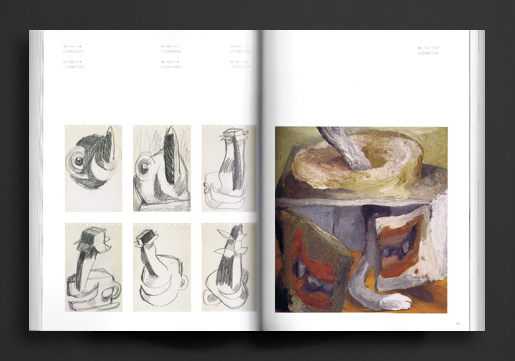
Mystery shrouds the American avant-garde artist Lee Lozano (1930–1999), and yet at the same time she is one of the least-known great artists of theNew York art scene of the sixties and early seventies. Working during the transition from Pop Art to Minimalism and Conceptual Art, Lozano created a radical, frequently obscene, and extremely provocative body of work in a world dominated by her male counterparts. Her brief career ended in the early seventies when she withdrew from the New York art scene, a move she presented in her Dropout Piece.
Only recently has there been more interest in Lozano’s art, as the presence of her work at the documenta 12 and elsewhere demonstrates. The publication of this volume coincides with a retrospective of her works and undertakes a new presentation of Lozano’s multifaceted oeuvre, ranging as it does from surreal pictorial worlds and large-format minimalist paintings to conceptual works from the late sixties.
2013, English
Hardcover (clothbound w. dust jacket), 112 pages, 25.5 x 31 cm
Published by
Galerie Eva Presenhuber / Zürich
JRP Ringier / Zürich
$69.00 - Out of stock
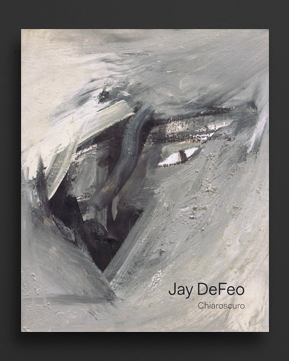
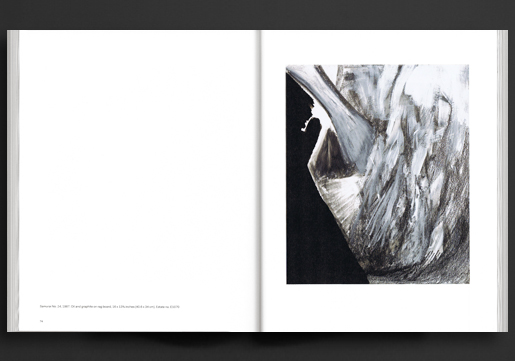
In this major monograph on Jay DeFeo, John Yau looks at the breadth of the artist's work and her broad range of interests and influences, while the book focuses on her late work, paintings of the 1980s as well as the exceptional corpus of drawings of the 1980s and her photographic oeuvre of the 1970s.
Jay DeFeo (1929-1989) was part of a vibrant community of avant-garde artists, poets, and musicians in San Francisco during the 1950s and 1960s. Her circle included Wallace Berman, Joan Brown, Bruce Conner, Wally Hedrick, Edward Kienholz, and Michael McClure. Although best known for her monumental painting “The Rose” (1958-1966), DeFeo worked in a wide range of media and produced an astoundingly diverse and compelling body of work over four decades. DeFeo's unconventional approach to materials and her intensive, physical method make her a unique figure in postwar American art.
1970, English / Swedish
Softcover (card backing, cloth tape binding with staples), 144 pages (many foldout colour), 21.5 x 27 cm
1st ed., Out of print title / used*,
Published by
Moderna Museet / Stockholm
$75.00 - Out of stock
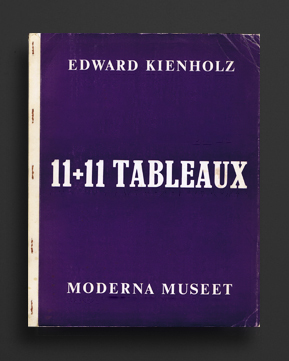
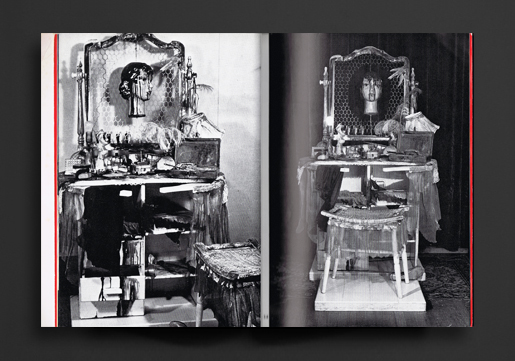
First printing of the great "11+11 Tableaux" monographic book on the work of Edward Kienholz, published by the Moderna Museet in 1970 on the occasion of a gigantic travelling exhibition in 1970. Brought out the same year as Kienholz's "1960 -1970" (Dusseldorf), which roughly shares the same content as this book, "11+11 Tableaux" functions as a sort-of bound archive/artist's book of Kienholz's major sculptural "Tableaux" works and installations throughout the 1960's, each work illustrated through colour fold-out gloss pages and multiple black and white images, accompanied by introductory texts in English and Swedish. Also features a biography and bibliography. An incredible book on Kienholz and an enormously valuable reference source on the artist's amazing early works. First edition.
Edward Kienholz (October 23, 1927 – June 10, 1994) was an American installation artist and assemblage sculptor whose work was highly critical of aspects of modern life. From 1972 onwards, he assembled much of his artwork in close collaboration with his artistic partner and fifth wife, Nancy Reddin Kienholz. Throughout much of their career, the work of the Kienholzes was more appreciated in Europe than in their native United States, though American museums have featured their art more prominently since the 1990s.
Art critic Brian Sewell called Edward Kienholz "the least known, most neglected and forgotten American artist of Jack Kerouac's Beat Generation of the 1950s, a contemporary of the writers Allen Ginsberg, William Burroughs and Norman Mailer, his visual imagery at least as grim, gritty, sordid and depressing as their literary vocabulary".
2016, English
Hardcover, 160 pages, 17 x 24 cm
Published by
JRP Ringier / Zürich
$88.00 - Out of stock
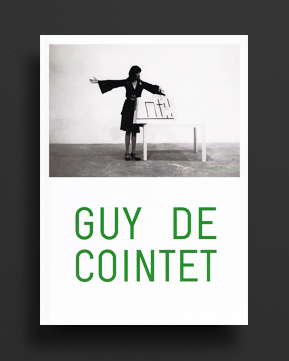
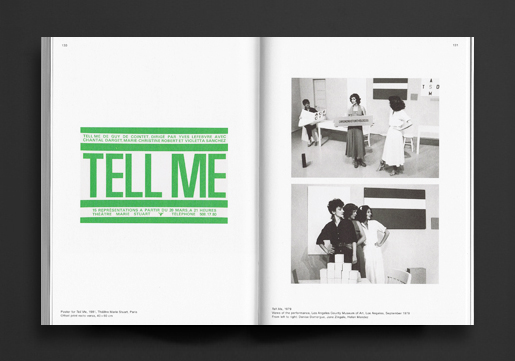
The book, written by Marie de Brugerolle and published with the Estate of Guy de Cointet, is the first to offer an overview of Cointet's enigmatic and influential oeuvre.
Guy de Cointet (American, b. France. 1934–1983) was fascinated with language, which he explored primarily through performance and drawing. His practice involved collecting random phrases, words, and even single letters from popular culture and literary sources—he often cited Raymond Roussel's novel "Impressions of Africa" as influential—and working these elements into non-linear narratives, which were presented as plays to his audience.
Paintings and works on paper would then figure prominently within these performances. In his play "At Sunrise . . . A Cry Was Heard" (1976), a large painting depicting letters bisected by a white sash served as a main subject and prop, with the lead actress continuously referring to it and reading its jumble of letters as if it were an ordinary script. His drawings likewise are almost readable but just beyond comprehension.
De Cointet is recognized as one of the major figures in the Conceptual art movement that emerged in Los Angeles in the 1970s, having strongly influenced a number of prominent artists working in southern California today, including Paul McCarthy and Mike Kelley, for whom both drawing and performance figure significantly in their artistic practices.
Edited by Clément Dirié.
Text by Larry Bell, Marie de Brugerolle, Gérard Wajcman.
2017, English
Hardcover (w. dust jacket), 368 pages, 192 x 233 cm
Published by
Zone Books / New York
$76.00 - Out of stock
In recent years, the group Forensic Architecture began using novel research methods to undertake a series of investigations into human rights abuses. Today, the group provides crucial evidence for international courts and works with a wide range of activist groups, NGOs, Amnesty International, and the UN. Forensic Architecture has not only shed new light on human rights violations and state crimes across the globe, but has also created a new form of investigative practice that bears its name. The group uses architecture as an optical device to investigate armed conflicts and environmental destruction, as well as to cross-reference a variety of evidence sources, such as new media, remote sensing, material analysis, witness testimony, and crowd-sourcing.
In Forensic Architecture, Eyal Weizman, the group’s founder, provides, for the first time, an in-depth introduction to the history, practice, assumptions, potentials, and double binds of this practice. The book includes an extensive array of images, maps, and detailed documentation that records the intricate work the group has performed. Traversing multiple scales and durations, the case studies in this volume include the analysis of the shrapnel fragments in a room struck by drones in Pakistan, the reconstruction of a contested shooting in the West Bank, the architectural recreation of a secret Syrian detention center from the memory of its survivors, a blow-by-blow account of a day-long battle in Gaza, and an investigation of environmental violence and climate change in the Guatemalan highlands and elsewhere.
Weizman’s Forensic Architecture, stunning and shocking in its critical narrative, powerful images, and daring investigations, presents a new form of public truth, technologically, architecturally, and aesthetically produced. The practice calls for a transformative politics in which architecture as a field of knowledge and a mode of interpretation exposes and confronts ever-new forms of state violence and secrecy.
About the Author
Eyal Weizman is Professor of Spatial and Visual Cultures at Goldsmiths College, University of London and a Global Scholar at Princeton University. A founder of Forensic Architecture, he is also a founding member of the architectural collective DAAR in Beit Sahour/Palestine. His books include Mengele’s Skull, The Least of All Possible Evils, and Hollow Land.
Endorsements
“The investigative work of Eyal Weizman and his colleagues at Forensic Architecture is truly remarkable, breaking novel theoretical ground while actively supporting struggles for justice. Again and again, landscapes of power, violence, resistance and ecological stress are transformed in stunning new ways. Among the many revelations in these pages is a new mapping of the connections between climate-change, drought, drones and armed conflict. These are powerful analytic tools that will be indispensable to the construction of a new human rights framework.”
—Naomi Klein, author of This Changes Everything and The Shock Doctrine
“In many respects Forensic Architecture is the current reincarnation of Soviet Russia’s Factography, a collective enterprise that, in the 1920’s and 30’s, was geared towards the construction of facts, as opposed to merely documenting them. The difference between both endeavors, each similarly brazen in taking advantage of unprecedented advances of media technology, is that the facts that Forensic Architecture wishes to (re)construct are for the most part acts of state violence that the perpetrating state deliberately conceals. Those facts are registered in buildings (or traces thereof), which Weizman and his team equate both to photographs (sensors) and to tools for decoding other sensors (such as the clouds of smoke hovering over a bombed city). Analyzing the vast bank of images provided by social media in conflict zones through a computation of differential parallaxes, Forensic Architecture is fast becoming the most efficient visual machine against the suppression of evidence by the authors of crimes against humanity. Recent history tells us that its work will be evermore needed.”
—Yve-Alain Bois
“In a world where environmental crimes are increasingly linked to human rights violations, Forensic Architecture has become an essential practice. Weizman and his team have understood how the tools of science and architecture can influence and transform the juridical system.”
—Baltasar Garzón, former Spanish investigating judge and president of the human rights foundation FIBGAR