World Food Books' programme is largely produced on Kulin Nation land. We acknowledge the Wurundjeri people of the Kulin Nation as the first and continuing custodians of this land, and pay respect to their Elders past, present, and emerging.
World Food Books is an arts and special interests bookshop in Naarm / Melbourne. Founded in 2010, World Food Books is devoted to the presentation of a rotating, hand-selection of international art, design, literary and counterculture publications with an emphasis on the anti-traditional, the experimental, the avant-garde, the heretic, the marginal.
Presenting new titles alongside rare and out-of-print books, catalogues and journals spanning the fields of modern and contemporary art, design, photography, illustration, film, literature, poetry, cultural theory, philosophy, sexuality, popular and underground culture in its many radical forms, World Food Books wishes to encourage adventurous, thoughtful and open-minded reading, looking, writing, and exchange of publishing and ideas, both current and historical.
As well as our bookshop, located in Melbourne's historical Nicholas Building, all of our inventory is available internationally via our online mail-order service.
World Food Books semi-regularly co-ordinates "Occasions", a programme of exhibits and events at the bookshop and in partnership with other hosts (such as museums and art galleries) that develop out of the activities, relationships and content of the bookshop itself.
World Food Books
The Nicholas Building
37 Swanston Street
Room 5, Level 6
Melbourne 3000
Australia
SHOP HOURS:
Thu–Fri 12–6, Sat 12–5
WEB-SHOP OPEN 24/7
World Food Books
Postal Address:
PO Box 435
Flinders Lane
Victoria 8009
Australia
Art
Theory / Essay
Architecture / Interior
Graphic Design / Typography
Photography
Fashion
Eros
LGBTQ+
Fiction / Poetry
Weird / Speculative / Science Fiction / Horror
Transgressive / Visceral / Abject
Symbolism / Decadence / Fin de siècle
Film / Video
Painting
Sculpture / Installation
Performance / Dance / Theater
Drawing
Sound / Music
Curatorial
Group Shows / Collections
Periodicals
Out-of-print / Rare
Posters / Ephemera / Discs
Signed Books
World Food Books Gift Voucher
World Food Book Bag
Australian Art
Australian Fiction
Australian Science Fiction / Speculative Fiction
Australian Poetry
Australian Photography
Japanese Photography
Conceptual Art
Minimal Art
Dada
'Pataphysics / Oulipo
Fluxus
Concrete Poetry
Pop Art
Surrealism
Arte Povera
Arte Informale / Haute Pâte / Tachism
Nouveau Réalisme / Zero / Kinetic
Situationism / Lettrism
Collage / Mail Art / Xerox Art
Art Brut / Folk / Visionary / Fantastic
Illustration / Graphic Art / Bandes Dessinées
Furniture
Italian Radical Design / Postmodernism
Textiles
Ceramics / Glass
Counterculture
Protest / Revolt
Philosophy
Psychoanalysis
Anthropology
Anarchism
Socialism / Anarchism / Communism / Capitalism
Literary Theory / Semiotics / Language
Feminism / Women's Studies
Gender Studies / Sexuality
Anthropology
Fetishism / BDSM
Drugs / Psychedelia
Crime / Violence
Animal Rights / Veganism
Occult / Esoterica
Ecology / Earth / Alternative Living
Whole Earth / Crafts
All prices in AUD (Australian dollars)
Pick-Ups
Pick-up orders can be collected in our bookshop during opening hours after order date. Please collect any Pick-up orders within 2 weeks of ordering as we have limited storage space. Orders will be released back into stock if not collected within this time. No refunds can be made for pick-ups left un-collected. If you cannot make it in to the bookshop in this time-frame, please choose postage option.
Return Policy
All sales are final. We do accept returns (for refund or exchange) for items received in error. All our orders are packed with special care using heavy-duty padding and cardboard book-mailers or bubble mailers (for smaller books), using reinforcement where required. We cannot take responsibility for any lost, stolen or damaged parcels.
Insurance
Should you wish to insure your package, please email us directly after placing your order and we can organise this at a small extra expense. Although all standard/express tracked packages are very safe and dependable, we cannot take responsibility for any lost, stolen or damaged parcels. We recommend insurance on valuable orders.
Interested in selling your old books, catalogues, journals, magazines, comics, fanzines, ephemera? We are always looking for interesting, unusual and out-of-print books to buy. We only buy books in our fields of interest and specialty, and that we feel we can resell.
We base these prices on desirability, market value, in-print prices, condition and our current stock levels. We offer cash, store credit, and can take stock on consignment. All
about 25% of the price we expect to get when we sell them, or 30% in store credit. We base these prices on desirability, market value, in-print prices, condition and our current stock levels.
Sell your books any day of the week. You can drop them off and return later. If you have a lot of books, we can visit your Sydney home.
We buy books that we feel we can resell. We offer about 25 % of the price we expect to get when we sell them, or 30% in store credit. We base these prices on desirability, market value, in-print prices, condition and our current stock levels.
Philadelphia Wireman
03 August - 01 September, 2018
World Food Books is proud to announce our next Occasion, the first presentation of sculptures by Philadelphia Wireman in Australia.
The Philadelphia Wireman sculptures were found abandoned in an alley off Philadelphia’s South Street on trash night in 1982. Their discovery in a rapidly-changing neighbourhood undergoing extensive renovation, compounded with the failure of all attempts to locate the artist, suggests that the works may have been discarded after the maker’s death. Dubbed the "Philadelphia Wireman" during the first exhibition of this work, in 1985, the maker’s name, age, ethnicity, and even gender remain uncertain. The entire collection totals approximately 1200 pieces, all intricately bound together with tightly-wound heavy-gauge wire (along with a few small, abstract marker drawings, reminiscent both of Mark Tobey and J.B. Murry). The dense construction of the work, despite a modest range of scale and materials, is singularly obsessive and disciplined in design: a wire armature or exoskeleton firmly binds a bricolage of found objects including plastic, glass, food packaging, umbrella parts, tape, rubber, batteries, pens, leather, reflectors, nuts and bolts, nails, foil, coins, toys, watches, eyeglasses, tools, and jewellery.
Heavy with associations—anthropomorphic, zoomorphic, and socio-cultural responses to wrapped detritus—the totemic sculptures by Philadelphia Wireman have been discussed in the context of work created to fulfil the shamanistic needs of alternative religions in American culture. Curators, collectors, and critics have variously compared certain pieces to sculpture from Classical antiquity, Native American medicine bundles, African-American memory jugs, and African fetish objects. Reflecting the artist’s prolific and incredibly focused scavenging impulse, and despite—or perhaps enhanced by—their anonymity, these enigmatic objects function as urban artefacts and arbiters of power, though their origin and purpose is unknown. Philadelphia Wireman, whatever their identity, possessed an astonishing ability to isolate and communicate the concepts of power and energy through the selection and transformation of ordinary materials. Over the course of the past two decades, this collection has come to be regarded as an important discovery in the field of self-taught art and vernacular art.
Presented in collaboration with Fleisher-Ollman Gallery, Philadelphia, and Robert Heald, Wellington.
Susan Te Kahurangi King
02 February - 10 March, 2018
Susan Te Kahurangi King (24 February 1951 - ) has been a confident and prolific artist since she was a young child, drawing with readily available materials - pencils, ballpoint pens and felt-tip markers, on whatever paper is at hand. Between the ages of four and six Susan slowly ceased verbal communication. Her grandparents William and Myrtle Murphy had developed a special bond with Susan so they took on caring responsibilities for extended periods. Myrtle began informally archiving her work, carefully collecting and storing the drawings and compiling scrapbooks. No drawing was insignificant; every scrap of paper was kept. The King family are now the custodians of a vast collection containing over 7000 individual works, from tiny scraps of paper through to 5 meter long rolls.
The scrapbooks and diaries reveal Myrtle to be a woman of great patience and compassion, seeking to understand a child who was not always behaving as expected. She encouraged Susan to be observant, to explore her environment and absorb all the sights and sounds. Myrtle would show Susan’s drawings to friends and people in her community that she had dealings with, such as shopkeepers and postal workers, but this was not simply a case of a grandmother’s bias. She recognised that Susan had developed a sophisticated and unique visual language and sincerely believed that her art deserved serious attention.
This was an unorthodox attitude for the time. To provide some context, Jean Dubuffet coined the term Art Brut in 1945 to describe work created by self-taught artists – specifically residents of psychiatric institutions and those he considered to be visionaries or eccentrics. In 1972 Roger Cardinal extended this concept by adopting the term Outsider Art to describe work made by non-academically trained artists operating outside of mainstream art networks through choice or circumstance. Susan was born in Te Aroha, New Zealand in 1951, far from the artistic hubs of Paris and London that Dubuffet and Cardinal operated in. That Myrtle fêted Susan as a self-taught artist who deserved to be taken seriously shows how progressive her attitudes were.
Susan’s parents Doug and Dawn were also progressive. Over the years they had consulted numerous health practitioners about Susan’s condition, as the medical establishment could not provide an explanation as to why she had lapsed into silence. Dawn educated herself in the field of homeopathy and went on to treat all twelve of her children using these principles – basing prescriptions on her observations of their physical, mental and emotional state.
Doug was a linguist with an interest in philosophy who devoted what little spare time he had to studying Maori language and culture. To some extent their willingness to explore the fringes of the mainstream made them outsiders too but it was their commitment to living with integrity and their respect for individuality that ensured Susan’s creativity was always encouraged.
Even though Susan’s family supported her artistic pursuits, some staff in schools and hospitals saw it as an impediment to her assimilation into the community and discouraged it in a variety of ways. Her family was not always aware of this and therefore did not fully understand why Susan stopped drawing in the early 1990s. However, rather than dwell on the challenges that Susan faced in pursuit of her artistic practice, they prefer to highlight her achievements. In 2008 Susan began drawing again in earnest, after an almost 20 year interruption, and her work is now shown in galleries around the world.
Susan grew up without television and has been heavily influenced by the comics she read as a child. She is absolutely fearless in the appropriation of recognizable characters, such as Donald Duck and Mickey Mouse, in her work. She twists their limbs, contorts their faces, compresses them together, blends them into complex patterned backgrounds - always imbuing them with an incredible energy. Although Susan often used pop culture characters in her work they are not naive or childlike. These are drawings by a brilliant self-taught artist who has been creating exceptional work for decades without an audience in mind.
Mladen Stilinović
"Various Works 1986 - 1999"
02 February 16 - September 10, 2016
Various works 1986 - 1999, from two houses, from the collections of John Nixon, Sue Cramer, Kerrie Poliness, Peter Haffenden and Phoebe Haffenden.
Including: Geometry of Cakes (various shelves), 1993; Poor People’s Law (black and white plate), 1993; White Absence (glasses, ruler, set square, silver spoon, silver ladel with skin photograph and wooden cubes), 1990-1996; Exploitation of the Dead (grey and red star painting, wooden painting, black spoon with red table, red plate), 1984-1990; Money and Zeros (zero tie, paintings made for friends in Australia (Sue, John, Kerrie), numbers painting), 1991-1992; Words - Slogans (various t-shirts) - “they talk about the death of art...help! someone is trying to kill me”, “my sweet little lamb”, “work is a disease - Karl Marx”; Various artist books, catalogues, monographs, videos; Poster from exhibition Insulting Anarchy; "Circular" Croatian - Australian edition; Artist book by Vlado Martek (Dostoyevsky); more.
Thanks to Mladen Stilinović and Branka Stipančić.
Jonathan Walker
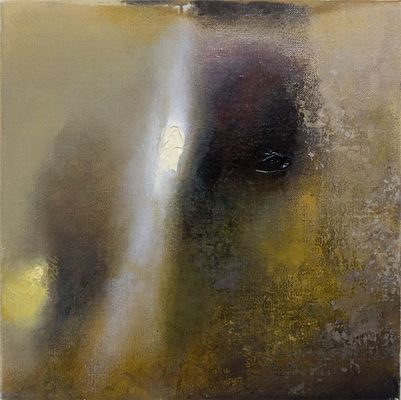
Always Will Need To Wear Winter Shirt Blue + Ochre Small Check Pattern
21 August - 21 September, 2015
Untitled
I am not a great reader of poetry but I always return to the work of Melbourne poet, Vincent Buckley (1925- 1988). Perhaps I find his most tantalising piece to be not a finished poem but a fragment left on a scrap of paper discovered on his desk after the poet’s death.
The poetry gathers like oil
In the word-core, and spreads
It has its music meet,
Its music is in movement.
This fragment is more the shell left behind from a volatile thought than a finished poem. I find the last two lines honest but awkward whereas the first two lines work like an arrow. Most likely he could not find a resolution so it was left. Still, in its present form, it remains an eloquent testimony to the ultimate failure of a medium to express mobile thought and sensation, in Buckley’s case, through verbal language. It’s an important matter because this is something all artists have to deal with regardless of the medium.
I have never written a poem, however, I am forever copying fragments from books on paper scraps in a vain effort to fix certain notions in my head. At first, they function as bookmarks that are sometimes returned to when I open the book. But before long, as they accumulate, they fall out littering the table interspersed with A4 photocopies, bills, books and medications.
To return to Buckley’s fragment, the first two lines very much evoke how I paint nowadays. As you age, detail diminishes and patches of light become more luminous and float. I feel the most honest way of dealing with this is by smearing the oil paint on the canvas with the fingers and working close-up, blind. Only if the patches coalesce into an approaching image can the work gain a life.
-
Jonathan Walker was born in Melbourne, Australia and brought up on a dairy farm in Gippsland. In the 1970’s he studied painting at RMIT and won the Harold Wright Scholarship to the British Museum, London. During the 1980’s he exhibited at Pinacotheca Gallery, Richmond and had work shown at the NGV and Heidi City Art Gallery. Over the same period he designed the cover for the “Epigenesi” LP by Giancarlo Toniutti, Italy and conducted a mail exchange work with Achim Wollscheid, Germany. The work with artists through the post resulted in an article published in the bicentenary issue of Art and Australia 1988. He showed in artist run spaces such as WestSpace in the 90’s and 2000’s, and until 2012, taught painting at Victoria University, which is where we (Colleen Ahern and Lisa Radford) as organisers of the exhibition, among many others, had the privilege of being his student.
Walker’s knowledge was imparted to students through the careful selection of music, literature, and artists found in books that he himself had ordered for the library. Walker’s strategy was the generosity of sharing his vast knowledge with references specific to each student and their context.
Walker’s paintings share a similar focus and intimacy.
This exhibition presents a small selection of recent paintings alongside a publication that includes Walker’s writing. Observational and analytical, Walker’s work is a type of material notation — the time of day, colour and how it is blended, the both specific and fleeting location of a reflection on lino or the question of whether a chair leg should be included in a painting.
Please join us on Friday August 21 between 6-8pm to celebrate the opening of the exhibition.
Curated by Colleen Ahern and Lisa Radford.
B. Wurtz
Curated by Nic Tammens
March 26 - April 4, 2015
B.Wurtz works from a basement studio in his home on Manhattan’s Lower East Side.
This local fact is attested to by the plastic shopping bags and newsprint circulars that appear in his work. As formal objects, they don’t make loud claims about their origins but nonetheless transmit street addresses and places of business from the bottom of this long thin island. Like plenty of artists, Wurtz is affected by what is local and what is consumed. His work is underpinned by this ethic. It often speaks from a neighborhood or reads like the contents of a hamper:
“BLACK PLUMS $1.29 lb.”
“Food Bazaar”
“USDA Whole Pork Shoulder Picnic 99c lb.”
“RITE AID Pharmacy, with us it’s personal.”
“H. Brickman & Sons.”
“Sweet Yams 59c lb."
Most of the work in this exhibition was made while the artist was in residence at Dieu Donne, a workshop dedicated to paper craft in Midtown. Here Wurtz fabricated assemblages with paper and objects that are relatively lightweight, with the intention that they would be easily transportable to Australia. This consideration isn’t absolute in Wurtz’s work, but was prescriptive for making the current exhibition light and cheap. Packed in two boxes, these works were sent from a USPS post office on the Lower East Side and delivered to North Melbourne by Australia Post.
Wurtz appears courtesy of Metro Pictures, New York.
Thanks to Rob Halverson, Joshua Petherick, Sari de Mallory, Matt Hinkley, Helen Johnson, Fayen d'Evie, Ask Kilmartin, Lisa Radon, Ellena Savage, Yale Union, and "Elizabeth".
John Nixon
"Archive"
December 15 - January 20, 2014
The presentation of John Nixon's archive offered a rare showcase of this extensive collection of the artist's own publications, catalogues, posters, ephemera, editions and more, from the mid 1980s onwards, alongside a selection of his artworks.
Organized by John Nixon, Joshua Petherick and Matt Hinkley.
<a href=http://wfb.public-office.info/artist/john-nixon>All titles by John Nixon
"Habitat"
at Minerva, Sydney (organised by Joshua Petherick and Matt Hinkley)
November 15 - December 20, 2014
Lupo Borgonovo, Janet Burchill & Jennifer McCamley,
Lewis Fidock, HR Giger, Piero Gilardi, Veit Laurent Kurz,
Cinzia Ruggeri, Michael E. Smith, Lucie Stahl, Daniel Weil, Wols
Press Release:
“...It contained seven objects. The slender fluted bone, surely formed for flight, surely from the wing of some large bird. Three archaic circuitboards, faced with mazes of gold. A smooth white sphere of baked clay. An age-blackened fragment of lace. A fingerlength segment of what she assumed was bone from a human wrist, grayish white, inset smoothly with the silicon shaft of a small instrument that must once have ridden flush with the surface of the skin - but the thing’s face was seared and blackened.”
William Gibson, “Count Zero”, 1986
"Autumn Projects Archive"
Curated by Liza Vasiliou
March 6 - March 15, 2014
World Food Books, in conjunction with the Virgin Australia Melbourne Fashion Festival 2014, presented the Autumn Projects archive, consisting of a selection of early examples in Australian fashion with a particular interest in collecting designers and labels from the period beginning in the 1980’s, who significantly influenced the discourse of Australian Fashion.
Curated by Liza Vasiliou, the exhibition provided a unique opportunity to view pieces by designers Anthea Crawford, Barbara Vandenberg, Geoff Liddell and labels CR Australia, Covers, Jag along with early experimental collage pieces by Prue Acton and Sally Browne’s ‘Fragments’ collection, suspended throughout the functioning World Food Books shop in Melbourne.
H.B. Peace
presented by CENTRE FOR STYLE
November 14, 2013
"Hey Blinky, you say chic, I say same"
Anon 2013
H.B. Peace is a clothing collaboration between great friends Blake Barns and Hugh Egan Westland. Their pieces explore the divergences between 'character’ and ‘personality’ in garments....etc
Special Thanks to Joshua Petherick and Matt Hinkley of WFB and Gillian Mears
and a Very Special Thank you to Audrey Thomas Hayes for her shoe collaboration.
Janet Burchill & Jennifer McCamley
"Aesthetic Suicide"
May 10 - June 8, 2013
The first of our occasional exhibitions in the World Food Books office/shop space in Melbourne, "Aesthetic Suicide" presented a body of new and older works together by artists Janet Burchill & Jennifer McCamley, including videos, prints, a wall work, and publications.
During shop open hours videos played every hour, on the hour.
2011, English
Hardcover, 72 pages, 17.5 x 22 cm
1st edition, Out of print title / As New,
Published by
L&M Arts / New York
$190.00 - Out of stock
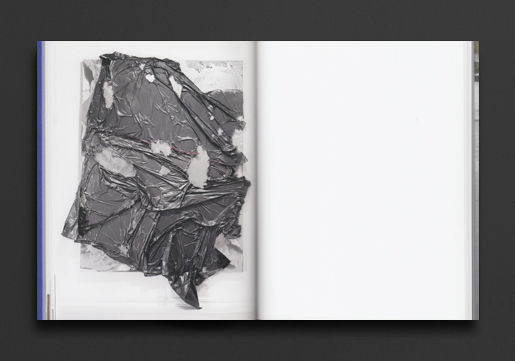
Very scarce catalogue published to accompany David Hammons' solo exhibition at L&M Arts, 26 Jan - 26 Feb, 2011. Cover to cover this hardcover book reproduces Hammons' amazing untitled "paintings" that play with the sculptural wrapping, draping and obscuring of what are mostly oil on canvas abstract expressionistic paintings, using black plastic garbage bags, torn industrial tarps and worn-out blankets and towels. L&M Arts is considered a gallery for Modernist painting (Willem de Kooning, Jackson Pollock, Franz Kline) founded by the collector Robert Mnuchin. The only text in the book is the invitation to open, and a New Yorker "Goings On" review of the exhibition, referring to the works as "Minimalist Expressionism".
A fantastic and seldom seen Hammons publication.
2016, English
Softcover, 154 pages, 28 x 23.5 cm
Published by
Mumok / Vienna
Walther König / Köln
$55.00 - Out of stock
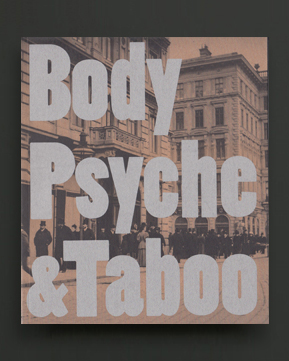
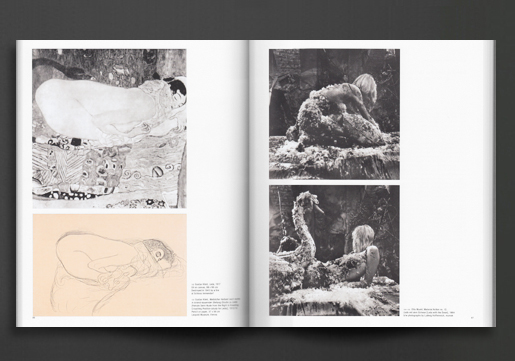
The central concepts of Body, Psyche, and Taboo is a presentation of both the intellectual and the formal links between Vienna Actionism and artistic developments in early 20th century Vienna.
Works by Günter Brus, Otto Muehl, Hermann Nitsch, and Rudolf Schwarzkogler – the ‘scandal artists’ of the 1960s – are compared and contrasted with pieces by their equally controversial colleagues working at the dawn of the twentieth century, including Gustav Klimt, Oskar Kokoschka, and Egon Schiele, among others.
Published on the occasion of the exhibition Body, Psyche, and Taboo: Vienna Actionism and Early Vienna Modernism at mumok, Vienna, 4 March – 16 May 2016.
Striking and heavily illustrated catalogue featuring the work of Artists Günter Brus, Richard Gerstl, Gustav Klimt, Oskar Kokoschka, Koloman Moser, Otto Muehl, Hermann Nitsch, Max Oppenheimer, Anton Romako, Egon Schiele, Rudolf Schwarzkogler, and accompanying texts by Eva Badura-Triska, Brigitte Borchhardt-Birbaumer, Rosemarie Brucher, and Bernadette Reinhold.
1977, English / German / Portuguese
Softcover, 226 pages, 21 x 29.5 cm
Signed / Out of print title / Used*,
Published by
XIV Internationale Biennale São Paulo / Brazil
$240.00 - Out of stock
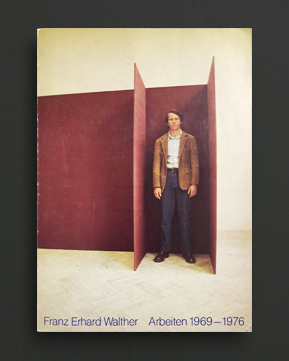
Signed copy of the major exhibition catalogue published in conjunction with the XIV Internationale Biennale São Paulo, Brazil, October 1 - December 18, 1977.
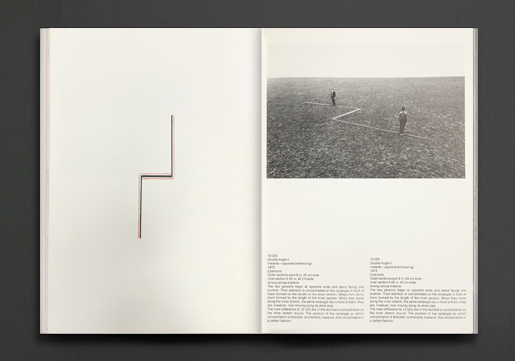
Profusely illustrated throughout with 232 illustrations of the work of Franz Erhard Walther, including his actions and drawings, alongside text by Götz Adriani, a biography, bibliography, and exhibition history. In English, German and Portuguese.
This special copy is inscribed by the artist on the title page in pencil with the words "ein anderer werkbegriff - Walther", which translates roughly to English as "a different work concept" or "a different concept of the work". This is a term Walther used in relation to his work, seeing it as something that does not end with the object of the artist, but with the construction of action. This means that the observer is replaced by the acting recipient who becomes a producer at the same time. The artists are the instruments at hand, with which he can act. In action execution it is then not only an active subject in the work experience, but primarily in the work of creation.
Having participated in Harald Szeemann’s legendary When Attitudes Become Form (1969) and dOCUMENTA V (1972) as well as the Museum of Modern Art’s landmark Spaces (1970), Walther’s remarkable coupling of elementary forms with conceptual ideas and a radical rethinking of the relationship between sculpture and action, has become so influential to the contemporary practices of young artists today.
The German conceptualist and sculptor Franz Erhard Walther counts among those artists who, in the 1960s, sought to undermine the authorial role of the artist in favour of a more democratic aesthetic dependent on the interaction of viewer and object; simple and individual acts such as folding and lying, leaning and stepping are either the source of his often minimal works or the means by which individual viewers may interact with them. His means of sculptural expression often involved the use of soft materials. His canvas sculptures are simply meant to be held, worn, lain in or stood under, usually by two or more people, creating strange moments of social intimacy and spatial awareness.
2016, English / German
Softcover, 264 pages, 23 x 16.5 cm
Published by
Texte Zur Kunst / Berlin
$30.00 - Out of stock
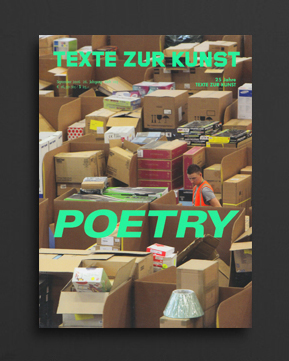
TZK #103 addresses "poetry," a language form central to the recent shift toward affect in contemporary critical writing. Seeing the “artist-poet” as a vital site for the intersection of politics, affect, and digitality, we consider her voice and her currency from various perspectives, pro and con, across generations, analyzing her rising success, also asking what is gained and lost in this move from "rational" thought to what one feels? Scanning populist poetry, anarchist poetry, post-millennial net-poetry, the poetry of surplus-language and social media, the art historical poetic/poet-turned-object, and shades of fading Poesie, this issue, conceived by the editors with John Kelsey and Isabelle Graw explores how the seeming immediacy of #poetry and the suggestion of a hyper-personal voice correlates with current economic demand to claim visibility.
ISSUE NO. 103 / SEPTEMBER 2016 “POETRY”
TABLE OF CONTENTS
PREFACE
TIM GRIFFIN
WHAT IS POETRY?
JOSHUA CLOVER
OBJECTIVELY SPEAKING / Remarks on Subjectivity and Poetry
ISABELLE GRAW
THE POET'S SEDUCTION / Six Theses on Marcel Broodthaers’s Contemporary Relevance
LIZ KOTZ
WORD PIECES, EVENT SCORES, COMPOSITIONS
MONIKA RINCK
THE PROMISE OF POETIC LANGUAGE
ADA O'HIGGINS
IF YOU DON’T LIKE THE REFLECTION. DON’T LOOK IN THE MIRROR. I DON’T CARE.
CHRIS KRAUS AND ARIANA REINES
THE FEELINGS I FAIL TO CAPITALIZE, I FAIL / Chris Kraus and Ariana Reines in conversation on auto-fiction and biography
FELIX BERNSTEIN
THE IRREPROACHABLE ESSAY / On the Amazon Discourse of Hybrid Literature
DANIELA SEEL
IMMEDIACY, I MEET WITH SKEPTICISM / Three questions for Daniela Seel
MICAELA DURAND
DEVIL SHIT
KAROLIN MEUNIER
HEARING VOICES / On the reading and performance of poetry
DENA YAGO
EMPIRE POETRY
SHORT CUT
FOUR THESES ON BRANDING / David Joselit on Berlin Biennale 9
MANTRAS DER GEGENWART / Hanna Magauer über die Berlin Biennale 9
ROTATION
SEHNSUCHT NACH DER VERLORENEN STADT / Johannes Paul Raether über "spiritus" von Honey-Suckle Company
BENJAMIN BUCHLOH, ART HISTORIAN / Christine Mehring on Benjamin H. D. Buchloh’s “Formalism and Historicity: Models and Methods in Twentieth-Century Art”
ES WAR ZWEIMAL SAGTE SIE / Vojin Sasa Vukadinovic über Eva Meyers „Legende sein“
LESS IS MORE? / John Miller on Justin Lieberman’s “The Corrector’s Custom Pre-Fab House”
SO MACHEN WIR'S / Eva Geulen über „The Use of Bodies“ (Homo Sacer IV.2) von Giorgio Agamben
SHORT WAVES
Gunter Reski über Victor Man bei MD 72, Berlin / Harry Burke on Dean Blunt at Arcadia Missa, London / Rhea Dall on Stephen G. Rhodes at Eden Eden, Berlin / Tobias Vogt über Thea Djordjadze bei Sprüth Magers, Berlin / Deanna Havas on Marc Kokopeli at Lomex, New York / Martin Herbert on Fredrik Værslev at Bergen Kunsthall, Norway
REVIEWS
HABEAS CORPUS / Simon Baier über Francis Picabia im Kunsthaus Zürich
MARCEL BROODTHAERS, ART HISTORIAN’S ARTIST / Trevor Stark on Marcel Broodthaers at the Museum of Modern Art, New York
MALEREI ALS SOZIALES HANDELN? / Christian Spies über Fernand Léger im Museum Ludwig, Köln
SIMULIERTE MUSEALISIERUNG / Philipp Kleinmichel über Isa Genzken im Martin-Gropius-Bau, Berlin
ELEGANCE IS RESISTANCE / Stephanie LaCava on Lukas Duwenhögger at Artists Space, New York
NACHRUFE / OBITUARIES
TONY CONRAD (1940–2016)
by Diedrich Diederichsen
by Jay Sanders
EDITION
MARTHA ROSLER
AMY SILLMAN
AMY SILLMAN
2016, English
Softcover, 296 pages, 18 x 11 cm
Published by
August Verlag / Cologne
$46.00 - In stock -
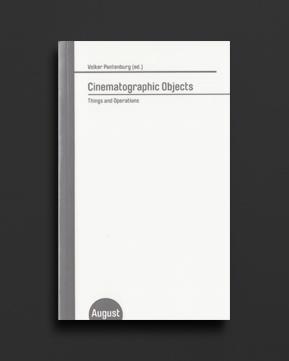
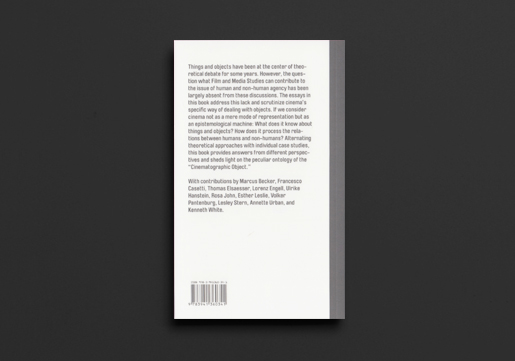
Things and objects have been at the center of theoretical debate for some years. However, the question what Film and Media Studies can contribute to questions of human and non-human agency has been largely absent from these discussions.
The essays in this book address this lack and scrutinize cinema’s specific way of dealing with objects. If we consider cinema not as a mere mode of representation but as an epistemological machine: What does it know about things and objects?
How does it process the relations between humans and non-humans? Alternating theoretical approaches with individual case studies, this book provides answers from different perspectives and sheds light on the peculiar ontology of the ‘Cinematographic Object’.
Artists/filmmakers featured in this book include: Fritz Lang, Max Ophüls, John Baldessari, John Stezaker, and Michael Snow, among others.
Texts by Marcus Becker, Francesco Casetti, Thomas Elsaesser, Lorenz Engell, Ulrike Hanstein, R. John, Esther Leslie, Volker Pantenburg, Lesley Stern, Annette Urban, Kenneth White.
Published by August Verlag.
2015, English / German
Softcover, 124 pages (colour ill.)
Published by
Museum Haus Konstruktiv / Zurich
Walther König / Köln
$58.00 - Out of stock
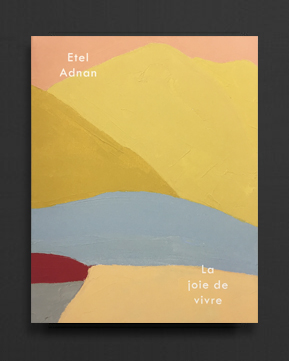
After her huge success at dOCUMENTA (13), Museum Haus Konstruktiv is taking the opportunity to honor the painted oeuvre of Lebanese artist, poet and writer Etel Adnan (b. 1925 in Beirut, lives in Paris) with a comprehensive solo exhibition for the first time in Switzerland.
Etel Adnan is often described as a wanderer between cultures, places, languages and forms of expression. In 1959, while also working as a writer, she began to get involved in painting and drawing, later going on to produce fold-out books, tapestries and Super 8 mm films.
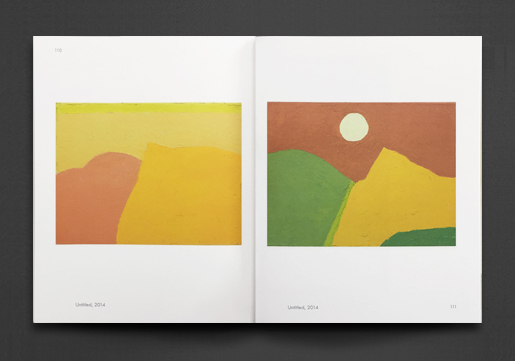
From the very start, her painting is solidly constructed, possessing a strong inner structure and organization: rectangles and cubes, laid on top of each other and beside each other, constitute her architectural vocabulary. She produces her work in one painterly flow, without making any corrections or painting over anything later.
Her painting style is strict, earnest and sensitive, without any sensationalism or superfluous embellishment. Her images play with memories that take on abstract forms and nevertheless develop a high degree of emotional strength.
Published on the occasion of the exhibition Etel Adnan: La Joie de Vivre at Museum Haus Konstruktiv, Zurich, 29 October 2015 – 31 January 2016.
2016, English
Softcover, 192 pages, 25 x 20 cm
Published by
Walther König / Köln
$55.00 - Out of stock
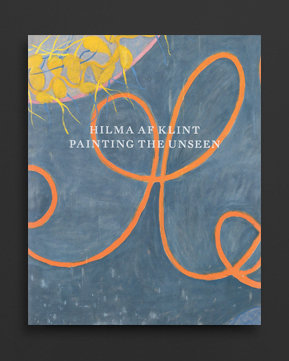
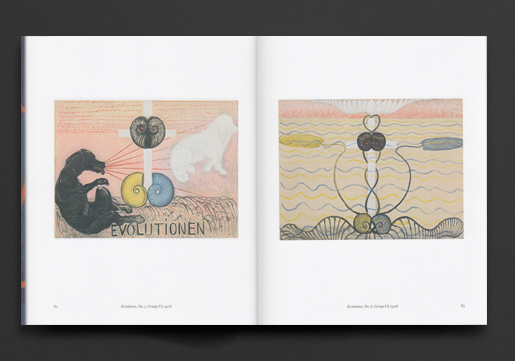
Hilma af Klint is now regarded as a pioneer of abstract art. While her paintings were not seen publicly until 1987, her work from the early 20th century pre-dates the first purely abstract paintings by Kandinsky, Mondrian or Malevich. Af Klint sought to express her feelings transmitted to her form nature and the unseen spiritual world.
After graduating from the Royal Academy of Fine Arts in Stockholm in 1887, af Klint took a studio in the city where she produced and exhibited traditional landscapes, botanical drawings and portraits. However, by 1886 she had abandoned the conventions she learned at the Academy in favour of painting the invisible worlds hidden within nature, the spiritual realm and the occult.
She privately joined four other female artists to form a group called ‘The Five’. They conducted séances to encounter what they believed to be spirits who wished to communicate via pictures, leading to experiments with automatic writing and drawing, which pre-dated the Surrealists by several decades.
This catalogue focuses primarily on af Klint’s body of work, The Paintings for the Temple (1906-1915), and numerous works from the key series never published before. Consisting of 193 predominately abstract paintings in various series and subgroups, she painted a path towards a harmony between the spiritual and material worlds; good and evil; man and woman; religion and science.
Texts by Daniel Birnbaum, Jennifer Higgie, Hans Ulrich Obrist, Julia Peyton-Jones, Julia Voss
Published on the occasion of the exhibition at the Serpentine Gallery, London, 3 March – 22 May 2016.
2016, English
Softcover, 432 pages, 21 x 29.7 cm
Published by
Walther König / Köln
$83.00 - Out of stock
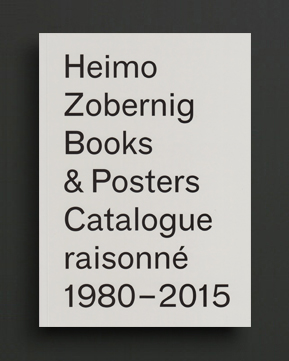
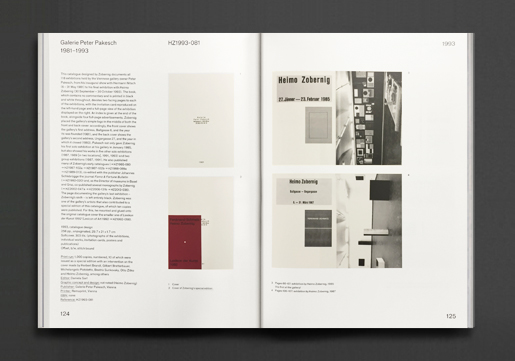
Catalogue Raisonne of Heimo Zobernig's vast history of Books & Posters: 1980-2015, including reproduction and detailed information on 114 books, and 117 bosters, alongside texts by Diana Baldon, Moritz Küng. An essential aspect of Zobernig's work and a must-have heavy archive document for any fan.
Published by Verlag Der Buchhandlung Walther Konig.
Heavy book may require additional postage.
2016, English
Softcover, 104 pages, 15 x 21.6 cm
Published by
Afterall / London
The MIT Press / Massachusetts
$34.00 - Out of stock
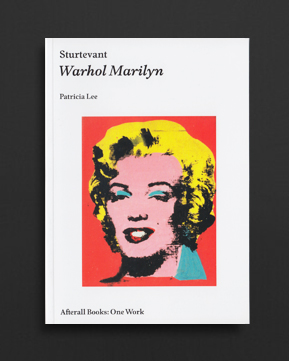
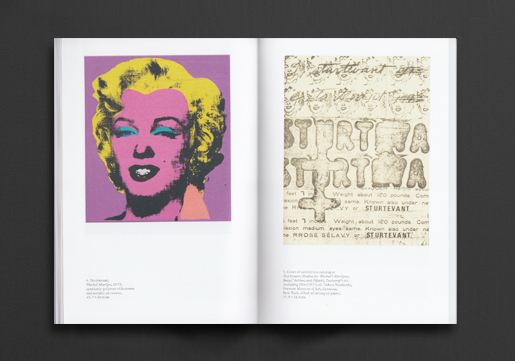
Warhol Marilyn (1965) is not a work by Andy Warhol but by the artist Elaine Sturtevant (1930--2014). Throughout her career, Sturtevant (as she preferred to be called) remade and exhibited works by other contemporary artists, among them Jasper Johns, Roy Lichtenstein, and Robert Rauschenberg. For Warhol Marilyn, Sturtevant used one of Warhol's own silkscreens from his series of Marilyn printed multiples. (When asked how he made his silkscreened work, Warhol famously answered, "I don't know. Ask Elaine.")
In this book, Patricia Lee examines Warhol Marilyn as representing a shift in thinking about artistic authorship and originality, highlighting a decisive moment in the rethinking of the contemporary artwork. Lee describes the cognitive dissonance a viewer might feel on learning the identity of Warhol Marilyn's author, and explains that mistaken identity is part of Sturtevant's intention for the operation of the work. She discusses the ways that Sturtevant's methodology went against the grain of a certain interpretation of modernism, and addresses the cultural significance of both Warhol and Monroe as celebrity figures. She considers Dorothy Podber's shooting a bullet through a stack of Warhol's Marilyns (thereafter known as The Shot Marilyns) at the Factory in 1964 and its possible influence on Sturtevant's decision to remake the work. Lee writes that Sturtevant's critical reception has been informed by some fictional forebears: the made-up artist Hank Herron (whose nonexistent work duplicating paintings by Frank Stella was reviewed by a fictional critic), and (suggested by Sturtevant herself) Pierre Menard, the title character of Jorge Luis Borges's "Pierre Menard, Author of the Quixote," who recreates a section of Cervantes's masterpiece line by line. And finally, she explores installation contexts and display strategies for Sturtevant's work as illuminating her broader artistic aims and principles.
2005, English / German
Softcover, 376 pages, 21 x 27 cm
1st Edition, Out of print title / Used*,
Published by
Hatje Cantz / Berlin
$180.00 - Out of stock
Volume one of the two-part major publication on the artist Sturtevant, both long out of print.
Sturtevant's investigations into the duality of original and copy, object and image, similarity and difference are contributions of outstanding importance to contemporary art.
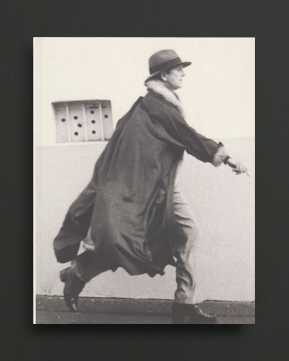
Elaine Sturtevant (1930--2014), has been concerned since the mid-1960s with one of the most important themes in Western art - the aspect of originality. Her works are reproductions of existing works by such artists as Marcel Duchamp, Roy Lichtenstein, Andy Warhol, Jasper Johns, and Frank Stella, to name only a few. Often indistinguishable from the originals, they call attention to the crucial issues of origin and difference. Designed and produced in close collaboration with the artist, this opulently illustrated publication (produced and published consecutively with another catalogue rainsonné volume) offers an unprecedented overview of the unique and unparalleled work of this American artist. This special book functions somewhat like an artist's scrapbook, reproducing rarely seen photographs of Sturtevant in her studio producing the above-mentioned works, alongside promotional imagery, exhibitions views, and sketches, drawings, plans, notes, and photos from her work production throughout her entire career. An incredible insight into her working. Edited by Udo Kittelmann, Mario Kramer and Lena Maculan, this particular book also features a great interview between Sturtevant and the great artist/film director John Waters!
Published on the largest exhibition of the artists work at the Museum für Moderne Kunst, Frankfurt/Main, September 25, 2004-January 30, 2005
2015, English
Softcover (w. clear plastic dust-jacket), 372 pages, 21 x 28 cm
Published by
De Appel / Amsterdam
Roma / Amsterdam
Stedelijk Museum / Amsterdam
$70.00 - Out of stock
Originally published by Siegelaub/Wendler in 1968. Republished in December 2015 on the occasion of the exhibition Seth Siegelaub: Beyond Conceptual Art at the Stedelijk Museum Amsterdam.
This exhibition in book form was originally published and organised to show work outside of the gallery setting by American curator and art dealer Seth Siegelaub. The book presents several artists (Carl Andre, Robert Barry, Douglas Huebler, Joseph Kosuth, Sol Lewitt, Robert Morris, Lawrence Weiner) associated with Siegelaub’s curatorial practice, and applies unconventional modes for the exhibition and distribution of art. Siegelaub asked each participating artist to create 25 pages of work that responded to the photocopy format, which was new at the time. A pivotal exhibition for conceptual art in the 1960s, it has now been republished in a second edition through a collaboration by Roma Publications, Stedelijk Museum Amsterdam, De Appel arts centre, and Egress Foundation.
2012, English
Softcover, 304 pages (140 b&w ill.), 215 x 156mm
Published by
Afterall / London
Van Abbemuseum / Eindhoven
Walther König / Köln
$28.00 - Out of stock
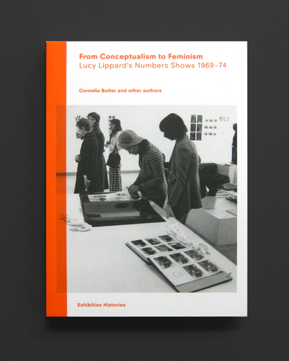
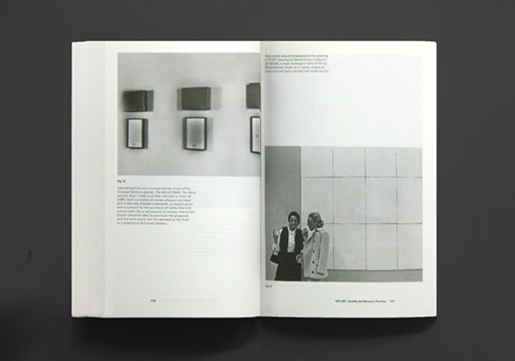
Four exhibitions of contemporary art curated by Lucy Lippard have become renowned as her 'numbers shows'. Each took the population of the city in which it was shown as its title: 557,087 in Seattle, 955,000 in Vancouver, 2,972,453 in Buenos Aires and c.7,500 opening in Valencia, California, before touring the US and to London.
This book follows Lippard's curatorial trajectory, analysing her transition from a writer about art to a maker of exhibitions, and tracing her growing political engagement and involvement with feminism.
Extensive photographic material is complemented by a major new essay by Cornelia Butler and interviews with Seth Siegelaub and artists Agnes Denes, Alice Aycock, Eleanor Antin and Mierle Laderman Ukeles.
The volume also includes critical responses written at the time by Peter Plagens and Griselda Pollock, and an analysis of artists initiatives in Argentina that give a context for Lippard's emerging political consciousness by Pip Day.
This is the third publication in the Exhibitions Histories series, co-published with Afterall Books, London.
2010, English
Hardcover (cloth bound), 392 pp. (46 ill.), 178 x 229 mm
Published by
October Books / New York
The MIT Press / Massachusetts
$65.00 - Out of stock
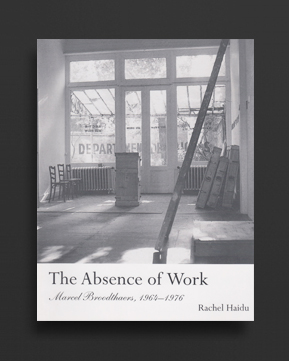
In 1964, at age forty, Marcel Broodthaers (1924-1976) proclaimed that his years of writing poetry—of being "good for nothing," in his words—were over, and a brief but dazzling artistic career began. Considered a founding father of institutional critique, Broodthaers created hundreds of objects, books, films, photographs and exhibitions, including a "fictive" museum of modern art that evolved from an installation in his own home to a massive exhibition of over three hundred works representing eagles. In The Absence of Work, Rachel Haidu argues that all of Broodthaers's art is defined by its relationship to language. His perception of his poetry's "failure to communicate" led him to explore in his art the noncommunicative, nontransparent uses of language. By showing us the ways in which language is instrumentalized across society—used for its efficiency despite the complexities it introduces into communication—Broodthaers shows us how we imagine language to work and points us to its hidden operations.
Haidu's characterization of Broodthaers's contribution to institutional critique represents a major departure from the usual approach to this movement. Considering the wider political implications of his work, including its reflections on national identity and democracy, she explores how they derive from historical references and examines his work's relationships to the works of other contemporary artists. With The Absence of Work, one of the first monographs on Broodthaers in English, Haidu demystifies a crucial and enigmatic figure in postwar and contemporary art.
About the Author:
Rachel Haidu is Associate Professor in the Department of Art and Art History and the Graduate Program in Visual and Cultural Studies at the University of Rochester.
2001, English
Softcover, 262 pages, 18 x 23 cm
Published by
October Books / New York
The MIT Press / Massachusetts
$76.00 $65.00 - Out of stock
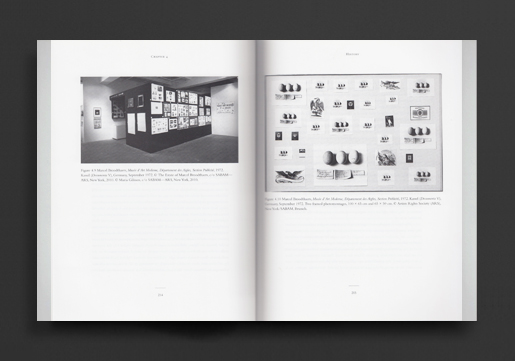
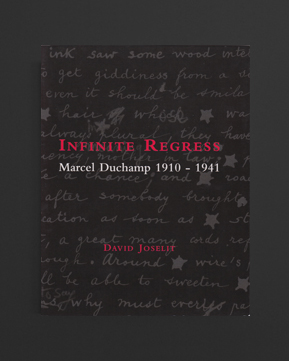
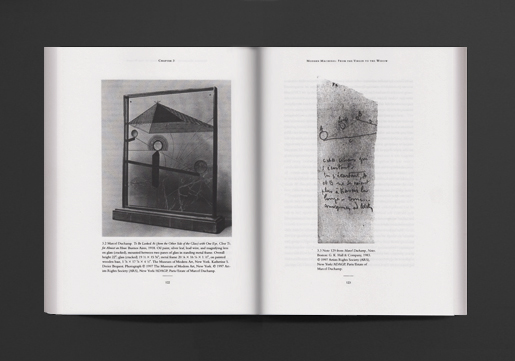
There is not one Marcel Duchamp, but several. Within his oeuvre Duchamp practiced a variety of modernist idioms and invented an array of contradictory personas: artist and art dealer, conceptualist and craftsman, chess champion and dreamer, dandy and recluse.
In Infinite Regress, David Joselit considers the plurality of identities and practices within Duchamp's life and art between 1910 and 1941, conducting a synthetic reading of his early and middle career. Taking into account underacknowledged works and focusing on the conjunction of the machine and the commodity in Duchamp's art, Joselit notes a consistent opposition between the material world and various forms of measurement, inscription, and quantification. Challenging conventional accounts, he describes the readymade strategy not merely as a rejection of painting, but as a means of producing new models of the modern self.
About the Author
David Joselit is Distinguished Professor in the Art History Department of CUNY Graduate Center and the author of Infinite Regress: Marcel Duchamp 1910-1941 (MIT Press, 1998) and American Art Since 1945.
Endorsements
"Duchamp's oeuvre is a kind of labyrinth through which few art historians have managed to come out with all their sanity: Joselit's work provides a remarkably original guide for it, and demonstrates, with radically new means, the centrality of Duchamp's oeuvre in this century."
—Yve-Alain Bois, Joseph Pulitzer, Jr. Professor of Modern Art, Harvard University
2015, English
Softcover, 304 pages, 14 x 20 cm
Published by
Independent Curators / New York
$45.00 - Out of stock
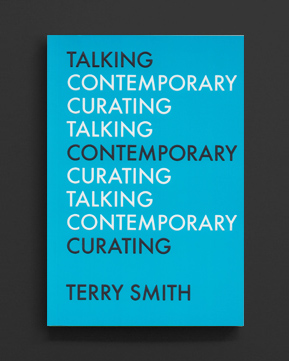
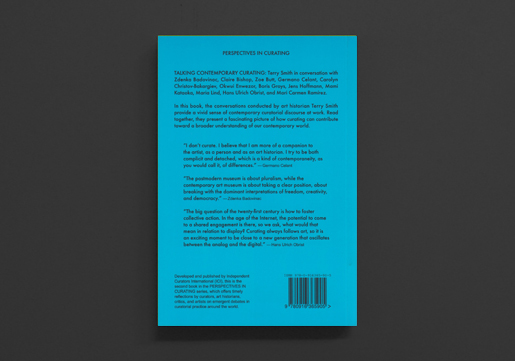
Since the publication of "Thinking Contemporary Curating" in 2012, art historian Terry Smith has continued his travels through the globalizing art world, talking to curators. The dozen searching conversations in this book--with Carolyn Christov-Bakargiev, Claire Bishop, Zdenka Badovinac, Mami Kataoka, Mari Carmen Ramírez, Okwui Enwezor, Germano Celant, Jens Hoffmann, Hans Ulrich Obrist, Maria Lind, Zoe Butt and Boris Groys--provide a vivid sense of contemporary curatorial thought at work. They show curators deeply immersed in thinking about the exigencies of practice, the contexts of exhibition-making, the platforms through which art may be made public, and about what their work can contribute toward understanding what it means to be alive today.
Terry Smith is Andrew W. Mellon Professor of Contemporary Art History and Theory in the Department of the History of Art and Architecture at the University of Pittsburgh. In 2010 he was named Australia Council Visual Arts Laureate by the Australian Government, and won the Mather Award for art criticism conferred by the College Art Association (USA). He is the author of "Making the Modern: Industry, Art and Design in America" (University of Chicago Press, 1993); "The Architecture of Aftermath" (University of Chicago Press, 2006), "What is Contemporary Art?" (University of Chicago Press, 2009), "Contemporary Art: World Currents" (Laurence King and Pearson/Prentice-Hall, 2011) and "Thinking Contemporary Curating" (Independent Curators International, 2012).
2016, English
Softcover, 200 pages, 178 x 229 mm
Published by
The MIT Press / Massachusetts
$40.00 - Out of stock
First paperback edition of Paul O'Neill's "Culture of Curating and the Curating of Culture(s)" (2012).
" O’Neill – a Bristol-based artist, curator and writer – has edited several useful books, including Curating and the Educational Turn (2010), and this latest publication is certainly one of the most invaluable histories of contemporary curating that I’ve come across. Though relatively slim, it combines a good deal of primary research (such as interviews with Seth Siegelaub and Brian O’Doherty) with wide-ranging case studies and an impressive synthesis of the now-vast body of related writing. The book tracks a shift from the curator as a behind-the-scenes carer, to a nomadic, semi-autonomous and very public figure – a cultural producer as diplomat. O’Neill identifies three key postwar developments: what Siegelaub calls the ‘demystification’ of the curatorial role during the late 1960s (when the terms Austellungsmacher and faiseur d’expositions first emerged, signifying an organizer of large exhibitions unaffiliated with a museum); the primacy of the curator-as-author model of the late 1980s (Harald Szeemann, Jean-Hubert Martin, Rudi Fuchs); and, most recently, the consolidation of a curator-centred discourse in the 1990s." -- Sam Thorne, Frieze magazine, 01/01/13
"Paul O'Neill guides us through the conflicting claims that surround the development of curating as an implicated set of roles. Focusing on the debates and differences that are part of curatorial practice, this book shows what is still required and may be possible. By exposing the historical origins and congested terrain of contemporary curatorial practice, O'Neill will stir a new generation to action."--Liam Gillick, Artist
"In this timely book, Paul O'Neill provides a much-needed overview of the historical development and central issues of contemporary curating. In clear, jargon-free prose he mines the curatorial literature to discuss disparate exhibition strategies and critically analyze the changing self-conception of the curator. This is a book that should be read by anyone interested in exhibitions and exhibition-making."--Bruce Altshuler, Director of New York University's Museum Studies Program
"This book is a thorough and convincing survey of the curatorial. It covers the changing relations between the curator and the artist or art institution over the last fifty years and shows how this triangle has been crucial to the way the public perceives the possibilities of art. It offers readers a digestible history of a phenomenon that profoundly influences our perception of art and how it is understood today." -- Charles Esche, Director, Van Abbemuseum; Eindhoven/Co-editorial Director, Afterall, London
Once considered a mere caretaker for collections, the curator is now widely viewed as a globally connected auteur. Over the last twenty-five years, as international group exhibitions and biennials have become the dominant mode of presenting contemporary art to the public, curatorship has begun to be perceived as a constellation of creative activities not unlike artistic praxis. The curator has gone from being a behind-the-scenes organizer and selector to a visible, centrally important cultural producer. In The Culture of Curating and the Curating of Culture(s), Paul O'Neill examines the emergence of independent curatorship and the discourse that helped to establish it. O'Neill describes how, by the 1980s, curated group exhibitions--large-scale, temporary projects with artworks cast as illustrative fragments--came to be understood as the creative work of curator-auteurs. The proliferation of new biennials and other large international exhibitions in the 1990s created a cohort of high-profile, globally mobile curators, moving from Venice to Paris to Kassel. In the 1990s, curatorial and artistic practice converged, blurring the distinction between artist and curator. O'Neill argues that this change in the understanding of curatorship was shaped by a curator-centered discourse that effectively advocated--and authorized--the new independent curatorial practice. Drawing on the extensive curatorial literature and his own interviews with leading curators, critics, art historians, and artists, O'Neill traces the development of the curator-as-artist model and the ways it has been contested. The Culture of Curating and the Curating of Culture(s) documents the many ways in which our perception of art has been transformed by curating and the discourses surrounding it.
Paul O'Neill is a curator, artist, and writer who has curated or co-curated more than fifty projects. As author and editor, he has published widely in books, anthologies, journals, and art magazines. He lives in Bristol, U.K.
2016, English
Softcover, 352 pages, 17.8 x 26.7 cm
Published by
Center for Curatorial Studies Bard College / New York
The MIT Press / Massachusetts
$73.00 $40.00 - Out of stock
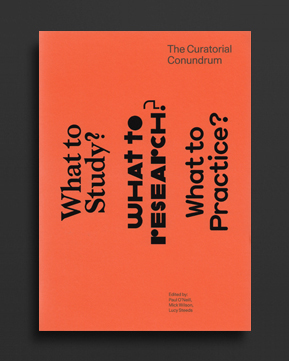
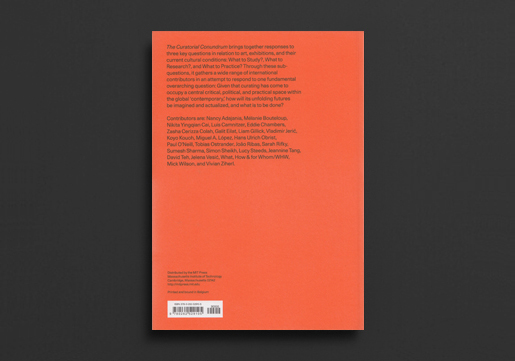
Today curators are sometimes more famous than the artists whose work they curate, and curatorship involves more than choosing objects for an exhibition. The expansion of the curatorial field in recent decades has raised questions about exhibition-making itself and the politics of production, display, and distribution. The Curatorial Conundrum looks at the burgeoning field of curatorship and tries to imagine its future. Indeed, practitioners and theorists consider a variety of futures: the future of curatorial education; the future of curatorial research; the future of curatorial and artistic practice; and the institutions that will make these other futures possible. The contributors examine the proliferation of graduate programs in curatorial studies over the last twenty years, and consider what can be taught without giving up what is precisely curatorial, within the ever-expanding parameters of curatorial practice in recent times. They discuss curating as collaborative research, asking what happens when exhibition operates as a mode of research in its own right. They explore curatorial practice as an exercise in questioning the world around us; and they speculate about what it will take to build new, innovative, and progressive curatorial research institutions.
Contributors: Nancy Adajania, Melanie Bouteloup, Nikita Yingqian Cai, Luis Camnitzer, Eddie Chambers, Zasha Cerizza Colah, Galit Eilat, Liam Gillick, Koyo Kouoh, Miguel A. Lopez, Hans Ulrich Obrist, Paul O'Neill, Tobias Ostrander, Joao Ribas, Sarah Rifky, Sumesh Sharma, Simon Sheikh, Lucy Steeds, Jeannine Tang, David The, Jelena Vesic & Vladimir Jeric Vlidi, What, How & for Whom/WHW, Mick Wilson, Vivian Ziherl
Copublished with the Center for Curatorial Studies Bard College/Luma Foundation
2016, English
Softcover, 208 pages, 15 x 22.5 cm
Published by
Semiotext(e) / Los Angeles
$36.00 - In stock -
The animal of the molecular revolution will be neither mole nor snake, but a drone-animal-thing that is solid, liquid, and a gas. — from Dividuum
As the philosophical, religious, and historical systems that have produced the "individual" (and its counterparts, society and community) over the years continue to break down, the age of "dividuality" is now upon us. The roots of the concept of the "dividuum" can be traced back to Latin philosophy, when Cicero used the term to translate the "divisible" in the writings of Epicurus and Plato; later, medieval scholars utilized the term in theological discussions on the unity of the trinity. Grounding himself in the writings of the medieval bishop Gilbert de Poitiers and his extensive commentaries on Boethius, Gerald Raunig charts a genealogy of the concept and develops a philosophy of dividuality as a way of addressing contemporary modes of production and forms of life. Through its components of dispersion, subsistence, and similarity, dividuality becomes a hidden principle of obedience and conformity, but it also brings with it the potential to realize disobedience and noncompliant con/dividualities. Raunig's bad news is that dividuality is responsible for much of the intensified exploitation and enslavement taking place under contemporary machinic capitalism. Algorithms, derivatives, big data, and social media technology all contribute to the rampant expansion of divisive management strategies and desires for self-division. The good news, however, is that this same terrain of dividuality presents an opportunity for a new kind of resistance, one that can be realized in the form of con/division.
Gerald Raunig is a philosopher and art theorist. He works at the Zurich University of the Arts, Zurich and the eipcp (European Institute for Progressive Cultural Policies), Vienna. He is coeditor of the multilingual publishing platform Transversal Texts and the Austrian journal Kamion. He is the author of Art and Revolution, A Thousand Machines, and Factories of Knowledge, Industries of Creativity, all published by Semiotext[e].
2006, English
Softcover, 296 pages, 152 x 229 mm
New Edition,
Published by
Semiotext(e) / Los Angeles
$35.00 - Out of stock
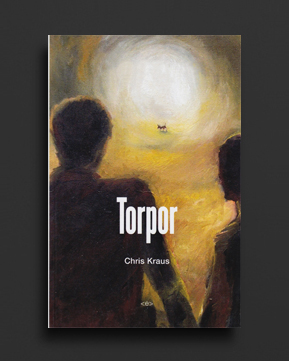
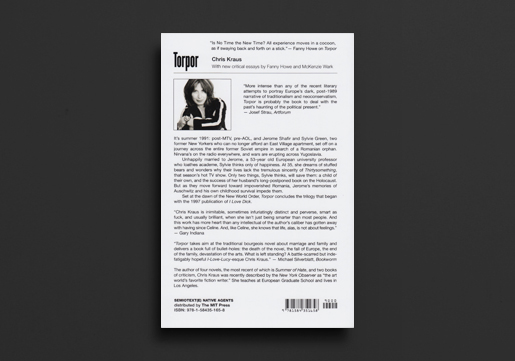
Sylvie wanted to believe that misery could simply be replaced with happiness. Time was a straight line, stretching out before you. If you could create a golden kind of time and lay it right beside the other time, the time of horror, Bad History could just recede into the distance without ever having to be resolved.--from TorporSet at the dawn of the New World Order, Chris Kraus's third novel, Torpor loops back to the beginning of the decade that was the basis of I Love Dick, her pseudo-confessional cult-classic debut. It's summer, 1991, post-MTV, pre-AOL. Jerome Shafir and Sylvie Green, two former New Yorkers who can no longer afford an East Village apartment, set off on a journey across the entire former Soviet Bloc with the specious aim of adopting a Romanian orphan. Nirvana's on the radio everywhere, and wars are erupting across Yugoslavia.Unhappily married to Jerome, a 53-year-old Columbia University professor who loathes academe, Sylvie thinks only of happiness. At 35, she dreams of stuffed bears and wonders why their lives lack the tremulous sincerity that pervades thirtysomething, that season's hot new TV show. There are only two things, Sylvie thinks, that will save them: a child of their own, and the success of The Anthropology of Unhappiness, her husband's long-postponed book on the Holocaust. But as they move forward toward impoverished Romania, Jerome's memories of his father's extermination at Auschwitz and his own childhood survival impede them. Savagely ironic and deeply lyrical, Torpor explores the swirling mix of nationalisms, capital flows and negative entropy that define the present, haunted by the persistence of historical memory. Written in the third person, it is her most personal novel to date.
Chris Kraus is the author of the novels Aliens and Anorexia, I Love Dick, and Torpor, as well as Video Green: Los Angeles Art and the Triumph of Nothingness and Where Art Belongs, all published by Semiotext(e). A Professor of Writing at the European Graduate School, she writes for various magazines and lives in Los Angeles.
1981, English
Softcover (staple-bound), 20 pages, 22 x 23cm
1st Edition, Out of print title / Used*,
Published by
Grace Borgenicht Gallery / New York
$45.00 - Out of stock
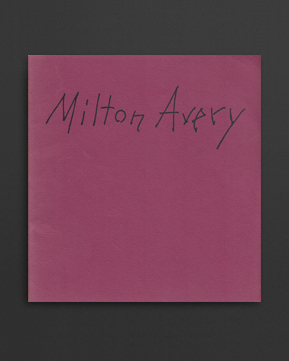
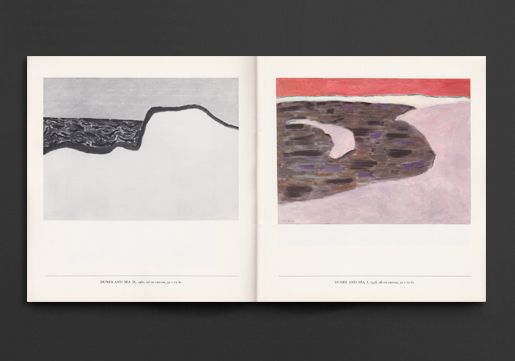
Catalogue produced on the occasion of the exhibition at Grace Borgenicht Gallery in New York, 1981. Includes reproductions of Avery's paintings; an introduction, "Milton Avery: An Appreciation" by Marianne Friedland; and chronology of major exhibitions, 1943-1982.
Milton Clark Avery (March 7, 1885 – January 3, 1965 ) was an American modern painter. Born in Altmar, New York, he moved to Connecticut in 1898 and later to New York City. Avery's work is seminal to American abstract painting—while his work is clearly representational, it focuses on color relations and is not concerned with creating the illusion of depth as most conventional Western painting since the Renaissance has. Avery was often thought of as an American Matisse, especially because of his colorful and innovative landscape paintings. His poetic, bold and creative use of drawing and color set him apart from more conventional painting of his era. Early in his career, his work was considered too radical for being too abstract; when Abstract Expressionism became dominant his work was overlooked, as being too representational.
1966, French
Softcover, 64 pages, 14 x 15 cm
1st Edition, Out of print title / Used*,
Published by
Pavillon de Marsan / Paris
$70.00 - Out of stock
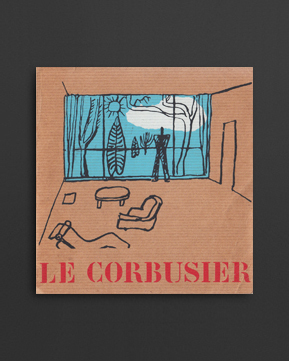
1st printing of scarce French catalogue published on the occasion of an exhibition of Le Corbusier held at Pavillon de Marsan in 1966.
A lovely publication with drawings by Le Corbusier, photography by Lucien Hervé of Le Corbusier's architectural works, an illustrated chronology of projects, a bibliography, list of collaborators, his Modulor system (an anthropometric scale of proportions developed by Le Corbusier) and texts by Claudius Petit and René Salanon.
2016, English
Hardcover (w. dustjacket), 160 pages, 25 x 25 cm
Published by
Black Dog Publishing Ltd / London
$58.00 - Out of stock
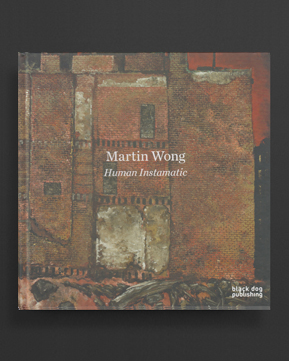
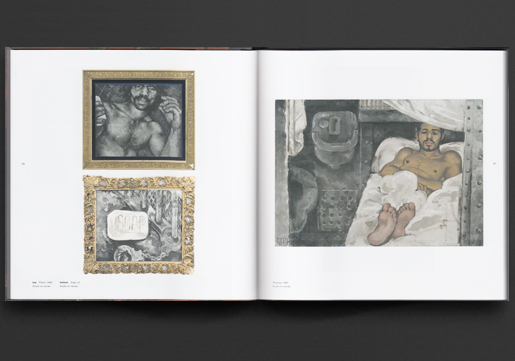
Martin Wong: Human Instamatic explores the work of Chinese American artist Martin Wong (1946-1999), tracing his transition from an introspective youth in San Francisco painting haunting self-portraits, to his subsequent engagements with communities in the Bay Area and later New York City.
In the late 1960s and 1970s, Wong became an active participant in the thriving countercultural movement in California, where he collaborated with the radical queer performance groups Cockettes and Angels of Light. In 1978, Wong moved to New York where he could play a pivotal role in the arts scene throughout the 1980s and 1990s. Wong's unique paintings of that period captures the vibrancy of the Lower East Side: a resilient, multi-ethnic, bohemian community grappling with an advanced process of gentrification. Diagnosed with HIV in 1994, Wong returned to San Francisco where he lived under the care of his parents until he died in 1999.
Martin Wong: Human Instamatic offers a comprehensive overview of Martin Wong's career through a number of scholarly essays, archival material, and an interview with Wong made accessible to the public for the first time. Martin Wong: Human Instamatic is in partnership with the Bronx Museum of the Arts.
Contributors: Antonio Sergio Bessa, John Yau, Benjamin Binstock, Dan Cameron, Julie Ault, Yasmin Ramirez, and Sam Ashman.
2014, English
Hardcover, 80 pages (colour ill.), 28 x 33 cm
Published by
Matthew Marks gallery / New York
$52.00 - In stock -
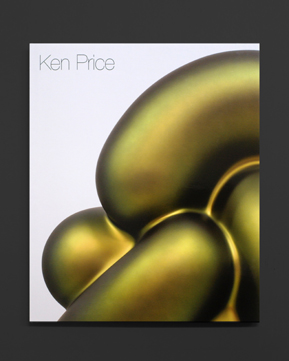
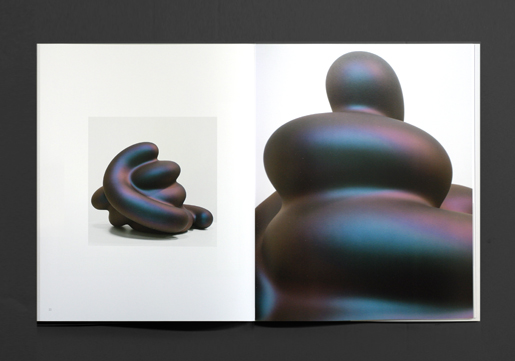
For over five decades, Ken Price (1935–2012) produced small-scale ceramic sculptures with brightly colored finishes that achieved a balance between form and surface. Then, in the last years of his life, he initiated a dramatic shift in scale and finish. Ken Price: The Large Sculptures unveils this final body of work in its entirety. With dimensions that echo those of the human body, these sculptures speak directly to the viewer’s corporeality. Cast in bronze composite and painted with color-shifting automotive paint, the large sculptures are in one sense the culmination of Price’s long career and in another the beginning of a new path cut tragically short. This large-format book includes a detailed essay by Alex Kitnick that situates these works in the history of modern sculpture. The plates section features multiple views of the works’ seemingly ever-shifting forms. Completing the book are numerous unpublished photographs of the fabrication process at Price’s studio.
2000, English
Hardcover (w. dustjacket), 251 pages, 26.4 x 26.4 cm
1st Edition, Out of print title / Used*,
Published by
LACMA / Los Angeles
Rizzoli / New York
$55.00 - Out of stock
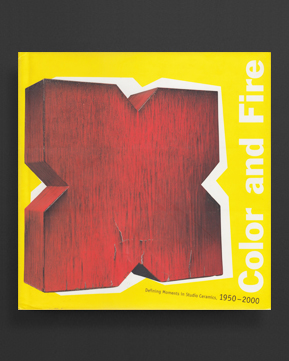
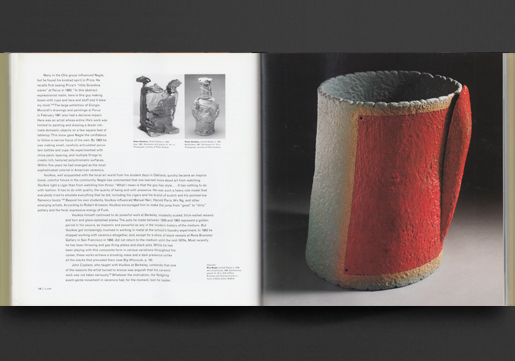
Drawn from the collection of the Los Angeles County Museum of Art, Color & Fire: Defining Moments in Studio Ceramics, 1950-2000 accompanies a major touring exhibition on the history of ceramic art in the second half of the twentieth century. Illustrated with more than 250 color photographs, Color & Fire explores the roles of key artists and the major stylistic movements they developed during the decades of pioneering innovation.
Based on the premise that the history of studio ceramics can be regarded as a series of breakthroughs or milestones, Color & Fire highlights the moments when talented artists came together to produce work in clay that challenged traditions and promoted aesthetic freedom. In the early years of the twentieth century, pottery was primarily mass-produced in factories, where specialists in wheel throwing, glazing, and kiln firing worked under a system of divided labor. In the 1930s and 1940s, ceramists such as the renowned team of Gertrud and Otto Natzler began to perform all of these exacting functions-from mixing clay to firing kilns-in their own studios, creating one-of-a-kind pots, breathtaking in design and construction. Since that time, ceramic art has followed a metaphorical journey from the earth to the air, as concerns with utility, materials, and techniques have given way to abstract conceptual considerations.
In Los Angeles in the 1950s, Peter Voulkos and his students upset the traditional values of craft pottery and the Bauhaus- inspired "form follows function" doctrine by creating nonfunctional, oversized, off-kilter vessels with cracks and holes, along with massive Abstract Expressionist monuments. In the 1960s in northern California, Robert Arneson and his students shattered taboos against clay as a sculptural medium in the oversized, off-kilter vessels with cracks and holes, along with massive Abstract Expressionist monuments. In the 1960s in northern California, Robert Arneson and his students shattered taboos against clay as a sculptural medium in the hands of potters with their radical, irreverent, and satirical "Funk" pieces. Today, no longer confined to the decorative arts or other craft categories, ceramic artists around the world explore an unlimited range of influences, styles, and ideas, engaging in a graceful and inventive dialogue with centuries of ceramic tradition.
A celebration as well as a valuable art-historical survey, Color & Fire: Defining Moments in Studio Ceramics, 1950-2000 showcases the finest works form the unparalleled collection of the Los Angeles County Museum of Art. Accessible to the novice as well as to the enthusiast, the book includes essays by Grechen Adkins, Garth Clark, Jo Lauria, Rebecca Niederlander, Susan Peterson, and Peter Selz.