World Food Books' programme is largely produced on Kulin Nation land. We acknowledge the Wurundjeri people of the Kulin Nation as the first and continuing custodians of this land, and pay respect to their Elders past, present, and emerging.
World Food Books is an arts and special interests bookshop in Naarm / Melbourne. Founded in 2010, World Food Books is devoted to the presentation of a rotating, hand-selection of international art, design, literary and counterculture publications with an emphasis on the anti-traditional, the experimental, the avant-garde, the heretic, the marginal.
Presenting new titles alongside rare and out-of-print books, catalogues and journals spanning the fields of modern and contemporary art, design, photography, illustration, film, literature, poetry, cultural theory, philosophy, sexuality, popular and underground culture in its many radical forms, World Food Books wishes to encourage adventurous, thoughtful and open-minded reading, looking, writing, and exchange of publishing and ideas, both current and historical.
As well as our bookshop, located in Melbourne's historical Nicholas Building, all of our inventory is available internationally via our online mail-order service.
World Food Books semi-regularly co-ordinates "Occasions", a programme of exhibits and events at the bookshop and in partnership with other hosts (such as museums and art galleries) that develop out of the activities, relationships and content of the bookshop itself.
World Food Books
The Nicholas Building
37 Swanston Street
Room 5, Level 6
Melbourne 3000
Australia
SHOP HOURS:
Thu–Fri 12–6, Sat 12–5
WEB-SHOP OPEN 24/7
World Food Books
Postal Address:
37 Swanston Street
Room 5, Level 6
Melbourne 3000
Australia
Art
Theory / Essay
Architecture / Interior
Graphic Design / Typography
Photography
Fashion
Eros
LGBTQ+
Fiction / Poetry
Weird / Speculative / Science Fiction / Horror
Transgressive / Visceral / Abject
Symbolism / Decadence / Fin de siècle
Film / Video
Painting
Sculpture / Installation
Performance / Dance / Theater
Drawing
Sound / Music
Curatorial
Group Shows / Collections
Periodicals
Out-of-print / Rare
Posters / Ephemera / Discs
Signed Books
World Food Books Gift Voucher
World Food Book Bag
Australian Art
Australian Fiction
Australian Science Fiction / Speculative Fiction
Australian Poetry
Australian Photography
Japanese Photography
Conceptual Art
Minimal Art
Dada
'Pataphysics / Oulipo
Fluxus
Concrete Poetry
Pop Art
Surrealism
Arte Povera
Arte Informale / Haute Pâte / Tachism
Nouveau Réalisme / Zero / Kinetic
Situationism / Lettrism
Collage / Mail Art / Xerox Art
Art Brut / Folk / Visionary / Fantastic
Illustration / Graphic Art / Bandes Dessinées
Furniture
Italian Radical Design / Postmodernism
Textiles
Ceramics / Glass
Counterculture
Protest / Revolt
Philosophy
Psychoanalysis
Anthropology
Anarchism
Socialism / Anarchism / Communism / Capitalism
Literary Theory / Semiotics / Language
Feminism / Women's Studies
Gender Studies / Sexuality
Anthropology
Fetishism / BDSM
Drugs / Psychedelia
Crime / Violence
Animal Rights / Veganism
Occult / Esoterica
Ecology / Earth / Alternative Living
Whole Earth / Crafts
All prices in AUD (Australian dollars)
Pick-Ups
Pick-up orders can be collected in our bookshop during opening hours after order date. Please collect any Pick-up orders within 2 weeks of ordering as we have limited storage space. Orders will be released back into stock if not collected within this time. No refunds can be made for pick-ups left un-collected. If you cannot make it in to the bookshop in this time-frame, please choose postage option.
Return Policy
All sales are final. We do accept returns (for refund or exchange) for items received in error. All our orders are packed with special care using heavy-duty padding and cardboard book-mailers or bubble mailers (for smaller books), using reinforcement where required. We cannot take responsibility for any lost, stolen or damaged parcels.
Insurance
Should you wish to insure your package, please email us directly after placing your order and we can organise this at a small extra expense. Although all standard/express tracked packages are very safe and dependable, we cannot take responsibility for any lost, stolen or damaged parcels. We recommend insurance on valuable orders.
Interested in selling your old books, catalogues, journals, magazines, comics, fanzines, ephemera? We are always looking for interesting, unusual and out-of-print books to buy. We only buy books in our fields of interest and specialty, and that we feel we can resell.
We base these prices on desirability, market value, in-print prices, condition and our current stock levels. We offer cash, store credit, and can take stock on consignment. All
about 25% of the price we expect to get when we sell them, or 30% in store credit. We base these prices on desirability, market value, in-print prices, condition and our current stock levels.
Sell your books any day of the week. You can drop them off and return later. If you have a lot of books, we can visit your Sydney home.
We buy books that we feel we can resell. We offer about 25 % of the price we expect to get when we sell them, or 30% in store credit. We base these prices on desirability, market value, in-print prices, condition and our current stock levels.
Philadelphia Wireman
03 August - 01 September, 2018
World Food Books is proud to announce our next Occasion, the first presentation of sculptures by Philadelphia Wireman in Australia.
The Philadelphia Wireman sculptures were found abandoned in an alley off Philadelphia’s South Street on trash night in 1982. Their discovery in a rapidly-changing neighbourhood undergoing extensive renovation, compounded with the failure of all attempts to locate the artist, suggests that the works may have been discarded after the maker’s death. Dubbed the "Philadelphia Wireman" during the first exhibition of this work, in 1985, the maker’s name, age, ethnicity, and even gender remain uncertain. The entire collection totals approximately 1200 pieces, all intricately bound together with tightly-wound heavy-gauge wire (along with a few small, abstract marker drawings, reminiscent both of Mark Tobey and J.B. Murry). The dense construction of the work, despite a modest range of scale and materials, is singularly obsessive and disciplined in design: a wire armature or exoskeleton firmly binds a bricolage of found objects including plastic, glass, food packaging, umbrella parts, tape, rubber, batteries, pens, leather, reflectors, nuts and bolts, nails, foil, coins, toys, watches, eyeglasses, tools, and jewellery.
Heavy with associations—anthropomorphic, zoomorphic, and socio-cultural responses to wrapped detritus—the totemic sculptures by Philadelphia Wireman have been discussed in the context of work created to fulfil the shamanistic needs of alternative religions in American culture. Curators, collectors, and critics have variously compared certain pieces to sculpture from Classical antiquity, Native American medicine bundles, African-American memory jugs, and African fetish objects. Reflecting the artist’s prolific and incredibly focused scavenging impulse, and despite—or perhaps enhanced by—their anonymity, these enigmatic objects function as urban artefacts and arbiters of power, though their origin and purpose is unknown. Philadelphia Wireman, whatever their identity, possessed an astonishing ability to isolate and communicate the concepts of power and energy through the selection and transformation of ordinary materials. Over the course of the past two decades, this collection has come to be regarded as an important discovery in the field of self-taught art and vernacular art.
Presented in collaboration with Fleisher-Ollman Gallery, Philadelphia, and Robert Heald, Wellington.
Susan Te Kahurangi King
02 February - 10 March, 2018
Susan Te Kahurangi King (24 February 1951 - ) has been a confident and prolific artist since she was a young child, drawing with readily available materials - pencils, ballpoint pens and felt-tip markers, on whatever paper is at hand. Between the ages of four and six Susan slowly ceased verbal communication. Her grandparents William and Myrtle Murphy had developed a special bond with Susan so they took on caring responsibilities for extended periods. Myrtle began informally archiving her work, carefully collecting and storing the drawings and compiling scrapbooks. No drawing was insignificant; every scrap of paper was kept. The King family are now the custodians of a vast collection containing over 7000 individual works, from tiny scraps of paper through to 5 meter long rolls.
The scrapbooks and diaries reveal Myrtle to be a woman of great patience and compassion, seeking to understand a child who was not always behaving as expected. She encouraged Susan to be observant, to explore her environment and absorb all the sights and sounds. Myrtle would show Susan’s drawings to friends and people in her community that she had dealings with, such as shopkeepers and postal workers, but this was not simply a case of a grandmother’s bias. She recognised that Susan had developed a sophisticated and unique visual language and sincerely believed that her art deserved serious attention.
This was an unorthodox attitude for the time. To provide some context, Jean Dubuffet coined the term Art Brut in 1945 to describe work created by self-taught artists – specifically residents of psychiatric institutions and those he considered to be visionaries or eccentrics. In 1972 Roger Cardinal extended this concept by adopting the term Outsider Art to describe work made by non-academically trained artists operating outside of mainstream art networks through choice or circumstance. Susan was born in Te Aroha, New Zealand in 1951, far from the artistic hubs of Paris and London that Dubuffet and Cardinal operated in. That Myrtle fêted Susan as a self-taught artist who deserved to be taken seriously shows how progressive her attitudes were.
Susan’s parents Doug and Dawn were also progressive. Over the years they had consulted numerous health practitioners about Susan’s condition, as the medical establishment could not provide an explanation as to why she had lapsed into silence. Dawn educated herself in the field of homeopathy and went on to treat all twelve of her children using these principles – basing prescriptions on her observations of their physical, mental and emotional state.
Doug was a linguist with an interest in philosophy who devoted what little spare time he had to studying Maori language and culture. To some extent their willingness to explore the fringes of the mainstream made them outsiders too but it was their commitment to living with integrity and their respect for individuality that ensured Susan’s creativity was always encouraged.
Even though Susan’s family supported her artistic pursuits, some staff in schools and hospitals saw it as an impediment to her assimilation into the community and discouraged it in a variety of ways. Her family was not always aware of this and therefore did not fully understand why Susan stopped drawing in the early 1990s. However, rather than dwell on the challenges that Susan faced in pursuit of her artistic practice, they prefer to highlight her achievements. In 2008 Susan began drawing again in earnest, after an almost 20 year interruption, and her work is now shown in galleries around the world.
Susan grew up without television and has been heavily influenced by the comics she read as a child. She is absolutely fearless in the appropriation of recognizable characters, such as Donald Duck and Mickey Mouse, in her work. She twists their limbs, contorts their faces, compresses them together, blends them into complex patterned backgrounds - always imbuing them with an incredible energy. Although Susan often used pop culture characters in her work they are not naive or childlike. These are drawings by a brilliant self-taught artist who has been creating exceptional work for decades without an audience in mind.
Mladen Stilinović
"Various Works 1986 - 1999"
02 February 16 - September 10, 2016
Various works 1986 - 1999, from two houses, from the collections of John Nixon, Sue Cramer, Kerrie Poliness, Peter Haffenden and Phoebe Haffenden.
Including: Geometry of Cakes (various shelves), 1993; Poor People’s Law (black and white plate), 1993; White Absence (glasses, ruler, set square, silver spoon, silver ladel with skin photograph and wooden cubes), 1990-1996; Exploitation of the Dead (grey and red star painting, wooden painting, black spoon with red table, red plate), 1984-1990; Money and Zeros (zero tie, paintings made for friends in Australia (Sue, John, Kerrie), numbers painting), 1991-1992; Words - Slogans (various t-shirts) - “they talk about the death of art...help! someone is trying to kill me”, “my sweet little lamb”, “work is a disease - Karl Marx”; Various artist books, catalogues, monographs, videos; Poster from exhibition Insulting Anarchy; "Circular" Croatian - Australian edition; Artist book by Vlado Martek (Dostoyevsky); more.
Thanks to Mladen Stilinović and Branka Stipančić.
Jonathan Walker
Always Will Need To Wear Winter Shirt Blue + Ochre Small Check Pattern
21 August - 21 September, 2015
Untitled
I am not a great reader of poetry but I always return to the work of Melbourne poet, Vincent Buckley (1925- 1988). Perhaps I find his most tantalising piece to be not a finished poem but a fragment left on a scrap of paper discovered on his desk after the poet’s death.
The poetry gathers like oil
In the word-core, and spreads
It has its music meet,
Its music is in movement.
This fragment is more the shell left behind from a volatile thought than a finished poem. I find the last two lines honest but awkward whereas the first two lines work like an arrow. Most likely he could not find a resolution so it was left. Still, in its present form, it remains an eloquent testimony to the ultimate failure of a medium to express mobile thought and sensation, in Buckley’s case, through verbal language. It’s an important matter because this is something all artists have to deal with regardless of the medium.
I have never written a poem, however, I am forever copying fragments from books on paper scraps in a vain effort to fix certain notions in my head. At first, they function as bookmarks that are sometimes returned to when I open the book. But before long, as they accumulate, they fall out littering the table interspersed with A4 photocopies, bills, books and medications.
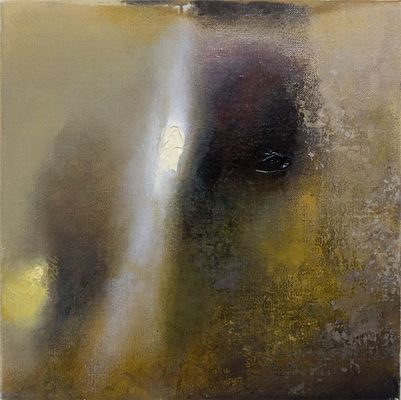
To return to Buckley’s fragment, the first two lines very much evoke how I paint nowadays. As you age, detail diminishes and patches of light become more luminous and float. I feel the most honest way of dealing with this is by smearing the oil paint on the canvas with the fingers and working close-up, blind. Only if the patches coalesce into an approaching image can the work gain a life.
-
Jonathan Walker was born in Melbourne, Australia and brought up on a dairy farm in Gippsland. In the 1970’s he studied painting at RMIT and won the Harold Wright Scholarship to the British Museum, London. During the 1980’s he exhibited at Pinacotheca Gallery, Richmond and had work shown at the NGV and Heidi City Art Gallery. Over the same period he designed the cover for the “Epigenesi” LP by Giancarlo Toniutti, Italy and conducted a mail exchange work with Achim Wollscheid, Germany. The work with artists through the post resulted in an article published in the bicentenary issue of Art and Australia 1988. He showed in artist run spaces such as WestSpace in the 90’s and 2000’s, and until 2012, taught painting at Victoria University, which is where we (Colleen Ahern and Lisa Radford) as organisers of the exhibition, among many others, had the privilege of being his student.
Walker’s knowledge was imparted to students through the careful selection of music, literature, and artists found in books that he himself had ordered for the library. Walker’s strategy was the generosity of sharing his vast knowledge with references specific to each student and their context.
Walker’s paintings share a similar focus and intimacy.
This exhibition presents a small selection of recent paintings alongside a publication that includes Walker’s writing. Observational and analytical, Walker’s work is a type of material notation — the time of day, colour and how it is blended, the both specific and fleeting location of a reflection on lino or the question of whether a chair leg should be included in a painting.
Please join us on Friday August 21 between 6-8pm to celebrate the opening of the exhibition.
Curated by Colleen Ahern and Lisa Radford.
B. Wurtz
Curated by Nic Tammens
March 26 - April 4, 2015
B.Wurtz works from a basement studio in his home on Manhattan’s Lower East Side.
This local fact is attested to by the plastic shopping bags and newsprint circulars that appear in his work. As formal objects, they don’t make loud claims about their origins but nonetheless transmit street addresses and places of business from the bottom of this long thin island. Like plenty of artists, Wurtz is affected by what is local and what is consumed. His work is underpinned by this ethic. It often speaks from a neighborhood or reads like the contents of a hamper:
“BLACK PLUMS $1.29 lb.”
“Food Bazaar”
“USDA Whole Pork Shoulder Picnic 99c lb.”
“RITE AID Pharmacy, with us it’s personal.”
“H. Brickman & Sons.”
“Sweet Yams 59c lb."
Most of the work in this exhibition was made while the artist was in residence at Dieu Donne, a workshop dedicated to paper craft in Midtown. Here Wurtz fabricated assemblages with paper and objects that are relatively lightweight, with the intention that they would be easily transportable to Australia. This consideration isn’t absolute in Wurtz’s work, but was prescriptive for making the current exhibition light and cheap. Packed in two boxes, these works were sent from a USPS post office on the Lower East Side and delivered to North Melbourne by Australia Post.
Wurtz appears courtesy of Metro Pictures, New York.
Thanks to Rob Halverson, Joshua Petherick, Sari de Mallory, Matt Hinkley, Helen Johnson, Fayen d'Evie, Ask Kilmartin, Lisa Radon, Ellena Savage, Yale Union, and "Elizabeth".
John Nixon
"Archive"
December 15 - January 20, 2014
The presentation of John Nixon's archive offered a rare showcase of this extensive collection of the artist's own publications, catalogues, posters, ephemera, editions and more, from the mid 1980s onwards, alongside a selection of his artworks.
Organized by John Nixon, Joshua Petherick and Matt Hinkley.
<a href=http://wfb.public-office.info/artist/john-nixon>All titles by John Nixon
"Habitat"
at Minerva, Sydney (organised by Joshua Petherick and Matt Hinkley)
November 15 - December 20, 2014
Lupo Borgonovo, Janet Burchill & Jennifer McCamley,
Lewis Fidock, HR Giger, Piero Gilardi, Veit Laurent Kurz,
Cinzia Ruggeri, Michael E. Smith, Lucie Stahl, Daniel Weil, Wols
Press Release:
“...It contained seven objects. The slender fluted bone, surely formed for flight, surely from the wing of some large bird. Three archaic circuitboards, faced with mazes of gold. A smooth white sphere of baked clay. An age-blackened fragment of lace. A fingerlength segment of what she assumed was bone from a human wrist, grayish white, inset smoothly with the silicon shaft of a small instrument that must once have ridden flush with the surface of the skin - but the thing’s face was seared and blackened.”
William Gibson, “Count Zero”, 1986
"Autumn Projects Archive"
Curated by Liza Vasiliou
March 6 - March 15, 2014
World Food Books, in conjunction with the Virgin Australia Melbourne Fashion Festival 2014, presented the Autumn Projects archive, consisting of a selection of early examples in Australian fashion with a particular interest in collecting designers and labels from the period beginning in the 1980’s, who significantly influenced the discourse of Australian Fashion.
Curated by Liza Vasiliou, the exhibition provided a unique opportunity to view pieces by designers Anthea Crawford, Barbara Vandenberg, Geoff Liddell and labels CR Australia, Covers, Jag along with early experimental collage pieces by Prue Acton and Sally Browne’s ‘Fragments’ collection, suspended throughout the functioning World Food Books shop in Melbourne.
H.B. Peace
presented by CENTRE FOR STYLE
November 14, 2013
"Hey Blinky, you say chic, I say same"
Anon 2013
H.B. Peace is a clothing collaboration between great friends Blake Barns and Hugh Egan Westland. Their pieces explore the divergences between 'character’ and ‘personality’ in garments....etc
Special Thanks to Joshua Petherick and Matt Hinkley of WFB and Gillian Mears
and a Very Special Thank you to Audrey Thomas Hayes for her shoe collaboration.
Janet Burchill & Jennifer McCamley
"Aesthetic Suicide"
May 10 - June 8, 2013
The first of our occasional exhibitions in the World Food Books office/shop space in Melbourne, "Aesthetic Suicide" presented a body of new and older works together by artists Janet Burchill & Jennifer McCamley, including videos, prints, a wall work, and publications.
During shop open hours videos played every hour, on the hour.
Published by World Food Books / Melbourne
$20.00 - In stock -
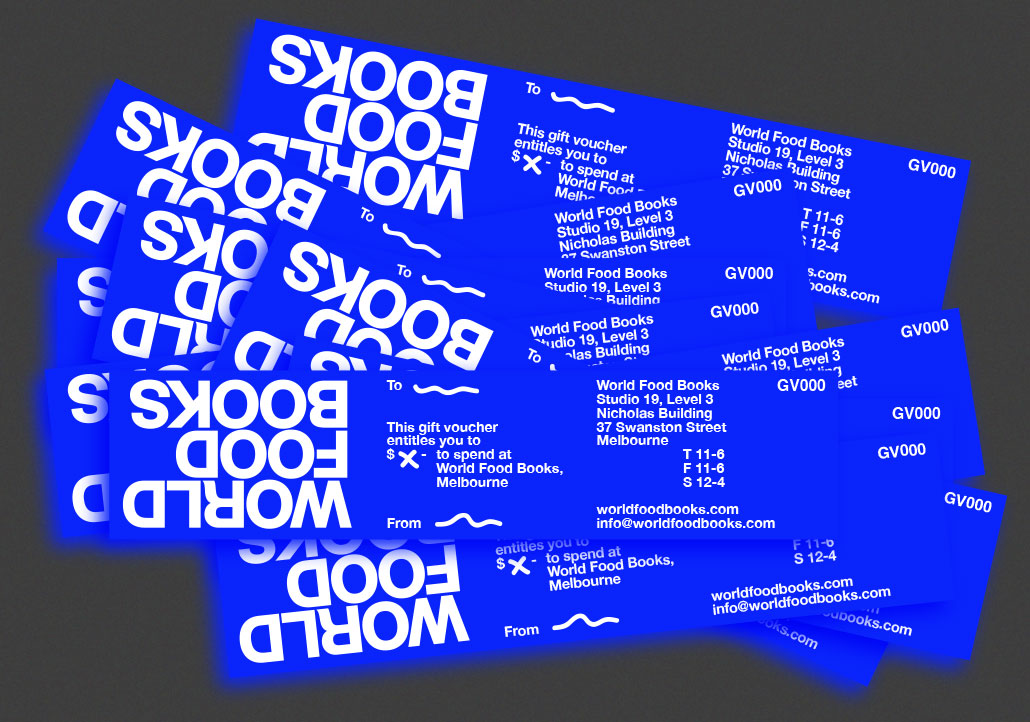
A World Food Books gift voucher is redeemable in our Melbourne bookshop or via our webshop (here). An e-voucher (printable pdf) will be sent to your purchase email address (please notify us if you wish to have the voucher sent to an alternate address and wish us to fill in the receiver's details on the card).
Gift vouchers can be purchased in increments of $20 (Australian Dollars) and the total amount can simply be added to by increasing the quantity in your shopping cart. eg. A quantity of 5 gift vouchers will result in an item total of $100 - a $100 gift voucher. Simply click "ADD TO CART" 5 times, or update your quantity in the shopping cart.
If you wish to purchase multiple, separate gift vouchers in one go, please just email us and we can personally prepare and email you a payment request.
Please note: Please select Pick-Up on gift voucher purchse to avoid any postage charges. Accidental postage charges will be refunded right away!
Thank you.
For any questions, please don't hesitate to email: [email protected]
1969, German / French
Softcover, 34 pages, 21 x 17 cm
1st Edition, Out of print title / used / very good
Published by
Galerie Sydow / Frankfurt
$90.00 - In stock -
Wonderful 1969 book that reproduces one of Bellmer's finest works in its entirety – Petit traité de morale, ten magnificent copperplates expertly engraved by Bellmer between 1966–1968, all inspired by the work of Marquis de Sade, and produced in a deluxe portfolio of 150 copies in 1968 by Èdition Georges Visat, Paris. This catalogue was published to commemorate the release at Galerie Sydow, Frankfurt, printed in a small run in Germany in Spring 1969. It contains all of the portfolio works reproduced in offset by F. Guhl & Co., Frankfurt, with their exquisite overlay colours, each plate protected by glassine (title–printed) sheets, accompanied by a single portrait of Bellmer by Marianne Kimpel. A provocative masterpiece of European graphic art by Bellmer at the height of his power, here available for a good $10,000 less than the folio itself.
Very Good copy with some foxing to boards, tanning to block edges.
1970, German
Softcover (w. dust jacket), 118 pages, 21 x 17 cm
Out of print title / used / very good
Published by
Studio 69 / Cologne
$100.00 - In stock -
First edition, edited and designed by Galerie Sydow's Heinrich Sydow-Zirkwitz, this beautiful book of Hans Bellmer's graphic works was published as a special project between Studio 69 in Cologne and Galerie Sydow in Frankfurt to accompany the exhibition "Ars Erotica" in 1970. Handsomely printed with spot-colour over-printing and illustrated throughout with Bellmer's graphic famous graphic series' "Bellmer à Sade" (1961), "Petite Traité de Morale" (1965) and illustrations for Georges Bataille's "Madame Edwarda" (1965). Includes text by Horst Albert Glaser. A very handsome collection and one of the nicest Bellmer books.
Very Good copy in Good dust jacket with light tanning to spine/edges, dustiness.
1971, French
Hardcover (w. dust jacket), 276 pages, 24 x 20 cm
1st Edition, Out of print title / used / good
Published by
Laconti / Brussels
$50.00 - In stock -
Curator at the Royal Museums of Fine Arts of Belgium in Brussels, Francine-Claire Legrand (Brussels, 1916–Saint-Gilles, 1995) was in charge of the modern art department. Published in 1971, her Le symbolisme en Belgique was and remains a pioneering work in which the author traces the history of the multiple trends that were developing in Belgium at that time. She brought them all together under the single concept of symbolism. Studies on Belgian symbolism have long relied on this groundbreaking work. Profusely illustrated in colour and b/w. That same year, the Belgian art historian published her first study on James Ensor, this unknown artist who became her favorite. She made a significant contribution to renewing the way we view the works of the Ostend painter created after 1900.
Good copy in Average DJ, moisture damage to boards and DJ (rippling), otherwise all-round good copy.
2013, English
Hardcover (in slipcase), 420 pages, 28.5 x 25.5 cm
1st Edition, Out of print title / used / fine
Published by
Skira / Milan
Rizzoli / New York
Munchmuseet / Oslo
$380.00 - In stock -
First hardcover, slipcased edition of this now very rare, beautifully illustrated comprehensive book published on the occasion of the 150th anniversary of the birth of Edvard Munch (1863-1944) in 2013, for which a once-in-a-lifetime exhibition was organized by the Munch Museum and the National Museum of Art, Architecture and Design in Oslo.
This major new book is the most comprehensive and ambitious full-scale retrospective of Munch's artistic oeuvre ever presented. It includes an exceptional number of renowned masterpieces as well as many lesser-known works from public and private collections worldwide. With some 350 illustrations, the volume beautifully illustrates the entire development of Munch's art from the 1880s to his death in 1944, including paintings, prints, and drawings. Texts by important scholars cover various aspects of the artist's work: self-presentation and self-portraiture, places and perception, visual rhetoric, The Frieze of Life series as a lifelong project, Munch and public life, narration and abstraction, figure and representation, and the staging of gender. With texts reflecting the most recent Munch scholarship as well as a timeline, a biography, and an index of names and places, this comprehensive book provides a new understanding of Munch's groundbreaking contribution to modernist painting.
Edvard Munch was one of Modernism's most significant artists. His tenacious experimentation within painting, graphic art, drawing, sculpture, photo and film has given him a unique position in Norwegian as well as international art history.
Fine copy in Near Fine illustrated slipcase with some light shelf wear.
1959, German
Softcover (staple-bound), 44 pages, 20 x 19.5 cm
1st Edition, Out of print title / used / very good
Published by
Kongresshalle / Berlin
$50.00 - In stock -
Lovely 1959 catalogue published on the occasion of the exhibition Edvard Munch 1863—1944, at the Kongresshalle Berlin, September—October, 1959, a very significant exhibition of the Norwegian painter's graphic works, profusely b/w illustrated throughout. Munch produced a substantial body of work using intaglio techniques—such as etching, drypoint, and aquatint—on copper plates. Beginning in 1894, he embarked on engraving directly onto copper and, largely self-taught and without formal instruction, created numerous masterpieces in this medium. Texts in German on alternating paper stocks throughout the galleries, plus a full catalogue of exhibited works.
Very Good copy, light wear.
2026, English / German
Softcover, 560 pages, 29.7 x 22.5 cm
Published by
Walther König / Köln
$100.00 - In stock -
This anthology tells the story of the influential Berlin exhibition space MD72 between 2007 and 2018, featuring more than 70 exhibitions. Over 190 contemporary artists, designers, curators, and writers are featured in this anthology. MD72 was founded by the gallerist and collector Alexander Schröder; its events reflected the repercussions of contextual art and post-institutional critique, as well as the cultural conditions of post-reunification Berlin shaped by post-feminism, postcolonial thought, and queer strategies. In addition to extensive visual documentation of exhibitions and artworks, the book offers a compendium of eyewitness accounts, essays, exhibition notes, interviews, excerpts, and commentaries from a wide range of authors.
Features: David Adamo, Jana Euler, Mark Leckey, Yves Saint Laurent, Michael Sanchez, Kai Althoff, Matias Faldbakken, Ang Lee, Peter Saville, Mathis Altmann, Barney Farmer, Lee Healey, Gunter Lepkowski, Magnus Schaefer, Tariq Alvi, Keith Farquhar, David Lewis, Mathias Schormann, Art & Language, Paul Feigelfeld, Klara Lidén, Alexander Schröder, Ian Hamilton Finlay, Valentina Liernur, Yasmine Schroeder-Elgarafi, Red Krayola, Marta Fontolan, Beca Lipscombe, Nora Schultz, Charles Asprey, Catherine Francblin, Hilary Lloyd, Elfie Semotan, Atelier E.B, Andrea Fraser, Hannes Loichinger, Gedi Sibony, Lutz Bacher, Luca Frei, Stefan Lux, Katharina Sieverding, Nairy Baghramian, Gelatin, Danny McDonald, Eric Banks, General Idea, Caoimhín Mac Giolla Leith, Amy Sillman, Dirk Bell, Isa Genzken, Eric N. Mack, Avery Singer, Kirsty Bell, Liam Gillick, Lucy McKenzie, Andreas Slominski, Sean Snyder, Bernadette Corporation, Marc Glöde, René Magritte, Gerry Bibby, Julian Göthe, Victor Man, Lucie Stahl, Julien Binet, Goldin+Senneby, André Masson, Frank Stella, BLESS, Fanny Gonella, Gordon Matta-Clark, Mladen Stilinović, Anna Blessmann, Isabelle Graw, Nick Mauss, Josef Strau, Peter Saville, Wade Guyton, Ken Okiishi, Studio Manuel Raeder, Juliette Blightman, Florian Hecker, Birgit Megerle, Juergen Teller, Cosima von Bonin, Manfred Hermes, John Miller, Philippe Thomas, Mark Borthwick, Georg Herold, Pierre Molinier, Simon Thompson, Michael Bracewell, Charline von Heyl, Sarah Morris, Torey Thornton, Janet Burchill, Max Jorge Hinderer Cruz, Ariane Müller, Wolfgang Tillmans, Jennifer McCamley, Ull Hohn, Jill Mulleady, Rirkrit Tiravanija, Tom Burr, Yngve Holen, Jeanette Mundt, Rosemarie Trockel, David Bussel, Karl Holmqvist, Geoff Nees, Donald Urquhart, Caroline Busta, Judith Hopf, Georgie Nettell, Mona Vătămanu, Florin Tudor, Michael Callies, Alex Hubbard, Albert Oehlen, Donna Huddleston, Roberto Ohrt, Francesco Vezzoli, Sergej Jensen, Alex Israel, Ken Okiishi, Danh Vo, Ellen Cantor, Robert Jarosz, Henrik Olesen, Heinz Peter Knes, Merlin Carpenter, Sergej Jensen, Paulina Olowska, Steven Warwick, Marc Camille Chaimowicz, Helen Johnson, Dietrich Orth, Michal Wasaznik, Alan Charlton, Stefan Kalmár, Daniel Pies, Marianna von Palombini, Scott Cameron Weaver, Doryun Chong, Tobias Kaspar, Manfred Pernice, Hannah Weinberger, Claire Fontaine, KAYA, Kerstin Brätsch, Kirsten Pieroth, Thilo Wermke, Anne Collier, Debo Eilers, Falke Pisano, Stephen Willats, Carole Condé, Karl Beveridge, Annette Kelm, Simon Popper, Susanne M. Winterling, John Kelsey, Genesis Breyer P-Orridge, Ashes Withyman, Isabelle Cornaro, Pierre Klossowski, Stephen Prina, David Woodard, Enrico David, John Knight, Mark Prince, Christopher Wool, Jacques de Koning, Valérie Knoll, Josephine Pryde, Cerith Wyn Evans, Gigiotto Del Vecchio, Jutta Koether, Manuel Raeder, Alex Zachary, Mark Dion, Stefan Korte, Reena Spaulings, Heimo Zobernig, Eliza Douglas, Andrzej Kostenko, Jeroen de Rijke, Lukas Duwenhogger, Christian Kracht, Willem de Rooij, Alexander Schröder, Martin Ebner, Kitty Kraus, Martha Rosler, Dominic Eichler, Mierle Laderman Ukeles, Annette Ruenzler, Marianna von Palombini, Florian Zeyfang, Colin de Land, J. St. Bernard, Dominic Eichler.
2026, English
Softcover, 276 pages, 27.9 x 22.2 cm
Published by
Walther König / Köln
$145.00 - In stock -
Edited with text by Susanne Pfeffer. Text by Valeria Gordeev, Quinn Latimer, Christoph Menke, Cord Riechelmann, Ann-Charlotte Gunzel.
From “knitting pictures” to upside down palm trees and mannequin heads in glass boxes, Trockel’s caustic oeuvre defies classification.
Finally here, the enormous MMK catalogue! German multimedia artist Rosemarie Trockel rose to fame in the 1980s with her “knitting pictures” made with industrial weaving machines. In 1999 she was the first woman to exhibit at the German Pavilion at the Venice Biennale. The brutality and absurdity of normative regimes emerge openly in the work of Rosemarie Trockel. Definitions, restrictions, paternalism, and violence due to gender become visible and transparent. Her advance is a risky, courageous, combative, and humorous one. In all media—drawing and painting, photography, sculpture, installation, and film—Trockel’s sociological gaze is as much directed at social regimes and political structures as it is at nature. Her observations and studies of processionary caterpillars, starlings, chickens, or lice, while scientifically sound and precise, always include her own critical gaze as a vital component. She appropriates the ambivalences in her work, capturing them decidedly.
The comprehensive exhibition and catalogue displays works from all periods of Rosemarie Trockel’s oeuvre, from the 1970s to the new works created especially for the Museum für Moderne Kunst in Frankfurt.
1970, English
Softcover, 224 pages, 10.8 cm x 17.8 cm
1st Edition, Out of print title / used / very good
Published by
Arrow Books / London
$30.00 - In stock -
First 1970 Arrow paperback edition of this landmark anthology of the experimental British "New Wave" movement, first published in 1969.
"From the world of Science Fiction writing there has come a totally new literature, a Space Age fiction created by writers whom new material demanded new techniques. Now they use the new techniques to explore territory way beyond the original Science Fiction bases.
These are writers who are not just reacting against the current conventions in fiction.
They are positive in their creation of new forms, certain in their aims. And above all they are enthusiastic.
Langdon Jones, editor of NEW WORLDS, has brought together the leaders of this new writing. They include: Brian Aldiss, George MacBeth, J. G. Ballard, Michael Moorcock, Michael Butterworth, Charles Platt, Thomas M. Disch, James Sallis, Giles Gordon, John Sladek, Maxim Jakubowsk, D. M. Thomas, Pamela Zoline"
VG copy, light age/tanning.
1968 / 1970, Japanese
Hardcover (clothbound), 144 pages, 19 x 27 cm
1st Edition, Out of print title / used / very good
Published by
Bijutsu Shuppan-sha / Japan
$100.00 - In stock -
Volume 1 of the great 1968–69 hardcover series "Twelve Persons in Graphic Design Today", art directed by Gan Hosoya. Each of these collectable books showcase four Japanese graphic designers (of the total 12 across 3 books) practicing in the 1960s through a large selection of their works beautifully reproduced in full-colour and black and white. Volume 1 showcases Akira Uno, Kazumasa Nagai, Shigeo Fukuda, and Gan Hosoya. Texts in Japanese, but almost entirely a visual document. First edition, 1970 print.
VG copy with tanning/foxing to block edges. Lacking dust jacket.
1968, Japanese / English
Hardcover (clothbound), 120 pages, 19 x 27 cm
1st Edition, Out of print title / used / very good
Published by
Bijutsu Shuppan-sha / Japan
$90.00 - In stock -
Volume 1 of the great 1968–1969 hardcover series "Graphic Designers in the U.S.A.", art directed by Gan Hosoya. Each of these collectable books showcase four leading American graphic designers (of the total 12 across 3 books) practicing in the 1960s through a large selection of their works beautifully reproduced in full-colour and black and white (120 pages and 163 illustrations). Volume 1 showcases Louis Danziger, Herb Lubalin, Peter Max, and Henry Wolf. Each designer profile is introduced with an English text about their work. Some other texts in Japanese, but almost entirely a visual document.
First edition with embossed metallic cloth boards, some tanning/foxing to block edge, light wear. Lacks dust jacket.
1965, English
Softcover, 522 pages, 18 x 11 cm
Out of print title / used / very good
Published by
Penguin Books / Australia
$25.00 - In stock -
1965 Penguin edition.
Seldom has a book so completely united the critics as this savage, grotesque, ludicrous vision of a mind on the slipway to madness.
"Strange, savage, subtle, beautifully mysterious... one of the great novels of the [twentieth] century"—Iris Murdoch
"One of the most important neglected novels of our time. It is a strange, eloquent and terrifying book, which tells us as much about the madness of our age as Kafka's The Trial or Musil's Man Without Qualities."—Philip Toynbee
Hardcover 1971 Jonathan Cape printing of Nobel Prize-winning author Elias Canetti's most well-known work, Auto-Da-Fé, first published in Germany in 1935, first translation to English in 1947.
Originally published in German as "Die Blendung" in 1935 and later banned in Nazi Germany, Auto-Da-Fe did not become widely known until the publication of Canetti's "Crowds and Power" in 1960. "In Auto-da-Fé no one is spared. Professor and furniture salesman, doctor, housekeeper, and thief all get it in the neck. The remoreseless quality of the comedy builds one of the most terrifying literary worlds of the century" (Salman Rushdie). "Savage, subtle, beautifully mysterious--one of the few great novels of the century" (Iris Murdoch). "A strange, eloquent and terrifying book" (Philip Toynbee). Auto da Fé is the story of Peter Kien, a distinguished, reclusive Sinologist living in Germany between the wars. With masterly precision, Canetti builds up the elements in Kien himself, and his personal relationships, which will lead to his destruction.
Elias Canetti (1905—1994) was a German-language writer, born in Ruse, Bulgaria to a Sephardic family. They moved to Manchester, England, but his father died in 1912, and his mother took her three sons back to continental Europe. They settled in Vienna. Canetti moved to England in 1938 after the Anschluss to escape Nazi persecution. He became a British citizen in 1952. He is known as a modernist novelist, playwright, memoirist, and nonfiction writer. He won the Nobel Prize in Literature in 1981, "for writings marked by a broad outlook, a wealth of ideas and artistic power". In late 1980s he started to live in Zurich permanently. He died in 1994 in Zurich. He is noted for his nonfiction book Crowds and Power, among other works.
Goof copy with light tanning and marking to covers.
1971, English
Softcover, 222 pages, 18 x 11 cm
1st Edition, Out of print title / used / very good
Published by
Penguin Books / London
$65.00 - In stock -
Rare first English–language 1971 edition of Munari's classic Design As Art, first published in Italy in 1966.
'A thing is not beautiful because it is beautiful, as the he-frog said to the she-frog: it is beautiful because one likes it.'
Here, with the lightest Latin touch, a famous Italian designer sketches out the principles and practice of the four branches of design - visual, graphic, industrial and research. The whole world is his oyster (and he will certainly have views on the design of oysters, as he has on the form and function of oranges and peas. Lamps, road-signs, cars, typography, posters, colours, knives, chairs, and Japanese houses are only some of the objects Munari discusses, with the constant insistence that things must be made right for function, right for production, right for distribution, and right for price. Design, in a word, is planning.
Through it the artist today renews genuine contact with the people.
With its irresistible humour, its wealth of anecdotes, quotations and pointed illustrations this treatise by the man who invented 'useless machines' and 'continuous structures' is a perfectly designed model of painless instruction.
One of the last surviving members of the futurist generation, Bruno Munari has been the enfant terrible of Italian art and design for most of the twentieth century.
Bruno Munari was among the most inspirational designers of all time, described by Picasso as 'the new Leonardo'. Munari insisted that design be beautiful, functional and accessible, and this enlightening and highly entertaining book sets out his ideas about visual, graphic and industrial design and the role it plays in the objects we use everyday. Lamps, road signs, typography, posters, children's books, advertising, cars and chairs - these are just some of the subjects to which he turns his illuminating gaze.
Cover design by Bruno Munari, heavily illustrated throughout by Munari.
VG copy with light wear/age to extremities, previous owner's name to title page/old tape marks to inner cover.
1976, English
Softcover, 414 pages, 21.5 x 14 cm
1st Edition, Out of print title / used / good
Published by
Dover / New York
$25.00 - Out of stock
"He is fumbling his way now along the wall; at this moment he must be laboriously spelling out the letters of my name in the darkness, on my door.... The door opens, and he comes in. with the gait of a man for ever in fear of falling • unfamiliar face clean shaven, with prominent cheek bones, eyes slanting Terror takes me by the throat..:"
This is the first meeting of Athanasius Pernath, gem-cutter with a shadow in his past, with the Golem, the strange supernatural force reputed to haunt the ancient Ghetto of Prague. From this meeting grows an incredible web of experiences within the twisted, crumbling walls and dark passages of the Ghetto. Strange mystical visions, wonderful transformations, lurking terrors and perplexing revelations come into being around the twin personalities of Pernath and the Golem, against a background of hatred and frustrated love, malice and cabalistic saintliness.
The Golem, the most famous supernatural novel in modern European literature, is the only major work in translation of the great satirist and supernaturalist Gustav Meyrink (1868-1932). Besides being a masterpiece of fantastic fiction, it also has the distinction of being the first important expressionist novel, a work of international stature.
The Man Who Was Born Again by Paul Busson (1873-1924), Tyrolean and Viennese journalist and author, is also well-known as perhaps the finest adventure fantasy in early twentieth-century German literature. The story of reincarnated memories ineighteenth-century Germany and France, it offers a fine integration of supernatural powers, ghosts, witchcraft, black magic, demons, and evocation of the dead; it is unique in its combination of wild imagination and realism.
The translations are based on those of Madge Pemberton for Meyrink, and Prince Alexander Mirski and Thomas Moult for Busson. In both cases, however, extensive corrections have been made and much material restored (in new translation) that had previously been omitted. As a result the versions in the present volume constitute the first full English translations of these two important novels.
Introduction by E. F. Bleiler.
Illustrated throughout with plates by Alfred Kubin and Hugo Steiner-Prag.
Good copy with some cover wear to extremities, tanning, light marking to block edge.
1992, English
Softcover, 224 pages, 19.5 x 12.5 cm
1st Edition, Out of print title / used / very good
Published by
Dedalus / Cambs
$30.00 - Out of stock
First 1992 Dadalus English translation of The Green Face, Meyrink's second novel, published in Germany in 1916 to critical and commercial acclaim. With cover art by Richard Oelze.
"Its setting is Amsterdam, which is used in the novel as a symbol of European decadence, and is ultimately destroyed. "The novel has the classic Meyrink features - the mystical wedding, the galaxy of grotesque characters and the haunting atmosphere of the ghetto. Mike Mitchell's superb translation of The Green Face will help establish Gustav Meyrink's reputation as one of this century's most important authors of fantastic fiction."—book jacket
"Meyrink's The Green Face is second in visionary power only to The Golem... By creating an all-pervading atmosphere of kafkaesque mystery and uncertainty, Meyrink succeeds in suggesting inexhaustible depths and heights of meaning."—Franz Rottensteiner
Good—VG copy with light wear/toning.
1995, English
Hardcover (w. dust jacket), 295 pages, 28 x 25 cm
1st Edition, Out of print title / used / very good
Published by
Edition Stemmle / Zürich
Frankfurter Kunstverein / Frankfurt
$65.00 - Out of stock
Erotic Art: From the 17th to the 20th Century is an exceptional volume showcasing over 200 plates from the renowned Hans-Jürgen Döpp collection, edited by Peter Weiermair and published by Edition Stemmle to accompany an exhibition at the Frankfurter Kunstverein. This is the English language edition. Essays by Georges Bataille, Hans-Jurgen Dopp, Claudia Gehrke, Volkmar Sigusch, Isabelle Azoulay.
The watercolors, drawings and print portfolios presented in this publication are not only outstanding examples of their genre, but also an invaluable documentation of social mores and cultural history from the 17th century onwards. These works of erotic art from all over Europe are part of a major private collection built up over a period of many years. The main focus of this particular selection is on lesser known and rarely published material, open to a wide range of possible interpretation. In tracing the history of taboo, secrecy and prohibition, this book gives its readers access to material previously available only to scholars and specialists.
Very Good copy in VG dust jacket with some light wear to extremities.
2012, Japanese
DVD
Signed by Tsurisaki Kiyotaka,
1st Edition, Out of print title / used / fine
Published by
Uplink / Japan
$120.00 - In stock -
Japanese death photographer Tsurisaki Kiyotaka is back, with his own unique vision of our planet. The Wasteland is a look into the world around us. It is a look into the aftermath of war, religion, and other evil facets that aid in the destruction of Earth. Kiyotaka teams up with the legendary doom metal band Corrupted to set the mood for this epic. Don't look away. The Wasteland is real.
First Uplink 2002 Japanese issue with insert. Disc signed by Tsurisaki Kiyotaka.
Since 1994, Japanese photographer, film director, and writer Kiyotaka Tsurisaki (b. 1966) has become known for prolifically photographing dead bodies; his images of death and conflict from global "hot-spots" earning him a reputation as a leading underground photographer. For Kiyotaka’s raw photo-journalistic practice he habitats disaster areas, accident sites and war zones, locations where society has collapsed to seek out and photograph man's ultimate taboo — death. Many of these people met with violent ends, whether by vehicle crash, homicide, or suicide. The images are stark, confronting, bleak and profound. Tsurisaki also brings the viewer into morgues and forensics labs, where the macabre work of embalming and autopsy is unapologetically documented. His work has led him from Fukoshima and Japan’s suicide forest Aokigahara, Thailand, Colombia, Mexico, Russia, and Palestine, as well as other lawless or war-torn parts of the world, to photograph human corpses. In El Cartucho, Bogota, Kiyotaka filmed the shockumentary Orozco The Embalmer (2001) — a now cult classic in its genre, alongside his Junk Films (2007) and Wasteland (2012). Tsurisaki has published several photo books and authored Book Of The Dead (2011), and The Dogs of the Nuclear War: A Chronicle Of The Fukushima Daiichi Nuclear Power Plant (2017).
NTSC Zone 2 DVD.
1962, German
Softcover, 190 pages, 21 x 16.8 cm
1st Edition, Out of print title / used / very good
Published by
Gerhardt Verlag / Berlin
$300.00 - In stock -
Rare 1962 edition of Bellmer's "Die Puppe", published by Gerhardt Verlag in Berlin. German artist Hans Bellmer (1902-1975) was one of the most subversive artists associated with Surrealism, famous—notorious, even--for his erotic engravings, objects and photographs. This collectable first edition of Die Puppe (The Doll) comprises a series of Bellmer's hand-painted photographs in the form of 10 monochrome and 15 coloured tipped-in plates accompanying his remarkable texts, here published for the first time. Bellmer's hand-coloured photographs subsequently acquired an iconic status as perhaps the purest exemplification of the Surrealist ideal of "convulsive beauty." Bellmer weaves a remarkably disparate set of concepts and intuitions—from fields as diverse as mathematics, morphology, optics and psychology—into a theory of eroticism that provides a totally unexpected rationale for his uncompromising art. His ideas are, in the words of poet Joë Bousquet, a "scandal to reason." The book also contains many b/w drawings by Bellmer along with prose poems by Paul Eluard. A book like no other!
Very Good—Near Fine preserved copy of this stunning edition with the die-cut decal cover. Light corner bump, light block shelf wear.
1969 / 1977, English
Hardcover (w. dust jacket), 480 pages, 21.6 x 16 cm
1st Edition, Out of print title / used / good
Published by
Thames and Hudson / London
Funk & Wagnalls / New York
$50.00 - Out of stock
First 1969 US hardcover edition of Wyndham Lewis on Art : Collected Writings 1913-1956, edited and introduced by Walter Michel & C.J. (Cyril James) Fox. A comprehensive anthology of the Vorticist founder's essays, manifestos, and art criticism. An "antagonistic collaborator" to Ezra Pound, Lewis was a brilliant, incisive critic of the modernist era. Distinguished and highly original, Wyndham Lewis (Amherst 1882–London 1957) – writer, painter, essayist and pamphleteer, and the leading figure in the English experimental adventure of 1912-1915 – is known for his sharp wit and sardonic insight. A modern master of satire, expert at deflating the pretensions of democracy, he was born off the coast of Maine in his English father's yacht and grew up in England. He was associated with Roger Fry and Ezra Pound on the vorticist magazine Blast (1914-15). Lewis served in France in World War I, and his dynamic paintings of war scenes soon gained him wide recognition for his ferocious and dehumanizing style.
VG in Good dust jacket with some wear, losses to edges. Preserved in mylar wrap.
2024, English / French
Softcover, 272 pages, 22 x 28 cm
Published by
JRP Ringier / Zürich
MUDAM / Luxembourg
$78.00 - In stock -
A book spanning Cosima von Bonin's work of the last decade, and a personal journey into her private world and references.
Published to accompany the German artist's comprehensive exhibition at Mudam Luxembourg (October 2024–March 2025), Cosima von Bonin's new monograph Songs for Gay Dogs is both a book spanning her work of the last decade, and a personal journey into her private world and references, designed by her long-time friend and collaborator Yvonne Quirmbach.
Introduced by Mudam Director Bettina Steinbrügge, it assembles a play by Australian writer and art critic Estelle Hoy that brings to life Cosima von Bonin's recurring characters, an essay by Mudam curator Clémentine Proby about the carnivalesque in her work, a contribution by Pop journalist and Cologne figure Clara Dreschler, and a "Privato" chapter comprising images, texts, and documentation from the artist's personal archive. The book includes 200 illustrations, previously unseen images, and pictures of Cosima von Bonin's newly commissioned installation in Mudam's Grand Hall.
Cosima von Bonin (born 1962 in Mombasa, lives in Cologne) began her career in the early 1990s, following in the footsteps of Martin Kippenberger. A prolific artist, she produced oversized stuffed animals and other fantastical creatures, as well as pseudo-Minimalist sculptures using comedy, cartoons, and pop culture to question social constructions and relations. She explores the relationship of the individual to work, the capitalist production system, and leisure society. She uses knitted and woven fabrics to create objects that enable her to mock industrial means of production, which she feels infantilize the individual. By advocating a life of dolce far niente, of carefree idleness, von Bonin is proposing a form of resistance against the consumerist regime. Her exhibitions include the Schirn Kunsthalle Frankfurt and Mudam Luxembourg, both 2024; Magasin III Jaffa, Tel Aviv (2019); CCS Bard, Annandale-on-Hudson (2018); and Sculpture Center, New York (2016). She participated in the 59th Biennale di Venezia (2022); Skulptur Projekte Münster (2017); Glasgow International (2016); MUMOK, Vienna (2014); Artipelag, Sweden (2013); Mildred Lane Kemper Art Museum, St. Louis (2011); Arnolfini, Bristol (2011); Musée d'Art Moderne et Contemporain, Geneva (2011); Museum Ludwig, Cologne (2011); Kunsthaus Bregenz, Austria (2010); Museum of Contemporary Art, Los Angeles (2008); and Documenta, Kassel (2007 & 1982).
Edited by Clémentine Proby and Cosima von Bonin.
Texts by Bettina Steinbrügge, Clara Dreschler, Clémentine Proby, Estelle Hoy.
1991, English / Japanese
Softcover, 180 pages, 30 x 21 cm
1st Edition, Out of print title / used / very good
Published by
Art Life / Japan
$80.00 - In stock -
Scarce 1991 catalogue published on the occasion of the travelling Japanese exhibition 'Pierre Bonnard'
curated by Norio Shimada, edited, produced and published by Art Life Ltd. Profusely illustrated in colour and b/w throughout with tri–lingual Englsih/Japanese/French texts by Gabriel P.Weisberg, Nicholas Watkins, Vincent Pomarède, Alain Daguerre de Hureaux, and Norio Shimada. These illustrated essays include rare illuminations on Bonnard's relationship to Japanese art.
Pierre Bonnard (1867–1947) is one of the most beloved painters of the twentieth century. Also a successful draughtsman, photographer, printmaker, illustrator and interior designer, the French artist is celebrated for his use of colour to convey an exquisite sense of emotion. His close friend Henri Matisse declared that Bonnard was ‘a great painter, for today and definitely also for the future’.
VG copy.
1986, English / Spanish
Softcover, 66 pages, 33 x 23 cm
1st Edition, Out of print title / used / very good
Published by
Sindicato de Trabajos Imaginarios (S.T.I.) / Zaragoza
$70.00 - In stock -
Very rare copy of Particular Motors Audio–Art Magazine issue 10, a special bi–lingual (Spanish/English), over–sized edition of the magazine published by Javier Cinca, who ran Sindicato de Trabajos Imaginarios (S.T.I) in Zaragoza, Spain, a cassette label specialising in homemade music, sound poetry and experimental video and mail art projects. The magazine specialised in the same, featuring artists like Etant Donnes or Vox Populi! and maintained correspondances with mail artists like Vittore Baroni or Rod Summers and sound poetry heavy-weights like Henri Chopin or Bernard Heidsieck. P.M. was a key publication in the 1980s postal art and experimental cassette networks in Europe.
Particular Motors 10 features interviews, articles, artworks, writings with/by: Nota Oficial, Paul Montague, Cranioclast, Sue Ann Harkey, Semiotext(e)/Audio Leter, Tox Movement, Angel Carrera, U. S. F., Visor X, Vivenza, Steve Tanza, Recloose Organisation, Steve Tanza, T. A. C., Camino Al Desvan, Amor Fati, Anton Jodra, Alex Adriaansens & Joke Brouwer, Los Rinos, Pedro Bericat, Etant Donnes, Peter R. Meyer, Marcelo Exposito, Die Todliche Doris, Vittore Baroni (Trax/Lieutenant Murnau/Arte Postale!), Francisco Felipe, Lagartijo, Victor Nubla, Orient Express/Micrart Group, Surco De Niño, Decay Int./Prima Linea, Phillipe Stojanovic, Informe Sobre La Industria, Varios, Alessandro Aiello, Papelera, Carlo Marcello Conti. Loads of collages, photography, tape reviews and adverts from the 1980s tape/mail–art network.
Very Good copy.
1997, Japanese
Softcover, 208 pages, Softcover, 15 cm x 21 cm
1st Edition, Out of print title / used / very good
Published by
Tom Shobo / Japan
$140.00 - In stock -
Too Negative issue no. 8, March 1997. Now rare and highly collectible, Too Negative, the "Forbidden Picture Book", was a visceral and visually explosive glossy cult arts magazine that reflected the gory-depraved-beyond salvation-bad taste expressions visible in international subculture at the height of 1990s underground publishing, a time when art was pushing the limits of taste and morality. Edited solely by legendary Japanese publisher and gallery owner Kotaro Kobayashi and published by Tom Publication Inc. between 1994—2000, each thick, glossy volume takes on the aesthetics of a vibrant fashion magazine in the great Japanese "mook" format (the magazine book) packed cover to cover with themes of Eros and Thanatos, such as fetishism, erotica, medical/autopsy photography, death journalism, Japanese bondage, grotesque and neo-surrealist art, crime scene photography, tattooing/irezumi, piercing, and all things of the mondo, macabre, bizarro realm. Frequent collaborators and featured artists were Kiyotaka Tsurisaki, Joel-Peter Witkin, Trevor Brown, Kiyoshi Ikejiri, to name a few. With a Japanese publishing lineage that may be found in earlier bounding-pushing periodicals such as the 1920s erotic grotesque magazine Hentai Shiriou (Pervert Documents), Tasuhiko Shibusawa’s incredible 1960s avant-garde journal Le Sang Et La Rose, or Fiction Inc’s SALE2 journal published from 1980—mid 1990s, Too Negative, and affiliated periodicals such as ORG, Spiral, Schizo, etc. took their subjects to another level of extremism, even by Japanese standards.
Not for the faint hearted.
This issue, Too Negative issue no. 8, March 1997, features the photography the paintings of Manuel Ocampo, the art of Helter Skelter corpse/death photography, the art of Jake and Dinos Chapman, grotesque tabloid news, the art of Pierre Molinier, the art of Damien Hirst, the fetish photography of Hiroshi Yokoi, latex/rubber fetish photography by Uchiyama Kazunori, Kiyotaka Tsurisaki, Kiyoshi Ikejiri, loads of abnormal medical photography, autopsy, anatomical photographic/illustrated, much more.
Mature readers only.
Very Good copy.
1997, Japanese
Softcover, 208 pages, Softcover, 15 cm x 21 cm
1st Edition, Out of print title / used / very good
Published by
Tom Shobo / Japan
$140.00 - Out of stock
Too Negative issue no. 9, May 1997. Now rare and highly collectible, Too Negative, the "Forbidden Picture Book", was a visceral and visually explosive glossy cult arts magazine that reflected the gory-depraved-beyond salvation-bad taste expressions visible in international subculture at the height of 1990s underground publishing, a time when art was pushing the limits of taste and morality. Edited solely by legendary Japanese publisher and gallery owner Kotaro Kobayashi and published by Tom Publication Inc. between 1994—2000, each thick, glossy volume takes on the aesthetics of a vibrant fashion magazine in the great Japanese "mook" format (the magazine book) packed cover to cover with themes of Eros and Thanatos, such as fetishism, erotica, medical/autopsy photography, death journalism, Japanese bondage, grotesque and neo-surrealist art, crime scene photography, tattooing/irezumi, piercing, and all things of the mondo, macabre, bizarro realm. Frequent collaborators and featured artists were Kiyotaka Tsurisaki, Joel-Peter Witkin, Trevor Brown, Kiyoshi Ikejiri, to name a few. With a Japanese publishing lineage that may be found in earlier bounding-pushing periodicals such as the 1920s erotic grotesque magazine Hentai Shiriou (Pervert Documents), Tasuhiko Shibusawa’s incredible 1960s avant-garde journal Le Sang Et La Rose, or Fiction Inc’s SALE2 journal published from 1980—mid 1990s, Too Negative, and affiliated periodicals such as ORG, Spiral, Schizo, etc. took their subjects to another level of extremism, even by Japanese standards.
Not for the faint hearted.
This issue, Too Negative issue no. 9, May 1997, features the historical death photography of criminology and medical sciences, Art Brut, photography of Cindy Sherman, lots of gore collage, latex/rubber fetish photography by Uchiyama Kazunori, Kiyotaka Tsurisaki, Yokoi Hiroshi, Kiyoshi Ikejiri, loads of abnormal medical photography, autopsy, anatomical photographic/illustrated, much more.
Mature readers only.
Very Good copy, with light wear to edges/light crease to cover corner.