World Food Books' programme is largely produced on Kulin Nation land. We acknowledge the Wurundjeri people of the Kulin Nation as the first and continuing custodians of this land, and pay respect to their Elders past, present, and emerging.
World Food Books is an arts and special interests bookshop in Naarm / Melbourne. Founded in 2010, World Food Books is devoted to the presentation of a rotating, hand-selection of international art, design, literary and counterculture publications with an emphasis on the anti-traditional, the experimental, the avant-garde, the heretic, the marginal.
Presenting new titles alongside rare and out-of-print books, catalogues and journals spanning the fields of modern and contemporary art, design, photography, illustration, film, literature, poetry, cultural theory, philosophy, sexuality, popular and underground culture in its many radical forms, World Food Books wishes to encourage adventurous, thoughtful and open-minded reading, looking, writing, and exchange of publishing and ideas, both current and historical.
As well as our bookshop, located in Melbourne's historical Nicholas Building, all of our inventory is available internationally via our online mail-order service.
World Food Books semi-regularly co-ordinates "Occasions", a programme of exhibits and events at the bookshop and in partnership with other hosts (such as museums and art galleries) that develop out of the activities, relationships and content of the bookshop itself.
World Food Books
The Nicholas Building
37 Swanston Street
Room 5, Level 6
Melbourne 3000
Australia
SHOP HOURS:
Thu–Fri 12–6
Sat 12–5
WEB-SHOP OPEN 24/7
World Food Books
Postal Address:
37 Swanston Street
Room 5, Level 6
Melbourne 3000
Australia
Art
Theory / Essay
Architecture / Interior
Graphic Design / Typography
Photography
Fashion
Eros
LGBTQ+
Fiction / Poetry
Weird / Speculative / Science Fiction / Horror
Transgressive / Visceral / Abject
Symbolism / Decadence / Fin de siècle
Film / Video
Painting
Sculpture / Installation
Performance / Dance / Theater
Drawing
Sound / Music
Curatorial
Group Shows / Collections
Periodicals
Out-of-print / Rare
Posters / Ephemera / Discs
Signed Books
World Food Books Gift Voucher
World Food Book Bag
Australian Art
Australian Fiction
Australian Science Fiction / Speculative Fiction
Australian Poetry
Australian Photography
Japanese Photography
Conceptual Art
Minimal Art
Dada
'Pataphysics / Oulipo
Fluxus
Concrete Poetry
Pop Art
Surrealism
Arte Povera
Arte Informale / Haute Pâte / Tachism
Nouveau Réalisme / Zero / Kinetic
Situationism / Lettrism
Collage / Mail Art / Xerox Art
Art Brut / Folk / Visionary / Fantastic
Illustration / Graphic Art / Bandes Dessinées
Furniture
Italian Radical Design / Postmodernism
Textiles
Ceramics / Glass
Counterculture
Protest / Revolt
Philosophy
Psychoanalysis
Anthropology
Anarchism
Socialism / Anarchism / Communism / Capitalism
Literary Theory / Semiotics / Language
Feminism / Women's Studies
Gender Studies / Sexuality
Anthropology
Fetishism / BDSM
Drugs / Psychedelia
Crime / Violence
Animal Rights / Veganism
Occult / Esoterica
Ecology / Earth / Alternative Living
Whole Earth / Crafts
All prices in AUD (Australian dollars)
Pick-Ups
Pick-up orders can be collected in our bookshop during opening hours after order date. Please collect any Pick-up orders within 2 weeks of ordering as we have limited storage space. Orders will be released back into stock if not collected within this time. No refunds can be made for pick-ups left un-collected. If you cannot make it in to the bookshop in this time-frame, please choose postage option.
Return Policy
All sales are final. We do accept returns (for refund or exchange) for items received in error. All our orders are packed with special care using heavy-duty padding and cardboard book-mailers or bubble mailers (for smaller books), using reinforcement where required. We cannot take responsibility for any lost, stolen or damaged parcels.
Insurance
Should you wish to insure your package, please email us directly after placing your order and we can organise this at a small extra expense. Although all standard/express tracked packages are very safe and dependable, we cannot take responsibility for any lost, stolen or damaged parcels. We recommend insurance on valuable orders.
Interested in selling your old books, catalogues, journals, magazines, comics, fanzines, ephemera? We are always looking for interesting, unusual and out-of-print books to buy. We only buy books in our fields of interest and specialty, and that we feel we can resell.
We base these prices on desirability, market value, in-print prices, condition and our current stock levels. We offer cash, store credit, and can take stock on consignment. All
about 25% of the price we expect to get when we sell them, or 30% in store credit. We base these prices on desirability, market value, in-print prices, condition and our current stock levels.
Sell your books any day of the week. You can drop them off and return later. If you have a lot of books, we can visit your Sydney home.
We buy books that we feel we can resell. We offer about 25 % of the price we expect to get when we sell them, or 30% in store credit. We base these prices on desirability, market value, in-print prices, condition and our current stock levels.
Philadelphia Wireman
03 August - 01 September, 2018
World Food Books is proud to announce our next Occasion, the first presentation of sculptures by Philadelphia Wireman in Australia.
The Philadelphia Wireman sculptures were found abandoned in an alley off Philadelphia’s South Street on trash night in 1982. Their discovery in a rapidly-changing neighbourhood undergoing extensive renovation, compounded with the failure of all attempts to locate the artist, suggests that the works may have been discarded after the maker’s death. Dubbed the "Philadelphia Wireman" during the first exhibition of this work, in 1985, the maker’s name, age, ethnicity, and even gender remain uncertain. The entire collection totals approximately 1200 pieces, all intricately bound together with tightly-wound heavy-gauge wire (along with a few small, abstract marker drawings, reminiscent both of Mark Tobey and J.B. Murry). The dense construction of the work, despite a modest range of scale and materials, is singularly obsessive and disciplined in design: a wire armature or exoskeleton firmly binds a bricolage of found objects including plastic, glass, food packaging, umbrella parts, tape, rubber, batteries, pens, leather, reflectors, nuts and bolts, nails, foil, coins, toys, watches, eyeglasses, tools, and jewellery.
Heavy with associations—anthropomorphic, zoomorphic, and socio-cultural responses to wrapped detritus—the totemic sculptures by Philadelphia Wireman have been discussed in the context of work created to fulfil the shamanistic needs of alternative religions in American culture. Curators, collectors, and critics have variously compared certain pieces to sculpture from Classical antiquity, Native American medicine bundles, African-American memory jugs, and African fetish objects. Reflecting the artist’s prolific and incredibly focused scavenging impulse, and despite—or perhaps enhanced by—their anonymity, these enigmatic objects function as urban artefacts and arbiters of power, though their origin and purpose is unknown. Philadelphia Wireman, whatever their identity, possessed an astonishing ability to isolate and communicate the concepts of power and energy through the selection and transformation of ordinary materials. Over the course of the past two decades, this collection has come to be regarded as an important discovery in the field of self-taught art and vernacular art.
Presented in collaboration with Fleisher-Ollman Gallery, Philadelphia, and Robert Heald, Wellington.
Susan Te Kahurangi King
02 February - 10 March, 2018
Susan Te Kahurangi King (24 February 1951 - ) has been a confident and prolific artist since she was a young child, drawing with readily available materials - pencils, ballpoint pens and felt-tip markers, on whatever paper is at hand. Between the ages of four and six Susan slowly ceased verbal communication. Her grandparents William and Myrtle Murphy had developed a special bond with Susan so they took on caring responsibilities for extended periods. Myrtle began informally archiving her work, carefully collecting and storing the drawings and compiling scrapbooks. No drawing was insignificant; every scrap of paper was kept. The King family are now the custodians of a vast collection containing over 7000 individual works, from tiny scraps of paper through to 5 meter long rolls.
The scrapbooks and diaries reveal Myrtle to be a woman of great patience and compassion, seeking to understand a child who was not always behaving as expected. She encouraged Susan to be observant, to explore her environment and absorb all the sights and sounds. Myrtle would show Susan’s drawings to friends and people in her community that she had dealings with, such as shopkeepers and postal workers, but this was not simply a case of a grandmother’s bias. She recognised that Susan had developed a sophisticated and unique visual language and sincerely believed that her art deserved serious attention.
This was an unorthodox attitude for the time. To provide some context, Jean Dubuffet coined the term Art Brut in 1945 to describe work created by self-taught artists – specifically residents of psychiatric institutions and those he considered to be visionaries or eccentrics. In 1972 Roger Cardinal extended this concept by adopting the term Outsider Art to describe work made by non-academically trained artists operating outside of mainstream art networks through choice or circumstance. Susan was born in Te Aroha, New Zealand in 1951, far from the artistic hubs of Paris and London that Dubuffet and Cardinal operated in. That Myrtle fêted Susan as a self-taught artist who deserved to be taken seriously shows how progressive her attitudes were.
Susan’s parents Doug and Dawn were also progressive. Over the years they had consulted numerous health practitioners about Susan’s condition, as the medical establishment could not provide an explanation as to why she had lapsed into silence. Dawn educated herself in the field of homeopathy and went on to treat all twelve of her children using these principles – basing prescriptions on her observations of their physical, mental and emotional state.
Doug was a linguist with an interest in philosophy who devoted what little spare time he had to studying Maori language and culture. To some extent their willingness to explore the fringes of the mainstream made them outsiders too but it was their commitment to living with integrity and their respect for individuality that ensured Susan’s creativity was always encouraged.
Even though Susan’s family supported her artistic pursuits, some staff in schools and hospitals saw it as an impediment to her assimilation into the community and discouraged it in a variety of ways. Her family was not always aware of this and therefore did not fully understand why Susan stopped drawing in the early 1990s. However, rather than dwell on the challenges that Susan faced in pursuit of her artistic practice, they prefer to highlight her achievements. In 2008 Susan began drawing again in earnest, after an almost 20 year interruption, and her work is now shown in galleries around the world.
Susan grew up without television and has been heavily influenced by the comics she read as a child. She is absolutely fearless in the appropriation of recognizable characters, such as Donald Duck and Mickey Mouse, in her work. She twists their limbs, contorts their faces, compresses them together, blends them into complex patterned backgrounds - always imbuing them with an incredible energy. Although Susan often used pop culture characters in her work they are not naive or childlike. These are drawings by a brilliant self-taught artist who has been creating exceptional work for decades without an audience in mind.
Mladen Stilinović
"Various Works 1986 - 1999"
02 February 16 - September 10, 2016
Various works 1986 - 1999, from two houses, from the collections of John Nixon, Sue Cramer, Kerrie Poliness, Peter Haffenden and Phoebe Haffenden.
Including: Geometry of Cakes (various shelves), 1993; Poor People’s Law (black and white plate), 1993; White Absence (glasses, ruler, set square, silver spoon, silver ladel with skin photograph and wooden cubes), 1990-1996; Exploitation of the Dead (grey and red star painting, wooden painting, black spoon with red table, red plate), 1984-1990; Money and Zeros (zero tie, paintings made for friends in Australia (Sue, John, Kerrie), numbers painting), 1991-1992; Words - Slogans (various t-shirts) - “they talk about the death of art...help! someone is trying to kill me”, “my sweet little lamb”, “work is a disease - Karl Marx”; Various artist books, catalogues, monographs, videos; Poster from exhibition Insulting Anarchy; "Circular" Croatian - Australian edition; Artist book by Vlado Martek (Dostoyevsky); more.
Thanks to Mladen Stilinović and Branka Stipančić.
Jonathan Walker
Always Will Need To Wear Winter Shirt Blue + Ochre Small Check Pattern
21 August - 21 September, 2015
Untitled
I am not a great reader of poetry but I always return to the work of Melbourne poet, Vincent Buckley (1925- 1988). Perhaps I find his most tantalising piece to be not a finished poem but a fragment left on a scrap of paper discovered on his desk after the poet’s death.
The poetry gathers like oil
In the word-core, and spreads
It has its music meet,
Its music is in movement.
This fragment is more the shell left behind from a volatile thought than a finished poem. I find the last two lines honest but awkward whereas the first two lines work like an arrow. Most likely he could not find a resolution so it was left. Still, in its present form, it remains an eloquent testimony to the ultimate failure of a medium to express mobile thought and sensation, in Buckley’s case, through verbal language. It’s an important matter because this is something all artists have to deal with regardless of the medium.
I have never written a poem, however, I am forever copying fragments from books on paper scraps in a vain effort to fix certain notions in my head. At first, they function as bookmarks that are sometimes returned to when I open the book. But before long, as they accumulate, they fall out littering the table interspersed with A4 photocopies, bills, books and medications.
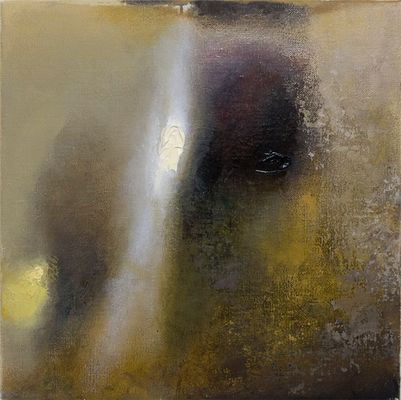
To return to Buckley’s fragment, the first two lines very much evoke how I paint nowadays. As you age, detail diminishes and patches of light become more luminous and float. I feel the most honest way of dealing with this is by smearing the oil paint on the canvas with the fingers and working close-up, blind. Only if the patches coalesce into an approaching image can the work gain a life.
-
Jonathan Walker was born in Melbourne, Australia and brought up on a dairy farm in Gippsland. In the 1970’s he studied painting at RMIT and won the Harold Wright Scholarship to the British Museum, London. During the 1980’s he exhibited at Pinacotheca Gallery, Richmond and had work shown at the NGV and Heidi City Art Gallery. Over the same period he designed the cover for the “Epigenesi” LP by Giancarlo Toniutti, Italy and conducted a mail exchange work with Achim Wollscheid, Germany. The work with artists through the post resulted in an article published in the bicentenary issue of Art and Australia 1988. He showed in artist run spaces such as WestSpace in the 90’s and 2000’s, and until 2012, taught painting at Victoria University, which is where we (Colleen Ahern and Lisa Radford) as organisers of the exhibition, among many others, had the privilege of being his student.
Walker’s knowledge was imparted to students through the careful selection of music, literature, and artists found in books that he himself had ordered for the library. Walker’s strategy was the generosity of sharing his vast knowledge with references specific to each student and their context.
Walker’s paintings share a similar focus and intimacy.
This exhibition presents a small selection of recent paintings alongside a publication that includes Walker’s writing. Observational and analytical, Walker’s work is a type of material notation — the time of day, colour and how it is blended, the both specific and fleeting location of a reflection on lino or the question of whether a chair leg should be included in a painting.
Please join us on Friday August 21 between 6-8pm to celebrate the opening of the exhibition.
Curated by Colleen Ahern and Lisa Radford.
B. Wurtz
Curated by Nic Tammens
March 26 - April 4, 2015
B.Wurtz works from a basement studio in his home on Manhattan’s Lower East Side.
This local fact is attested to by the plastic shopping bags and newsprint circulars that appear in his work. As formal objects, they don’t make loud claims about their origins but nonetheless transmit street addresses and places of business from the bottom of this long thin island. Like plenty of artists, Wurtz is affected by what is local and what is consumed. His work is underpinned by this ethic. It often speaks from a neighborhood or reads like the contents of a hamper:
“BLACK PLUMS $1.29 lb.”
“Food Bazaar”
“USDA Whole Pork Shoulder Picnic 99c lb.”
“RITE AID Pharmacy, with us it’s personal.”
“H. Brickman & Sons.”
“Sweet Yams 59c lb."
Most of the work in this exhibition was made while the artist was in residence at Dieu Donne, a workshop dedicated to paper craft in Midtown. Here Wurtz fabricated assemblages with paper and objects that are relatively lightweight, with the intention that they would be easily transportable to Australia. This consideration isn’t absolute in Wurtz’s work, but was prescriptive for making the current exhibition light and cheap. Packed in two boxes, these works were sent from a USPS post office on the Lower East Side and delivered to North Melbourne by Australia Post.
Wurtz appears courtesy of Metro Pictures, New York.
Thanks to Rob Halverson, Joshua Petherick, Sari de Mallory, Matt Hinkley, Helen Johnson, Fayen d'Evie, Ask Kilmartin, Lisa Radon, Ellena Savage, Yale Union, and "Elizabeth".
John Nixon
"Archive"
December 15 - January 20, 2014
The presentation of John Nixon's archive offered a rare showcase of this extensive collection of the artist's own publications, catalogues, posters, ephemera, editions and more, from the mid 1980s onwards, alongside a selection of his artworks.
Organized by John Nixon, Joshua Petherick and Matt Hinkley.
<a href=http://wfb.public-office.info/artist/john-nixon>All titles by John Nixon
"Habitat"
at Minerva, Sydney (organised by Joshua Petherick and Matt Hinkley)
November 15 - December 20, 2014
Lupo Borgonovo, Janet Burchill & Jennifer McCamley,
Lewis Fidock, HR Giger, Piero Gilardi, Veit Laurent Kurz,
Cinzia Ruggeri, Michael E. Smith, Lucie Stahl, Daniel Weil, Wols
Press Release:
“...It contained seven objects. The slender fluted bone, surely formed for flight, surely from the wing of some large bird. Three archaic circuitboards, faced with mazes of gold. A smooth white sphere of baked clay. An age-blackened fragment of lace. A fingerlength segment of what she assumed was bone from a human wrist, grayish white, inset smoothly with the silicon shaft of a small instrument that must once have ridden flush with the surface of the skin - but the thing’s face was seared and blackened.”
William Gibson, “Count Zero”, 1986
"Autumn Projects Archive"
Curated by Liza Vasiliou
March 6 - March 15, 2014
World Food Books, in conjunction with the Virgin Australia Melbourne Fashion Festival 2014, presented the Autumn Projects archive, consisting of a selection of early examples in Australian fashion with a particular interest in collecting designers and labels from the period beginning in the 1980’s, who significantly influenced the discourse of Australian Fashion.
Curated by Liza Vasiliou, the exhibition provided a unique opportunity to view pieces by designers Anthea Crawford, Barbara Vandenberg, Geoff Liddell and labels CR Australia, Covers, Jag along with early experimental collage pieces by Prue Acton and Sally Browne’s ‘Fragments’ collection, suspended throughout the functioning World Food Books shop in Melbourne.
H.B. Peace
presented by CENTRE FOR STYLE
November 14, 2013
"Hey Blinky, you say chic, I say same"
Anon 2013
H.B. Peace is a clothing collaboration between great friends Blake Barns and Hugh Egan Westland. Their pieces explore the divergences between 'character’ and ‘personality’ in garments....etc
Special Thanks to Joshua Petherick and Matt Hinkley of WFB and Gillian Mears
and a Very Special Thank you to Audrey Thomas Hayes for her shoe collaboration.
Janet Burchill & Jennifer McCamley
"Aesthetic Suicide"
May 10 - June 8, 2013
The first of our occasional exhibitions in the World Food Books office/shop space in Melbourne, "Aesthetic Suicide" presented a body of new and older works together by artists Janet Burchill & Jennifer McCamley, including videos, prints, a wall work, and publications.
During shop open hours videos played every hour, on the hour.
2006, English
Softcover, 258 pages, 25 x 18 cm
1st Edition, Out of print title / used / very good
Published by
The MIT Press / Massachusetts
$20.00 - In stock -
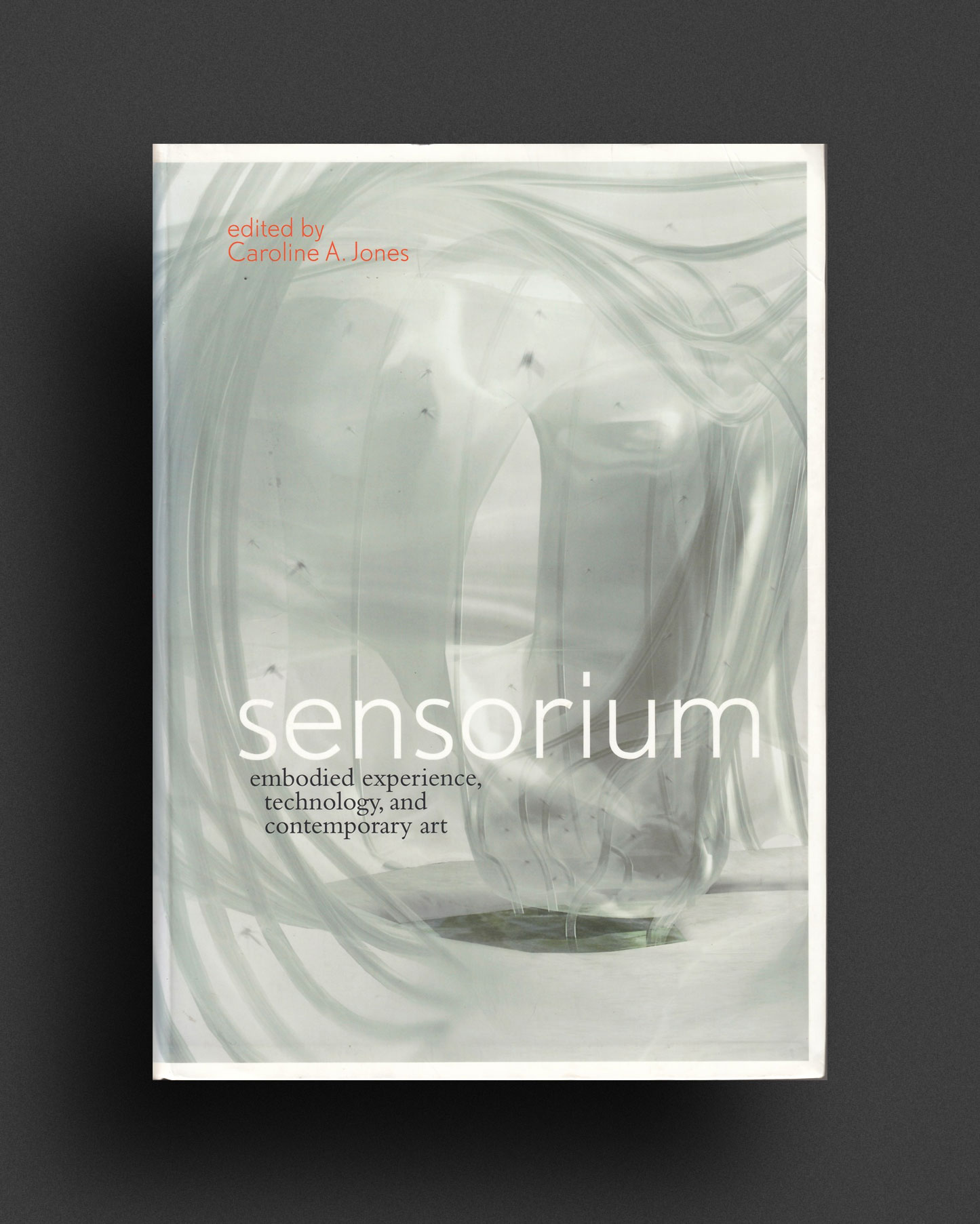
Artists and writers reconsider the relationship between the body and electronic technology in the twenty-first century through essays, artworks, and an encyclopedic "Abecedarius of the New Sensorium."
The relationship between the body and electronic technology, extensively theorized through the 1980s and 1990s, has reached a new technosensual comfort zone in the early twenty-first century. In Sensorium, contemporary artists and writers explore the implications of the techno-human interface. Ten artists, chosen by an international team of curators, offer their own edgy investigations of embodied technology and the technologized body. These range from Matthieu Briand's experiment in "controlled schizophrenia" and Janet Cardiff and Georges Bures Miller's uneasy psychological soundscapes to Bruce Nauman's uncanny night visions and François Roche's destabilized architecture. The art in Sensorium—which accompanies an exhibition at the MIT List Visual Arts Center—captures the aesthetic attitude of this hybrid moment, when modernist segmentation of the senses is giving way to dramatic multisensory mixes or transpositions. Artwork by each artist appears with an analytical essay by a curator, all of it prefaced by an anchoring essay on "The Mediated Sensorium" by Caroline Jones.
In the second half of Sensorium, scholars, scientists, and writers contribute entries to an "Abecedarius of the New Sensorium." These short, playful pieces include Bruno Latour on "Air," Barbara Maria Stafford on "Hedonics," Michel Foucault (from a little-known 1966 radio lecture) on the "Utopian Body," Donna Haraway on "Compoundings," and Neal Stephenson on the "Viral." Sensorium is both forensic and diagnostic, viewing the culture of the technologized body from the inside, by means of contemporary artists' provocations, and from a distance, in essays that situate it historically and intellectually.
Caroline A. Jones is an art historian, author, and curator and Professor in the History, Theory, and Criticism in the Department of Architecture at MIT. She is the author of, most recently, The Global Work of Art: World's Fairs, Biennials, and the Aesthetics of Experience.
Vg copy light edges wear to boards.
1978, English / German
Softcover, 223 pages, 19 x 10.8 cm
1st Edition, Out of print title / used / average
Published by
International Publishers / New York
$25.00 - In stock -
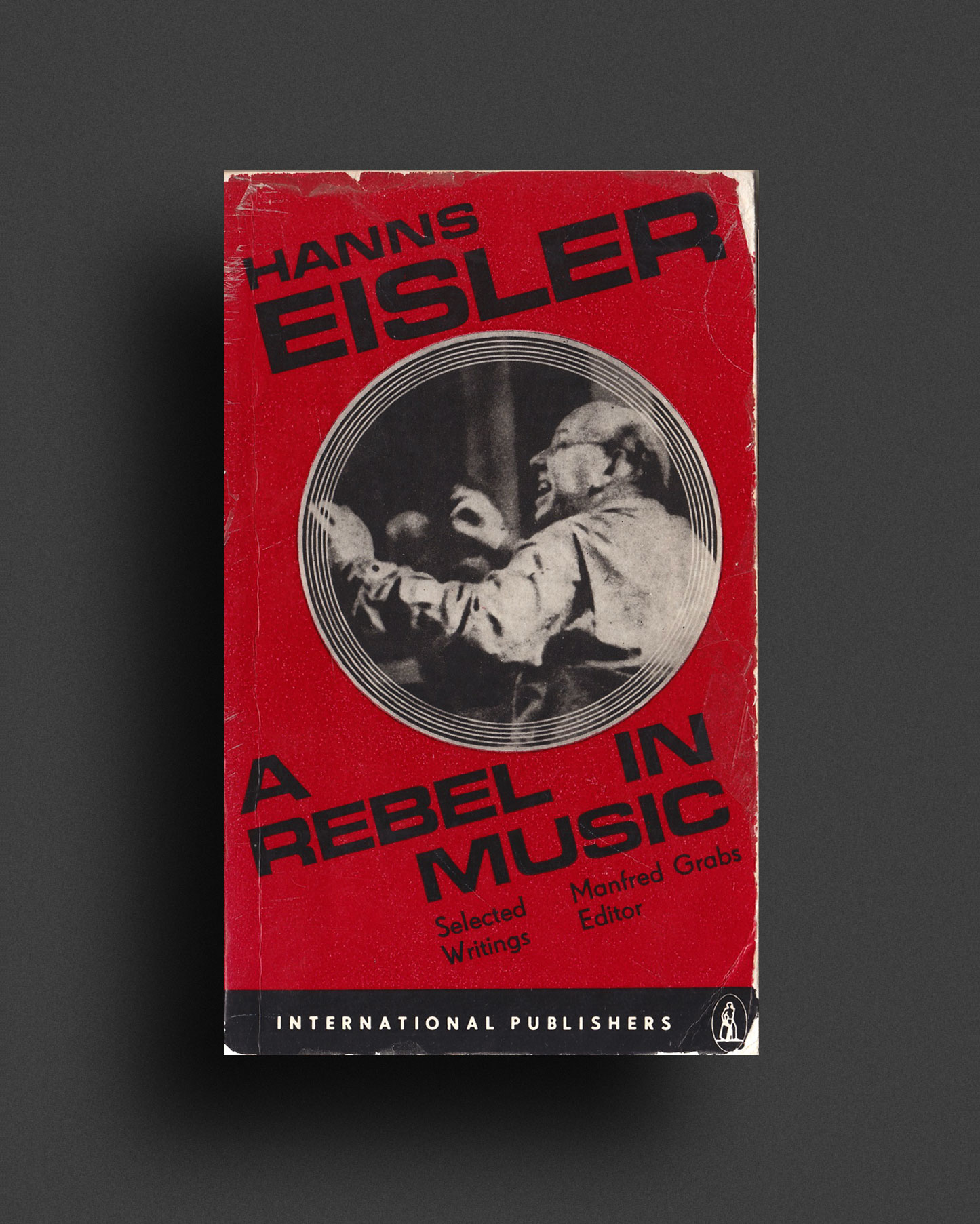
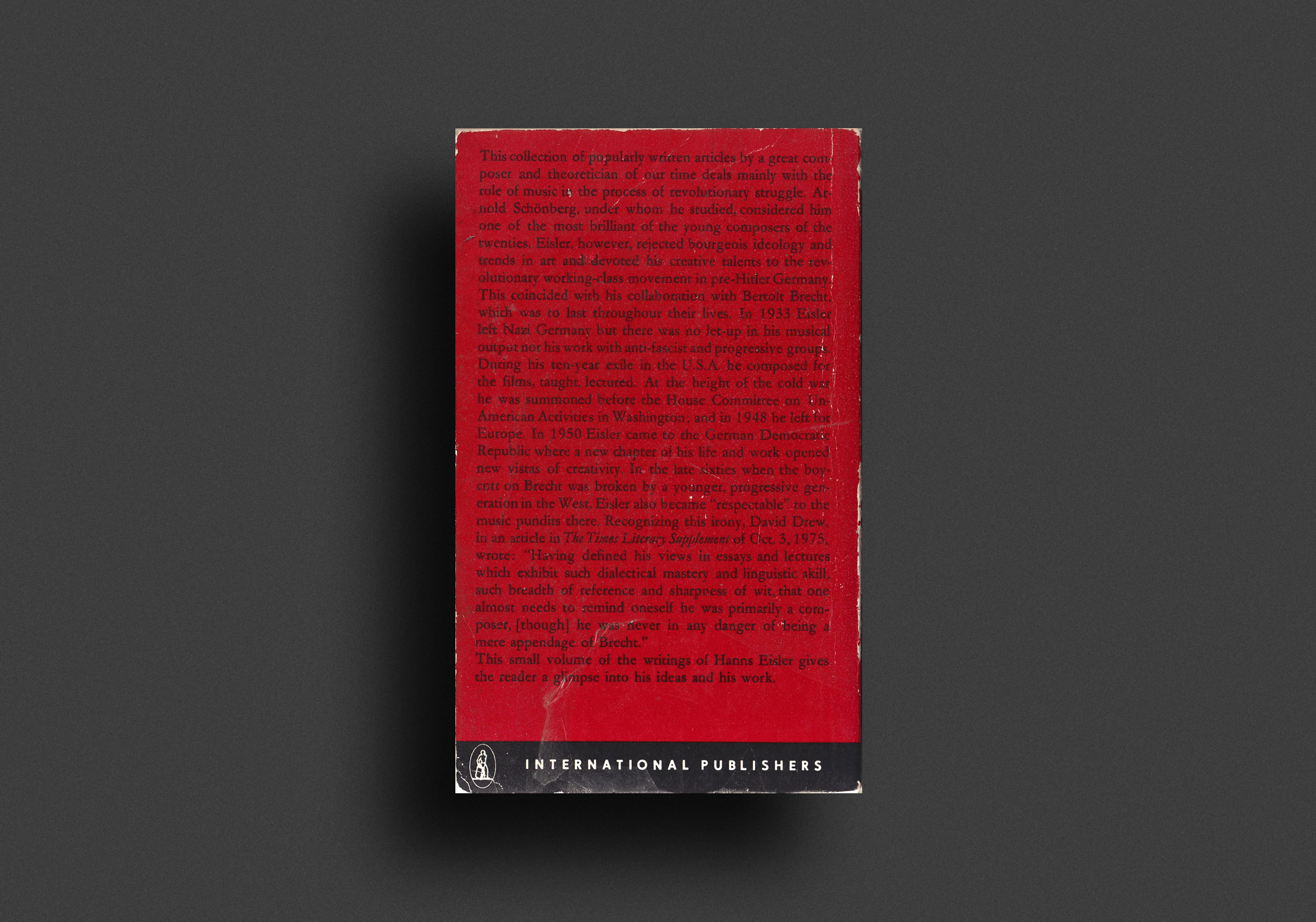
First 1978 edition of this bi–lingual collection of essays, speeches, and lectures by the German-Austrian composer Hanns Eisler (1898–1962), a student of Arnold Schoenberg, and a prominent Marxist known for his lifelong artistic collaboration with Bertolt Brecht, edited by Manfred Grabs with a preface by David Blake. Includes: On Old and New Music, Satirical Aphorisms, Progress in the Workers' Music Movement, On Schönberg, The Birth of the Worker's Song, Hollywood Seen from the Left, On Stupidity in Music, Bertolt Brecht and Music, and more.
Average–Good copy with wear to board extremities, peeling to board laminate.
2010, English
Softcover (+ audio CD), 62 pages, 19 x 13 cm
1st Edition, Out of print title / as new
Published by
Thin Man Press / London
$65.00 - Out of stock
This is the first time Aragon's seminal 1924 French surrealist text has been published in English as a single volume. Aragon's extraordinary prose-poem-essay A Wave of Dreams (Une vague de reves), is a compelling, lyrical, first-hand account of the early days of surrealist experimentation in Paris. Writing in 1924, Aragon vividly describes, and philosophically evaluates, the inner adventures, the hallucinations and encounters with the 'Marvellous' which took the young surrealists to the brink of insanity as a revolutionary new era in Art History was born. Among Aragon’s companions in derangement are André Breton (whose own Surrealist Manifesto was preceded by this book), Max Ernst, Man Ray, Antonin Artaud, Robert Desnos, Georgio de Chirico, Philippe Soupault and Benjamin Peret.
This beautifully presented art book contains Susan de Muth’s translation of the text in English with an introduction by Dawn Ades.
The physical copy of A Wave of Dreams is accompanied by a complimentary CD of eight extracts from the test, spoken by actor Alex Walker, evocatively set in musical soundscapes by Tymon Dogg and Alex Thomas.
"A leftfield treat…mysteriously opaque and strangely lovely."—Thomas H Green, Daily Telegraph.
Fine—As New.
2021, English
Softcover, 240 pages, 23.4 x 14.2 cm
Published by
Uniformbooks / Devon
$35.00 - In stock -
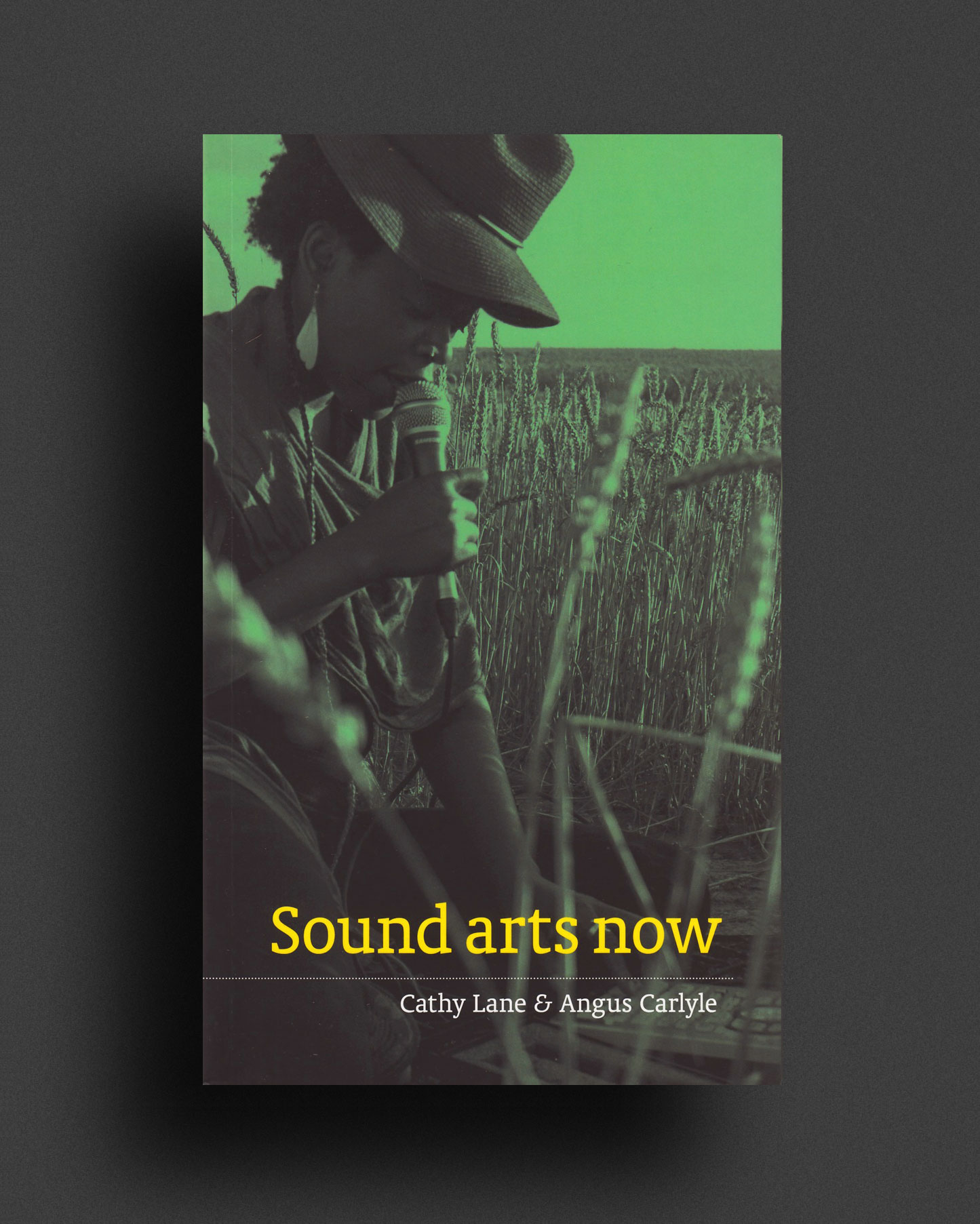
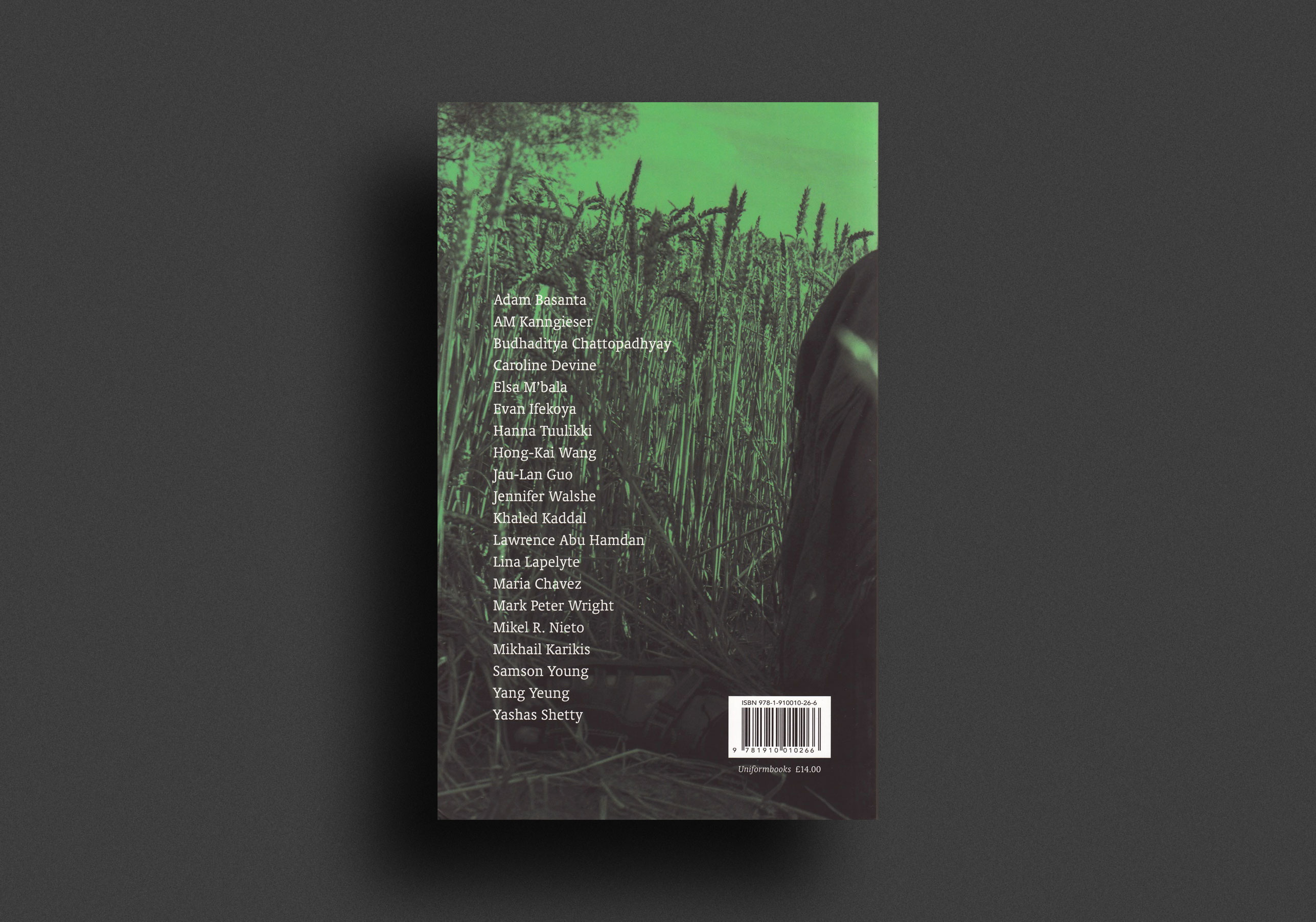
In Sound arts now, Cathy Lane and Angus Carlyle explore contemporary artistic practices and theories, and what contributes to or hinders artistic and career development. This is conducted through a series of interviews with artists and curators, putting the often-unheard voice of the maker at the centre of the discourse. While not claiming to be a definitive survey, the book broadens and destabilises what we have come to understand as sound arts, offering new and different pathways, frames of reference, and modes of thinking.
2026, English
Softcover, 80 pages, 17 x 11.5 cm
Published by
Wolke / Berlin
$35.00 - In stock -
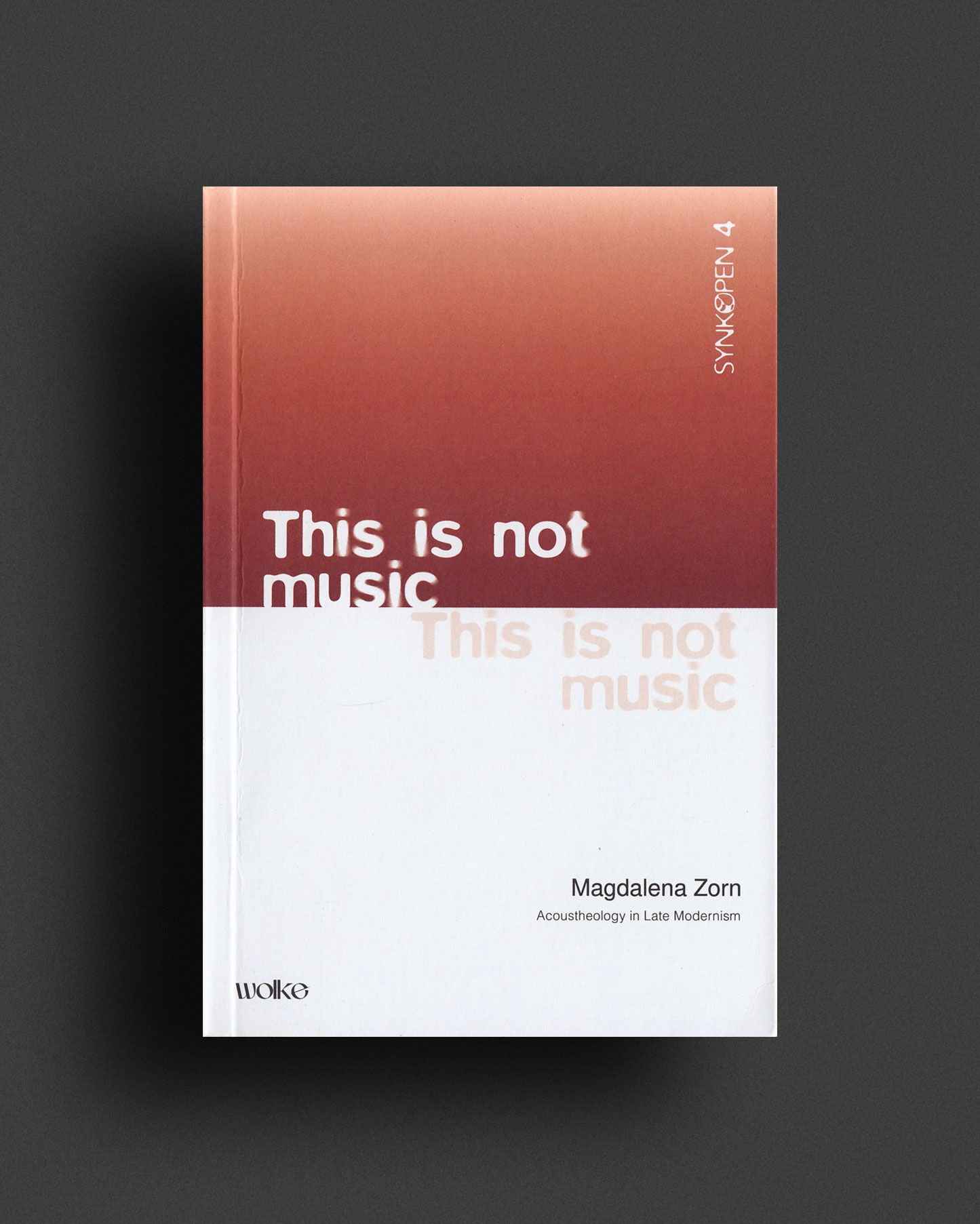
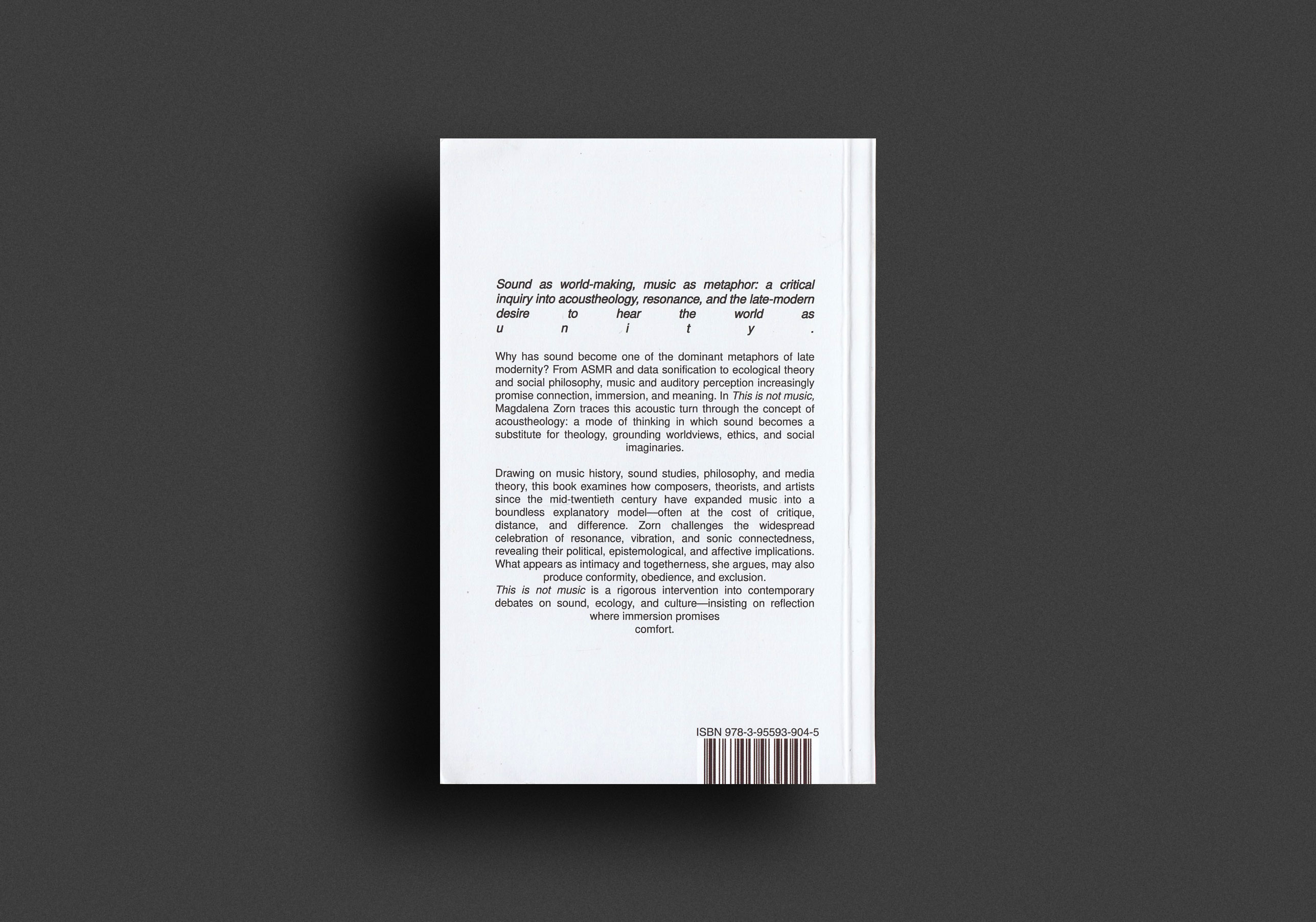
Sound as world-making, music as metaphor: a critical investigation of acoustheology, resonance and the late-modern desire to hear the world as unity.
Why has sound become one of the dominant metaphors of late modernity? From ASMR and data sonification to ecological theory and social philosophy music and auditory perception increasingly promise connection, immersion and meaning. In This is not music Magdalena Zorn traces this acoustic turn through the concept of “acoustheology”: a mode of thought in which sound becomes a substitute for theology and grounds worldviews, ethics and social imaginations.
Drawing on music history, sound studies, philosophy and media theory the book examines how composers, theorists and artists since the mid-twentieth century have expanded music into a boundless explanatory model — often at the expense of critique, distance and difference. Zorn questions the widespread celebration of resonance, vibration and sonic connectedness and reveals their political, epistemological and affective implications. What appears as intimacy and togetherness, she argues, may just as easily produce conformity, obedience and exclusion.
This is not music is a precise contribution to current debates on sound, ecology and culture – and insists on reflection where immersion promises comfort.
2025, English
Softcover + flexi–disc, 184 pages, 26 x 19.5 cm
Limited Edition,
Published by
First To Knock / Michigan
$72.00 - In stock -
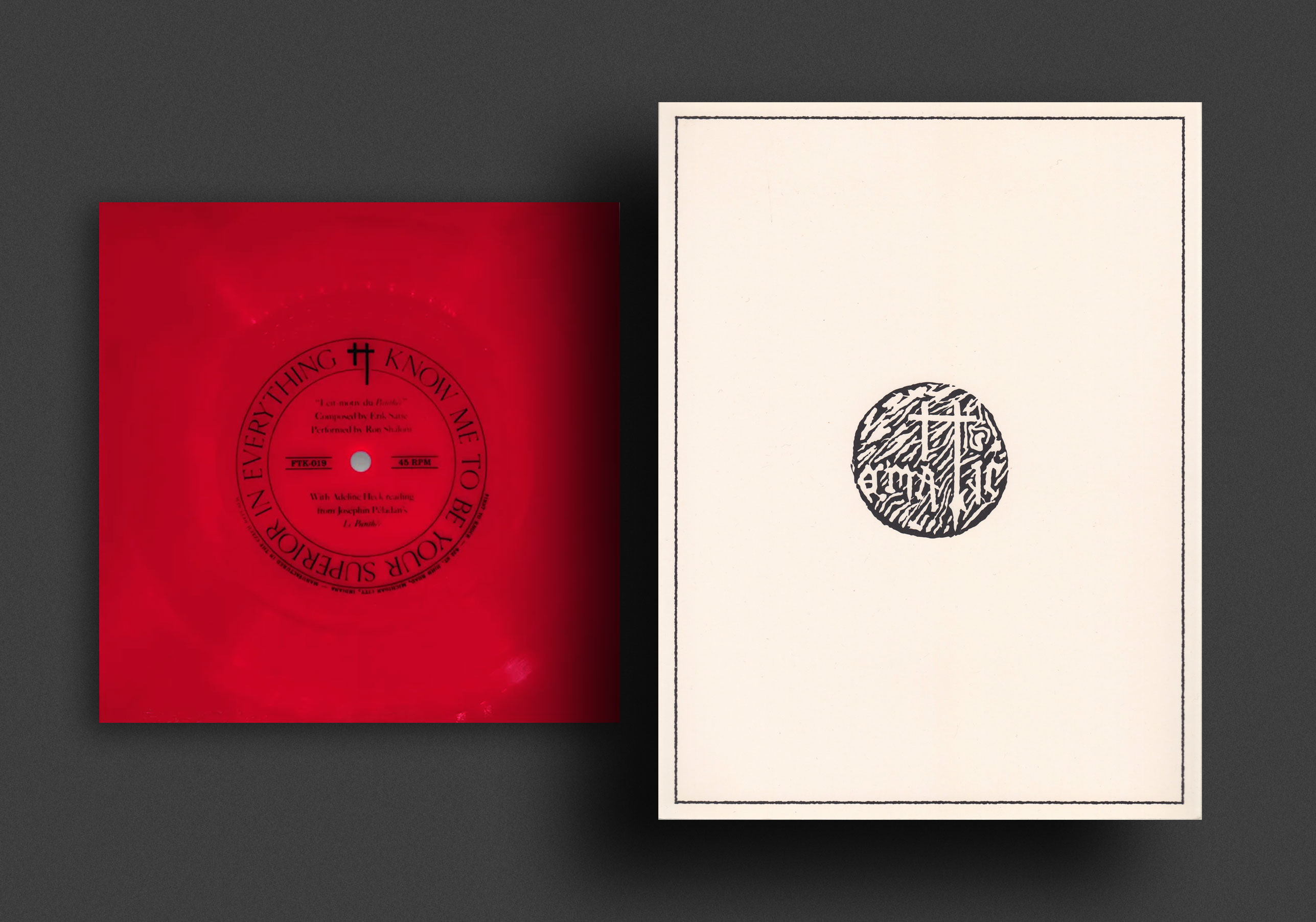
Limited-edition version with flexi-disc recording of Satie’s “Leit-motiv du Panthée” performed, as intended, as an accompaniment to a reading of Joséphin Péladan’s Le Panthée.
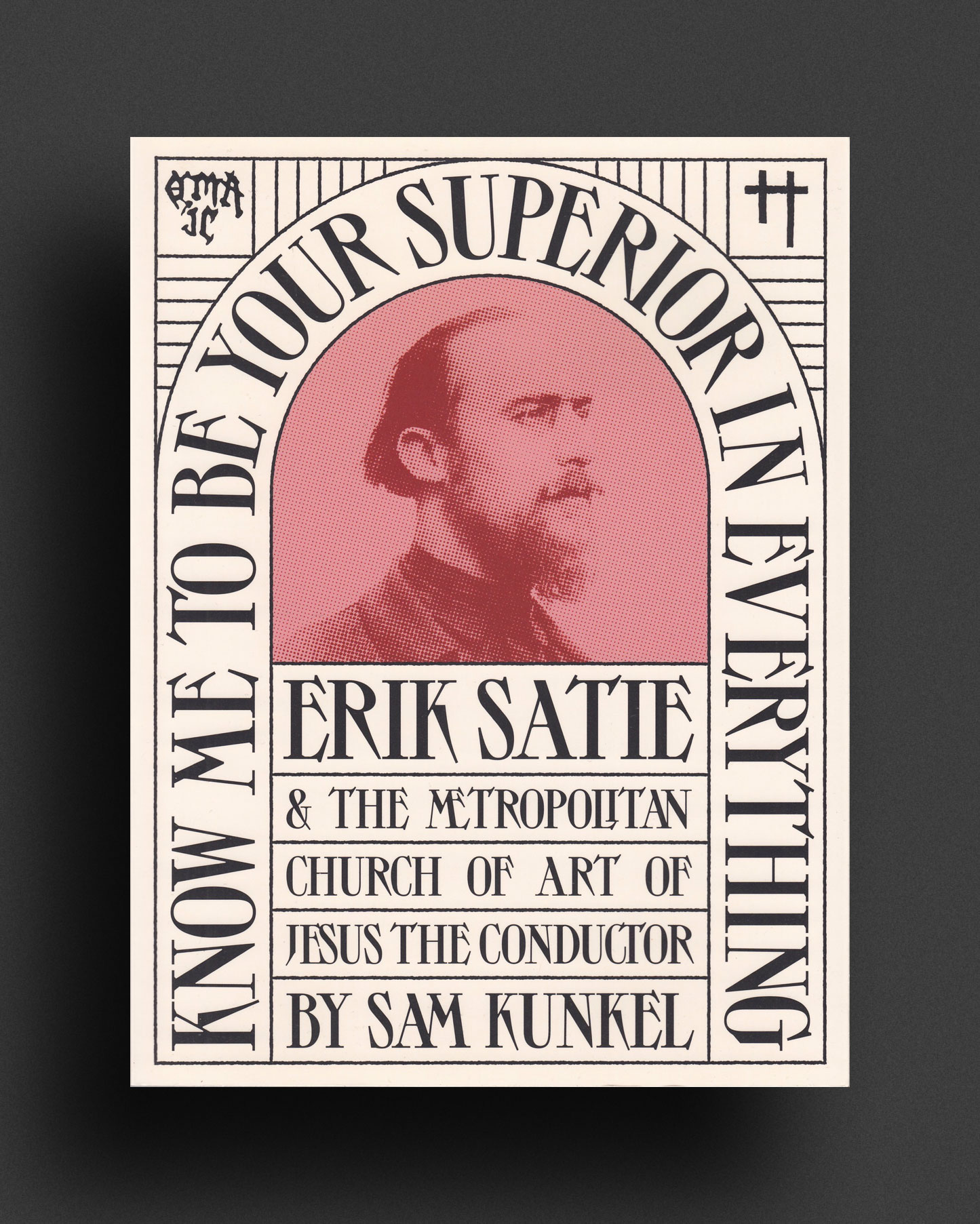
In 1892, Erik Satie was at a crossroads. Despite having already composed some of the finest works ever written for piano, the 26-year-old was still penniless and unappreciated. His artistic ethos—a paradoxical mix of reactionary Medievalism and avant-garde absurdism—could find no quarter in fin-de-siècle Paris. And so, with his musical aspirations dashed and nowhere left to turn, Satie would turn to himself.
His subsequent revolt was as shocking as it was incomprehensible to his contemporaries. Satie announced himself to be “the Parcener,” the head of a new religious order. It was, in fact, a church of his own founding—The Metropolitan Church of Art of Jesus the Conductor.
Transforming his dilapidated apartment into an “Abbatial Church,” Satie began issuing scathing letters to prominent cultural figures who had sought to render judgment upon his Art. Targets of the Parcener’s screeds ranged from the cape-clad mystagogue, Joséphin Péladan, to the pompous composer, Camille Saint-Saëns; from the novelist Octave Mirbeau, who had dared to lampoon the Parcener, to the theatre director Aurélien Lugné-Poe, whose unintentionally nude stage production had offended the Parcener’s moral sensibilities. The fiercest feud was reserved for music critic Henry Gauthier-Villars, whom the Parcener battled in the press for years, until the spat culminated in a physical altercation at a concert. Throughout the 1890s, luminaries, such as these, found themselves excommunicated from a church to which they had not even known they once belonged.
Inscrutable as the author himself, Satie’s writings from this brief period strike a tone that lies somewhere between fervent Catholicism, anarchistic satire, and the righteous rage of the true Artist—leaving readers befuddled as to the composer’s true intent. Yet, despite the impenetrability of his writings, the Parcener’s missives took the Parisian art scene by storm and, as Satie’s crusade grew in intensity, so too did his reputation, making this era as historically crucial as it is bewildering. Nevertheless, the Metropolitan Church was ultimately a solitary undertaking. Despite certain documents indicating that the Church expected to have more than a billion members, history would show that its congregation never grew beyond one: Erik Satie himself.
Know Me To Be Your Superior in Everything is the first book dedicated exclusively to the story of Erik Satie’s Metropolitan Church of Art of Jesus the Conductor. Drawing upon a multitude of firsthand sources—including documents held in the Erik Satie archives in Caen—the book includes new English translations of all known Church publications and correspondence by Satie as the Parcener. Facsimilic translations of Satie’s Church publications are reproduced herein as well, capturing, for the first time in English, the design and typography of the original productions.
Know Me To Be Your Superior in Everything was written by Sam Kunkel, a scholar of 19th century Symbolist literature. Previous to this book, Kunkel has also provided translations for Echoes of a Natural World—Tales of the Strange & Estranged (First To Knock, 2020); A Beam of Sunlight in the Deep Forest—Mystical Prose Works by Édouard Schuré (First To Knock, 2021); as well as The Solar Circus by Gustave Kahn (First To Knock, 2022). Kunkel has also written extensively in French, covering topics such as Joséphin Péladan and religion in fin-de-siècle Paris. His critical reedition of Péladan’s notorious novel, Istar, was published by Éditions du Lérot in 2024, and his book, L’Orphisme et le roman post-romantique, a comparative study of the mystical novel, was released by Éditions Otrante in 2023.
Design by Bryan Cipolla
1974 / 1997, English / Korean
Softcover, 23.7 x 20.5 cm
Out of print title / used / very good
Published by
Everson Museum of Art / Syracuse
$70.00 - In stock -
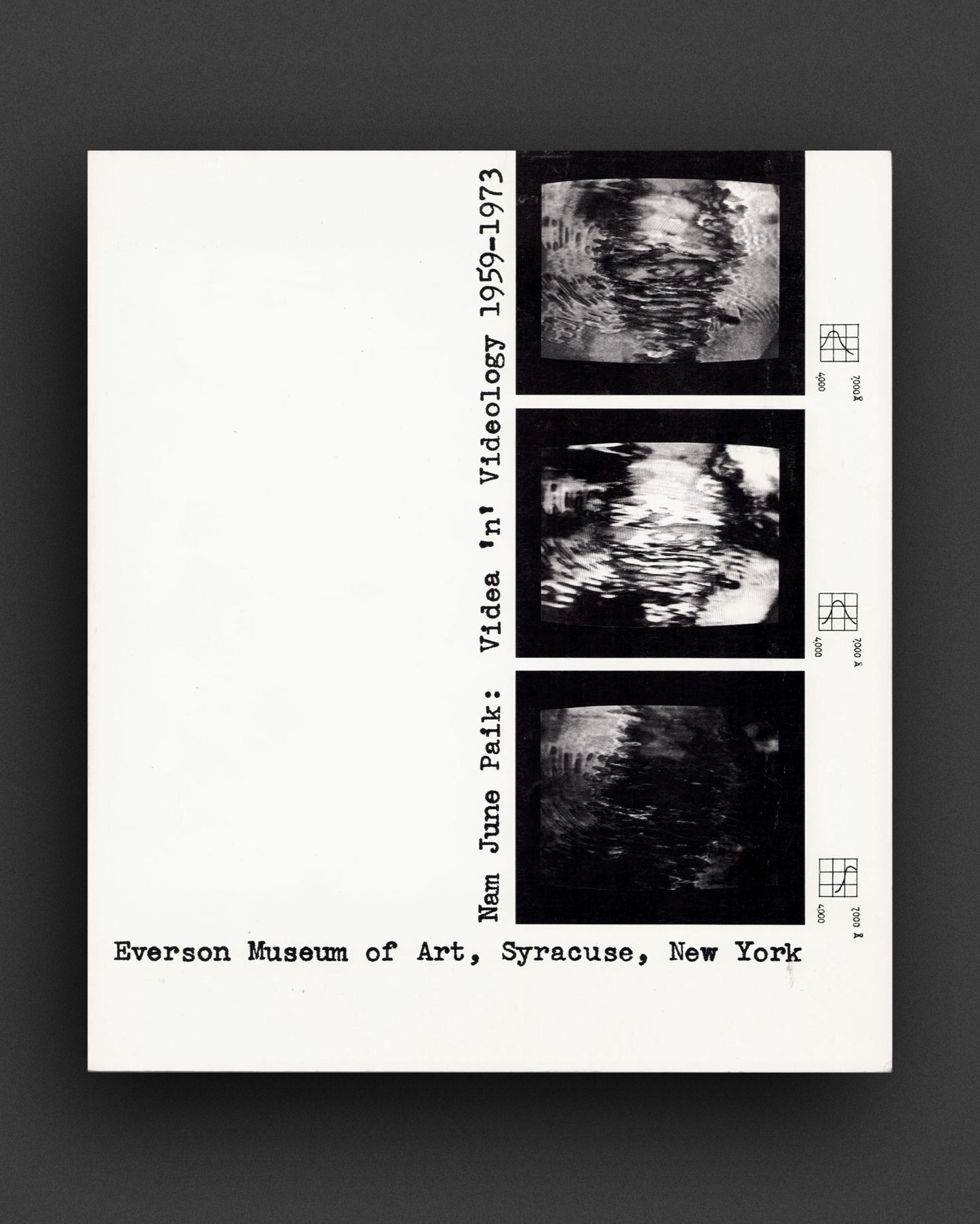
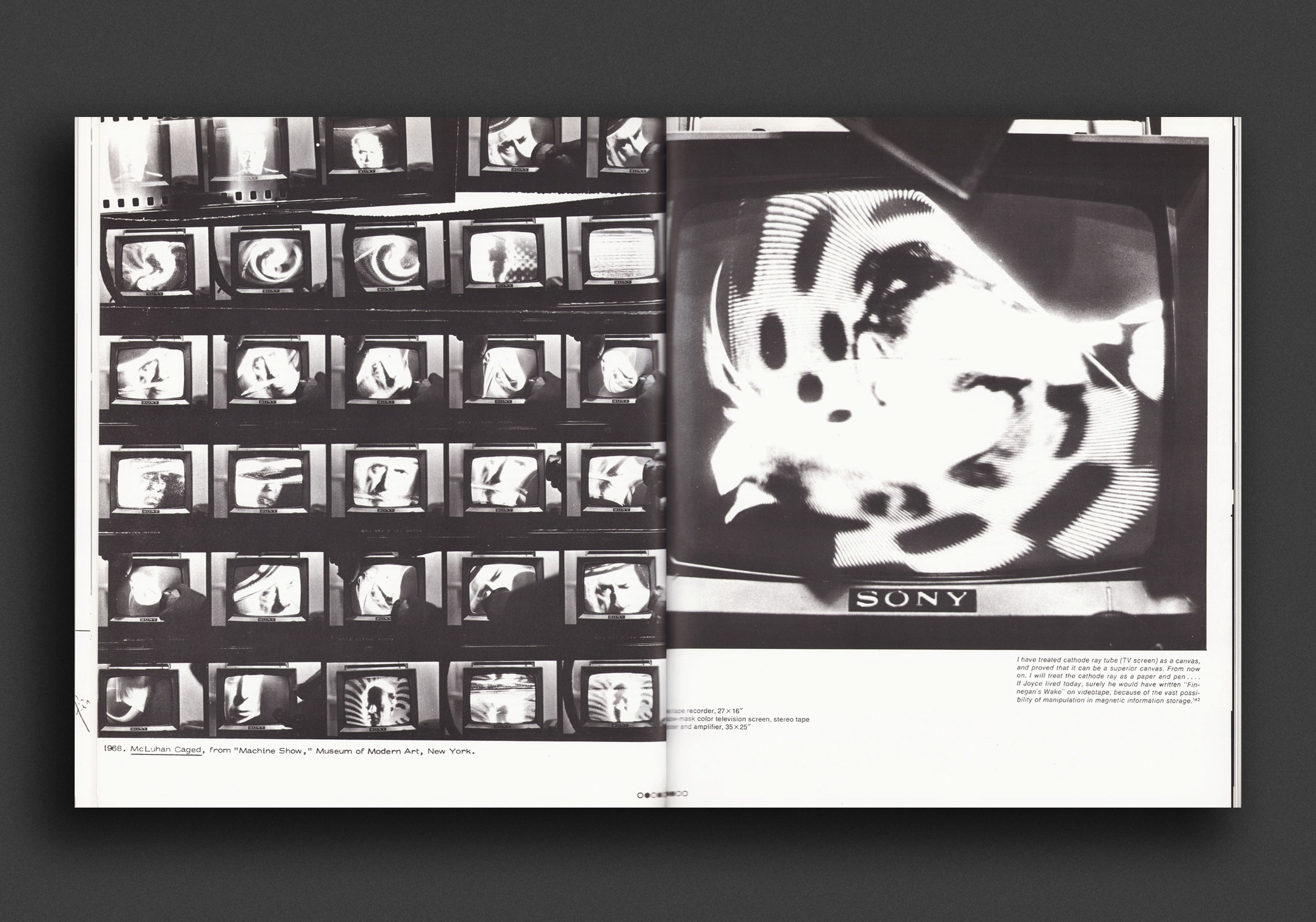
Special limited edition 1997 over–sized re–print of this landmark 1974 exhibition catalogue and artist book by the "father of video art", Nam June Paik, published in conjunction with exhibitions at the Everson Museum of Art, Syracuse and Galeria Bonino, Ltd., New York, January, 1974. Features black-and-white reproductions of Paik's early television/video documentation, reprints of his letters, notes, and essays (some in Korean), a brief biography, a bibliography, and an exhibition chronology. Foreword by James Harithas. Edited by Judson Rosebush, photographs by Peter Moore and Robert A. Lorenz, design by David Hicock.
This print of Video 'n' Videology is an exact enlargement of the original, co-sponsored by Mr. Yang S. Kim, Eat and Drink/Space Untitled, New York, and has been printed in 1997 by Tova Press in New York.
Nam June Paik (1932–2006, South Korea) was one of the most influential artists of the twentieth century. As a pioneer of technology-based art, Paik has created a large body of work comprising performances, single-channel moving image works, video sculptures, and installations. Known for his experimental, collaborative, and interdisciplinary practice, he was a key member of the Fluxus movement and a visionary thinker who predicted the future of art making and communication in the internet age.
VG copy.
2021, English
Softcover (staple–bound), 16 pages, 14 x 14 cm
Published by
No Label / Aotearoa New Zealand
Witchhammer Press / Aotearoa New Zealand
$10.00 - In stock -
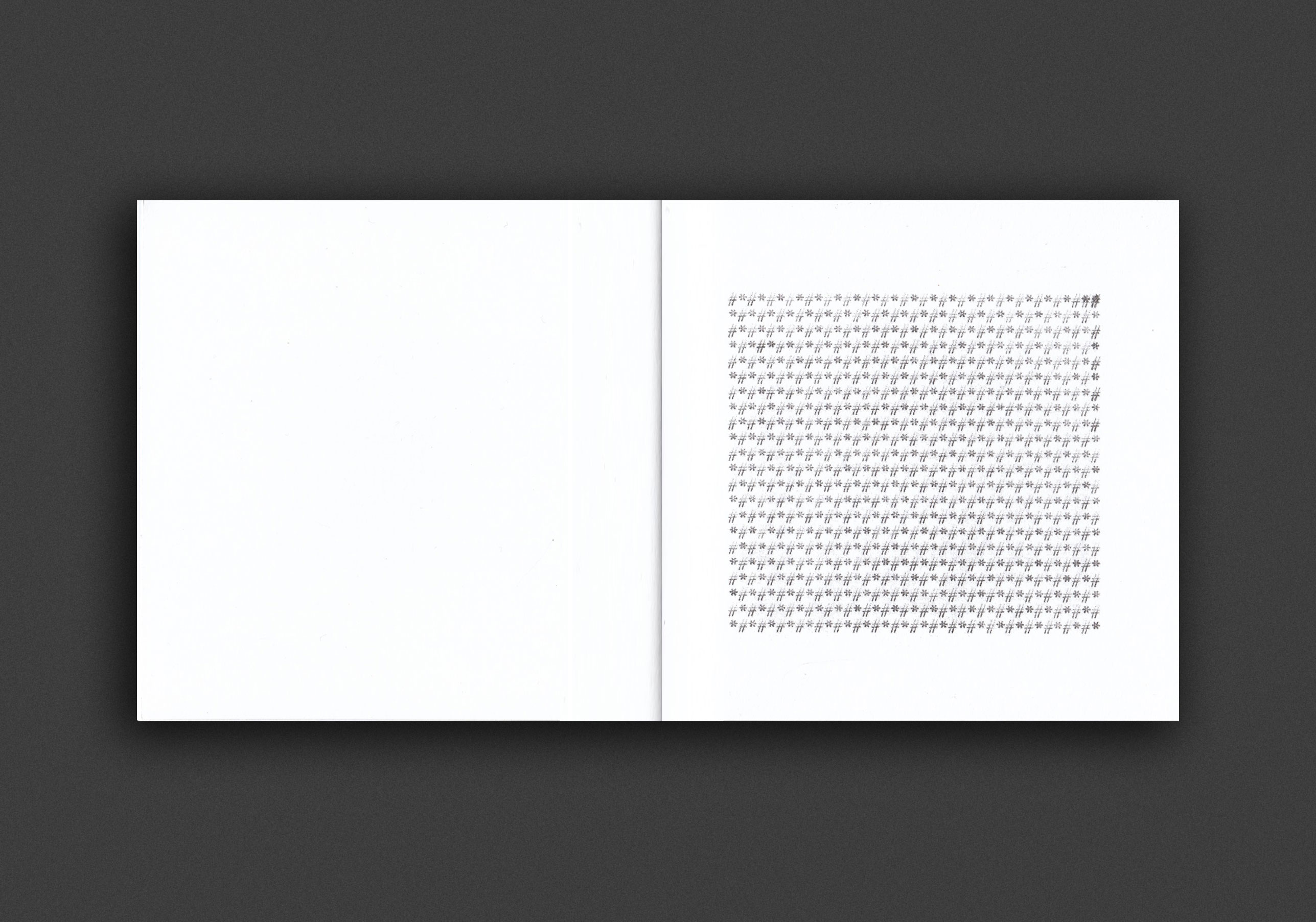
A book of conrete poetry by John Krausbauer.
John Krausbauer is an American composer/musician, artist, writer, refusenik. He has performed his musics and presented his A/V works in a myriad of venues throughout North America, Europe, Japan, and New Zealand. Numerous recordings of his music have been released in the last 25 years by an array of international labels in solo, duo, and group contexts. Recent music collaborators include — Tetuzi Akiyama, Alan Licht, Patrick Shiroishi, R Keenan Lawler, and Kaori Suzuki. His first writings (Art End Times' Art of End Times) were recently published by Witchhammer Press (NZ) + Carbon Records (US).
2018, English
Hardcover, 192 pages, 24 x 19.5 cm
1st Edition, Out of print title / used / very good
Published by
Spector Books / Leipzig
$50.00 - Out of stock
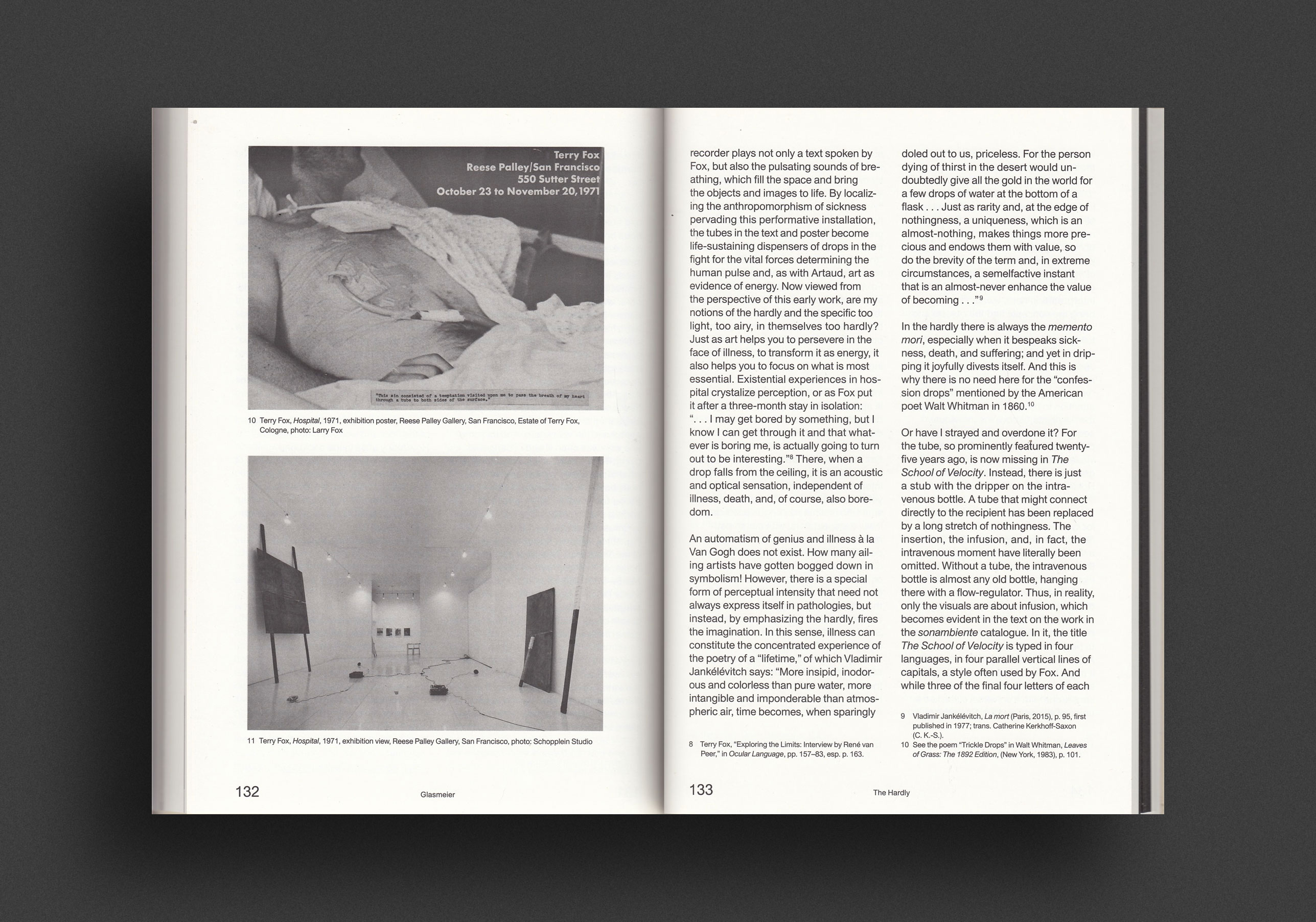
The retrospective Terry Fox: Elemental Gestures, which opened at the Berlin Academy of the Arts in 2015 before being shown in Mons, Wuppertal, and the Kunstmuseum Bern in 2017, clearly demonstrated Fox’s key role in the development of art since the 1970s. It not only revealed him as a pioneer of performance, video art, and sound installation but also presented his experimental exploration of language and space. A symposium held in conjunction with the Bern exhibition adopted a variety of approaches to reflect on the performances and installations of this European American based in Switzerland. This is the starting point for the publication in which scholars, artists, and close associates seek to define more precisely the often silent “situations” at work between object and word, sound and sculpture, labyrinth and experience, body and action. Thanks to Spector Books (Leipzig).
Out–of–print, NF copy.
2003, English / German
Hardcover (w. CD), 120 pages, 24.5 x 21 cm
1st Edition, Out of print title / used / fine
Published by
Kehrer Verlag / Heidelberg
$60.00 - In stock -
"Works with Sound" presents a complex body of work, comprising thirty years of sculptures, drawings, environments, and performances. Fox, who since the 1960s radically rejected traditional art forms and sought new ways of artistic expression, has been increasingly concerned with investigating the seldom-observed energetic aspects of materials. Hence, sound gained a central significance in his works. The artist is dedicated to finding sounds that make energies palpable and connect the listener and his physical surroundings. Profusely illustrated rich chronology of all works with sound, including extensive biography and accompanying texts by Terry Fox and contributions by Matthias Osterwold and Eva Schmidt. Edited by Bernd Schulz. Bi-lingual English and German texts.
Accompanied by an audio CD with excerpts from six sound performances since 1975.
NF copy with unplayed CD.
Signed dedication to historian and sound theorist Douglas Kahn, from the book's author Matthias Osterwold, a prominent German curator and artistic director who shared a long-standing creative relationship with Terry Fox (1943–2008).
2025, English
Softcover (staple bound), unpaginated, 19.5 x 14.2 cm
Ed. of 40, signed,
Published by
No Label / Aotearoa New Zealand
Witchhammer Press / Aotearoa New Zealand
$14.00 - In stock -
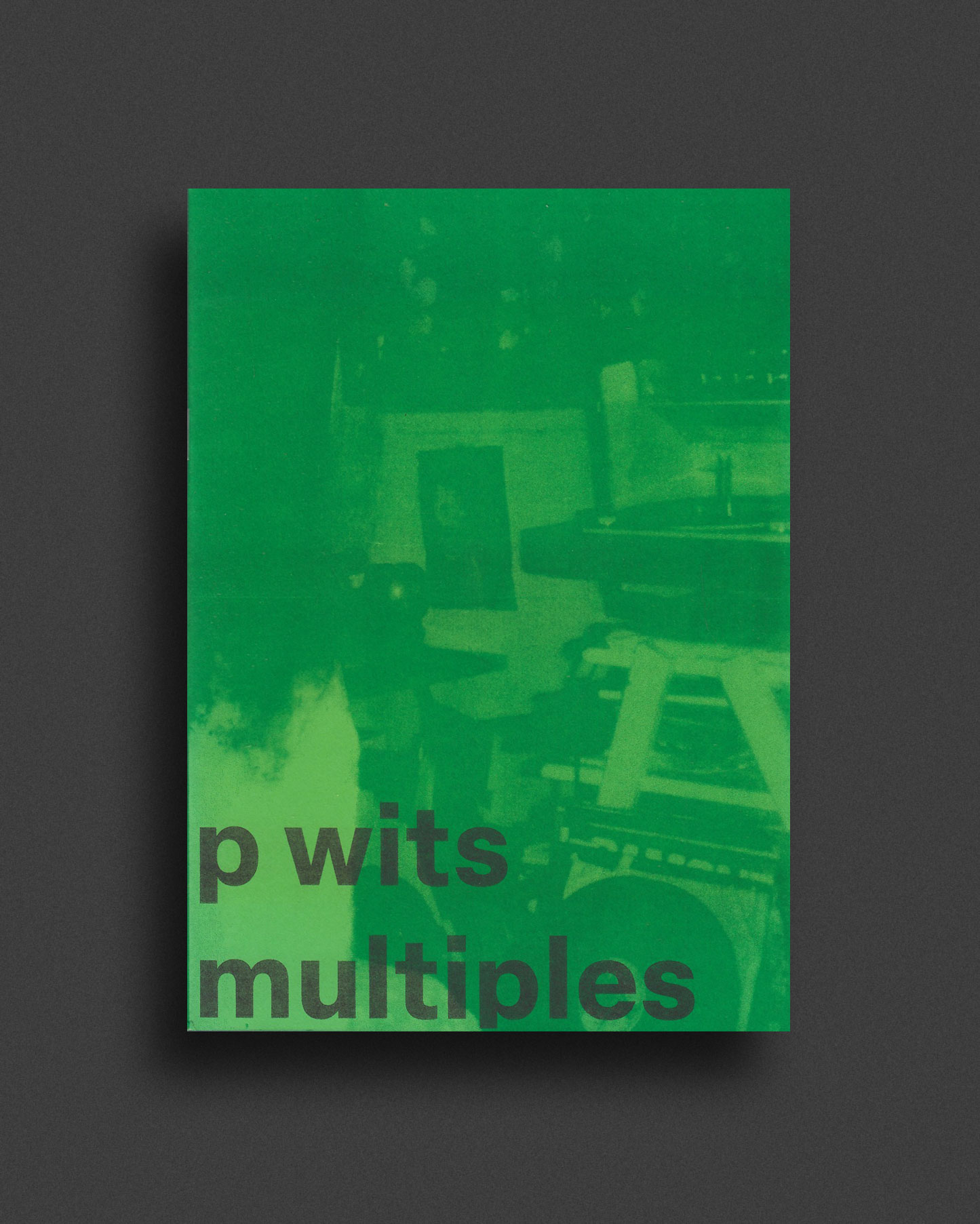
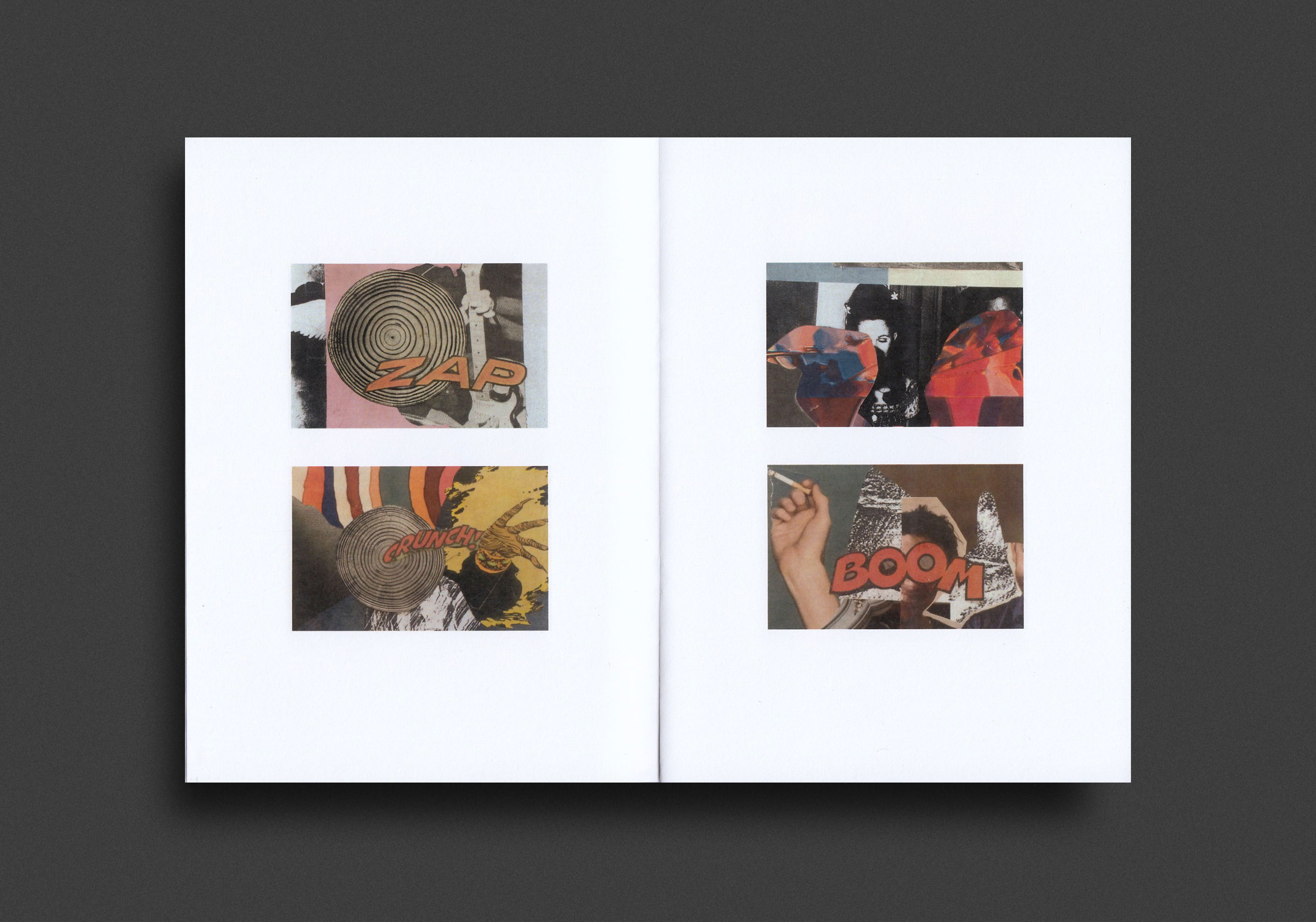
Multiples is a zine collection of collages produced for limited run lathe cuts by New Zealand artist P Wits. Published in an edition of 40 signed and numbered copies, 2 colour Riso cover, full colour interiors, by No Label/Witchhammer Press, New Zealand.
2021, English
Softcover (staple–bound), unpaginated, 20.5 x 14.5 cm
Ed. of 53 hand numbered copies.,
Published by
No Label / Aotearoa New Zealand
Witchhammer Press / Aotearoa New Zealand
$28.00 - In stock -
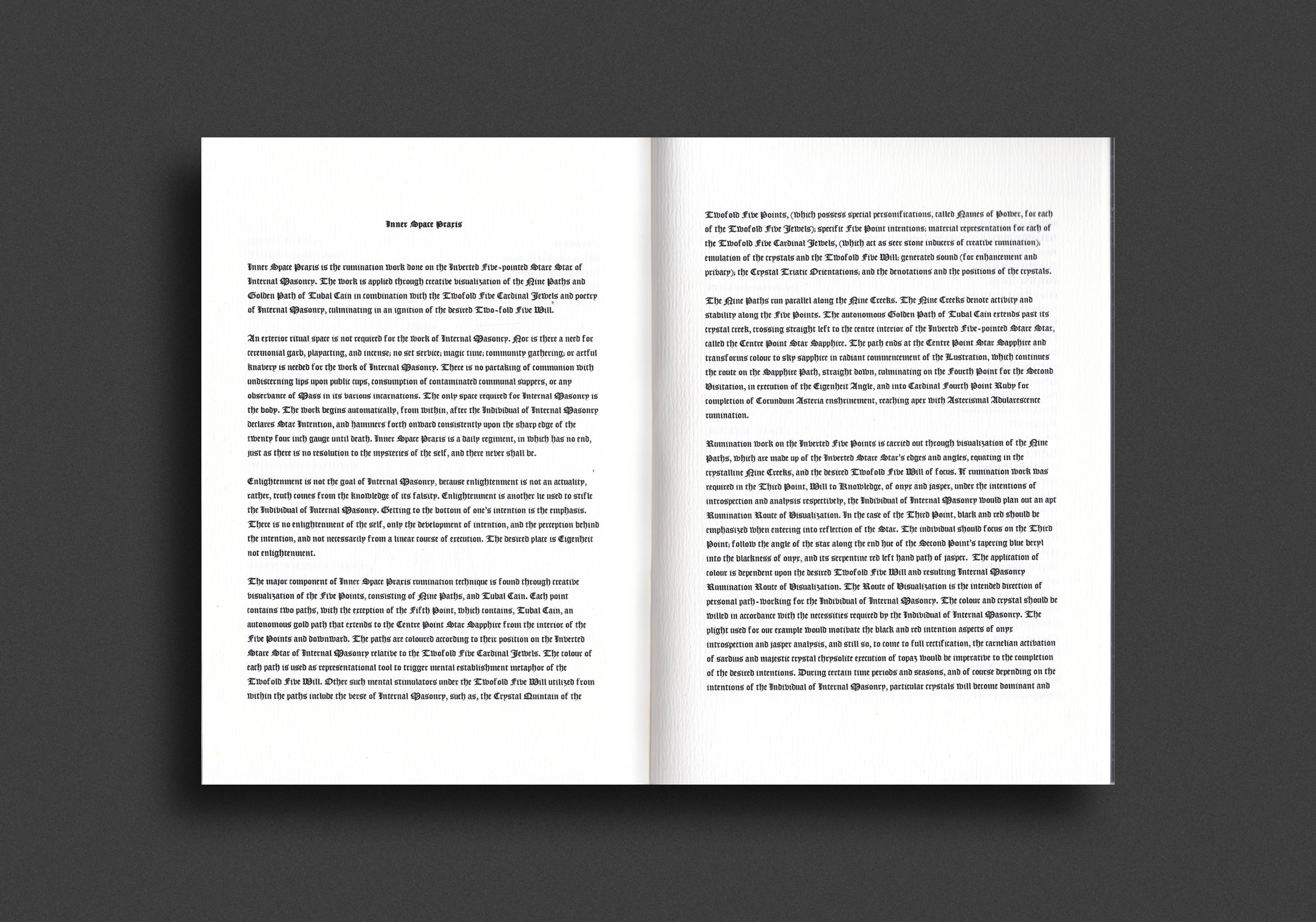
Goat’s Foot Lever is a tract on the craft of witching by Sean Campbell published by No Label/Witchhammer Press, New Zealand.
The grimoire displays systemic explanation into the teachings and practices of Internal Masonry, along with psycho-poetical-libidinal observations of fetishistic occurrences within the bible and other similar cultural esoterica.
In 2010 Sean Campbell completed a master’s degree in Religious Studies/Philosophy at the University of Regina in Canada. His MA thesis was included in a publication titled, Tubal Cain, put out in limited edition by The Matthew Barney Studio. He then penned, “Myrrh’s Clarion Call”, a poetical essay contributed to the playbill for the production of “BA”, a filmed performance by Matthew Barney and Jonathan Bepler; published 2014 by Skira Rizzoli Publications, Inc., New York, as an insert in the monograph for River of Fundament. Campbell is also the creator of acclaimed musical projects Wold and Black Mecha. He resides in Providence, Rhode Island.
Edition of 53 numbered copies with foil embossed card covers.
2004, English
Softcover, 144 pages, 23.5 x 20.5 cm
1st Edition, Out of print title / used / very good
Published by
Guggenheim Museum / New York
Hatje Cantz / Berlin
$25.00 - In stock -
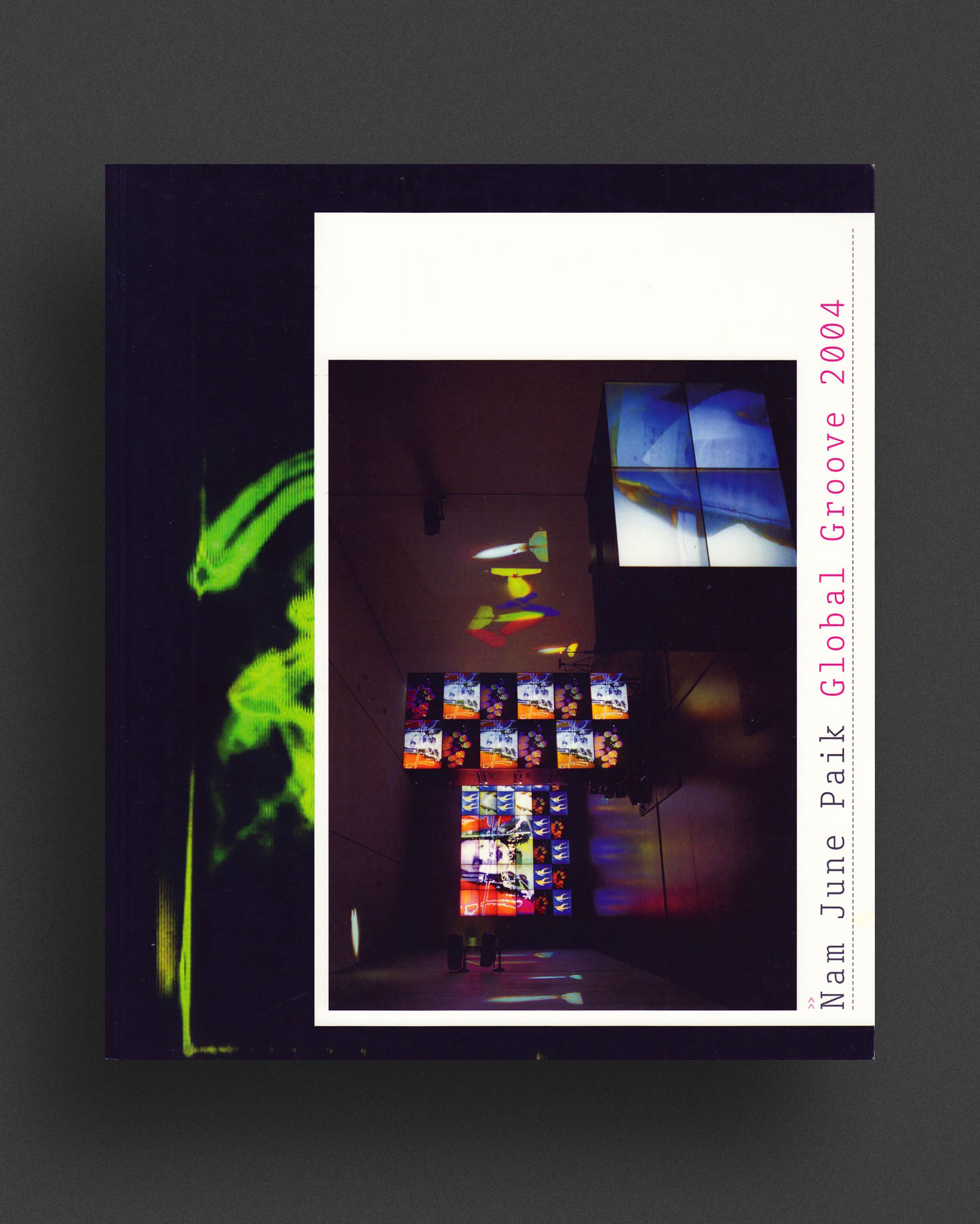
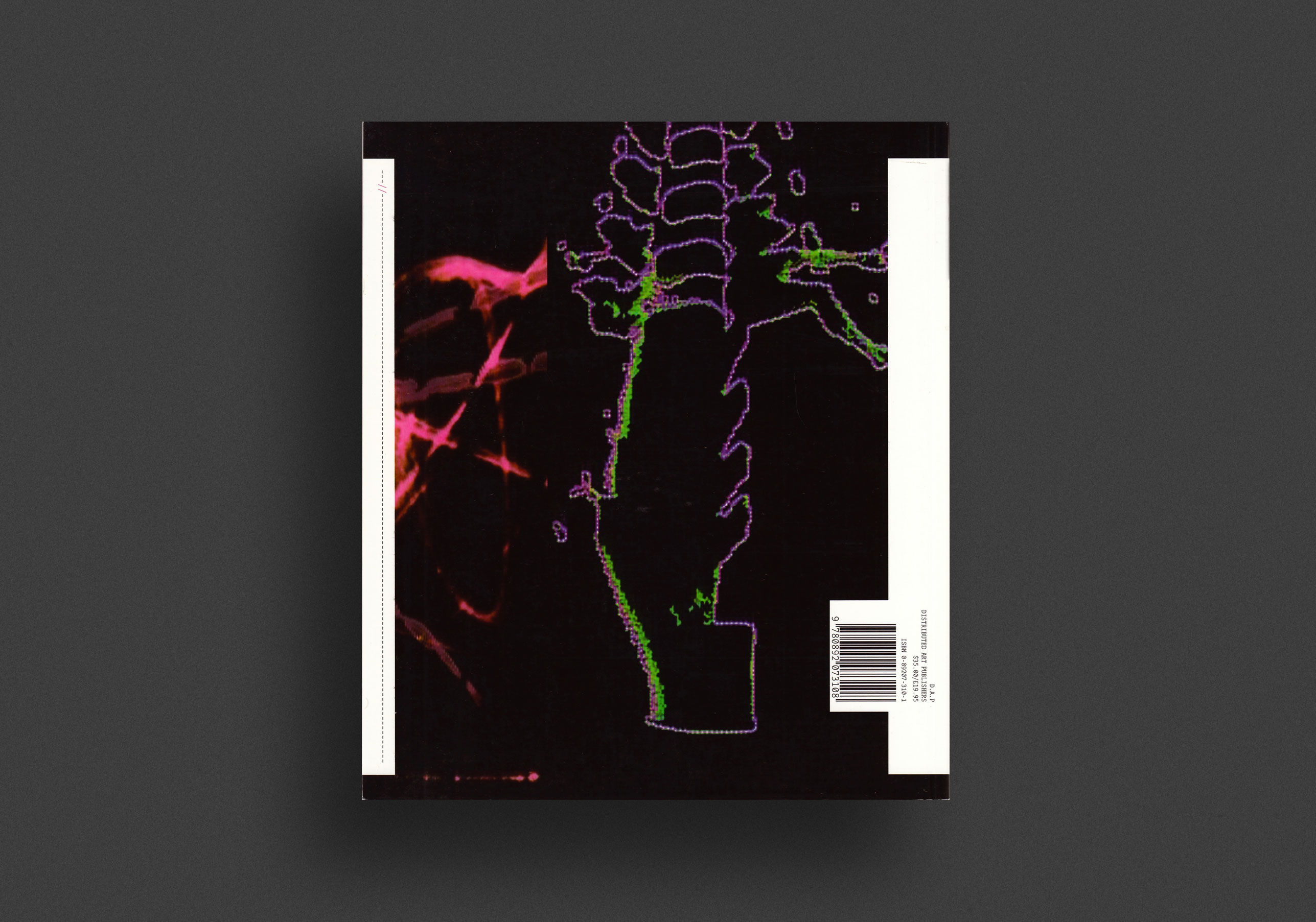
This catalogue combines the publication accompanying the 30th anniversary of Nam June Paik's Global Groove with a re–print of his foundational collection Videa 'n' Videology 1959 – 1973, first published in 1974. Organized by John G. Hanhardt and Caitlin Jones, profusely illustrated with texts in German, English, and Korean.
In 1974, WNET-Channel 13 in New York City broadcast Nam June Paik's Global Groove, a whirlwind, multi-media piece and one of the most influential works of video art. The program took a wide look at culture and transformed the WNET broadcast studio into an experimental venue for dancers, musicians, and performance artists. Weaved into Global Groove were films and videotapes by other artists, interviews and voiceovers, pop music, appropriated commercials, and broadcast breaks.
In celebration of the 30th anniversary of the broadcast, Global Groove 2004 celebrates Paik's work on and for television, documenting and interpreting his key television projects. The included essays survey and interpret the distinctive contribution Paik made to remaking video and television into an artist's medium, and examine Paik's historical importance and relevance to new developments in internet art. In-depth analysis and photo essays reveal the range of Paik's transformation of video, including his experiments in the 1960s with the Paik-Abe video synthesizer; his seminal videotapes for broadcast: Global Groove, Suite 212, Guadalcanal Requiem, Lake Placid 80, Living with the Living Theater; and his global television productions: Good Morning, Mr. Orwell, Bye Bye Kipling, Wrap Around the World. Additionally, a selection of the artist's seminal writings on the future of television is featured.
VG with light wear to extremities.
1985, Dutch
Softcover (fold–out), 27 x 17.5 cm (folded); 27 x 87.5 (unfolded)
1st Edition, Out of print title / used / good
Published by
Het Apollohuis / Eindhoven
$25.00 - In stock -
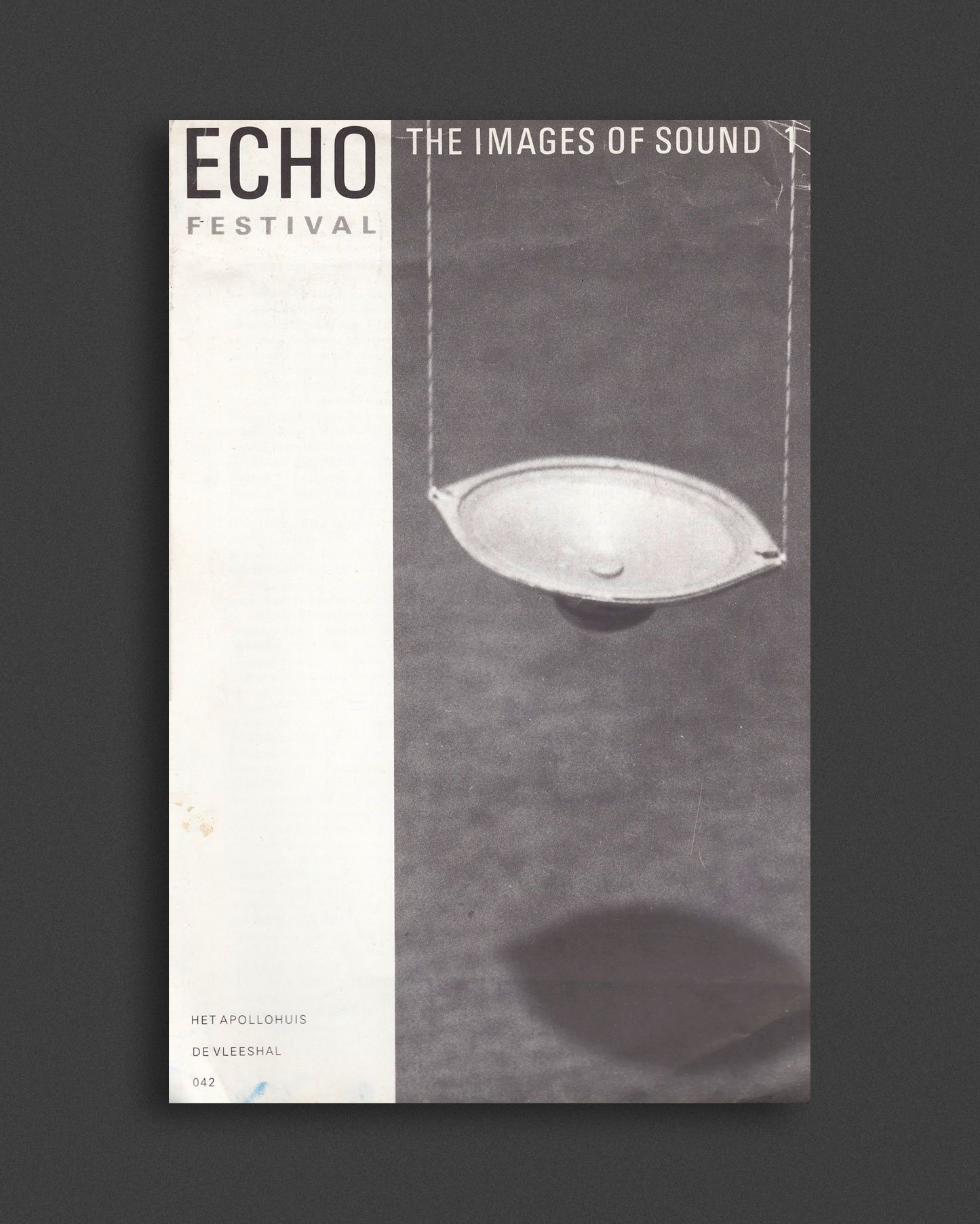
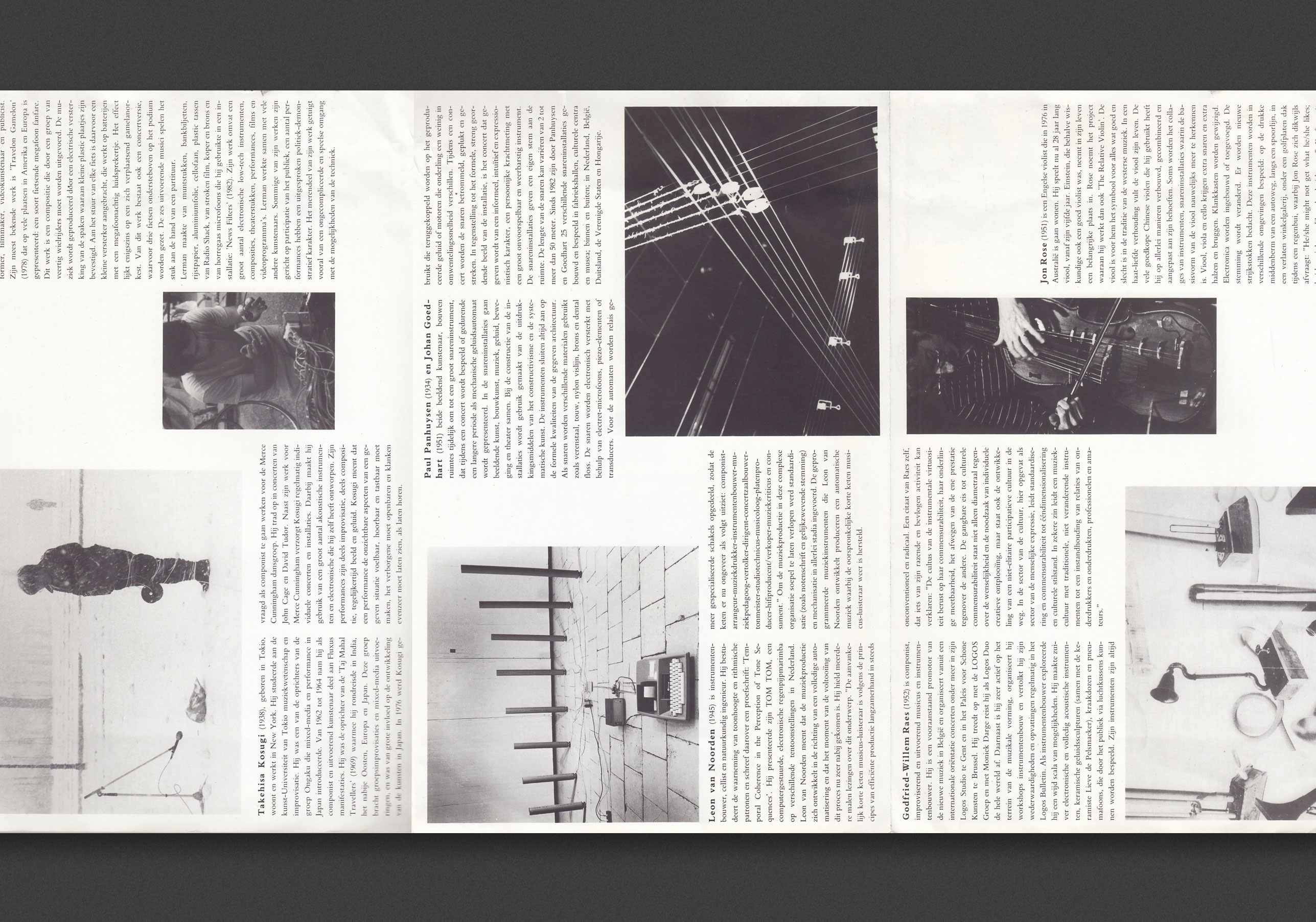
Very rare 1985 fold–out exhibition guide/programme published in conjunction with Echo : The Images of Sound 1, held November 22—January 6, 1985. A complete guide to all of the concerts and installations, illustrated throughout with profiles of all the artists, and accompanying text by Paul Panhuysen. Artists featured: Julius, Ellen Fullman, HUM, Max Eastley, Takehisa Kosugi, Hugh Davies, Godfried-Willem Reas, STEIM, The Simulated Wood, VANDALIA, Arnold Dreyblatt, Richard Lerman, Leon van Noorden, Paul Panhuysen, Johan Goedhart, Hans-Karsten Raecke, Jon Rose and George Smits.
"From November 1984 until January 1985 a group was held in Het Apollohuis, Eindhoven of works that combined image and sound. Installations, concerts and a symposium were organised around the exhibition, featuring artists who use sound in their work and composers who use visual aspects."
Good copy, light general wear, some creasing. Folded as issued.
27 x 17.5 cm (folded); 27 x 87.5 (unfolded)
1987, English
Softcover, 144 pages, 21 x 20 cm
1st Edition, Out of print title / used / very good
Published by
Het Apollohuis / Eindhoven
$80.00 - Out of stock
Rare 1987 exhibition catalogue published in conjunction with show held November 22—January 6, 1985. Illustrated throughout with texts by Paul Panhuysen, Ellen Fullman, Godfried-Willem Raes, Anton van Gemert, Bart Lootsma, Arnold Dreyblatt, Leon van Noorden, George Smits, and Hugh Davies. Artists include Max Eastly, Takeisha Kosugi, Walter Marchetti, Ellen Fullman, Godfried-Willem Raes, Horst Rickels, Rik van Lersel, Giancarlo Cardini, Juan Hidalgo, Jon Rose, and others. Includes selected bibliography, discography, and index.
blurb: "From November 1984 until January 1985 a group was held in Het Apollohuis, Eindhoven of works that combined image and sound. Installations, concerts and a symposium were organised around the exhibition, featuring artists who use sound in their work and composers who use visual aspects. In addition to a photographic report of this festival 'ECHO. The images of Sound I', this book contains a general survey of the development of sound arts and cassettes that have been published in the field of sound art. This section is written by Hugh Davies. Photographs, scores, drawings of articles describing the development of their own work are supplied by Julius, Ellen Fullman, HUM, Max Eastley, Takehisa Kosugi, Hugh Davies, Godfried-Willem Reas, STEIM, The Simulated Wood, VANDALIA, Arnold Dreyblatt, Richard Lerman, Leon van Noorden, Paul Panhuysen, Johan Goedhart, Hans-Karsten Raecke, Jon Rose and George Smits.[...]"
Very Good—Near Fine copy
1980, Japanese
Softcover, 112 pages, 25.5 x 18.5 cm
1st Edition, Out of print title / used / very good
Published by
Fool's Mate / Tokyo
$50.00 - In stock -
Rare early issue of the world's finest "Euro Rock Magazine", Fool's Mate, from Japan. Fool's Mate Vol. 13 August 1980. In the 1970's—1980's, Fool's Mate (named after the 1971 Peter Hammill LP), edited by Masashi Kitamura with regular contributions by Masami Akita (Merzbow) and many other heads, was a vital conduit between emerging and metamorphosing avant-garde music cultures in Europe (Progressive Rock, Art Rock, Free Music, Electronic, Cosmic, Psychedelic Folk, Avant Pop, Rock in Opposition, Post Punk, Industrial, etc.) and Japan. No doubt responsible for the resonance of experimental contemporary music there during that period through to today, each issue of Fool's Mate during these early years was packed cover-to-cover with exclusive interviews with the artists, rare photographs and graphics, thematic genre/artist/label/artistic movement features, in-depth profiles/discographies/family-trees, catalogues, lyrics, letters, collage art, record, book, and live reviews, columns and an endless stream of concert and import/record store/label/venue/cafe adverts, all presented in a perfectly obsessive fanzine aesthetic manner, cut 'n' pasted across many paper stocks. The Americas and other realms, including new directions in Japanese alternative music, are all covered alongside their European counterparts, with many issues exploring key artistic and theoretical influences, such as Symbolism, Dadaism, Surrealism, Eros, Futurism, etc.
This issue "La Pop Metaphysique" with cover feature on the history of King Crimson (Part 1) with in-depth chronology, the history of German Rock Music part 1 (Amon Düül I and II, Gila, Kluster, Neu!, Harmonia, Conrad Schnizler, Klaus Schulze, Tangerine Dream, Can, Sky Records, Roedelius, Moebius, etc), "Pop Music for all the Schizoid-Human & Schizoid-Ages" (Suicide, James Chance, Monochrome Set, etc.), Slapp Happy/Peter Blegvad/Kew Rhone/Amateur/Henry Cow/Faust, "The Real Story of National Health", "U.S.A. Free Music" (L.A.F.M.S., Trans Museq, Henry Kaiser, etc.), Georges Bataille, Gunjogacrayon, Metabolist, David Bowie, Etron Fou Leloublan, Mario Millo, PFM, Ralph Lundsten, Memoriance, and much more. Highly recommended to any fan of such things.
Very Good copy. General wear/age. Price–dropped due to one LP cover cut out of review section.
2003, English / German
Softcover, 64 pages, 29 x 25 cm
1st Edition, Out of print title / used / good
Published by
Fridericianum / Kassel
$65.00 - In stock -
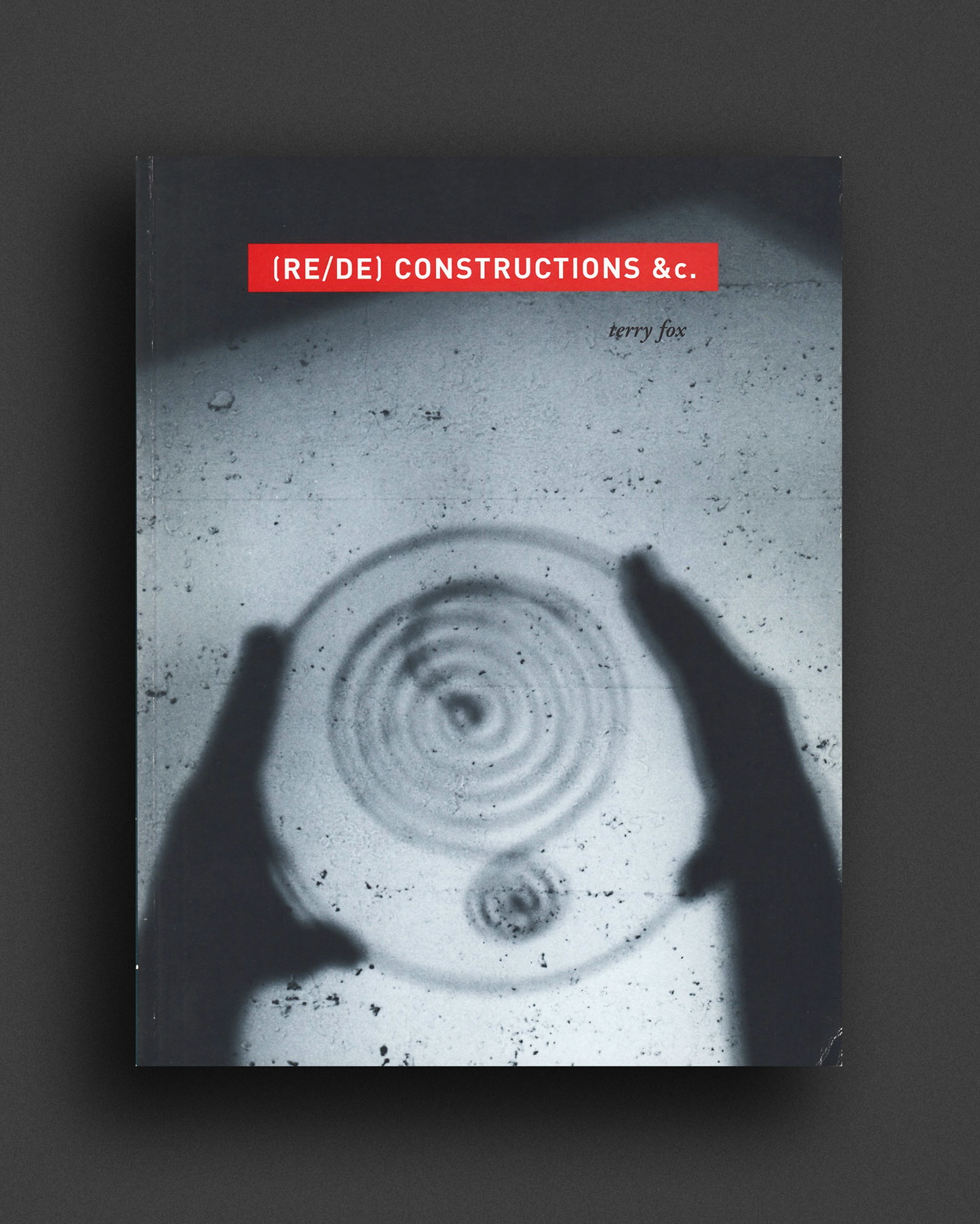
"(RE/DE) CONSTRUCTIONS &c." was a major exhibition by the American conceptual, Fluxus, and sound artist Terry Fox (1943 – 2008), May 31–July 13, 2003, at the Kunsthalle Fridericianum in Kassel, Germany. This profusely illustrated, comprehensive exhibition catalogue accompanied the show, with contributions by Ulli Seegers and Nikola Dietrich, foreword by Rene Block. Bi–lingual German and English texts. A figure in the conceptual and performance art movements, Fox's work frequently integrated bodily experiences, political actions, and intricate multi-layered audio environments. (RE/DE) CONSTRUCTIONS &c. highlighted his ongoing thematic preoccupations with restructuring spaces, transforming materials, and analyzing sounds. This was an important late survey of the artist's work.
Terry Alan Fox (1943 – 2008) was an American conceptual and fluxus artist known for his work in performance art, video art and sculpture. He was one of the first generation conceptual artists and was a central participant in West Coast conceptual art movements and fluxus in the 1960s and 1970s. More than 120 performances - the first of which took place in Germany in 1970 at the invitation and with the assistance of Joseph Beuys - and numerous museum exhibitions have made him internationally known, especially in museum and artistic circles. He was represented three times at documenta in Kassel. Fox was active in the San Francisco Bay Area and Europe, living and working in Liège, Belgium in the later part of his life.
G–VG copy, some wear to extremities.
2011, English
Softcover, 169 pages, 25.5 x 18 cm
1st Edition, Out of print title / used / very good
Published by
PAJ Communications / New York
$65.00 - In stock -
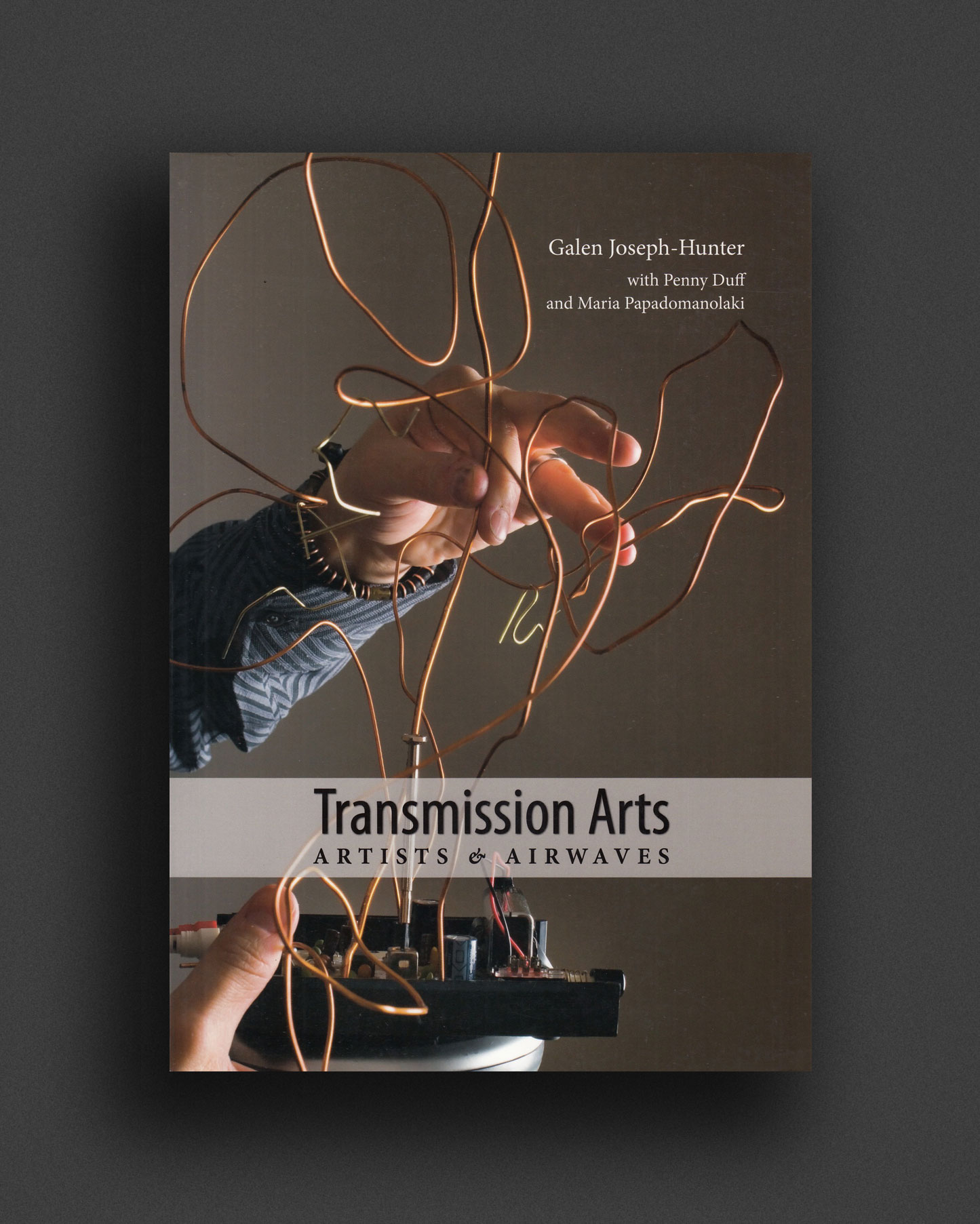
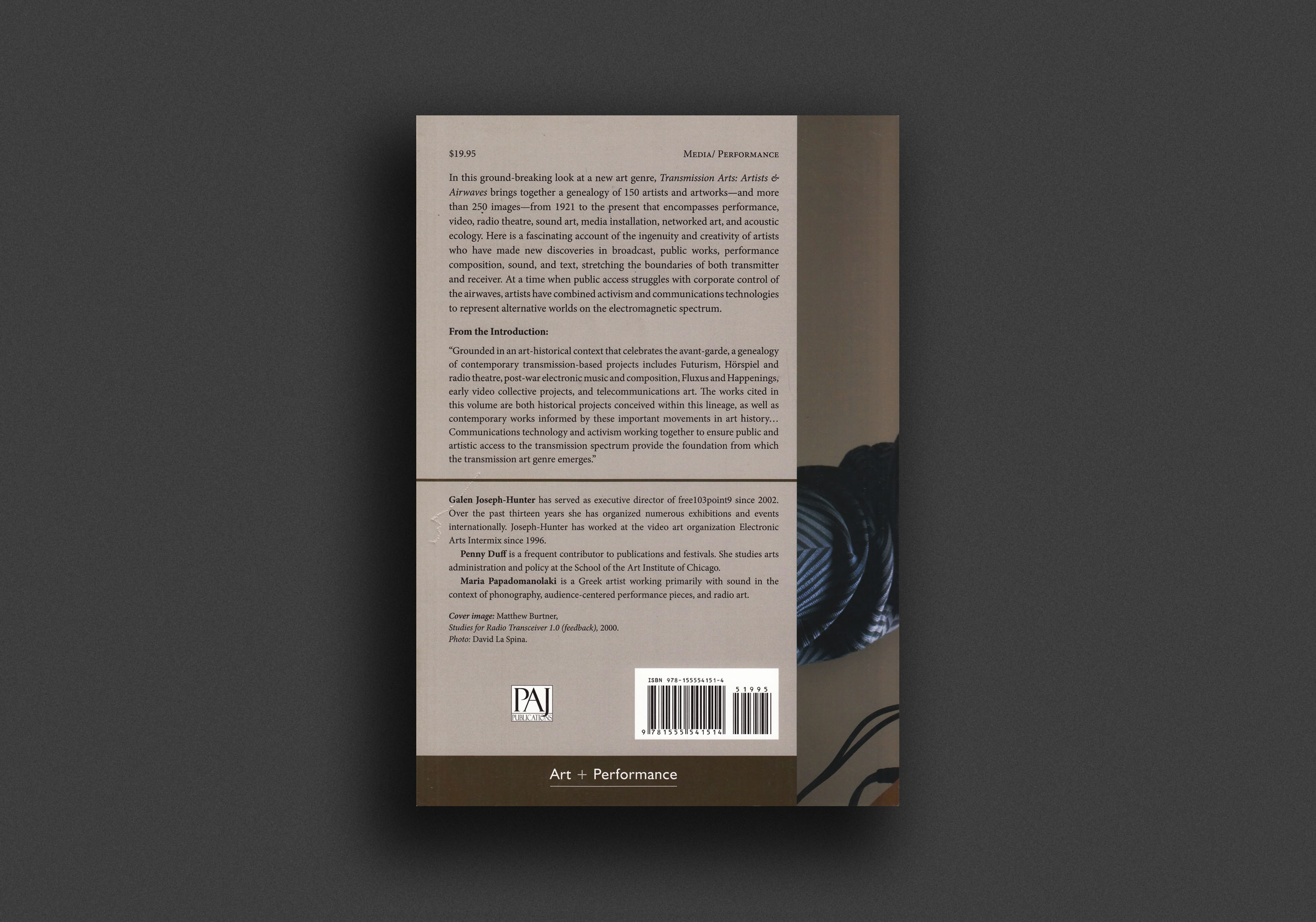
In this ground-breaking look at a new art genre, Transmission Arts: Artists and Airwaves brings together a genealogy of 150 artists and artworks—and more than 250 images—from 1921 to the present that encompasses performance, video, radio theatre, sound art, media installation, networked art, and acoustic ecology. Here is a fascinating account of the ingenuity and creativity of artists who have made new discoveries in broadcast, public works, performance composition, sound, and text, stretching the boundaries of both transmitter and receiver. At a time when public access struggles with corporate control of the airwaves, artists have combined activism and communications technologies to represent alternative worlds on the electromagnetic spectrum.
Artists featured include Walter Benjamin, Antonin Artaud, Delia Derbyshire, John Cage, Allan Kaprow, Maryanne Amacher, Ray Johnson, Scanner, Videofreex, Valie Export, William Basinski, Marshall McLuhan, Bertolt Brecht, Pierre Schaefer, Negativland, Antoni Muntadas, László Moholy-Nagy, Otto Piene, Robert Whitman, Hildegard Westerkamp, Wolf Vostell, Orson Welles, Brandon LaBelle, Tetsuo Kogawa, Max Neuhaus, Keith Sonnier, Ezra Pound, Nam June Paik, Lucio Fontana, Alison Knowles, Chris Burden, Jean Tinguely, Rirkrit Tiravanija, Filippo Tommaso Marinetti, Karlheinz Stockhausen, and many more.
Very Good copy.
2000, English
Softcover, 250 pages, 17.15 x 24.13 cm
1st Edition, Out of print title / used / very good
Published by
Granary Books / New York
$40.00 - In stock -
First edition of this out-of-print volume of Alison Knowles collage journal spanning 30 years.
Once upon a time [composer] Jim Tenney and I went walking in the woods. We came to a clearing and there under a tree was an arrangement of toy locomotives in the middle of nowhere. Pausing, we mused, where were they going, where had they been?
Attempting to write just such an imaginative history of her own life, and its comings and goings, New York artist Alison Knowles has compiled Footnotes—a collection of collage pages made from small, red travel books collected over 30 years, then pasted up and redrawn, in no definite or logical order. The settings of these collages range from Germany to Japan (but always coming back to New York), with a loosely woven context provided by jotted-down ideas and overheard conversations between her friends. These delicate pencil drawings convey a sense of time lost and regained, displacement and reorientation, of the scattered nature of our interior lives.
Alison Knowles (b. 1933) is an American visual artist and a founding member of the Fluxus movement, internationally known for her installations, performances, soundworks, and publications.
Very Good copy with light tanning to edges of book block.
1995 / 1999, English
Softcover, 272 pages, 24.5 x 17 cm
1st Edition, Out of print title / used / very good
Published by
Creation Books / London
$80.00 - In stock -
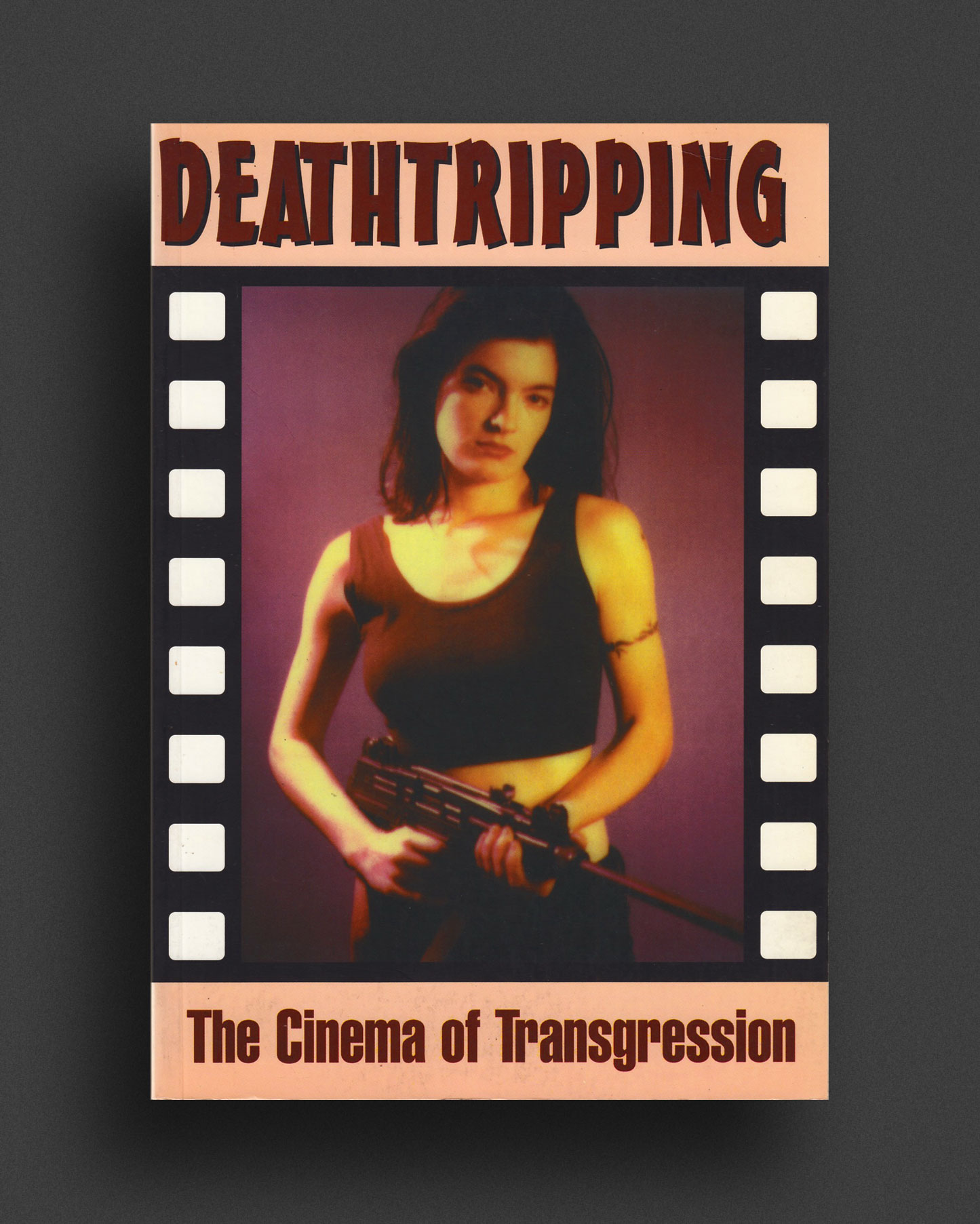
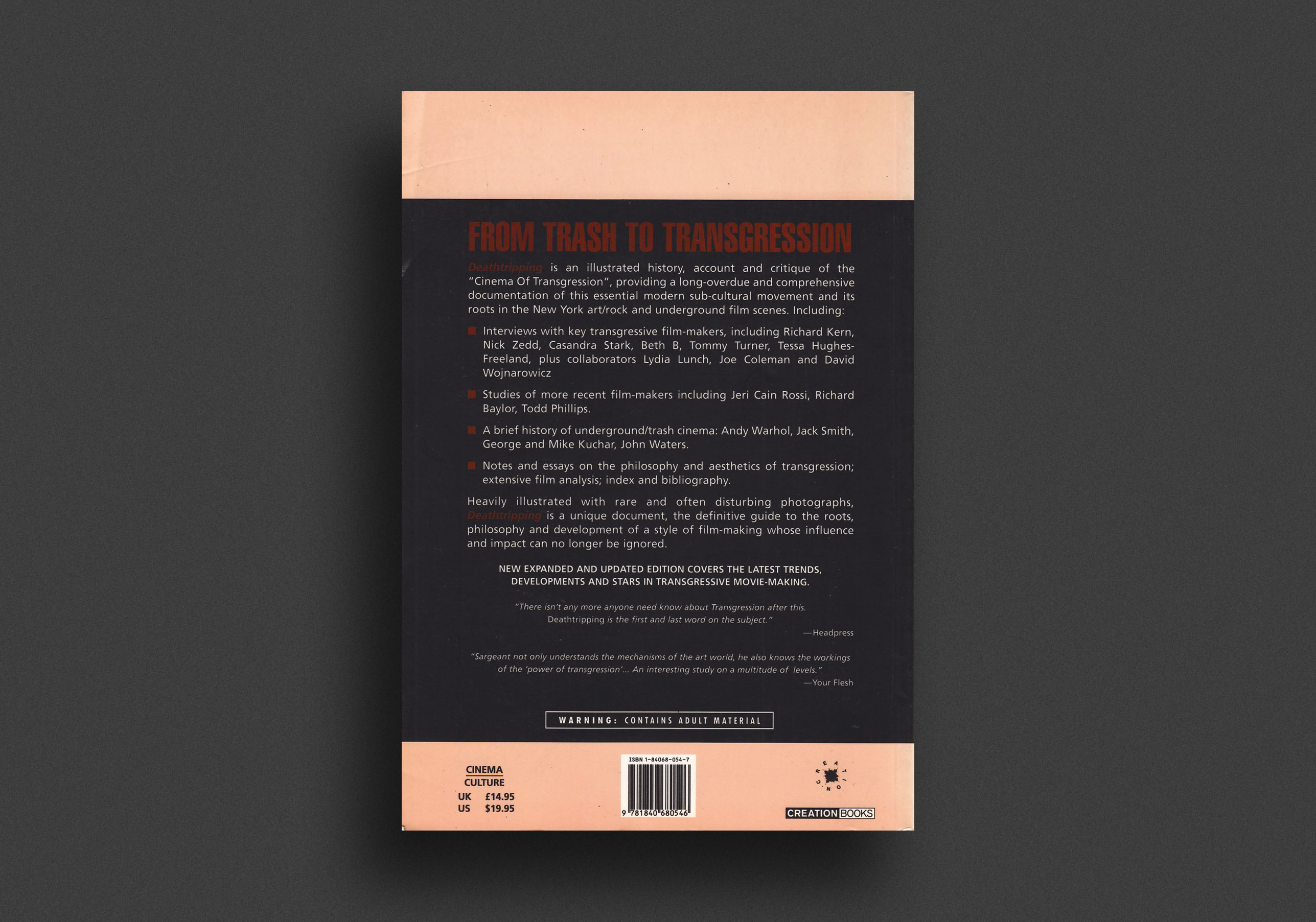
Expanded 1999 print of the first 1995 Creation edition of Deathtripping, the first illustrated history, account and critique of the "Cinema Of Transgression", providing a long-overdue and comprehensive documentation of this essential modern sub-cultural movement and its roots in the New York art/rock and underground film scenes. Including interviews with key transgressive film-makers, including Richard Kern, Nick Zedd, Casandra Stark, Beth B, Tommy Turner, Tessa Hughes-Freeland, plus collaborators Lydia Lunch, Joe Coleman and David Wojnarowicz; studies of more recent film-makers including Jeri Cain Rossi, Richard Baylor, Todd Phillips; a brief history of underground/trash cinema: Andy Warhol, Jack Smith, George and Mike Kuchar, John Waters; notes and essays on the philosophy and aesthetics of transgression; extensive film analysis; index and bibliography. Heavily illustrated with rare and often disturbing photographs, Deathtripping is a unique document, the definitive guide to the roots, philosophy and development of a style of film-making whose influence and impact can no longer be ignored.
WARNING: CONTAINS ADULT MATERIAL
VG copy.
1995, English
Softcover, 136 pages, 28 x 21 cm
Published by
Dover / New York
$38.00 - In stock -
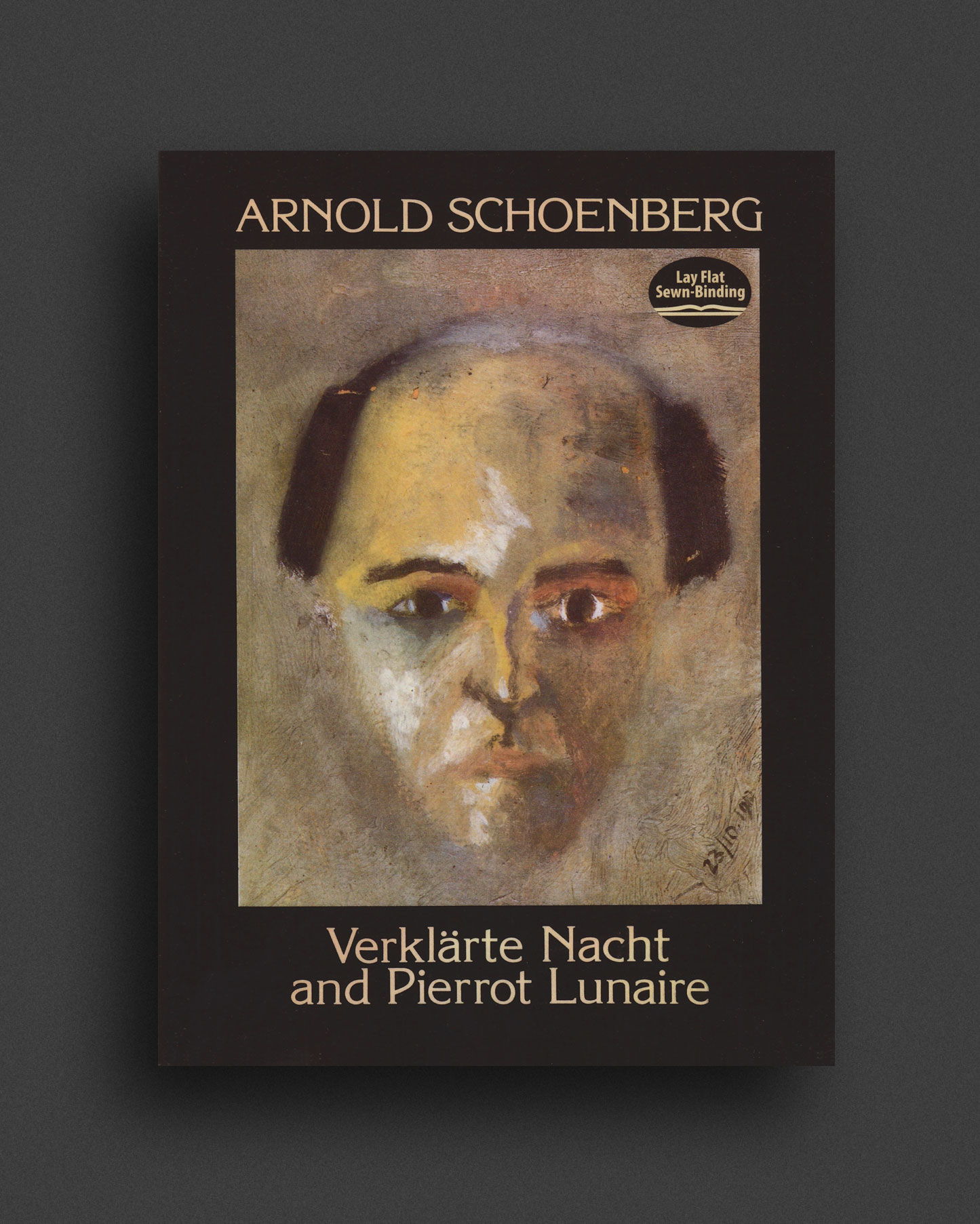
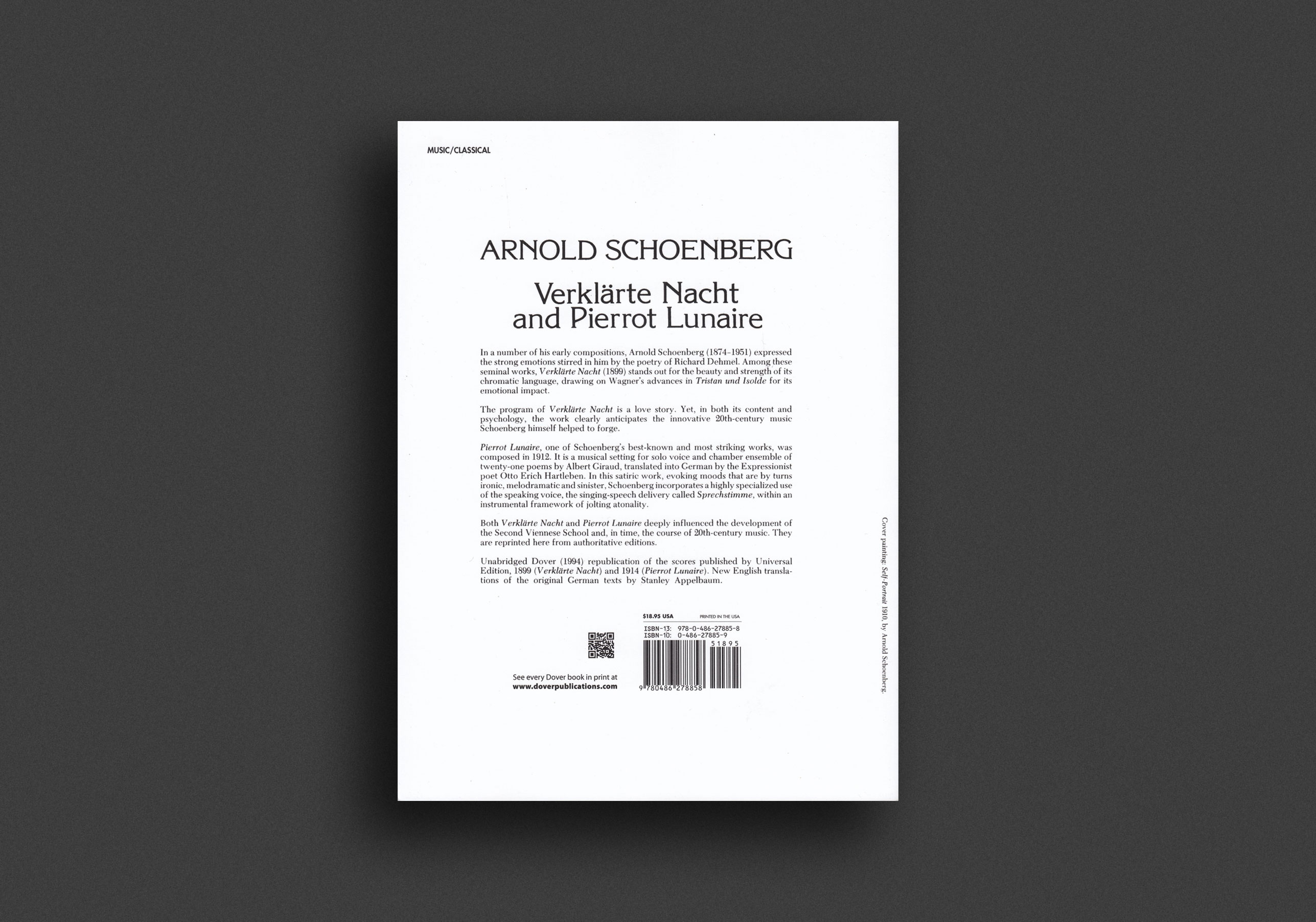
In a number of his early compositions, Arnold Schoenberg (1874–1951) expressed the strong emotions stirred in him by the poetry of Richard Dehmel. Among these seminal works, Verklärte Nacht (1899) stands out for the beauty and strength of its chromatic language, drawing on Wagner's advances in Tristan und Isolde for its emotional impact.
The program of Verklärte Nacht is a love story. Yet, in both its content and psychology, the work clearly anticipates the innovative twentieth-century music Schoenberg himself helped to forge.
Pierrot Lunaire, one of Schoenberg's best-known and most striking works, was composed in 1912. It is a music setting for solo voice and chamber ensemble of 21 poems by Albert Giraud, translated into German by the Expressionist poet Otto Erich Hartleben. In this satiric work, evoking moods that are by turns ironic, melodramatic, and sinister, Schoenberg incorporates a highly specialized use of the speaking voice, the singing-speech delivery call Sprechstimme, within an instrumental framework of jolting atonality.
Both Verklärte Nacht and Pierrot Lunaire deeply influenced the development of the Second Viennese School and, in time, the course of twentieth-century music. They are reprinted here from authoritative editions.
2019, English
Softcover (w. flexi-disc), 280 pages, 26 x 21 cm
Ed. of 2500,
Published by
Primary Information / New York
$65.00 - In stock -
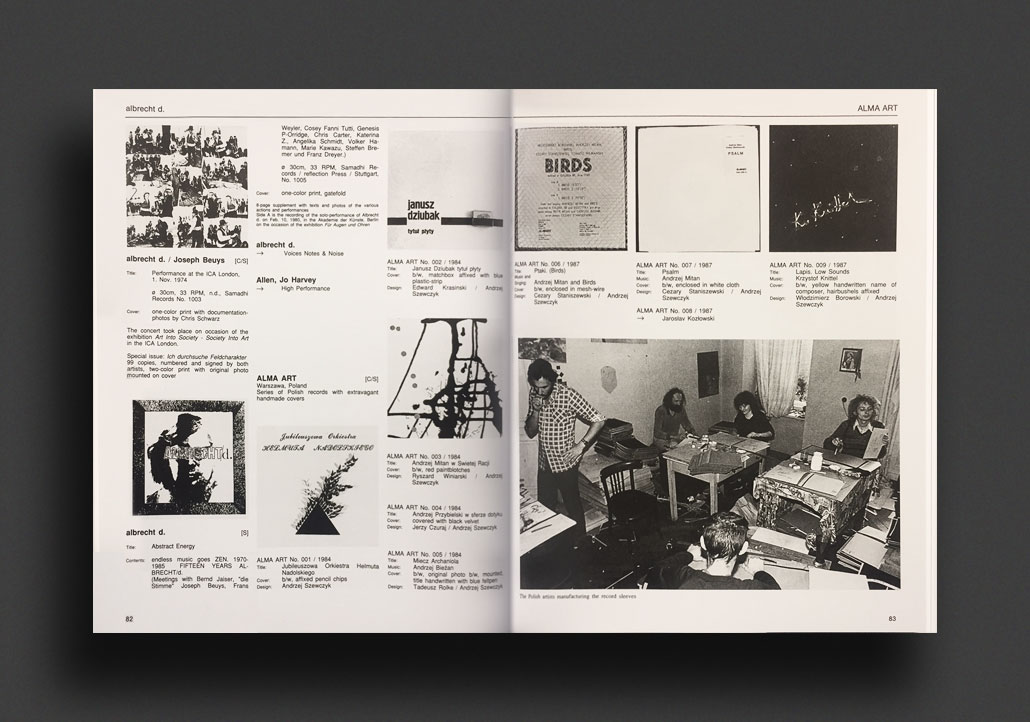
Broken Music is an essential compendium for records created by visual artists. The publication was edited by Ursula Block and Michael Glasmeier and originally published in 1989 by DAAD. Broken Music focuses on recordings, record-objects, artwork for records, and record installations made by thousands of artists between WWII and 1989.
It also includes essays by both editors as well as Theodor W. Adorno, René Block, Jean Dubuffet, Milan Knizak, László Moholy-Nagy, Christiane Seiffert, and Hans Rudolf Zeller, as well as a flexi disc of the Arditti Quartet performing Knizak’s “Broken Music.” The centerpiece of the publication is a nearly 200-page bibliography of artists’ records.
Works chosen for the publication revolved around four criteria: (1) record covers created as original work by visual artists; (2) record or sound-producing objects (multiples/editions/sculptures); (3) books and publications that contain a record or recorded-media object; and (4) records or recorded media that have sound by visual artists.
Artists documented in the volume include Vito Acconci, albrecht/d., Laurie Anderson, Guillaume Apollinaire, Karel Appel, Arman, Hans Arp, Antonin Artaud, John Baldessari, Hugo Ball, Claus van Bebber, John Bender, Harry Bertoia, Jean-Pierre Bertrand, Joseph Beuys, Mel Bochner, Claus Böhmler, Christian Boltanski, KP Brehmer, William Burroughs, John Cage, Henri Chopin, Henning Christiansen, Jean Cocteau, William Copley, Philip Corner, Merce Cunningham, Hanne Darboven, Jim Dine, Marcel Duchamp, Max Ernst, Lawrence Ferlinghetti, Fischli and Weiss, R. Buckminster Fuller, Allen Ginsberg, Philip Glass, Jack Goldstein, Peter Gordon, Hans Haacke, Richard Hamilton, Bernard Heidsieck, Holger Hiller, Richard Huelsenbeck, Isidore Isou, Marcel Janco, Servie Janssen, Jasper Johns, Joe Jones, Thomas Kapielski, Allan Kaprow, Martin Kippenberger, Per Kirkeby, Cheri Knight, Milan Knizak, Richard Kriesche, Christina Kubisch, Laibach, John Lennon, Sol Lewitt, Roy Lichtenstein, Annea Lockwood, Paul McCarthy, Meredith Monk, Josef Felix Müller, Piotr Nathan, Hermann Nitsch, Albert Oehlen, Frank O’Hara, Claes Oldenburg, Yoko Ono, Dennis Oppenheim, Nam June Paik, Charlemagne Palestine, A.R. Penck, Tom Phillips, Robert Rauschenberg, The Red Crayola, Ursula Reuter Christiansen, Gerhard Richter, Jim Rosenquist, Dieter Roth, Gerhard Rühm, Robert Rutman, Sarkis, Thomas Schmit, Conrad Schnitzler, Kurt Schwitters, Selten Gehörte Musik, Richard Serra, Robert Smithson, Michael Snow, Keith Sonnier, Strafe für Rebellion, Jean Tinguely, Moniek Toebosch, Tristan Tzara, Ben Vautier, Yoshi Wada, Emmett Walsh, Andy Warhol, William Wegman, and Lawrence Weiner.
Ursula Block is a curator living in Berlin, Germany. From 1981 until 2014, she ran gelbe Musik, a gallery and record shop in Berlin that featured work by artists at the crossroads between music and art.
Michael Glasmeier is a professor, writer, and editor living in Berlin, Germany. Since the early 1980s, he has curated dozens of shows that explore the intersection between the visual arts, music, film, and language.
1989, English / German / French
Softcover (w. flexi-disc), 280 pages, 26 x 21 cm
1st Edition, Out of print title / used / very good
Published by
Daadgalerie / Berlin
Gelbe Musik / Berlin
$180.00 - In stock -
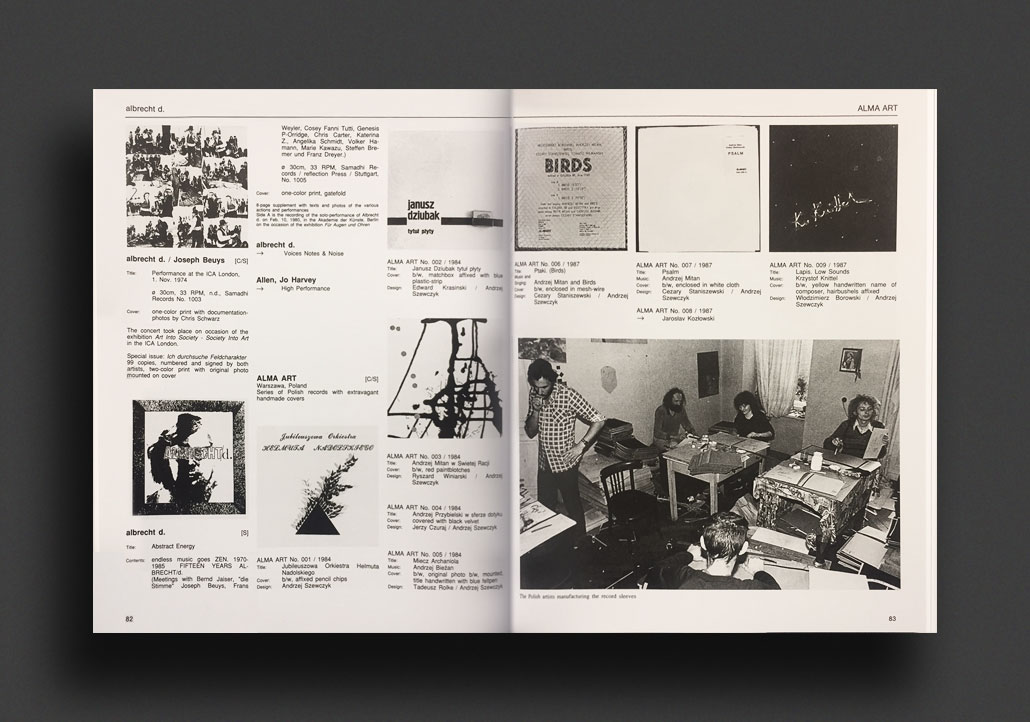
Rare first 1989 edition of Broken Music, an essential compendium for records created by visual artists. Complete with original flexi-disc. The publication was edited by Ursula Block and Michael Glasmeier and published in 1989 by DAAD and Gelbe Musik, Berlin. Broken Music focuses on recordings, record-objects, artwork for records, and record installations made by thousands of artists between WWII and 1989.
It also includes essays by both editors as well as Theodor W. Adorno, René Block, Jean Dubuffet, Milan Knizak, László Moholy-Nagy, Christiane Seiffert, and Hans Rudolf Zeller, as well as a flexi disc of the Arditti Quartet performing Knizak’s “Broken Music.” The centerpiece of the publication is a nearly 200-page bibliography of artists’ records.
Works chosen for the publication revolved around four criteria: (1) record covers created as original work by visual artists; (2) record or sound-producing objects (multiples/editions/sculptures); (3) books and publications that contain a record or recorded-media object; and (4) records or recorded media that have sound by visual artists.
Artists documented in the volume include Vito Acconci, albrecht/d., Laurie Anderson, Guillaume Apollinaire, Karel Appel, Arman, Hans Arp, Antonin Artaud, John Baldessari, Hugo Ball, Claus van Bebber, John Bender, Harry Bertoia, Jean-Pierre Bertrand, Joseph Beuys, Mel Bochner, Claus Böhmler, Christian Boltanski, KP Brehmer, William Burroughs, John Cage, Henri Chopin, Henning Christiansen, Jean Cocteau, William Copley, Philip Corner, Merce Cunningham, Hanne Darboven, Jim Dine, Marcel Duchamp, Max Ernst, Lawrence Ferlinghetti, Fischli and Weiss, R. Buckminster Fuller, Allen Ginsberg, Philip Glass, Jack Goldstein, Peter Gordon, Hans Haacke, Richard Hamilton, Bernard Heidsieck, Holger Hiller, Richard Huelsenbeck, Isidore Isou, Marcel Janco, Servie Janssen, Jasper Johns, Joe Jones, Thomas Kapielski, Allan Kaprow, Martin Kippenberger, Per Kirkeby, Cheri Knight, Milan Knizak, Richard Kriesche, Christina Kubisch, Laibach, John Lennon, Sol Lewitt, Roy Lichtenstein, Annea Lockwood, Paul McCarthy, Meredith Monk, Josef Felix Müller, Piotr Nathan, Hermann Nitsch, Albert Oehlen, Frank O’Hara, Claes Oldenburg, Yoko Ono, Dennis Oppenheim, Nam June Paik, Charlemagne Palestine, A.R. Penck, Tom Phillips, Robert Rauschenberg, The Red Crayola, Ursula Reuter Christiansen, Gerhard Richter, Jim Rosenquist, Dieter Roth, Gerhard Rühm, Robert Rutman, Sarkis, Thomas Schmit, Conrad Schnitzler, Kurt Schwitters, Selten Gehörte Musik, Richard Serra, Robert Smithson, Michael Snow, Keith Sonnier, Strafe für Rebellion, Jean Tinguely, Moniek Toebosch, Tristan Tzara, Ben Vautier, Yoshi Wada, Emmett Walsh, Andy Warhol, William Wegman, and Lawrence Weiner.
Ursula Block is a curator living in Berlin, Germany. From 1981 until 2014, she ran gelbe Musik, a gallery and record shop in Berlin that featured work by artists at the crossroads between music and art. She was married to curator René Block.
Michael Glasmeier is a professor, writer, and editor living in Berlin, Germany. Since the early 1980s, he has curated dozens of shows that explore the intersection between the visual arts, music, film, and language.
Very Good copy all-round, light cover/corner wear.
2022, English
Hardcover, 224 pages, 22 x 29 cm
Published by
Masala Noir / Paris
$89.00 $55.00 - Out of stock
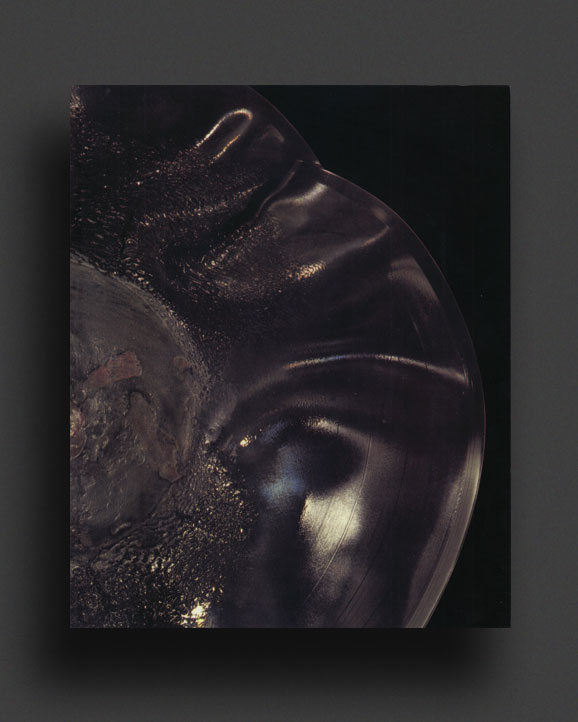
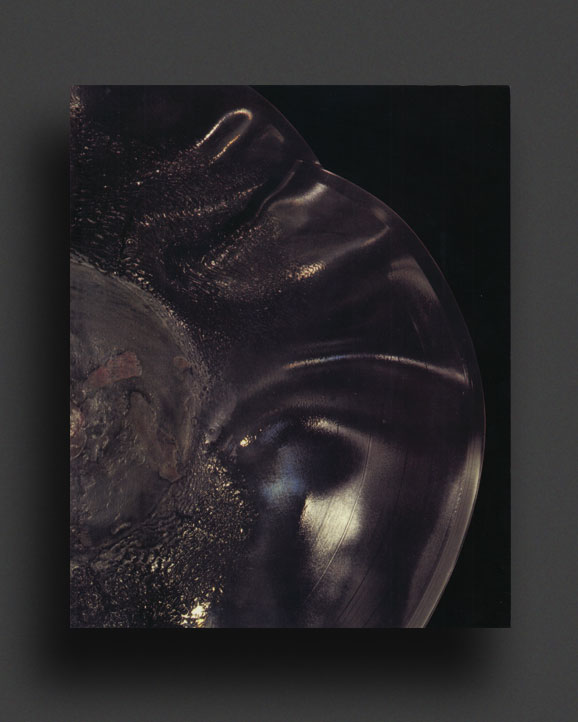
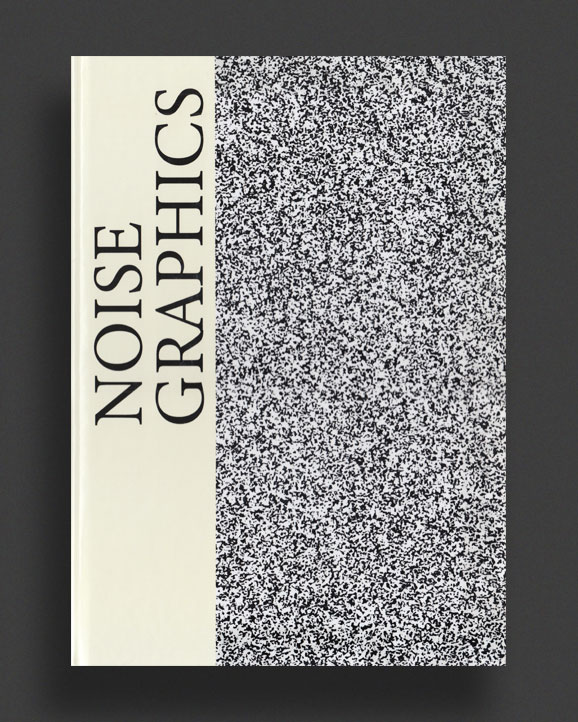
A visual archive of Noise vinyl and cassette covers, 1980—1990. Merzbow, Bourbonese Qualk, Maurizio Bianchi (MB), Controlled Bleeding, The Haters, Whitehouse, Le Syndicat, Broken Flag, Anti-Music, Borbetomagus, Sonic Youth, Sonic Death, ZSF Produkt, Ramleh, P16.D4, Area Condizionata, Kleistwahr, Masonna, DD. Records, Alto Stratus, Boredoms, Pussy Galore, Septiembre Negro, GG Allin, Lokomotiv S.S., Giancarlo Toniutti, The New Blockaders, Club Moral, Coup De Grace, H.N.A.S., Come Organisation, Birthbiter, Consumer Electronics, Minamata, Mauthausen Orchestra, Pain Teens, S·Core, The Gerogerigegege, Psychic T.V., Sonic Violence, Epitapes, ZG Music, Recloose Organisation, Con-Dom, Deviant & the Clones, Skullflower, Pure, Thee Un-Kommuniti, Skullflower, Putrefier, Ethnic Acid, and many many more.......
Last remaining copy discounted as the content (book block) has been bound upside–down. Sample image only (the right way around).