World Food Books' programme is largely produced on Kulin Nation land. We acknowledge the Wurundjeri people of the Kulin Nation as the first and continuing custodians of this land, and pay respect to their Elders past, present, and emerging.
World Food Books is an arts and special interests bookshop in Naarm / Melbourne. Founded in 2010, World Food Books is devoted to the presentation of a rotating, hand-selection of international art, design, literary and counterculture publications with an emphasis on the anti-traditional, the experimental, the avant-garde, the heretic, the marginal.
Presenting new titles alongside rare and out-of-print books, catalogues and journals spanning the fields of modern and contemporary art, design, photography, illustration, film, literature, poetry, cultural theory, philosophy, sexuality, popular and underground culture in its many radical forms, World Food Books wishes to encourage adventurous, thoughtful and open-minded reading, looking, writing, and exchange of publishing and ideas, both current and historical.
As well as our bookshop, located in Melbourne's historical Nicholas Building, all of our inventory is available internationally via our online mail-order service.
World Food Books semi-regularly co-ordinates "Occasions", a programme of exhibits and events at the bookshop and in partnership with other hosts (such as museums and art galleries) that develop out of the activities, relationships and content of the bookshop itself.
World Food Books
The Nicholas Building
37 Swanston Street
Room 5, Level 6
Melbourne 3000
Australia
SHOP HOURS:
Thu–Fri 12–6
WEB-SHOP OPEN 24/7
World Food Books
Postal Address:
37 Swanston Street
Room 5, Level 6
Melbourne 3000
Australia
Art
Theory / Essay
Architecture / Interior
Graphic Design / Typography
Photography
Fashion
Eros
LGBTQ+
Fiction / Poetry
Weird / Speculative / Science Fiction / Horror
Transgressive / Visceral / Abject
Symbolism / Decadence / Fin de siècle
Film / Video
Painting
Sculpture / Installation
Performance / Dance / Theater
Drawing
Sound / Music
Curatorial
Group Shows / Collections
Periodicals
Out-of-print / Rare
Posters / Ephemera / Discs
Signed Books
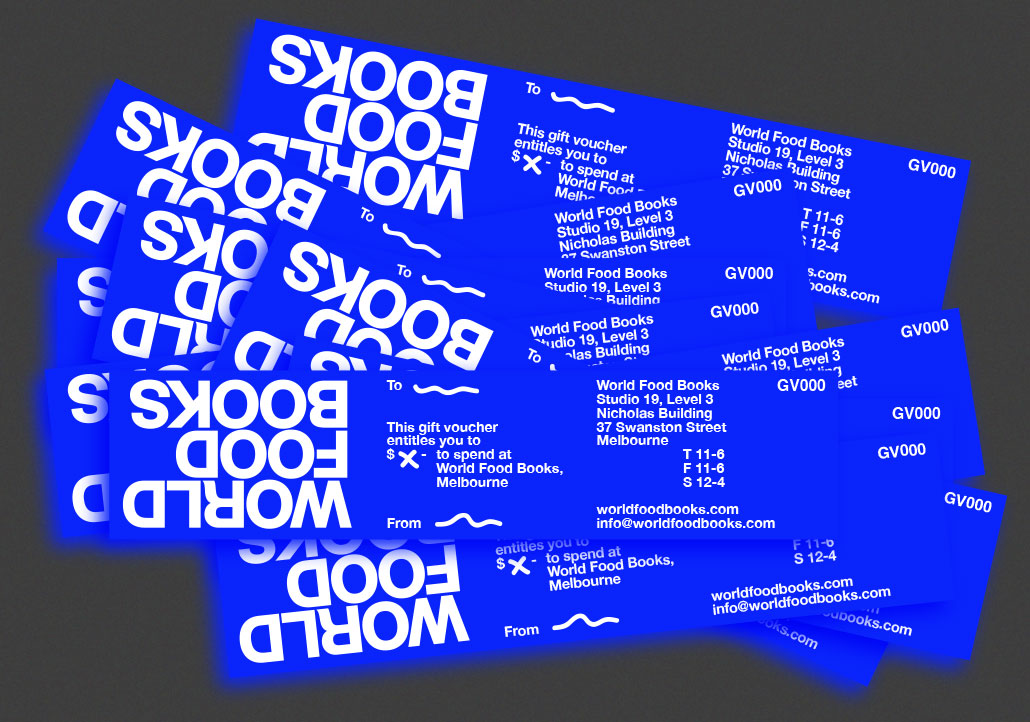
World Food Books Gift Voucher
World Food Book Bag
Australian Art
Australian Fiction
Australian Science Fiction / Speculative Fiction
Australian Poetry
Australian Photography
Japanese Photography
Conceptual Art
Minimal Art
Dada
'Pataphysics / Oulipo
Fluxus
Concrete Poetry
Pop Art
Surrealism
Arte Povera
Arte Informale / Haute Pâte / Tachism
Nouveau Réalisme / Zero / Kinetic
Situationism / Lettrism
Collage / Mail Art / Xerox Art
Art Brut / Folk / Visionary / Fantastic
Illustration / Graphic Art / Bandes Dessinées
Furniture
Italian Radical Design / Postmodernism
Textiles
Ceramics / Glass
Counterculture
Protest / Revolt
Philosophy
Psychoanalysis
Anthropology
Anarchism
Socialism / Anarchism / Communism / Capitalism
Literary Theory / Semiotics / Language
Feminism / Women's Studies
Gender Studies / Sexuality
Anthropology
Fetishism / BDSM
Drugs / Psychedelia
Crime / Violence
Animal Rights / Veganism
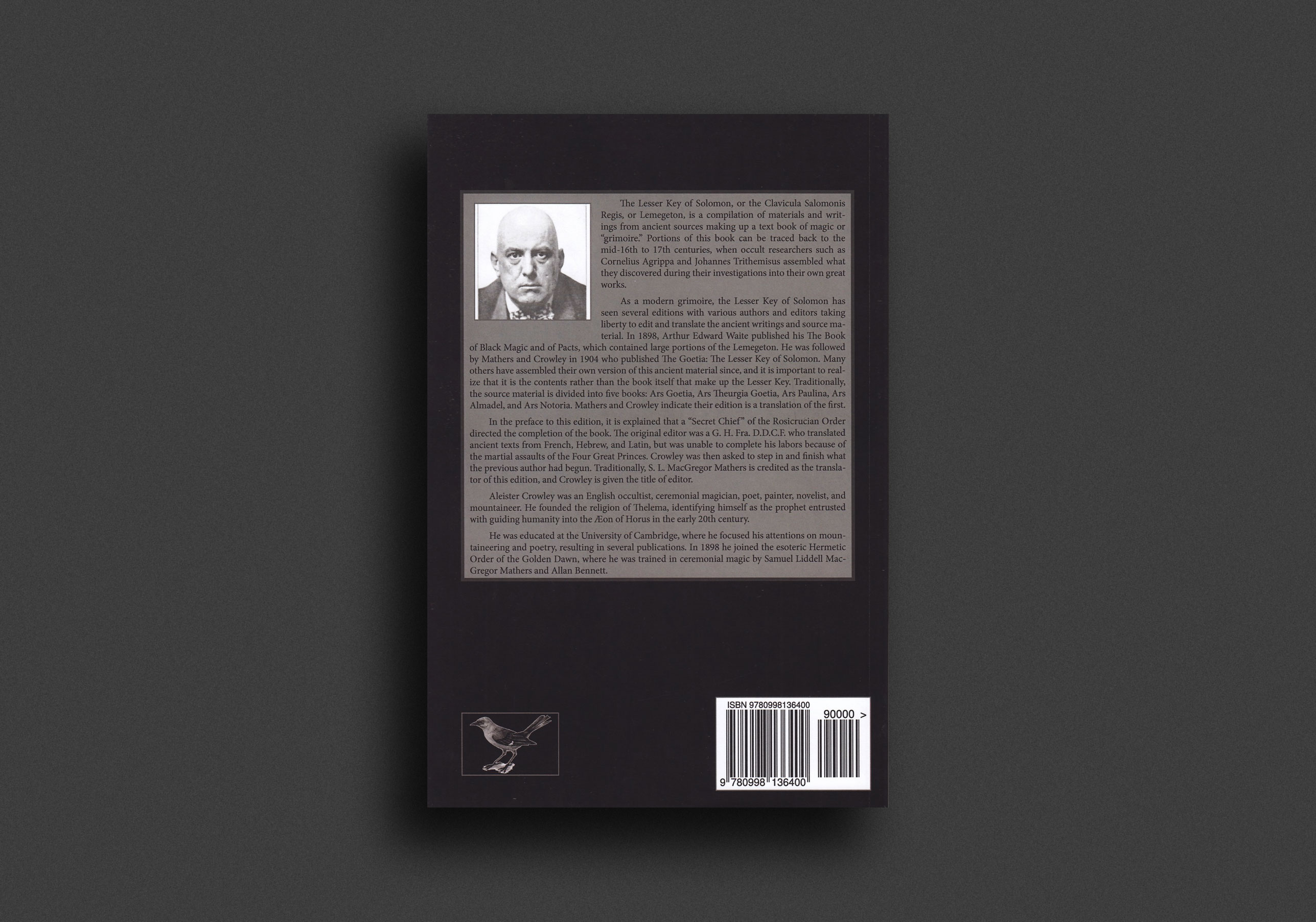
Occult / Esoterica
Ecology / Earth / Alternative Living
Whole Earth / Crafts
All prices in AUD (Australian dollars)
Pick-Ups
Pick-up orders can be collected in our bookshop during opening hours after order date. Please collect any Pick-up orders within 2 weeks of ordering as we have limited storage space. Orders will be released back into stock if not collected within this time. No refunds can be made for pick-ups left un-collected. If you cannot make it in to the bookshop in this time-frame, please choose postage option.
Return Policy
All sales are final. We do accept returns (for refund or exchange) for items received in error. All our orders are packed with special care using heavy-duty padding and cardboard book-mailers or bubble mailers (for smaller books), using reinforcement where required. We cannot take responsibility for any lost, stolen or damaged parcels.
Insurance
Should you wish to insure your package, please email us directly after placing your order and we can organise this at a small extra expense. Although all standard/express tracked packages are very safe and dependable, we cannot take responsibility for any lost, stolen or damaged parcels. We recommend insurance on valuable orders.
Interested in selling your old books, catalogues, journals, magazines, comics, fanzines, ephemera? We are always looking for interesting, unusual and out-of-print books to buy. We only buy books in our fields of interest and specialty, and that we feel we can resell.
We base these prices on desirability, market value, in-print prices, condition and our current stock levels. We offer cash, store credit, and can take stock on consignment. All
about 25% of the price we expect to get when we sell them, or 30% in store credit. We base these prices on desirability, market value, in-print prices, condition and our current stock levels.
Sell your books any day of the week. You can drop them off and return later. If you have a lot of books, we can visit your Sydney home.
We buy books that we feel we can resell. We offer about 25 % of the price we expect to get when we sell them, or 30% in store credit. We base these prices on desirability, market value, in-print prices, condition and our current stock levels.
Philadelphia Wireman
03 August - 01 September, 2018
World Food Books is proud to announce our next Occasion, the first presentation of sculptures by Philadelphia Wireman in Australia.
The Philadelphia Wireman sculptures were found abandoned in an alley off Philadelphia’s South Street on trash night in 1982. Their discovery in a rapidly-changing neighbourhood undergoing extensive renovation, compounded with the failure of all attempts to locate the artist, suggests that the works may have been discarded after the maker’s death. Dubbed the "Philadelphia Wireman" during the first exhibition of this work, in 1985, the maker’s name, age, ethnicity, and even gender remain uncertain. The entire collection totals approximately 1200 pieces, all intricately bound together with tightly-wound heavy-gauge wire (along with a few small, abstract marker drawings, reminiscent both of Mark Tobey and J.B. Murry). The dense construction of the work, despite a modest range of scale and materials, is singularly obsessive and disciplined in design: a wire armature or exoskeleton firmly binds a bricolage of found objects including plastic, glass, food packaging, umbrella parts, tape, rubber, batteries, pens, leather, reflectors, nuts and bolts, nails, foil, coins, toys, watches, eyeglasses, tools, and jewellery.
Heavy with associations—anthropomorphic, zoomorphic, and socio-cultural responses to wrapped detritus—the totemic sculptures by Philadelphia Wireman have been discussed in the context of work created to fulfil the shamanistic needs of alternative religions in American culture. Curators, collectors, and critics have variously compared certain pieces to sculpture from Classical antiquity, Native American medicine bundles, African-American memory jugs, and African fetish objects. Reflecting the artist’s prolific and incredibly focused scavenging impulse, and despite—or perhaps enhanced by—their anonymity, these enigmatic objects function as urban artefacts and arbiters of power, though their origin and purpose is unknown. Philadelphia Wireman, whatever their identity, possessed an astonishing ability to isolate and communicate the concepts of power and energy through the selection and transformation of ordinary materials. Over the course of the past two decades, this collection has come to be regarded as an important discovery in the field of self-taught art and vernacular art.
Presented in collaboration with Fleisher-Ollman Gallery, Philadelphia, and Robert Heald, Wellington.
Susan Te Kahurangi King
02 February - 10 March, 2018
Susan Te Kahurangi King (24 February 1951 - ) has been a confident and prolific artist since she was a young child, drawing with readily available materials - pencils, ballpoint pens and felt-tip markers, on whatever paper is at hand. Between the ages of four and six Susan slowly ceased verbal communication. Her grandparents William and Myrtle Murphy had developed a special bond with Susan so they took on caring responsibilities for extended periods. Myrtle began informally archiving her work, carefully collecting and storing the drawings and compiling scrapbooks. No drawing was insignificant; every scrap of paper was kept. The King family are now the custodians of a vast collection containing over 7000 individual works, from tiny scraps of paper through to 5 meter long rolls.
The scrapbooks and diaries reveal Myrtle to be a woman of great patience and compassion, seeking to understand a child who was not always behaving as expected. She encouraged Susan to be observant, to explore her environment and absorb all the sights and sounds. Myrtle would show Susan’s drawings to friends and people in her community that she had dealings with, such as shopkeepers and postal workers, but this was not simply a case of a grandmother’s bias. She recognised that Susan had developed a sophisticated and unique visual language and sincerely believed that her art deserved serious attention.
This was an unorthodox attitude for the time. To provide some context, Jean Dubuffet coined the term Art Brut in 1945 to describe work created by self-taught artists – specifically residents of psychiatric institutions and those he considered to be visionaries or eccentrics. In 1972 Roger Cardinal extended this concept by adopting the term Outsider Art to describe work made by non-academically trained artists operating outside of mainstream art networks through choice or circumstance. Susan was born in Te Aroha, New Zealand in 1951, far from the artistic hubs of Paris and London that Dubuffet and Cardinal operated in. That Myrtle fêted Susan as a self-taught artist who deserved to be taken seriously shows how progressive her attitudes were.
Susan’s parents Doug and Dawn were also progressive. Over the years they had consulted numerous health practitioners about Susan’s condition, as the medical establishment could not provide an explanation as to why she had lapsed into silence. Dawn educated herself in the field of homeopathy and went on to treat all twelve of her children using these principles – basing prescriptions on her observations of their physical, mental and emotional state.
Doug was a linguist with an interest in philosophy who devoted what little spare time he had to studying Maori language and culture. To some extent their willingness to explore the fringes of the mainstream made them outsiders too but it was their commitment to living with integrity and their respect for individuality that ensured Susan’s creativity was always encouraged.
Even though Susan’s family supported her artistic pursuits, some staff in schools and hospitals saw it as an impediment to her assimilation into the community and discouraged it in a variety of ways. Her family was not always aware of this and therefore did not fully understand why Susan stopped drawing in the early 1990s. However, rather than dwell on the challenges that Susan faced in pursuit of her artistic practice, they prefer to highlight her achievements. In 2008 Susan began drawing again in earnest, after an almost 20 year interruption, and her work is now shown in galleries around the world.
Susan grew up without television and has been heavily influenced by the comics she read as a child. She is absolutely fearless in the appropriation of recognizable characters, such as Donald Duck and Mickey Mouse, in her work. She twists their limbs, contorts their faces, compresses them together, blends them into complex patterned backgrounds - always imbuing them with an incredible energy. Although Susan often used pop culture characters in her work they are not naive or childlike. These are drawings by a brilliant self-taught artist who has been creating exceptional work for decades without an audience in mind.
Mladen Stilinović
"Various Works 1986 - 1999"
02 February 16 - September 10, 2016
Various works 1986 - 1999, from two houses, from the collections of John Nixon, Sue Cramer, Kerrie Poliness, Peter Haffenden and Phoebe Haffenden.
Including: Geometry of Cakes (various shelves), 1993; Poor People’s Law (black and white plate), 1993; White Absence (glasses, ruler, set square, silver spoon, silver ladel with skin photograph and wooden cubes), 1990-1996; Exploitation of the Dead (grey and red star painting, wooden painting, black spoon with red table, red plate), 1984-1990; Money and Zeros (zero tie, paintings made for friends in Australia (Sue, John, Kerrie), numbers painting), 1991-1992; Words - Slogans (various t-shirts) - “they talk about the death of art...help! someone is trying to kill me”, “my sweet little lamb”, “work is a disease - Karl Marx”; Various artist books, catalogues, monographs, videos; Poster from exhibition Insulting Anarchy; "Circular" Croatian - Australian edition; Artist book by Vlado Martek (Dostoyevsky); more.
Thanks to Mladen Stilinović and Branka Stipančić.
Jonathan Walker
Always Will Need To Wear Winter Shirt Blue + Ochre Small Check Pattern
21 August - 21 September, 2015
Untitled
I am not a great reader of poetry but I always return to the work of Melbourne poet, Vincent Buckley (1925- 1988). Perhaps I find his most tantalising piece to be not a finished poem but a fragment left on a scrap of paper discovered on his desk after the poet’s death.
The poetry gathers like oil
In the word-core, and spreads
It has its music meet,
Its music is in movement.
This fragment is more the shell left behind from a volatile thought than a finished poem. I find the last two lines honest but awkward whereas the first two lines work like an arrow. Most likely he could not find a resolution so it was left. Still, in its present form, it remains an eloquent testimony to the ultimate failure of a medium to express mobile thought and sensation, in Buckley’s case, through verbal language. It’s an important matter because this is something all artists have to deal with regardless of the medium.
I have never written a poem, however, I am forever copying fragments from books on paper scraps in a vain effort to fix certain notions in my head. At first, they function as bookmarks that are sometimes returned to when I open the book. But before long, as they accumulate, they fall out littering the table interspersed with A4 photocopies, bills, books and medications.
To return to Buckley’s fragment, the first two lines very much evoke how I paint nowadays. As you age, detail diminishes and patches of light become more luminous and float. I feel the most honest way of dealing with this is by smearing the oil paint on the canvas with the fingers and working close-up, blind. Only if the patches coalesce into an approaching image can the work gain a life.
-
Jonathan Walker was born in Melbourne, Australia and brought up on a dairy farm in Gippsland. In the 1970’s he studied painting at RMIT and won the Harold Wright Scholarship to the British Museum, London. During the 1980’s he exhibited at Pinacotheca Gallery, Richmond and had work shown at the NGV and Heidi City Art Gallery. Over the same period he designed the cover for the “Epigenesi” LP by Giancarlo Toniutti, Italy and conducted a mail exchange work with Achim Wollscheid, Germany. The work with artists through the post resulted in an article published in the bicentenary issue of Art and Australia 1988. He showed in artist run spaces such as WestSpace in the 90’s and 2000’s, and until 2012, taught painting at Victoria University, which is where we (Colleen Ahern and Lisa Radford) as organisers of the exhibition, among many others, had the privilege of being his student.
Walker’s knowledge was imparted to students through the careful selection of music, literature, and artists found in books that he himself had ordered for the library. Walker’s strategy was the generosity of sharing his vast knowledge with references specific to each student and their context.
Walker’s paintings share a similar focus and intimacy.
This exhibition presents a small selection of recent paintings alongside a publication that includes Walker’s writing. Observational and analytical, Walker’s work is a type of material notation — the time of day, colour and how it is blended, the both specific and fleeting location of a reflection on lino or the question of whether a chair leg should be included in a painting.
Please join us on Friday August 21 between 6-8pm to celebrate the opening of the exhibition.
Curated by Colleen Ahern and Lisa Radford.
B. Wurtz
Curated by Nic Tammens
March 26 - April 4, 2015
B.Wurtz works from a basement studio in his home on Manhattan’s Lower East Side.
This local fact is attested to by the plastic shopping bags and newsprint circulars that appear in his work. As formal objects, they don’t make loud claims about their origins but nonetheless transmit street addresses and places of business from the bottom of this long thin island. Like plenty of artists, Wurtz is affected by what is local and what is consumed. His work is underpinned by this ethic. It often speaks from a neighborhood or reads like the contents of a hamper:
“BLACK PLUMS $1.29 lb.”
“Food Bazaar”
“USDA Whole Pork Shoulder Picnic 99c lb.”
“RITE AID Pharmacy, with us it’s personal.”
“H. Brickman & Sons.”
“Sweet Yams 59c lb."
Most of the work in this exhibition was made while the artist was in residence at Dieu Donne, a workshop dedicated to paper craft in Midtown. Here Wurtz fabricated assemblages with paper and objects that are relatively lightweight, with the intention that they would be easily transportable to Australia. This consideration isn’t absolute in Wurtz’s work, but was prescriptive for making the current exhibition light and cheap. Packed in two boxes, these works were sent from a USPS post office on the Lower East Side and delivered to North Melbourne by Australia Post.
Wurtz appears courtesy of Metro Pictures, New York.
Thanks to Rob Halverson, Joshua Petherick, Sari de Mallory, Matt Hinkley, Helen Johnson, Fayen d'Evie, Ask Kilmartin, Lisa Radon, Ellena Savage, Yale Union, and "Elizabeth".
John Nixon
"Archive"
December 15 - January 20, 2014
The presentation of John Nixon's archive offered a rare showcase of this extensive collection of the artist's own publications, catalogues, posters, ephemera, editions and more, from the mid 1980s onwards, alongside a selection of his artworks.
Organized by John Nixon, Joshua Petherick and Matt Hinkley.
<a href=http://wfb.public-office.info/artist/john-nixon>All titles by John Nixon
"Habitat"
at Minerva, Sydney (organised by Joshua Petherick and Matt Hinkley)
November 15 - December 20, 2014
Lupo Borgonovo, Janet Burchill & Jennifer McCamley,
Lewis Fidock, HR Giger, Piero Gilardi, Veit Laurent Kurz,
Cinzia Ruggeri, Michael E. Smith, Lucie Stahl, Daniel Weil, Wols
Press Release:
“...It contained seven objects. The slender fluted bone, surely formed for flight, surely from the wing of some large bird. Three archaic circuitboards, faced with mazes of gold. A smooth white sphere of baked clay. An age-blackened fragment of lace. A fingerlength segment of what she assumed was bone from a human wrist, grayish white, inset smoothly with the silicon shaft of a small instrument that must once have ridden flush with the surface of the skin - but the thing’s face was seared and blackened.”
William Gibson, “Count Zero”, 1986
"Autumn Projects Archive"
Curated by Liza Vasiliou
March 6 - March 15, 2014
World Food Books, in conjunction with the Virgin Australia Melbourne Fashion Festival 2014, presented the Autumn Projects archive, consisting of a selection of early examples in Australian fashion with a particular interest in collecting designers and labels from the period beginning in the 1980’s, who significantly influenced the discourse of Australian Fashion.
Curated by Liza Vasiliou, the exhibition provided a unique opportunity to view pieces by designers Anthea Crawford, Barbara Vandenberg, Geoff Liddell and labels CR Australia, Covers, Jag along with early experimental collage pieces by Prue Acton and Sally Browne’s ‘Fragments’ collection, suspended throughout the functioning World Food Books shop in Melbourne.
H.B. Peace
presented by CENTRE FOR STYLE
November 14, 2013
"Hey Blinky, you say chic, I say same"
Anon 2013
H.B. Peace is a clothing collaboration between great friends Blake Barns and Hugh Egan Westland. Their pieces explore the divergences between 'character’ and ‘personality’ in garments....etc
Special Thanks to Joshua Petherick and Matt Hinkley of WFB and Gillian Mears
and a Very Special Thank you to Audrey Thomas Hayes for her shoe collaboration.
Janet Burchill & Jennifer McCamley
"Aesthetic Suicide"
May 10 - June 8, 2013
The first of our occasional exhibitions in the World Food Books office/shop space in Melbourne, "Aesthetic Suicide" presented a body of new and older works together by artists Janet Burchill & Jennifer McCamley, including videos, prints, a wall work, and publications.
During shop open hours videos played every hour, on the hour.
Published by World Food Books / Melbourne
$20.00 - In stock -
A World Food Books gift voucher is redeemable in our Melbourne bookshop or via our webshop (here). An e-voucher (printable pdf) will be sent to your purchase email address (please notify us if you wish to have the voucher sent to an alternate address and wish us to fill in the receiver's details on the card).
Gift vouchers can be purchased in increments of $20 (Australian Dollars) and the total amount can simply be added to by increasing the quantity in your shopping cart. eg. A quantity of 5 gift vouchers will result in an item total of $100 - a $100 gift voucher. Simply click "ADD TO CART" 5 times, or update your quantity in the shopping cart.
If you wish to purchase multiple, separate gift vouchers in one go, please just email us and we can personally prepare and email you a payment request.
Please note: Please select Pick-Up on gift voucher purchse to avoid any postage charges. Accidental postage charges will be refunded right away!
Thank you.
For any questions, please don't hesitate to email: [email protected]
1989, English / German / French
Softcover (w. flexi-disc), 280 pages, 26 x 21 cm
1st Edition, Out of print title / used / very good
Published by
Daadgalerie / Berlin
Gelbe Musik / Berlin
$200.00 - In stock -
Rare first 1989 edition of Broken Music, an essential compendium for records created by visual artists. Complete with original flexi-disc. The publication was edited by Ursula Block and Michael Glasmeier and published in 1989 by DAAD and Gelbe Musik, Berlin. Broken Music focuses on recordings, record-objects, artwork for records, and record installations made by thousands of artists between WWII and 1989.
It also includes essays by both editors as well as Theodor W. Adorno, René Block, Jean Dubuffet, Milan Knizak, László Moholy-Nagy, Christiane Seiffert, and Hans Rudolf Zeller, as well as a flexi disc of the Arditti Quartet performing Knizak’s “Broken Music.” The centerpiece of the publication is a nearly 200-page bibliography of artists’ records.
Works chosen for the publication revolved around four criteria: (1) record covers created as original work by visual artists; (2) record or sound-producing objects (multiples/editions/sculptures); (3) books and publications that contain a record or recorded-media object; and (4) records or recorded media that have sound by visual artists.
Artists documented in the volume include Vito Acconci, albrecht/d., Laurie Anderson, Guillaume Apollinaire, Karel Appel, Arman, Hans Arp, Antonin Artaud, John Baldessari, Hugo Ball, Claus van Bebber, John Bender, Harry Bertoia, Jean-Pierre Bertrand, Joseph Beuys, Mel Bochner, Claus Böhmler, Christian Boltanski, KP Brehmer, William Burroughs, John Cage, Henri Chopin, Henning Christiansen, Jean Cocteau, William Copley, Philip Corner, Merce Cunningham, Hanne Darboven, Jim Dine, Marcel Duchamp, Max Ernst, Lawrence Ferlinghetti, Fischli and Weiss, R. Buckminster Fuller, Allen Ginsberg, Philip Glass, Jack Goldstein, Peter Gordon, Hans Haacke, Richard Hamilton, Bernard Heidsieck, Holger Hiller, Richard Huelsenbeck, Isidore Isou, Marcel Janco, Servie Janssen, Jasper Johns, Joe Jones, Thomas Kapielski, Allan Kaprow, Martin Kippenberger, Per Kirkeby, Cheri Knight, Milan Knizak, Richard Kriesche, Christina Kubisch, Laibach, John Lennon, Sol Lewitt, Roy Lichtenstein, Annea Lockwood, Paul McCarthy, Meredith Monk, Josef Felix Müller, Piotr Nathan, Hermann Nitsch, Albert Oehlen, Frank O’Hara, Claes Oldenburg, Yoko Ono, Dennis Oppenheim, Nam June Paik, Charlemagne Palestine, A.R. Penck, Tom Phillips, Robert Rauschenberg, The Red Crayola, Ursula Reuter Christiansen, Gerhard Richter, Jim Rosenquist, Dieter Roth, Gerhard Rühm, Robert Rutman, Sarkis, Thomas Schmit, Conrad Schnitzler, Kurt Schwitters, Selten Gehörte Musik, Richard Serra, Robert Smithson, Michael Snow, Keith Sonnier, Strafe für Rebellion, Jean Tinguely, Moniek Toebosch, Tristan Tzara, Ben Vautier, Yoshi Wada, Emmett Walsh, Andy Warhol, William Wegman, and Lawrence Weiner.
Ursula Block is a curator living in Berlin, Germany. From 1981 until 2014, she ran gelbe Musik, a gallery and record shop in Berlin that featured work by artists at the crossroads between music and art. She was married to curator René Block.
Michael Glasmeier is a professor, writer, and editor living in Berlin, Germany. Since the early 1980s, he has curated dozens of shows that explore the intersection between the visual arts, music, film, and language.
Very Good copy all-round, light cover/corner wear.
1995, Japanese
Softcover (w. dust jacket), 164 pages, 21 x 14.8 cm
1st Edition, Out of print title / used / fine
Published by
World Comics / Japan
Kubo Shoten / Japan
$150.00 - In stock -
Very rare original first printing Volume 3 Japanese book collection of the infamous cult classic eromanga "Bondage Fairies" by Kondom, published by Kubo Shoten way back in 1995. Volume 3 of the first ever book collection bringing together over 160 pages of the the original series from the early 1990s, in the original Japanese language, as they appeared in the pages of Kubo Shoten's Young Lemon magazine for the first time as "Bondage Fairies". Includes colour artwork galleries.
Created by manga artist Teruo Kakuta under the pen name "Kondom", a multilingual pun, meaning "little insect" in Japanese and "condom" in English, Bondage Fairies is an erotic series about highly sexual female forest fairies, who work as police officers protecting the forest, whilst engaging in a wild array of anthropomorphized, inter-species sexual acts. The series began in Japan in 1990 as Insect Hunter, but it was quickly banned from sale by the Tokyo Metropolitan Ordinance. Under a new title, the manga was serialized in manga magazine Lemon Kids. The series is among the earliest sexually explicit manga (eromanga) commercially translated and published uncensored in the United States where the earliest editions date from 1994 (Venus Press). Eros Comix subsequently published a multi-volume series of the collected Bondage Fairies, and subsequent stories, now all very collectible. Translated to Swedish, German, French, and Italian, Bondage Fairies is one of the most popular underground adult Japanese comics outside Japan.
Near Fine copy in original NF dust jacket.
2024, English
Hardcover, 224 pages, 24.5 x 24.5 cm
Published by
Hatje Cantz / Berlin
Albertina Modern / Vienna
$90.00 - In stock -
Kubin's eerie, unsettling illustrations reveal his preoccupation with the world's evils
For Austrian artist Alfred Kubin (1877-1959), evil was intrinsic to his life and work. After a traumatic childhood growing up in Zell am See and subsequent mental crises, he began his artistic training in Munich in 1898. He processed his nightmares and obsessions in a large number of fantastical drawings. His subjects, perpetually pessimistic, remain relevant a century later: war, famine, pestilence, death and every horror in between. Kubin had a pronounced fear of the feminine, sexuality, night time and of being at the mercy of fate, all of which visited him in uncanny dreams. For Kubin, the aesthetic of evil proved to be the antithesis of the idyll: the deliberate suppression of a hideous reality.
Drawn from the Albertina Museum's collection of over 1,800 drawings by the artist, The Aesthetic of Evil displays Kubin's grotesque vision as well as his superb draftsmanship. Amid the violent, haunting atmosphere of his graphic works it is easy to see how Kubin became trapped in his dark visions, to the point where the inexhaustible, intangible specter of evil consumed his life. Essays by Elisabeth Dutz, Natalie Lettner and Brigitte Holzinger explore Kubin's cosmos of the sinister: his personal iconography of evil fueled by his nightmares and obsessions.
Highest recommendation.
1982, Dutch
Softcover, 56 pages, 30 x 22 cm
1st Edition, Out of print title / used / very good
Published by
Museum Boymans-van Beuningen / Rotterdam
$140.00 - In stock -
Rare 1982 catalogue published to accompany the solo survey exhibition, Daan van Golden, Overzichtstentoonstelling 1963-1982, at Boymans-van Beuningen, Rotterdam. Profusely illustrated throughout with Daan van Golden's works, accompanied by texts in Dutch and biography.
Daniël (Daan) van Golden (1936-2017) was a Dutch artist, who has been active as a painter, photographer, collagist, installation artist, wall painter and graphic artist. He is known for his meticulous paintings of motives and details of everyday life and every day images. Daan van Golden developed his style in Japan in 1963. Having previously painted abstract-expressionistic works, between 1963 and 1965 in Japan he refined a technique that involved Japanese enamel paints and enabled him to give his works an unimagined colourfulness and presence. He began painting textile and paper patterns with extreme precision and at an almost meditative speed. His models included tablecloths, fabrics and packaging. He generally focussed on everyday items which he experienced in his surroundings, transferring them to an artistic context in his unique way and thereby unifying life and art. Van Golden is often linked with Pop Art or Minimal Art, but in fact his art hovered between all these tendencies and positions. It was frequently exhibited in the same context, to which he was considered to be formally suited. But at the same time, he clearly pointed up the limits of the respective stylistic trend.
Very Good copy, light wear.
2004, Japanese
Softcover (w. dust jacket), 120 pages, 28 x 21 cm
1st Edition, Out of print title / used / fine
Published by
Graphic-sha / Tokyo
$90.00 - In stock -
Wonderful 2004 special edition of Japan's Dolly-Dolly magazine devoted entirely to girl dolls created by Japanese doll artists. An incredible collection of lush full-colour photographic galleries of girl dolls of the gothic lolita variety—many incredible life-size ball-jointed dolls, corpse-brides, Faeries, and macabre Alices—alongside artist profiles, featuring the work of many now well-known leading Japanese artists of the subculture and many rarely seen. Artists featured include Koizukihime, Ryo Yoshida, Mahoko Akiyama, Yuriko Yamayoshi, Ryu Kimura, Hiiro Yuka Yuri, Yoshiko Hori, Miho Sato, sun moon, Etsuko Miura, Ryo Hata, Yumi Urano, Gentaro Araki, IZARRA, Tamako, Toko Usui, Sumire Obata, pomegranate, Miu, melyu, Yogu. This issue moves far away from the usual Blythe dolls and barbies of Dolly-Dolly magazine into the artistic underground of Japanese doll-makers.
Dolly-Dolly was a Japanese book magazine (mook), "a book for those who love dolls and small, cute things. It features a wealth of photographs and helpful information to showcase wonderful dolls that will resonate with doll lovers. We hope that by looking at this book, making, and shopping for dolls, your doll life will become even more enjoyable."—publisher
Fine copy in Fine dust jacket.
2013, English / Japanese
Softcover, 642 pages, 18.8 x 26 cm
1st Edition, Out of print title / used / fine
Published by
Aomori Museum of Art / Aomori
$180.00 - In stock -
This enormous and exhaustive (now out of print) volume on the work and life of Japanese artist Tetsumi Kudo was produced to accompany the recent, most comprehensive retrospective exhibition of his work, "Your Portrait: A Tetsumi Kudo Retrospective", that toured Japan throughout 2013-2014 (The National Museum of Art, Osaka; The National Museum of Modern Art, Tokyo; Aomori Museum of Art, Aomori).
Like the exhibition, this wonderfully designed and compiled book is the most comprehensive publication on Tetsumi Kudo ever published. The book breaks-down the periods of production, activity and major bodies of work/installations in Tetsumi Kudo's career alongside his ever-evolving philosophy of complex ideas thus: "1956-1962 "From Anti-art to the Philosophy of Impotence"; 1962-1969 "From Your Portrait to Cultivation by Radioactivity"; 1969-1970 "A Brief Return To Japan and The Making of Monument to Metamorphosis"; 1970-1975 "From Portrait of Ionesco to Pollution-Cultivation-New Ecology"; 1975-1979 "From Portrait of Artist in the Crisis to Waiting for the Revelation in the Rain of Heredity-Chromosome"; 1980-1990 "From Paradise and the Structure of the Emperor Systme to the Soul of the Avant-garde Artist".
Amongst an endless stream of visual documentation of Kudo's individual artworks, installations and performances, the book comprises of many republished texts by the artist himself throughout his career, as well as texts by Atsuhiko Shima, Yasuyuki Nakai, Takashi Fukumoto, Tomohiro Masuda, Takayo Lida, Toru Ikeda.
The book also includes a list of works for the exhibition, a thorough biography/exhibitions/bibliography section, Tetsumi Kudo's notes (including the many drawings and plans Kudo made for his installations, artworks and exhibition designs), and a photographic catalogue of works by Tetsumi Kudo, 1955-1988.
By far the most exhaustive document on the prolific work and unique vision of this important Japanese artist.
All texts are in both English and Japanese.
Born in Osaka, Japan, in 1935 Kudo first gained notoriety in the Tokyo art scene of the late 50s. He began exhibiting his work at the Salon of Independents, Yomiuri and had his first solo exhibition at the Galerie Blanche, Tokyo. He was awarded the Grand Prize and a travel grant to Paris through his painting participation in the 1962 Second International Young Artists Exhibition in Tokyo. Immigrating to Paris, he immediately started working in a range of media--objects, sculpture, installation, drawing and painting--and presenting numerous Happenings and performances. Kudo's work and activities intersect with many important postwar artistic trends--including French Nouveau Realisme, Fluxus, Pop art, 60s anti-art tendencies and 80s Postmodernism. Throughout his life and career, Kudo remained particularly Japanese while his art and vision were consistently and uniquely transcultural, internationalist and cosmopolitan. His work made international appearances at the Stedelijk Museum, Amsterdam (1972), Kunstverein für die Rheinlande und Westfalen, Düsseldorf, Germany, (1970), Venice Biennial (1976), and the Biennial São Paulo (1977, awarded a special mention) while also appearing frequently in museums and galleries throughout Japan and France, with a growing recognition in the Netherlands.
Near-Fine copy.
1968, French
Softcover, 16 pages, 27 x 18 cm
Edition of 1500,
1st UK Edition, Out of print title / used / very good
Published by
Galerie Cogeime / Brussels
$140.00 - In stock -
Rare early catalogue from 1968, printed in an edition of 1500 copies on the occasion of Alina Szapocznikow's solo exhibition at Galerie Cogeime, Brussels (12 November to 3 December 1968).
Illustrated throughout in black and white, with texts by Pierre Restany and Giuseppe Marchiori and biography of the artist. Beautifully designed by the great Roman Cieślewicz.
Alina Szapocznikow (May 16, 1926 – March 2, 1973), was a Polish sculptor who began working during the postwar period in a classical figurative style, but radically reconceptualized sculpture as an imprint not only of memory but of her own body. Though her career effectively spanned less than two decades (cut short by the artist's premature death in 1973 aged 47), Szapocznikow left behind a legacy of provocative objects that evoke Surrealism, Nouveau Realisme and Pop art. Her tinted polyester casts of body parts, often transformed into everyday objects like lamps or ashtrays; her poured polyurethane forms; and her elaborately constructed sculptures, which at times incorporated photographs, clothing or car parts, all remain as wonderfully idiosyncratic and culturally resonant today as when they were first made.
NF copy with light aging, still tightly bound.
1976, Japanese
Hardcover (in slipcase with dust jacket), 88 pages, 32 x 25 cm
1st Edition, Out of print title / used / very good
Published by
Seven Sha / Tokyo
Kawade Shobo Shinsha / Tokyo
$160.00 - In stock -
Rare and wonderful 1976 slip-cased hardcover monograph on Swedish surrealist painter, illustrator, and designer, Max Walter Svanberg (1912–1994). Svanberg’s visionary work, heavily praised by André Breton, merged surrealism with the metamorphic female form. His exploration of eroticism and the subconscious, biological, and natural worlds resulted in dreamlike, hybrid figures that intertwined female anatomy with lush flora and fauna. Bound in purple cloth and wrapped in illustrated original dust-jacket, this heavily illustrated book surveys Svanberg's drawings, paintings, and erotic collages through beautiful colour and monochrome gravure reproductions, alongside various texts, biography, bibliography and portrait of the artist — a most complete copy including insert booklet. Published within the deluxe La Septième Face du Dé series by Kawade Shobo Shinsha in Japan in the 1970s after the Editions Filipacchi series. All editions now out-of-print.
Born in Malmö, Sweden, Svanberg was denied admission to the Academy of Fine Arts in 1931, contracted polio in 1934, suffering from paralyzed arms. He founded the Swedish artist group Imaginisterna in 1948, but left them soon after. He also co–founded the Minotaur group. In 1950, he published an album of lithographs. Svangerg’s visual world, unique and quirky in Swedish art life, attracted international attention in the 1940s and 1950s; a fate or happiness few Swedish artists have ever known. In 1953, he was invited to join a surrealist group in Paris led by André Breton. Svanberg exhibited at the Galerie de l’Etoile Scellee in 1955. In 1958, he illustrated an edition of Arthur Rimbaud’s Illuminations.
VG copy in VG dust jacket with light foxing/rippling in VG slipcase with minor wear, foxing and age.
1942, German
Softcover (w. dust jacket), 126 pages, 19 x 13 cm
1st Edition, Out of print title / used / good
Published by
Rudolf Geering / Basel
$40.00 - In stock -
Rare 1942 edition of Hermann Beckh's Vom Geheimnis Der Stoffeswelt (Alchymie) — (Alchymy: The Secrets of the World of Substances) — published Rudolf Geering, Basel.
As a practising Christian priest, Hermann Beckh was profoundly aware that the mystery of substance – its transmutation in the cosmos and the human being – was a mystical fact to be approached with the greatest reverence, requiring at once ever-deepening scholarship and meditation. He viewed chemistry as a worthy but materialistic science devoid of spirit, while the fullness of spiritual-physical nature could be approached by what he preferred to call ‘chymistry’ or ‘alchymy’, thereby taking in millennia of spiritual tradition.
In consequence, Beckh’s Alchymy: The Secrets of the World of Substances is not limited to the conventional workings of Western alchemy, nor to what can be found in the Bible from Genesis to Revelation – although he does unveil hidden riches there. Neither should Beckh be considered only as a learned Professor with impeccable academic qualifications and European-wide recognition. Beckh writes about such topics as ‘Isis’, ‘the Golden Fleece’, traditional fairy-stories and Wagner’s Parsifal in a way that enables the reader to catch glimpses of the Mystery of Substance; to share the writer’s authentic experience of the divine substantia – the living reality – of Christ in the world.
Beckh’s Alchymy set an entirely new standard, and went on to become his most popular publication.
Hermann Beckh (1875—1937) was a pioneering German Tibetologist and prominent promoter of anthroposophy.
Good copy with tanning, marking, closed edge tears, water marking to dust jacket. Book well preserved. 3rd printing of this edition.
1999, Japanese
Hardcover (w. dust jacket), 108 pages,
1st Edition, Out of print title / used / very good
Published by
Korinsha Press & Co / Kyoto
$180.00 - Out of stock
Very scarce first edition, first printing of this wonderful photo book by Daido Moriyama, published in Kyoto in 1999. Contrary to the title's implication, Visions of Japan actually features Moriyama's photographs of Paris, its streets, shop windows and advertising, all presented through the artist's singular lens. Unquestionably Moriyama, unquestionably Paris. Text (in Japanese) by Toshiharu Ito. Includes a biography, exhibition history and illustrated bibliography (in Japanese). A lovely book from a series of monographs dedicated to Japanese masters of photography.
Daidō Moriyama (b. 1938) is an award winning, internationally acclaimed Japanese photographer. Born in Ikeda, Osaka, Moriyama studied photography under Takeji Iwamiya, before moving to Tokyo in 1961 to work as an assistant to the photographer Eikoh Hosoe. He produced a collection of photographs, Nippon gekijō shashinchō, which showed the darker sides of urban life and the less-seen parts of cities. In them, he attempted to show how life in certain areas was being left behind in the wake of industrialised Japan. Moriyama's style is synonymous with that of Provoke magazine, which he was involved with in 1969, namely 'are, bure, bokeh', translated as 'grainy / rough, blurry, and out-of-focus'. Known mostly for his work in black and white, his images often use high contrast and tilted horizons to convey the fragmentary nature of modern life. Since 1968, he has published more than 150 photo books. He received the Infinity Award for Lifetime Achievement from the International Center of Photography in New York in 2004 and the Hasselblad Award in 2019.
Long out of print. Very Good copy with original dust jacket and obi strip.
1985, English
Softcover, 144 pages, 18.5 x 24 cm
1st Edition, Out of print title / used / very good
Published by
Art & Text / Prahran
$70.00 - In stock -
Outstanding and hard-to-find issue of Melbourne's Art & Text, edited by Paul Foss, Paul Taylor, and Allen S. Weiss, devoted entirely to the work of philosopher, writer, translator and artist Pierre Klossowski (1905-2001). This special issue provides many unpublished and insightful English translations of key texts by Klossowski, including rare texts on his image-making, essays from his associates and intellectual circles, and critical contemporary writings, along with many illustrations, references and biological information. An invaluable English reference on this great artist and thinker.
CONTENTS: Preface; Pierre Klossowski "On the Collaboration of Demons in the Work of Art"; Pierre Klossowski "SELF-PORTRAITS"; Pierre Klossowski "The Decline of the Nude"; Pierre Klossowski "The Phantasms of Perversion: Sade and Fourier"; J.-M. Monnoyer and Pierre Klossowski "In the Charm of Her Hand"; Rémy Zaugg and Pierre Klossowski "Simulacra"; MONTAGE; Pierre Zucca "From Roberte interdite"; PORTRAITS OF OTHERS; André Masson "Introduction"; Walo Von Fellenberg "Parallel Bars, Parallel Worlds"; Chantal Thomas "The Indiscreet Gaze"; Alphonso Lingis "The Incommunicable"; Allen S. Weiss "A Logic of the Simulacrum, or The Anti-Roberte"; Postface; Paul Foss "On the 'Difficulty' of Picturing the Emotions of Pierre Klossowski"; References.
Art & Text, one of the landmark contemporary art magazines of the 1980s and 1990s. Founded in Melbourne, Australia, in 1981 by Paul Taylor (1957–92), who soon moved to New York City to make his mark as an art critic, the magazine went on to become one of a handful of international art magazines that succeeded in capturing the turmoil and passing brilliance of that period of postmodernism.
Pierre Klossowski (1905-2001) was a significant and influential philosopher, writer, translator and artist who befriended Georges Bataille and formulated an original stance on many theological issues, as well as the philosophy of the Marquis de Sade. His first novel, Roberte, ce soir, appeared in 1954 as a limited edition containing six of his own erotic illustrations, after he rejected drawings by his younger brother, the painter Balthus. Following the encouragement of Robert Lebel, Andre Masson and Alberto Giacometti, Klossowski held his first exhibition in Paris in 1956, and subsequently produced numerous life-size drawings of erotic scenes imbued with mythological, allegorical and philosophical connotations. By the 1970s, he had won the acclaim of such eminent thinkers as Maurice Blanchot, Michel Butor, Gilles Deleuze, Michel Foucault and Felix Guattari. Of Klossowski, Gilles Deleuze once said, “That bodies speak has been known for a long time.”
Vey Good copy.
1989, English
Softcover, 94 pages, 17.5 x 24 cm
1st Edition, Out of print title / used / very good
Published by
Art & Text / Prahran
$45.00 - Out of stock
Sound, a special issue of Art & Text devoted to the material, cultural and political dimensions of sound, radio and listening, introduced by Martin Harrison, Tony MacGregor and Virginia Madsen. Featuring Gregory Whitehead on the materiality of radio, René Farabet on the primacy of listening, Robert Douglas and Hugo Farmer's La Sphère Frissonante, McKenzie Wark on Elvis, Kaye Mortley on memory and place, Paul Carter on performance history, Ruark Lewis on directional modality, Douglas Kahn on parasitism, and Ole Bornedal on the sound of murder. Also includes reviews and criticism by Edward Colless, John Neylon, Nicholas Zurbrugg, Peter Anderson, Chris McAuliffe, Brenda Ludeman, Helen Grace, Pam Hansford, Nicholas Baume, Peter Hutchings, Frazer Ward, Joan Kerr and Martin Thomas.
Art & Text was one of the defining contemporary art magazines of the 1980s and 1990s. Founded in Melbourne in 1981 by Paul Taylor (1957–1992), it quickly established an international reputation for its incisive engagement with postmodern art, theory and criticism. Bringing together leading artists, critics and cultural theorists, the magazine captured the intellectual energy and shifting debates of a pivotal moment in contemporary art.
VG copy.
1987, English
Softcover, 144 pages, 17.5 x 24 cm
1st Edition, Out of print title / used / very good
Published by
Art & Text / Prahran
$45.00 - In stock -
After THE EVENT, a special double issue of Art & Text on "culturecidal" aspects of appropriation and (post) modernity, edited by Paul Foss, with Juan Davila, Laleen Jayamanne and Geeta Kapur, and Eric Michaels - plus Yvonne Rainer discusses The Man Who Envied Women, Peter Tyndall sketches the 1986 Sydney Biennale, Imants Tillers plays Bicentennial in the Park, Paul Carter takes a gondola through Gondwanaland, Sophie Calle and Jean Baudrillard follow perfect strangers, Allen S. Weiss mocks the Sun King dazed in anamorphic gardens, and Danielle Duval chases Borges and others through the labyrinth of Australian "picturing".
Art & Text, one of the landmark contemporary art magazines of the 1980s and 1990s. Founded in Melbourne, Australia, in 1981 by Paul Taylor (1957–92), who soon moved to New York City to make his mark as an art critic, the magazine went on to become one of a handful of international art magazines that succeeded in capturing the turmoil and passing brilliance of that period of postmodernism.
VG copy.
1989 / 1992, English
Softcover, 184 pages, 21 x 15 cm
1st Edition, Out of print title / used / very good
Published by
ReR Megacorp / Surrey
Autonomedia / New York
Semiotext(e) / Los Angeles
$55.00 - In stock -
"A stirringly aggressive antidote to contemporary pop cynicism."–Simon Frith
1992 ReR Megacorp/Semiotext(e)/Autonomedia edition of File Under Popular: Theoretical and Critical Writings on Music, a classic collection of seven essays on the political theory of popular music written by English percussionist, lyricist and music theorist, Chris Cutler (of Henry Cow, Art Bears, News from Babel, Pere Ubu, Gong/Mothergong and Recommended Records fame). The essays were written between 1978 and 1983, four of them in response to requests and the rest unprompted. Two of the essays were first published in two German publications, and two were originally presented by Cutler at two international symposia on popular music. The book was first published in 1985 in London by November Books, the publishing wing of Cutler's independent record label, Recommended Records. It was also published in Polish, German and Japanese.
The essays in File Under Popular tackle the subject of "popular music", what it is, its origins and the political and marketing forces behind it. Cutler charts the history of music and how it was changed by written notation and then recording technology. Three of the essays dwell specifically on individual musicians and groups, namely Sun Ra, The Residents, Phil Ochs and Elvis Presley, but their stories are told within the context of the evolution of music. "Necessity and Choice in Musical Forms" is the first sketch of an analytical theory that shows how memory systems underpin the forms that music can take; part III of this essay is a personnel memoir of Cutler's that explains how his former band, Henry Cow functioned outside the music industry and their involvement in the establishment of Rock in Opposition. The last two essays deal with the development of progressive rock in the United Kingdom, its significance and the politics behind it.
Very Good copy.
1973, English
Softcover, 232 pages, 21 x 15 cm
1st Edition, Out of print title / used / very good
Published by
The Viking Press / New York
$35.00 - In stock -
The history of art has run a complex and often confusing course, and yet we still rely heavily on critics and historians to interpret for us the development of modern art and even the works themselves. Robert Motherwell, one of America's most distinguished artists and the originator of Documents of 20th-Century Art, believes that the writings of artists and their associates should be made available in English to enable stu-dents, artists, and general readers to study and understand the art of this century at its source.
On February 20, 1909, a belligerent manifesto announcing the birth of the Futurist movement appeared on the front page of the Paris newspaper Le Figaro and had immediate repercussions throughout Europe. The author, F. T. Marinetti, an Italian poet, demanded that writers and artists reject the classic art of the past and celebrate the dynamic technology of modern city life. Joined by a group of like-minded artists, including Boccioni, Carrá, Balla, Severini in the visual arts; Sant' Elia in architec-ture; and Russolo and Pratella in music, Marinetti and the Futurists pioneered an art that would represent movement, in a reaction against the related but essentially static art of Cubism. As writers, these young men are fiery, explosive, and witty; as artists, they are innovators whose true importance is only now being recognized.
This long-awaited anthology of their writings includes unusual documentary illustrations and a bibliography by Bernard Karpel. Umbro Apollonio, Curator of the Historical Archives of Contemporary Art of the Venice Biennale, is the author of many works on modern art.
VG copy, 1st Viking Edition.
1964, English
Softcover (staple–bound), 30 pages, 24.5 x 19 cm
1st Edition, Out of print title / used / very good
Published by
Melbourne University Press / Melbourne
$20.00 - In stock -
Rare publication issued in 1964 by Melbourne University Press on behalf of the Australian Humanities Research Council and Melbourne University Press as Occasional Paper No. 6., an essay by the leading scholar of the unknown artist, Sir John Beazley. The Attic Greek vase painter dubbed the Berlin Painter, is one of the two chief pot-painters from the late archaic period, thought to have been working in Athens c. 490–460s BC, who is widely regarded as among the most talented of his time. There are no painter signatures on any of the Berlin Painter's attributed works. From the surviving vases, it is safe to assume that he was a major painter, as there are over 400 vases and fragments attributed to him.
Beazley's essay is followed by a gallery of b/w glossy plates.
VG copy with some light marking to covers, tanning.
1969 / 1977, English
Hardcover (w. dust jacket), 480 pages, 21.6 x 16 cm
1st Edition, Out of print title / used / good
Published by
Thames and Hudson / London
Funk & Wagnalls / New York
$50.00 - In stock -
First 1969 US hardcover edition of Wyndham Lewis on Art : Collected Writings 1913-1956, edited and introduced by Walter Michel & C.J. (Cyril James) Fox. A comprehensive anthology of the Vorticist founder's essays, manifestos, and art criticism. An "antagonistic collaborator" to Ezra Pound, Lewis was a brilliant, incisive critic of the modernist era. Distinguished and highly original, Wyndham Lewis (Amherst 1882–London 1957) – writer, painter, essayist and pamphleteer, and the leading figure in the English experimental adventure of 1912-1915 – is known for his sharp wit and sardonic insight. A modern master of satire, expert at deflating the pretensions of democracy, he was born off the coast of Maine in his English father's yacht and grew up in England. He was associated with Roger Fry and Ezra Pound on the vorticist magazine Blast (1914-15). Lewis served in France in World War I, and his dynamic paintings of war scenes soon gained him wide recognition for his ferocious and dehumanizing style.
VG in Good dust jacket with some wear, losses to edges. Preserved in mylar wrap.
1988, English
Softcover, 80 pages, 28 x 25.5 cm
1st Edition, Out of print title / used / very good
Published by
Aperture / New York
$240.00 - In stock -
These are faces you will never forget.
Lulu, a high-strung 19-year-old with "an extraordinary sense of justice." Lulu was killed in a knife fight while defending a wronged friend.
"Tiny," a 13-year-old malnourished child prostitute with dreams of a horse farm, diamonds and furs, and a baby of her own.
Rat and Mike, 16-year-olds who roller skate in the halls of a condemned building and share tips on eating from dumpsters.
Dewayne, a fragile 16-year-old errand boy for drug pushers, who hanged himself in the cell of a juvenile facility when faced with the prospect of returning to the streets.
First 1988 edition of Streetwise by Mary Ellen Mark, published by Aperture, one of the best documentary photo books, period. Mark's intimate and moving portrait of teenagers in the streets of 1980's Seattle who survive as pimps, prostitutes, panhandlers and small-time drug dealers to get by. Heartbreaking and inspiring, Mark's cast of youths exude attitude and spirt in defiance of their dangerous circumstances. Streetwise captures not only the children's lives on the streets but, in their expressions and mannerisms, the effect of that life on them. With a text adapted from the film documentary made by Mark's husband, filmmaker Martin Bell, this book is a powerful education into one of the darker sides of American life.
"The photographs... are always poignant even when these children are laughing, it tears at your heart strings."—The Washington Post Book World
"I cared about the children when I looked at their portraits. The sense of hardship and waste of potential came to haunt me. The text made me marvel at the details of their difficult lives; it sent me back to study their portraits all over again."—Elsa Dorfman, The Women's Review of Books
"What distinguishes... Ms. Mark's photographs... is their shunning of sordid details in favor of a deeper and more intimate approach to their subjects—Diane Jacobs, The New York Times Book Review
Introduction by John Irving.
Foreword by Jerry Easterly.
dited by Nancy Baker.
Very Good copy with only notable defect being a black sticker to the front cover we are not willing to remove. Otherwise only light cover wear, minor laminate peeling to bottom-right corner of cover, light shelf wear. Tightly bound, interior near Fine. Preserved in archival sleeve.
1971, French
Hardcover (w. dust jacket), 169 pages, 32.5 x 25 cm
1st Edition, Out of print title / used / very good
Published by
Eric Losfeld / Paris
$60.00 - In stock -
First 1971 hardcover edition of Dessins érotiques by Jean-Pierre Stholl (1949–), published by the mighty Eric Losfeld Paris publishing imprint, and the third in a series of four books devoted to collections of erotic illustration by three young artists, Raymond Bertrand, Rachel Menchior and Jean-Pierre Stholl. This is the earliest example of Stholl's artwork, whose work had first exhibited in Paris in 1968, followed a year later by a solo exhibition in Tokyo. The young French painter and lithographer grew up in Ermont in the northern suburbs of Paris and produced for this volume more than one hundred fantasy illustrations of naked women, reproducing his experimental erotic dream–like ink works in mono and duotones, with compositions and themes very heavily influenced by the work of Bertrand before him and using a decalcomania method popular with the surrealists. It also includes his full colour painted works. His later work would become more detailed and slightly reminiscent of fellow French erotic illustrator Loïc Dubigeon. Dessins érotiques was Stholl’s introduction to the world of book illustration, and for the next ten years he produced prints for editions of Hans Christian Andersen, Beauty and the Beast, Marcel Aymé’s La vouivre (The Wyvern), Baudelaire’s Les fleurs du mal (The Flowers of Evil), and Mirabeau’s Le rideau levé (The Curtain Lifted). During the late 1970s and early 80s, the publisher Michel Sorano and his Éditions Phimag published a series of illustrated books with extracts from well-known authors – Goethe, Victor Hugo, Nerval, Baudelaire, Verlaine and Rimbaud – accompanied by Stholl prints.
Preface by Jacques Chambon.
Very Good copy in VG dust jacket, some light tanning/age/mustiness.
1969, French
Hardcover (w. dust jacket), 169 pages, 32.5 x 25 cm
1st Edition, Out of print title / used / very good
Published by
Eric Losfeld / Paris
$80.00 - Out of stock
Numbered first edition of the beautiful 1969 original French hardcover monograph on the work of graphic artist Raymond Bertrand, published by the mighty Eric Losfeld Paris publishing imprint. Profusely illustrated with almost 200 drawings and paintings in monochrome and colour, with introduction by French critic and essayist Raymond Borde and text by French novelist Emmanuelle Arsan. Along with Leonor Fini, Raymond Bertrand became acknowledged as one of the major new artists dealing with the modern sexuality in a highly personal fashion in the late 1960s-early 1970s, a period that seemed to encapsulate the entire published work of this little-known artist. Bertrand's work became known through his incredible illustrations for French SF journals Fiction, Galaxie, illustrations for the erotic Emmanuelle novels, and Eric Losfeld published collections. Bertrand is a somewhat elusive and shadowy figure about whom it is hard to find biographical information, and it is sadly unknown whether he continued his work after this period, despite the influence and popularity of his fantastic erotic visions.
Very Good in VG illustrated dust jacket.
1992, English
Softcover, 158 pages, 23 x 15 cm
1st Edition, Out of print title / used / very good
Published by
State University of New York Press / New York
$45.00 - Out of stock
Art Brut, also termed Outsider Art, has long been suppressed from most art historical writing. Why this rejection? The hyperbolic expressions of Romanticism and Symbolism nourished a desire for derangement and dissociation that inspired both Expressionism and Surrealism. Simulated delirium became the object of the new art - experimental, avant-garde, modernist - which arose from the fragmented codes, the shattered forms of everyday communication. But what of those artists whose works, and often whose deliria, are the manifestations of sheer eccentricity, of social isolation and marginalization, or of madness? In this book Weiss investigates the origins of the unrestricted contemporary artistic field, seeking its sources in those works hitherto absent from the official histories of art - works that constitute art's dark interior, its disturbing netherworld. Secluded, occluded, excluded, Art Brut nevertheless extends the limits of artistic creativity and aesthetic discourse, regardless of whatever anxieties such works may produce. Shattered Forms explores the relations between Art Brut, the psychopathology of expression, and avant-garde Modernism, attempting to show how the consideration of Art Brut should lead to a revision of our theoretical and museological paradigms.
Illustrated throughout with works by Rosemarie Koczy, Pascal Maisonneuve, Michel Nedjar, Vojislav Jakić, Oswald Tschirtner, Philipp Schöpke, "Max," Michel Nedjar, Katherina, Adolf Wölfli, August Neter, Comte de Tromelin.
Allen S. Weiss is a writer, translator, editor, and curator in the fields of Aesthetics, Art History, Cinema Studies, and Comparative Literature. He edited Art Brut: Madness and Marginalia (a special issue of Art & Text); co-edited Psychosis and Sexual Identity and Portraits from the Outside: Figurative Expression in Outsider Art; and wrote The Aesthetics of Excess, published by SUNY Press.
Very Good copy, light age.
1975, English / Portuguese
Softcover, 8–page fold–out, 30 x 10.5 cm (folded)
1st Edition, Out of print title / used / very good
Published by
Museu De Arte Contemporânea Da Universidade De São Paulo / São Paulo
$55.00 - In stock -
Very rare catalogue published to accompany an exhibition at Museu De Arte Contemporânea Da Universidade De São Paulo of Spanish born, American–based Antoni Muntadas, Projeto através da América Latina Nov 1975 — Feb 1976, 'Projeto através da América Latina', designed by Spanish-born Brazilian artist and designer, Julio Plaza (1938–2003). 8 page fold–out illustrated with the works of Muntadas accompanied by text in Portuguese and English by acclaimed Brazilian curator, art critic and museum director, Walter Zanini (1925–2013). Museu De Arte Contemporânea Da Universidade De São Paulo is one of the most important modern and contemporary art museums of Latin America
Antoni Muntadas (b. 1942, Barcelona, Spain) is an internationally acclaimed pioneer of media art and conceptual art. Born in Spain, he has lived and worked in New York City since 1971. Through his works, Muntadas addresses social, political and communication issues such as the relationship between public and private space within social frameworks, and investigates channels of information and the ways they may be used to censor or promulgate ideas. His projects are presented in different media including photography, video, publications, the Internet, installations and urban interventions. His projects have been exhibited in prestigious museums such as The Museum of Modern Art in New York, the Berkeley Art Museum in California, the Musée Contemporain de Montreal, the Museo Nacional Centro de Arte Reina Sofía in Madrid, the Museo de Arte Moderno in Buenos Aires, the Museu de Arte Moderna in Rio de Janeiro, MACBA, the Museu d’Art Contemporani de Barcelona, OCAT Shanghai, etc. Muntadas has been selected to participate in international events such as Documenta Kassel (1977, 1997), the 51st Venice Biennial (2005), the 16th and 17th Sao Paulo Biennal (1981, 1983), the Whitney Biennial of American Art (1991), and other international biennales in Lyon, Taipei, Gwangju, Havana, etc.
VG copy.
1976, Portuguese
Softcover, 8–page fold–out, 30 x 10.5 cm (folded)
1st Edition, Out of print title / used / very good
Published by
Museu De Arte Contemporânea Da Universidade De São Paulo / São Paulo
$65.00 - In stock -
Very rare catalogue published to accompany the group exhibition Multi–Media II at Museu De Arte Contemporânea Da Universidade De São Paulo, March – May 1976, designed by Spanish-born Brazilian artist and designer, Julio Plaza (1938–2003). An international exhibition of conceptual, experimental media featuring visual poets/artists/designers Július Koller, Edgardo Antonio Vigo, Ugo Carrega, Gérard Duchene, Amelia Toledo, Klaus Groh, Tim Jones, Ângelo de Aquino, Jarosław Kozłowski, Regina Silveira, Hervé Fischer, J.O. Mallander, Karel Miler, Jean Scheurer, Jerzy Treliński, and the designer of the catalogue itself, Julio Plaza. Organised by acclaimed Brazilian curator, art critic and museum director, Walter Zanini (1925–2013). 8 page fold–out illustrated with the works of the artists, accompanied by text in Portuguese by Harumi Yamaguchi. Could this be Harumi Yamaguchi of Harumi Gals?
"Overcoming the concepts and traditional supports of artistic language, conceptual art brought a significant renewal of the dimension of the artist's performance, criticism and its dissemination to the public. Different human realities are informed through the use of mass media: xerox, off set, newspaper, photos, mimeographed texts, letters, cards, posters, catalogues, books and numerous other work processes." (from the exhibition text)
VG copy.