World Food Books' programme is largely produced on Kulin Nation land. We acknowledge the Wurundjeri people of the Kulin Nation as the first and continuing custodians of this land, and pay respect to their Elders past, present, and emerging.
World Food Books is an arts and special interests bookshop in Naarm / Melbourne. Founded in 2010, World Food Books is devoted to the presentation of a rotating, hand-selection of international art, design, literary and counterculture publications with an emphasis on the anti-traditional, the experimental, the avant-garde, the heretic, the marginal.
Presenting new titles alongside rare and out-of-print books, catalogues and journals spanning the fields of modern and contemporary art, design, photography, illustration, film, literature, poetry, cultural theory, philosophy, sexuality, popular and underground culture in its many radical forms, World Food Books wishes to encourage adventurous, thoughtful and open-minded reading, looking, writing, and exchange of publishing and ideas, both current and historical.
As well as our bookshop, located in Melbourne's historical Nicholas Building, all of our inventory is available internationally via our online mail-order service.
World Food Books semi-regularly co-ordinates "Occasions", a programme of exhibits and events at the bookshop and in partnership with other hosts (such as museums and art galleries) that develop out of the activities, relationships and content of the bookshop itself.
World Food Books
The Nicholas Building
37 Swanston Street
Room 5, Level 6
Melbourne 3000
Australia
SHOP HOURS:
Thu–Fri 12–6, Sat 12–5
WEB-SHOP OPEN 24/7
World Food Books
Postal Address:
PO Box 435
Flinders Lane
Victoria 8009
Australia
Art
Theory / Essay
Architecture / Interior
Graphic Design / Typography
Photography
Fashion
Eros
LGBTQ+
Fiction / Poetry
Weird / Speculative / Science Fiction / Horror
Transgressive / Visceral / Abject
Symbolism / Decadence / Fin de siècle
Film / Video
Painting
Sculpture / Installation
Performance / Dance / Theater
Drawing
Sound / Music
Curatorial
Group Shows / Collections
Periodicals
Out-of-print / Rare
Posters / Ephemera / Discs
Signed Books
World Food Books Gift Voucher
World Food Book Bag
Australian Art
Australian Fiction
Australian Science Fiction / Speculative Fiction
Australian Poetry
Australian Photography
Japanese Photography
Conceptual Art
Minimal Art
Dada
'Pataphysics / Oulipo
Fluxus
Concrete Poetry
Pop Art
Surrealism
Arte Povera
Arte Informale / Haute Pâte / Tachism
Nouveau Réalisme / Zero / Kinetic
Situationism / Lettrism
Collage / Mail Art / Xerox Art
Art Brut / Folk / Visionary / Fantastic
Illustration / Graphic Art / Bandes Dessinées
Furniture
Italian Radical Design / Postmodernism
Textiles
Ceramics / Glass
Counterculture
Protest / Revolt
Philosophy
Psychoanalysis
Anthropology
Anarchism
Socialism / Anarchism / Communism / Capitalism
Literary Theory / Semiotics / Language
Feminism / Women's Studies
Gender Studies / Sexuality
Anthropology
Fetishism / BDSM
Drugs / Psychedelia
Crime / Violence
Animal Rights / Veganism
Occult / Esoterica
Ecology / Earth / Alternative Living
Whole Earth / Crafts
All prices in AUD (Australian dollars)
Pick-Ups
Pick-up orders can be collected in our bookshop during opening hours after order date. Please collect any Pick-up orders within 2 weeks of ordering as we have limited storage space. Orders will be released back into stock if not collected within this time. No refunds can be made for pick-ups left un-collected. If you cannot make it in to the bookshop in this time-frame, please choose postage option.
Return Policy
All sales are final. We do accept returns (for refund or exchange) for items received in error. All our orders are packed with special care using heavy-duty padding and cardboard book-mailers or bubble mailers (for smaller books), using reinforcement where required. We cannot take responsibility for any lost, stolen or damaged parcels.
Insurance
Should you wish to insure your package, please email us directly after placing your order and we can organise this at a small extra expense. Although all standard/express tracked packages are very safe and dependable, we cannot take responsibility for any lost, stolen or damaged parcels. We recommend insurance on valuable orders.
Interested in selling your old books, catalogues, journals, magazines, comics, fanzines, ephemera? We are always looking for interesting, unusual and out-of-print books to buy. We only buy books in our fields of interest and specialty, and that we feel we can resell.
We base these prices on desirability, market value, in-print prices, condition and our current stock levels. We offer cash, store credit, and can take stock on consignment. All
about 25% of the price we expect to get when we sell them, or 30% in store credit. We base these prices on desirability, market value, in-print prices, condition and our current stock levels.
Sell your books any day of the week. You can drop them off and return later. If you have a lot of books, we can visit your Sydney home.
We buy books that we feel we can resell. We offer about 25 % of the price we expect to get when we sell them, or 30% in store credit. We base these prices on desirability, market value, in-print prices, condition and our current stock levels.
Philadelphia Wireman
03 August - 01 September, 2018
World Food Books is proud to announce our next Occasion, the first presentation of sculptures by Philadelphia Wireman in Australia.
The Philadelphia Wireman sculptures were found abandoned in an alley off Philadelphia’s South Street on trash night in 1982. Their discovery in a rapidly-changing neighbourhood undergoing extensive renovation, compounded with the failure of all attempts to locate the artist, suggests that the works may have been discarded after the maker’s death. Dubbed the "Philadelphia Wireman" during the first exhibition of this work, in 1985, the maker’s name, age, ethnicity, and even gender remain uncertain. The entire collection totals approximately 1200 pieces, all intricately bound together with tightly-wound heavy-gauge wire (along with a few small, abstract marker drawings, reminiscent both of Mark Tobey and J.B. Murry). The dense construction of the work, despite a modest range of scale and materials, is singularly obsessive and disciplined in design: a wire armature or exoskeleton firmly binds a bricolage of found objects including plastic, glass, food packaging, umbrella parts, tape, rubber, batteries, pens, leather, reflectors, nuts and bolts, nails, foil, coins, toys, watches, eyeglasses, tools, and jewellery.
Heavy with associations—anthropomorphic, zoomorphic, and socio-cultural responses to wrapped detritus—the totemic sculptures by Philadelphia Wireman have been discussed in the context of work created to fulfil the shamanistic needs of alternative religions in American culture. Curators, collectors, and critics have variously compared certain pieces to sculpture from Classical antiquity, Native American medicine bundles, African-American memory jugs, and African fetish objects. Reflecting the artist’s prolific and incredibly focused scavenging impulse, and despite—or perhaps enhanced by—their anonymity, these enigmatic objects function as urban artefacts and arbiters of power, though their origin and purpose is unknown. Philadelphia Wireman, whatever their identity, possessed an astonishing ability to isolate and communicate the concepts of power and energy through the selection and transformation of ordinary materials. Over the course of the past two decades, this collection has come to be regarded as an important discovery in the field of self-taught art and vernacular art.
Presented in collaboration with Fleisher-Ollman Gallery, Philadelphia, and Robert Heald, Wellington.
Susan Te Kahurangi King
02 February - 10 March, 2018
Susan Te Kahurangi King (24 February 1951 - ) has been a confident and prolific artist since she was a young child, drawing with readily available materials - pencils, ballpoint pens and felt-tip markers, on whatever paper is at hand. Between the ages of four and six Susan slowly ceased verbal communication. Her grandparents William and Myrtle Murphy had developed a special bond with Susan so they took on caring responsibilities for extended periods. Myrtle began informally archiving her work, carefully collecting and storing the drawings and compiling scrapbooks. No drawing was insignificant; every scrap of paper was kept. The King family are now the custodians of a vast collection containing over 7000 individual works, from tiny scraps of paper through to 5 meter long rolls.
The scrapbooks and diaries reveal Myrtle to be a woman of great patience and compassion, seeking to understand a child who was not always behaving as expected. She encouraged Susan to be observant, to explore her environment and absorb all the sights and sounds. Myrtle would show Susan’s drawings to friends and people in her community that she had dealings with, such as shopkeepers and postal workers, but this was not simply a case of a grandmother’s bias. She recognised that Susan had developed a sophisticated and unique visual language and sincerely believed that her art deserved serious attention.
This was an unorthodox attitude for the time. To provide some context, Jean Dubuffet coined the term Art Brut in 1945 to describe work created by self-taught artists – specifically residents of psychiatric institutions and those he considered to be visionaries or eccentrics. In 1972 Roger Cardinal extended this concept by adopting the term Outsider Art to describe work made by non-academically trained artists operating outside of mainstream art networks through choice or circumstance. Susan was born in Te Aroha, New Zealand in 1951, far from the artistic hubs of Paris and London that Dubuffet and Cardinal operated in. That Myrtle fêted Susan as a self-taught artist who deserved to be taken seriously shows how progressive her attitudes were.
Susan’s parents Doug and Dawn were also progressive. Over the years they had consulted numerous health practitioners about Susan’s condition, as the medical establishment could not provide an explanation as to why she had lapsed into silence. Dawn educated herself in the field of homeopathy and went on to treat all twelve of her children using these principles – basing prescriptions on her observations of their physical, mental and emotional state.
Doug was a linguist with an interest in philosophy who devoted what little spare time he had to studying Maori language and culture. To some extent their willingness to explore the fringes of the mainstream made them outsiders too but it was their commitment to living with integrity and their respect for individuality that ensured Susan’s creativity was always encouraged.
Even though Susan’s family supported her artistic pursuits, some staff in schools and hospitals saw it as an impediment to her assimilation into the community and discouraged it in a variety of ways. Her family was not always aware of this and therefore did not fully understand why Susan stopped drawing in the early 1990s. However, rather than dwell on the challenges that Susan faced in pursuit of her artistic practice, they prefer to highlight her achievements. In 2008 Susan began drawing again in earnest, after an almost 20 year interruption, and her work is now shown in galleries around the world.
Susan grew up without television and has been heavily influenced by the comics she read as a child. She is absolutely fearless in the appropriation of recognizable characters, such as Donald Duck and Mickey Mouse, in her work. She twists their limbs, contorts their faces, compresses them together, blends them into complex patterned backgrounds - always imbuing them with an incredible energy. Although Susan often used pop culture characters in her work they are not naive or childlike. These are drawings by a brilliant self-taught artist who has been creating exceptional work for decades without an audience in mind.
Mladen Stilinović
"Various Works 1986 - 1999"
02 February 16 - September 10, 2016
Various works 1986 - 1999, from two houses, from the collections of John Nixon, Sue Cramer, Kerrie Poliness, Peter Haffenden and Phoebe Haffenden.
Including: Geometry of Cakes (various shelves), 1993; Poor People’s Law (black and white plate), 1993; White Absence (glasses, ruler, set square, silver spoon, silver ladel with skin photograph and wooden cubes), 1990-1996; Exploitation of the Dead (grey and red star painting, wooden painting, black spoon with red table, red plate), 1984-1990; Money and Zeros (zero tie, paintings made for friends in Australia (Sue, John, Kerrie), numbers painting), 1991-1992; Words - Slogans (various t-shirts) - “they talk about the death of art...help! someone is trying to kill me”, “my sweet little lamb”, “work is a disease - Karl Marx”; Various artist books, catalogues, monographs, videos; Poster from exhibition Insulting Anarchy; "Circular" Croatian - Australian edition; Artist book by Vlado Martek (Dostoyevsky); more.
Thanks to Mladen Stilinović and Branka Stipančić.
Jonathan Walker
Always Will Need To Wear Winter Shirt Blue + Ochre Small Check Pattern
21 August - 21 September, 2015
Untitled
I am not a great reader of poetry but I always return to the work of Melbourne poet, Vincent Buckley (1925- 1988). Perhaps I find his most tantalising piece to be not a finished poem but a fragment left on a scrap of paper discovered on his desk after the poet’s death.
The poetry gathers like oil
In the word-core, and spreads
It has its music meet,
Its music is in movement.
This fragment is more the shell left behind from a volatile thought than a finished poem. I find the last two lines honest but awkward whereas the first two lines work like an arrow. Most likely he could not find a resolution so it was left. Still, in its present form, it remains an eloquent testimony to the ultimate failure of a medium to express mobile thought and sensation, in Buckley’s case, through verbal language. It’s an important matter because this is something all artists have to deal with regardless of the medium.
I have never written a poem, however, I am forever copying fragments from books on paper scraps in a vain effort to fix certain notions in my head. At first, they function as bookmarks that are sometimes returned to when I open the book. But before long, as they accumulate, they fall out littering the table interspersed with A4 photocopies, bills, books and medications.
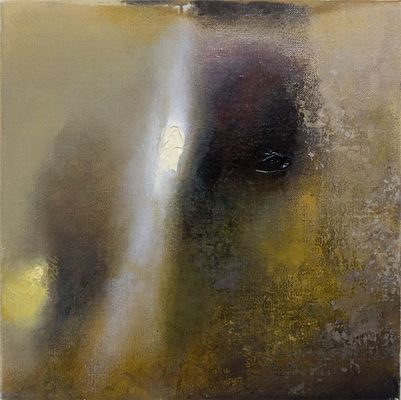
To return to Buckley’s fragment, the first two lines very much evoke how I paint nowadays. As you age, detail diminishes and patches of light become more luminous and float. I feel the most honest way of dealing with this is by smearing the oil paint on the canvas with the fingers and working close-up, blind. Only if the patches coalesce into an approaching image can the work gain a life.
-
Jonathan Walker was born in Melbourne, Australia and brought up on a dairy farm in Gippsland. In the 1970’s he studied painting at RMIT and won the Harold Wright Scholarship to the British Museum, London. During the 1980’s he exhibited at Pinacotheca Gallery, Richmond and had work shown at the NGV and Heidi City Art Gallery. Over the same period he designed the cover for the “Epigenesi” LP by Giancarlo Toniutti, Italy and conducted a mail exchange work with Achim Wollscheid, Germany. The work with artists through the post resulted in an article published in the bicentenary issue of Art and Australia 1988. He showed in artist run spaces such as WestSpace in the 90’s and 2000’s, and until 2012, taught painting at Victoria University, which is where we (Colleen Ahern and Lisa Radford) as organisers of the exhibition, among many others, had the privilege of being his student.
Walker’s knowledge was imparted to students through the careful selection of music, literature, and artists found in books that he himself had ordered for the library. Walker’s strategy was the generosity of sharing his vast knowledge with references specific to each student and their context.
Walker’s paintings share a similar focus and intimacy.
This exhibition presents a small selection of recent paintings alongside a publication that includes Walker’s writing. Observational and analytical, Walker’s work is a type of material notation — the time of day, colour and how it is blended, the both specific and fleeting location of a reflection on lino or the question of whether a chair leg should be included in a painting.
Please join us on Friday August 21 between 6-8pm to celebrate the opening of the exhibition.
Curated by Colleen Ahern and Lisa Radford.
B. Wurtz
Curated by Nic Tammens
March 26 - April 4, 2015
B.Wurtz works from a basement studio in his home on Manhattan’s Lower East Side.
This local fact is attested to by the plastic shopping bags and newsprint circulars that appear in his work. As formal objects, they don’t make loud claims about their origins but nonetheless transmit street addresses and places of business from the bottom of this long thin island. Like plenty of artists, Wurtz is affected by what is local and what is consumed. His work is underpinned by this ethic. It often speaks from a neighborhood or reads like the contents of a hamper:
“BLACK PLUMS $1.29 lb.”
“Food Bazaar”
“USDA Whole Pork Shoulder Picnic 99c lb.”
“RITE AID Pharmacy, with us it’s personal.”
“H. Brickman & Sons.”
“Sweet Yams 59c lb."
Most of the work in this exhibition was made while the artist was in residence at Dieu Donne, a workshop dedicated to paper craft in Midtown. Here Wurtz fabricated assemblages with paper and objects that are relatively lightweight, with the intention that they would be easily transportable to Australia. This consideration isn’t absolute in Wurtz’s work, but was prescriptive for making the current exhibition light and cheap. Packed in two boxes, these works were sent from a USPS post office on the Lower East Side and delivered to North Melbourne by Australia Post.
Wurtz appears courtesy of Metro Pictures, New York.
Thanks to Rob Halverson, Joshua Petherick, Sari de Mallory, Matt Hinkley, Helen Johnson, Fayen d'Evie, Ask Kilmartin, Lisa Radon, Ellena Savage, Yale Union, and "Elizabeth".
John Nixon
"Archive"
December 15 - January 20, 2014
The presentation of John Nixon's archive offered a rare showcase of this extensive collection of the artist's own publications, catalogues, posters, ephemera, editions and more, from the mid 1980s onwards, alongside a selection of his artworks.
Organized by John Nixon, Joshua Petherick and Matt Hinkley.
<a href=http://wfb.public-office.info/artist/john-nixon>All titles by John Nixon
"Habitat"
at Minerva, Sydney (organised by Joshua Petherick and Matt Hinkley)
November 15 - December 20, 2014
Lupo Borgonovo, Janet Burchill & Jennifer McCamley,
Lewis Fidock, HR Giger, Piero Gilardi, Veit Laurent Kurz,
Cinzia Ruggeri, Michael E. Smith, Lucie Stahl, Daniel Weil, Wols
Press Release:
“...It contained seven objects. The slender fluted bone, surely formed for flight, surely from the wing of some large bird. Three archaic circuitboards, faced with mazes of gold. A smooth white sphere of baked clay. An age-blackened fragment of lace. A fingerlength segment of what she assumed was bone from a human wrist, grayish white, inset smoothly with the silicon shaft of a small instrument that must once have ridden flush with the surface of the skin - but the thing’s face was seared and blackened.”
William Gibson, “Count Zero”, 1986
"Autumn Projects Archive"
Curated by Liza Vasiliou
March 6 - March 15, 2014
World Food Books, in conjunction with the Virgin Australia Melbourne Fashion Festival 2014, presented the Autumn Projects archive, consisting of a selection of early examples in Australian fashion with a particular interest in collecting designers and labels from the period beginning in the 1980’s, who significantly influenced the discourse of Australian Fashion.
Curated by Liza Vasiliou, the exhibition provided a unique opportunity to view pieces by designers Anthea Crawford, Barbara Vandenberg, Geoff Liddell and labels CR Australia, Covers, Jag along with early experimental collage pieces by Prue Acton and Sally Browne’s ‘Fragments’ collection, suspended throughout the functioning World Food Books shop in Melbourne.
H.B. Peace
presented by CENTRE FOR STYLE
November 14, 2013
"Hey Blinky, you say chic, I say same"
Anon 2013
H.B. Peace is a clothing collaboration between great friends Blake Barns and Hugh Egan Westland. Their pieces explore the divergences between 'character’ and ‘personality’ in garments....etc
Special Thanks to Joshua Petherick and Matt Hinkley of WFB and Gillian Mears
and a Very Special Thank you to Audrey Thomas Hayes for her shoe collaboration.
Janet Burchill & Jennifer McCamley
"Aesthetic Suicide"
May 10 - June 8, 2013
The first of our occasional exhibitions in the World Food Books office/shop space in Melbourne, "Aesthetic Suicide" presented a body of new and older works together by artists Janet Burchill & Jennifer McCamley, including videos, prints, a wall work, and publications.
During shop open hours videos played every hour, on the hour.
$.00 - Out of stock
The eternal clean out! New items weekly.
https://worldfoodbooks.com/category/sale
Published by World Food Books / Melbourne
$20.00 - In stock -
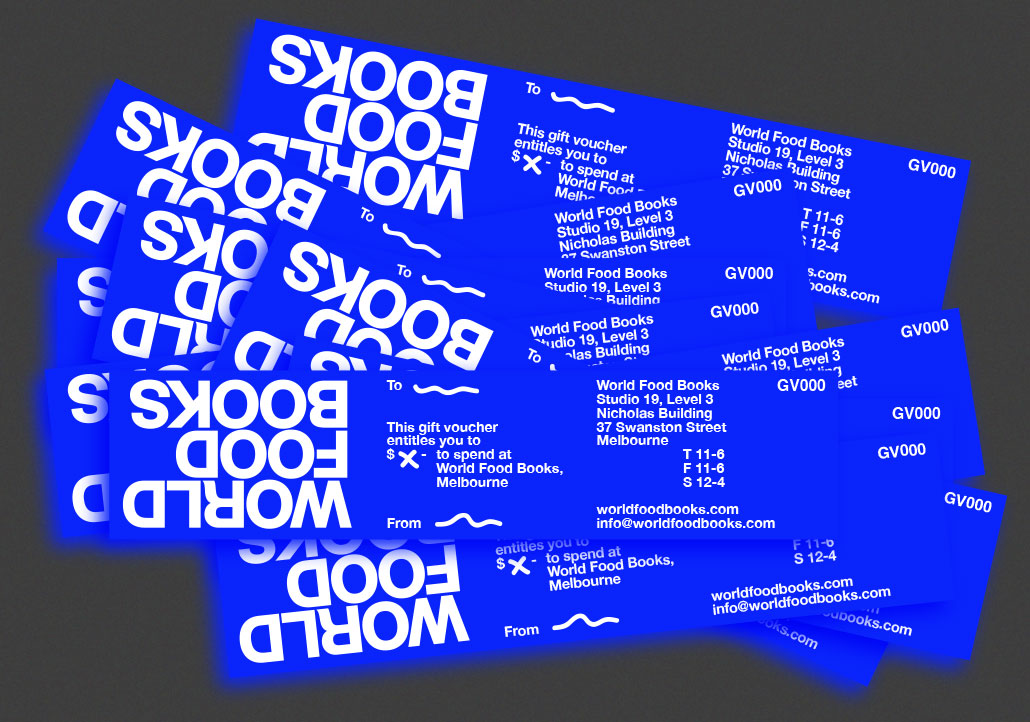
A World Food Books gift voucher is redeemable in our Melbourne bookshop or via our webshop (here). An e-voucher (printable pdf) will be sent to your purchase email address (please notify us if you wish to have the voucher sent to an alternate address and wish us to fill in the receiver's details on the card).
Gift vouchers can be purchased in increments of $20 (Australian Dollars) and the total amount can simply be added to by increasing the quantity in your shopping cart. eg. A quantity of 5 gift vouchers will result in an item total of $100 - a $100 gift voucher. Simply click "ADD TO CART" 5 times, or update your quantity in the shopping cart.
If you wish to purchase multiple, separate gift vouchers in one go, please just email us and we can personally prepare and email you a payment request.
Please note: Please select Pick-Up on gift voucher purchse to avoid any postage charges. Accidental postage charges will be refunded right away!
Thank you.
For any questions, please don't hesitate to email: [email protected]
2012, English
Hardcover (w. dust jacket), 198 pages, 22.5 x15 cm
Published by
Indiana University Press / Indiana
$65.00 - In stock -
This volume consists of two lecture series given by Heidegger in the 1940s and 1950s. The lectures given in Bremen constitute the first public lectures Heidegger delivered after World War II, when he was officially banned from teaching. Here, Heidegger openly resumes thinking that deeply engaged him with Hölderlin's poetry and themes developed in his earlier works. In the Freiburg lectures Heidegger ponders thought itself and freely engages with the German idealists and Greek thinkers who had provoked him in the past. Andrew J. Mitchell's translation allows English-speaking readers to explore important connections with Heidegger's earlier works on language, logic, and reality.
2017, English
Paperback, 128 pages, 17 x 25 cm
Published by
Bergen Kunsthall / Norway
Dancing Fox Press
$65.00 - In stock -
This latest book by New York–based artist Moyra Davey is based on two related projects, Les Goddesses (2011) and Hemlock Forest (2016), which each take form through text, photography, and film. Layering introspection and personal narratives with meditations on the lives and works of other writers, filmmakers, and artists—ranging from 18th-century feminist writer and activist Mary Wollstonecraft to Chantal Akerman, Karl Ove Knausgård, and Davey’s own five sisters—the artist explores such themes as compulsion, artistic production, family, and life and its passing.
Edited by Karen Kelly and Barbara Schroeder.
Texts by Moyra Davey and an introduction by Aveek Sen.
Design by Filiep Tacq.
2026, English
Softcover, 189 pages. 19.6 x 13.1 cm
Published by
Peninsula Press / UK
$35.00 - In stock -
'The Waterfront Journals' is a road trip through the sensuous, perilous landscape of alternative America – a series of fictional monologues that ventriloquise the real people Wojnarowicz met on his travels while he was sleeping rough. We meet these hustlers, runaways and dreamers in unassuming locations – in truck stops, bus stations and parks. Their stories are disturbing, often shocking; but they're told with an honesty and a hallucinatory intensity that demands to be heard. Published for the first time in the UK, this electrifying collection confirms that David Wojnarowicz was not only one of millennial America’s most necessary and visionary artists, but also among its most humane and urgent literary chroniclers.
David Wojnarowicz was a writer, artist, AIDS activist and anticensorship advocate. He wrote five books, and his paintings are exhibited in MoMA and the Whitney Museum of American Art. He died from AIDS in 1992.
A visceral and carnivalesque mosaic of life at the fringes.A totally crucial book by one of the 20th century’s greatest artists and writers.' – Maggie Nelson
2025, English
Hardcover, 208 pages, 28 x 24 cm
Published by
Skira / Milan
$95.00 - In stock -
Edited by Antonio Sergio Bessa
One of David Wojnarowicz's few incursions into photography is a testimony of urban, social and political change in New York in the late 1970s.
In 1978 and 1979, David Wojnarowicz took a series of photographs of a man wearing a paper mask bearing the visage of Arthur Rimbaud, the French poet equally known for his fervid verse and dramatic life. Rimbaud was the instantiation, and perhaps the inventor, of the idea of the young gay hustler of genius.
Presenting a selection of photographs by Wojnarowicz, this amply illustrated volume features an introductory essay by Antonio Sergio Bessa contextualizing the series within a foundation of other works across literature, photography and performance. Nicholas Martin explores Wojnarowicz's practice in the context of the rise of the punk movement in downtown Manhattan in the late 1970s. Craig Dworkin explores Rimbaud's years as a runaway youth in Paris during the Commune, and his acquaintances with the city's bohemia. Marguerite Van Cook contributes an essay about her experiences with the London and New York music and art scenes throughout the 1970s and 1980s. Phillip Aarons offers a personal account of his engagement as a collector of Wojnarowicz's work. The book also features an interview with photographer Allen Frame, who produced several performances of Wojnarowicz's monologues in the early 1980s in New York's Lower East Side, Berlin and Brooklyn.
Painter, photographer, writer, filmmaker, performance artist, songwriter and activist David Wojnarowicz was born in Red Bank, New Jersey, in 1954 and died from AIDS-related illness in New York in 1992. He authored a few books, most famously Close to the Knives. Wojnarowicz attained national prominence as a writer and advocate for AIDS awareness and for his stance against censorship.
2024, English
Softcover, 72 pages, 17.27 x 10.92 cm
Published by
Wakefield Press / Cambridge
$29.00 - In stock -
Introduction by Jean-Luc Nancy
Translated by Stéphanie Boulard and Timothy Lavenz
In 1902, Hugo von Hofmannsthal’s “Lord Chandos Letter” articulated a deep crisis of faith in language; having “lost completely the ability to think or speak of anything coherently,” the titular character abandons literature in favor of silence. In The Answer to Lord Chandos, a text the author spent forty-one years meticulously crafting, Pascal Quignard passionately challenges this withdrawal and urges us not to forsake the power of poetry. By uniting us with the tremendous cry at nature’s birth, literature rejuvenates our connection to the universe and transcends the strictures of acquired speech. In this exhilarating exhortation, which meditates on Emily Brontë, Handel, Rembrandt, and the legend of Bluebeard, Quignard inspires us to resurrect the ecstatic eruption of nature through the written word.
In an introduction to this first English edition, French philosopher Jean-Luc Nancy illuminates the core question animating this debate, which has resonated within literature since its inception: Can poetry give access to the real? Quignard’s resounding answer offers a testament to the immense value of literary expression.
Pascal Quignard (b. 1948) is the French author of over sixty books of fiction, essays, and his own genre of fragmented philosophical reflection: an amalgamation of personal journal, historical narrative, and poetic theory. His books in English include The Hatred of Music, All the World’s Mornings, Sex and Terror, and The Sexual Night, as well as the multiple volumes of his ongoing book project The Last Kingdom, which to date includes The Roving Shadows, The Silent Crossing, Abysses, The Fount of Time, and Dying of Thinking.
Jean-Luc Nancy (1940–2021) was a French philosopher. The subject of a monograph by Jacques Derrida, his long career saw a wide range of books on various thinkers, art, film, and the ideas of community, justice, and freedom. Nearly all his major works have been translated into English, including The Inoperative Community, The Birth to Presence, The Experience of Freedom, The Gravity of Thought, and Being Singular Plural.
2023, English
Softcover, 72 pages, 17.8 x 11.4 cm
Published by
Wakefield Press / Cambridge
$29.00 - In stock -
Translated, with an introduction, by Justin Vicari.
Conceived in a hospital bed in 1917, then written a few months later after his first and fateful encounter with Lautréamont’s Maldoror, Philippe Soupault’s novella, The Voyage of Horace Pirouelle, preceded the author’s involvement with the Parisian Dada movement and the adventure of surrealism he would later launch with his friends. Inspired by a Liberian schoolmate’s sudden departure for Greenland on a whim and his subsequent disappearance into that distant country, Soupault imagines his alter ego’s adventures as entries in a journal both personal and fictional. Adopted by an Inuit tribe, Pirouelle drifts from one encounter to another, from one casual murder to another, until his life of liberty and spontaneity leads him to stasis at the edge of existence.
Floating between the romantic legacy of Arthur Rimbaud’s abandonment of literature and the banality and loss of personality and morality in the adventurer’s abandonment of society, The Voyage of Horace Pirouelle charts out a troubled tribute to wanderlust and the acte gratuit.
After taking an active part in French Dada, Philippe Soupault (1897–1990) cofounded the surrealist movement with André Breton and Louis Aragon, and authored with Breton The Magnetic Fields, the first official surrealist work. After being expelled from the movement for the crime of being “too literary,” he devoted his life to writing, travel, journalism, and political activity (for which he was put in prison by the collaborationist Vichy government).
2024, English
Softcover, 160 pages, 20.5 x 13.5 cm
Published by
Wakefield Press / Cambridge
$34.00 - In stock -
With the 2018 publication of Letters, Dreams, and Other Writings, Wakefield Press introduced the writings of Surrealist painter Remedios Varo into English for the first time. These texts, never published during her lifetime, presented something of a missing chapter, and offered the same qualities to be found in her visual work: an engagement with mysticism and magic, a breakdown of the border between the everyday and the marvelous, a love of mischief, and an ongoing meditation on the need for (and the trauma of) escape in all its forms.
This new, expanded volume brings together the painter’s collected writings, an unpublished interview, letters to friends and acquaintances (as well as to people unknown), dream accounts, notes for unrealized projects, a project for a theater piece, whimsical recipes for controlled dreaming, and exercises in Surrealist automatic writing, as well as prose-poem commentaries on her paintings. It also includes her longest manuscript, the pseudoscientific On Homo rodans: an absurdist study of the wheeled predecessor to Homo sapiens (the skeleton of which Varo had built out of chicken bones). Written by the invented anthropologist Hälikcio von Fuhrängschmidt, the essay utilizes eccentric Latin and a tongue-in-cheek pompous discourse to explain the origins of the first umbrella and in what ways Myths are merely corrupted Myrtles.
Also included are newly discovered writings, among them three short stories, never before published in any language.
Edited and translated by Margaret Carson
Remedios Varo (1908–1963) was a Spanish-born painter who entered the Surrealist circle in Paris before the German occupation forced her into exile to Mexico at the end of 1941, where she would stay until the end of her life. Her dream-infused allegorical works combine the elements of classical training, alchemical mysticism, and fairy-tale science.
1997 / 1999, English
Softcover, 188 pages, 22.5 x 15 cm
1st Edition, Out of print title / used / fine
Published by
Cambridge University Press / Cambridge
$30.00 - In stock -
Kant is the central figure of modern philosophy. He sought to rebuild philosophy from the ground up, and he succeeded in permanently changing its problems and methods. This revised edition of the Prolegomena, which is the best introduction to the theoretical side of his philosophy, presents his thought clearly by paying careful attention to his original language. Also included are selections from the Critique of Pure Reason, which fill out and explicate some of Kant's central arguments (including famous sections of the Schematism and Analogies), and in which Kant himself explains his special terminology. The first reviews of the Critique, to which Kant responded in the Prolegomena, are included in this revised edition. The volume is completed by a historical and philosophical introduction, explanatory notes, a chronology, and a guide to further reading.
Fine copy.
2025, English
Softcover, 176 pages, 19.8 x 12.9 cm
Published by
Silver Press / London
$55.00 - In stock -
When Ursula K. Le Guin started writing a new story, she would begin by drawing a map. The Word for World presents a selection of these images by the celebrated author, many of which have never been published before, to consider how her imaginary worlds enable us to re-envision our own.
Le Guin’s maps offer journeys of consciousness beyond conventional cartography, from the Rorschach-like archipelagos of Earthsea to the talismanic maps of Always Coming Home. Rather than remaining within known terrain, they open up paradigms of knowledge, exemplified by the map’s edges and how a map is read, made and re-made, together. The Word for World brings her maps together with poems, stories, interviews, recipes and essays by contributors from a variety of perspectives to enquire into the relationship between worlds and how they are represented and imagined.
Contributors: Federico Campagna, Theo Downes-Le Guin, Daniel Heath Justice, Bhanu Kapil, Canisia Lubrin, Una McCormack, David Naimon, Nisha Ramayya, Shoshone Collective, Standard Deviation, Marilyn Strathern.
Co-published by Spiral House and AA Publications to coincide with an exhibition of Ursula K. Le Guin’s maps at the Architectural Association, London, opening on 10 October 2025.
”One of the literary greats of the 20th century.” Margaret Atwood
”An anarchic destabilizer of established power structures and a ferocious critic of racist and sexist narratives.” Maria Dahvana Headley
“great teacher. great spirit.” adrienne maree brown
“A crafter of fierce, focused, fertile dreams.” David Mitchell
“A deepener and clarifier of possibility.” Nicola Griffith
“A literary icon.” Stephen King
1989, English
Softcover, 176 pages, 13.6 x 20 cm
1st Edition, Out of print title / used / good
Published by
Columbia University Press / New York
$25.00 - In stock -
Derrida offers significant insights into de Man's understanding of Heidegger, Holderlin, Hegel, Austin, and Rouseau. A warm, personal, and at times touching account of the de Man/Derrida intellectual friendship and the existential experience of a friend's death, this work shows a very human side to a thinker whose humanity has been questioned by the critics.
"Derrida offers significant insights into de Man's understanding of Heidegger, Hoderlin, Hegel, Austin, and Rosseau. A warm, personal, and at times touching account of the de Man/Derrida intellectual friendship and the existential experience of a friend's death, this work shows a very human side to a thinker whose humanity has been questioned by the critics. A welcome addition to any library already containing some writings of Derrida."—Choice
1989 edition, revised, year? Good copy, light general wear, chip to spine.
1993, English
Softcover, 106 pages, 21.6 x 14 cm
1st Edition, Out of print title / used / good
Published by
State University of New York Press / New York
$15.00 - In stock -
Here are the major statements of the leading figures in the nineteenth- and twentieth-century German and French hermeneutic traditions—the major statements on the aims, methods, and techniques of interpretation. Some of these appear here for the first time in English.
This book establishes the context for contemporary analyses of interpretation. Part I traces the evolution of hermeneutics from Friedrich Ast and Friedrich Schleiermacher through Wilhelm Dilthey to Martin Heidegger's placing of hermeneutics at the center of the ontological analysis of human being. Part II follows the development of the Heideggerian tradition in the writings of Hans-Georg Gadamer. Gadamer's "philosophical hermeneutics" is then located at the center of several important exchanges with more traditional, objective hermeneutical methodologists like Emilio Betti, ideology-critics like Jürgen Habermas, and linguistic-phenomenological thinkers like Paul Ricoeur.
Gayle L. Ormiston is Professor in the Department of Philosophy at Kent State University. Alan D. Schrift is Assistant Professor of Philosophy at Grinnell College.
Good copy with some wear and bumping to extremities/boards.
2006, English
Softcover, 122 pages, 21.5 x 14 cm
1st Edition, Out of print title / used / fine
Published by
Power Publications / Sydney
$60.00 - In stock -
First 2006 edition. Edited by Paul Patton and Terry Smith. Long out-of-print.
Jacques Derrida's two Sydney seminars of August 1999 enabled him to present some of the principal themes of his work to non-specialist audiences. As might be expected of a Sydney setting, warmth of feeling and openness of spirit pervaded both occasions. Derrida's willingness to engage with both interlocutors and audiences ensured an exciting demonstration of the subtlety and flexibility of deconstructive thinking in action.
This book is reconstructed from the transcripts of those sessions. It provides a clear, systematic and highly accessible introduction to many of the central concerns of Derrida's engagement with philosophy, visual art and politics.
Fine copy.
1993, English
Softcover, 106 pages, 21.6 x 14 cm
1st Edition, Out of print title / used / very good
Published by
Stanford University Press / Palo Alto
$20.00 - In stock -
Derrida's Aporias bears a special significance because it focuses on an issue that has informed the whole of his work up to the present. One of the aporetic experiences touched upon is that "my death" can never be subject to an experience that would be properly mine, that I can have and account for, yet that there is, at the same time, nothing closer to me and more properly mine than "my death."
Translated by Thomas Dutoit.
VG copy of the 1st ed.
1991 / 2000, English
Softcover, 304 pages, 23 x 15 cm
Published by
University of Minnesota Press / Minnesota
$35.00 - In stock -
A fresh take on this critical philosopher. In this essential rereading of Spinoza's (1632-1677) philosophical and political writings, Negri positions this thinker within the historical context of the development of the modern state and its attendant political economy. Through a close examination of Spinoza, Negri reveals him as unique among his contemporaries for his nondialectical approach to social organization in a bourgeois age.
After living in exile in France for nearly fourteen years, Antonio Negri is currently serving a jail sentence in Italy, his home country, for his political activism in the 1970s. His conviction, which was based on the substance of his writings, led Michel Foucault to ask, "Isn't he in prison simply for being an intellectual?" Negri's works in English include Insurgencies (1999) and, with Michael Hardt, Labor of Dionysus (1994), both published by Minnesota.
1998, English
Softcover, 372 pages, 23.5 x 14.8 cm
1st Edition, Out of print title / used / very good
Published by
Johns Hopkins University Press / Baltimore
$35.00 - In stock -
A classic work on Freud by one of France's foremost philosophers and literary critics.
Jacques Lacan's commentaries on Freud had revolutionary implications not only for the analytic movement but also for contemporary philosophy and literary criticism. Lacan held that if the unconscious, as Freud described it, exists, it functions linguistically, rather than symbolically or instinctually. He refers to the unconscious as a language: "the discourse of the Other." In The Language of the Self Lacan offers a significant and fertile return to the heart of the Freudian texts.
Originally published in paperback under the title Speech and Language in Psychoanalysis, this book is based on Anthony Wilden's translation of "Fonction et champ de la parole et du langage en psychanalyse," a 1953 article that became a manifesto for a generation interested in a new reading of Freud. Wilden expands and amplifies the text with extensive notes and a commentary that places Lacan's work in the context of contemporary thought.
VG 1998 edition. Some sticker remnants to b.c.
2018, English
Hardcover, 788 pages, 28.7 x 25.4 cm
Published by
Kant / Prague
$220.00 - In stock -
Art theorist and critic, graphic designer, artist, author and translator Karel Teige (1900–51) is today recognized not just as the creator of internationally acclaimed surrealist collages, but also as a leading figure of the European avant-garde. Teige spent his entire life commenting on and interpreting developments in the visual arts. His multifaceted theoretical writings helped shape the conceptual foundations of modern art, and his activities and intensive contacts with other members of the European avant-garde helped secure Czech art's place on the international art scene. His work anticipated, initiated and helped to develop the progressive artistic movements that fundamentally influenced art in the 20th century.
Karel Teige was one of the great European intellectuals of his time; his efforts were aimed at creating not just a system of aesthetics but also an all-encompassing life philosophy. He was intensively interested in architecture and found inspiration in Germany's Bauhaus (where he spent a year lecturing); architectural functionalism would have looked completely different without his input. Teige's preference for rational, minimalist designs with an emphasis on the social uses of modern architecture was the "most functionalist functionalism" of his time.
Teige's own work consisted primarily of a series of phenomenal collages that reveal the hidden and passionate aspects of his personality. His book designs set the tone for an entire generation, and his design principles remain valid today. Teige's complicated personality, full of contradictions, utopian dreams and a yearning for order and logic make him an indecipherable and deeply human individual, a perfect symbol for the 20th century.
This comprehensive, nearly 800-page monograph, by the art historian Rea Michalová, takes a wide-ranging look at the evolution of Teige's ideological, theoretical and political views, and recalls important moments in his life and their significance within the international context. The book includes a rich set of illustrations, photographs from his life, and examples of his unique collages and graphic designs.
"Just a few of the reasons why we can't get over this new Karel Teige monograph. Measuring more than 2.5 inches thick and just under 800 pages long—with 318 color reproductions and a whopping 635 pages of scholarly texts—Karel Teige: Captain of the Avant-Garde, the new Teige monograph from noted Czech art book publisher Kant, is truly extraordinary. "There is no need to explain who Karel Teige was," a Czech writer for Typografia magazine proclaimed in 1927. "I don't think that there was a single modern impulse in our country that he did not either directly inspire or at least support. Architecture, poetry, film, photography, painting, theater, typography—all these bear traces of his insightfulness and modernity."
1966, Czech
Folder/dust jacket containing 2 staple-bound booklets, 24 + 24 pages, 22 x 20.5 cm
1st Edition, Out of print title / used / very good
Published by
Dum Umeni Mesta / Brno
$70.00 - In stock -
Lovely rare exhibition catalogue by Czechoslovak surrealist painter and ceramist, Václav Tikal (1906—1965), a 1966 posthumous exhibition of paintings from between 1941-1965, published by Dum Umeni Mesta, Brno. The show travelled between Brno and Prague. Catalogue comprises a folder/dust jacket housing 2 booklets, each 24 pages — the first a lengthy text by František Šmejkal, portrait of Tikal by Karel Kuklík, bio, list of exhibitions, and full catalogue of exhibited works. The second is entirely made up of b/w reproductions of Tikal's paintings.
Václav Tikal was a Czech painter associated with the Surrealist movement in Prague. Active from the 1930s onward, he worked within the circle of the Czech Surrealist group, whose members were deeply influenced by the ideas of André Breton and the international Surrealist movement. Tikal was closely connected with leading figures of Czech Surrealism such as Karel Teige, Toyen, Jindřich Štyrský, and poet Vítězslav Nezval. While some of his colleagues focused strongly on erotic or poetic imagery, Tikal’s paintings often reflected his background in architecture: he created carefully structured compositions filled with enigmatic objects, landscapes, and spatial constructions that evoke a sense of quiet mystery.
Very Good copy is light softening at edges, light/marking tanning.
1967, English / German
Hardcover (w. dust jacket), 167 pages, 28.5 x 22.5 cm
1st Edition, Out of print title / used / good
Published by
Verlag Gerd Hatje / Stuttgart
$65.00 - Out of stock
Wonderful 1967 hardcover book on cutting edge International Shop Design from the mid-1960s, edited by Karl Kaspar and published by Verlag Gerd Hatje, Stuttgart. Bi-lingual English and German texts accompany beautiful monochrome interior photography and technical drawings of lavish (mostly) European retail spaces that put contemporary retail design to shame, including stores for fashion, jewellery, photographic equipment, shoes, textiles, electrical appliances, bookshops, travel bureaux, hairdressing salons, showrooms for Knoll International, Olivetti, and IBM, and much more. Includes architects/designers: Robin Day, Joe Columbo, Hans Hollein, Franco Albini, Marvin B. Affrime, Gordon Andrews, Carl Aubock, Ingeborg August, BPRR Studio Architetti, Walter G. Bee, Walter Belz, Emiliano Bernasconi, Gian Antonio Bernasconi, Werner Blaser, Jørgen Bo, Gordon Bowyer & Ursula Bowyer, H. Brauns, Cesare Casati, Gaviglio Chini, Lacca Christen, Andreas Colombo, Conran Design Group, Claus Cullmann, Robin Day, Redfern & Partners Diamond, Madigan Edwards Torzillo & Partners, Hans Eichenberger, Frank R. Falla, Fautz & Rau, Sverre Fehn, Luigi Figini, Rodney Fitch, Gianfranco Frattini, Alexander Girardi, Rolf Gutbier, Franca Helg, Bård Henriksen, Hans Hollein, Enzo Hybsch, R. Jäneschitz-Kriegl, Hans Kammerer, Morris Ketchum Jr. & Associates, Knoll International Planungsabteilung, Knoll Planning Unit, Aris Konstantinidis, E. und G. Kuhn, Henry F. Kurz, Julio Lafuente, Victor Lundy, Gerald Luss, Helmut Magg, Karl Mang and Eva Mang, José Sotera Mauri, Mavis Milburn, Peter Moro & Partners, Arne Neegård, Eliot Noyes & Associates, Hans Peter Piel, Gino Pollini, Giancarlo Pozzo, Max Rasser, David Rock, Rosenthal Studio B, Carlo Scarpa, Pierluigi Spadolini, Francis B. Tamborini, The Space Design Group, Tibere Vadi, Vittoriano Vigano, Hans G. Walter, Ward & Saks, Inc., Bryan & Norman Westwood, Piet & Partners.
Good copy with tanning to edges of block and dust jacket, wear to cloth boards extremities. Tapes marks to interior initial blanks/dust jacket interior.
1970, Czech
Hardcover (w. dust jacket), 178 pages, 26 x 22.5 cm
1st Edition, Out of print title / used / very good
Published by
Odeon / Prague
$160.00 - Out of stock
First 1970 hardcover edition of the seldom seen artist's book/monograph of one of the most important representatives of the Czech avant-garde - Jindřich Štyrský (1899–1942). This book presents Štyrský's written and artistic records of dreams through his drawings, paintings and collages, alongside his poetry and other writings spanning 1925-1940. Originally published as a slim private press edition in 1941, in 1967 author/editor František Šmejkal expanded the original with an afterword and prepared it for this major hardcover edition with the publisher that Štyrský himself regularly worked for as a writer and author, Odean Press in Prague. By studying his own dreams, writings of Freud, works of symbolism, surrealism or authors such as A. Rimbaud, de Sade or Lautréamont, Jindřich Štyrský tried to understand the conditions of imagination (sources of evil, pain, sadism, condolences and hope contained in one human mind). Published in an edition of 3000 copies and now long collectable.
Jindřich Štyrský (1899 – 1942) was a Czech Surrealist painter, poet, editor, photographer, and graphic artist. Precocious, he began executing remarkable, original artwork in his teens and soon connected with soulmates Karel Teige, the painter Toyen, and the poet Vítězslav Nezval who would form the nexus of the Czech avant-garde. His outstanding and varied oeuvre included numerous book covers, illustrations and written studies of both Arthur Rimbaud and Marquis de Sade. Along with his artistic partner Toyen (Marie Čermínová), he became a member of Devětsil in 1923. He and Toyen also exhibited in Paris in the late 1920s, where they founded their own movement, Artificialism. Between 1928 and 1929 he was designer for the group's drama wing, the Osvobozené divadlo, where he collaborated with Vítězslav Nezval and others. Štyrský was also an active editor. In addition to his Edition 69 series, he edited the Erotická revue, which he launched in 1930, and Odeon, where many of his shorter texts appeared. He was a founding member of The Surrealist Group of Czechoslovakia and a force of inner resistance in the German occupation.
Very Good copy with Good dust jacket.
1990, Japanese
Softcover, 300 pages, 21 x 15 cm
1st Edition, Out of print title / used / very good
Published by
Million Publishing / Tokyo
$60.00 - In stock -
August 1990 issue of S&M Sniper, the cutting-edge cult glossy fetish magazine published in Japan between 1979—2009 that, unlike previous SM magazines, didn't centre so much around professional kinbakushi, favouring instead the exploration of new innovations of fetish and underground sex culture and emphasising the work of the models, stylists, make-up artists, and fashions designers, as much as the writers or photographers. The "new wave" of SM counterculture, embedded in 1980s underground music, fashion and visual art culture in Japan. Explicitly and profusely illustrated, each issue came wrapped in the iconic hyper-stylized airbrushed front covers of artist Yosuke Onishi, veiling the core content of non-fiction realist degradation and an eclectic, expressive editorial of kinbaku and all manner of SM, and extreme fetish photoshoots, illustrations, comics, essays, diaries, reports, exhibitions, reviews, interviews, and included regular contributors such as SM archivist and noise musician Masami Akita (Merzbow), legendary SM writer and editor Dan Oniroku ("the most celebrated writer of popular SM novels in Japan"), features by legendary SM and seppuku performer, actress, and author Hiromi Saotome, features by contributing photographers Nobuyoshi Araki, Masaaki Toyoura, Kenichi Murata, Nobuhiko Ansai, Kinichi Tanaka, Domu Kitahara, sadistic BDSM trainer Shima Shikou, and regular writings by convicted murderer and cannibal Issei Sagawa!! Including his translations of Guido Crepax comics from Italian to Japanese. This was not a magazine like the others. Each issue is also brimming with amazing Japanese advertisements and classifieds for the latest bondage clubs, boutiques, dungeons, fashion, toys, video and publication catalogues, hook-ups, phone sex, and much more. This issue includes Nobuyoshi Araki, Yosuke Onishi, Katsu Yoshida, Ansai Nobuhiko, Kinichi Tanaka, Masao Takahashi, Tadao Chigusa, Masatoshi Aki, Shima Shikou, Tokuro Takahashi, Yukimasa Okumura, Naito Hisashi, all the usual and more... Not for the faint of heart.
Very Good copy.
1985, Japanese
Softcover, 300 pages, 21 x 15 cm
1st Edition, Out of print title / used / very good
Published by
Million Publishing / Tokyo
$65.00 - In stock -
November 1985 issue of S&M Sniper, the cutting-edge cult glossy fetish magazine published in Japan between 1979—2009 that, unlike previous SM magazines, didn't centre so much around professional kinbakushi, favouring instead the exploration of new innovations of fetish and underground sex culture and emphasising the work of the models, stylists, make-up artists, and fashions designers, as much as the writers or photographers. The "new wave" of SM counterculture, embedded in 1980s underground music, fashion and visual art culture in Japan. Explicitly and profusely illustrated, each issue came wrapped in the iconic hyper-stylized airbrushed front covers of artist Yosuke Onishi, veiling the core content of non-fiction realist degradation and an eclectic, expressive editorial of kinbaku and all manner of SM, and extreme fetish photoshoots, illustrations, comics, essays, diaries, reports, exhibitions, reviews, interviews, and included regular contributors such as SM archivist and noise musician Masami Akita (Merzbow), legendary SM writer and editor Dan Oniroku ("the most celebrated writer of popular SM novels in Japan"), features by legendary SM and seppuku performer, actress, and author Hiromi Saotome, features by contributing photographers Nobuyoshi Araki, Masaaki Toyoura, Kenichi Murata, Nobuhiko Ansai, Kinichi Tanaka, Domu Kitahara, sadistic BDSM trainer Shima Shikou, and regular writings by convicted murderer and cannibal Issei Sagawa!! Including his translations of Guido Crepax comics from Italian to Japanese. This was not a magazine like the others. Each issue is also brimming with amazing Japanese advertisements and classifieds for the latest bondage clubs, boutiques, dungeons, fashion, toys, video and publication catalogues, hook-ups, phone sex, and much more.
This issue includes Nobuyoshi Araki, Yosuke Onishi, Fumika Kitahara, actress Mami Fujimura, Hiromi Hiraguchi, Junji Yoshizaki, Satoshi Tokuno, Yayoi Honda, Mitsuhiko Yoshida, Tadao Chigusa, Kinichi Tanaka, Nobuhiko Ansai, Nakai Sugimura, all the usual and more... Not for the faint of heart.
Very Good copy.
1985, Japanese
Softcover, 300 pages, 21 x 15 cm
1st Edition, Out of print title / used / very good
Published by
Million Publishing / Tokyo
$65.00 - In stock -
October 1985 issue of S&M Sniper, the cutting-edge cult glossy fetish magazine published in Japan between 1979—2009 that, unlike previous SM magazines, didn't centre so much around professional kinbakushi, favouring instead the exploration of new innovations of fetish and underground sex culture and emphasising the work of the models, stylists, make-up artists, and fashions designers, as much as the writers or photographers. The "new wave" of SM counterculture, embedded in 1980s underground music, fashion and visual art culture in Japan. Explicitly and profusely illustrated, each issue came wrapped in the iconic hyper-stylized airbrushed front covers of artist Yosuke Onishi, veiling the core content of non-fiction realist degradation and an eclectic, expressive editorial of kinbaku and all manner of SM, and extreme fetish photoshoots, illustrations, comics, essays, diaries, reports, exhibitions, reviews, interviews, and included regular contributors such as SM archivist and noise musician Masami Akita (Merzbow), legendary SM writer and editor Dan Oniroku ("the most celebrated writer of popular SM novels in Japan"), features by legendary SM and seppuku performer, actress, and author Hiromi Saotome, features by contributing photographers Nobuyoshi Araki, Masaaki Toyoura, Kenichi Murata, Nobuhiko Ansai, Kinichi Tanaka, Domu Kitahara, sadistic BDSM trainer Shima Shikou, and regular writings by convicted murderer and cannibal Issei Sagawa!! Including his translations of Guido Crepax comics from Italian to Japanese. This was not a magazine like the others. Each issue is also brimming with amazing Japanese advertisements and classifieds for the latest bondage clubs, boutiques, dungeons, fashion, toys, video and publication catalogues, hook-ups, phone sex, and much more.
This issue includes Nobuyoshi Araki, Yosuke Onishi, Kitahara Fumika, Aki Ryo, Todoroki Sukeroku, Kinichi Tanaka, Tokuno Masahito, Naomi Hagio, Hiromi Haraguchi, Yukiko Hayashi, actress Mai Momonoki, all the usual and more... Not for the faint of heart.
Very Good copy.