World Food Books' programme is largely produced on Kulin Nation land. We acknowledge the Wurundjeri people of the Kulin Nation as the first and continuing custodians of this land, and pay respect to their Elders past, present, and emerging.
World Food Books is an arts and special interests bookshop in Naarm / Melbourne. Founded in 2010, World Food Books is devoted to the presentation of a rotating, hand-selection of international art, design, literary and counterculture publications with an emphasis on the anti-traditional, the experimental, the avant-garde, the heretic, the marginal.
Presenting new titles alongside rare and out-of-print books, catalogues and journals spanning the fields of modern and contemporary art, design, photography, illustration, film, literature, poetry, cultural theory, philosophy, sexuality, popular and underground culture in its many radical forms, World Food Books wishes to encourage adventurous, thoughtful and open-minded reading, looking, writing, and exchange of publishing and ideas, both current and historical.
As well as our bookshop, located in Melbourne's historical Nicholas Building, all of our inventory is available internationally via our online mail-order service.
World Food Books semi-regularly co-ordinates "Occasions", a programme of exhibits and events at the bookshop and in partnership with other hosts (such as museums and art galleries) that develop out of the activities, relationships and content of the bookshop itself.
World Food Books
The Nicholas Building
37 Swanston Street
Room 5, Level 6
Melbourne 3000
Australia
SHOP HOURS:
Thu–Fri 12–6
Sat 12–5
WEB-SHOP OPEN 24/7
World Food Books
Postal Address:
37 Swanston Street
Room 5, Level 6
Melbourne 3000
Australia
Art
Theory / Essay
Architecture / Interior
Graphic Design / Typography
Photography
Fashion
Eros
LGBTQ+
Fiction / Poetry
Weird / Speculative / Science Fiction / Horror
Transgressive / Visceral / Abject
Symbolism / Decadence / Fin de siècle
Film / Video
Painting
Sculpture / Installation
Performance / Dance / Theater
Drawing
Sound / Music
Curatorial
Group Shows / Collections
Periodicals
Out-of-print / Rare
Posters / Ephemera / Discs
Signed Books
World Food Books Gift Voucher
World Food Book Bag
Australian Art
Australian Fiction
Australian Science Fiction / Speculative Fiction
Australian Poetry
Australian Photography
Japanese Photography
Conceptual Art
Minimal Art
Dada
'Pataphysics / Oulipo
Fluxus
Concrete Poetry
Pop Art
Surrealism
Arte Povera
Arte Informale / Haute Pâte / Tachism
Nouveau Réalisme / Zero / Kinetic
Situationism / Lettrism
Collage / Mail Art / Xerox Art
Art Brut / Folk / Visionary / Fantastic
Illustration / Graphic Art / Bandes Dessinées
Furniture
Italian Radical Design / Postmodernism
Textiles
Ceramics / Glass
Counterculture
Protest / Revolt
Philosophy
Psychoanalysis
Anthropology
Anarchism
Socialism / Anarchism / Communism / Capitalism
Literary Theory / Semiotics / Language
Feminism / Women's Studies
Gender Studies / Sexuality
Anthropology
Fetishism / BDSM
Drugs / Psychedelia
Crime / Violence
Animal Rights / Veganism
Occult / Esoterica
Ecology / Earth / Alternative Living
Whole Earth / Crafts
All prices in AUD (Australian dollars)
Pick-Ups
Pick-up orders can be collected in our bookshop during opening hours after order date. Please collect any Pick-up orders within 2 weeks of ordering as we have limited storage space. Orders will be released back into stock if not collected within this time. No refunds can be made for pick-ups left un-collected. If you cannot make it in to the bookshop in this time-frame, please choose postage option.
Return Policy
All sales are final. We do accept returns (for refund or exchange) for items received in error. All our orders are packed with special care using heavy-duty padding and cardboard book-mailers or bubble mailers (for smaller books), using reinforcement where required. We cannot take responsibility for any lost, stolen or damaged parcels.
Insurance
Should you wish to insure your package, please email us directly after placing your order and we can organise this at a small extra expense. Although all standard/express tracked packages are very safe and dependable, we cannot take responsibility for any lost, stolen or damaged parcels. We recommend insurance on valuable orders.
Interested in selling your old books, catalogues, journals, magazines, comics, fanzines, ephemera? We are always looking for interesting, unusual and out-of-print books to buy. We only buy books in our fields of interest and specialty, and that we feel we can resell.
We base these prices on desirability, market value, in-print prices, condition and our current stock levels. We offer cash, store credit, and can take stock on consignment. All
about 25% of the price we expect to get when we sell them, or 30% in store credit. We base these prices on desirability, market value, in-print prices, condition and our current stock levels.
Sell your books any day of the week. You can drop them off and return later. If you have a lot of books, we can visit your Sydney home.
We buy books that we feel we can resell. We offer about 25 % of the price we expect to get when we sell them, or 30% in store credit. We base these prices on desirability, market value, in-print prices, condition and our current stock levels.
Philadelphia Wireman
03 August - 01 September, 2018
World Food Books is proud to announce our next Occasion, the first presentation of sculptures by Philadelphia Wireman in Australia.
The Philadelphia Wireman sculptures were found abandoned in an alley off Philadelphia’s South Street on trash night in 1982. Their discovery in a rapidly-changing neighbourhood undergoing extensive renovation, compounded with the failure of all attempts to locate the artist, suggests that the works may have been discarded after the maker’s death. Dubbed the "Philadelphia Wireman" during the first exhibition of this work, in 1985, the maker’s name, age, ethnicity, and even gender remain uncertain. The entire collection totals approximately 1200 pieces, all intricately bound together with tightly-wound heavy-gauge wire (along with a few small, abstract marker drawings, reminiscent both of Mark Tobey and J.B. Murry). The dense construction of the work, despite a modest range of scale and materials, is singularly obsessive and disciplined in design: a wire armature or exoskeleton firmly binds a bricolage of found objects including plastic, glass, food packaging, umbrella parts, tape, rubber, batteries, pens, leather, reflectors, nuts and bolts, nails, foil, coins, toys, watches, eyeglasses, tools, and jewellery.
Heavy with associations—anthropomorphic, zoomorphic, and socio-cultural responses to wrapped detritus—the totemic sculptures by Philadelphia Wireman have been discussed in the context of work created to fulfil the shamanistic needs of alternative religions in American culture. Curators, collectors, and critics have variously compared certain pieces to sculpture from Classical antiquity, Native American medicine bundles, African-American memory jugs, and African fetish objects. Reflecting the artist’s prolific and incredibly focused scavenging impulse, and despite—or perhaps enhanced by—their anonymity, these enigmatic objects function as urban artefacts and arbiters of power, though their origin and purpose is unknown. Philadelphia Wireman, whatever their identity, possessed an astonishing ability to isolate and communicate the concepts of power and energy through the selection and transformation of ordinary materials. Over the course of the past two decades, this collection has come to be regarded as an important discovery in the field of self-taught art and vernacular art.
Presented in collaboration with Fleisher-Ollman Gallery, Philadelphia, and Robert Heald, Wellington.
Susan Te Kahurangi King
02 February - 10 March, 2018
Susan Te Kahurangi King (24 February 1951 - ) has been a confident and prolific artist since she was a young child, drawing with readily available materials - pencils, ballpoint pens and felt-tip markers, on whatever paper is at hand. Between the ages of four and six Susan slowly ceased verbal communication. Her grandparents William and Myrtle Murphy had developed a special bond with Susan so they took on caring responsibilities for extended periods. Myrtle began informally archiving her work, carefully collecting and storing the drawings and compiling scrapbooks. No drawing was insignificant; every scrap of paper was kept. The King family are now the custodians of a vast collection containing over 7000 individual works, from tiny scraps of paper through to 5 meter long rolls.
The scrapbooks and diaries reveal Myrtle to be a woman of great patience and compassion, seeking to understand a child who was not always behaving as expected. She encouraged Susan to be observant, to explore her environment and absorb all the sights and sounds. Myrtle would show Susan’s drawings to friends and people in her community that she had dealings with, such as shopkeepers and postal workers, but this was not simply a case of a grandmother’s bias. She recognised that Susan had developed a sophisticated and unique visual language and sincerely believed that her art deserved serious attention.
This was an unorthodox attitude for the time. To provide some context, Jean Dubuffet coined the term Art Brut in 1945 to describe work created by self-taught artists – specifically residents of psychiatric institutions and those he considered to be visionaries or eccentrics. In 1972 Roger Cardinal extended this concept by adopting the term Outsider Art to describe work made by non-academically trained artists operating outside of mainstream art networks through choice or circumstance. Susan was born in Te Aroha, New Zealand in 1951, far from the artistic hubs of Paris and London that Dubuffet and Cardinal operated in. That Myrtle fêted Susan as a self-taught artist who deserved to be taken seriously shows how progressive her attitudes were.
Susan’s parents Doug and Dawn were also progressive. Over the years they had consulted numerous health practitioners about Susan’s condition, as the medical establishment could not provide an explanation as to why she had lapsed into silence. Dawn educated herself in the field of homeopathy and went on to treat all twelve of her children using these principles – basing prescriptions on her observations of their physical, mental and emotional state.
Doug was a linguist with an interest in philosophy who devoted what little spare time he had to studying Maori language and culture. To some extent their willingness to explore the fringes of the mainstream made them outsiders too but it was their commitment to living with integrity and their respect for individuality that ensured Susan’s creativity was always encouraged.
Even though Susan’s family supported her artistic pursuits, some staff in schools and hospitals saw it as an impediment to her assimilation into the community and discouraged it in a variety of ways. Her family was not always aware of this and therefore did not fully understand why Susan stopped drawing in the early 1990s. However, rather than dwell on the challenges that Susan faced in pursuit of her artistic practice, they prefer to highlight her achievements. In 2008 Susan began drawing again in earnest, after an almost 20 year interruption, and her work is now shown in galleries around the world.
Susan grew up without television and has been heavily influenced by the comics she read as a child. She is absolutely fearless in the appropriation of recognizable characters, such as Donald Duck and Mickey Mouse, in her work. She twists their limbs, contorts their faces, compresses them together, blends them into complex patterned backgrounds - always imbuing them with an incredible energy. Although Susan often used pop culture characters in her work they are not naive or childlike. These are drawings by a brilliant self-taught artist who has been creating exceptional work for decades without an audience in mind.
Mladen Stilinović
"Various Works 1986 - 1999"
02 February 16 - September 10, 2016
Various works 1986 - 1999, from two houses, from the collections of John Nixon, Sue Cramer, Kerrie Poliness, Peter Haffenden and Phoebe Haffenden.
Including: Geometry of Cakes (various shelves), 1993; Poor People’s Law (black and white plate), 1993; White Absence (glasses, ruler, set square, silver spoon, silver ladel with skin photograph and wooden cubes), 1990-1996; Exploitation of the Dead (grey and red star painting, wooden painting, black spoon with red table, red plate), 1984-1990; Money and Zeros (zero tie, paintings made for friends in Australia (Sue, John, Kerrie), numbers painting), 1991-1992; Words - Slogans (various t-shirts) - “they talk about the death of art...help! someone is trying to kill me”, “my sweet little lamb”, “work is a disease - Karl Marx”; Various artist books, catalogues, monographs, videos; Poster from exhibition Insulting Anarchy; "Circular" Croatian - Australian edition; Artist book by Vlado Martek (Dostoyevsky); more.
Thanks to Mladen Stilinović and Branka Stipančić.
Jonathan Walker
Always Will Need To Wear Winter Shirt Blue + Ochre Small Check Pattern
21 August - 21 September, 2015
Untitled
I am not a great reader of poetry but I always return to the work of Melbourne poet, Vincent Buckley (1925- 1988). Perhaps I find his most tantalising piece to be not a finished poem but a fragment left on a scrap of paper discovered on his desk after the poet’s death.
The poetry gathers like oil
In the word-core, and spreads
It has its music meet,
Its music is in movement.
This fragment is more the shell left behind from a volatile thought than a finished poem. I find the last two lines honest but awkward whereas the first two lines work like an arrow. Most likely he could not find a resolution so it was left. Still, in its present form, it remains an eloquent testimony to the ultimate failure of a medium to express mobile thought and sensation, in Buckley’s case, through verbal language. It’s an important matter because this is something all artists have to deal with regardless of the medium.
I have never written a poem, however, I am forever copying fragments from books on paper scraps in a vain effort to fix certain notions in my head. At first, they function as bookmarks that are sometimes returned to when I open the book. But before long, as they accumulate, they fall out littering the table interspersed with A4 photocopies, bills, books and medications.
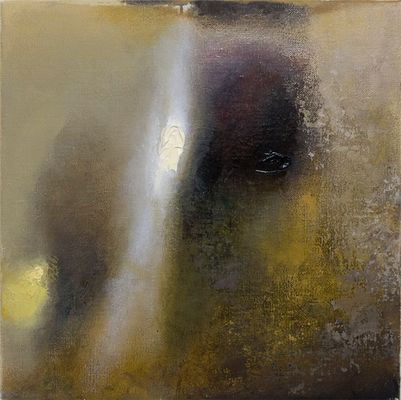
To return to Buckley’s fragment, the first two lines very much evoke how I paint nowadays. As you age, detail diminishes and patches of light become more luminous and float. I feel the most honest way of dealing with this is by smearing the oil paint on the canvas with the fingers and working close-up, blind. Only if the patches coalesce into an approaching image can the work gain a life.
-
Jonathan Walker was born in Melbourne, Australia and brought up on a dairy farm in Gippsland. In the 1970’s he studied painting at RMIT and won the Harold Wright Scholarship to the British Museum, London. During the 1980’s he exhibited at Pinacotheca Gallery, Richmond and had work shown at the NGV and Heidi City Art Gallery. Over the same period he designed the cover for the “Epigenesi” LP by Giancarlo Toniutti, Italy and conducted a mail exchange work with Achim Wollscheid, Germany. The work with artists through the post resulted in an article published in the bicentenary issue of Art and Australia 1988. He showed in artist run spaces such as WestSpace in the 90’s and 2000’s, and until 2012, taught painting at Victoria University, which is where we (Colleen Ahern and Lisa Radford) as organisers of the exhibition, among many others, had the privilege of being his student.
Walker’s knowledge was imparted to students through the careful selection of music, literature, and artists found in books that he himself had ordered for the library. Walker’s strategy was the generosity of sharing his vast knowledge with references specific to each student and their context.
Walker’s paintings share a similar focus and intimacy.
This exhibition presents a small selection of recent paintings alongside a publication that includes Walker’s writing. Observational and analytical, Walker’s work is a type of material notation — the time of day, colour and how it is blended, the both specific and fleeting location of a reflection on lino or the question of whether a chair leg should be included in a painting.
Please join us on Friday August 21 between 6-8pm to celebrate the opening of the exhibition.
Curated by Colleen Ahern and Lisa Radford.
B. Wurtz
Curated by Nic Tammens
March 26 - April 4, 2015
B.Wurtz works from a basement studio in his home on Manhattan’s Lower East Side.
This local fact is attested to by the plastic shopping bags and newsprint circulars that appear in his work. As formal objects, they don’t make loud claims about their origins but nonetheless transmit street addresses and places of business from the bottom of this long thin island. Like plenty of artists, Wurtz is affected by what is local and what is consumed. His work is underpinned by this ethic. It often speaks from a neighborhood or reads like the contents of a hamper:
“BLACK PLUMS $1.29 lb.”
“Food Bazaar”
“USDA Whole Pork Shoulder Picnic 99c lb.”
“RITE AID Pharmacy, with us it’s personal.”
“H. Brickman & Sons.”
“Sweet Yams 59c lb."
Most of the work in this exhibition was made while the artist was in residence at Dieu Donne, a workshop dedicated to paper craft in Midtown. Here Wurtz fabricated assemblages with paper and objects that are relatively lightweight, with the intention that they would be easily transportable to Australia. This consideration isn’t absolute in Wurtz’s work, but was prescriptive for making the current exhibition light and cheap. Packed in two boxes, these works were sent from a USPS post office on the Lower East Side and delivered to North Melbourne by Australia Post.
Wurtz appears courtesy of Metro Pictures, New York.
Thanks to Rob Halverson, Joshua Petherick, Sari de Mallory, Matt Hinkley, Helen Johnson, Fayen d'Evie, Ask Kilmartin, Lisa Radon, Ellena Savage, Yale Union, and "Elizabeth".
John Nixon
"Archive"
December 15 - January 20, 2014
The presentation of John Nixon's archive offered a rare showcase of this extensive collection of the artist's own publications, catalogues, posters, ephemera, editions and more, from the mid 1980s onwards, alongside a selection of his artworks.
Organized by John Nixon, Joshua Petherick and Matt Hinkley.
<a href=http://wfb.public-office.info/artist/john-nixon>All titles by John Nixon
"Habitat"
at Minerva, Sydney (organised by Joshua Petherick and Matt Hinkley)
November 15 - December 20, 2014
Lupo Borgonovo, Janet Burchill & Jennifer McCamley,
Lewis Fidock, HR Giger, Piero Gilardi, Veit Laurent Kurz,
Cinzia Ruggeri, Michael E. Smith, Lucie Stahl, Daniel Weil, Wols
Press Release:
“...It contained seven objects. The slender fluted bone, surely formed for flight, surely from the wing of some large bird. Three archaic circuitboards, faced with mazes of gold. A smooth white sphere of baked clay. An age-blackened fragment of lace. A fingerlength segment of what she assumed was bone from a human wrist, grayish white, inset smoothly with the silicon shaft of a small instrument that must once have ridden flush with the surface of the skin - but the thing’s face was seared and blackened.”
William Gibson, “Count Zero”, 1986
"Autumn Projects Archive"
Curated by Liza Vasiliou
March 6 - March 15, 2014
World Food Books, in conjunction with the Virgin Australia Melbourne Fashion Festival 2014, presented the Autumn Projects archive, consisting of a selection of early examples in Australian fashion with a particular interest in collecting designers and labels from the period beginning in the 1980’s, who significantly influenced the discourse of Australian Fashion.
Curated by Liza Vasiliou, the exhibition provided a unique opportunity to view pieces by designers Anthea Crawford, Barbara Vandenberg, Geoff Liddell and labels CR Australia, Covers, Jag along with early experimental collage pieces by Prue Acton and Sally Browne’s ‘Fragments’ collection, suspended throughout the functioning World Food Books shop in Melbourne.
H.B. Peace
presented by CENTRE FOR STYLE
November 14, 2013
"Hey Blinky, you say chic, I say same"
Anon 2013
H.B. Peace is a clothing collaboration between great friends Blake Barns and Hugh Egan Westland. Their pieces explore the divergences between 'character’ and ‘personality’ in garments....etc
Special Thanks to Joshua Petherick and Matt Hinkley of WFB and Gillian Mears
and a Very Special Thank you to Audrey Thomas Hayes for her shoe collaboration.
Janet Burchill & Jennifer McCamley
"Aesthetic Suicide"
May 10 - June 8, 2013
The first of our occasional exhibitions in the World Food Books office/shop space in Melbourne, "Aesthetic Suicide" presented a body of new and older works together by artists Janet Burchill & Jennifer McCamley, including videos, prints, a wall work, and publications.
During shop open hours videos played every hour, on the hour.
Published by World Food Books / Melbourne
$20.00 - In stock -
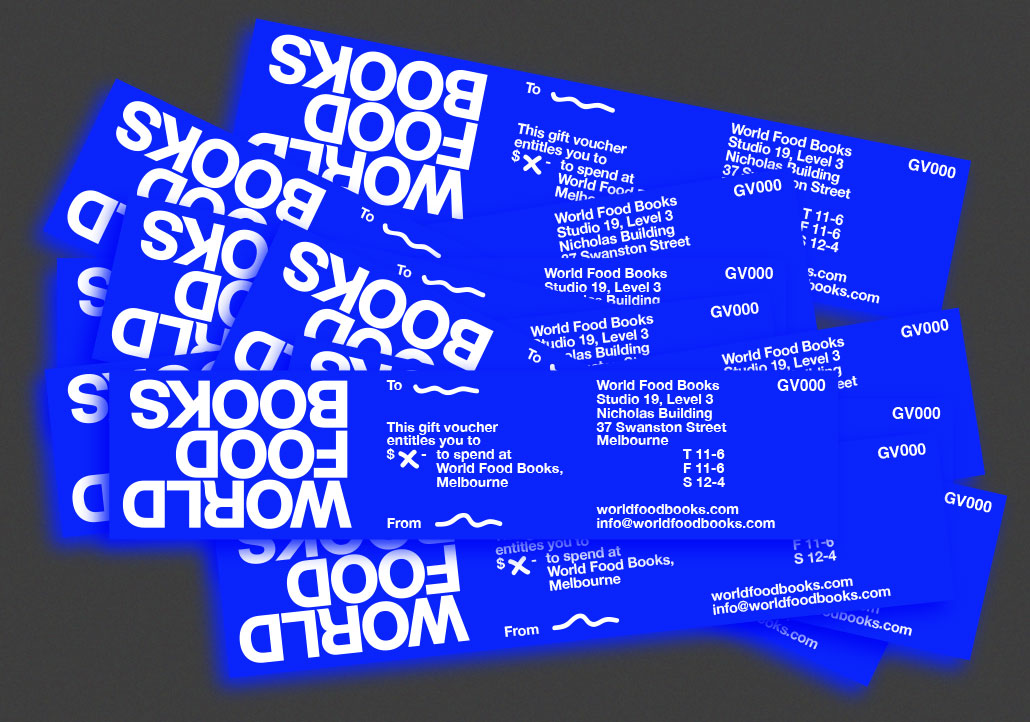
A World Food Books gift voucher is redeemable in our Melbourne bookshop or via our webshop (here). An e-voucher (printable pdf) will be sent to your purchase email address (please notify us if you wish to have the voucher sent to an alternate address and wish us to fill in the receiver's details on the card).
Gift vouchers can be purchased in increments of $20 (Australian Dollars) and the total amount can simply be added to by increasing the quantity in your shopping cart. eg. A quantity of 5 gift vouchers will result in an item total of $100 - a $100 gift voucher. Simply click "ADD TO CART" 5 times, or update your quantity in the shopping cart.
If you wish to purchase multiple, separate gift vouchers in one go, please just email us and we can personally prepare and email you a payment request.
Please note: Please select Pick-Up on gift voucher purchse to avoid any postage charges. Accidental postage charges will be refunded right away!
Thank you.
For any questions, please don't hesitate to email: [email protected]
1999, Japanese / English / Spanish
Softcover (French Flaps), 170 pages, 29 x 20 cm
1st Edition, Out of print title / used / fine
Published by
Tokyo Shimbun / Tokyo
$140.00 - In stock -
Scarce, stunning Japanese catalogue on Spanish surrealist Remedios Varo, published on the occasion of a major touring retrospective of her work throughout Japan in 1999. Only available in the participating Japanese museums in the late 1990s and now long out-of-print, this book beautifully reproduces Varo's paintings and drawings (including preliminary sketches alongside final oils) with detailed captions and descriptions, accompanied by illustrated essays and other texts by Masayo Nonaka, Octavio Paz, Luis-Martin Lozano, and Walter Green, portraits of the artist, exhibition history, bibliography, work list and more.
Remedios Varo Uranga (1908 – 1963) was a Spanish surrealist artist. Born in Anglès (north of Catalonia), Spain in 1908, she studied at the Real Academia de Bellas Artes de San Fernando, Madrid. Varo spent her formative years between France and Barcelona and was greatly influenced by the surrealist movement. The summer of 1935 marked Varo's formal invitation into Surrealism when French surrealist Marcel Jean arrived in Barcelona. While still married to her first husband Gerardo Lizarraga, Varo met her second partner, the French surrealist poet Benjamin Péret, in Barcelona. During the Spanish Civil War she fled to Paris with Péret leaving Lizarraga behind (1937). It was through Peret that Remedios Varo met André Breton and the Surrealist circle, which included Leonora Carrington, Dora Maar, Roberto Matta, Wolfgang Paalen, and Max Ernst among others. Shortly after arriving in France, Varo took part in the International Surrealist exhibitions in Paris and in Amsterdam in 1938. She was forced into exile from Paris during the German occupation of France and moved to Mexico City at the end of 1941 when the Mexican president, Lázaro Cardenas, made it a policy to welcome Spanish and European refugees. In Mexico, she met native artists such as Frida Kahlo and Diego Rivera, but her strongest ties were to other exiles and expatriates, notably the English painter Leonora Carrington and the French pilot and adventurer, Jean Nicolle. However, because Mexican muralism still dominated the country's art scene, surrealism was not generally well received. She worked as an assistant to Marc Chagall with the design of the costumes for the production of the ballet Aleko, which premiered in Mexico City in 1942. In 1947, Péret returned to Paris, and Varo traveled to Venezuela, living there for two years. She returned to Mexico and began her third and last important relationship with Austrian refugee Walter Gruen, who had endured concentration camps before escaping Europe. Gruen believed fiercely in Varo, and he gave her the economic and emotional support that allowed her to fully concentrate on her painting. In 1955, Varo had her first solo exhibition at the Galería Diana in Mexico City. Buyers were put on waiting lists for her work. Even Diego Rivera was supportive. In 1960, her representative, Juan Martín, opened his own gallery and showed her work there, and opened a second in 1962. Only a year after that opening, at the height of her career, she died from a heart attack in Mexico City. Her work is well known in Mexico, but not as commonly known throughout the rest of the world.
Fine, As New copy.
1991, English
Softcover, 60 pages, 28 x 21.8 cm
1st Edition, Out of print title / used / very good
Published by
Fantagraphics / Seattle
$65.00 - Out of stock
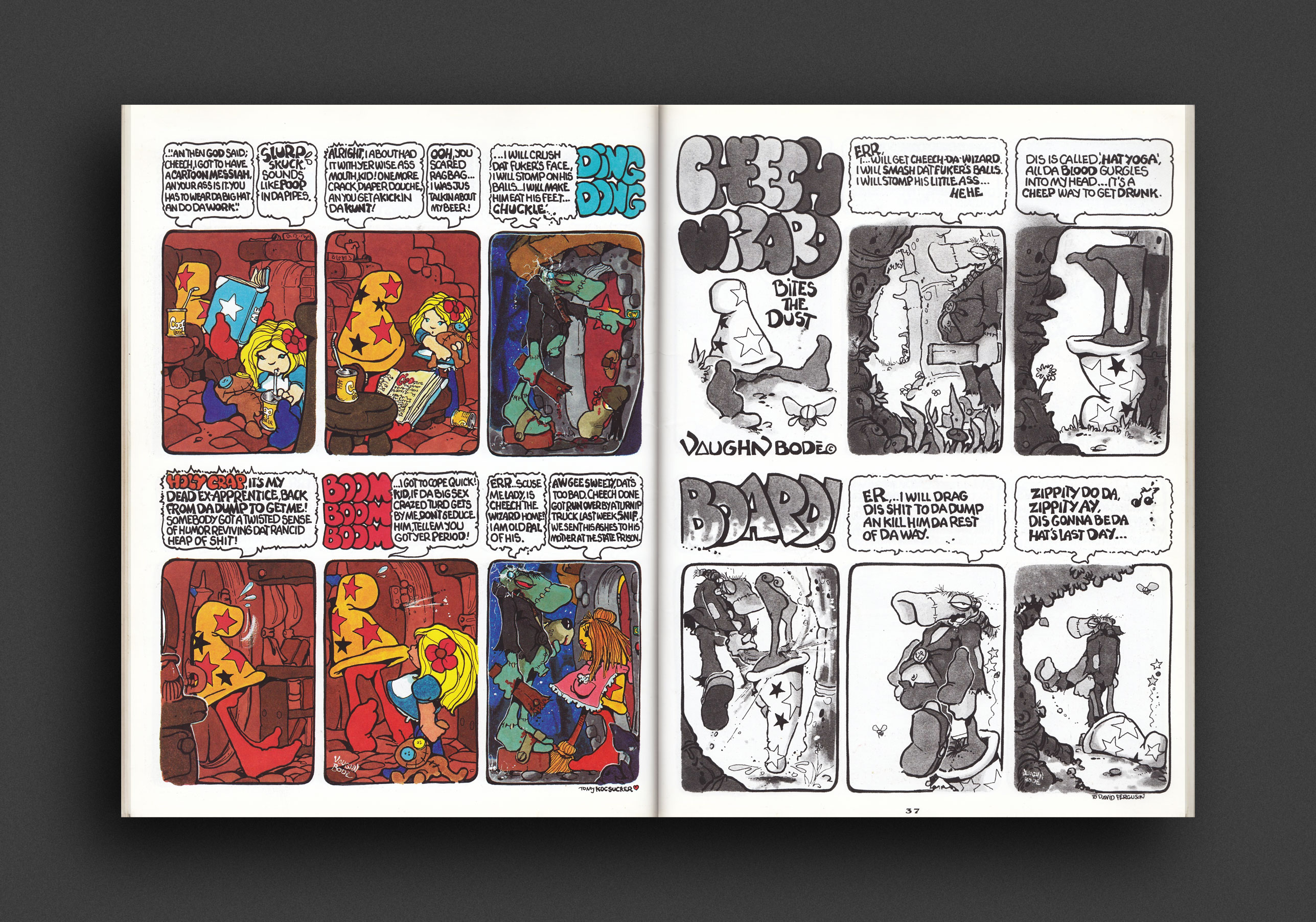
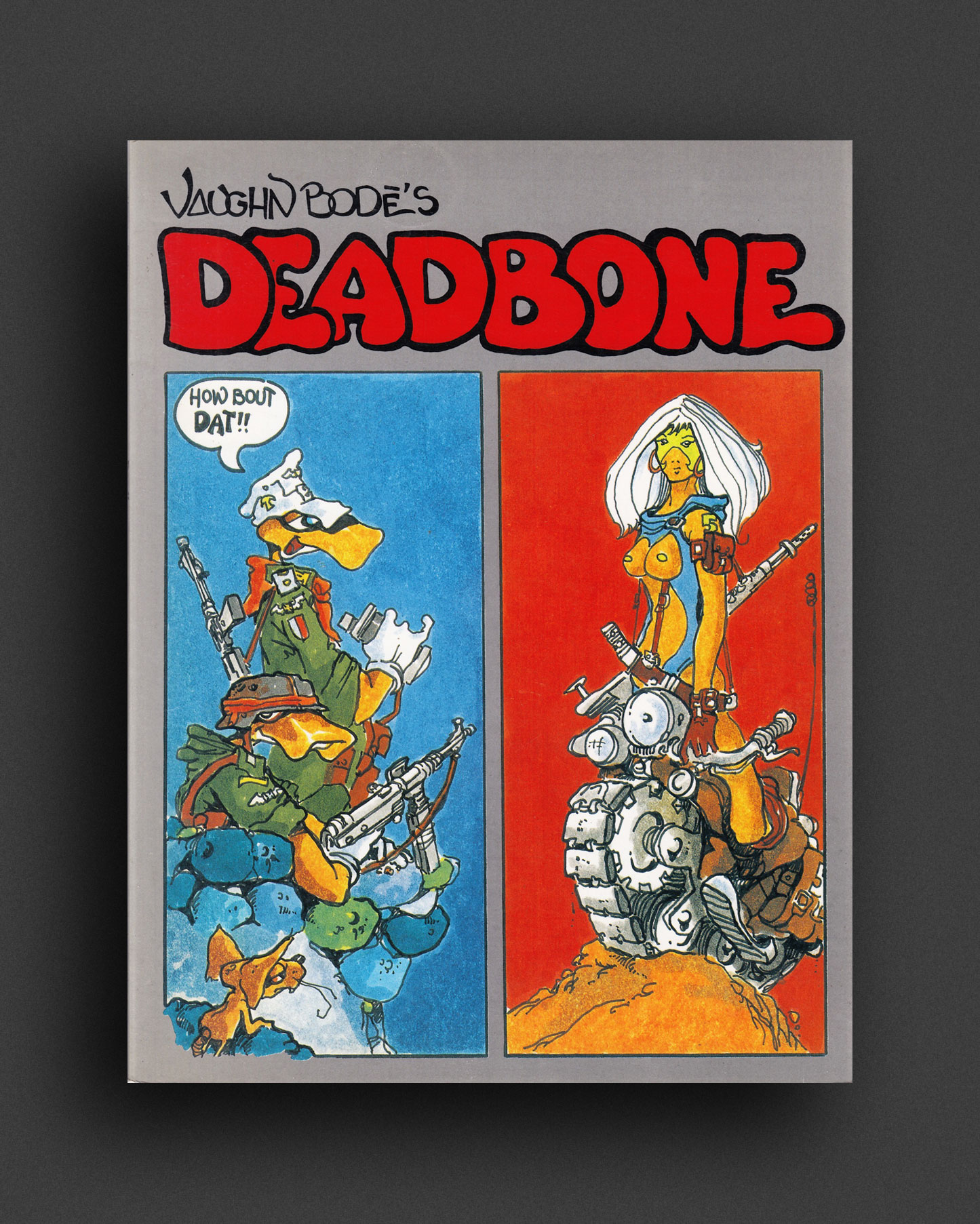
"Vaughn was one of the lights of America."—Moebius
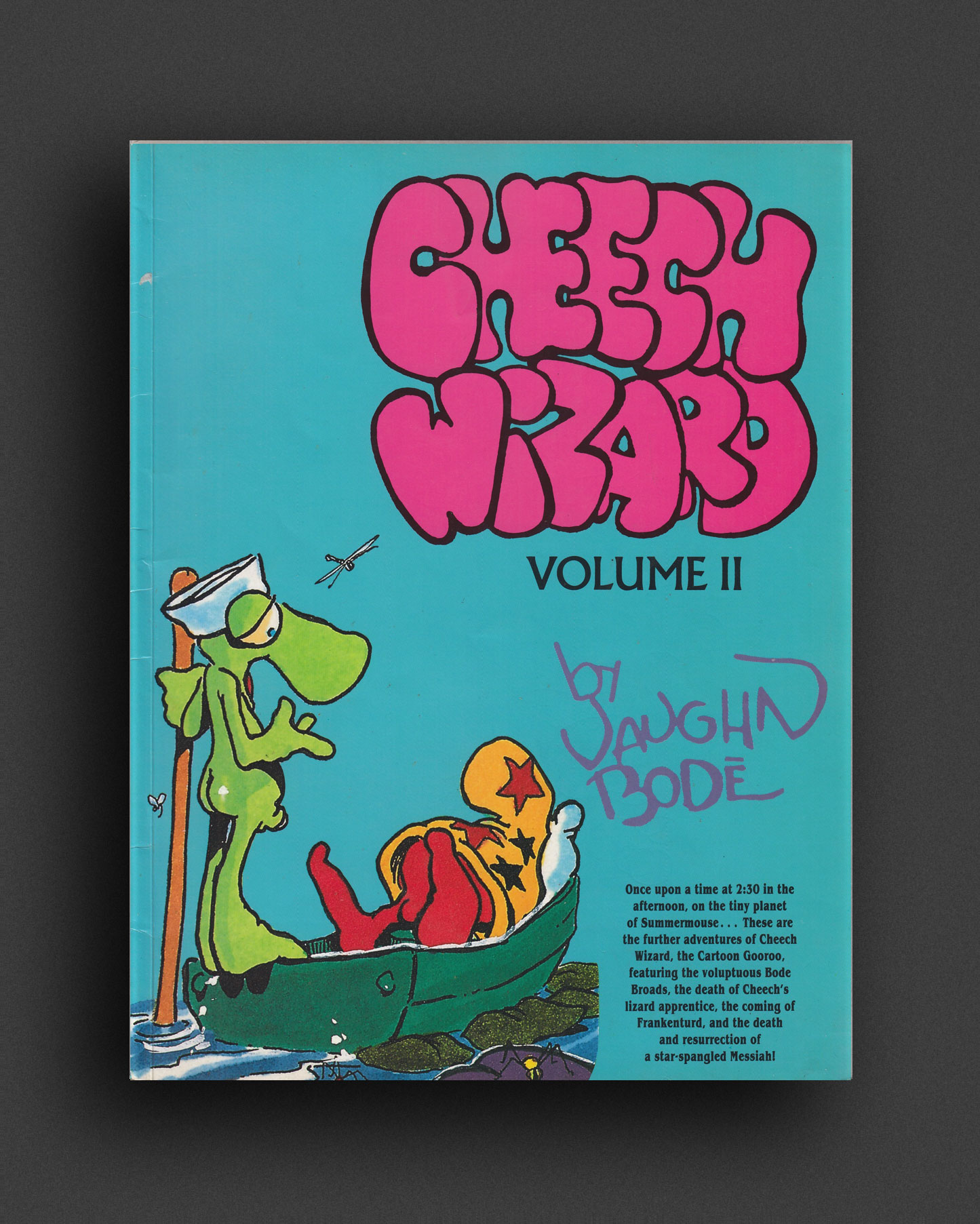
"Vaughn Bode created Cheech Wizard in 1956 at the age of 15. Cheech remained an ongoing project for the rest of Bode's career (cut short by his death in 1975), surfacing in his college paper, various underground comix, and, ultimately, the National Lampoon. Bode's style evolved and grew during those twenty years, but Cheech himself remained constant: an irascible, sarcastic, lascivious con-man who nevertheless possesses some degree of cosmic insight.
This eagerly-awaited collection contains Bode's Bode's earliest National Lampoon work, the long story of Cheech Wizard's death and rebirth, a stunning color section, the samples Bode did for his proposed daily strip The Yellow Hat, the rare, unbroadcast Cheech Wizard radio scripts done for the National Lampoon Radio Hour, and lots of previously unseen sketchbook material."
First 1991 edition published by Fantagraphics Books, first printing.
Vaughn Bodē (1941 – 1975) was an American underground cartoonist and illustrator known for his character Cheech Wizard and his artwork depicting voluptuous women. In 1963, at age 21, and while living in Utica, New York, Bodē self-published Das Kämpf, considered one of the first underground comic books. In the late 1960s and early 1970s, he illustrated covers and interior art for the science fiction digests Amazing Stories, Fantastic, Galaxy Science Fiction, Witzend and Worlds of If. Discovered by fellow cartoonist Trina Robbins, Bodē moved to Manhattan in 1969 and joined the staff of the underground newspaper the East Village Other. Beginning in 1968 and continuing until his untimely death from autoerotic asphyxiation in 1975, Bodē entered a prolific period of creativity, introducing a number of strips and ongoing series, most of which ran in underground newspapers or erotic magazines. Bodē described his sexuality as "auto-sexual, heterosexual, homosexual, mano-sexual, sado-sexual, trans-sexual, uni-sexual, omni-sexual." A contemporary of animator Ralph Bakshi, Bodē has been credited as an influence on Bakshi's animated films Wizards and The Lord of the Rings. Bodē has a huge following among graffiti artists, with his characters remaining a popular subject of the culture. Bodē was inducted into the Will Eisner Award Hall of Fame for comics artists in 2006.
Very Good copy, light wear/marking.
1989 / 1994, English
Softcover, 62 pages, 28 x 21.8 cm
1st Edition, Out of print title / used / very good
Published by
Fantagraphics / Seattle
$70.00 - In stock -
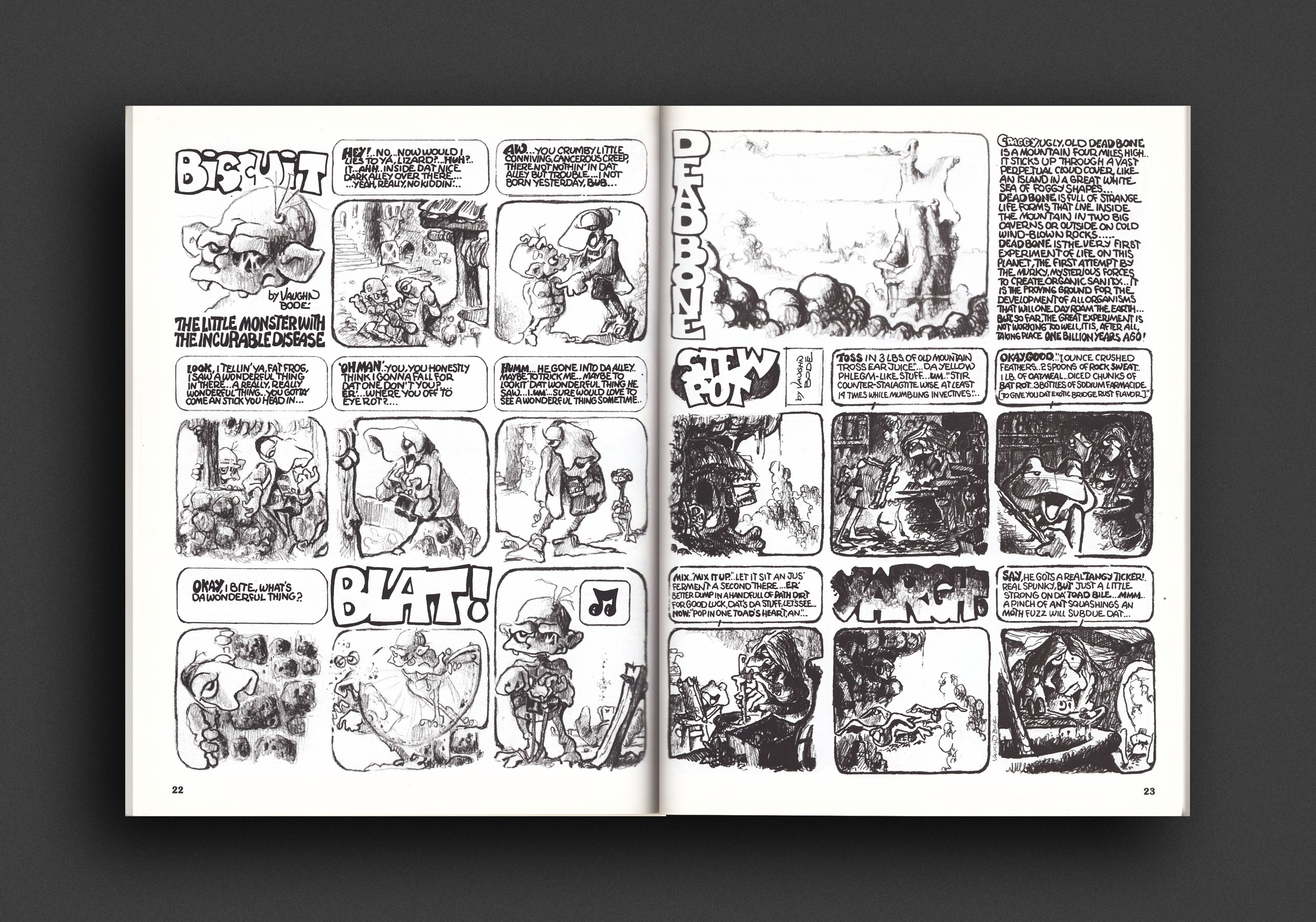
"Vaughn was one of the lights of America."—Moebius
"The first in a series collecting the black and white work of Vaughn Bodē, Deadbone reprints for the first time in their original format and order the first pencil Deadbone Erotica pages, plus character and background sketches and Bodē's own introduction. These early episodes downplay the sexual humor that would dominate the color version in favor of Bode's unique brand of Dead End Kid mysticism and social satire. Future volumes will reprint Cheech Wizard, the science fiction strips, the underground newspaper strips (many never before reprinted), the Syracuse University work, and many pages of sketchbook material and unpublished work."
First 1989 edition published by Fantagraphics Books. This is the second 1994 printing.
Vaughn Bodē (1941 – 1975) was an American underground cartoonist and illustrator known for his character Cheech Wizard and his artwork depicting voluptuous women. In 1963, at age 21, and while living in Utica, New York, Bodē self-published Das Kämpf, considered one of the first underground comic books. In the late 1960s and early 1970s, he illustrated covers and interior art for the science fiction digests Amazing Stories, Fantastic, Galaxy Science Fiction, Witzend and Worlds of If. Discovered by fellow cartoonist Trina Robbins, Bodē moved to Manhattan in 1969 and joined the staff of the underground newspaper the East Village Other. Beginning in 1968 and continuing until his untimely death from autoerotic asphyxiation in 1975, Bodē entered a prolific period of creativity, introducing a number of strips and ongoing series, most of which ran in underground newspapers or erotic magazines. Bodē described his sexuality as "auto-sexual, heterosexual, homosexual, mano-sexual, sado-sexual, trans-sexual, uni-sexual, omni-sexual." A contemporary of animator Ralph Bakshi, Bodē has been credited as an influence on Bakshi's animated films Wizards and The Lord of the Rings. Bodē has a huge following among graffiti artists, with his characters remaining a popular subject of the culture. Bodē was inducted into the Will Eisner Award Hall of Fame for comics artists in 2006.
Very Good copy.
1986, Japanese
Softcover, 106 pages, 30 x 21 cm
1st Edition, Out of print title / used / very good
Published by
V-Zone / Japan
$110.00 - In stock -
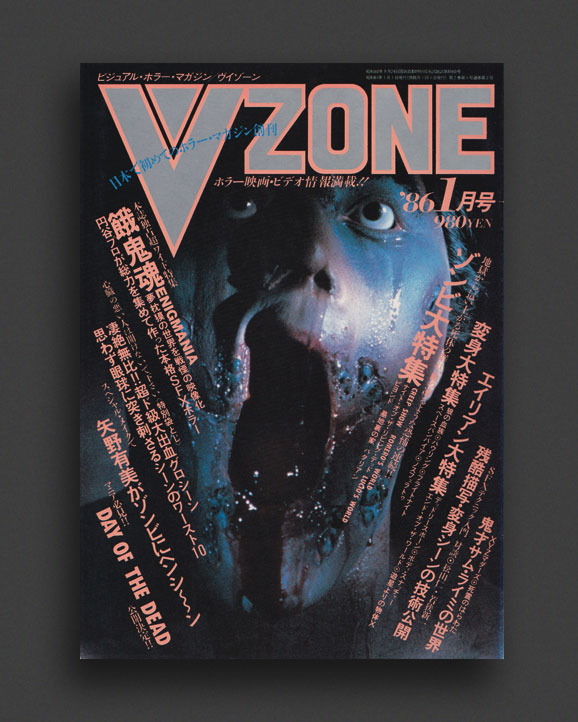
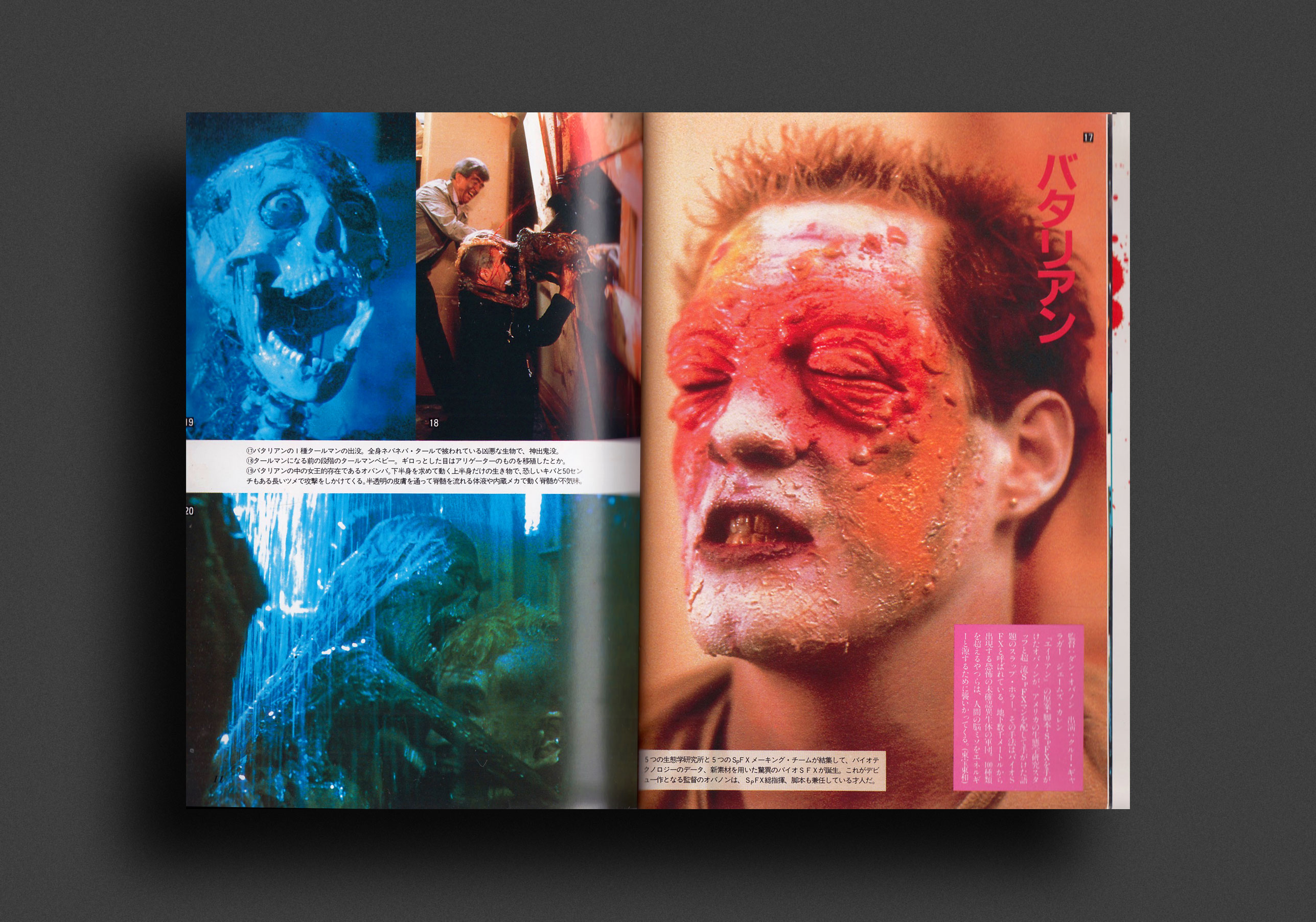
Rare 1986 collectible second issue of V-Zone, the wild, short-lived cult horror/sci-fi/fantasy movie magazine from Japan, published between 1985–1987. This issue is particularly sought after for the rare special feature on the controversial Guinea Pig 2: Flower of Flesh and Blood, a film written and directed by horror magna master Hideshi Hino, that was withdrawn from the US and Japanese video market for it's realistic gruesome special effects. The film achieved further notoriety after incident in which American actor Charlie Sheen is said to have watched the film and believed that it depicted the actual killing and dismemberment of a real woman, prompting him to report it to authorities. The feature herein includes the sealed shut pages that readers had to cut it open to see the gruesome images of various shock films. This copy is still sealed!
At the height of the home video revolution of the 1980s, V-Zone committed it's graphic-saturated pages to the explosion of horror, fantasy, and science fiction films that came with it. V-Zone's coverage of American horror is unparalleled in the world of Japanese magazines, but they also focused attention on historical and underground western science fiction and cult cinema, whilst also playing an important role in fostering the new wave of Japanese gore and V-Cinema (direct-to-video splatter films). Heavy with film features, interviews, stills, ads and reviews, each issue has amazing behind-the-scenes reportage from industry conventions and sfx fan parties, content you would not find anywhere but Japan, including a regular column by legendary Godzilla special effects artist Shinichi Wakasa on how to make your own SFX makeup, gore, and even craft realistic squibs with dimestore prophylactics.
Needless to say, V-Zone is a must for any 1980s video collector or lover of gore.
Very Good copy.
?, English
Softcover (staple–bound), 32 pages, 27.8 x 21.6 cm
1st Edition, Out of print title / used / very good
Published by
Classical Illustrations Co. / Queensland
$80.00 - In stock -
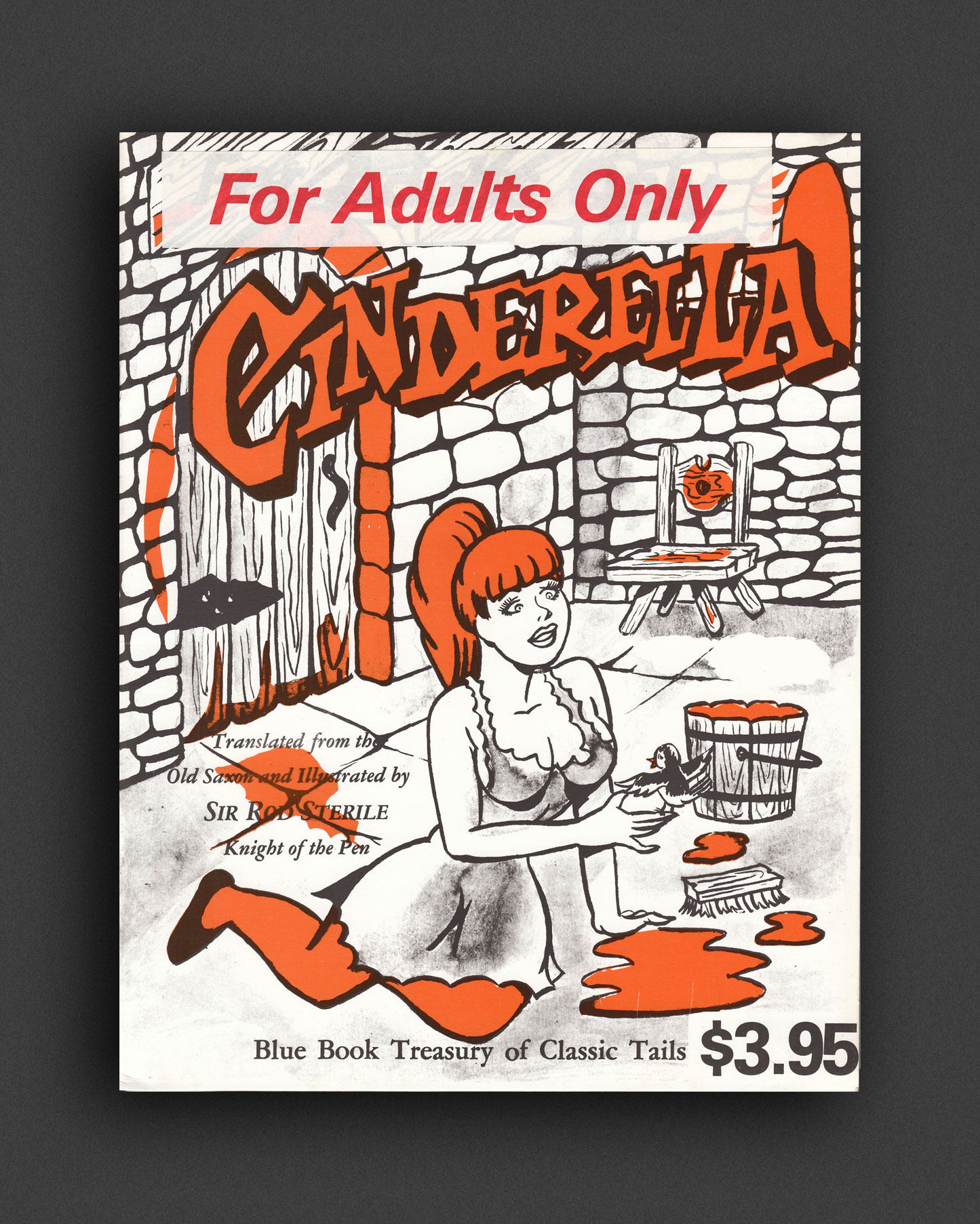
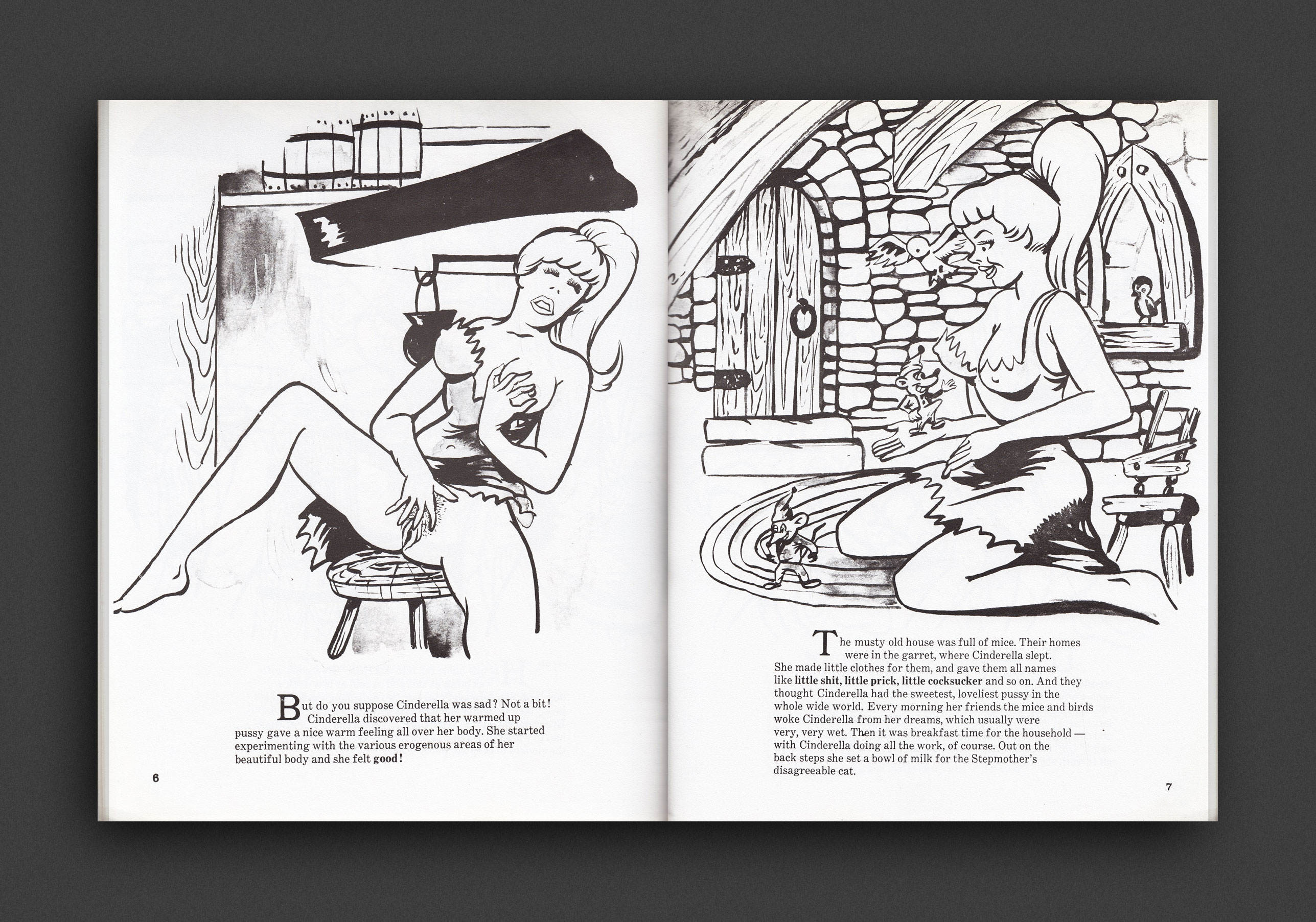
Extremely rare copy of this Australian underground, self–published adult story book of Cinderella, "Translated from the Old Saxon and Illustrated by Sir Rod Sterile, Knight of the Pen", from the "Blue Book Treasury of Classic Tails". Under the imprint "Classical Illustrations Co.", Redcliffe, Queensland, Sir Rod Sterile with his sexually explicit illustrated tale of Cinderella.
Very Good copy (unread deadstock).
?, English
Softcover (staple bound), 40 pages, 27 x 21 cm
1st Edition, Out of print title / used / very good
Published by
? / ?
$60.00 - In stock -
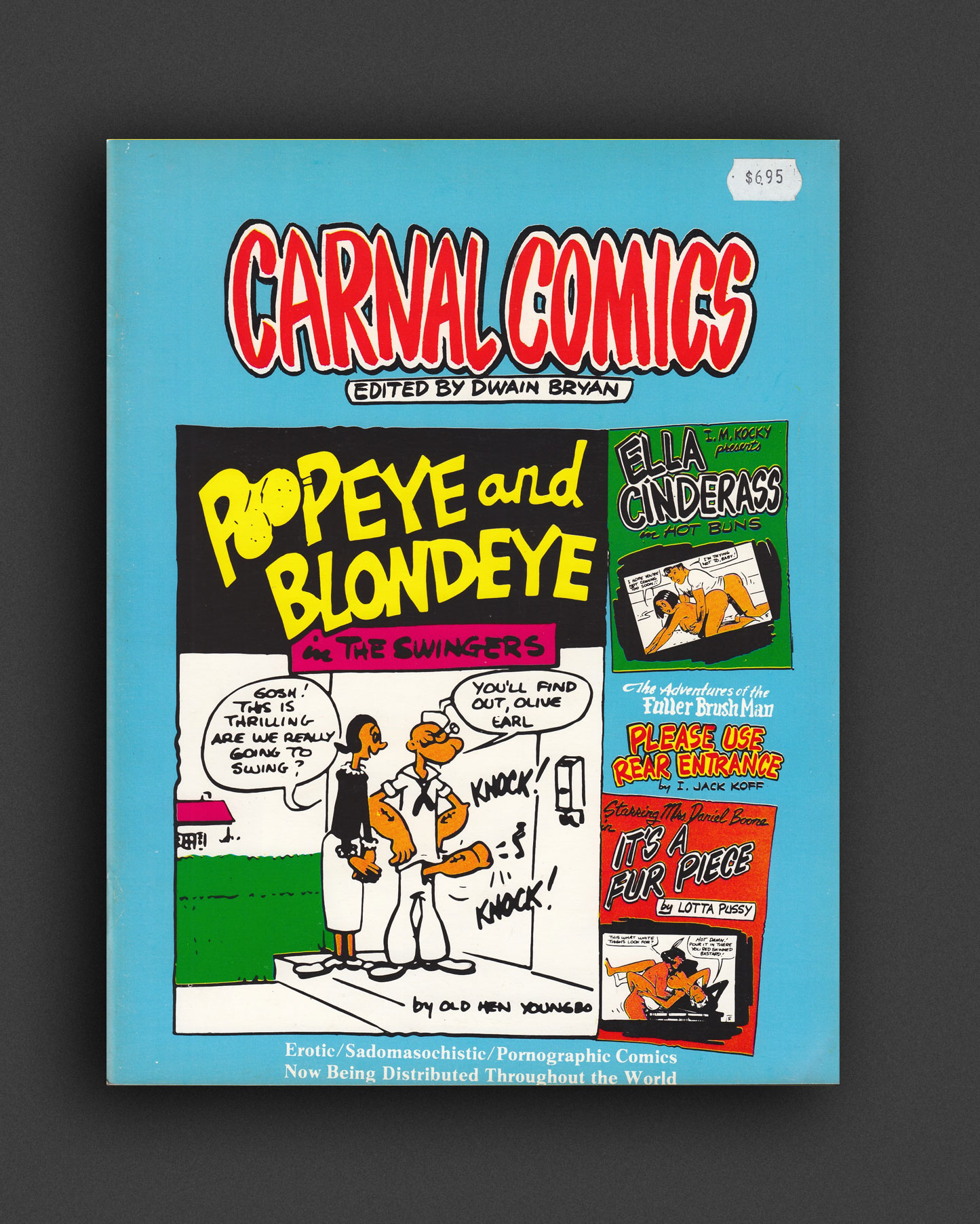
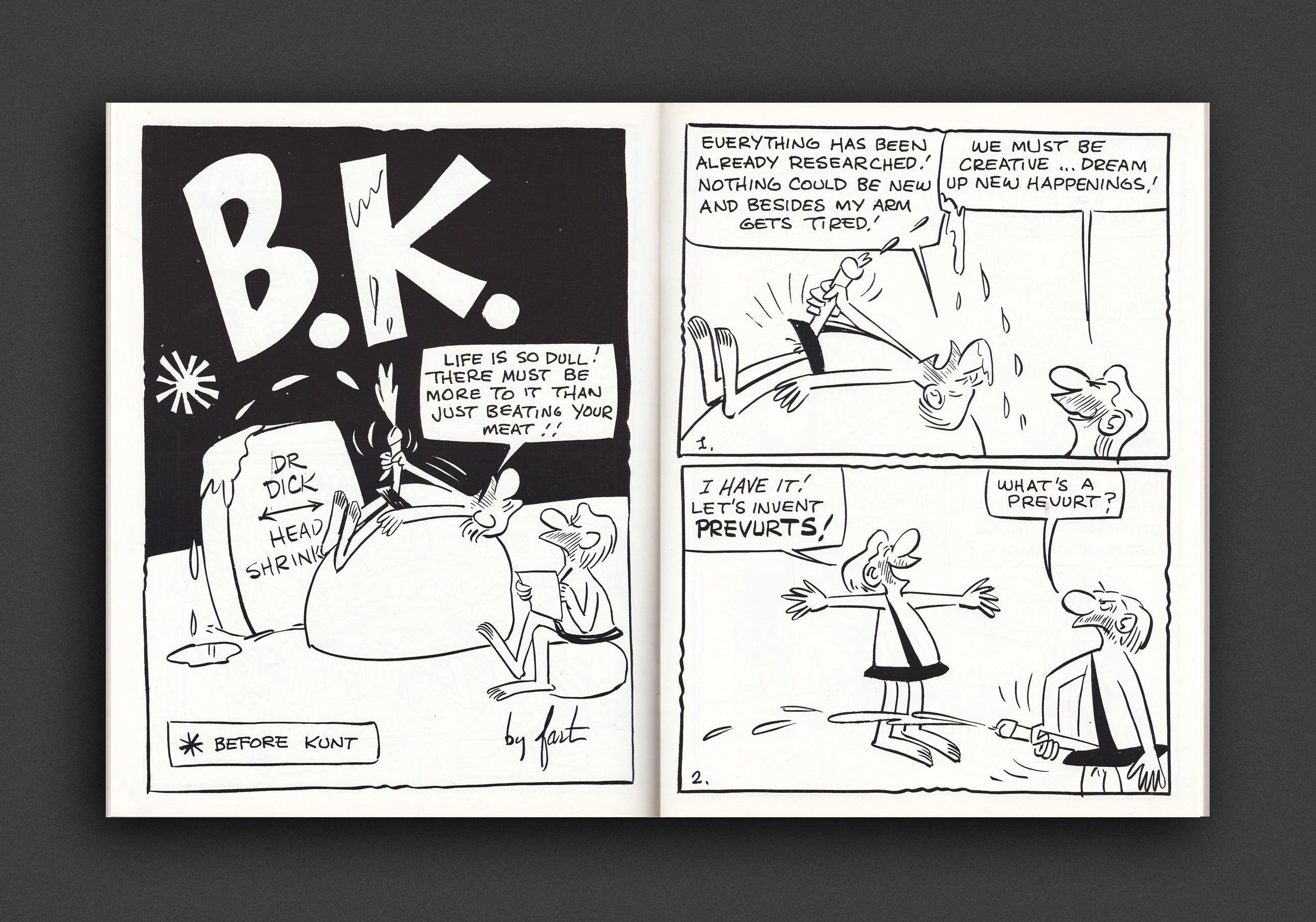
Carnal Comics No. 1, publisher unknown, year unknown, is a collection of satirical, sexually explicit comics, many being dirty spoofs of famous cartoons, plus jokes and photos. Main stories include: "Poopeye and Blondeye in 'The Swingers'" by Old Hen Youngboy, "Ella Cinderass in 'Hot Buns'" by anonymous, "Starring Mrs. Daniel Boone in "It's a Fur Piece" by Lotta Pussy, "The Adventures of the Fuller Brush Man in 'Happy Hubby'" by llene Overbutt, "B.K. (Before Kunt)" by Fart, and more... Editor Dwain Bryan made a number of these adult parody comic books in 1970s/80s including the adventures of SpiderKok (Spiderman), Fag Man (Batmna), etc.
Very Good copy (unread deadstock).
?, English
Softcover (staple bound), 40 pages, 27 x 21 cm
1st Edition, Out of print title / used / very good
Published by
? / ?
$60.00 - In stock -
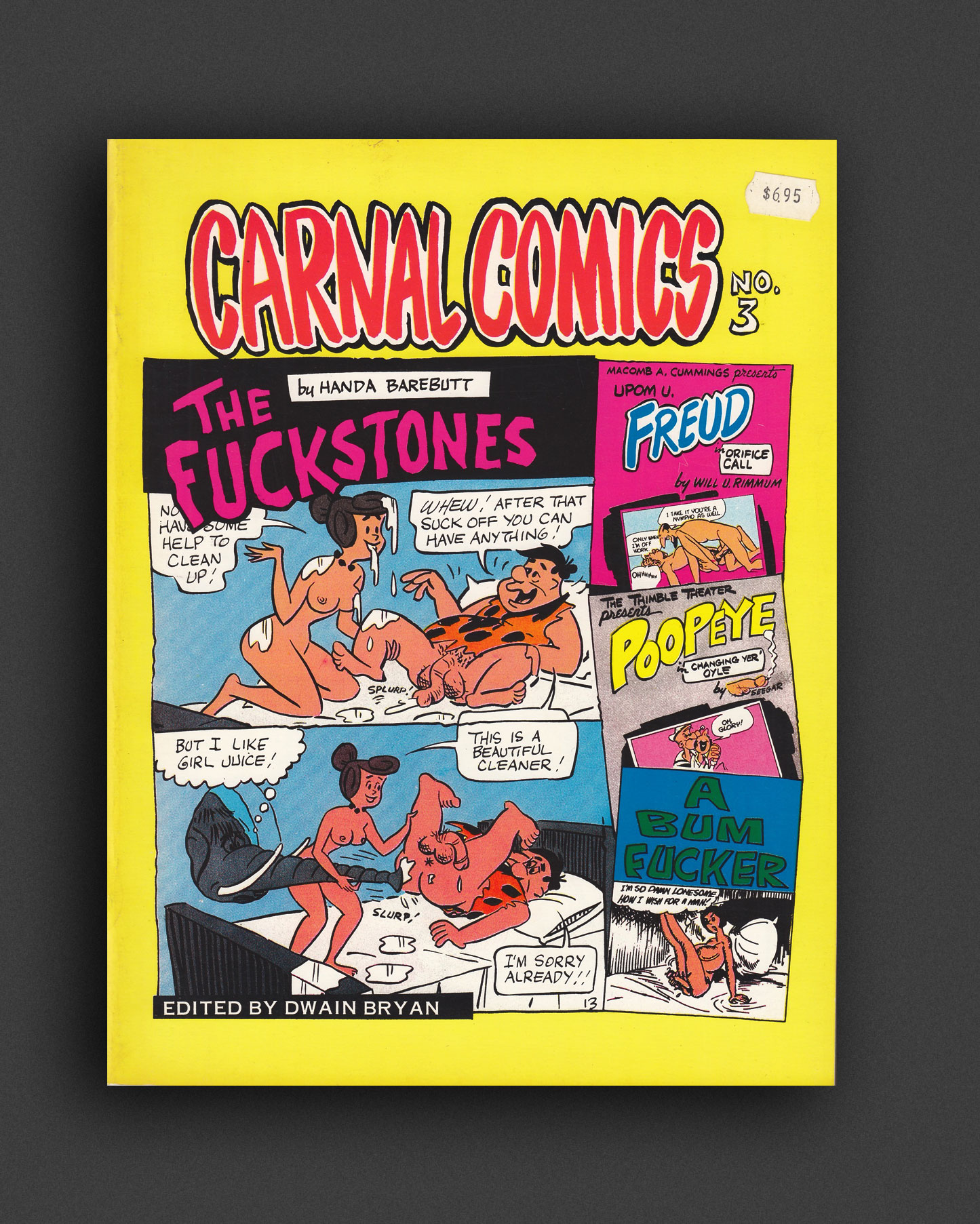
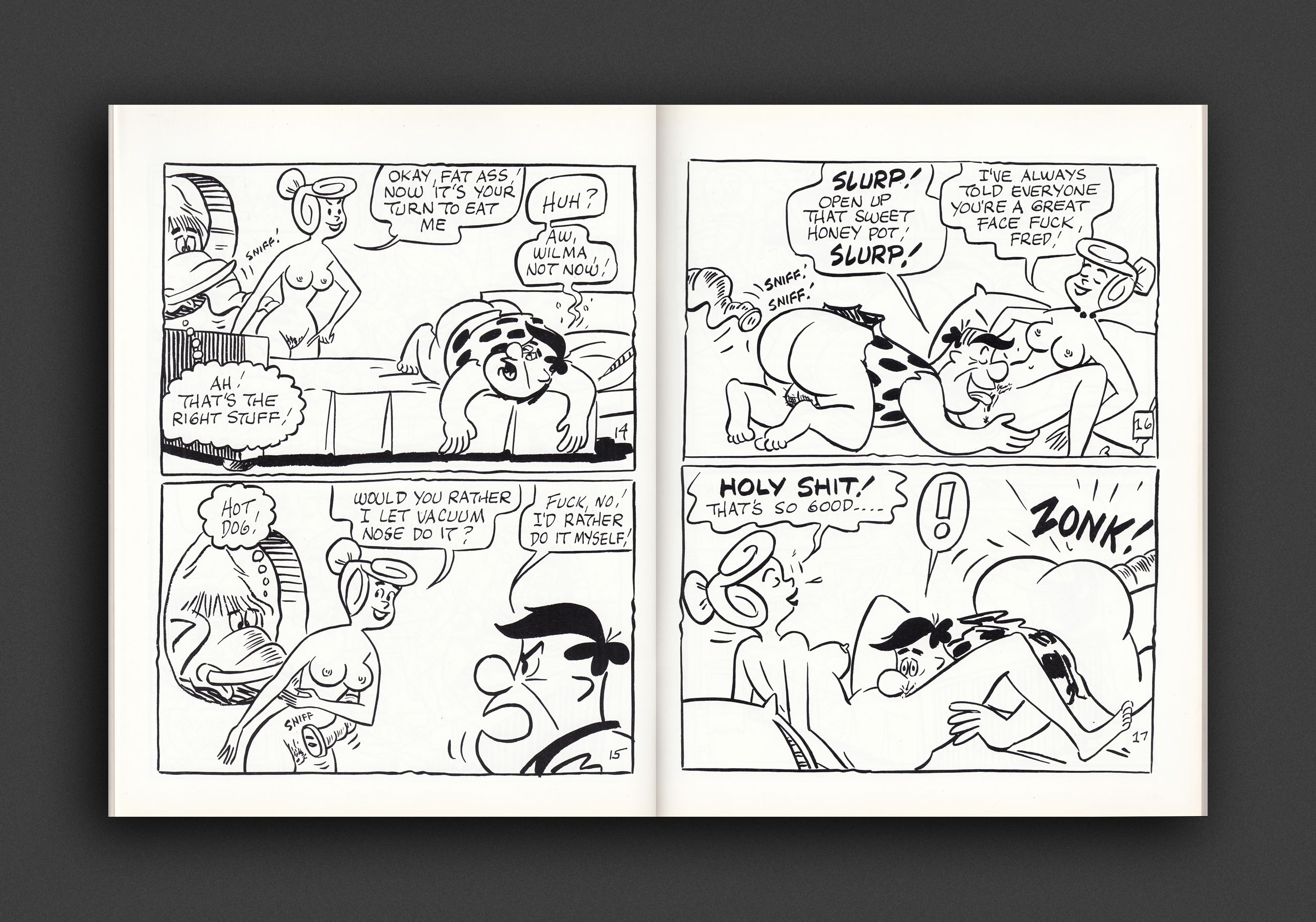
Carnal Comics No. 3, publisher unknown, year unknown, is a collection of satirical, sexually explicit comics, many being dirty spoofs of famous cartoons, plus jokes and photos. Main stories include: "A Bum Fucker" by anonymous, "Upom U. Freud in 'Orifice Call'" by Will U. Rimmum, "The Fuckstones in 'Up Your Nose, Baby!'" by Handa Barebutt, "The Dirty Thirties" by Anonymous, "My Love's A Cheat" by Anonymous, "Super Queen" by Anonymous, "Happy Humpers" by Anonymous... Editor Dwain Bryan made a number of these adult parody comic books in 1970s/80s including the adventures of SpiderKok (Spiderman), Fag Man (Batmna), etc.
Very Good copy (unread deadstock).
1992 / ?, English
Softcover, 147 pages, 21.2 x 13.5 cm
1st Edition, Out of print title / used / good
Published by
Feral House / Los Angeles
$20.00 - In stock -
The Devil's Notebook is the fourth book by Anton LaVey, published in 1992 by Feral House. It includes a foreword by Adam Parfrey and design by Sean Tejaratchi. The book contains forty-one essays in which LaVey provides commentary on such topics as nonconformity, occult faddism, Nazism, terrorism, cannibalism, erotic politics, the “Goodguy badge”, demoralization and the construction of artificial human companions. Included are instructions for the creation of what LaVey terms "total environments", or places of magical evocation, where the enlightened may escape the deleterious effects of contemporary existence.
1992 edition, later reprint. Very Good copy.
2026, English
Softcover, 432 pages, 19 x 10 cm
Published by
Mandylion Press / Connecticut
$65.00 - In stock -
Elizabeth Stuart Phelps Avis Dobell is a talented young painter on the rise, working to establish herself, when she meets professor Philip Ostrander. Though she has sworn to never marry and at first rejects her suitor, she relents after he returns wounded from the Civil War. Following Avis’ struggles to balance her passion with her duties, palettes with doilies, Phelps’ novel proves that artistic ambition is not extinguished by love, but slowly eroded by the constraints of 19th-century womanhood.
Feminist and social reformer Elizabeth Stuart Phelps Ward (1844–1911) authored 57 books. She is perhaps best remembered for the trilogy of Spiritualist novels that she published in the wake of the Civil War – the first of which, The Gates Ajar, had sold 180,000 copies in the US and England by 1900.
2026, English
Softcover, 96 pages, 17.8 x 11.4 cm
Published by
Wakefield Press / Cambridge
$34.00 - In stock -
Translated, with an introduction, by Edward Gauvin
The city of Aquelon is sheltered by moored lightsails, ensconced in a calm and misty land where the division between water and sky has dissipated. Its people are happy, living an ecstasy of subtle frissons, free of jealousy and any ties to affection. The Emperor of Aquelon has signed a final law repealing all past and future laws and has cast his crown upon the waters. It is the era of the ineffable, without distinction between life and death, and in which the lure of water leads even children to live and die as flowers, drowning themselves with smiles to drift down the estuary to a shoreless horizon of eternity.
A traveler arrives to this idyllic paradise, speaking of Rome’s marble palaces and monuments—the land of Virgil with laws carved into stone. And Aquelon’s reign of dream begins to come apart under the destructive force of desire and the violence of nothingness as rituals are broken and nights are consumed by shrieks of horror.
Paul Willems spent three years working on The Drowned Land, transforming his memories of the Drowned Land of Saeftinghe into an oneiric Atlantis. Its ruins of reverie offer up a luminous pessimism.
Paul Willems (1912–1997) published his first novel, Everything Here Is Real, in 1941. Three more novels and, toward the end of his life, two collections of short stories bracketed his career as a playwright.
1996, English
Softcover, 252 pages, 30.5 x 23 cm
Out of print title / used / average
Published by
University of Nebraska Press / Lincoln
$35.00 - In stock -
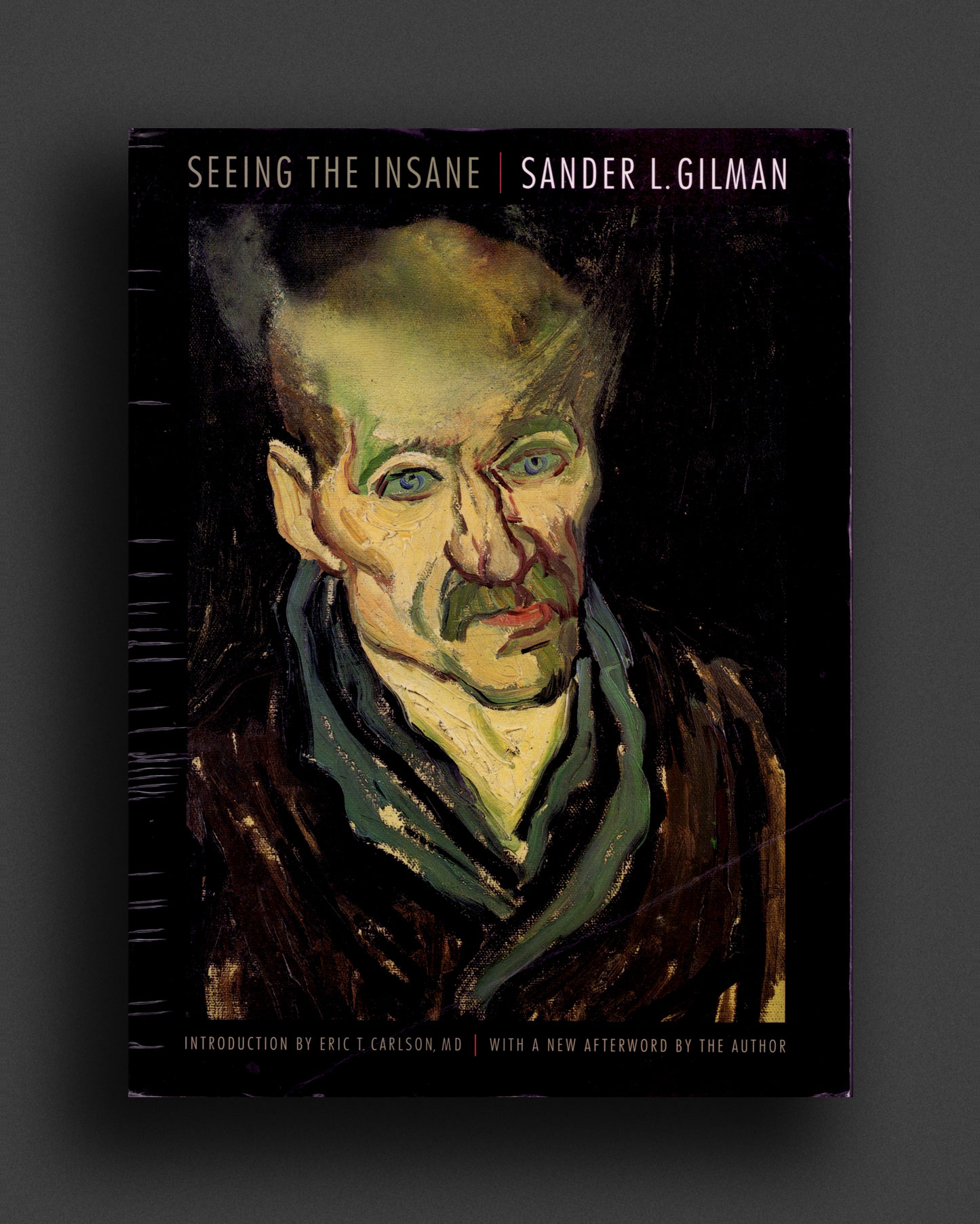
1996 Bison edition with Van Gogh cover. First published in 1982.
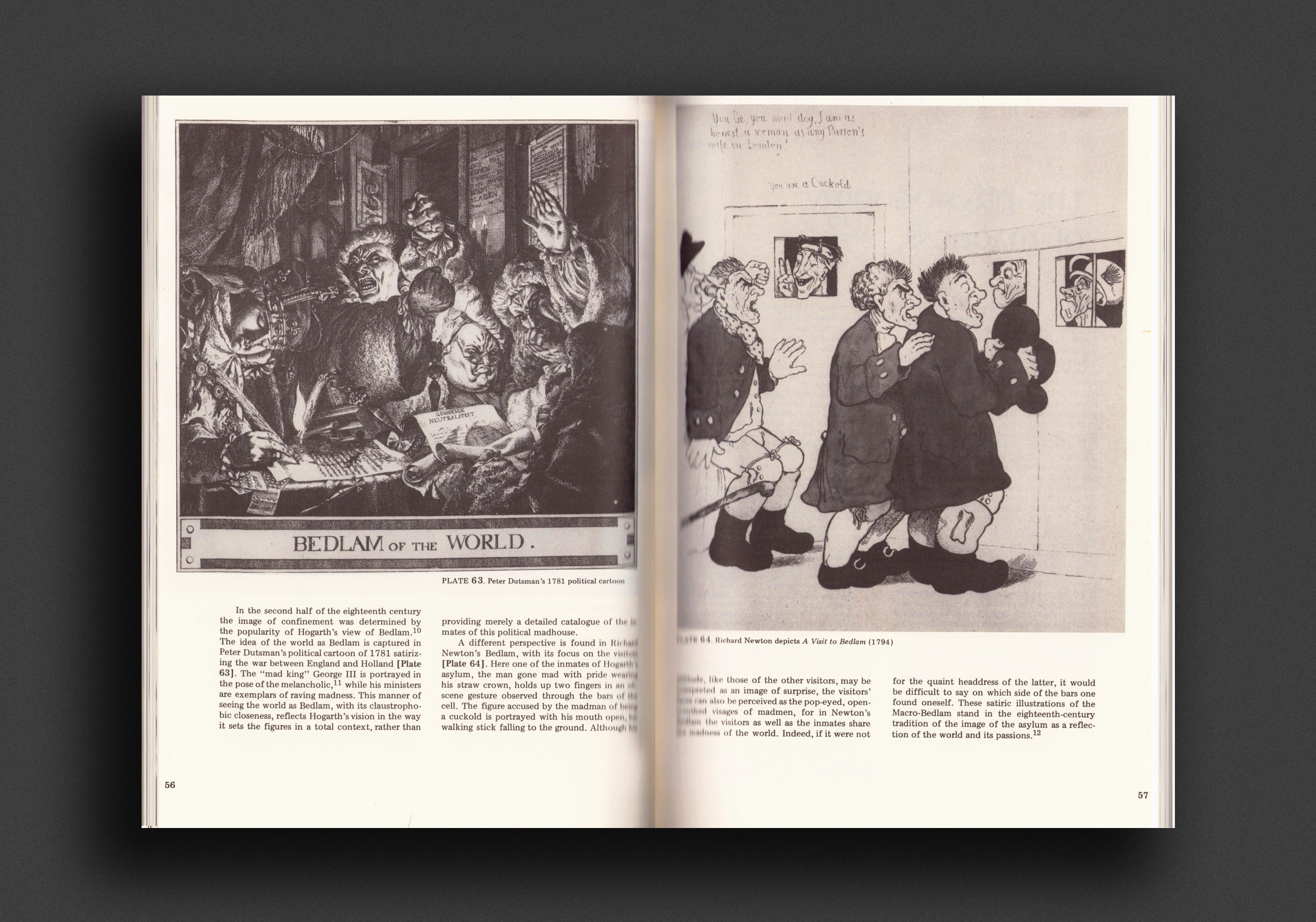
A cultural history of madness and art in the western world, showing how the portrayal of stereotypes has both reflected and shaped the perception and treatment of the mentally disturbed as depicted in manuscripts, woodcuts, engravings, drawings, paintings, sculptures, lithographs and photographs, from the middle ages to the end of the nineteenth century.
"Seeing the Insane is a visual history of the stereotypes that have shaped the perception of the mentally ill from medieval through modern times. The result is nearly as heart-breaking as a visual history of the Holocaust. In picture after picture, the book portrays centuries of intolerance for deviance, mindless cruelty, unthinking prejudice, and self-righteous abuse of the weak and ill."–American Journal of Psychiatry
"As extraordinary in concept as it is in its execution.... This remarkable book helps laymen as well as specialists to see the insane, but it does far more. When we study the past, we understand the present. When we see the conventional stereotype images of insanity, we find they still color our concepts of madness. Through these pictures of the insane, we see all humanity. We look, not through a glass darkly, but through a multiplicity of media, brightly."–Antiquarian Bookman
Seeing the Insane is a richly detailed cultural history of madness and art in the Western world, showing how the portrayal of stereotypes has both reflected and shaped the perception and treatment of the mentally disturbed.
Sander L. Gilman is Henry R. Luce Professor of the Liberal Arts in Human Biology at the University of Chicago. The late Eric T. Carlson, m.D., was a clinical professor of psychiatry at New York Hospital-Cornell Medical Center.
Average–Good copy with cover creases and rippling to laminate.
1983, English
Softcover (staple-bound), 22 pages, 26.6 x 18.5 cm
1st Edition, Out of print title / used / very good
Published by
George Paton Gallery / Melbourne
$160.00 - In stock -
Wonderful, exceptionally rare catalogue published on the occasion of the group exhibition Comic Stripping at George Paton Gallery, Melbourne, May 31—June 24 1983. Features the work of Howard Arkley, Julie Cunningham, Juliet Darling, Juan Davila, Linda Marrinon, Raymond X, Peter Tyndall, Christopher Van Der Craats, → ↑ →. Illustrated throughout with work and texts by the artists and an introduction by Denise McGrath.
Very Good copy with ex-libris 200 Gertrude St. archive stamps to contents and final page of catalogue. Small mark, soft surface tear from old sticker to bottom-left of cover, otherwise a lovely copy with only light wear.
1987, English
Softcover (screenprinted and staple–bound), 24 pages, 29.6 x 20.9 cm
1st Edition, Out of print title / used / very good
Published by
Humongous Publications / Melbourne
$160.00 - Out of stock
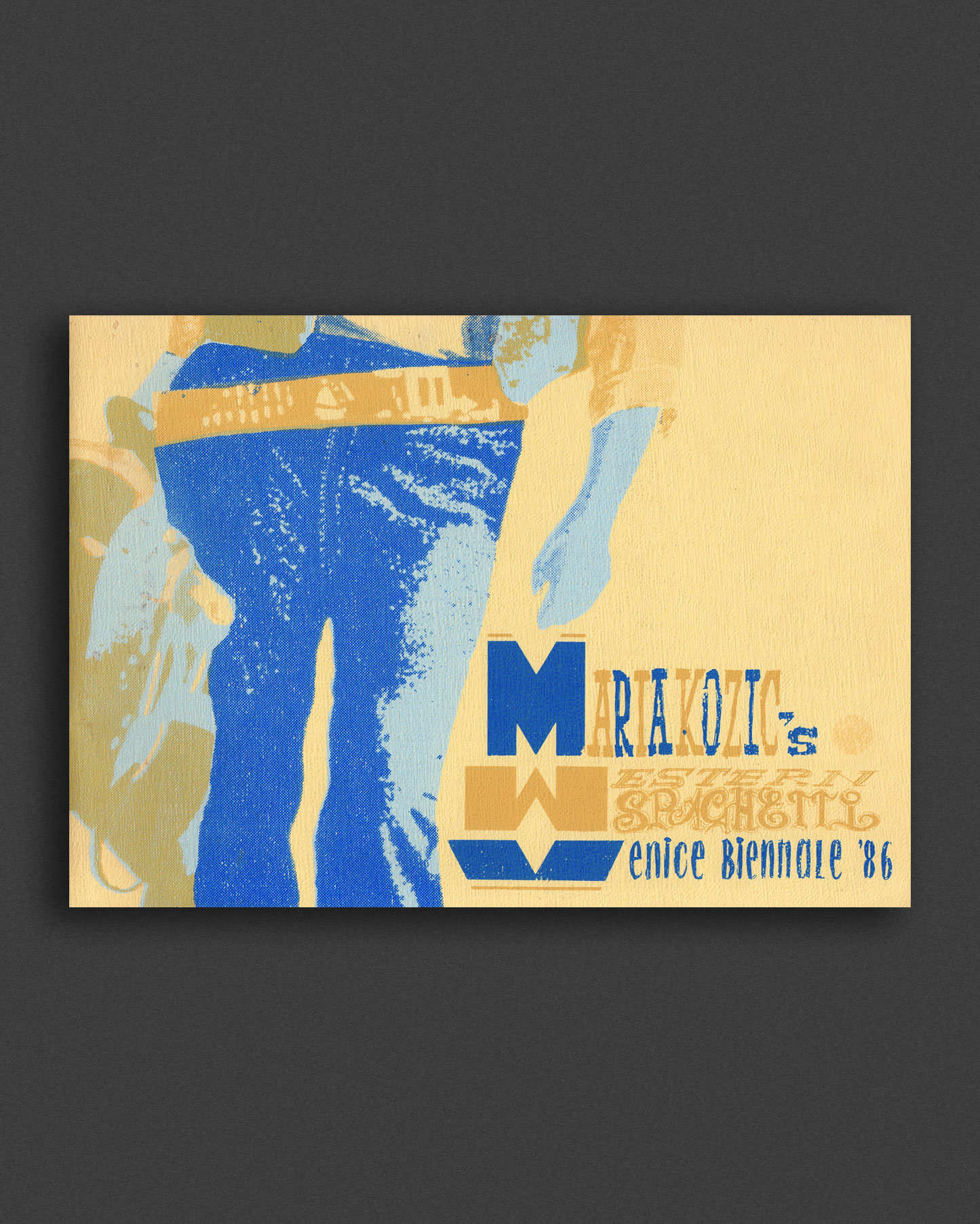
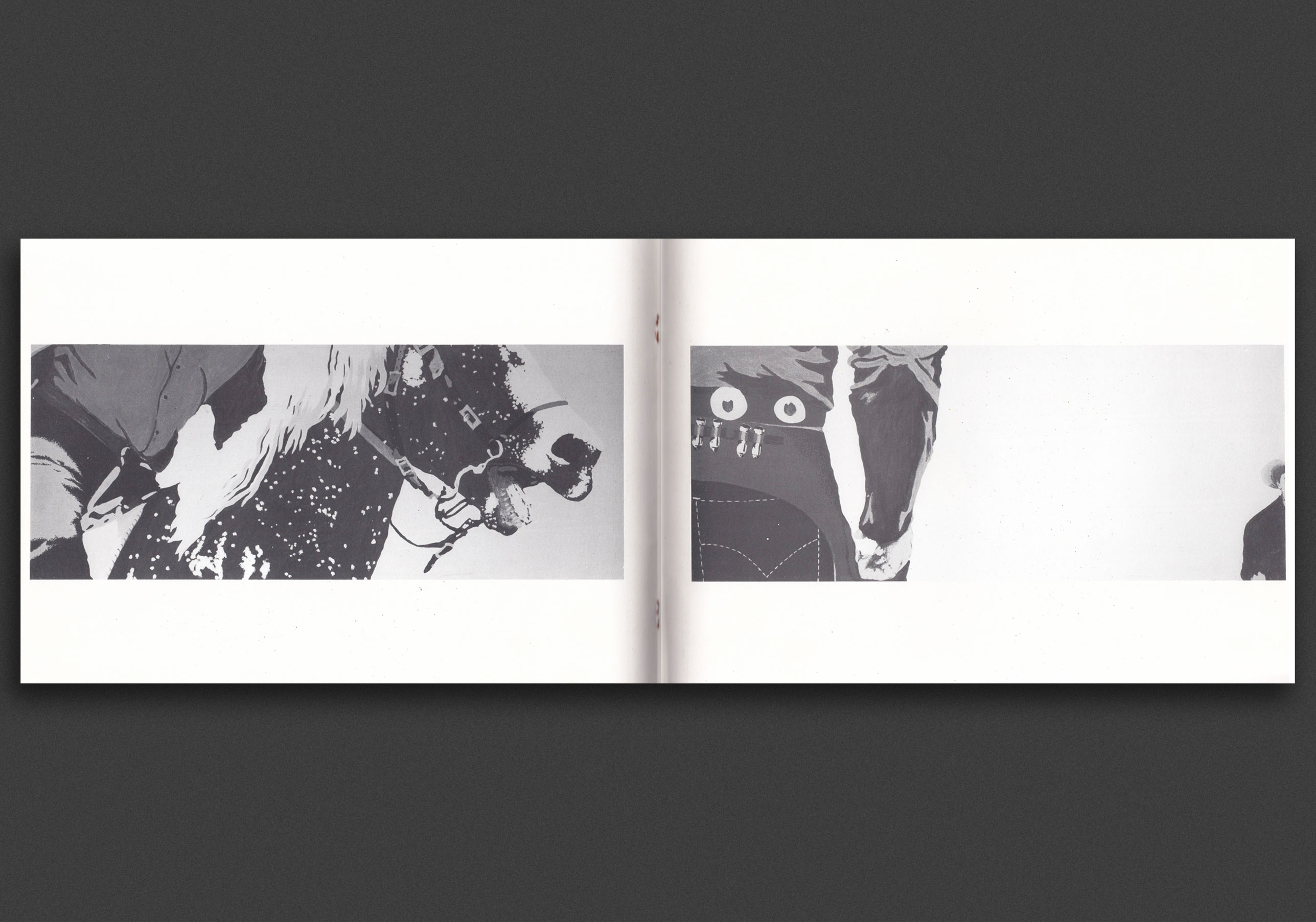
Rare copy of Maria Kozic's artist book, Western Spaghetti: Venice Biennale '86, self–published by Humongous Publications, Melbourne, 1987. With a cover screenprinted by Kozic herself, artwork, design and layout by Kozic, lettering and text by Philip Brophy, the book presents Australian artist Maria Kozic's Western Spaghetti series of cinematic graphic paintings from 1984, presented at the Venice Biennale in 1986. Alongside Brophy's text on Kozic's Western Spaghetti via Pop history, Art history, and Cinema history, the entire series is presented in offset colour, then in large black and white reproductions throughout the book, with an installation photo by Henry Jolles from the Arsenale installation in Venice. Includes an exhibition history, bibliography, list of film screening and other activities, → ↑ →, etc.
Maria Kozic began producing work in the late 1970s, and her prolific output defies simple categorisation. Kozic’s art can be critiqued through the lens of the avant-garde, pop art, conceptual art and/or feminist art. Or one could argue that she is a riot grrrl – one of the subcultural movement that began in the early ’90s and is known for its feminist consciousness, punk style and politics, DIY aesthetics and bands that challenge the male-dominated music scene.
Kozic is a multidisciplinary artist who works across mediums, including theatre, set design, experimental film and video, sound, record-cover design, zines and publications, T-shirts, installation and more traditional media such as painting, sculpture, printmaking, drawing and photography. Maria Kozic Is Bitch (1990) is the artist’s most iconic work. The simple combination of image and text mimics the language of advertising to literally create a poster for female empowerment. The billboard unblinkingly stares down the omnipresent male gaze, the provocatively clad artist public in her defiance.
Very Good copy with some very light marking to covers, small previous price–sticker ghosting, light wear, well preserved and clean interior throughout.
2015, English / Japanese
Hardcover (w. dust jacket), 80 pages, 23.8 x 19.5 cm
1st Edition, Out of print title / used / fine
Published by
Pan-Exotica / Tokyo
$70.00 - In stock -
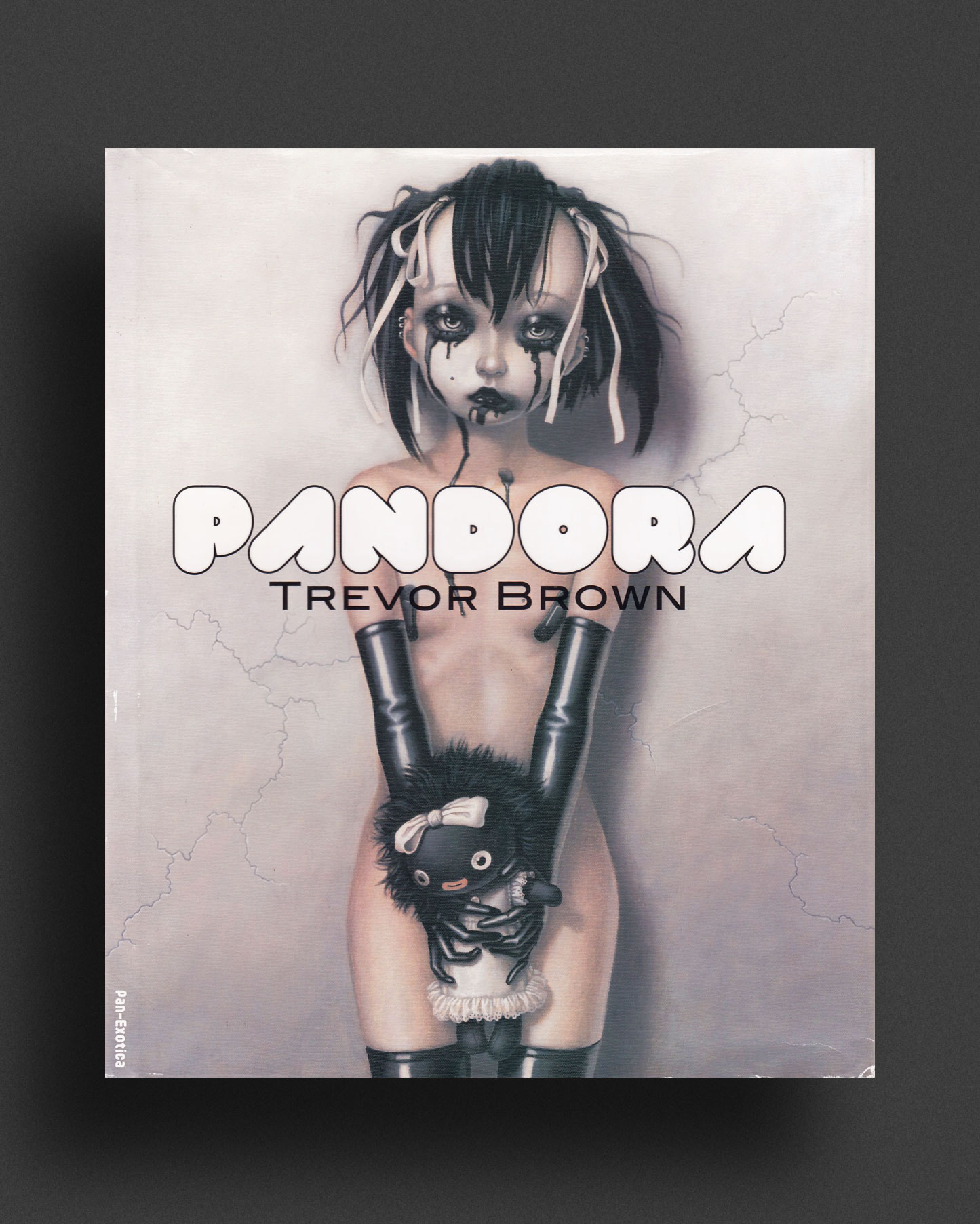
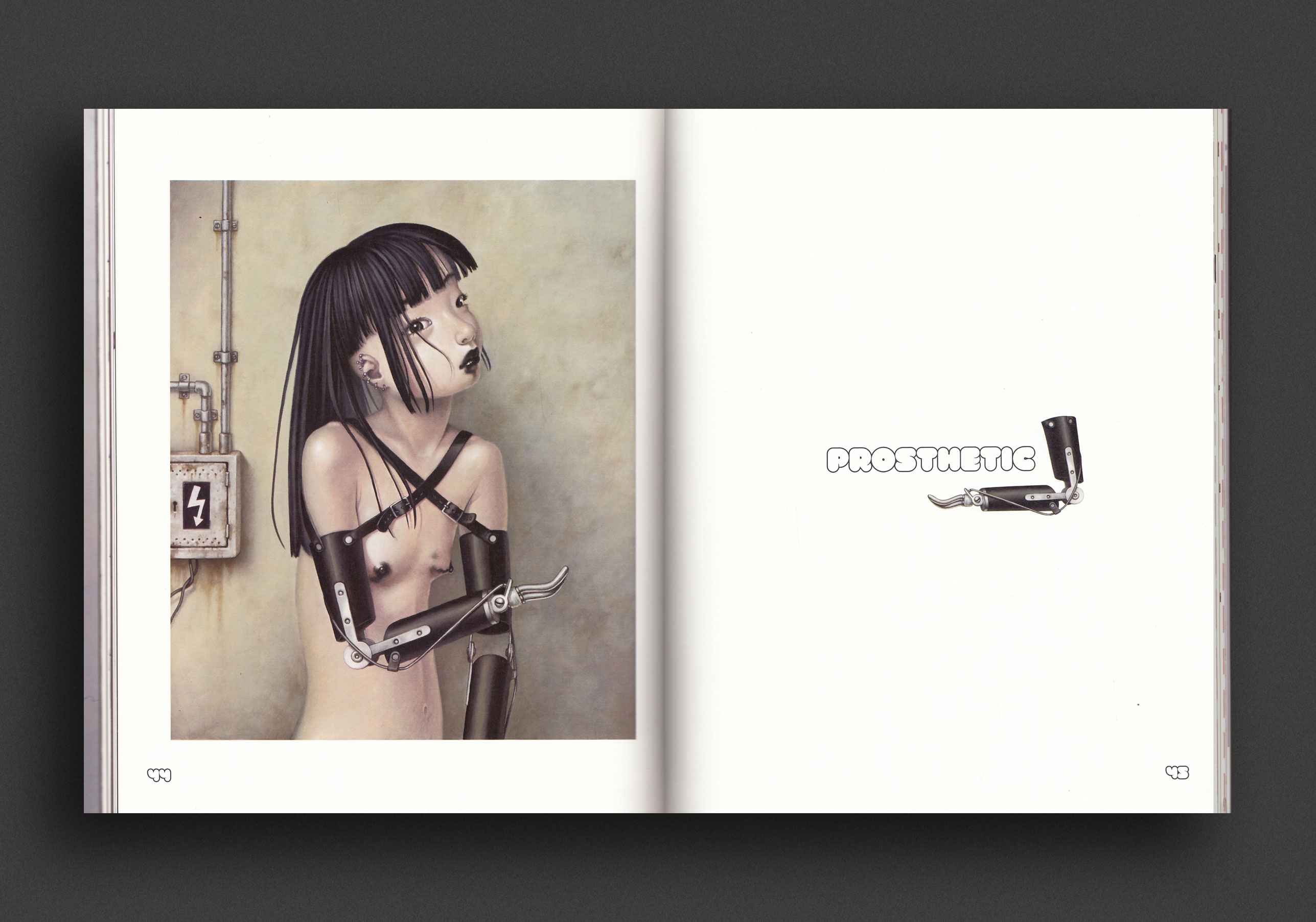
First 2015 hardcover edition of Trevor Brown's Pandora, a collection of uniquely cutesy/disturbing and now iconic paintings of girls and themes of "medical art", like his friend, Bazooka-artist and photographer, Romain Slocombe. Brown's lolita-esque girls and girl-dolls, however, dwell in the world of gothic horror and transgressive scenarios of fetishism, bondage, violence, body modification, etc. This series features artwork influenced by the art of Japanese doll–maker Etsuko Miura, whose book "Reincarnation" shares the same size and format and feature artworks from their joint exhibition at Bunkamura Gallery. Published only in Japan, where the English artist has resided since 1994.
Trevor Brown (b. 1959) is an illusive and prolific artist who's work explores paraphilias, such as lolicon, ero guro, BDSM, and other fetish themes. Innocence and violence collide in Brown's confronting images. Early features on his art appeared in Adam Parfrey's Apocalypse Culture II, Shade Rupe's Funeral Party 2, and in Jim Goad's ANSWER Me! zine, garnering him wide notoriety across the provocative underground publishing scene of the 1980s—90s. He's contributed artwork to many album covers of Whitehouse, Coil, John Zorn, and many more, illustrated for Coup de Grace, an edition of Friedrich Nietzsche's Der Antichrist, the covers of Timeless magazine, and more recently illustrated the cover of the Gothic & Lolita Bible (a subculture in which Brown has many dedicated fans) in Japan, where the the artist has lived since 1994 and where his work has been published in many art book editions.
NF in NF DJ.
1961 / 1973, English
Softcover, 184 pages, 20 x 14 cm
Out of print title / used / very good
Published by
City Lights Books / San Francisco
$30.00 - Out of stock
"This Book of Dreams is what Jack Kerouac saw in his sleep, not day-dreams or day reveries. It's his private dream-record, all his nights strung together. It's the poetic raw material of the Kerouac saga, the substrata of his novels and a commentary upon them. The characters who appear in the book are names who have appeared in "On the Road," "The Subterraneans," and "The Dharma Bums." From the Foreword by Kerouac: "The reader should know that this is just a collection of dreams that I scribbled after I woke up from my sleep - They were all written spontaneously, nonstop, just like dreams happen, sometimes written before I was even wide awake - The characters that I've written about in my novels reappear in these dreams in weird new dream situations and they continue the same story which is the one story that I always write about. The heroes of 'On the Road,' 'The Subterraneans,' etc. reappear here doing further strange things for no other particular reason than that the mind goes on, the brain ripples, the moon sinks, and everybody hides their heads under pillows with sleepingcaps."
Jack Kerouac (1922-1969) was a principal actor in the Beat Generation, a companion of Allen Ginsberg and Neal Cassady in that great adventure. His books include On the Road, The Dharma Bums, Mexico City Blues, Lonesome Traveler, Visions of Cody, Pomes All Sizes (City Lights), Scattered Poems (City Lights), and Scripture of the Golden Eternity (City Lights).
Very Good copy. 1973 print.
2025, English
Hardcover (w. dust jacket), 356 pages, 23 x 15.5 cm
1st Edition, Out of print title / used / fine
$45.00 - Out of stock
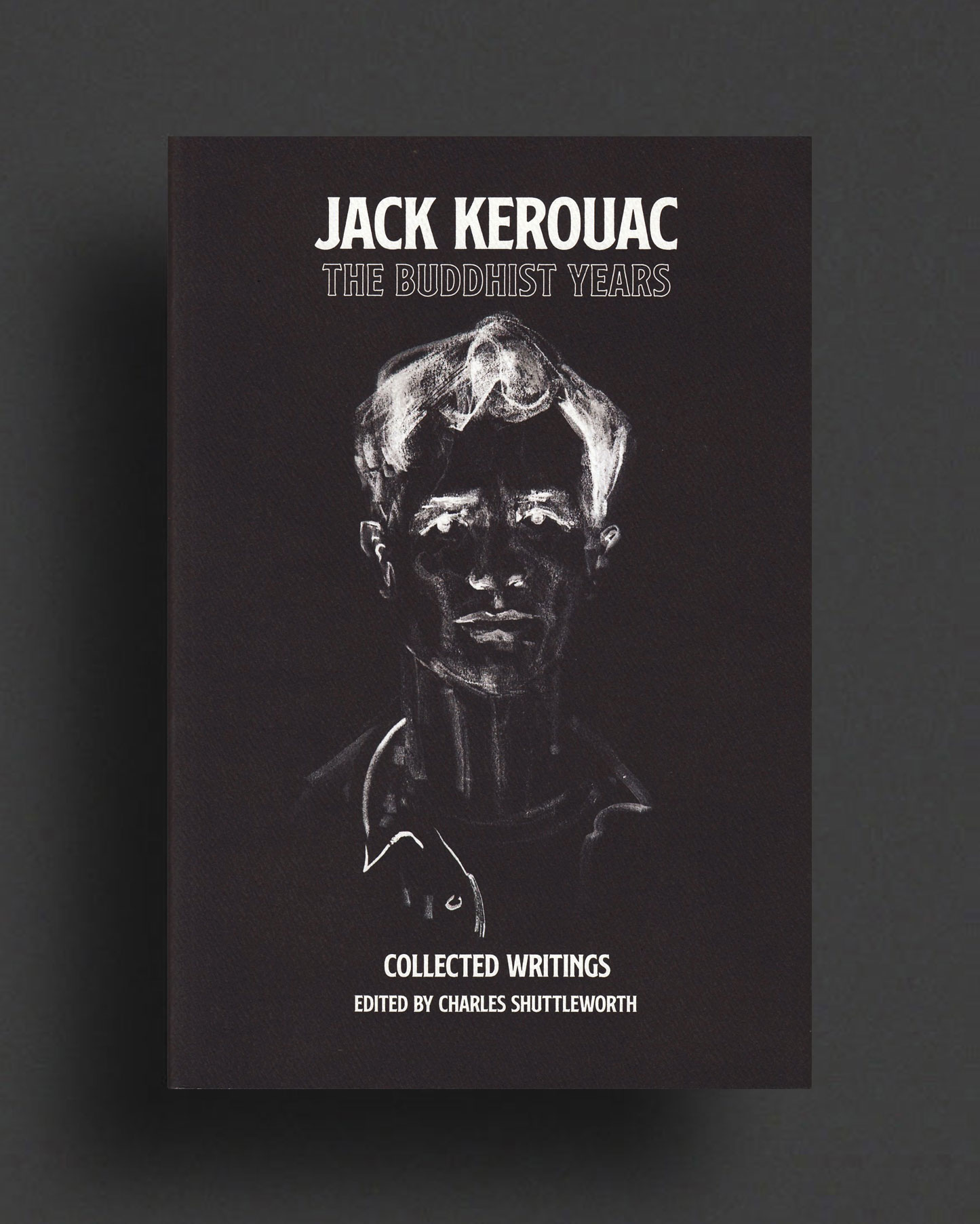
A brand new volume of previously unpublished writings from the archives reflecting Jack Kerouac's Buddhist thinking.
From a young age Kerouac was a spiritual thinker and questioner, and he always considered himself a spiritual writer. Buddhism gave more meaning to Jack's work as a writer: he was working not for personal accomplishment and glory but for human betterment. And Buddhism justified his lifestyle: with its vision of the material world as empty and illusory, he was free to do what he wanted. This collection shows Jack at his earnest, soulful best. The writing is consistently and wonderfully Kerouacian: it is honest, reflective, heartfelt, and revealing, with great characterizations amid his self-exploration as he wrestles with his consciousness, desperate for belief.
Jack Kerouac was born in Lowell, Massachusetts, in 1922, the youngest of three children in a Franco-American family. He attended local Catholic and public schools and won a scholarship to Columbia University in New York City, where he first met Neal Cassady, Allen Ginsberg, and William S. Burroughs. His first novel, The Town and the City, appeared in 1950, but it was On the Road, published in 1957 and memorializing his adventures with Neal Cassady, that epitomized to the world what became known as the "Beat generation" and made Kerouac one of the most best-known writers of his time. Publication of many other books followed, among them The Dharma Bums, The Subterraneans, and Big Sur. Kerouac considered all of his autobiographical fiction to be part of "one vast book," The Duluoz Legend. He died in St. Petersburg, Florida, in 1969, at the age of forty-seven.
1979, English
Softcover, 188 pages, 28 x 22 cm
1st US Edition, Out of print title / used / very good
Published by
St. Martin's Press / New York
$70.00 - In stock -
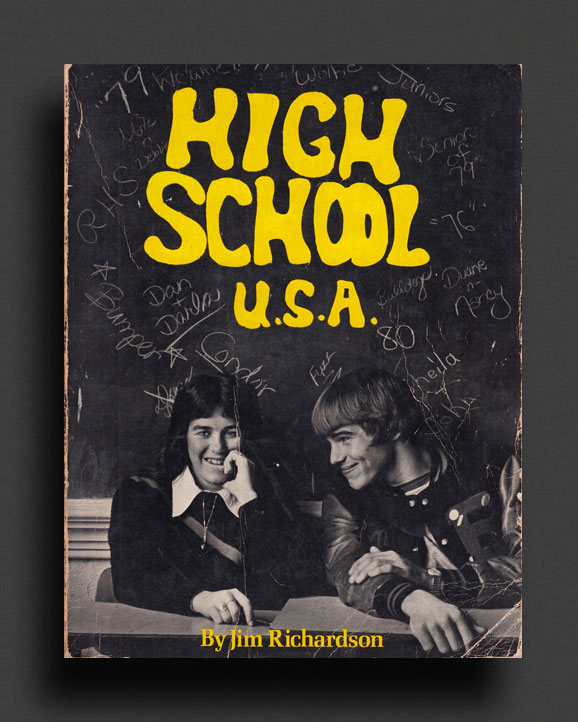
Softcover edition of the first (only) printing of cult photobook "High School U.S.A.", Jim Richardson's intimate 1979 portrait of American adolescence at Rossville High in Rossville, Kansas.
For three years in the late 1970's, Richardson photographed and documented the life of these high school teenagers, coming back every year to vicariously live through all of the life-altering events that high school presents to these young adults. Richardson's photographs of students, teachers, and coaches at Rossville High School in Rossville, Kansas, combined with the students' own words, capture the high school experience from football season to graduation and through identity struggles and romantic involvements that files perfectly alongside Joseph Szabo's great "Almost Grown".
Average–Good Copy throughout with decent cover wear to extremities/small creases (see picture). Internally g–VG with revious owner's name penned to title page.
2003, English / Japanese
Softcover (die-cut, embossed stiff slipcase w. internal illustrated card fold-out sleeve), 92 pages, 22 x 30 cm
Signed by artist,
1st Edition, Out of print title / used / very good
Published by
Treville / Tokyo
$350.00 - In stock -
First, deluxe edition of this rare Hajime Sorayama book published by Treville especially for the exhibition 'Hajime Sorayama - The Exhibition' at Ginza Graphic Gallery in 2003. Now out-of-print and collectible, this extra special copy is also signed by Sorayama himself on the cover "cleavage". Housed in an embossed, die-cut corset slipcase, with an illustrated, fold-out "pin-up" doubled-sided internal sleeve, both made from stiff card, this catalogue is profusely illustrated throughout with Japanese airbrush master Hajime Sorayama's erotic, futuristic, hyper-realistic illustrations with a heavy emphasis on latex and bondage mistresses. Includes his own commentary throughout (in English and Japanese), plus a special look inside his atelier.
Hajime Sorayama (b. 1947) is a Japanese illustrator famed for his precisely detailed, erotic portrayals of feminine robots and fetish pin-ups, and also well-known for his design work on the original Sony AIBO. He describes his highly detailed style as "superrealism", which he says "deals with the technical issue of how close one can get to one's object."
Very Good copy.
1967 / 1976, English
Hardcover (w. dust jacket), 96 pages, 25.5 x 19 cm
Out of print title / used / very good
Published by
Studio Vista / London
$35.00 - In stock -
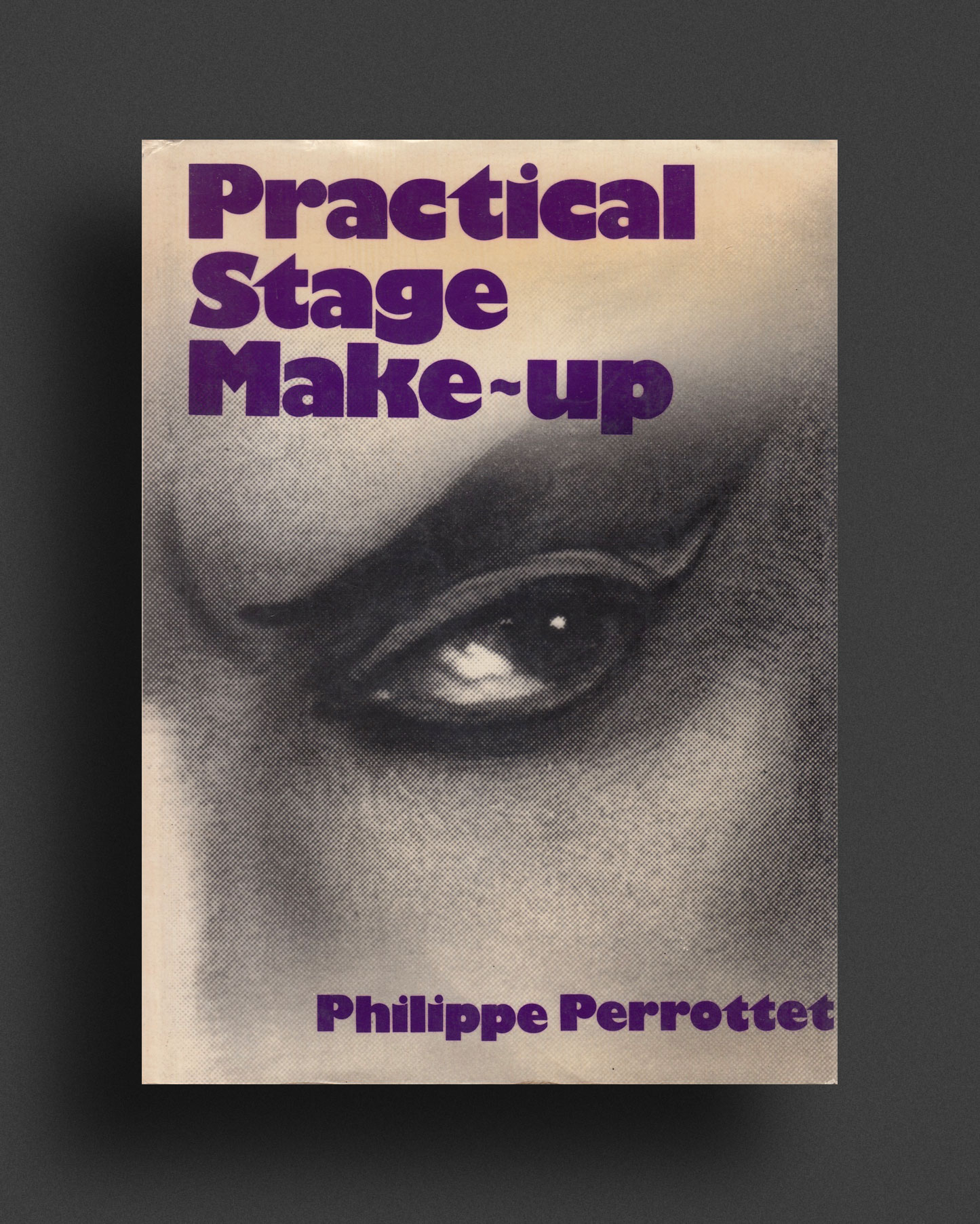
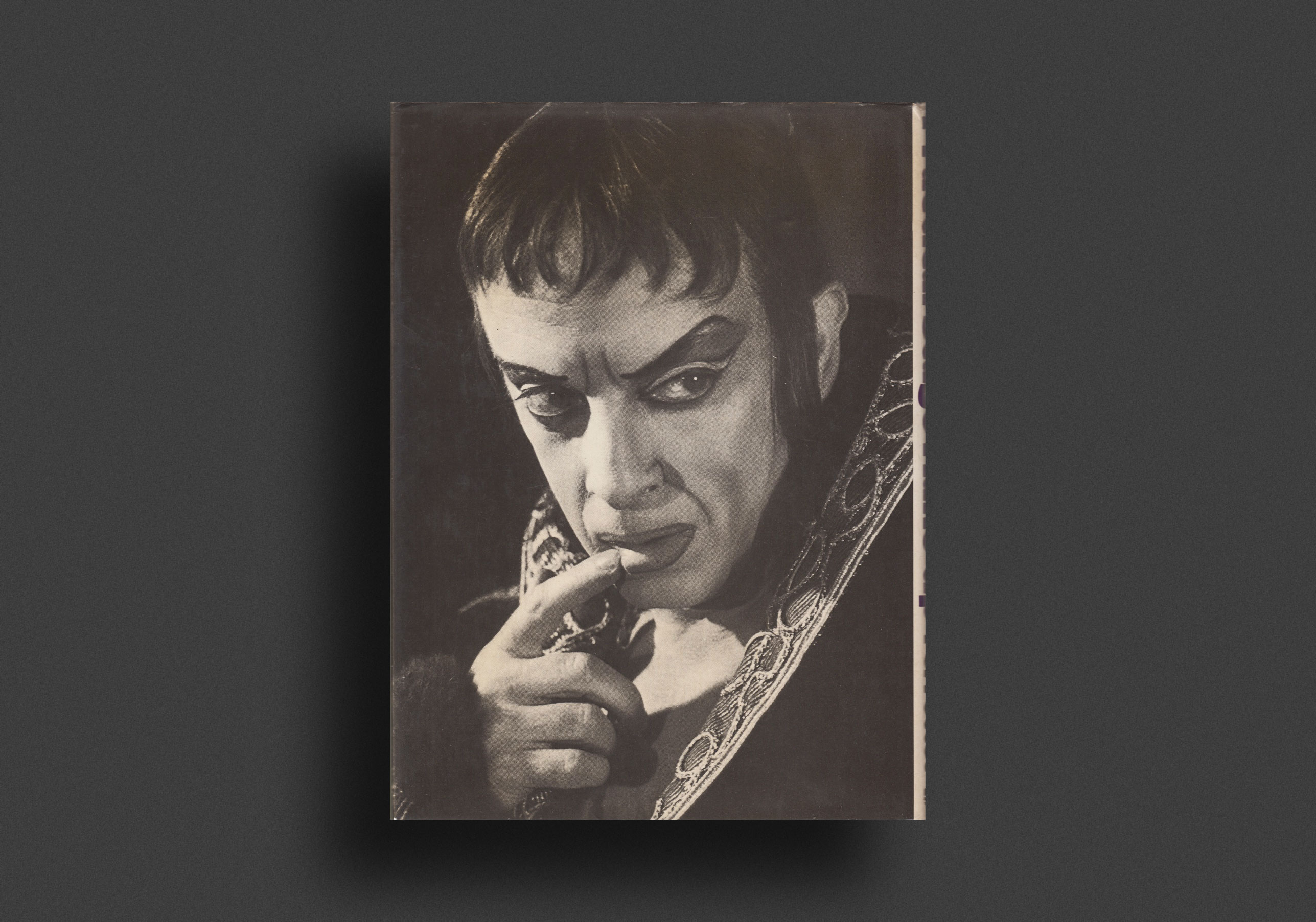
Published in 1967, and revised in this hardcover edition in 1975/1976 by Studio Vista, London, Practical Stage Make-Up by Australian dancer, choreographer, and act Philippe Perrottet. Heavily illustrated in colour and b/w with a wealth of practical information on make–up for theatre, from an expert in the field.
Philippe Louis Gaston Perrottet (1921–1982) was an Australian dancer, choreographer, and actor celebrated for his work in British theatre, opera, and television. Born in Kew, Melbourne, he served in the Royal Australian Air Force during World War II before training under dance luminaries like Anton Dolin and Edvard Borovansky. After performing with the Australian Ballet Society and Colonel de Basil’s Russian Ballet, he relocated to the UK in 1947. There, he danced in the classic film The Red Shoes (1948), appeared in London's West End, and spent a decade (1958–1968) as a prominent choreographer for Sadler's Wells Opera, alongside choreographing numerous British television productions until his death in Rome in 1982.
VG copy with some foxing in VG dust jacket (price–clipped), preserved in mylar wrap.
2019, English
Hardcover, 464 pages, 28.6 x 21.8 cm
1st Edition, Out of print title / as new
Published by
The MIT Press / Massachusetts
$80.00 - In stock -
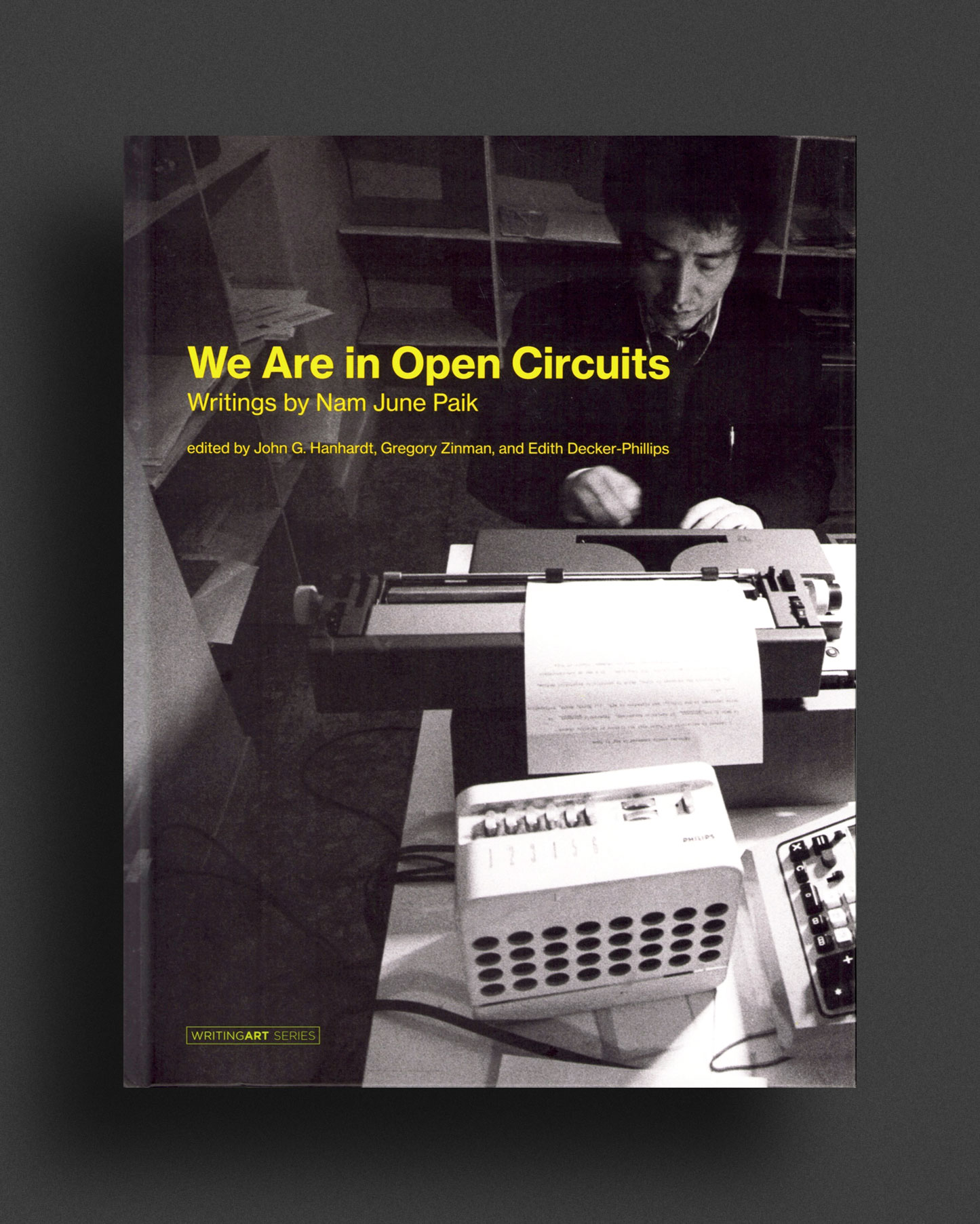
Edited by John G. Hanhardt, Gregory Zinman and Edith Decker-Phillips
Essays, project plans, and correspondence from across Nam Jun Paik's career, much of it previously out of print or unpublished.
Nam June Paik (1932–2006) is a pivotal figure in the history of modern art. Arguably the most important video artist of all time, and certainly among the most influential and prolific, Paik was a legendary innovator who transformed the electronic moving image into an artist's medium. He wrote incessantly—corresponding with friends, composing performance scores, making production notes for television projects, drafting plans for video installations, writing essays and articles. Celebrated for his visionary development of new artistic tools and for his pioneering work in video and television, Paik often wrote to sharpen his thinking and hone his ideas. He used the typewriter to fashion sentences that broke apart and reassembled themselves as he wrote, producing both poetic texts and aesthetic objects on the page. This first extensive collection of Paik's writings includes many previously unpublished and out-of-print texts.
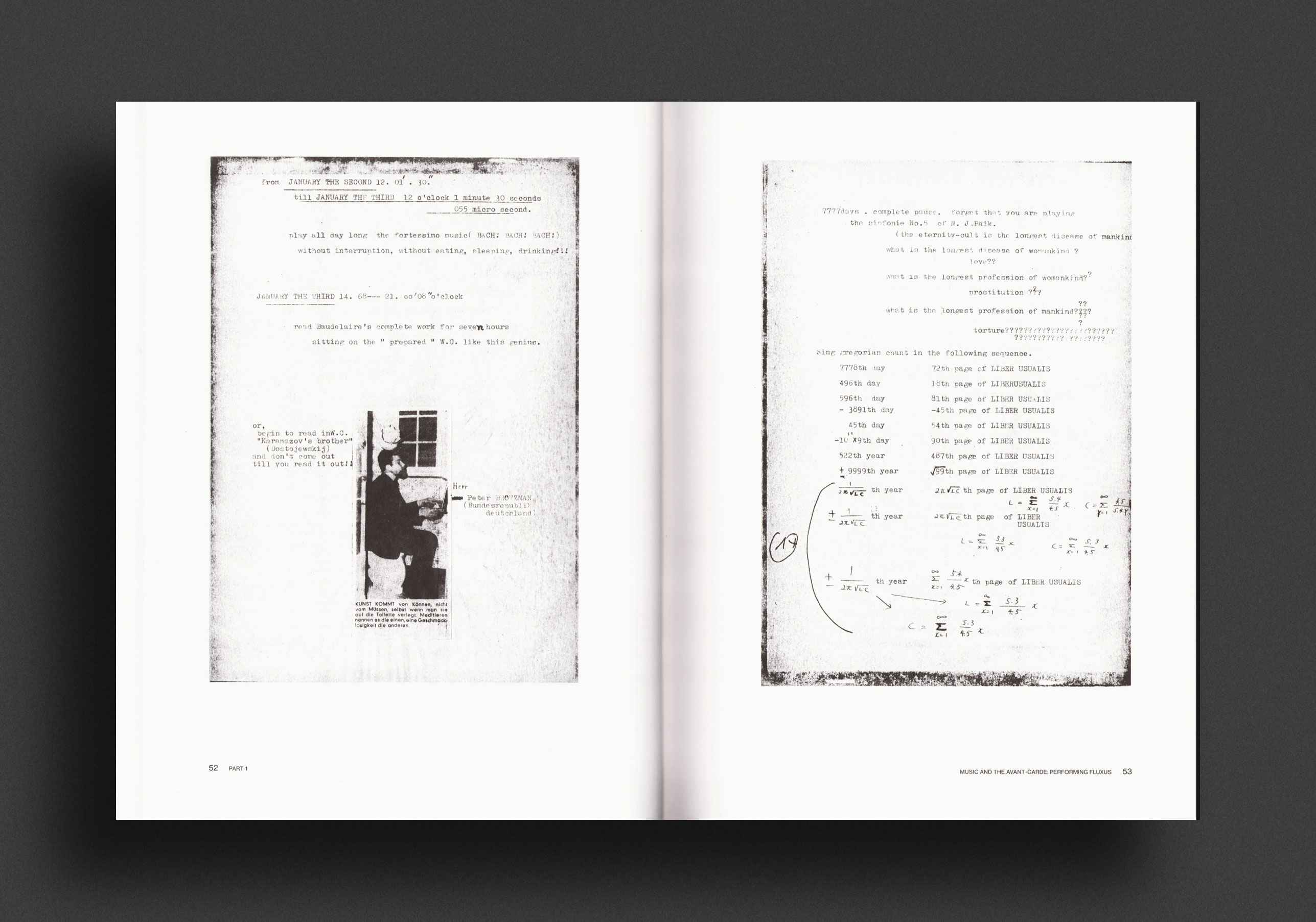
Drawing on materials from the Smithsonian American Art Museum's Nam June Paik Archive and from a range of international publications, We Are in Open Circuits offers important but long-unavailable essays, including “Global Groove and Video Common Market”; unpublished writings on such topics as his creative partnership with the cellist Charlotte Moorman and the role of public television; a substantial part of his compilation “Scrutable Chinese”; and detailed plans for some of his groundbreaking broadcast works, including the trio Good Morning, Mr. Orwell (1984), Bye Bye Kipling (1986), and Wrap Around the World (1988). It also includes nearly 150 pages that reproduce Paik's original typed and handwritten pages, letting readers see his writing in various stages of inspiration and execution.
John G. Hanhardt is an independent curator of film and the media arts and has curated Nam June Paik retrospectives at the Whitney Museum of American Art, Guggenheim Museum, and Smithsonian American Art Museum.
Gregory Zinman is Assistant Professor in the School of Literature, Media, and Communication at Georgia Tech.
Edith Decker-Phillips is an art historian and the author of Paik Video.
As New.
1986, Japanese
Softcover (w. dust jacket), 128 pages, 15 x 21 cm
1st Edition, Out of print title / used / very good
Published by
Bandai / Tokyo
$140.00 - In stock -
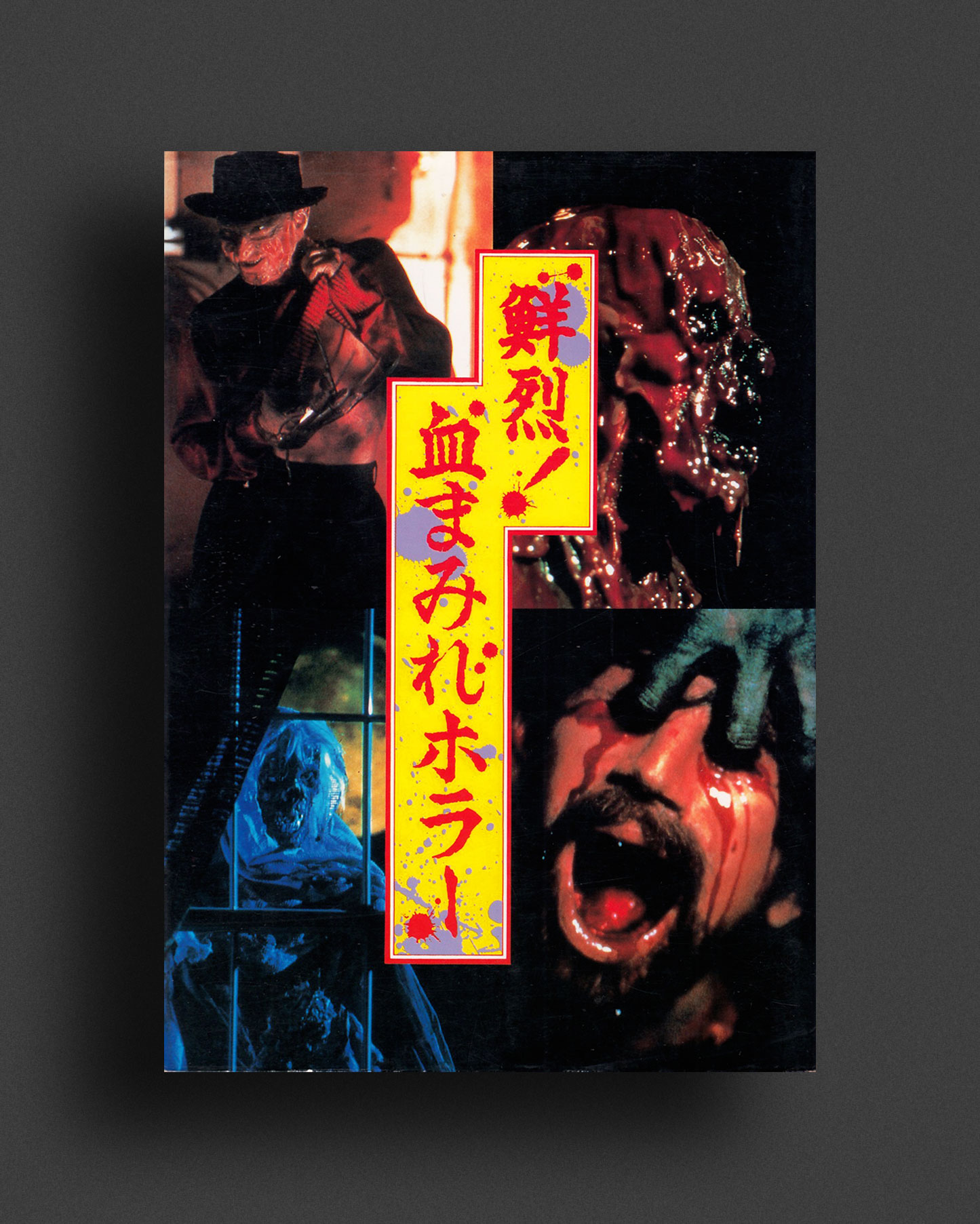
Rare copy of 1986's Vivid! Bloody Horror, the amazing Japanese book that collects articles and hundreds of stills, as well as poster art, from the bloodiest of horror film history. Profusely illustrated throughout in vivid gore-saturated colour and b/w with image features on the films of Dario Argento, Lucio Fulci, Tobe Hooper, David Cronenberg, George A. Romero, Herschell Gordon Lewis, Wes Craven, William Malone... Heavily illustrated articles document the horror films of South East Asia, pay tribute to Tobe Hooper and Herschell Gordon Lewis, survey of prop weaponry, and much more. Includes the "Blood-Stained Cathode-Ray Tube Horror Movie Collection" — the ultimate guide to horror on video. Too much in here to list. The ultimate ode to splatter, and a valuable resource. Texts in Japanese.
Very Good copy.
1993, Japanese
Hardcover (w. dust jacket), 220 pages, 13.6 cm x 19.4 cm
1st Edition, Out of print title / used / fine
Published by
Seikyūsha / Tokyo
$110.00 - In stock -
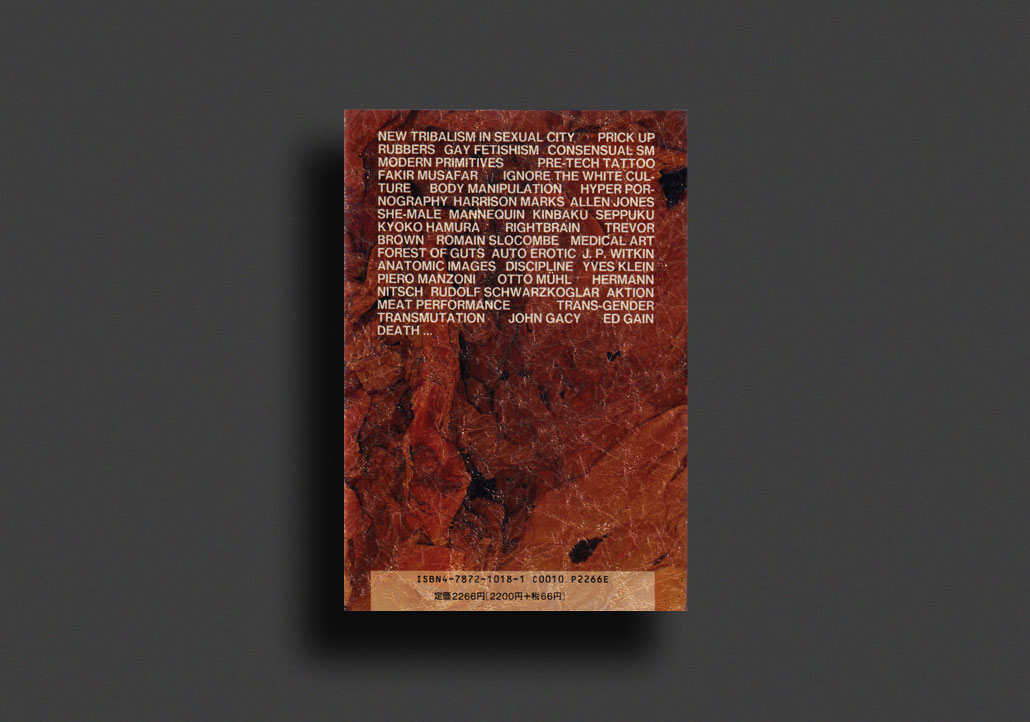
New Tribalism In Sexual City, Prick Up, Rubbers, Gay Fetishism, Consensual SM, Modern Primitives, Pre-Tech Tattoo, Fakir Musafar, Ignore the White Culture, Body Manipulation, Hyper Pornography, Harrison Marks, Allen Jones, She-Male, Mannequin, Kinbaku, Seppuku, Kyoko Hamura, Rightbrain, Trevor Brown, Roman Slocombe, Medical Art, Forest Of Guts, Auto Erotic, J. P. Witkin, Anatomic Images, Discipline, Yves Klein, Piero Manzoni, Otto Mühl, Hermann Nitsch, Rudolf Schwarzkoglar, Aktion, Meat Performance, Trans-Gender, Transmutation, John Gacy, Ed Gain, Death ...
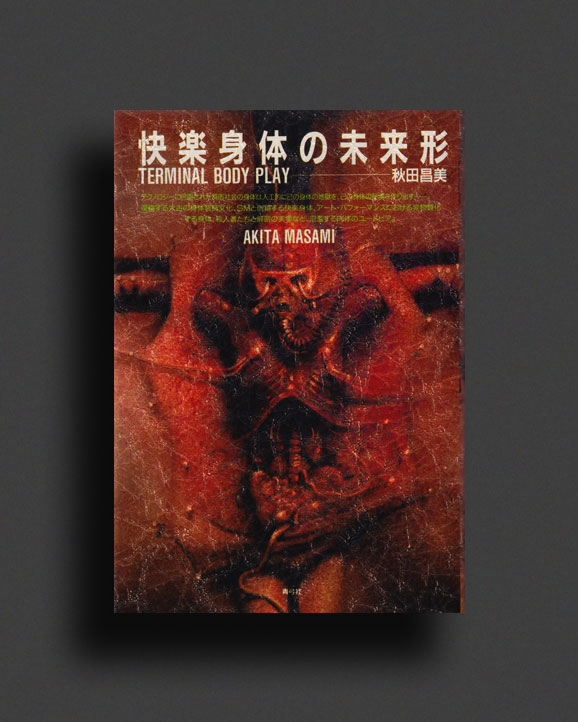
First hardcover edition of "Terminal Body Play", written by Merzbow's Masami Akita and published only in Japan in 1993. Covering all the above subjects with b/w illustrations, "Terminal Body Play" explores a plethora of physical utopias, including a revived ancient culture of body decoration and manipulation, the pleasure of the body perverted by BDSM, the dematerialised body of performance art, the aesthetics of murder, medicine and anatomy, and so much more. Merzbow is a noise project created in Tokyo, Japan in 1979 under the direction of noise technician Masami Akita. As well as a legendary underground noise artist, Akita is a prolific writer in Japan and frequently writes on the arts, music, erotica, esoterica, modern architecture, and animal rights, with articles on emerging subcultures and underground extreme cultures appearing in publications like SM Sniper, Studio Voice and Fool's Mate. His development of the Merzbow aesthetic ran parallel with a series of investigative books in which he catalogued and introduced a vast amount of hermetic types of music, sexual practices and autonomous creativity to a fairly conservative (but not close-minded) Japanese audience. "Terminal Body Play" is one of these very books.
First edition, Japanese text, fine copy with fine "textured" and illustrated dust jacket.
1985, English
Softcover, 160 pages, 23 x 15.5 cm
1st Edition, Out of print title / used / very good
Published by
University of Minnesota Press / Minnesota
$45.00 - Out of stock
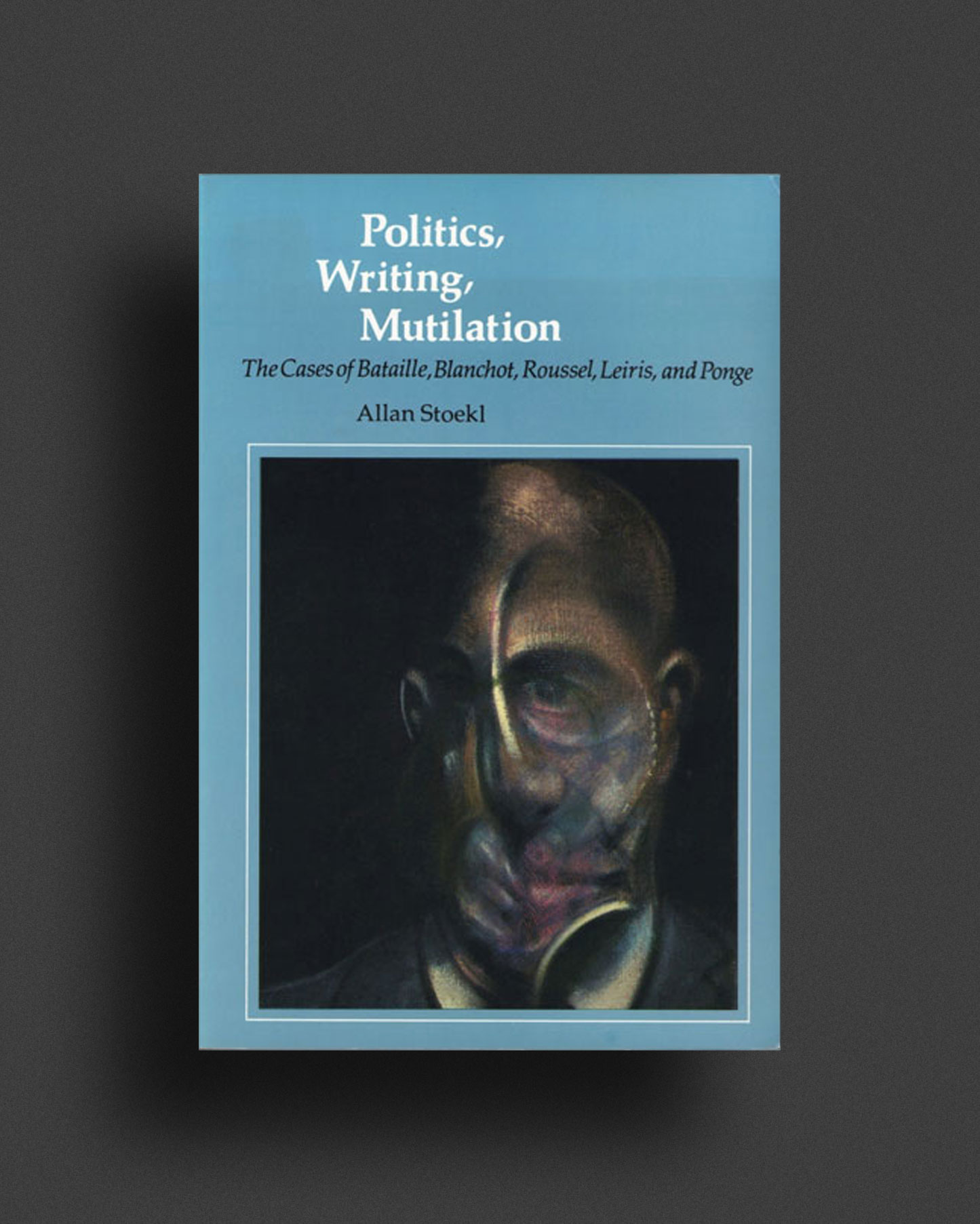
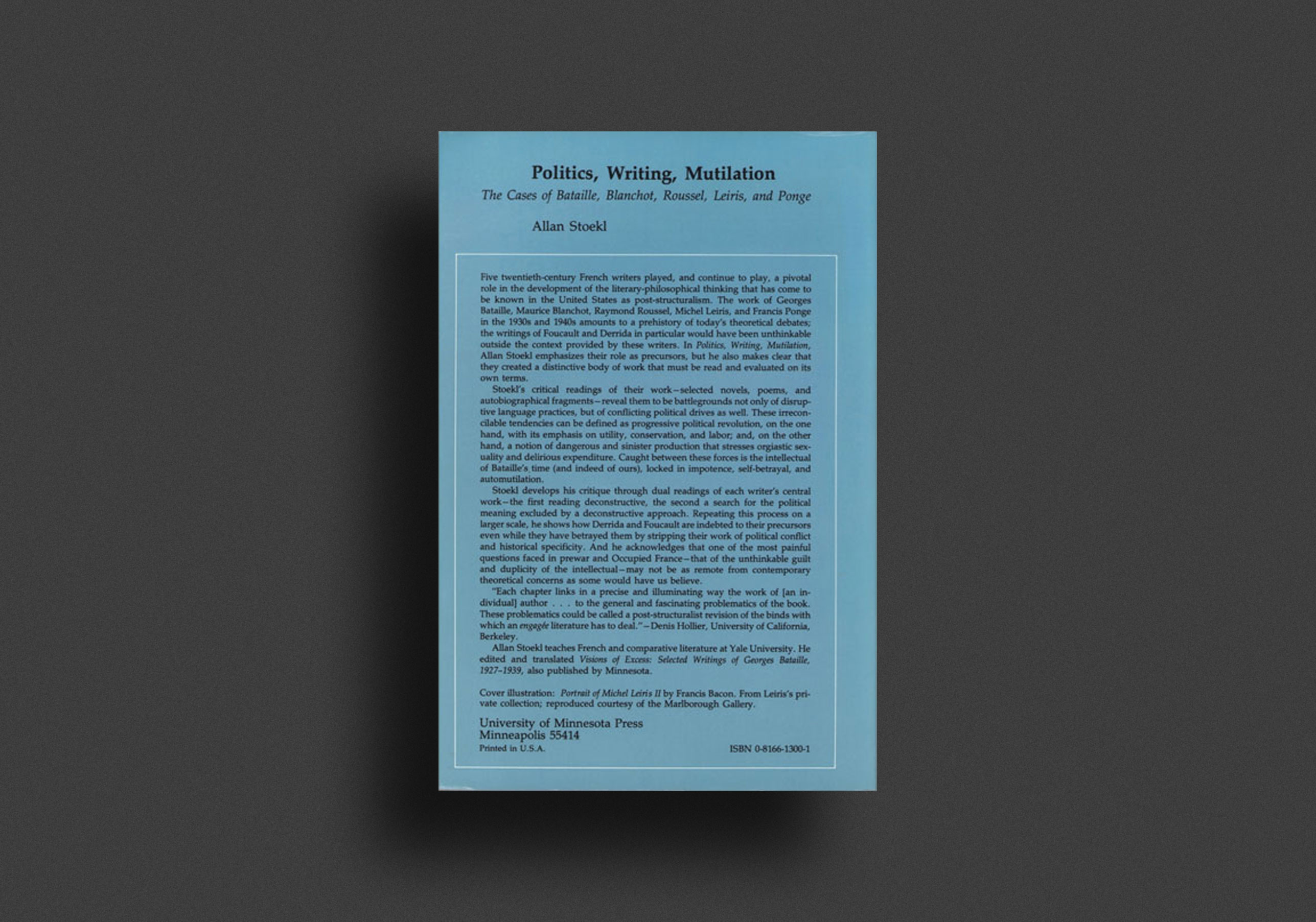
First edition of Allan Stoekl's Politics, Writing, Mutilation, published in 1985 by Minnesota Press.
Five twentieth-century French writers played, and continue to play, a pivotal role in the development of literary-philosophical thinking that has come to be known in the United States as post-structuralism. The work of Georges Bataille, Maurice Blanchot, Raymond Roussel, Michel Leiris, and Francis Ponge in the 1930s and 1940s amounts to a prehistory of today's theoretical debates; the writings of Foucault and Derrida in particular would have been unthinkable outside the context provided by these writers. In Politics, Writing, Mutilation, Allan Stoekl emphasizes their role as precursors, but he also makes clear that they created a distinctive body of work that must be read and evaluated on its own terms.
Stoekl's critical readings of their work-selected novels, poems, and autobiographical fragments-reveal them to be battlegrounds not only of disruptive language practices, but of conflicting political drives as well. These irreconcilable tendencies can be defined as progressive political revolution, on the one hand with its emphasis on utility, conservation, and labor; and, on the other hand, a notion of dangerous and sinister production that stresses orgiastic sexuality and delirious expenditure. Caught between these forces is the intellectual of Bataille's time (and indeed of ours), locked in impotence, self-betrayal, and automutilation.
Stoekl develops his critique through dual readings of each writer's central work-the first reading deconstructive, the second a search for the political meaning excluded by a deconstructive approach. Repeating this process on a larger scale, he shows how Derrida and Foucault are indebted to their precursors even while they have betrayed them by stripping their work of political conflict and historical specificity. And he acknowledges that one of the most painful questions faced in prewar and Occupied France-that of the unthinkable guilt and duplicity of the intellectual-may not be as remote from contemporary theoretical concerns as some would have us believe.
"Allan Stoekl teaches french and comparative literature at Yale University. He edited and translated Vision of Excess: Selected Writings of Georges Bataille, 1997-1939, also published by Minnesota. "
VG copy.