World Food Books' programme is largely produced on Kulin Nation land. We acknowledge the Wurundjeri people of the Kulin Nation as the first and continuing custodians of this land, and pay respect to their Elders past, present, and emerging.
World Food Books is an arts and special interests bookshop in Naarm / Melbourne. Founded in 2010, World Food Books is devoted to the presentation of a rotating, hand-selection of international art, design, literary and counterculture publications with an emphasis on the anti-traditional, the experimental, the avant-garde, the heretic, the marginal.
Presenting new titles alongside rare and out-of-print books, catalogues and journals spanning the fields of modern and contemporary art, design, photography, illustration, film, literature, poetry, cultural theory, philosophy, sexuality, popular and underground culture in its many radical forms, World Food Books wishes to encourage adventurous, thoughtful and open-minded reading, looking, writing, and exchange of publishing and ideas, both current and historical.
As well as our bookshop, located in Melbourne's historical Nicholas Building, all of our inventory is available internationally via our online mail-order service.
World Food Books semi-regularly co-ordinates "Occasions", a programme of exhibits and events at the bookshop and in partnership with other hosts (such as museums and art galleries) that develop out of the activities, relationships and content of the bookshop itself.
World Food Books
The Nicholas Building
37 Swanston Street
Room 5, Level 6
Melbourne 3000
Australia
SHOP HOURS:
Thu–Fri 12–6
WEB-SHOP OPEN 24/7
World Food Books
Postal Address:
37 Swanston Street
Room 5, Level 6
Melbourne 3000
Australia
Art
Theory / Essay
Architecture / Interior
Graphic Design / Typography
Photography
Fashion
Eros
LGBTQ+
Fiction / Poetry
Weird / Speculative / Science Fiction / Horror
Transgressive / Visceral / Abject
Symbolism / Decadence / Fin de siècle
Film / Video
Painting
Sculpture / Installation
Performance / Dance / Theater
Drawing
Sound / Music
Curatorial
Group Shows / Collections
Periodicals
Out-of-print / Rare
Posters / Ephemera / Discs
Signed Books
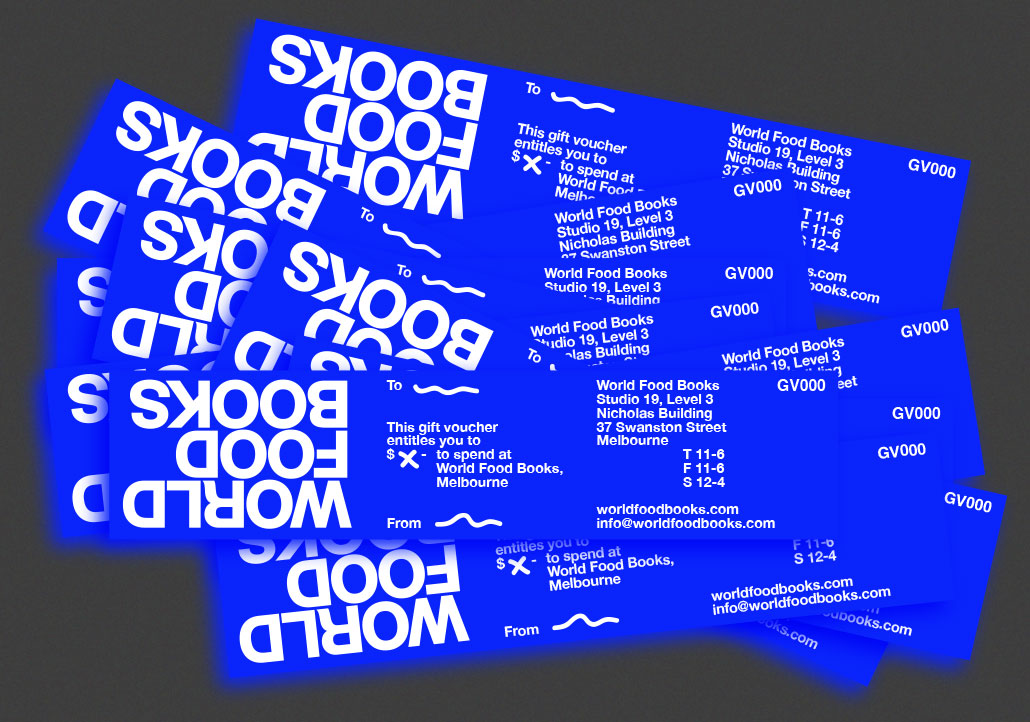
World Food Books Gift Voucher
World Food Book Bag
Australian Art
Australian Fiction
Australian Science Fiction / Speculative Fiction
Australian Poetry
Australian Photography
Japanese Photography
Conceptual Art
Minimal Art
Dada
'Pataphysics / Oulipo
Fluxus
Concrete Poetry
Pop Art
Surrealism
Arte Povera
Arte Informale / Haute Pâte / Tachism
Nouveau Réalisme / Zero / Kinetic
Situationism / Lettrism
Collage / Mail Art / Xerox Art
Art Brut / Folk / Visionary / Fantastic
Illustration / Graphic Art / Bandes Dessinées
Furniture
Italian Radical Design / Postmodernism
Textiles
Ceramics / Glass
Counterculture
Protest / Revolt
Philosophy
Psychoanalysis
Anthropology
Anarchism
Socialism / Anarchism / Communism / Capitalism
Literary Theory / Semiotics / Language
Feminism / Women's Studies
Gender Studies / Sexuality
Anthropology
Fetishism / BDSM
Drugs / Psychedelia
Crime / Violence
Animal Rights / Veganism
Occult / Esoterica
Ecology / Earth / Alternative Living
Whole Earth / Crafts
All prices in AUD (Australian dollars)
Pick-Ups
Pick-up orders can be collected in our bookshop during opening hours after order date. Please collect any Pick-up orders within 2 weeks of ordering as we have limited storage space. Orders will be released back into stock if not collected within this time. No refunds can be made for pick-ups left un-collected. If you cannot make it in to the bookshop in this time-frame, please choose postage option.
Return Policy
All sales are final. We do accept returns (for refund or exchange) for items received in error. All our orders are packed with special care using heavy-duty padding and cardboard book-mailers or bubble mailers (for smaller books), using reinforcement where required. We cannot take responsibility for any lost, stolen or damaged parcels.
Insurance
Should you wish to insure your package, please email us directly after placing your order and we can organise this at a small extra expense. Although all standard/express tracked packages are very safe and dependable, we cannot take responsibility for any lost, stolen or damaged parcels. We recommend insurance on valuable orders.
Interested in selling your old books, catalogues, journals, magazines, comics, fanzines, ephemera? We are always looking for interesting, unusual and out-of-print books to buy. We only buy books in our fields of interest and specialty, and that we feel we can resell.
We base these prices on desirability, market value, in-print prices, condition and our current stock levels. We offer cash, store credit, and can take stock on consignment. All
about 25% of the price we expect to get when we sell them, or 30% in store credit. We base these prices on desirability, market value, in-print prices, condition and our current stock levels.
Sell your books any day of the week. You can drop them off and return later. If you have a lot of books, we can visit your Sydney home.
We buy books that we feel we can resell. We offer about 25 % of the price we expect to get when we sell them, or 30% in store credit. We base these prices on desirability, market value, in-print prices, condition and our current stock levels.
Philadelphia Wireman
03 August - 01 September, 2018
World Food Books is proud to announce our next Occasion, the first presentation of sculptures by Philadelphia Wireman in Australia.
The Philadelphia Wireman sculptures were found abandoned in an alley off Philadelphia’s South Street on trash night in 1982. Their discovery in a rapidly-changing neighbourhood undergoing extensive renovation, compounded with the failure of all attempts to locate the artist, suggests that the works may have been discarded after the maker’s death. Dubbed the "Philadelphia Wireman" during the first exhibition of this work, in 1985, the maker’s name, age, ethnicity, and even gender remain uncertain. The entire collection totals approximately 1200 pieces, all intricately bound together with tightly-wound heavy-gauge wire (along with a few small, abstract marker drawings, reminiscent both of Mark Tobey and J.B. Murry). The dense construction of the work, despite a modest range of scale and materials, is singularly obsessive and disciplined in design: a wire armature or exoskeleton firmly binds a bricolage of found objects including plastic, glass, food packaging, umbrella parts, tape, rubber, batteries, pens, leather, reflectors, nuts and bolts, nails, foil, coins, toys, watches, eyeglasses, tools, and jewellery.
Heavy with associations—anthropomorphic, zoomorphic, and socio-cultural responses to wrapped detritus—the totemic sculptures by Philadelphia Wireman have been discussed in the context of work created to fulfil the shamanistic needs of alternative religions in American culture. Curators, collectors, and critics have variously compared certain pieces to sculpture from Classical antiquity, Native American medicine bundles, African-American memory jugs, and African fetish objects. Reflecting the artist’s prolific and incredibly focused scavenging impulse, and despite—or perhaps enhanced by—their anonymity, these enigmatic objects function as urban artefacts and arbiters of power, though their origin and purpose is unknown. Philadelphia Wireman, whatever their identity, possessed an astonishing ability to isolate and communicate the concepts of power and energy through the selection and transformation of ordinary materials. Over the course of the past two decades, this collection has come to be regarded as an important discovery in the field of self-taught art and vernacular art.
Presented in collaboration with Fleisher-Ollman Gallery, Philadelphia, and Robert Heald, Wellington.
Susan Te Kahurangi King
02 February - 10 March, 2018
Susan Te Kahurangi King (24 February 1951 - ) has been a confident and prolific artist since she was a young child, drawing with readily available materials - pencils, ballpoint pens and felt-tip markers, on whatever paper is at hand. Between the ages of four and six Susan slowly ceased verbal communication. Her grandparents William and Myrtle Murphy had developed a special bond with Susan so they took on caring responsibilities for extended periods. Myrtle began informally archiving her work, carefully collecting and storing the drawings and compiling scrapbooks. No drawing was insignificant; every scrap of paper was kept. The King family are now the custodians of a vast collection containing over 7000 individual works, from tiny scraps of paper through to 5 meter long rolls.
The scrapbooks and diaries reveal Myrtle to be a woman of great patience and compassion, seeking to understand a child who was not always behaving as expected. She encouraged Susan to be observant, to explore her environment and absorb all the sights and sounds. Myrtle would show Susan’s drawings to friends and people in her community that she had dealings with, such as shopkeepers and postal workers, but this was not simply a case of a grandmother’s bias. She recognised that Susan had developed a sophisticated and unique visual language and sincerely believed that her art deserved serious attention.
This was an unorthodox attitude for the time. To provide some context, Jean Dubuffet coined the term Art Brut in 1945 to describe work created by self-taught artists – specifically residents of psychiatric institutions and those he considered to be visionaries or eccentrics. In 1972 Roger Cardinal extended this concept by adopting the term Outsider Art to describe work made by non-academically trained artists operating outside of mainstream art networks through choice or circumstance. Susan was born in Te Aroha, New Zealand in 1951, far from the artistic hubs of Paris and London that Dubuffet and Cardinal operated in. That Myrtle fêted Susan as a self-taught artist who deserved to be taken seriously shows how progressive her attitudes were.
Susan’s parents Doug and Dawn were also progressive. Over the years they had consulted numerous health practitioners about Susan’s condition, as the medical establishment could not provide an explanation as to why she had lapsed into silence. Dawn educated herself in the field of homeopathy and went on to treat all twelve of her children using these principles – basing prescriptions on her observations of their physical, mental and emotional state.
Doug was a linguist with an interest in philosophy who devoted what little spare time he had to studying Maori language and culture. To some extent their willingness to explore the fringes of the mainstream made them outsiders too but it was their commitment to living with integrity and their respect for individuality that ensured Susan’s creativity was always encouraged.
Even though Susan’s family supported her artistic pursuits, some staff in schools and hospitals saw it as an impediment to her assimilation into the community and discouraged it in a variety of ways. Her family was not always aware of this and therefore did not fully understand why Susan stopped drawing in the early 1990s. However, rather than dwell on the challenges that Susan faced in pursuit of her artistic practice, they prefer to highlight her achievements. In 2008 Susan began drawing again in earnest, after an almost 20 year interruption, and her work is now shown in galleries around the world.
Susan grew up without television and has been heavily influenced by the comics she read as a child. She is absolutely fearless in the appropriation of recognizable characters, such as Donald Duck and Mickey Mouse, in her work. She twists their limbs, contorts their faces, compresses them together, blends them into complex patterned backgrounds - always imbuing them with an incredible energy. Although Susan often used pop culture characters in her work they are not naive or childlike. These are drawings by a brilliant self-taught artist who has been creating exceptional work for decades without an audience in mind.
Mladen Stilinović
"Various Works 1986 - 1999"
02 February 16 - September 10, 2016
Various works 1986 - 1999, from two houses, from the collections of John Nixon, Sue Cramer, Kerrie Poliness, Peter Haffenden and Phoebe Haffenden.
Including: Geometry of Cakes (various shelves), 1993; Poor People’s Law (black and white plate), 1993; White Absence (glasses, ruler, set square, silver spoon, silver ladel with skin photograph and wooden cubes), 1990-1996; Exploitation of the Dead (grey and red star painting, wooden painting, black spoon with red table, red plate), 1984-1990; Money and Zeros (zero tie, paintings made for friends in Australia (Sue, John, Kerrie), numbers painting), 1991-1992; Words - Slogans (various t-shirts) - “they talk about the death of art...help! someone is trying to kill me”, “my sweet little lamb”, “work is a disease - Karl Marx”; Various artist books, catalogues, monographs, videos; Poster from exhibition Insulting Anarchy; "Circular" Croatian - Australian edition; Artist book by Vlado Martek (Dostoyevsky); more.
Thanks to Mladen Stilinović and Branka Stipančić.
Jonathan Walker
Always Will Need To Wear Winter Shirt Blue + Ochre Small Check Pattern
21 August - 21 September, 2015
Untitled
I am not a great reader of poetry but I always return to the work of Melbourne poet, Vincent Buckley (1925- 1988). Perhaps I find his most tantalising piece to be not a finished poem but a fragment left on a scrap of paper discovered on his desk after the poet’s death.
The poetry gathers like oil
In the word-core, and spreads
It has its music meet,
Its music is in movement.
This fragment is more the shell left behind from a volatile thought than a finished poem. I find the last two lines honest but awkward whereas the first two lines work like an arrow. Most likely he could not find a resolution so it was left. Still, in its present form, it remains an eloquent testimony to the ultimate failure of a medium to express mobile thought and sensation, in Buckley’s case, through verbal language. It’s an important matter because this is something all artists have to deal with regardless of the medium.
I have never written a poem, however, I am forever copying fragments from books on paper scraps in a vain effort to fix certain notions in my head. At first, they function as bookmarks that are sometimes returned to when I open the book. But before long, as they accumulate, they fall out littering the table interspersed with A4 photocopies, bills, books and medications.
To return to Buckley’s fragment, the first two lines very much evoke how I paint nowadays. As you age, detail diminishes and patches of light become more luminous and float. I feel the most honest way of dealing with this is by smearing the oil paint on the canvas with the fingers and working close-up, blind. Only if the patches coalesce into an approaching image can the work gain a life.
-
Jonathan Walker was born in Melbourne, Australia and brought up on a dairy farm in Gippsland. In the 1970’s he studied painting at RMIT and won the Harold Wright Scholarship to the British Museum, London. During the 1980’s he exhibited at Pinacotheca Gallery, Richmond and had work shown at the NGV and Heidi City Art Gallery. Over the same period he designed the cover for the “Epigenesi” LP by Giancarlo Toniutti, Italy and conducted a mail exchange work with Achim Wollscheid, Germany. The work with artists through the post resulted in an article published in the bicentenary issue of Art and Australia 1988. He showed in artist run spaces such as WestSpace in the 90’s and 2000’s, and until 2012, taught painting at Victoria University, which is where we (Colleen Ahern and Lisa Radford) as organisers of the exhibition, among many others, had the privilege of being his student.
Walker’s knowledge was imparted to students through the careful selection of music, literature, and artists found in books that he himself had ordered for the library. Walker’s strategy was the generosity of sharing his vast knowledge with references specific to each student and their context.
Walker’s paintings share a similar focus and intimacy.
This exhibition presents a small selection of recent paintings alongside a publication that includes Walker’s writing. Observational and analytical, Walker’s work is a type of material notation — the time of day, colour and how it is blended, the both specific and fleeting location of a reflection on lino or the question of whether a chair leg should be included in a painting.
Please join us on Friday August 21 between 6-8pm to celebrate the opening of the exhibition.
Curated by Colleen Ahern and Lisa Radford.
B. Wurtz
Curated by Nic Tammens
March 26 - April 4, 2015
B.Wurtz works from a basement studio in his home on Manhattan’s Lower East Side.
This local fact is attested to by the plastic shopping bags and newsprint circulars that appear in his work. As formal objects, they don’t make loud claims about their origins but nonetheless transmit street addresses and places of business from the bottom of this long thin island. Like plenty of artists, Wurtz is affected by what is local and what is consumed. His work is underpinned by this ethic. It often speaks from a neighborhood or reads like the contents of a hamper:
“BLACK PLUMS $1.29 lb.”
“Food Bazaar”
“USDA Whole Pork Shoulder Picnic 99c lb.”
“RITE AID Pharmacy, with us it’s personal.”
“H. Brickman & Sons.”
“Sweet Yams 59c lb."
Most of the work in this exhibition was made while the artist was in residence at Dieu Donne, a workshop dedicated to paper craft in Midtown. Here Wurtz fabricated assemblages with paper and objects that are relatively lightweight, with the intention that they would be easily transportable to Australia. This consideration isn’t absolute in Wurtz’s work, but was prescriptive for making the current exhibition light and cheap. Packed in two boxes, these works were sent from a USPS post office on the Lower East Side and delivered to North Melbourne by Australia Post.
Wurtz appears courtesy of Metro Pictures, New York.
Thanks to Rob Halverson, Joshua Petherick, Sari de Mallory, Matt Hinkley, Helen Johnson, Fayen d'Evie, Ask Kilmartin, Lisa Radon, Ellena Savage, Yale Union, and "Elizabeth".
John Nixon
"Archive"
December 15 - January 20, 2014
The presentation of John Nixon's archive offered a rare showcase of this extensive collection of the artist's own publications, catalogues, posters, ephemera, editions and more, from the mid 1980s onwards, alongside a selection of his artworks.
Organized by John Nixon, Joshua Petherick and Matt Hinkley.
<a href=http://wfb.public-office.info/artist/john-nixon>All titles by John Nixon
"Habitat"
at Minerva, Sydney (organised by Joshua Petherick and Matt Hinkley)
November 15 - December 20, 2014
Lupo Borgonovo, Janet Burchill & Jennifer McCamley,
Lewis Fidock, HR Giger, Piero Gilardi, Veit Laurent Kurz,
Cinzia Ruggeri, Michael E. Smith, Lucie Stahl, Daniel Weil, Wols
Press Release:
“...It contained seven objects. The slender fluted bone, surely formed for flight, surely from the wing of some large bird. Three archaic circuitboards, faced with mazes of gold. A smooth white sphere of baked clay. An age-blackened fragment of lace. A fingerlength segment of what she assumed was bone from a human wrist, grayish white, inset smoothly with the silicon shaft of a small instrument that must once have ridden flush with the surface of the skin - but the thing’s face was seared and blackened.”
William Gibson, “Count Zero”, 1986
"Autumn Projects Archive"
Curated by Liza Vasiliou
March 6 - March 15, 2014
World Food Books, in conjunction with the Virgin Australia Melbourne Fashion Festival 2014, presented the Autumn Projects archive, consisting of a selection of early examples in Australian fashion with a particular interest in collecting designers and labels from the period beginning in the 1980’s, who significantly influenced the discourse of Australian Fashion.
Curated by Liza Vasiliou, the exhibition provided a unique opportunity to view pieces by designers Anthea Crawford, Barbara Vandenberg, Geoff Liddell and labels CR Australia, Covers, Jag along with early experimental collage pieces by Prue Acton and Sally Browne’s ‘Fragments’ collection, suspended throughout the functioning World Food Books shop in Melbourne.
H.B. Peace
presented by CENTRE FOR STYLE
November 14, 2013
"Hey Blinky, you say chic, I say same"
Anon 2013
H.B. Peace is a clothing collaboration between great friends Blake Barns and Hugh Egan Westland. Their pieces explore the divergences between 'character’ and ‘personality’ in garments....etc
Special Thanks to Joshua Petherick and Matt Hinkley of WFB and Gillian Mears
and a Very Special Thank you to Audrey Thomas Hayes for her shoe collaboration.
Janet Burchill & Jennifer McCamley
"Aesthetic Suicide"
May 10 - June 8, 2013
The first of our occasional exhibitions in the World Food Books office/shop space in Melbourne, "Aesthetic Suicide" presented a body of new and older works together by artists Janet Burchill & Jennifer McCamley, including videos, prints, a wall work, and publications.
During shop open hours videos played every hour, on the hour.
Published by World Food Books / Melbourne
$20.00 - In stock -
A World Food Books gift voucher is redeemable in our Melbourne bookshop or via our webshop (here). An e-voucher (printable pdf) will be sent to your purchase email address (please notify us if you wish to have the voucher sent to an alternate address and wish us to fill in the receiver's details on the card).
Gift vouchers can be purchased in increments of $20 (Australian Dollars) and the total amount can simply be added to by increasing the quantity in your shopping cart. eg. A quantity of 5 gift vouchers will result in an item total of $100 - a $100 gift voucher. Simply click "ADD TO CART" 5 times, or update your quantity in the shopping cart.
If you wish to purchase multiple, separate gift vouchers in one go, please just email us and we can personally prepare and email you a payment request.
Please note: Please select Pick-Up on gift voucher purchse to avoid any postage charges. Accidental postage charges will be refunded right away!
Thank you.
For any questions, please don't hesitate to email: [email protected]
2026, English
Softcover, 490 pages, 27.9 x 21.6 cm.
Published by
Blank Forms / New York
$130.00 - In stock -
Had it been produced, Maryanne Amacher’s media opera Intelligent Life would have represented the summation of the composer’s concept to date. As she wrote to John Cage in the autumn of 1983, following the untimely deaths of the opera’s patrons—Wies Smals, founder of De Appel, and curator Josine van Droffelaar, in a plane crash in the Swiss Alps—she would have at last had the support to “communicate the finest of my thought to others.” Amacher’s serial, intended for broadcast, sought to transmit her evolving ideas about perception, listening, and composition to a broader public—shifting music away from “nod and tap recognition” toward a transformative practice that could awaken intelligence to “unrecognized and new perceptual modes.”
Set in the year 2021, Intelligent Life follows the employees of Supreme Connections Inc., a music entertainment corporation navigating a future in which artificial intelligence generates music faster than composers can. Anticipating an industry-wide downturn, Supreme Connections president Aplisa Kandel seeks advanced technologies that will revolutionize the act of listening and the future of music, including a bio-music script that lets the user hear Bach from the aural perspective of a reindeer and a wearable device that goes beyond replicating the mechanical tympanic resonances of the listening subject to produce the “listening mind” or the “sophisticated perceiver”—capturing and reproducing all the emotional and psychological associations unique to each individual.
Though Amacher could not realize Intelligent Life in any of its intended forms—she theorized its publication as a serialized radio broadcast and television simulcast, among other configurations—she continued designing “treatments” for the opera for much of her career. This volume makes the most complete of these working documents—including episodic scripts, notes on the use of LaserDisc, and an illustrated storyboard for the pilot—available to the public for the first time.
Maryanne Amacher (1938–2009) was a composer of large-scale fixed-duration sound installations and a highly original thinker in the areas of perception, sound spatialization, creative intelligence, and aural architecture. She is frequently cited as a pioneer of what has come to be called sound art, although her thought and creative practice consistently challenges key assumptions about the capacities and limitations of this nascent genre. Often considered to be part of a post-Cagean lineage, her work anticipates some of the most important developments in network culture, media arts, acoustic ecology, and sound studies.
2026, English
Softcover, 240 pages, 23 x 16.6 cm
Published by
Memo Review / Naarm
$35.00 - In stock -
Issue 5 centres on NY–based artist Marc Kokopeli, whose work moves between transparent screens, childhood archives, consumer electronics, pop-cultural debris, and sculptures assembled from nappies and nursery products. George Egerton-Warburton, Camille Orel, Miranda Samuels, and Sabeth Buchmann & Stephan Geene consider how Kokopeli’s practice gives form to class anxiety, reproductive labour, media saturation, & an art world in which critique increasingly circulates as content.
The issue also brings together philosopher Alenka Zupančič on Jacqueline Harpman’s cult novel I Who Have Never Known Men; Wayne Koestenbaum in conversation with Chelsea Hopper on desire, repetition, and the pressure of the sentence; and Anna Greenspan on the lineage connecting Eden, Frankenstein, robotics, and artificial intelligence. Joshua Citarella and Audrey Pfister examine conspiracy as the dominant cultural form of the networked present, while Helen Hughes, Rex Butler, and Francis Plagne revisit the doubt, negation, and enduring philosophical force of Elizabeth Newman’s work in a special focus on the artist.
Also featured are Jon Rafman, CC Hennix, Daniel Spoerri, Tim Hardy, Claire Lambe, Marcus Whale, Cecilia Bjartmar Hylta, Lévi McLean, fashion, sound, reviews from across Australia, and more.
ISBN 9780645106091. Memo Review. pb. 240 pages. Soft-cover. 16.6 x 23 cm.
2026, English
Softcover (staple-bound), 16 pages, 29.7 x 21 cm
Ed. of 50,
Published by
Light of Day Books / Melbourne
$10.00 - In stock -
These photographs were taken in the Victorian Mallee country, the wheatbelt of Western Australia and along the Murray River. Over the last two decades we have spent significant periods of time living in the Mallee for Jennifer’s work as an ecologist. Prior to that we had spent time in the West Australian wheatbelt for an arts residency. Over this time, we assembled a large body of images of what we are terming INFRA-structures. Space was not at a premium in these landscapes – although rural demographics and land use are now changing- so time played out visually. We were interested in the sculptural nature, the joinages and the assemblage of ‘at hand’ materials and the remnants of time in these structures.
Janet Burchill and Jennifer McCamley are artists currently based in Naarm/Melbourne.
@lightofdaybooks. Photography. Sometimes work that has never been shown or published before. Sometimes work that has not been seen for years. Sometimes work that may otherwise never be seen. Mainly just photographs but sometimes with text.
2026, English
Softcover (staple-bound), 16 pages, 29.7 x 21 cm
Ed. of 50,
Published by
Light of Day Books / Melbourne
$10.00 - In stock -
In need of some respite from the ongoing effects of workplace bullying, I found comfort in the sea.
It is a tonic to the buzzing anxiety. Not traditional swimming, but playful immersion. There is no choice but to be present in the moving mass. Photographing the waves has become part of the routine. Using a point of view near the surface of the water pulls us into sharing the experience. This intimate view becomes a reimagined landscape; it appears as detail and immense vista.
Kik Gollings grew up surrounded by photography as her parents photo business was always in the family home. She has worked extensively in photographic postproduction throughout her career initially printing in darkrooms and progressing to digital postproduction and retouching as photography itself evolved. From a young age she has photographed the life around her, especially her friends, which led to her interest in portrait photography. She worked as a freelancer for Australian Art Collector magazine shooting both artists and collectors for over 10 years. In 2022 she self-published a book called ‘112 Days’ which was a document of her wanderings through Melb CBD during the 2020 lockdown.
@lightofdaybooks. Photography. Sometimes work that has never been shown or published before. Sometimes work that has not been seen for years. Sometimes work that may otherwise never be seen. Mainly just photographs but sometimes with text.
2026, English
Softcover (staple-bound), 16 pages, 29.7 x 21 cm
Ed. of 50,
Published by
Light of Day Books / Melbourne
$10.00 - In stock -
Tobias Titz is a photographer and educator based in Naarm/Melbourne. His work has been exhibited throughout Australia as well as internationally in Germany, the United States, China, and South Korea. He is the recipient of the HeadOn Photography Prize (2008), the Doug Moran Contemporary Photography Prize (2012), the Art Handlers' Award at the National Photographic Portrait Prize (2017), the People's Choice Award at the Martin Kantor Portrait Prize (2023), and the Australian Photography Awards (2026). Tobias's work is held in public and private collections, including the Southeast Museum of Photography (Florida, USA), the Museum of Australian Democracy, the National Library of Australia, and the Moran Foundation. Since 1998, Tobias has developed the collaborative Polaroid Project, inviting participants to etch a personal message into the wet emulsion of a large-format Polaroid negative, creating a unique collective archive of individual voices. Alongside his artistic practice, Tobias lectures in Photography at Monash University.
In the collaboration between Tobias Titz and Arts Project Australia the APA artists share the image making process by etching their artwork in the wet emulsion of the large format Polaroid Type 665 film negative.
Arts Project Australia is an internationally leading visual arts organisation that champions neurodivergent artists and artists with intellectual disability. Through their studio program, exhibition opportunities and professional development pathways, they empower Arts Project artists to develop their practice and build meaningful careers in the contemporary arts sector.
@lightofdaybooks. Photography. Sometimes work that has never been shown or published before. Sometimes work that has not been seen for years. Sometimes work that may otherwise never be seen. Mainly just photographs but sometimes with text.
2026, English
Softcover (staple-bound), 16 pages, 29.7 x 21 cm
Ed. of 50,
Published by
Light of Day Books / Melbourne
$10.00 - In stock -
These are images taken during walks around Melbourne and its periphery. Like many who take photographs I have used a number of cameras over the years, mainly SLRs and DSLRs, but in the last two decades I have also taken many images on ‘smartphones’. My favourite phone to use for photographs is the Nokia E71. It was released in 2008. It has an extremely primitive camera that gets everything wrong: focus, colours, exposure, and the like. It produces miniscule file sizes. They are nevÅer greater than 400kB.
So why would I even bother using such an abysmally poor camera. That is a difficult question to answer, but I suspect it might be because ‘control’ is at the very core of my work and using the E71 is my occasional attempt to work against this need, against this compulsion. The E71 is not controllable in any way, shape or form, and the work then becomes about what can be salvaged with such meagre means. It is a challenge to both my work approach and indeed to my personality. It might well be a form of perversion
Nicholas Gioia lives and works in Naarm/Melbourne, and has qualifications in the visual arts field. His work has been exhibited in about half a dozen solo shows and about a dozen group shows. He has been an award finalist three times in the last couple of years, and his work is held in private collections in Australia and a number of other countries. Some work is also held in corporate and institutional collections in Australia. His art practice is varied and ranges from the production of images that are representational to those that others have described as “abstract”.
@lightofdaybooks. Photography. Sometimes work that has never been shown or published before. Sometimes work that has not been seen for years. Sometimes work that may otherwise never be seen. Mainly just photographs but sometimes with text.
2026, English
Softcover (staple-bound), 16 pages, 29.7 x 21 cm
Ed. of 50,
Published by
Light of Day Books / Melbourne
$10.00 - In stock -
While living with friends in California in the 1970s, Godden documented close friends with babies and small children. This included the pregnancy of a housemate, and the homebirth supported by loving friends (which is the subject of this series). These intimate images, made with simple camera equipment in the early morning sunlight, engagingly capture the atmosphere, the 70's environment, the labour and the joy of the occasion.
Christine Godden (1947– ) has played a significant role in Australian photography as a maker, curator and advocate. After completing a Masters in the USA, Godden became director of the Australian Centre for Photography in Sydney in 1978 and was consequently a prominent spokesperson for Australian photography during the 1980s. Her own photographic work is a highly personal and poetic form of documentary practice, informed by a feminist interest in developing distinctly female perspectives on the world. Her familiarity with the tradition of fine art photography is evident in her own practice. Godden's photographs are in the NGA, NGV, AGNSW and MaPH collections.
@lightofdaybooks. Photography. Sometimes work that has never been shown or published before. Sometimes work that has not been seen for years. Sometimes work that may otherwise never be seen. Mainly just photographs but sometimes with text.
2026, English
Softcover (staple-bound), 16 pages, 29.7 x 21 cm
Ed. of 50,
Published by
Light of Day Books / Melbourne
$10.00 - In stock -
“I once heard Ringholt, perhaps disingenuously, describe his Nudes as occult metaphysical allegories, confusing listeners who now wondered if they had totally missed the point in engaging with the obvious—you can’t always tell a book by its cover. Pointedly, one of the Nudes does not use an artwork as its fig leaf but a book cover. In it, Dita Von Teese’s nakedness is coyly concealed, or redacted, by a giant copy of Professor Imre Lakatos’s seminal mathematics treatise Proofs and Refutations: The Logic of Mathematical Discovery. The image is ambiguous. The book could be hovering phantasm-like between us and the woman, or perhaps we have interrupted her while she was doing her homework (in her hosiery). While it is an exception, I fancy this image is also a key to the series. I am reminded of Slavoj Zizek, who compared himself with the drooling pervert who, in public, conceals his pornography within a worthy textbook. The same but the opposite, Zizek said he instead hid his abstruse philosophy behind pornography (Hegel being the greater and preferred obscenity).” Robert Leonard, Stuart Ringholt: The Artist Will Be Naked, Vault Magazine 2014
Stuart Ringholt’s work takes many forms including performance, video, drawing, collage, sculpture and collaborative workshops. Personal and social themes such as fear and embarrassment are often represented through absurd situations or amateur self-help environments. Ringholt’s recent solo exhibitions include Low Sculpture Mega Sydney (2026), Verso Pictures, Quartz Turin (2025), Verso Pictures, Propane Melbourne (2025), Your mouth your anus Cathedral Cabinet (2025), Around Them if Disturbed, Hair Melbourne (2025) and Conceptual Art Improved my Embarrassing Life, Cache (2025). He has participated in major international exhibitions such as Aichi Triennale (2019), Proposals to Surrender Ming Contemporary Art Museum Shanghai (2016), dOCUMENTA 13 Germany (2012), Singapore Biennale (2011) and Sydney Biennale (2008). He is the author of Hashish Psychosis: What it's Like to be Mentally Ill and Recover (2006) and A Problem Smile: Workshops, Tours and Discos (2018).
@lightofdaybooks. Photography. Sometimes work that has never been shown or published before. Sometimes work that has not been seen for years. Sometimes work that may otherwise never be seen. Mainly just photographs but sometimes with text.
1998, English
Softcover, 302 pages, 21.8 x 14.1 cm
Published by
University of Chicago Press / Chicago
$89.00 - In stock -
Translated by Daniel W. Smith
A landmark explication of Nietzsche’s work from one of the most prominent experts on the philosopher’s thought
Long recognized as a masterpiece of Nietzsche scholarship, Nietzsche and the Vicious Circle is made available here for the first time in English. Taking a structuralist approach to the relation between Nietzsche’s thought and his life, Klossowski emphasizes the centrality of the notion of Eternal Return (a cyclical notion of time and history) for understanding Nietzsche’s propensities for self-denial, self-reputation, and self-consumption.
Nietzsche’s ideas did not stem from personal pathology, according to Klossowski. Rather, he made a pathological use of his best ideas, anchoring them in his own fluctuating bodily and mental conditions. Thus Nietzsche’s belief that questions of truth and morality are at base questions of power and fitness resonates dynamically and intellectually with his alternating lucidity and delirium.
Klossowski, brother of the painter Balthus, is widely rcognized as a central figure in the contemporary French avant-garde.^Daniel W. Smith is an associate professor in philosophy at Purdue University in West Lafayette, Indiana. He specializes in contemporary 19th and 20th century philosophy from Europe, particularly the thought of Gilles Deleuze on whom he has published his renowned Essays on Deleuze, and translation of Essays , Clinical and Critical and Logic of Sensation. His essays are also published in numerous academic journals such as Continental Philosophy Review and Deleuze Studies.
2026, English
Softcover, 308 pages, 20.96 x 15 cm
Published by
Urbanomic / Cornwall
$60.00 - In stock -
Neorationalism as a distinctive philosophical trajectory, exploring the outermost possibilities of Prometheanism, Inhumanism, and Enlightenment.
What is the fate of Reason in the twenty-first century? Today more than ever, in the face of disinformation, memetic plagues, and neuroactive media, if we are to resist not just the continual solicitation of our cognitive reflexes, but also the unearned authority of endless everyman rationalists and self-appointed secular priests of rationality, then we have no choice but to mobilize Reason to continually dissect the responsibilities they shirk, and to embrace the future demands of thought. Peter Wolfendale has long been dedicated to this philosophical task, and The Revenge of Reason lays out his vision for Neorationalism as a distinctive philosophical trajectory, exploring the outermost possibilities of Prometheanism, Inhumanism, and Enlightenment.
This volume collects interviews and writings on various philosophical figures and topics, addressing the deepest questions of Physis, Logos, and Ethos-all with exemplary clarity and pedagogical generosity. Against those who would chain the fate of humanity to its animal nature, Wolfendale's work makes the case for unbinding our rationality from every petty naturalism and every fixed image of thought, heralding an inhuman destiny unleashed by the revenge of Reason.
2005, English
Softcover, 248 pages, 22.86 x 15.2 cm
Published by
Semiotext(e) / Los Angeles
$36.00 - In stock -
Cutting-edge theorist Jean Baudrillard on the complicitous dance of art, politics, economics, and media; includes "War Porn," on Abu Ghraib as a new genre of reality TV.
The images from Abu Ghraib are as murderous for America as those of the World Trade Center in flames. The whole West is contained in the burst of sadistic laughter of the American soldiers, as it is behind the construction of the Israeli wall. This is where the truth of these images lies. Truth, but not veracity. As virtual as the war itself, their specific violence adds to the specific violence of the war. In The Conspiracy of Art, Baudrillard questions the privilege attached to art by its practitioners. Art has lost all desire for illusion- feeding back endlessly into itself, it has turned its own vanishment into an art unto itself. Far from lamenting the "end of art," Baudrillard celebrates art's new function within the process of insider-trading. Spiraling from aesthetic nullity to commercial frenzy, art has become transaesthetic, like society as a whole.
Conceived and edited by life-long Baudrillard collaborator Sylvère Lotringer, The Conspiracy of Art presents Baudrillard's writings on art in a complicitous dance with politics, economics, and media. Culminating with "War Porn," a scathing analysis of the spectacular images from Abu Ghraib prison as a new genre of reality TV, the book folds back on itself to question the very nature of radical thought.
2026, English
Softcover, 180 pages, 21.59 x 15.24 cm
Published by
City Lights Books / San Francisco
$36.00 - In stock -
Leonora Carrington meets Georges Bataille in these outlandish surrealist tales.
Egyptian exile Joyce Mansour was one of the most important writers to join André Breton's Paris Surrealist group after the Second World War. This exciting follow-up to City Lights' acclaimed selection of Mansour's poems (Emerald Wounds, 2023) is a milestone in the ongoing rediscovery of one of the most powerful voices of 20th-century Surrealism. Known during her lifetime primarily as a poet, Mansour also published a small but significant body of prose. Satisfied Sarcophagi collects her complete short stories, drawing from her two collections published in France, Les Gisantes Satisfaits (1958) and Ça (1970).
Mansour portrays a universe of constant transformation and constant violence, weaving an eroticised surrealist texture from unsettling areas of the psyche, replete with Sadean excess, incestuous relations, and her usual complement of bodily fluids. In 'Mary, or the Honor of Serving', the protagonist endures a series of grotesque events, deciding to remain with her murderous lover rather than escape to a banal bourgeois life. 'Cancer' depicts a boy's obsession with an old woman's hump, which threatens to subsume her. 'The Tip' and 'Infinitely...on the Lawn' explore oedipal struggles, the one featuring a gender-switching protagonist caught between the family maid and his mother, the other a woman and her mother sharing the same lover. Other stories like 'Dolman the Evil' and 'Sunday Shakes' concern demonic beings of uncertain origin. With Satisfied Sarcophagi – brought into English by noted Mansour translator C. Francis Fisher – Joyce Mansour rightly claims her place as a take-no-prisoners bad-girl progenitor of a growing body of women's writing known in the 21st century as 'fantastic/erotic horror'.
Joyce Mansour was born in England in 1928 to a Jewish family of Syrian descent who moved to Egypt when she was still an infant. She grew up among the English-speaking elite of Egypt. Despite her privileged childhood, she was deeply scarred by the loss of her mother to cancer at 15 years old and the death of her first husband six months into their marriage, when she was just 18. She learned to speak and write in French when she married her second husband, a Francophone Egyptian, and was exiled to Paris when Nasser came to power. Mansour was part of the inner circle of Surrealists, a close friend of André Breton and the most significant poet to join the group after World War II. She wrote 16 books of poetry, as well as prose works and plays. She lived in Paris, France until her death in 1986 at age of 58.
'Mansour saw in the erotic the possibilities for individual and collective freedom. Inside the void, a reimagining of the self and the world can occur, illuminating new ways to live that contrast with the default world of the everyday.' – Ama Kwarteng, Los Angeles Review of Books
'Powerful, transgressive, and obscene, Mansour's stories spin an elaborate dance between death and sex, disemboweling the patriarchy (and every other authority figure) in the process. These stories, though written decades ago, are still beautifully unsettling today. This is the path surrealist prose could have taken, if it hadn't balked.' – Brian Evenson, author of Last Days
'Vividly translated by C. Francis Fischer, Joyce Mansour's prose is erotic, funny, scary, intensive, and grotesque, sometimes all at once. It follows the inclinations of a mind operating in utter inventiveness. Every sentence is unpredictable, every image startling. This must be why there has been such an explosion of interest in her work – as in the work of fellow woman surrealist Leonora Carrington. In extreme times, we need extreme measures, convulsive beauty.' – Johannes Göransson, author of The New Quarantine
2023, English / French
Softcover, 219 pages, 15.2 x 21.5 cm
Published by
City Lights Books / San Francisco
$40.00 - In stock -
Erotic-macabre poetry by an overlooked Surrealist woman from the Middle East.
"You know very well, Joyce, that you are for me—and very objectively too—the greatest poet of our time. Surrealist poetry, that's you."—André Breton
"Your poems know the essential cries, those which speak of passion in its vertigo."—Gaston Bachelard, author of The Poetics of Space
The most significant Surrealist poet to emerge in 1950s Paris was a woman, Joyce Mansour. Mansour was a Syrian Jewish exile from Egypt whose fierce, macabre, erotically charged works gave André Breton's Surrealist group a much-needed jolt after the ravages of the Second World War. Among new adherents, only Mansour wrote poems commensurate with those of Robert Desnos, René Char, Benjamin Péret, and other poets from the movement's heyday. Yet she remains curiously neglected in English translation, and even her posthumous reputation in France suffers from the patriarchal and chauvinist biases of the French literary establishment.
Emerald Wounds: Selected Poems by Joyce Mansour is a much-needed corrective to this state of affairs, a compact yet career-spanning, bilingual anthology of this incendiary poet. With a biographical introduction by translator Emilie Moorhouse, Emerald Wounds showcases the entire arc of Mansour's trajectory as a poet, from the at-once gothic and minimalist fragments of her first collection in 1953, Screams, to the serpentine power of her final poems of the 1980s. Juxtaposing the original French poems with their English translations, Mansour's voice surges forward uncensored and raw, communicating the frustrations, anger, and sadness of an intelligent, worldly woman who defies the constraints and oppression of a male-dominated society that sees women as superficial objects of desire rather than multidimensional, autonomous subjects. Mansour is a poet the world needs today.
2026, English
Hardcover (w. dust jacket), 200 pages, 20.8 x 15.6 cm
Published by
Reaktion books / London
$46.00 - Out of stock
The Museum of Imaginary Musical Instruments is a guided tour through centuries of instruments that never existed. From ancient myths to futuristic media, these imagined devices appear in literature, theory, video games and art, at times echoing real instruments, other times pushing far beyond the bounds of technology. This book presents a wide-ranging collection of such creations, showing how they reflect changing ideas about sound, invention and the limits of the possible. At once a cultural history and a study of creative thought, it uncovers unexpected links between music, design and the human urge to make meaning through sound. These are not just fictional artefacts – they are windows into what music might mean, even when it cannot be played.
“Musical instruments exemplify the development of highly specialized and elaborate technologies, designed for mutual compatibility in collaborative contexts. In this fascinating book, Loughridge and Patteson uncover a quite different strata of invention in which speculative, impossible, and deeply strange instruments live and function within the imagination. They demonstrate conclusively that, despite the dazzling range of existent instruments, there is in human culture an appetite for musical forms that cannot be heard.”—David Toop, musician, writer, and emeritus professor
2024, English
Hardcover, 224 pages, 24.5 x 24.5 cm
Published by
Hatje Cantz / Berlin
Albertina Modern / Vienna
$90.00 - In stock -
Kubin's eerie, unsettling illustrations reveal his preoccupation with the world's evils
For Austrian artist Alfred Kubin (1877-1959), evil was intrinsic to his life and work. After a traumatic childhood growing up in Zell am See and subsequent mental crises, he began his artistic training in Munich in 1898. He processed his nightmares and obsessions in a large number of fantastical drawings. His subjects, perpetually pessimistic, remain relevant a century later: war, famine, pestilence, death and every horror in between. Kubin had a pronounced fear of the feminine, sexuality, night time and of being at the mercy of fate, all of which visited him in uncanny dreams. For Kubin, the aesthetic of evil proved to be the antithesis of the idyll: the deliberate suppression of a hideous reality.
Drawn from the Albertina Museum's collection of over 1,800 drawings by the artist, The Aesthetic of Evil displays Kubin's grotesque vision as well as his superb draftsmanship. Amid the violent, haunting atmosphere of his graphic works it is easy to see how Kubin became trapped in his dark visions, to the point where the inexhaustible, intangible specter of evil consumed his life. Essays by Elisabeth Dutz, Natalie Lettner and Brigitte Holzinger explore Kubin's cosmos of the sinister: his personal iconography of evil fueled by his nightmares and obsessions.
Highest recommendation.
2001, English
Softcover, 188 pages, 20.4 x 13.97 cm
Published by
City Lights Books / San Francisco
$36.00 - In stock -
Translations by Robert Hurley.
In a philosophical erotic narrative, an essay on poetry, and in poems Georges Bataille pursues his guiding concept, the impossible. The narrator engages in a journey, one reminiscent of the Grail quest; failing, he experiences truth. He describes a movement toward a disappearing object, the same elusive object that moved Theresa of Avila and Catherine of Siena to ecstasy.
"Humanity is faced with a double perspective: in one direction, violent pleasure, horror and death – precisely the perspective of poetry – and in the opposite direction, that of science or the real world of utility. Only the useful, the real, have a serious character. We are never within our rights in preferring seduction to it: truth has rights over us. Indeed it has every right. And yet we can, and indeed we must respond to something which, not being God, is stronger than every right, that impossible to which we accede only by forgetting the truth of all these rights." —Georges Bataille
Georges Bataille (1897-1962) was a French intellectual and literary icon who wrote essays, novels, and poems exploring philosophical and sociological subjects such as eroticism and surrealism. City Lights published more of Bataille's works including Erotism, The Tears of Eros, and Story of the Eye.
1985, English
Softcover, 304 pages, 23 x 15.2 cm
Published by
University of Minnesota Press / Minnesota
$68.00 - In stock -
Since the publication of Visions of Excess in 1985, there has been an explosion of interest in the work of Georges Bataille. The French surrealist continues to be important for his groundbreaking focus on the visceral, the erotic, and the relation of society to the primeval. This collection of prewar writings remains the volume in which Bataille’s positions are most clearly, forcefully, and obsessively put forward.
This book challenges the notion of a “closed economy” predicated on utility, production, and rational consumption, and develops an alternative theory that takes into account the human tendency to lose, destroy, and waste. This collection is indispensable for an understanding of the future as well as the past of current critical theory.
Edited by Allan Stoekl
Translated by Allan Stoekl, Carl R. Lovitt, and Donald M. Leslie Jr.
Introduction by Allan Stoekl
Georges Bataille (1897-1962), a librarian by profession, was founder of the French review Critique. He is the author of several books, including Story of the Eye, The Accused Share, Erotism, and The Absence of Myth.
Allan Stoekl is professor of French and comparative literature at Pennsylvania State University and author of Agonies of the Intellectual.
2007, English
Softcover, 213 pages, 23 x 15 cm
Published by
Semiotext(e) / Los Angeles
$44.00 - In stock -
A report on the administration of deviant desire in specialized clinics that documents the way our postmodern society exposes sexuality to the point of overexposure.
Do you ever get aroused by your patient's fantasies? Do you discover through them something about your own sexuality?
–About my sexuality?
You are exposed to a lot of fantasies.
–Oh yes. Quite frankly, I think it has a satiation effect on me. I've been a sex researcher for ten years, and sometimes I get fed up with it, you know. I talk to people about sex all day long, and it does get to be a drag.
–from Overexposed
The most perverse perversions are not always those one would expect. Originally conceived as an American update to Foucault's History of Sexuality, Overexposed is even more outrageous and thought-provoking today than it was twenty years ago when first published by a commercial publisher. By a strange reversal, rather than being punished, deviant desire now is administrated in specialized clinics under medical supervision. Sexual excess is being turned into a "boredom therapy" claiming to rid patients of their own desires by forcing them to indulge them past the point of satiety. But are perversions still perverse when they are vindicated unconditionally? At once clinical, bewildering, and deeply poignant, Overexposed shows how science can pervert itself by identifying too closely with its object. This insider's exposition of controversial cognitive behavioral methods (carried out with instruments straight out of A Clockwork Orange–penile transducer? pupillometer?) is a hallucinatory document on the manner in which our postmodern society exposes sexuality to the point of overexposure–in order to exterminate it.
"Overexposed is a most remarkable work... A brilliant piece of undercover reporting, from the strangest of strange lands."–J.G. Ballard
"Overexposed is a voyage through hell. A gleaming, air-conditioned, sanitary, and polite hell where a triumphant psychotechnology replaces the old-fashioned shackles of the Law and 'cures' the sex-offender by boring to death his desire. Sylvère Lotringer's account of this charnel house of behaviorisim is deft, witty, and precise."–Joel Kovel
"The sexualization of postwar American culture has produced results that would astonish Freud, Reich, or even Kinsey. Modern techniques of behavior modification now cast doubt on the sources of individual eroticism. Overexposed is an engrossing description of sexual conditioning condoned by the state. A fascinating book."–William Burroughs
1998, English
Softcover, 512 pages, 28 x 18.5 cm
Published by
Zone Books / New York
$70.00 - In stock -
Wonders and the Order of Nature is about the ways in which European naturalists from the High Middle Ages through the Enlightenment used wonder and wonders, the passion and its objects, to envision themselves and the natural world. Monsters, gems that shone in the dark, petrifying springs, celestial apparitions — these were the marvels that adorned romances, puzzled philosophers, lured collectors, and frightened the devout.
Drawing on the histories of art, science, philosophy, and literature, Lorraine Daston and Katharine Park explore and explain how wonder and wonders fortified princely power, rewove the texture of scientific experience, and shaped the sensibility of intellectuals. This is a history of the passions of inquiry, of how wonder sometimes inflamed, sometimes dampened curiosity about nature’s best-kept secrets. Refracted through the prism of wonders, the order of nature splinters into a spectrum of orders, a tour of possible worlds.
Wonders and the Order of Nature was awarded the 1999 Pfizer Prize by the History of Science Society and the 1999 Roland H. Bainton Prize for History and Theology by the Sixteenth Century Conference.
“A handsome and endlessly intriguing book.” –Washington Post
“Park and Daston’s splendid book opens up a whole new perspective, not only on the modern aspects of the collections … but on the larger history to which they belong. Their rich illustrations and detailed, learned captions, ingeniously laid out in dialogue with the erudite text, bring the reader into a series of spaces where natural objects were laid out for display and study, from the court banquet to the early laboratory.” — New York Review of Books
“A handsome and endlessly intriguing book.” —Washington Post
2020, English
Softcover, 290 pages, 21.6 x 14 cm
Published by
Snuggly Books / UK
$45.00 - In stock -
Double Heart, Marcel Schwob's first collection of short stories, here presented in English for the first time, in an expert translation by Brian Stableford, was originally published in 1891, all of the stories in it having previously appeared in the daily newspaper L'Echo de Paris while the author was part of a "stable" of writers attached to the newspaper, commissioned to supply stories at weekly or fortnightly intervals.
Considered superficially, the project of writing a short story once a fortnight, or even once a week, does not seem particularly daunting, but the reality was that few were able to keep up such a pace while maintaining diversity and originality. During the years when he was penning the stories assembled in Coeur double, Schwob was, however, one of those aristocrats, and the collection is remarkably heterogeneous, both thematically and in terms of its narrative strategies, perhaps more so than any other issued in the nineteenth century, and its variety offers an interesting example of disciplined randomness: not only a relentless quest for difference but a relentless quest for different kinds of difference.
Marcel Schwob was a genius, albeit one only appreciated by a limited cognoscenti, and the present book, with its idiosyncratic brand of black comedy, and its mastery of abbreviation and understatement, is a long overdue addition to the work of this wonderful author available in English.
2022, English
Softcover, 224 pages, 13.5 x 20.3 cm
Published by
Wakefield Press / Cambridge
$36.00 - In stock -
Exquisitely crafted essays on medieval criminal slang, ancient Greek prostitution, laughter, anarchy and more from the endlessly influential Marcel Schwob.
"All over the world," wrote Jorge Luis Borges, "there are devotees of the writer Marcel Schwob who constitute little secret societies." Spicilege, Schwob's last book published under his name, constitutes the handbook to these societies--to Schwob's work, to himself as erudite scholar and author, and to the twilight of the era of French Symbolism. Schwob was, as Paul Léautaud described him, a "living library," and the critical biographies gathered in the essays of Spicilege display a few of the volumes in that library: his groundbreaking research on François Villon (work that remains a cornerstone to our knowledge of Villon), his passion for Robert Louis Stevenson and his encounters with such less-remembered writers as George Meredith. But it is the carefully developed ideas in these essays and the eccentric yet thorough scholarship that draws them together that are of particular interest today: the understanding of criminal slang in the Middle Ages; the study of prostitution in ancient Greece; the folklore inspired by a Flaubert story; a complex critique of individuality that effectively laid the groundwork for Jarry's "pataphysics"; as well as ruminations on perversity, laughter, biography, love, terror and pity, and art and anarchy.
Marcel Schwob (1867-1905) was a scholar of startling breadth, an incomparable storyteller and a secret influence on generations of writers, from Apollinaire and Borges to Roberto Bolaño and J. Rodolfo Wilcock.
Translated by Alex Andriesse.
2024, English
Softcover, 168 pages, 20.32 x 13.34 cm
Published by
Wakefield Press / Cambridge
$37.00 - In stock -
When Jean Maleux, a young, naïve sailor, is appointed assistant keeper of the Ar-Men lighthouse off the coast of Brittany, he is drawn into a lonely, dark world of physical peril, sexual obsession, and necrophilia. The lighthouse is a chamber of locked doors and terrible secrets—and home to the eccentric, embittered keeper he is to assist, Mathurin Barnabas: an illiterate, irascible, and grizzled old man who appears to be more animal than human.
Time passes in alternating stages of mind-numbing monotony and bouts of horror as our hero struggles against the endless assaults of wind and loneliness, with only his duties, his mind fraying with guilt, and his mute companion for distraction. The sea evolves into a wild force and the lighthouse itself into a monster that Jean must tame if he is to survive.
First published in French in 1899 and never before translated, this gripping novel retains its shock value even now, and will be of keen interest to readers of Decadence, Symbolism, and Romantic horror fiction.
Rachilde was the pen name of Marguerite Vallette-Eymery (1860–1953). By her mid-twenties she was a prominent figure in Parisian literary circles and was the only female writer for the literary journal Le decadent (1886–1889). Her life and work were unconventional: she was a cross-dresser (in direct violation of French law) who constantly questioned gender identity and social norms, and her 1884 novel Monsieur Vénus was judged to be pornographic and was subsequently banned in Belgium, incurring for the author a sentence of two years in prison and a fine of two thousand francs. In 1889 she married Alfred Vallette, with whom she cofounded the Mercure de France, the most important journal and publishing house of the French Symbolists.
Translated by Jennifer Higgins, with an introduction by Melanie C. Hawthorne
“A captivating exercise in intriguing symbolism.”—John Taylor, Times Literary Supplement
“Gothic, gorgeous, thrilling, unnerving, and deliriously ahead of its time.”—Warren Maxwell, Independent Book Review
2024, English
Softcover, 142 pages, 20.4 x 12.7 cm
Published by
Snuggly Books / UK
$44.00 - In stock -
There is no other reality than things invented by an inimitable imagination. Everything else is foolishness or error... If Rachilde is the only one to be frightened by mirrors, to contemplate in the glory of the sunset or the hermetic castle where she will never enter, to experience the pangs of death for a pulled tooth, it is because she sees further than we. The master of the absurd has entered our bodies, according to Jesus’ permission, and our sight has become obscured. If Rachilde’ s tales seem absurd to the demon named “Legion,” we can be sure that they contain an invaluable part of the truth.
Thus wrote Marcel Schwob in his introduction to Rachilde’ s classic collection of Decadent stories, The Demon of the Absurd, first published in 1894 and here presented for the first time in English, in a translation by Shawn Garrett.
These tales and pièces de théâtre, uniting tragedy and comedy, horror and deep mystery, in their sum total, represent a major work by the Queen of Decadence.
“Rachilde” was the pen name of Marguerite Vallette-Eymery (1860–1953), one of the most important writers of the Decadent Movement. Her works include the novels Monsieur Vénus (1884), and The Princess of Darkness (1895), the latter book being written under the pseudonym Jean de Chilra. She also wrote a 1928 monograph on gender identity, Pourquoi je ne suis pas féministe (“Why I am not a Feminist”).
About the Translator: Shawn Garrett is a freelance editor, critic and short fiction aficionado. He currently co-edits the horror fiction podcast Pseudopod and posts weekly columns with Rue Morgue. His translations include Robert Scheffer’ s Prince Narcissus and Other Stories (Snuggly Books, 2019), and Gabriel Mourey’ s Monada (Snuggly Books, 2021).