World Food Books' programme is largely produced on Kulin Nation land. We acknowledge the Wurundjeri people of the Kulin Nation as the first and continuing custodians of this land, and pay respect to their Elders past, present, and emerging.
World Food Books is an arts and special interests bookshop in Naarm / Melbourne. Founded in 2010, World Food Books is devoted to the presentation of a rotating, hand-selection of international art, design, literary and counterculture publications with an emphasis on the anti-traditional, the experimental, the avant-garde, the heretic, the marginal.
Presenting new titles alongside rare and out-of-print books, catalogues and journals spanning the fields of modern and contemporary art, design, photography, illustration, film, literature, poetry, cultural theory, philosophy, sexuality, popular and underground culture in its many radical forms, World Food Books wishes to encourage adventurous, thoughtful and open-minded reading, looking, writing, and exchange of publishing and ideas, both current and historical.
As well as our bookshop, located in Melbourne's historical Nicholas Building, all of our inventory is available internationally via our online mail-order service.
World Food Books semi-regularly co-ordinates "Occasions", a programme of exhibits and events at the bookshop and in partnership with other hosts (such as museums and art galleries) that develop out of the activities, relationships and content of the bookshop itself.
World Food Books
The Nicholas Building
37 Swanston Street
Room 5, Level 6
Melbourne 3000
Australia
SHOP HOURS:
Thu–Fri 12–6, Sat 12–5
WEB-SHOP OPEN 24/7
World Food Books
Postal Address:
37 Swanston Street
Room 5, Level 6
Melbourne 3000
Australia
Art
Theory / Essay
Architecture / Interior
Graphic Design / Typography
Photography
Fashion
Eros
LGBTQ+
Fiction / Poetry
Weird / Speculative / Science Fiction / Horror
Transgressive / Visceral / Abject
Symbolism / Decadence / Fin de siècle
Film / Video
Painting
Sculpture / Installation
Performance / Dance / Theater
Drawing
Sound / Music
Curatorial
Group Shows / Collections
Periodicals
Out-of-print / Rare
Posters / Ephemera / Discs
Signed Books
World Food Books Gift Voucher
World Food Book Bag
Australian Art
Australian Fiction
Australian Science Fiction / Speculative Fiction
Australian Poetry
Australian Photography
Japanese Photography
Conceptual Art
Minimal Art
Dada
'Pataphysics / Oulipo
Fluxus
Concrete Poetry
Pop Art
Surrealism
Arte Povera
Arte Informale / Haute Pâte / Tachism
Nouveau Réalisme / Zero / Kinetic
Situationism / Lettrism
Collage / Mail Art / Xerox Art
Art Brut / Folk / Visionary / Fantastic
Illustration / Graphic Art / Bandes Dessinées
Furniture
Italian Radical Design / Postmodernism
Textiles
Ceramics / Glass
Counterculture
Protest / Revolt
Philosophy
Psychoanalysis
Anthropology
Anarchism
Socialism / Anarchism / Communism / Capitalism
Literary Theory / Semiotics / Language
Feminism / Women's Studies
Gender Studies / Sexuality
Anthropology
Fetishism / BDSM
Drugs / Psychedelia
Crime / Violence
Animal Rights / Veganism
Occult / Esoterica
Ecology / Earth / Alternative Living
Whole Earth / Crafts
All prices in AUD (Australian dollars)
Pick-Ups
Pick-up orders can be collected in our bookshop during opening hours after order date. Please collect any Pick-up orders within 2 weeks of ordering as we have limited storage space. Orders will be released back into stock if not collected within this time. No refunds can be made for pick-ups left un-collected. If you cannot make it in to the bookshop in this time-frame, please choose postage option.
Return Policy
All sales are final. We do accept returns (for refund or exchange) for items received in error. All our orders are packed with special care using heavy-duty padding and cardboard book-mailers or bubble mailers (for smaller books), using reinforcement where required. We cannot take responsibility for any lost, stolen or damaged parcels.
Insurance
Should you wish to insure your package, please email us directly after placing your order and we can organise this at a small extra expense. Although all standard/express tracked packages are very safe and dependable, we cannot take responsibility for any lost, stolen or damaged parcels. We recommend insurance on valuable orders.
Interested in selling your old books, catalogues, journals, magazines, comics, fanzines, ephemera? We are always looking for interesting, unusual and out-of-print books to buy. We only buy books in our fields of interest and specialty, and that we feel we can resell.
We base these prices on desirability, market value, in-print prices, condition and our current stock levels. We offer cash, store credit, and can take stock on consignment. All
about 25% of the price we expect to get when we sell them, or 30% in store credit. We base these prices on desirability, market value, in-print prices, condition and our current stock levels.
Sell your books any day of the week. You can drop them off and return later. If you have a lot of books, we can visit your Sydney home.
We buy books that we feel we can resell. We offer about 25 % of the price we expect to get when we sell them, or 30% in store credit. We base these prices on desirability, market value, in-print prices, condition and our current stock levels.
Philadelphia Wireman
03 August - 01 September, 2018
World Food Books is proud to announce our next Occasion, the first presentation of sculptures by Philadelphia Wireman in Australia.
The Philadelphia Wireman sculptures were found abandoned in an alley off Philadelphia’s South Street on trash night in 1982. Their discovery in a rapidly-changing neighbourhood undergoing extensive renovation, compounded with the failure of all attempts to locate the artist, suggests that the works may have been discarded after the maker’s death. Dubbed the "Philadelphia Wireman" during the first exhibition of this work, in 1985, the maker’s name, age, ethnicity, and even gender remain uncertain. The entire collection totals approximately 1200 pieces, all intricately bound together with tightly-wound heavy-gauge wire (along with a few small, abstract marker drawings, reminiscent both of Mark Tobey and J.B. Murry). The dense construction of the work, despite a modest range of scale and materials, is singularly obsessive and disciplined in design: a wire armature or exoskeleton firmly binds a bricolage of found objects including plastic, glass, food packaging, umbrella parts, tape, rubber, batteries, pens, leather, reflectors, nuts and bolts, nails, foil, coins, toys, watches, eyeglasses, tools, and jewellery.
Heavy with associations—anthropomorphic, zoomorphic, and socio-cultural responses to wrapped detritus—the totemic sculptures by Philadelphia Wireman have been discussed in the context of work created to fulfil the shamanistic needs of alternative religions in American culture. Curators, collectors, and critics have variously compared certain pieces to sculpture from Classical antiquity, Native American medicine bundles, African-American memory jugs, and African fetish objects. Reflecting the artist’s prolific and incredibly focused scavenging impulse, and despite—or perhaps enhanced by—their anonymity, these enigmatic objects function as urban artefacts and arbiters of power, though their origin and purpose is unknown. Philadelphia Wireman, whatever their identity, possessed an astonishing ability to isolate and communicate the concepts of power and energy through the selection and transformation of ordinary materials. Over the course of the past two decades, this collection has come to be regarded as an important discovery in the field of self-taught art and vernacular art.
Presented in collaboration with Fleisher-Ollman Gallery, Philadelphia, and Robert Heald, Wellington.
Susan Te Kahurangi King
02 February - 10 March, 2018
Susan Te Kahurangi King (24 February 1951 - ) has been a confident and prolific artist since she was a young child, drawing with readily available materials - pencils, ballpoint pens and felt-tip markers, on whatever paper is at hand. Between the ages of four and six Susan slowly ceased verbal communication. Her grandparents William and Myrtle Murphy had developed a special bond with Susan so they took on caring responsibilities for extended periods. Myrtle began informally archiving her work, carefully collecting and storing the drawings and compiling scrapbooks. No drawing was insignificant; every scrap of paper was kept. The King family are now the custodians of a vast collection containing over 7000 individual works, from tiny scraps of paper through to 5 meter long rolls.
The scrapbooks and diaries reveal Myrtle to be a woman of great patience and compassion, seeking to understand a child who was not always behaving as expected. She encouraged Susan to be observant, to explore her environment and absorb all the sights and sounds. Myrtle would show Susan’s drawings to friends and people in her community that she had dealings with, such as shopkeepers and postal workers, but this was not simply a case of a grandmother’s bias. She recognised that Susan had developed a sophisticated and unique visual language and sincerely believed that her art deserved serious attention.
This was an unorthodox attitude for the time. To provide some context, Jean Dubuffet coined the term Art Brut in 1945 to describe work created by self-taught artists – specifically residents of psychiatric institutions and those he considered to be visionaries or eccentrics. In 1972 Roger Cardinal extended this concept by adopting the term Outsider Art to describe work made by non-academically trained artists operating outside of mainstream art networks through choice or circumstance. Susan was born in Te Aroha, New Zealand in 1951, far from the artistic hubs of Paris and London that Dubuffet and Cardinal operated in. That Myrtle fêted Susan as a self-taught artist who deserved to be taken seriously shows how progressive her attitudes were.
Susan’s parents Doug and Dawn were also progressive. Over the years they had consulted numerous health practitioners about Susan’s condition, as the medical establishment could not provide an explanation as to why she had lapsed into silence. Dawn educated herself in the field of homeopathy and went on to treat all twelve of her children using these principles – basing prescriptions on her observations of their physical, mental and emotional state.
Doug was a linguist with an interest in philosophy who devoted what little spare time he had to studying Maori language and culture. To some extent their willingness to explore the fringes of the mainstream made them outsiders too but it was their commitment to living with integrity and their respect for individuality that ensured Susan’s creativity was always encouraged.
Even though Susan’s family supported her artistic pursuits, some staff in schools and hospitals saw it as an impediment to her assimilation into the community and discouraged it in a variety of ways. Her family was not always aware of this and therefore did not fully understand why Susan stopped drawing in the early 1990s. However, rather than dwell on the challenges that Susan faced in pursuit of her artistic practice, they prefer to highlight her achievements. In 2008 Susan began drawing again in earnest, after an almost 20 year interruption, and her work is now shown in galleries around the world.
Susan grew up without television and has been heavily influenced by the comics she read as a child. She is absolutely fearless in the appropriation of recognizable characters, such as Donald Duck and Mickey Mouse, in her work. She twists their limbs, contorts their faces, compresses them together, blends them into complex patterned backgrounds - always imbuing them with an incredible energy. Although Susan often used pop culture characters in her work they are not naive or childlike. These are drawings by a brilliant self-taught artist who has been creating exceptional work for decades without an audience in mind.
Mladen Stilinović
"Various Works 1986 - 1999"
02 February 16 - September 10, 2016
Various works 1986 - 1999, from two houses, from the collections of John Nixon, Sue Cramer, Kerrie Poliness, Peter Haffenden and Phoebe Haffenden.
Including: Geometry of Cakes (various shelves), 1993; Poor People’s Law (black and white plate), 1993; White Absence (glasses, ruler, set square, silver spoon, silver ladel with skin photograph and wooden cubes), 1990-1996; Exploitation of the Dead (grey and red star painting, wooden painting, black spoon with red table, red plate), 1984-1990; Money and Zeros (zero tie, paintings made for friends in Australia (Sue, John, Kerrie), numbers painting), 1991-1992; Words - Slogans (various t-shirts) - “they talk about the death of art...help! someone is trying to kill me”, “my sweet little lamb”, “work is a disease - Karl Marx”; Various artist books, catalogues, monographs, videos; Poster from exhibition Insulting Anarchy; "Circular" Croatian - Australian edition; Artist book by Vlado Martek (Dostoyevsky); more.
Thanks to Mladen Stilinović and Branka Stipančić.
Jonathan Walker
Always Will Need To Wear Winter Shirt Blue + Ochre Small Check Pattern
21 August - 21 September, 2015
Untitled
I am not a great reader of poetry but I always return to the work of Melbourne poet, Vincent Buckley (1925- 1988). Perhaps I find his most tantalising piece to be not a finished poem but a fragment left on a scrap of paper discovered on his desk after the poet’s death.
The poetry gathers like oil
In the word-core, and spreads
It has its music meet,
Its music is in movement.
This fragment is more the shell left behind from a volatile thought than a finished poem. I find the last two lines honest but awkward whereas the first two lines work like an arrow. Most likely he could not find a resolution so it was left. Still, in its present form, it remains an eloquent testimony to the ultimate failure of a medium to express mobile thought and sensation, in Buckley’s case, through verbal language. It’s an important matter because this is something all artists have to deal with regardless of the medium.
I have never written a poem, however, I am forever copying fragments from books on paper scraps in a vain effort to fix certain notions in my head. At first, they function as bookmarks that are sometimes returned to when I open the book. But before long, as they accumulate, they fall out littering the table interspersed with A4 photocopies, bills, books and medications.
To return to Buckley’s fragment, the first two lines very much evoke how I paint nowadays. As you age, detail diminishes and patches of light become more luminous and float. I feel the most honest way of dealing with this is by smearing the oil paint on the canvas with the fingers and working close-up, blind. Only if the patches coalesce into an approaching image can the work gain a life.
-
Jonathan Walker was born in Melbourne, Australia and brought up on a dairy farm in Gippsland. In the 1970’s he studied painting at RMIT and won the Harold Wright Scholarship to the British Museum, London. During the 1980’s he exhibited at Pinacotheca Gallery, Richmond and had work shown at the NGV and Heidi City Art Gallery. Over the same period he designed the cover for the “Epigenesi” LP by Giancarlo Toniutti, Italy and conducted a mail exchange work with Achim Wollscheid, Germany. The work with artists through the post resulted in an article published in the bicentenary issue of Art and Australia 1988. He showed in artist run spaces such as WestSpace in the 90’s and 2000’s, and until 2012, taught painting at Victoria University, which is where we (Colleen Ahern and Lisa Radford) as organisers of the exhibition, among many others, had the privilege of being his student.
Walker’s knowledge was imparted to students through the careful selection of music, literature, and artists found in books that he himself had ordered for the library. Walker’s strategy was the generosity of sharing his vast knowledge with references specific to each student and their context.
Walker’s paintings share a similar focus and intimacy.
This exhibition presents a small selection of recent paintings alongside a publication that includes Walker’s writing. Observational and analytical, Walker’s work is a type of material notation — the time of day, colour and how it is blended, the both specific and fleeting location of a reflection on lino or the question of whether a chair leg should be included in a painting.
Please join us on Friday August 21 between 6-8pm to celebrate the opening of the exhibition.
Curated by Colleen Ahern and Lisa Radford.
B. Wurtz
Curated by Nic Tammens
March 26 - April 4, 2015
B.Wurtz works from a basement studio in his home on Manhattan’s Lower East Side.
This local fact is attested to by the plastic shopping bags and newsprint circulars that appear in his work. As formal objects, they don’t make loud claims about their origins but nonetheless transmit street addresses and places of business from the bottom of this long thin island. Like plenty of artists, Wurtz is affected by what is local and what is consumed. His work is underpinned by this ethic. It often speaks from a neighborhood or reads like the contents of a hamper:
“BLACK PLUMS $1.29 lb.”
“Food Bazaar”
“USDA Whole Pork Shoulder Picnic 99c lb.”
“RITE AID Pharmacy, with us it’s personal.”
“H. Brickman & Sons.”
“Sweet Yams 59c lb."
Most of the work in this exhibition was made while the artist was in residence at Dieu Donne, a workshop dedicated to paper craft in Midtown. Here Wurtz fabricated assemblages with paper and objects that are relatively lightweight, with the intention that they would be easily transportable to Australia. This consideration isn’t absolute in Wurtz’s work, but was prescriptive for making the current exhibition light and cheap. Packed in two boxes, these works were sent from a USPS post office on the Lower East Side and delivered to North Melbourne by Australia Post.
Wurtz appears courtesy of Metro Pictures, New York.
Thanks to Rob Halverson, Joshua Petherick, Sari de Mallory, Matt Hinkley, Helen Johnson, Fayen d'Evie, Ask Kilmartin, Lisa Radon, Ellena Savage, Yale Union, and "Elizabeth".
John Nixon
"Archive"
December 15 - January 20, 2014
The presentation of John Nixon's archive offered a rare showcase of this extensive collection of the artist's own publications, catalogues, posters, ephemera, editions and more, from the mid 1980s onwards, alongside a selection of his artworks.
Organized by John Nixon, Joshua Petherick and Matt Hinkley.
<a href=http://wfb.public-office.info/artist/john-nixon>All titles by John Nixon
"Habitat"
at Minerva, Sydney (organised by Joshua Petherick and Matt Hinkley)
November 15 - December 20, 2014
Lupo Borgonovo, Janet Burchill & Jennifer McCamley,
Lewis Fidock, HR Giger, Piero Gilardi, Veit Laurent Kurz,
Cinzia Ruggeri, Michael E. Smith, Lucie Stahl, Daniel Weil, Wols
Press Release:
“...It contained seven objects. The slender fluted bone, surely formed for flight, surely from the wing of some large bird. Three archaic circuitboards, faced with mazes of gold. A smooth white sphere of baked clay. An age-blackened fragment of lace. A fingerlength segment of what she assumed was bone from a human wrist, grayish white, inset smoothly with the silicon shaft of a small instrument that must once have ridden flush with the surface of the skin - but the thing’s face was seared and blackened.”
William Gibson, “Count Zero”, 1986
"Autumn Projects Archive"
Curated by Liza Vasiliou
March 6 - March 15, 2014
World Food Books, in conjunction with the Virgin Australia Melbourne Fashion Festival 2014, presented the Autumn Projects archive, consisting of a selection of early examples in Australian fashion with a particular interest in collecting designers and labels from the period beginning in the 1980’s, who significantly influenced the discourse of Australian Fashion.
Curated by Liza Vasiliou, the exhibition provided a unique opportunity to view pieces by designers Anthea Crawford, Barbara Vandenberg, Geoff Liddell and labels CR Australia, Covers, Jag along with early experimental collage pieces by Prue Acton and Sally Browne’s ‘Fragments’ collection, suspended throughout the functioning World Food Books shop in Melbourne.
H.B. Peace
presented by CENTRE FOR STYLE
November 14, 2013
"Hey Blinky, you say chic, I say same"
Anon 2013
H.B. Peace is a clothing collaboration between great friends Blake Barns and Hugh Egan Westland. Their pieces explore the divergences between 'character’ and ‘personality’ in garments....etc
Special Thanks to Joshua Petherick and Matt Hinkley of WFB and Gillian Mears
and a Very Special Thank you to Audrey Thomas Hayes for her shoe collaboration.
Janet Burchill & Jennifer McCamley
"Aesthetic Suicide"
May 10 - June 8, 2013
The first of our occasional exhibitions in the World Food Books office/shop space in Melbourne, "Aesthetic Suicide" presented a body of new and older works together by artists Janet Burchill & Jennifer McCamley, including videos, prints, a wall work, and publications.
During shop open hours videos played every hour, on the hour.
Published by World Food Books / Melbourne
$20.00 - In stock -
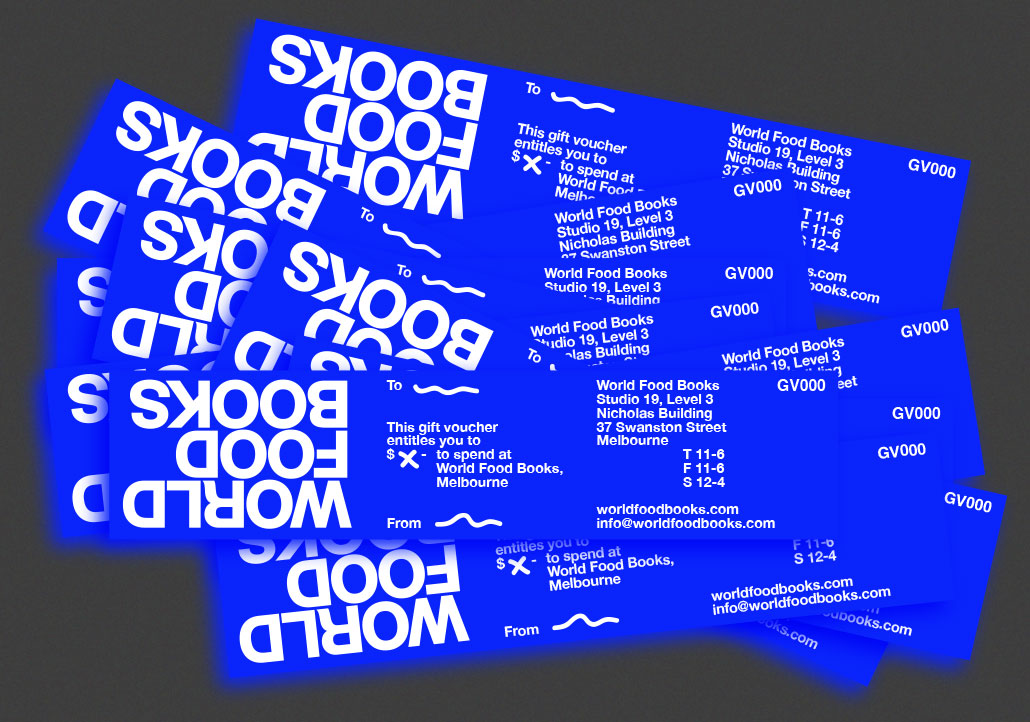
A World Food Books gift voucher is redeemable in our Melbourne bookshop or via our webshop (here). An e-voucher (printable pdf) will be sent to your purchase email address (please notify us if you wish to have the voucher sent to an alternate address and wish us to fill in the receiver's details on the card).
Gift vouchers can be purchased in increments of $20 (Australian Dollars) and the total amount can simply be added to by increasing the quantity in your shopping cart. eg. A quantity of 5 gift vouchers will result in an item total of $100 - a $100 gift voucher. Simply click "ADD TO CART" 5 times, or update your quantity in the shopping cart.
If you wish to purchase multiple, separate gift vouchers in one go, please just email us and we can personally prepare and email you a payment request.
Please note: Please select Pick-Up on gift voucher purchse to avoid any postage charges. Accidental postage charges will be refunded right away!
Thank you.
For any questions, please don't hesitate to email: [email protected]
1969 / 1977, English
Hardcover (w. dust jacket), 480 pages, 21.6 x 16 cm
1st Edition, Out of print title / used / good
Published by
Thames and Hudson / London
Funk & Wagnalls / New York
$50.00 - Out of stock
First 1969 US hardcover edition of Wyndham Lewis on Art : Collected Writings 1913-1956, edited and introduced by Walter Michel & C.J. (Cyril James) Fox. A comprehensive anthology of the Vorticist founder's essays, manifestos, and art criticism. An "antagonistic collaborator" to Ezra Pound, Lewis was a brilliant, incisive critic of the modernist era. Distinguished and highly original, Wyndham Lewis (Amherst 1882–London 1957) – writer, painter, essayist and pamphleteer, and the leading figure in the English experimental adventure of 1912-1915 – is known for his sharp wit and sardonic insight. A modern master of satire, expert at deflating the pretensions of democracy, he was born off the coast of Maine in his English father's yacht and grew up in England. He was associated with Roger Fry and Ezra Pound on the vorticist magazine Blast (1914-15). Lewis served in France in World War I, and his dynamic paintings of war scenes soon gained him wide recognition for his ferocious and dehumanizing style.
VG in Good dust jacket with some wear, losses to edges. Preserved in mylar wrap.
2024, English / French
Softcover, 272 pages, 22 x 28 cm
Published by
JRP Ringier / Zürich
MUDAM / Luxembourg
$78.00 - In stock -
A book spanning Cosima von Bonin's work of the last decade, and a personal journey into her private world and references.
Published to accompany the German artist's comprehensive exhibition at Mudam Luxembourg (October 2024–March 2025), Cosima von Bonin's new monograph Songs for Gay Dogs is both a book spanning her work of the last decade, and a personal journey into her private world and references, designed by her long-time friend and collaborator Yvonne Quirmbach.
Introduced by Mudam Director Bettina Steinbrügge, it assembles a play by Australian writer and art critic Estelle Hoy that brings to life Cosima von Bonin's recurring characters, an essay by Mudam curator Clémentine Proby about the carnivalesque in her work, a contribution by Pop journalist and Cologne figure Clara Dreschler, and a "Privato" chapter comprising images, texts, and documentation from the artist's personal archive. The book includes 200 illustrations, previously unseen images, and pictures of Cosima von Bonin's newly commissioned installation in Mudam's Grand Hall.
Cosima von Bonin (born 1962 in Mombasa, lives in Cologne) began her career in the early 1990s, following in the footsteps of Martin Kippenberger. A prolific artist, she produced oversized stuffed animals and other fantastical creatures, as well as pseudo-Minimalist sculptures using comedy, cartoons, and pop culture to question social constructions and relations. She explores the relationship of the individual to work, the capitalist production system, and leisure society. She uses knitted and woven fabrics to create objects that enable her to mock industrial means of production, which she feels infantilize the individual. By advocating a life of dolce far niente, of carefree idleness, von Bonin is proposing a form of resistance against the consumerist regime. Her exhibitions include the Schirn Kunsthalle Frankfurt and Mudam Luxembourg, both 2024; Magasin III Jaffa, Tel Aviv (2019); CCS Bard, Annandale-on-Hudson (2018); and Sculpture Center, New York (2016). She participated in the 59th Biennale di Venezia (2022); Skulptur Projekte Münster (2017); Glasgow International (2016); MUMOK, Vienna (2014); Artipelag, Sweden (2013); Mildred Lane Kemper Art Museum, St. Louis (2011); Arnolfini, Bristol (2011); Musée d'Art Moderne et Contemporain, Geneva (2011); Museum Ludwig, Cologne (2011); Kunsthaus Bregenz, Austria (2010); Museum of Contemporary Art, Los Angeles (2008); and Documenta, Kassel (2007 & 1982).
Edited by Clémentine Proby and Cosima von Bonin.
Texts by Bettina Steinbrügge, Clara Dreschler, Clémentine Proby, Estelle Hoy.
1991, English / Japanese
Softcover, 180 pages, 30 x 21 cm
1st Edition, Out of print title / used / very good
Published by
Art Life / Japan
$80.00 - In stock -
Scarce 1991 catalogue published on the occasion of the travelling Japanese exhibition 'Pierre Bonnard'
curated by Norio Shimada, edited, produced and published by Art Life Ltd. Profusely illustrated in colour and b/w throughout with tri–lingual Englsih/Japanese/French texts by Gabriel P.Weisberg, Nicholas Watkins, Vincent Pomarède, Alain Daguerre de Hureaux, and Norio Shimada. These illustrated essays include rare illuminations on Bonnard's relationship to Japanese art.
Pierre Bonnard (1867–1947) is one of the most beloved painters of the twentieth century. Also a successful draughtsman, photographer, printmaker, illustrator and interior designer, the French artist is celebrated for his use of colour to convey an exquisite sense of emotion. His close friend Henri Matisse declared that Bonnard was ‘a great painter, for today and definitely also for the future’.
VG copy.
1986, English / Spanish
Softcover, 66 pages, 33 x 23 cm
1st Edition, Out of print title / used / very good
Published by
Sindicato de Trabajos Imaginarios (S.T.I.) / Zaragoza
$70.00 - In stock -
Very rare copy of Particular Motors Audio–Art Magazine issue 10, a special bi–lingual (Spanish/English), over–sized edition of the magazine published by Javier Cinca, who ran Sindicato de Trabajos Imaginarios (S.T.I) in Zaragoza, Spain, a cassette label specialising in homemade music, sound poetry and experimental video and mail art projects. The magazine specialised in the same, featuring artists like Etant Donnes or Vox Populi! and maintained correspondances with mail artists like Vittore Baroni or Rod Summers and sound poetry heavy-weights like Henri Chopin or Bernard Heidsieck. P.M. was a key publication in the 1980s postal art and experimental cassette networks in Europe.
Particular Motors 10 features interviews, articles, artworks, writings with/by: Nota Oficial, Paul Montague, Cranioclast, Sue Ann Harkey, Semiotext(e)/Audio Leter, Tox Movement, Angel Carrera, U. S. F., Visor X, Vivenza, Steve Tanza, Recloose Organisation, Steve Tanza, T. A. C., Camino Al Desvan, Amor Fati, Anton Jodra, Alex Adriaansens & Joke Brouwer, Los Rinos, Pedro Bericat, Etant Donnes, Peter R. Meyer, Marcelo Exposito, Die Todliche Doris, Vittore Baroni (Trax/Lieutenant Murnau/Arte Postale!), Francisco Felipe, Lagartijo, Victor Nubla, Orient Express/Micrart Group, Surco De Niño, Decay Int./Prima Linea, Phillipe Stojanovic, Informe Sobre La Industria, Varios, Alessandro Aiello, Papelera, Carlo Marcello Conti. Loads of collages, photography, tape reviews and adverts from the 1980s tape/mail–art network.
Very Good copy.
1997, Japanese
Softcover, 208 pages, Softcover, 15 cm x 21 cm
1st Edition, Out of print title / used / very good
Published by
Tom Shobo / Japan
$140.00 - In stock -
Too Negative issue no. 8, March 1997. Now rare and highly collectible, Too Negative, the "Forbidden Picture Book", was a visceral and visually explosive glossy cult arts magazine that reflected the gory-depraved-beyond salvation-bad taste expressions visible in international subculture at the height of 1990s underground publishing, a time when art was pushing the limits of taste and morality. Edited solely by legendary Japanese publisher and gallery owner Kotaro Kobayashi and published by Tom Publication Inc. between 1994—2000, each thick, glossy volume takes on the aesthetics of a vibrant fashion magazine in the great Japanese "mook" format (the magazine book) packed cover to cover with themes of Eros and Thanatos, such as fetishism, erotica, medical/autopsy photography, death journalism, Japanese bondage, grotesque and neo-surrealist art, crime scene photography, tattooing/irezumi, piercing, and all things of the mondo, macabre, bizarro realm. Frequent collaborators and featured artists were Kiyotaka Tsurisaki, Joel-Peter Witkin, Trevor Brown, Kiyoshi Ikejiri, to name a few. With a Japanese publishing lineage that may be found in earlier bounding-pushing periodicals such as the 1920s erotic grotesque magazine Hentai Shiriou (Pervert Documents), Tasuhiko Shibusawa’s incredible 1960s avant-garde journal Le Sang Et La Rose, or Fiction Inc’s SALE2 journal published from 1980—mid 1990s, Too Negative, and affiliated periodicals such as ORG, Spiral, Schizo, etc. took their subjects to another level of extremism, even by Japanese standards.
Not for the faint hearted.
This issue, Too Negative issue no. 8, March 1997, features the photography the paintings of Manuel Ocampo, the art of Helter Skelter corpse/death photography, the art of Jake and Dinos Chapman, grotesque tabloid news, the art of Pierre Molinier, the art of Damien Hirst, the fetish photography of Hiroshi Yokoi, latex/rubber fetish photography by Uchiyama Kazunori, Kiyotaka Tsurisaki, Kiyoshi Ikejiri, loads of abnormal medical photography, autopsy, anatomical photographic/illustrated, much more.
Mature readers only.
Very Good copy.
1997, Japanese
Softcover, 208 pages, Softcover, 15 cm x 21 cm
1st Edition, Out of print title / used / very good
Published by
Tom Shobo / Japan
$140.00 - Out of stock
Too Negative issue no. 9, May 1997. Now rare and highly collectible, Too Negative, the "Forbidden Picture Book", was a visceral and visually explosive glossy cult arts magazine that reflected the gory-depraved-beyond salvation-bad taste expressions visible in international subculture at the height of 1990s underground publishing, a time when art was pushing the limits of taste and morality. Edited solely by legendary Japanese publisher and gallery owner Kotaro Kobayashi and published by Tom Publication Inc. between 1994—2000, each thick, glossy volume takes on the aesthetics of a vibrant fashion magazine in the great Japanese "mook" format (the magazine book) packed cover to cover with themes of Eros and Thanatos, such as fetishism, erotica, medical/autopsy photography, death journalism, Japanese bondage, grotesque and neo-surrealist art, crime scene photography, tattooing/irezumi, piercing, and all things of the mondo, macabre, bizarro realm. Frequent collaborators and featured artists were Kiyotaka Tsurisaki, Joel-Peter Witkin, Trevor Brown, Kiyoshi Ikejiri, to name a few. With a Japanese publishing lineage that may be found in earlier bounding-pushing periodicals such as the 1920s erotic grotesque magazine Hentai Shiriou (Pervert Documents), Tasuhiko Shibusawa’s incredible 1960s avant-garde journal Le Sang Et La Rose, or Fiction Inc’s SALE2 journal published from 1980—mid 1990s, Too Negative, and affiliated periodicals such as ORG, Spiral, Schizo, etc. took their subjects to another level of extremism, even by Japanese standards.
Not for the faint hearted.
This issue, Too Negative issue no. 9, May 1997, features the historical death photography of criminology and medical sciences, Art Brut, photography of Cindy Sherman, lots of gore collage, latex/rubber fetish photography by Uchiyama Kazunori, Kiyotaka Tsurisaki, Yokoi Hiroshi, Kiyoshi Ikejiri, loads of abnormal medical photography, autopsy, anatomical photographic/illustrated, much more.
Mature readers only.
Very Good copy, with light wear to edges/light crease to cover corner.
2013 / 2020, English
Softcover (w. dust jacket), 96 pages, 15 x 10.7 cm
Ed. of 500,
Published by
Setsuko / London
$30.00 - In stock -
Setsuko Hara (b. Masae Aida, 1920) is one of the biggest, the most memorable, and the most beautiful actresses in Japan. She is called "Eternal Virgin" and her presence is now god like legend. Maybe because she suddenly and mysteriously quit her job without a notice in 1962; when she was still beautiful and in the stardom. And never showed up in the public eyes since then, and having a seclusion life in a temple located at Kamakura, which is an ancient city, for almost 40 years.
Best known for her performances in Yasujirō Ozu's films Late Spring, Tokyo Story and Tokyo Twilight, amongst many others, and for working extensively with director Mikio Naruse. She is widely considered to be one of the greatest Japanese film actresses of all time. This is a book made entirely of images of Setsuko Hara, published to accompany a 2013 exhibition in London.
First published in London 2013 by The Block
This second 2020 edition of 500 copies by Setsuko
Designed by Richard Bevan and Tamsin Clark with Wolfram Wiedner Studio
1998, English
Hardcover (3 volume boxset)
1st Edition, Out of print title / used / very good
Published by
Taschen / Cologne
$260.00 - Out of stock
First 1998 box–set of The Complete Reprint of EXOTIQUE. The first 36 issues from 1951-1959. Foreword by Kim Christy.
Exotique was a specialized fetish magazine published by Leonard Burtman under his Burmel Publishing Company imprint in New York City between 1955 and 1959. The magazine's femdom theme, photos, and artwork mark it as a direct descendant of the first major fetish magazine Bizarre (1946–1959), produced by John Willie.
Exotique was entirely devoted to fetish fashions and female-dominant bondage fantasies. The 36 issues featured photos and illustrations of dominatrix-inspired vamps (including wife Tana Louise and iconic model Bettie Page) wearing exotic leather and rubber ensembles, corsets, stockings/garters, boots, and high heels. The articles, many written by Burtman using an alias, covered various aspects of sadomasochism and transvestism, with men depicted as slaves to imperious, all-powerful women.
Fetish artists Eric Stanton and Gene Bilbrew, also known by his pseudonym ENEG, were frequent contributors to this magazine and others produced by Burtman.
All 3 volumes VG in VG illustrated box (not pictured). Vol. I: No. 1-11; Vol. II: No. 12-24; Vol. III: No. 25-36.
1987, English
Softcover, 180 pages, 20.3 x 13.4 cm
Published by
New Directions / New York
$34.00 - In stock -
Why don't you take a permanent job, Albert? You're twenty-eight now, you know," his mother remarks when he goes on his weekend duty visit home. Albert Angelo is by vocation an architect and only by economic necessity working as a substitute teacher. He had thought he was, if not dedicated, at least competent. But now, on temporary assignments in schools located in the tough neighborhoods of London, Albert feels ineffectual. He is failing as a teacher and failing to fulfil himself as an architect. And then, too, he is pained by the memory of a failed love affair.
"I'm trying to say something not tell a story telling stories is telling lies and I want to tell the truth," Johnson insists in the penultimate section of the book when his authorial voice intervenes. Or, as Johan Thielman writes in The Review of Contemporary Fiction, "Johnson is trying to use fiction to reproduce life as closely as possible and, in his inevitable failure to succeed, he extends our notion of the possibilities of the novel...he made a body of work which remains fascinating, not in the least because he achieved one of his main ambitions: to be totally honest...His novels are the moving traces of a passionate devotion to and pursuit of his truth."
B.S. Johnson was an English experimental novelist, poet, and critic.
2011, English
Softcover, 92 pages, 12.7 x 17.8 cm
Published by
ECW Press / Canada
$32.00 - In stock -
For more than three decades, Lucien—one of the most notorious characters in the history of the novel—has haunted the imaginations of readers around the world. Remarkably, the astounding protagonist of Gabrielle Wittkop's lyrical 1972 novella, The Necrophiliac, has never appeared in English until now.
This new translation introduces readers to a masterpiece of French literature, striking not only for its astonishing subject matter but for the poetic beauty of the late author's subtle, intricate writing.
Like the best writings of Edgar Allan Poe or Baudelaire, Wittkop's prose goes far beyond mere gothic horror to explore the melancholy in the loneliest depths of the human condition, forcing readers to confront their own mortality with an unprecedented intimacy.
Born in 1920 in Nantes, Gabrielle Wittkop is the author of several novels, including La Mort de C., Sérénissime assassinat, and la Marchande d’enfants, as well as numerous poems and short stories. She died in 2002 in Frankfurt where she had lived for several decades.
Tranlator Don Bapst is an award-winning filmmaker and the author of three novels, including The Hanged Man.
2026, English
Softcover, 320 pages, 22.8 x 15.2 cm
Published by
Feral House / Los Angeles
$62.00 - In stock -
The Apocalypse Omnibus collects the best of Adam Parfrey's essays in a single volume.
Adam Parfrey was, before starting iconoclastic publisher Feral House, a writer. His foresight in revealing extreme trends and societal angst long before mainstream media had any inkling of the darkness bubbling just under the surface of American culture earned him praise and derision.Apocalypse Culture 1987) was hailed by J. G. Ballard as the 'terminal documents of the Twentieth Century'.
Many of the included essays are eerily prescient as Parfrey warned about right-wing militias in the early nineties and documented the rise of conspiracy-dominated thinking decades before Republican government officials loudly declared political opponents were satanically inspired drinkers of baby blood. Yet Parfrey's interests were wide-ranging and Apocalypse Omnibus includes profiles of outre characters, artists, and, yes, some crackpots. Parfrey loved tweaking American mythology by resurrecting lost texts highlighting outlaws and outsiders. He continually sought to expose the absurdity of American culture. His collective writings have become the ur-texts of the 'Dirtbag Left'.
Parfrey was fascinated by the contrast between America portrayed as wholesome freedom-loving peacekeepers and the reality of covert military operations, mass-drug experiments, and the obscured 'wizards' hidden behind the curtain pulling the levers of power. His work has been lauded as groundbreaking and criticised as dangerous. In a time when truth has been stretched to the breaking point, Parfrey's essays remind readers that there is always more to the story.
Apocalypse Omnibus also contains material previously published in the out-of-print books, Apocalypse Culture 2 (2003) and Cult Rapture (1995), as well as new material culled from his extensive private archives. It also contains a selection of Parfrey's essays and investigations, originally published in the San Diego Reader, Village Voice, Hustler Magazine, and on his own site, and inaccessible for years, are collected here in a single volume.
2019, English
Softcover, 600 pages, 11.4 x 17.8 cm
Published by
Urbanomic / Cornwall
Sequence Press / New York
$55.00 - In stock -
A fragmentary catalogue of poetic derangements that reveals the ways in which mania communicates with an extreme will to annihilation
What kind of circumstances provoke an obsessive focus on the most minute object or activity? And what causes such mania to blossom into the lethal conviction that everything must be annihilated? There is no turning away from the imperative to study this riddle in all its mystifying complexity and its disturbing contemporary resonance-to trace the obscure passage between a lone state of delirium and the will to world-erasure..
A fragmentary catalogue of the thousand-and-one varieties of manic disposition (augomania, dromomania, catoptromania, colossomania...), Omnicide enters the chaotic imaginations of the most significant poetic talents of the Middle East in order to instigate a new discourse on obsession, entrancement, excess, and delirium. Placing these voices into direct conversation, Jason Bahbak Mohaghegh excavates an elaborate network of subterranean ideas and interpretive chambers, byways, and burrows by which mania communicates with fatality. Like secret passages leading from one of the multitudinous details of a bustling Persian miniature to the blank burning immanence of the desert, each is a contorted yet effective channel connecting some attractive universe (of adoration, worship, or astonishment) to the instinct for all-engulfing oblivion (through hatred, envy, indifference, rage, or forgetting).
A captivating fractal of conceptual prisms in half-storytelling, half-theoretical prose, a rhythmic, poetic, insidious work that commands submission, Omnicide absorbs the reader into unfamiliar and estranging landscapes whose every subtle euphoric aspect threatens to become an irresistible invitation to the end of all things.
2023, English
Softcover, 570 pages, 11.4 x 17.8 cm
Published by
Urbanomic / Cornwall
$55.00 - In stock -
An infernal catalogue of manic visionaries, inspired by the poetry of the Middle East.
In a new work in which conceptual elaboration, storytelling, and poetics are fused in the infernal heat of the desert, the cycle of Omnicide is closed with a philosophy of doom, deception, and the game, plunging headlong into the inevitable, the fatal, and the infinite.
A series of controlled combustions fuelled by fragments drawn from the poetry and literature of the Middle-East, Omnicide II introduces us to a new cast of manic visionaries, from the Selemaniac to the Crystallomaniac, the Bibliomaniac to the Aeromaniac. In his relentless cataloguing of the myriad figures and portents of omnicidal doom, Jason Bahbak Mohaghegh resumes the offensive of those writers, artists, and thinkers for whom the fiercest creative incandescence is only kindled in the shadow of certain doom.
Amid war cries and lullabies, mages, wolves and pelicans, sabres and crystals, drones and soul-stealers, in settings ranging from the opium den to the Qatari luxury hotels, with his unique style and methodology, his dizzying breadth of references, and his implacable will to follow the most deranging lines of thought and evoke the most startling images, Mohaghegh draws the reader into territories disturbing and unfamiliar, atmospheres delicate and grotesque, moods morbid yet life-affirming, in a book that evokes fever and exudes dead calm.
The utterly absorbing music of this writing both lulls and disquiets-a contemporary Necronomicon, an inexhaustible treasury of recipes for disaster, catastrophe, ruination and destruction, all in the name of the most intense creation.
Jason Bahbak Mohaghegh is Associate Professor of Comparative Literature at Babson College. His focus is on tracking experimental thought in the so-called Middle East and the West, with particular attention to exploring concepts of chaos, violence, illusion, silence, sectarianism, madness, disappearance, and apocalyptic writing. He is the author of The Chaotic Imagination (2010); Inflictions (2012); The Radical Unspoken (2013); Insurgent, Poet, Mystic, Sectarian (2015); Omnicide- Mania, Fatality, and the Future-In-Delirium (Urbanomic/Sequence Press, 2019); and Night- A Philosophy of the After-Dark (2020).
1982, English
Softcover, 96 pages, 28 x 20 cm
1st Edition, Out of print title / used / very good
Published by
Thames and Hudson / London
$45.00 - Out of stock
First edition.
"As healer, ceremonialist, spiritual guide and artist, the shaman has been a key figure in human society since earliest times. He is depicted in the cave paintings made 30,000 years ago by the Palaeolithic hunters of Europe, and in his bestselling books the anthropologist Carlos Castaneda has described how still today a shaman like Don Juan is actively at work in America, using trance and ecstasy to master the unseen forces of nature, to penetrate the visionary realms beyond everyday experience and to transcend time and space. The age-old practice of shamanism lies at the very heart of some cultures and survives in the shadowy fringes of others. This account of the sacred and perilous activities of the man or woman 'who is doomed to inspiration' picks out those threads that link the tradition wherever it appears, whether in aboriginal Australia or Siberia, in Japan or the jungles of the Upper Orinoco. The words and insights, the costumes and regalia of the shamans themselves, together with actual photographs of their rituals and of their paintings, are the basis of this vivid and informed book."
Lavishly illustrated throughout. Contents include: Paths to the underworld, Departure and incubation, Spirts, Death and skeletonization, Covenents and animal transformations, Life energy force and the ally of power, World tree and Axis Mundi; Flight, Mastery of fire, etc. Keywords: Paths, Underworld, Departure, Incubation, Spirts, Death, Skeletonization, Covenents, Animal transformations, Life Energy, Force, Ally, Power, World tree, Axis Mundi; Flight, Mastery, Fire.
VG copy.
2026, English
Hardcover (w. dust jacket), 388 pages, 27.2 x 23.5 cm
Published by
MoMA / New York
$115.00 - In stock -
An essential and lavishly illustrated visual compendium on the epoch-shifting artist whose radical vision reshaped art―and the museum―forever.
More than any other modern artist, Marcel Duchamp challenged and transformed the very definition of art. Published to accompany the first North American retrospective of his work in more than 50 years, the volume features the world's largest collection of Duchamp's work, bringing together such iconic works as Fountain and Nude Descending a Staircase for the first time in decades. Beautifully illustrated with more than 400 works spanning six decades―including painting, sculpture, readymades, film, photography and ephemera―and featuring a deeply researched chronology interwoven with archival and documentary material, Marcel Duchamp offers a new generation the first opportunity to experience the breadth of Duchamp's revolutionary and provocative work, strongly associated with the Surrealist and Dada movements. An expansive introduction by curators Ann Temkin, Michelle Kuo and Matthew Affron explores Duchamp's radical rethinking of art and the museum, transformation of authorship, innovative exhibition and installation displays, and lifelong dedication to changing the relationship between art and life. Revealing new dimensions of his conceptual brilliance, subversive wit and lasting impact on generations of artists, Marcel Duchamp is a rich visual compendium and an essential resource for anyone seeking to understand an artist who changed the course of modern art.
Although Marcel Duchamp (American, born France, 1887–1968) defied definition or association with any single movement, he is perhaps the most impactful artist of the modern era in Europe as well as in the United States. Despite his place as a central figure in numerous artistic groups in both countries―including Cubism, Dada and Surrealism―Duchamp resisted categorization, prioritizing creative individuality. Though he is primarily remembered as an artist, he was also a curator, conservator, art advisor, professional chess player, writer, inventor and celebrity.
"Love isn’t a word, or a concept, that one usually associates with Marcel Duchamp, the modernist master of irony and distance, but love―love of the mind and what it can do, love of bodies and play, love of freedom, love of what art can be, love of women, queerdom, poetry, and chance―is what makes 'Marcel Duchamp' such a wonder."—Hilton Als, The New Yorker
1988, Japanese / English
Hardcover (w. dust jacket), 70 pages, 21 x 19 cm
1st Edition, Out of print title / used / very good
Published by
Atelier Peyotl / Tokyo
$100.00 - In stock -
Wonderful and very rarely seen hardcover Japanese publication on the work of the great Pierre Klossowski. Features an extensive selection of his paintings and drawings reproduced in full-colour and black and white, alongside texts, biography and photographic portraits of Klossowski. Published by Atelier Peyotl and printed in Tokyo in 1988 on the occasion of a major exhibition at The Seed Hall, Seibu Shibuya. First printing in original illustrated dust jacket.
Pierre Klossowski (1905-2001) was a significant and influential philosopher, writer, translator and artist who befriended Georges Bataille and formulated an original stance on many theological issues, as well as the philosophy of the Marquis de Sade. His first novel, Roberte, ce soir, appeared in 1954 as a limited edition containing six of his own erotic illustrations, after he rejected drawings by his younger brother, the painter Balthus. Following the encouragement of Robert Lebel, Andre Masson and Alberto Giacometti, Klossowski held his first exhibition in Paris in 1956, and subsequently produced numerous life-size drawings of erotic scenes imbued with mythological, allegorical and philosophical connotations. By the 1970s, he had won the acclaim of such eminent thinkers as Maurice Blanchot, Michel Butor, Gilles Deleuze, Michel Foucault and Felix Guattari. Of Klossowski, Gilles Deleuze once said, "That bodies speak has been known for a long time."
Very Good copy in Good dust jacket with some rubbing to front print, light wear.
1979, English
Hardcover (w. dust jacket), 127 pages, 13.5 x 22 cm
1st UK Edition, Out of print title / used / good
Published by
Marion Boyars / London
$190.00 - In stock -
Wonderful first English hardcover edition of George Bataille's Story of the Eye, published by Marion Boyars, London, in 1979. Translated by Joachim Neugroschal with accompanying essays by Susan Sontag and Roland Barthes.
"The caress of the eye over the skin is so utterly, so extraordinarily gentle, and the sensation is so bizarre that it has something of a rooster's horrible crowing." - G.B.
A masterpiece of transgressive, surrealist erotica, Bataille's first novel, published under the pseudonym 'Lord Auch', is still his most notorious work. Called a "metaphysician of evil, Bataille wrote the 1928 novella "Story of the Eye (French: L'histoire de l'œil) as a psychoanalytical task. In this explicit erotic fantasy, the young male narrator and his lovers Simone and Marcelle embark on a sexual quest involving sadism, torture, orgies, madness and defilement, culminating in a final act of transgression. Shocking and sacrilegious, Story of the Eye is the fullest expression of Bataille's obsession with the closeness of sex, violence and death. Yet it is also hallucinogenic in its power, and is one of the erotic classics of the twentieth century.
This edition also includes Susan Sontag's superb study of pornography as art, 'The Pornographic Imagination', as well as Roland Barthes' essay 'The Metaphor of the Eye', which was first published in Bataille's own journal Critique, shortly after Bataille's death in 1962. Barthes' analysis focuses on the centrality of the eye to this series of vignettes, and notices that it is interchangeable with eggs, bulls' testicles and other ovular objects within the narrative. He also traces a second series of liquid metaphors within the text, which flow through tears, cat's milk, egg yolks, frequent urination scenes, blood and semen.
Georges Bataille (1897-1962), French essayist and novelist, was born in Billom, France. He converted to Catholicism, then later to Marxism, and was interested in psychoanalysis and mysticism, forming a secret society dedicated to glorifying human sacrifice. Leading a simple life as the curator of a municipal library, Bataille was involved on the fringes of Surrealism, founding the Surrealist magazine Documents in 1929, and editing the literary review Critique from 1946 until his death.
Good—VG ex-libris copy with light library wear to end blanks, small stamp to colophon in original G—VG dust jacket, no library markings, preserved under mylar wrap. Scarce in this edition with dust jacket present. General reading wear and tanning with age. There is a fierce feminist critique of Susan Sontag's essay in the margins that is an isolated attack Sontag. The rest is left unscathed.
2021, English
Blu-ray + 84 page booklet
Published by
Ex Film / Melbourne
$40.00 - Out of stock
“All of the film you are about to see is real,” it begins. “Nothing has been staged.”
In 1981, filmmakers Sheldon Renan and Academy Award® nominee Leonard Schrader (KISS OF THE SPIDER WOMAN, MISHIMA, BLUE COLLAR) created a graphic and provocative examination of America’s history with – and penchant for – senseless violence, mass shootings and cold-blooded murder. It was condemned as “exploitive and obscene” (The New York Times), acclaimed as “among the most controversial documentaries in the history of cinema” (Fantasia Festival), and never distributed, televised or made available for sale in the United States. Ex Film presents this infamous ‘shock doc’ fully restored, uncut and loaded with exclusive Bonus Features – including the even more unnerving Japanese version known as VIOLENCE U.S.A. – which remains one of the most profoundly disturbing and still chillingly relevant documentary experiences of our time.
Finally available in Australia!
Features for this Blu-ray edition include:
2021, English
Softcover, 84 pages, 15 x 12 cm
Published by
Ex Film / Melbourne
$15.00 - In stock -
Leonard Schrader and Sheldon Renan's 1981 documentary on violence in American society was never released for almost 40 years in the country which it profiles, such was its visceral impact and blunt force message. The film was a major success in Australia, running for 3 weeks at Melbourne's Capitol theatre and huge sales on home video. For people of a certain generation, viewing was a rite of passage - an assemblage of various real-life footage in the peak era of the US serial killer, political assassinations and the post-Vietnam mayhem of American society.
Ex Film's Australian Blu-ray restoration and release was accompanied by this 84 page perfect-bound booklet containing liner notes by Dean Brandum (Technicolor Yawn) and Chris Desjardins (The Flesh Eaters, Slash magazine) accompanied by years of archival material collected from years of research, including, ad mats, theatrical and home video art and Japanese promotional material translated into English for the first time.
1977, English
Hardcover (w. dust jacket), 254 pages, 31 x 24 cm
1st Edition, Out of print title / used / very good
Published by
Peebles Press / New York
$65.00 - In stock -
"...A Chinese beheading in Shanghai is the same as a lynching in early Mississippi which is the same as the Buchenwald death camp which is the same, God help us, as a child beating in Chicago..."
First 1977 hardcover edition.
"We all carry the seeds of destruction within us–if a new adjustment to santiny is not reached soon we will eventually manage to destroy ourselves as well as our brothers."
This book of 400 candid photographs and on-the-spot news pictures presents overwhelming evidence that we are all individually, to one degree or another, responsible for the pain inflicted on any other person in the world. The age of potential nuclear holocaust has propelled us into a time of inter-responsibility; we are all to answer for any violence in the world.
In his introduction, Sandy Lesberg makes this point regarding inter-responsibility: A Chinese beheading in Shanghai is the same as a lynching in early Mississippi which is the same as the Buchenwald death camp which is the same, God help us, as a child beating in Chicago."
For the first time graphic evidence of our capacity for aggression and destruction as individuals has been condensed between the covers of one book. To merely contemplate the table of contents as a chronicle of this capacity is an arresting experience; exposure to the pictures that illustrate our sad history is almost a necessity if we are to be shocked out of our complacency and into an active participation to put an end to our own cruelty.
Very Good copy in Good dust jacket with some small closed tears, chips to edges, now preserved in mylar wrap.
1971 / 1991, English
Softcover, 182 pages, 17.8 x 10.8 cm
Out of print title / used / very good
Published by
Del Rey SF / New York
$20.00 - Out of stock
1991 Del Ray paperback edition of this classic collection of Lovecraft's most famous stories, The Lurking Fear, Dagon, Beyond the Wall of Sleep, The White Ship, Arthur Jermyn, From Beyond, The Temple, The Moon-Bog, The Hound, The Unnamable, The Outsider, The Shadow Over Innsmouth.
The Lurking Fear: "an entire upstate New York clan degenerates into thunder-crazed, shocking creatures with the hideous habits of man-eating moles."–Time Magazine
The Shadow Over Innsmouth: "A doomed Massachusetts fishing town whose population is obscenely corrupted by intermingling with a race of fiendish undersea creatures. Learning all this, the narratorattempts to flee on the outskirts of town, he looks back and sees his pursuers 'in a limitless stream ...surging inhumanly through the spectral moonlight in a grotesque, malignant saraband of fantastic nightmare!"–Time Magazine
G–VG copy, some wear to boards, tanning to block.
1998, English
Softcover, 576 pages, 20.96 x 15.24 cm
1st Edition, Out of print title / used / very good
Published by
Taschen / Cologne
$55.00 - In stock -
First 1998 English language edition of The Dominant Wives & Other Stories, Eric Stanton's brick-sized collection of his highly prized femdom Stantoons.
That bottom won’t spank itself!
20 stories from America’s premier fetish artist Eric Stanton (1926–1999) was America’s premier fetish artist, a man of very particular tastes, as all fetishists are. Most keep their work and sex preferences separate, but Stanton made his desires the center of his art, pouring his passions onto the page. These preferences included, in no particular order, female dominance, female fighting, mixed gender wrestling, and face sitting.
Perhaps if the man born Ernest Stanzoni in New York City, 1926, had grown taller, all would have been different. As happened, he topped out around 5’5” (165 cm), making him smaller and weaker than many women, and rather than bemoan this shortcoming, he chose to eroticize it. Then, like Robert Crumb and Tom of Finland to follow, he put his fantasies on paper.
Stanton produced paperback book covers, magazine illustrations, comics and even wrestling and smother videos, but what he is best known for is his Stantoons: self-published 16- to 28-page booklets produced between 1982 and his death in 1999. These booklets best represent Stanton’s rich and complex fantasy life, as well as the lives of his fans, whose fantasies he also incorporated. This new edition of The Dominant Wives & Other Stories, brings together the finest of the Stantoons, along with Stanton’s most famous series for Irving Klaw: Bound in Leather, parts 1 and 2. Done in pencil, pen and ink, gouache and mixed media, these 20 stories represent the best of Stanton, who himself represents the best of fetish.
Good—VG copy with some light edge wear an minor buckling (common due to size)
2010, English
Hardcover, 400 pages, 24 x 31 cm
Published by
Les Presses Du Reel / Paris
Mennour / Paris
$150.00 - In stock -
The Molinier bible! A mammoth, crucial 400 page book on the method and genesis of Pierre Molinier's provocative, gender-bending photos and artwork. Beautifully printed and prodigiously illustrated with over 800 pictures, mostly unpublished, numerous documents, manuscripts and letters, a complete (nearly 100-page) chronology, a critical biography, and a text by Jean-Luc Mercié.Molinier. Essential publication on Molinier, the most comprehensive to date, and a must for any fan.
Rare English edition translated from the French by Edward Penwarden.
Pierre Molinier is an unknown of worldwide renown. Every book and every exhibition on the body, gender confusion or sexual excess seems to feature at least one work by this artist whose “genius” was acclaimed by André Breton in a memorable text published in 1956. But the bulk of his work has remained inaccessible. A number of pictures have never been shown and a corpus of only 160 prints has been published. The ensemble revealed by the artist's archives is much more extensive. It includes numerous proofs made to prepare his photomontages and working prints given to friends, but also notebooks and personal letters. Here, precise links emerge between his paintings, photographs and scandalous life. The myth carefully constructed by the artist begins to crumble before the reality of the work.
An inveterate seducer, thoroughgoing fetishist, unrepentant transvestite and inadvertent bisexual, to the very last Molinier remained haunted by two obsessions: pleasure, meaning immediate access to la petite mort, and “leaving a trace in the infinity of time.” This book charts the aesthetic incarnation of his passions. Its 819 photographs, most of them never published before, reveal the method, shed light on the procedures and give details of the origin and alchemy of his latent or composed images. Finally, an exhaustive chronology offers a new biography of Molinier, based on his letters: for it is in the intimacy of these writings that the shaman's heart beats closest to the truth.
In a career shared between the university (fifteen years) and publishing (twenty) Jean-Luc Mercié has written widely on painting and photography. This monograph is his fourth book about Pierre Molinier, the master from Bordeaux.
Born 1900 in Agen (France), Pierre Molinier, surrealistic painter and photographer, a precursor to body art, died in 1976 after having thought out radical and pornographic artwork.