World Food Books' programme is largely produced on Kulin Nation land. We acknowledge the Wurundjeri people of the Kulin Nation as the first and continuing custodians of this land, and pay respect to their Elders past, present, and emerging.
World Food Books is an arts and special interests bookshop in Naarm / Melbourne. Founded in 2010, World Food Books is devoted to the presentation of a rotating, hand-selection of international art, design, literary and counterculture publications with an emphasis on the anti-traditional, the experimental, the avant-garde, the heretic, the marginal.
Presenting new titles alongside rare and out-of-print books, catalogues and journals spanning the fields of modern and contemporary art, design, photography, illustration, film, literature, poetry, cultural theory, philosophy, sexuality, popular and underground culture in its many radical forms, World Food Books wishes to encourage adventurous, thoughtful and open-minded reading, looking, writing, and exchange of publishing and ideas, both current and historical.
As well as our bookshop, located in Melbourne's historical Nicholas Building, all of our inventory is available internationally via our online mail-order service.
World Food Books semi-regularly co-ordinates "Occasions", a programme of exhibits and events at the bookshop and in partnership with other hosts (such as museums and art galleries) that develop out of the activities, relationships and content of the bookshop itself.
World Food Books
The Nicholas Building
37 Swanston Street
Room 5, Level 6
Melbourne 3000
Australia
SHOP HOURS:
Thu–Fri 12–6
Sat 12–5
WEB-SHOP OPEN 24/7
World Food Books
Postal Address:
37 Swanston Street
Room 5, Level 6
Melbourne 3000
Australia
Art
Theory / Essay
Architecture / Interior
Graphic Design / Typography
Photography
Fashion
Eros
LGBTQ+
Fiction / Poetry
Weird / Speculative / Science Fiction / Horror
Transgressive / Visceral / Abject
Symbolism / Decadence / Fin de siècle
Film / Video
Painting
Sculpture / Installation
Performance / Dance / Theater
Drawing
Sound / Music
Curatorial
Group Shows / Collections
Periodicals
Out-of-print / Rare
Posters / Ephemera / Discs
Signed Books
World Food Books Gift Voucher
World Food Book Bag
Australian Art
Australian Fiction
Australian Science Fiction / Speculative Fiction
Australian Poetry
Australian Photography
Japanese Photography
Conceptual Art
Minimal Art
Dada
'Pataphysics / Oulipo
Fluxus
Concrete Poetry
Pop Art
Surrealism
Arte Povera
Arte Informale / Haute Pâte / Tachism
Nouveau Réalisme / Zero / Kinetic
Situationism / Lettrism
Collage / Mail Art / Xerox Art
Art Brut / Folk / Visionary / Fantastic
Illustration / Graphic Art / Bandes Dessinées
Furniture
Italian Radical Design / Postmodernism
Textiles
Ceramics / Glass
Counterculture
Protest / Revolt
Philosophy
Psychoanalysis
Anthropology
Anarchism
Socialism / Anarchism / Communism / Capitalism
Literary Theory / Semiotics / Language
Feminism / Women's Studies
Gender Studies / Sexuality
Anthropology
Fetishism / BDSM
Drugs / Psychedelia
Crime / Violence
Animal Rights / Veganism
Occult / Esoterica
Ecology / Earth / Alternative Living
Whole Earth / Crafts
All prices in AUD (Australian dollars)
Pick-Ups
Pick-up orders can be collected in our bookshop during opening hours after order date. Please collect any Pick-up orders within 2 weeks of ordering as we have limited storage space. Orders will be released back into stock if not collected within this time. No refunds can be made for pick-ups left un-collected. If you cannot make it in to the bookshop in this time-frame, please choose postage option.
Return Policy
All sales are final. We do accept returns (for refund or exchange) for items received in error. All our orders are packed with special care using heavy-duty padding and cardboard book-mailers or bubble mailers (for smaller books), using reinforcement where required. We cannot take responsibility for any lost, stolen or damaged parcels.
Insurance
Should you wish to insure your package, please email us directly after placing your order and we can organise this at a small extra expense. Although all standard/express tracked packages are very safe and dependable, we cannot take responsibility for any lost, stolen or damaged parcels. We recommend insurance on valuable orders.
Interested in selling your old books, catalogues, journals, magazines, comics, fanzines, ephemera? We are always looking for interesting, unusual and out-of-print books to buy. We only buy books in our fields of interest and specialty, and that we feel we can resell.
We base these prices on desirability, market value, in-print prices, condition and our current stock levels. We offer cash, store credit, and can take stock on consignment. All
about 25% of the price we expect to get when we sell them, or 30% in store credit. We base these prices on desirability, market value, in-print prices, condition and our current stock levels.
Sell your books any day of the week. You can drop them off and return later. If you have a lot of books, we can visit your Sydney home.
We buy books that we feel we can resell. We offer about 25 % of the price we expect to get when we sell them, or 30% in store credit. We base these prices on desirability, market value, in-print prices, condition and our current stock levels.
Philadelphia Wireman
03 August - 01 September, 2018
World Food Books is proud to announce our next Occasion, the first presentation of sculptures by Philadelphia Wireman in Australia.
The Philadelphia Wireman sculptures were found abandoned in an alley off Philadelphia’s South Street on trash night in 1982. Their discovery in a rapidly-changing neighbourhood undergoing extensive renovation, compounded with the failure of all attempts to locate the artist, suggests that the works may have been discarded after the maker’s death. Dubbed the "Philadelphia Wireman" during the first exhibition of this work, in 1985, the maker’s name, age, ethnicity, and even gender remain uncertain. The entire collection totals approximately 1200 pieces, all intricately bound together with tightly-wound heavy-gauge wire (along with a few small, abstract marker drawings, reminiscent both of Mark Tobey and J.B. Murry). The dense construction of the work, despite a modest range of scale and materials, is singularly obsessive and disciplined in design: a wire armature or exoskeleton firmly binds a bricolage of found objects including plastic, glass, food packaging, umbrella parts, tape, rubber, batteries, pens, leather, reflectors, nuts and bolts, nails, foil, coins, toys, watches, eyeglasses, tools, and jewellery.
Heavy with associations—anthropomorphic, zoomorphic, and socio-cultural responses to wrapped detritus—the totemic sculptures by Philadelphia Wireman have been discussed in the context of work created to fulfil the shamanistic needs of alternative religions in American culture. Curators, collectors, and critics have variously compared certain pieces to sculpture from Classical antiquity, Native American medicine bundles, African-American memory jugs, and African fetish objects. Reflecting the artist’s prolific and incredibly focused scavenging impulse, and despite—or perhaps enhanced by—their anonymity, these enigmatic objects function as urban artefacts and arbiters of power, though their origin and purpose is unknown. Philadelphia Wireman, whatever their identity, possessed an astonishing ability to isolate and communicate the concepts of power and energy through the selection and transformation of ordinary materials. Over the course of the past two decades, this collection has come to be regarded as an important discovery in the field of self-taught art and vernacular art.
Presented in collaboration with Fleisher-Ollman Gallery, Philadelphia, and Robert Heald, Wellington.
Susan Te Kahurangi King
02 February - 10 March, 2018
Susan Te Kahurangi King (24 February 1951 - ) has been a confident and prolific artist since she was a young child, drawing with readily available materials - pencils, ballpoint pens and felt-tip markers, on whatever paper is at hand. Between the ages of four and six Susan slowly ceased verbal communication. Her grandparents William and Myrtle Murphy had developed a special bond with Susan so they took on caring responsibilities for extended periods. Myrtle began informally archiving her work, carefully collecting and storing the drawings and compiling scrapbooks. No drawing was insignificant; every scrap of paper was kept. The King family are now the custodians of a vast collection containing over 7000 individual works, from tiny scraps of paper through to 5 meter long rolls.
The scrapbooks and diaries reveal Myrtle to be a woman of great patience and compassion, seeking to understand a child who was not always behaving as expected. She encouraged Susan to be observant, to explore her environment and absorb all the sights and sounds. Myrtle would show Susan’s drawings to friends and people in her community that she had dealings with, such as shopkeepers and postal workers, but this was not simply a case of a grandmother’s bias. She recognised that Susan had developed a sophisticated and unique visual language and sincerely believed that her art deserved serious attention.
This was an unorthodox attitude for the time. To provide some context, Jean Dubuffet coined the term Art Brut in 1945 to describe work created by self-taught artists – specifically residents of psychiatric institutions and those he considered to be visionaries or eccentrics. In 1972 Roger Cardinal extended this concept by adopting the term Outsider Art to describe work made by non-academically trained artists operating outside of mainstream art networks through choice or circumstance. Susan was born in Te Aroha, New Zealand in 1951, far from the artistic hubs of Paris and London that Dubuffet and Cardinal operated in. That Myrtle fêted Susan as a self-taught artist who deserved to be taken seriously shows how progressive her attitudes were.
Susan’s parents Doug and Dawn were also progressive. Over the years they had consulted numerous health practitioners about Susan’s condition, as the medical establishment could not provide an explanation as to why she had lapsed into silence. Dawn educated herself in the field of homeopathy and went on to treat all twelve of her children using these principles – basing prescriptions on her observations of their physical, mental and emotional state.
Doug was a linguist with an interest in philosophy who devoted what little spare time he had to studying Maori language and culture. To some extent their willingness to explore the fringes of the mainstream made them outsiders too but it was their commitment to living with integrity and their respect for individuality that ensured Susan’s creativity was always encouraged.
Even though Susan’s family supported her artistic pursuits, some staff in schools and hospitals saw it as an impediment to her assimilation into the community and discouraged it in a variety of ways. Her family was not always aware of this and therefore did not fully understand why Susan stopped drawing in the early 1990s. However, rather than dwell on the challenges that Susan faced in pursuit of her artistic practice, they prefer to highlight her achievements. In 2008 Susan began drawing again in earnest, after an almost 20 year interruption, and her work is now shown in galleries around the world.
Susan grew up without television and has been heavily influenced by the comics she read as a child. She is absolutely fearless in the appropriation of recognizable characters, such as Donald Duck and Mickey Mouse, in her work. She twists their limbs, contorts their faces, compresses them together, blends them into complex patterned backgrounds - always imbuing them with an incredible energy. Although Susan often used pop culture characters in her work they are not naive or childlike. These are drawings by a brilliant self-taught artist who has been creating exceptional work for decades without an audience in mind.
Mladen Stilinović
"Various Works 1986 - 1999"
02 February 16 - September 10, 2016
Various works 1986 - 1999, from two houses, from the collections of John Nixon, Sue Cramer, Kerrie Poliness, Peter Haffenden and Phoebe Haffenden.
Including: Geometry of Cakes (various shelves), 1993; Poor People’s Law (black and white plate), 1993; White Absence (glasses, ruler, set square, silver spoon, silver ladel with skin photograph and wooden cubes), 1990-1996; Exploitation of the Dead (grey and red star painting, wooden painting, black spoon with red table, red plate), 1984-1990; Money and Zeros (zero tie, paintings made for friends in Australia (Sue, John, Kerrie), numbers painting), 1991-1992; Words - Slogans (various t-shirts) - “they talk about the death of art...help! someone is trying to kill me”, “my sweet little lamb”, “work is a disease - Karl Marx”; Various artist books, catalogues, monographs, videos; Poster from exhibition Insulting Anarchy; "Circular" Croatian - Australian edition; Artist book by Vlado Martek (Dostoyevsky); more.
Thanks to Mladen Stilinović and Branka Stipančić.
Jonathan Walker
Always Will Need To Wear Winter Shirt Blue + Ochre Small Check Pattern
21 August - 21 September, 2015
Untitled
I am not a great reader of poetry but I always return to the work of Melbourne poet, Vincent Buckley (1925- 1988). Perhaps I find his most tantalising piece to be not a finished poem but a fragment left on a scrap of paper discovered on his desk after the poet’s death.
The poetry gathers like oil
In the word-core, and spreads
It has its music meet,
Its music is in movement.
This fragment is more the shell left behind from a volatile thought than a finished poem. I find the last two lines honest but awkward whereas the first two lines work like an arrow. Most likely he could not find a resolution so it was left. Still, in its present form, it remains an eloquent testimony to the ultimate failure of a medium to express mobile thought and sensation, in Buckley’s case, through verbal language. It’s an important matter because this is something all artists have to deal with regardless of the medium.
I have never written a poem, however, I am forever copying fragments from books on paper scraps in a vain effort to fix certain notions in my head. At first, they function as bookmarks that are sometimes returned to when I open the book. But before long, as they accumulate, they fall out littering the table interspersed with A4 photocopies, bills, books and medications.
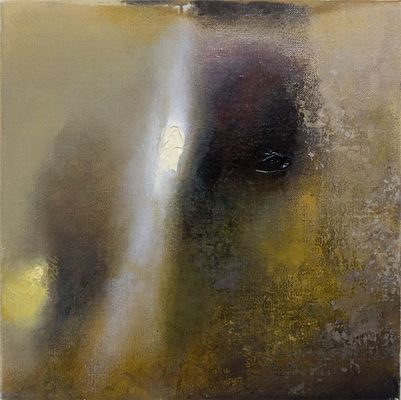
To return to Buckley’s fragment, the first two lines very much evoke how I paint nowadays. As you age, detail diminishes and patches of light become more luminous and float. I feel the most honest way of dealing with this is by smearing the oil paint on the canvas with the fingers and working close-up, blind. Only if the patches coalesce into an approaching image can the work gain a life.
-
Jonathan Walker was born in Melbourne, Australia and brought up on a dairy farm in Gippsland. In the 1970’s he studied painting at RMIT and won the Harold Wright Scholarship to the British Museum, London. During the 1980’s he exhibited at Pinacotheca Gallery, Richmond and had work shown at the NGV and Heidi City Art Gallery. Over the same period he designed the cover for the “Epigenesi” LP by Giancarlo Toniutti, Italy and conducted a mail exchange work with Achim Wollscheid, Germany. The work with artists through the post resulted in an article published in the bicentenary issue of Art and Australia 1988. He showed in artist run spaces such as WestSpace in the 90’s and 2000’s, and until 2012, taught painting at Victoria University, which is where we (Colleen Ahern and Lisa Radford) as organisers of the exhibition, among many others, had the privilege of being his student.
Walker’s knowledge was imparted to students through the careful selection of music, literature, and artists found in books that he himself had ordered for the library. Walker’s strategy was the generosity of sharing his vast knowledge with references specific to each student and their context.
Walker’s paintings share a similar focus and intimacy.
This exhibition presents a small selection of recent paintings alongside a publication that includes Walker’s writing. Observational and analytical, Walker’s work is a type of material notation — the time of day, colour and how it is blended, the both specific and fleeting location of a reflection on lino or the question of whether a chair leg should be included in a painting.
Please join us on Friday August 21 between 6-8pm to celebrate the opening of the exhibition.
Curated by Colleen Ahern and Lisa Radford.
B. Wurtz
Curated by Nic Tammens
March 26 - April 4, 2015
B.Wurtz works from a basement studio in his home on Manhattan’s Lower East Side.
This local fact is attested to by the plastic shopping bags and newsprint circulars that appear in his work. As formal objects, they don’t make loud claims about their origins but nonetheless transmit street addresses and places of business from the bottom of this long thin island. Like plenty of artists, Wurtz is affected by what is local and what is consumed. His work is underpinned by this ethic. It often speaks from a neighborhood or reads like the contents of a hamper:
“BLACK PLUMS $1.29 lb.”
“Food Bazaar”
“USDA Whole Pork Shoulder Picnic 99c lb.”
“RITE AID Pharmacy, with us it’s personal.”
“H. Brickman & Sons.”
“Sweet Yams 59c lb."
Most of the work in this exhibition was made while the artist was in residence at Dieu Donne, a workshop dedicated to paper craft in Midtown. Here Wurtz fabricated assemblages with paper and objects that are relatively lightweight, with the intention that they would be easily transportable to Australia. This consideration isn’t absolute in Wurtz’s work, but was prescriptive for making the current exhibition light and cheap. Packed in two boxes, these works were sent from a USPS post office on the Lower East Side and delivered to North Melbourne by Australia Post.
Wurtz appears courtesy of Metro Pictures, New York.
Thanks to Rob Halverson, Joshua Petherick, Sari de Mallory, Matt Hinkley, Helen Johnson, Fayen d'Evie, Ask Kilmartin, Lisa Radon, Ellena Savage, Yale Union, and "Elizabeth".
John Nixon
"Archive"
December 15 - January 20, 2014
The presentation of John Nixon's archive offered a rare showcase of this extensive collection of the artist's own publications, catalogues, posters, ephemera, editions and more, from the mid 1980s onwards, alongside a selection of his artworks.
Organized by John Nixon, Joshua Petherick and Matt Hinkley.
<a href=http://wfb.public-office.info/artist/john-nixon>All titles by John Nixon
"Habitat"
at Minerva, Sydney (organised by Joshua Petherick and Matt Hinkley)
November 15 - December 20, 2014
Lupo Borgonovo, Janet Burchill & Jennifer McCamley,
Lewis Fidock, HR Giger, Piero Gilardi, Veit Laurent Kurz,
Cinzia Ruggeri, Michael E. Smith, Lucie Stahl, Daniel Weil, Wols
Press Release:
“...It contained seven objects. The slender fluted bone, surely formed for flight, surely from the wing of some large bird. Three archaic circuitboards, faced with mazes of gold. A smooth white sphere of baked clay. An age-blackened fragment of lace. A fingerlength segment of what she assumed was bone from a human wrist, grayish white, inset smoothly with the silicon shaft of a small instrument that must once have ridden flush with the surface of the skin - but the thing’s face was seared and blackened.”
William Gibson, “Count Zero”, 1986
"Autumn Projects Archive"
Curated by Liza Vasiliou
March 6 - March 15, 2014
World Food Books, in conjunction with the Virgin Australia Melbourne Fashion Festival 2014, presented the Autumn Projects archive, consisting of a selection of early examples in Australian fashion with a particular interest in collecting designers and labels from the period beginning in the 1980’s, who significantly influenced the discourse of Australian Fashion.
Curated by Liza Vasiliou, the exhibition provided a unique opportunity to view pieces by designers Anthea Crawford, Barbara Vandenberg, Geoff Liddell and labels CR Australia, Covers, Jag along with early experimental collage pieces by Prue Acton and Sally Browne’s ‘Fragments’ collection, suspended throughout the functioning World Food Books shop in Melbourne.
H.B. Peace
presented by CENTRE FOR STYLE
November 14, 2013
"Hey Blinky, you say chic, I say same"
Anon 2013
H.B. Peace is a clothing collaboration between great friends Blake Barns and Hugh Egan Westland. Their pieces explore the divergences between 'character’ and ‘personality’ in garments....etc
Special Thanks to Joshua Petherick and Matt Hinkley of WFB and Gillian Mears
and a Very Special Thank you to Audrey Thomas Hayes for her shoe collaboration.
Janet Burchill & Jennifer McCamley
"Aesthetic Suicide"
May 10 - June 8, 2013
The first of our occasional exhibitions in the World Food Books office/shop space in Melbourne, "Aesthetic Suicide" presented a body of new and older works together by artists Janet Burchill & Jennifer McCamley, including videos, prints, a wall work, and publications.
During shop open hours videos played every hour, on the hour.
Published by World Food Books / Melbourne
$20.00 - In stock -
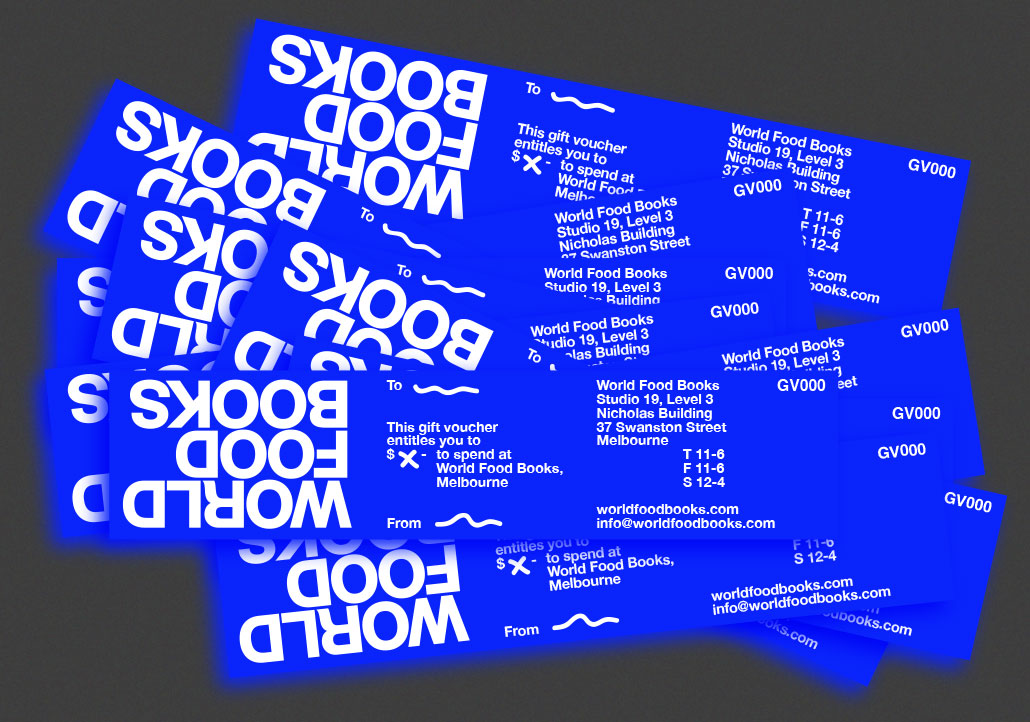
A World Food Books gift voucher is redeemable in our Melbourne bookshop or via our webshop (here). An e-voucher (printable pdf) will be sent to your purchase email address (please notify us if you wish to have the voucher sent to an alternate address and wish us to fill in the receiver's details on the card).
Gift vouchers can be purchased in increments of $20 (Australian Dollars) and the total amount can simply be added to by increasing the quantity in your shopping cart. eg. A quantity of 5 gift vouchers will result in an item total of $100 - a $100 gift voucher. Simply click "ADD TO CART" 5 times, or update your quantity in the shopping cart.
If you wish to purchase multiple, separate gift vouchers in one go, please just email us and we can personally prepare and email you a payment request.
Please note: Please select Pick-Up on gift voucher purchse to avoid any postage charges. Accidental postage charges will be refunded right away!
Thank you.
For any questions, please don't hesitate to email: [email protected]
1991, English
Softcover, 143 pages, 27 x 27 cm
1st Edition, Out of print title / used / very good
Published by
Hillwood Art Gallery / New York
$100.00 - Out of stock
First edition of this monographic book on the incredible work of American artist, Nancy Grossman. Grossman is best known for her wood and leather heads, using the leather, as well as straps, zippers, and string, to create sculptures that appear bound and restrained. She describes her work as autobiographical, and while others have reviewed her work as seemingly sexual and reminiscent of sadism and masochism, Grossman says her work challenges the ideas of gender identity and gender fluidity and refer to her "bondage in childhood". She is also well known for her mixed-media wall assemblages, drawings, collages and paintings, all of which are illustrated throughout this catalogue of her work from the late 1960s-early 1990s. Produced to accompany the first comprehensive survey of Grossman's extensive provocative career that opened at the Hillwood Art Museum in 1991, this book also features texts throughout by feminist art historian, author, critic, educator, curator and co-founder of the Feminist Studio Workshop, Arlene Raven.
Good—VG copy. Some general wear.
1970 / 1975, Japanese
Softcover (w. dust jacket), 100 pages, 26 x 18 cm
Out of print title / used / very good
Published by
Iwasaki Art Co. / Japan
$70.00 - Out of stock
Lovely 1975 Japanese monograph on the work of Aubrey Beardsley, first published in 1970. Profusely illustrated throughout with 155 works, illustrated biography, biography and list of works, wrapped up in textured stock cover and dust jacket. Texts by Tadayuki Omori.
Aubrey Vincent Beardsley (1872 – 1898) was an English illustrator and author. His black ink drawings were influenced by Japanese woodcuts, and emphasized the grotesque, the decadent, and the erotic. He was leading figure in the aesthetic movement, the British counterpart of Decadence and Symbolism. He produced extensive illustrations for books and magazines such as The Studio, The Yellow Book, and The Savoy. Beardsley was a public as well as private eccentric. He said "I have one aim—the grotesque. If I am not grotesque, I am nothing." Oscar Wilde said Beardsley had "a face like a silver hatchet, and grass green hair." Wilde's irreverent wit and work reflected the decadence of his era and his influence was enormous, despite his early death from tuberculosis at age 25. His influence is clearly visible in the work of the French Symbolists, the Poster Art Movement of the 1890s, the work of many later-period Art Nouveau artists such as Papé and Clarke and 20th fantasy illustration.
Very Good copy in VG original dust jacket.
1999, English / French / Japanese
Softcover (2 Vols in curregated cardboard slip-case), 226 + 120 pages, 18 x 25 cm
1st Edition, Out of print title / used / very good
Published by
APT International / Tokyo
Isetan Museum of Art / Tokyo
$150.00 - In stock -
First Edition of this long out-of-print, comprehensive, beautifully produced Japanese two-volume publication on the life and work of the great French avant-garde painter, poet and typographist, Francis Picabia.
Published by APT International in 1999 for a major Japanese travelling exhibition on Francis Picabia, starting at the Isetan Museum of Art in Tokyo in 1999, then to Fukushima and Osaka throughout 1999-2000.
Two Volumes bound in french-fold wraps, both housed in protective corrugated cardboard slip-case with scarlet label wrapped around spine. Slipcase itself is now protected under plastic sleeve.
First volume (226 page) forms a comprehensive retrospective of Picabia's life and prolific and defying work across painting, drawing, printing, poetry and film. Extensive colour and b&w reproductions of a vast collection of his painting, illustration and publishing projects are presented alongside a folio of his poems and drawings, plus photo documentation of his studio and private/social life. Also includes a biography and bibliography, as well as an insightful conversation between Olga Picabia (Francis Picabia's widow), Pierre Calté (director of Comité Picabia), Hans Ulrich Obrist (independent curator) and Stefan Banz (independent curator), about Picabia's life (text in English and Japanese). Introductory essays in Japanese and French by Beverley Calte and Arnauld Pierre.
Second volume (120 pages) "391" is a very special book made up of collated facsimiles of the 19 issues of Picabia's famous Dada periodical, "391", dating 1917-1924. 391 first appeared in January 1917 in Barcelona, published and edited by Picabia, assisted in assembling by Olga Sacharoff, a Georgian emigre residing in Barcelona. The title of the magazine derives from Alfred Stieglitz's New York periodical 291 (to which Picabia had contributed), and bore no relation to its contents. Despite Picabia's renown as an artist, it was mostly literary in content, with a wide-ranging aggressive tone, possibly influenced by Alfred Jarry and Apollinaire. There were contributions by two men new to Dada: Man Ray and Marcel Duchamp. However 391 remained essentially the expression of the inventive, energetic and wealthy Picabia, who stated of it: "Every page must explode, whether through seriousness, profundity, turbulence, nausea, the new, the eternal, annihilating nonsense, enthusiasm for principles, or the way it is printed. Art must be unaesthetic in the extreme, useless and impossible to justify."
Francis Picabia (22 January 1879 – 30 November 1953) was a French avant-garde painter, poet and typographist. After experimenting with Impressionism and pointillism, Picabia became associated with Cubism. His highly abstract planar compositions were colourful and rich in contrasts. He was one of the early major figures of the Dada movement in the United States and in France. His was later briefly associated with Surrealism, but would soon turn his back on the art establishment.
Very Good copy in Good slipcase that has discoloured with sun-tanning to spine, corregation has some wear. Books VG both.
2025, English / French
Hardcover (clothbound), 224 pages, 29.5 x 25 cm
Published by
Hauser & Wirth / Zurich
$110.00 - In stock -
Documenting the great, late, neglected work of a modernist master.
Prefaced by Beverley Calté, president of the Comité Picabia, this book delves into Picabia’s practice between the years 1945 to 1952—an incredibly rich period during which Picabia created paintings unlike anything he had produced before, working alongside the growing Art Informel movement in Paris.
Essays by art historians Arnauld Pierre and Candace Clements shed new light on the hidden signs and symbols buried in his abstractions, the new painting techniques he employed, and the mysterious and fantastical reappearance of the “dot” in his work.
'Éternel recommencement / Eternal Beginning' is an essential resource, marking the first focused exploration of a crucial chapter of Picabia’s practice.
2026, English
Hardcover, 460 pages, 26.1 x 19.9 cm
Published by
Larkin Erdmann Gallery / Zürich
Walther König / Köln
$115.00 - In stock -
This most comprehensive overview of Man Ray's art and life to date features around 150 works, each discussed in detail and fully catalogued. This book on Man Ray brings together works by the artist that range in date from his high school years to works made a few years before his death in 1976. Each work reproduced is discussed in a text by Francis M. Naumann, renowned expert on the work of Marcel Duchamp and Man Ray, and fully catalogued by Andrew Strauss, director of the Man Ray Expertise Committee in Paris. Together with colour photographs by Eric Lehmann of Man Ray's studio on the Rue Ferou in Paris, the book reflects the enjoyment and endless creativity of the famous surrealist.
Edited by Larkin Erdmann.
1980, French
Hardcover, 110 pages, 20 x 27.5 cm
1st Edition, Out of print title / used / very good
Published by
Editions Filipacchi / Paris
$480.00 - Out of stock
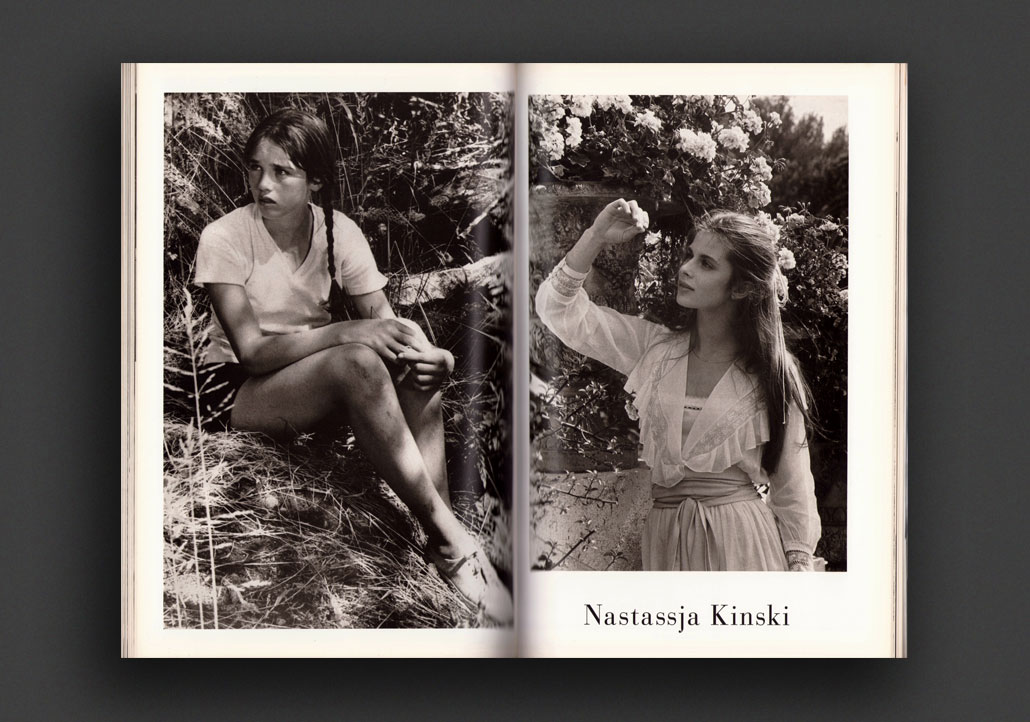
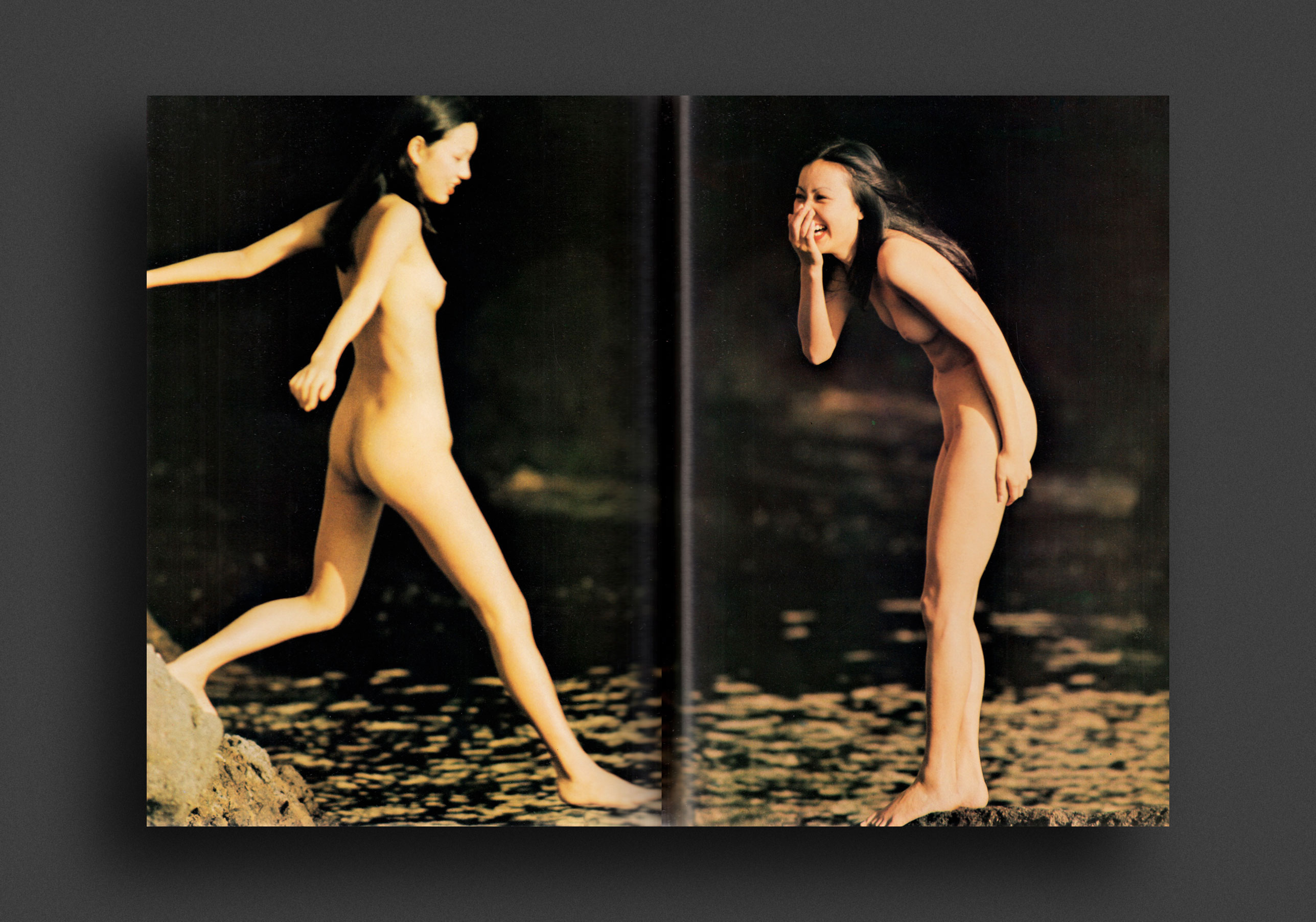
First edition of the collectable cult classic "Des corps naturels" photo book by French photographer Jacques Bourboulon, first published in 1980 by Filipacchi, Paris. A collection of Bourboulon's nude photography alongside a collection of sonnets by French singer Serge Gainsbourg. Largely photographed on Bourboulon's island home of Ibiza in the 1970s-80s, a refuge for hippies, artists and other free spirits from all over the world, his photographs are a testament to the freedom and experimentation of this time, and to the beauty, nature and simplicity of the island life itself.
Jacques Bourboulon (born 8 December 1946) is a French photographer, specializing in nude photography. In 1967 he started as a fashion photographer, publishing in Vogue and working for the fashion designers Dior, Féraud, and Carven. In the mid-1970s he switched to nude photography. Bourboulon's pictures were shot with a Pentax camera and focus on bright light and sharp contrasts. His most typical pictures portray girls and women on the Spanish island of Ibiza, playing on the juxtaposition of blue sky, white walls, and sun-tanned skin. His images become iconic through the pages of PHOTO magazine, CLub, High Society, Playmen and calendars for Pentax and BASF. Bourboulon's photography books sold over 400,000 copies.
Very Good copy in good dustjacket.
1992, Japanese / English
Softcover (w. dust jacket), 108 pages, 30 x 30.5 mm
1st Edition, Out of print title / used / very good
Published by
Bundgeishunju / Tokyo
$200.00 - In stock -
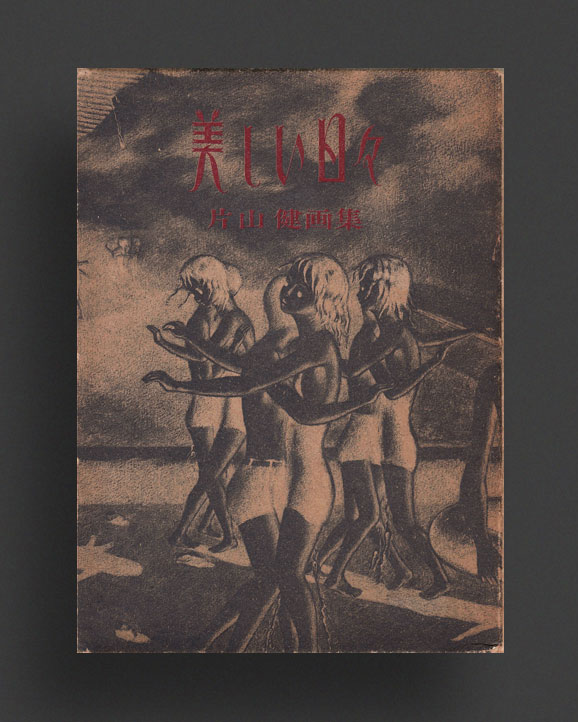
Beautiful first edition of this great photobook by Japanese photographer Joji "Geroge" Hashiguchi (b. born in Kagoshima in 1949). Starting in June 1990 on Iriomote Island, Okinawa, and ended in Tokyo in September 1992, Couple is Hashiguchi’s series of 103 portraits of couples living in Japanese at the beginning of the 1990s. Following on from his previous acclaimed collections, 17-year-old map (1988) and Father (1990), Couples follows Hashiguchi’s same method of portraiture. In addition to its value as an archaeological record, Hashiguchi's point of view always captures the social landscape behind it. Working as a sociological ethnographer with a survey approach, Hashiguchi produces a unique overview of Japanese society with a sense of considerable sociocultural diversity in light of stereotypic reductions of Japan as a homogeneous entity.
Texts in English and Japanese.
Very Good copy.
1988, Japanese / English
Softcover (w. dust jacket), 98 pages, 30 x 30.5 cm
Signed.,
1st Edition, Out of print title / used / very good
Published by
Bundgeishunju / Tokyo
$200.00 - In stock -
Beautiful, rare, signed first edition of this great photobook by Japanese photographer Joji "Geroge" Hashiguchi (b. born in Kagoshima in 1949), the first in his acclaimed collections that also includes Father (1990) and Couples (1992) following Hashiguchi’s same method of portraiture. "Seventeen's Map" is an intelligent sociological typology consisting of documentary black and white portraits of Japanese seventeen-year-olds in the late 1980s. Introductory text in Japanese and English by the photographer.
"From March 1987 to January 1988, I travelled almost the whole of Japan, up north to the Rebun Island in Hokkaido, and down south to the Yona- kuni Island in Okinawa. This is a collection of the pictures of the 17-year olds I met during my travels. As long as they were 17-year olds at the moment when I met them and pressed the shutter of my camera, I did not care who my models were. In return for letting me photograph them, I decided not to pick and choose, but to put them all into this book."—Joji "Geroge" Hashiguchi
In addition to its value as an archaeological record, Hashiguchi's point of view always captures the social landscape behind it. Working as a sociological ethnographer with a survey approach, Hashiguchi produces a unique overview of Japanese society with a sense of considerable sociocultural diversity in light of stereotypic reductions of Japan as a homogeneous entity.
This special copy boldly signed by the photographer and dated (1988) on loose-leaf endpaper stock in silver metallic marker.
Texts in English and Japanese. Cited in Parr / Badger Volume 2.
Very Good copy with tanning to otherwise VG dust jacket.
2026, English
Softcover, 276 pages, 27.9 x 22.2 cm
Published by
Walther König / Köln
$145.00 - In stock -
Edited with text by Susanne Pfeffer. Text by Valeria Gordeev, Quinn Latimer, Christoph Menke, Cord Riechelmann, Ann-Charlotte Gunzel.
From “knitting pictures” to upside down palm trees and mannequin heads in glass boxes, Trockel’s caustic oeuvre defies classification.
Finally here, the enormous MMK catalogue! German multimedia artist Rosemarie Trockel rose to fame in the 1980s with her “knitting pictures” made with industrial weaving machines. In 1999 she was the first woman to exhibit at the German Pavilion at the Venice Biennale. The brutality and absurdity of normative regimes emerge openly in the work of Rosemarie Trockel. Definitions, restrictions, paternalism, and violence due to gender become visible and transparent. Her advance is a risky, courageous, combative, and humorous one. In all media—drawing and painting, photography, sculpture, installation, and film—Trockel’s sociological gaze is as much directed at social regimes and political structures as it is at nature. Her observations and studies of processionary caterpillars, starlings, chickens, or lice, while scientifically sound and precise, always include her own critical gaze as a vital component. She appropriates the ambivalences in her work, capturing them decidedly.
The comprehensive exhibition and catalogue displays works from all periods of Rosemarie Trockel’s oeuvre, from the 1970s to the new works created especially for the Museum für Moderne Kunst in Frankfurt.
2005, English / German
Softcover (w. folded poster dust-jacket), 192 pages, 22.5 x 27 cm
1st Edition, Out of print title / used / very good
Published by
Walther König / Köln
$320.00 - Out of stock
Rare 2006 edition (w. original fold-out dust-jacket poster) of Rosemarie Trockel's Post Menopause catalogue (raisonné), published on the occasion of the major 2005—2006 exhibition Rosemarie Trockel: Menopause, at the Museum Ludwig, Köln, and MAXXI-Museo nazionale delle arti del XXI secolo, Rome.
This wonderful, major survey disappeared from print very fast, quickly becoming a valuable item in the mid-2000s. A catalogue raisonné of sorts, collecting Rosemarie Trockel's work from 1980—2005 (sculpture, wool works, drawings, publications, garments, photography, video — including many very rarely seen objects), Post Menopause remains one the best, most comprehensive, and Trockel-esque books produced on one of Germany's most important and influential conceptual artists. Not surprisingly, since Post Menopause was realised in close collaboration between Trockel herself with Museum Ludwig curator Barbara Engelbach, and designed by her regular design collaborator, and sometimes muse, the great graphic designer Yvonne Quirmbach. Extensive chronological cataloguing of all works, biography, bibliography, and bilingual (English and German) essays by Brigid Doherty, Silvia Eiblmayr, Barbara Engelbach, Kasper König, and Gregory Williams.
A highly recommended and invaluable resource on the artist.
Rosemarie Trockel (*1952) is widely regarded as one of the most important and influential conceptual artists in Germany. Her sculptures, collages, ceramics, knitted works, drawings and photographs are noted for their subtle social critique and range of subversive, aesthetic strategies—including the reinterpretation of “feminine” techniques, the ironic shifting of cultural codes, a delight in paradox, and a refusal to conform to the commercial and institutional ideologies of the art system.
VG/VG.
1986, English
Softcover, 319 pages, 175 x 229 mm
1st Edition, Out of print title / used / very good
Published by
The MIT Press / Massachusetts
$45.00 - Out of stock
Co-founder and co-editor of October magazine, a veteran of Artforum of the 1960s and early 1970s, Rosalind Krauss has presided over and shared in the major formulation of the theory of postmodernism. In this challenging collection of fifteen essays, most of which originally appeared in October, she explores the ways in which the break in style that produced postmodernism has forced a change in our various understandings of twentieth-century art, beginning with the almost mythic idea of the avant-garde. Krauss uses the analytical tools of semiology, structuralism, and poststructuralism to reveal new meanings in the visual arts and to critique the way other prominent practitioners of art and literary history write about art. In two sections, "Modernist Myths" and "Toward Postmodernism," her essays range from the problem of the grid in painting and the unity of Giacometti's sculpture to the works of Jackson Pollock, Sol Lewitt, and Richard Serra, and observations about major trends in contemporary literary criticism.
Rosalind E. Krauss, University Professor at Columbia University and an editor and cofounder of October magazine, is the author of The Originality of the Avant-Garde and Other Modernist Myths (1985), The Optical Unconscious (1993), The Picasso Papers (1999), and Bachelors (1999), all published by the MIT Press, and coauthor (with Yve-Alain Bois) of Formless: A User's Guide (Zone Books, 1997).
"All of her observations are unfailingly original and provocative."—Art Documentation
Very Good copy of original 1986 edition, 1993 printing.
2018, English
Hardcover, 480 pages, 17.4 x 23.2 cm
Published by
Atlas Press / London
$74.00 - In stock -
Georges Bataille's secret society, long the stuff of legend, is now revealed in its texts, meditations, rules and prohibitions.
This book recounts what must be one of the most unusual intellectual journeys of modern times, in which the influential philosopher, cultural theorist and occasional pornographer Georges Bataille (1897-1962), having spent the early 1930s in far-left groups opposing the rise of fascism, abandoned that approach in order to transfer the struggle onto "the mythological plane."
In 1937, Bataille founded two groups in order to explore the combinations of power and the "sacred" at work in society. The first group, the College of Sociology, gave lectures that were intended to reveal the hidden undercurrents within a society on the verge of catastrophe. The second group was Acéphale, a genuine secret society and anti-religion whose emblem was a headless figure that, in part, represented the death of God. Until the discovery a few years ago of the group's internal papers (which include theoretical texts, meditations, minutes of meetings, rules and prohibitions and even a membership list), almost nothing was known of its activities.
This book is the first to collect a representative selection of the writings of Bataille, and of those close to him, in the years leading up to World War II. The texts published here comprise lectures given to the College of Sociology by Bataille, Roger Caillois and Michel Leiris, essays from the Acéphale journal and a large cache of the internal papers from the secret society. A desperate narrative unfolds, wherein Bataille risked all in a wholly unreasonable quest--with a few fellow travelers, he undertook what he later described as a "journey out of this world."
Additional texts by Roger Caillois, Pierre Klossowski, Michel Leiris, and by Georges Ambrosino, Pierre Andler, Michel Carrouges, Jacques Chavy, Jean Dautry, Henri Dobier, Henri Dussat, Imre Kelemen, Jean Rollin, Patrick Waldberg.
And with drawings by André Masson
Highest recommendation!
1990, French
Hardcover (clothbound w. dust jacket), 288 pages, 24 x 21 cm
1st Edition, Out of print title / used / very good
Published by
Centre National Des Arts Plastiques / Paris
$220.00 - Out of stock
First beautiful hardcover edition of the comprehensive Pierre Klossowski catalogue raisonné published on the occasion of the major retrospective exhibition of his work held in Paris in 1990-1991 at CNAP. Profusely illustrated in colour and b/w with Klossowski's wonderful works, texts throughout by Catherine Grenier, Bernard Blistene, Claude Ritschard, Pascal Bonitzer, Marie-Dominique Wicker, Franco Cagnetta, André Masson, and Pierre Zucca (in French), a densely illustrated catalogue raisonné spanning his work dated 1952/53 through to 1990 (many not seen elsewhere), biography, exhibition history, and much more. Still the most in-depth book on Klossowski's oeuvre to date.
Pierre Klossowski (1905-2001) was a significant and influential philosopher, writer, translator and artist who befriended Georges Bataille and formulated an original stance on many theological issues, as well as the philosophy of the Marquis de Sade. His first novel, Roberte, ce soir, appeared in 1954 as a limited edition containing six of his own erotic illustrations, after he rejected drawings by his younger brother, the painter Balthus. Following the encouragement of Robert Lebel, Andre Masson and Alberto Giacometti, Klossowski held his first exhibition in Paris in 1956, and subsequently produced numerous life-size drawings of erotic scenes imbued with mythological, allegorical and philosophical connotations. By the 1970s, he had won the acclaim of such eminent thinkers as Maurice Blanchot, Michel Butor, Gilles Deleuze, Michel Foucault and Felix Guattari. Of Klossowski, Gilles Deleuze once said, "That bodies speak has been known for a long time."
Very Good in Very Good dust jacket with some tanning lines.
1996, English
Softcover, 176 pages, 23 x 21 cm
1st Edition, Out of print title / used / very good
Published by
Atlas Press / London
$100.00 - Out of stock
First edition of the incredible and sadly long out-of-print Encyclopedia Acephalica, published by Atlas Press in 1995 as part of their mighty Atlas Arkhive : Documents of the Avant Garde series..
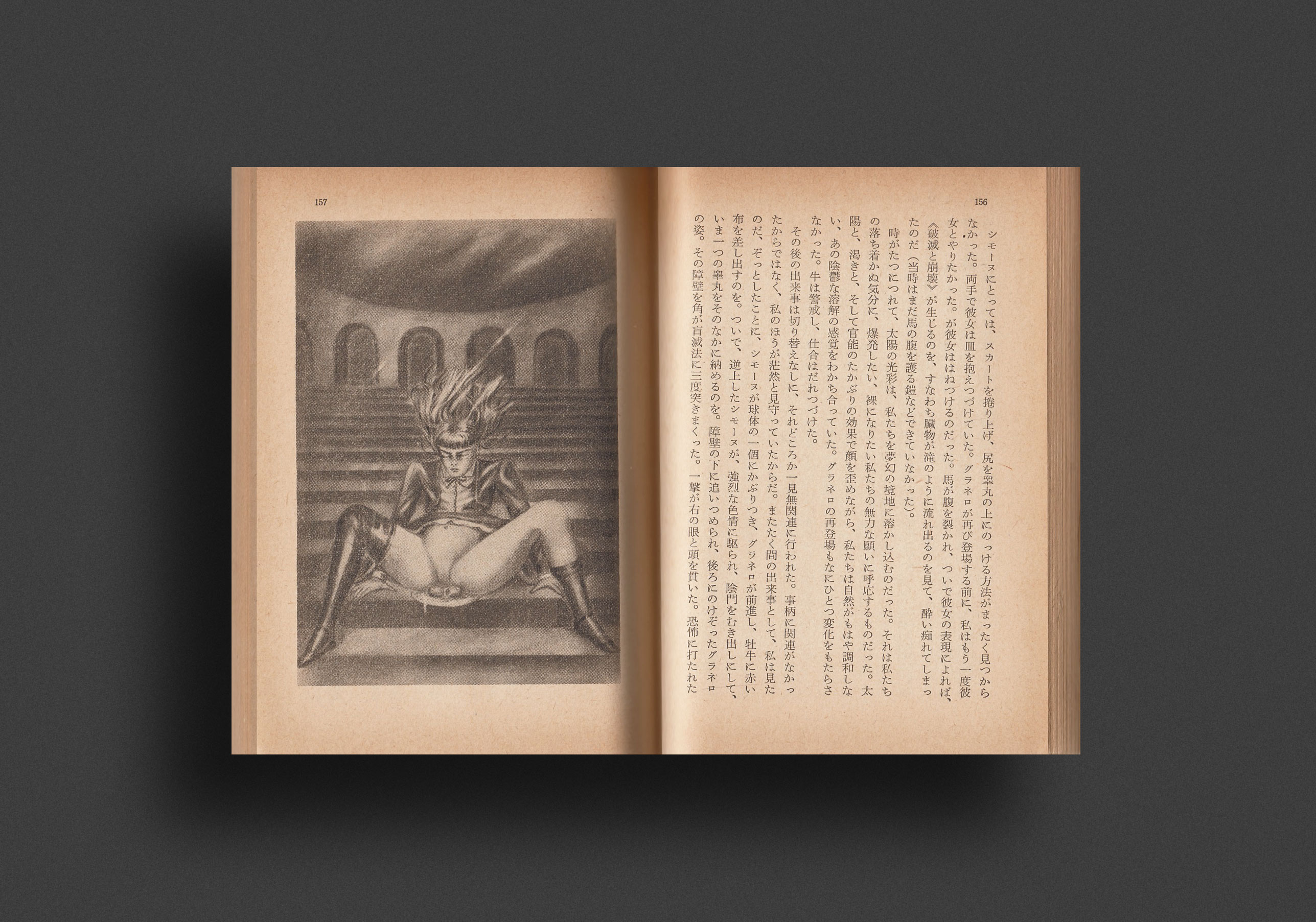
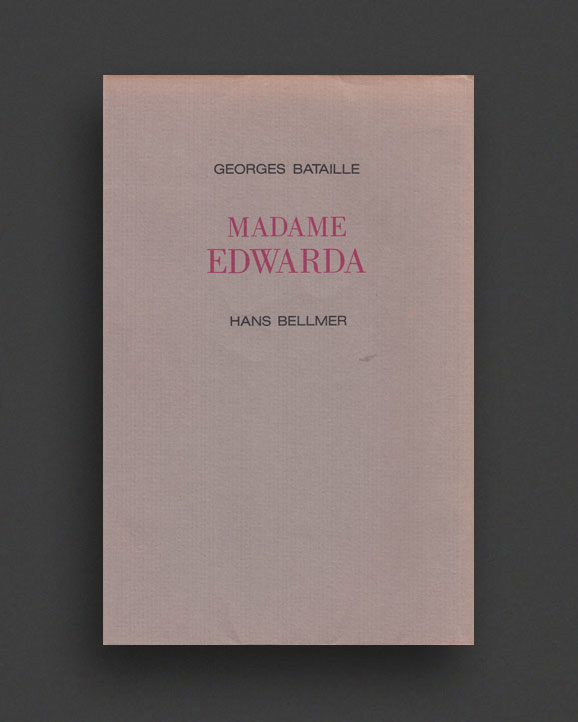
Bataille’s thought is complex, and his books make few concessions to the reader. The first series of texts here, however, were written for a wider audience by Bataille and his friends, in the form of a Critical Dictionary, and they provide a witty, poetic and concise introduction to his ideas. The Dictionary appeared in the magazine edited by Bataille, Documents, in the early 1930s, and includes entries from prominent ethnologists and cultural commentators of the day. The second series of texts here, the Da Costa Encyclopédique was published anonymously after the liberation of Paris in 1947 by members of the Acéphale group and writers associated with the Surrealists. Both cover the essential concepts of Bataille and his associates: sacred sociology; scatology, death and the erotic; base materialism; the aesthetics of the formless; sacrifice, the festival and the politics of the tumult etc: a new description of the limits of being human. Humour, albeit, sardonic, is not absent from these remarkable redefinitions of the most heterogeneous objects or ideas: Camel, Church, Dust, Museum, Spittle, Skyscraper, Threshold, Work – to name but a few.
While the Documents group was celebrated for joining together artists, authors, sociologists and ethnologists (among the most important of their time) in a literary and philosophical project, the Acéphale group was more mysterious. Until recently even its membership was only vaguely known, and its activities remained secret (these are explored in detail for the first time in English in The Sacred Conspiracy, published by Atlas Press, also available at World Food Books). The origins of the Da Costa only became known in 1993, the present volume revealed for the first time its principal compilers: Robert Lebel, Isabelle Waldberg and Marcel Duchamp, but the identity of the authors of a large part of it is still unknown.
Texts by Georges Bataille, Michel Leiris, Marcel Griaule, Carl Einstein, Robert Desnos and writers associated with the Acéphale and Surrealist groups.
Introduced by Alastair Brotchie. Translated by Iain White, Dominic Faccini, Annette Michelson, John Harman, Alexis Lykiard.
Very Good copy, only the lighest wear and previous owner's name penned to title page. (sample image only)
1999, English
Softcover, unpaginated, 18.5 x 18.5 cm
Out of print title / used / very good
Published by
Charta / Milan
$100.00 - Out of stock
The great Propo artist's book by Paul McCarthy, published by Charta in 1999. Comprised entirely of photos of everyday objects, soiled, dirtied and ruined, shot against colourful backdrops that contrast with the mysterious nature of the decontextualized objects. Children's toys, condiment bottles, latex masks, dolls ... these objects are in fact props from McCarthy's legendary performances, and their visual inventory here reads like a book of modernity's detritus. A photo book document of residual sculptural objects of performance. One of his best books, like no other!
Born in Salt Lake City in 1945, Paul McCarthy has lived and worked in the Los Angeles area since 1970. Originally formally trained as a painter, McCarthy's main interest lies in everyday activities and the mess created by them. Much of his work in the late 1960s, such as Mountain Bowling (1969) and Hold an Apple in Your Armpit (1970), are similar to the work of Happenings founder Allan Kaprow, with whom McCarthy had a professional relationship. From 1982 to 2002 he taught performance, video, installation, and performance art history at the University of California, Los Angeles. McCarthy currently works mainly in video and sculpture. His work has been widely exhibited throughout Europe and the U.S. including the Museum of Contemporary Art, Los Angeles; the Whitney Museum of American Art and The Museum of Modern Art; and the Centre Georges Pompidou, Paris.
Very Good copy with only light wear.
1993, English
Softcover, 150 pages, 24 x 17 cm
1st UK Edition, Out of print title / used / very good
Published by
Sonsbeek / Arnhem
$550.00 - Out of stock
First 1993 edition of one of the great art books, by one of the great artists. This provocative, copiously illustrated catalogue by renowned American artist Mike Kelley is a meditation on Sigmund Freud's "Uncanny", and its relation to the grotesque in art and everyday life. Published to accompany the exhibition curated by Kelley as part of the "Sonsbeek 93" exhibition in Arnhem, The Netherlands, June 5 - September 26, 1993, Kelley presents (like a photo scrapbook) an arresting mix of modern and contemporary artists alongside bizarre figurative, prosthesis, animatronic, and mannequin-related imagery throughout history. Artists included : Hans Bellmer, Robert Gober, Tetsumi Kudo, Zoe Leonard, Paul McCarthy, Nayland Blake, John Miller, Bruce Nauman, Tony Oursler, Cindy Sherman, Kiki Smith, Duane Hanson, Man Ray, Guillaume Bijl, Dennis Oppenheim, Edgar Degas, Piero Manzoni, Marcel Broodthaers, Goya, Nam June Paik, Andy Warhol, Marcel Duchamp, Dorothea Lange, Thom Puckey, Charles Ray, Edward Kienholz, Martin Kippenberger, Laurie Simmons, Jeff Koons, Yayoi Kusama, Paul Thek, Mike Kelley himself, and many more. Includes Kelley's accompanying essay, "Playing with Dead Things". The exhibition took on mythical status and was re-staged in Liverpool in 2004. The Uncanny has become one of the most desired of Kelley's books.
Very Good copy with only light cover wear.
2009, English
Hardcover, 550 pages, 22 x 28 cm
1st Edition, Out of print title / used / good
Published by
The MIT Press / Massachusetts
$400.00 - Out of stock
First edition of the scarce, highly sought after, and most comprehensive book ever published on American artist Paul Thek, published in 2009 by MIT Press. Edited by Harald Falckenberg and Peter Weibel, this enormous 550 page monograph contains more than 300 works by this groundbreaking artist, documenting his journey from legendary outsider to central figure in many contemporary art movements.
Paul Thek occupied a place between high art and low art, between the epic and the everyday. During his brief life (1933-1988), he went against the grain of art world trends, humanizing the institutional spaces of art with the force of his humor, spirituality, and character. Twenty years after Thek's death from AIDS, we can now recognize his influence on contemporary artists ranging from Vito Acconci and Bruce Nauman to Matthew Barney, Mike Kelley, and Paul McCarthy, as well as Kai Althoff, Jonathan Meese, and Thomas Hirschhorn. This book brings together more than 300 of Thek's works—many of which are published here for the first time—to offer the most comprehensive display of his work yet seen. The book, which accompanies an exhibition at ZKM ? Museum of Contemporary Art presenting Thek's work in dialogue with contemporary art by young artists, includes painting, sculpture, drawing, and installation work, as well as photographs documenting the room-size environments into which Thek incorporated elements from art, literature, theater, and religion. These works chart Thek's journey from legendary outsider to foundational figure in contemporary art. In their antiheroic diversity, Thek's works embody the art revolution of the 1960s; indeed, Susan Sontag dedicated her classic Against Interpretation to him. Thek's treatment of the body in such works as “Technological Reliquaries,” with their castings and replicas of human body parts, tissue, and bones, both evoke the aura of Christian relics and anticipate the work of Damien Hirst. The book, with more than 500 images (300 in colour) and nineteen essays by art historians, curators, collectors, and artists, investigates Thek's work on its own terms, and as a starting point for understanding the work of the many younger artists Thek has influenced.
Essays by Jean-Christophe Ammann, Margrit Brehm, Bazon Brock, Suzanne Delehanty, Harald Falckenberg, Marietta Franke, Stefan Germer, Kim Gordon, Roland Groenenboom, Axel Heil, Gregor Jansen, Mike Kelley, John Miller, Susanne Neubauer, Kenny Schachter, Harald Szeemann, Annette Tietenberg, Peter Weibel, Ann Wilson.
Good copy with heavy tanning to spine and covers (esp. fluro spot colour), some bumping to cover corners, light page edge tanning. Internally Very Good, clean throughout.
2002, English
Softcover, 310 pages, 23 x 18 cm
1st Edition, Out of print title / used / very good
Published by
The MIT Press / Massachusetts
$110.00 - In stock -
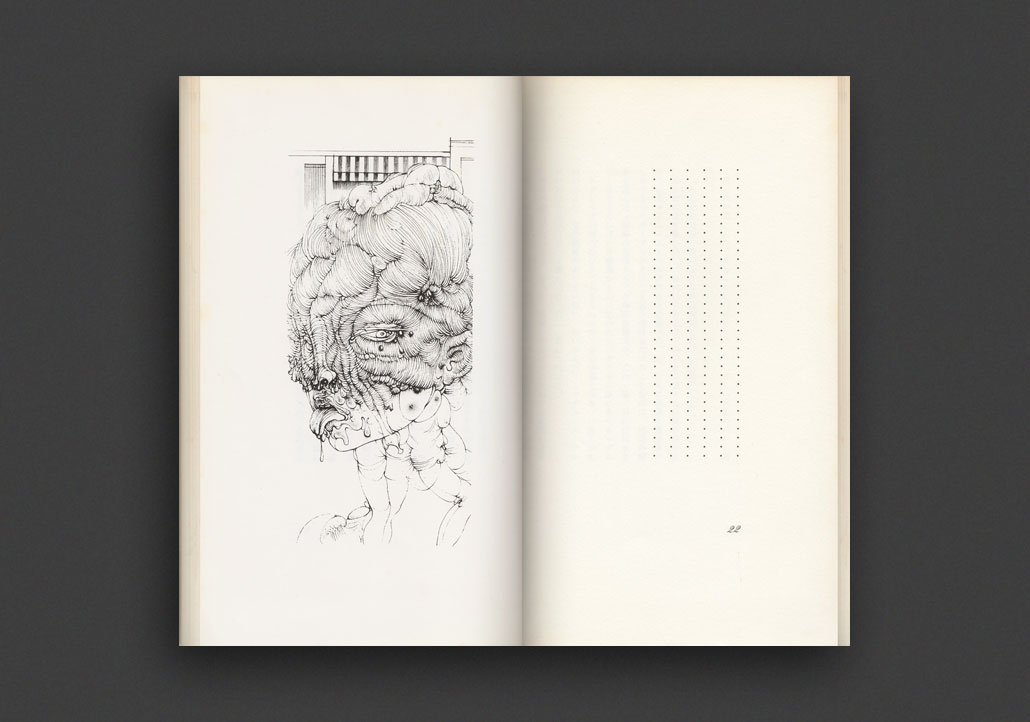
First 2002 paperback edition of this out-of-print study on Bellmer.
"The German-born surrealist Hans Bellmer (1902-1975), best known for his life-size pubescent dolls, devoted an artistic lifetime to creating sexualized images of the female body-distorted, dismembered, or menaced in sinister scenarios. In this book Sue Taylor draws on psychoanalytic theory to suggest why Bellmer was so driven by erotomania as well as a desire for revenge, suffering, and the safety of the womb. Tracing a repressed homoerotic attachment to his father, castration anxiety, and an unconscious sense of guilt, Taylor proposes that a feminine identification informs all the disquieting aspects of Bellmer's art.
Most scholarship to date has focused on Bellmer's work of the 1930s, especially the infamous dolls and the photographs he made of them. Taylor extends her discussion to the sexually explicit prints, drawings, paintings, and photographs he produced throughout the ensuing three decades. The book includes a color frontispiece and 121 black-and-white images (eight published here for the first time), as well as appendixes containing several significant texts by Bellmer previously unavailable in English.
Sue Taylor is Assistant Professor of Art History at Portland State University, Oregon.
"While ultimately subscribing to the conventional wisdom that the misogynist implications of Bellmer's many sinister images can never be altogether dismissed, [Taylor] insists that we look beyond their manifest content towards their latent meanings. Her tone and method is thus a long way from the punitive... literalism and crudity of much Bellmer criticism."—R. S. Short, Times Literary Supplement
"An impressive book by any standards. Every page displays intelligence, erudition and visual acuity."—Metapsychology
VG copy, light edge wear, faint edge tanning.
1988, English
Hardcover (w. dust jacket), 256 pages, 20 x 14 cm
1st Edition, Out of print title / used / good
Published by
Eridanos Press / Colorado
$70.00 - Out of stock
Rare first 1988 English translation of The Baphomet, Pierre Klossowski's last novel, considered by many to be his masterpiece, and awarded the Prix des Critique when first publsihed in France in 1965. Translation by Sophie Hawke and Stephen Sartorelli and published by Eridanos Press.
The author, who has written about Sade and Nietzsche as well as the Doctors of the Church, is a spirit particularly at ease with extremes. Of him it has been said that he never ceased to keep one foot in the seminary and the other in the brothel. The Baphomet is the perfect example of this. An experimental, non–linear, philosophical novel set in a Templar commandery, where the souls of martyred knights, or "pure breaths," gather to relive their final moments, engage in spirit possession of unwary animals and small children, and metaphysical debates on identity and divinity. Heavy with transgressive erotic subject matter, the plot involves the possession of a young page's body and includes figures such as the Grand Master, St. Teresa of Avila, and the figure of Friedrich Nietzsche, the "Antichrist," initially in the form of an anteater. The vignettes to follow are a commentary on eros, death, transgression and rejection of conventional morality. An intense and challenging novel blurring the lines between theology, Gnosticism, and esotericism, The Baphomet is recognized for its blend of the Gothic tale, Sadean eroticism and intense intellectual experimentation around the theme of "simulacrum"—the idea that life and memory are merely repeated performances of a theological nature.
Pierre Klossowski (1905—2001) was a French writer, translator and artist, widely recognized as a central figure in the contemporary French avant-garde. He was the eldest son of the artists Erich Klossowski and Baladine Klossowska, and his younger brother was the painter Balthus. As a writer, Pierre Klossowski wrote full length volumes on the Marquis de Sade and Friedrich Nietzsche, a number of essays on literary and philosophical figures, and five novels. Roberte Ce Soir (Roberte in the Evening) provoked controversy due to its graphic depiction of sexuality. He translated several important texts (by Virgil, Ludwig Wittgenstein, Martin Heidegger, Friedrich Hölderlin, Franz Kafka, Nietzsche, and Walter Benjamin) into French, worked on films and was also an artist, illustrating many of the scenes from his novels. Klossowski participated in most issues of George Bataille's review, Acéphale, in the late 1930s. His 1969 book, Nietzsche and the Vicious Circle, greatly influenced French philosophers such as Michel Foucault, Gilles Deleuze, and Jean-François Lyotard.
G—VG copy with previous owner's signature to title page, G—VG DJ with general light wear to edges, discolouration to spine edge, light rubbing.
2016, English
Softcover, 192 pages, 23 x 31 cm
Ed. of 400,
Published by
Secession / Vienna
$180.00 - Out of stock
This out-of-print artist’s book is published on the occasion of the exhibition ‘More Than This’ at the Secession, Vienna, and features the heterogeneous oeuvre of American artist Lutz Bacher. Over her 40-year career, Bacher has produced conceptual works that defy classification in a variety of formats, including videotapes, photographs, and other mixed media. Described as eclectic, rough, open-ended, and disturbing, many works incorporate elements from pop culture, personal artefacts, and found objects, and address questions of identity as expressed through sexuality and the human body. The book is filled with newspaper clippings, personal communications, and many images.
Limited to 400 copies. Absolutely essential!
2015, English
Softcover, 55 pages, 11.5 x 18 cm
Published by
Wakefield Press / Cambridge
$32.00 - In stock -
This fierce fable of childbirth by German Surrealist Unica Zorn was written after she had already given birth to two children and undergone the self-induced abortion of another in Berlin in the 1950s. Beginning in the relatively straightforward, if disturbing, narrative of a young woman in a tower (with a bat in her hair and ravens for company) engaged in a psychic war with the parasitic son in her belly, The Trumpets of Jericho dissolves into a beautiful nightmare of hypnotic obsession and mythical language, stitched together with anagrams and private ruminations. Arguably Zorn's most extreme experiment in prose, and never before translated into English, this novella dramatizes the frontiers of the body -- its defensive walls as well as its cavities and thresholds -- animating a harrowing and painfully, twistedly honest depiction of motherhood as a breakdown in the distinction between self and other, transposed into the language of darkest fairy tales.
Unica Zorn (1916-70) was born in Grunewald, Germany. Toward the end of World War II, she discovered the realities of the Nazi concentration camps -- a revelation which was to haunt and unsettle her for the rest of her life. After meeting Hans Bellmer in 1953, she followed him to Paris, where she became acquainted with the Surrealists and developed the body of drawings and writings for which she is best remembered: a series of anagram poems, hallucinatory accounts and literary enactments of the mental breakdowns from which she would suffer until her suicide in 1970.
1972, English
Hardcover (w. dust jacket), 405 pages, 24 x 16.5 cm
1st Edition, Out of print title / used / very good
Published by
George Allen / London
$110.00 - Out of stock
Rare first British hardcover edition of Bakunin on Anarchy, a new selection of writings nearly all published for the first time in English by the founder of the world Anarchist movement, published by George Allen & Unwin, London, 1972.
"This is the first comprehensive collection in English from the works of the founder of anarchism—culled and newly translated from Bakunin's writings, published and unpublished—including manuscripts left unfinished or unrevised at the time of his death almost a century ago."
Very Good copy in VG dust jacket. Mild wear to jacket extremities, closed tears. Preserved in mylar wrap.
2012, English / German
Softcover, 104 pages, 20.3 x 24.8 cm
1st Edition, Out of print title / as new
Published by
Walther König / Köln
Collection de l'Art Brut / Lausanne
$100.00 - In stock -
Scarce out-of-print monograph on the work of Morton Bartlett, one of only a couple of books on the artist, published by Collection de l'Art Brut Lausanne and Walther Koenig in 2012 and quickly sold out.
When the freelance photographer and graphic designer Morton Bartlett (1909–1992) died at the age of 83, his relatives found 15 chests among his possessions. Each chest contained a half-life-size doll and its accessories: 12 girls and three boys, a wardrobe of hand-sewn clothes, black-and-white photographs of each doll as well as countless studies and archival materials. Bartlett began designing these dolls in the mid-1930s, studying anatomy books and histories of costume, and learning to sew and mold with clay to make them as true to life as possible. Each doll entailed a huge amount of labor, taking up to a year to complete; Bartlett created costumes and wigs for each one and then staged them in lifelike scenarios and photographed them, documenting a family he had never had and creating a body of work that would remain unexhibited during his lifetime. The third installment in the Bahnhof Museum’s series on outsider artists, this volume examines Bartlett’s extraordinary lifelong obsession.
Edited and with foreword by Udo Kittelmann, Claudia Dichter. Text by Lee Kogan.
As New copy.