World Food Books' programme is largely produced on Kulin Nation land. We acknowledge the Wurundjeri people of the Kulin Nation as the first and continuing custodians of this land, and pay respect to their Elders past, present, and emerging.
World Food Books is an arts and special interests bookshop in Naarm / Melbourne. Founded in 2010, World Food Books is devoted to the presentation of a rotating, hand-selection of international art, design, literary and counterculture publications with an emphasis on the anti-traditional, the experimental, the avant-garde, the heretic, the marginal.
Presenting new titles alongside rare and out-of-print books, catalogues and journals spanning the fields of modern and contemporary art, design, photography, illustration, film, literature, poetry, cultural theory, philosophy, sexuality, popular and underground culture in its many radical forms, World Food Books wishes to encourage adventurous, thoughtful and open-minded reading, looking, writing, and exchange of publishing and ideas, both current and historical.
As well as our bookshop, located in Melbourne's historical Nicholas Building, all of our inventory is available internationally via our online mail-order service.
World Food Books semi-regularly co-ordinates "Occasions", a programme of exhibits and events at the bookshop and in partnership with other hosts (such as museums and art galleries) that develop out of the activities, relationships and content of the bookshop itself.
World Food Books
The Nicholas Building
37 Swanston Street
Room 5, Level 6
Melbourne 3000
Australia
SHOP HOURS:
Thu–Fri 12–6, Sat 12–5
WEB-SHOP OPEN 24/7
World Food Books
Postal Address:
PO Box 435
Flinders Lane
Victoria 8009
Australia
Art
Theory / Essay
Architecture / Interior
Graphic Design / Typography
Photography
Fashion
Eros
LGBTQ+
Fiction / Poetry
Weird / Speculative / Science Fiction / Horror
Transgressive / Visceral / Abject
Symbolism / Decadence / Fin de siècle
Film / Video
Painting
Sculpture / Installation
Performance / Dance / Theater
Drawing
Sound / Music
Curatorial
Group Shows / Collections
Periodicals
Out-of-print / Rare
Posters / Ephemera / Discs
Signed Books
World Food Books Gift Voucher
World Food Book Bag
Australian Art
Australian Fiction
Australian Science Fiction / Speculative Fiction
Australian Poetry
Australian Photography
Japanese Photography
Conceptual Art
Minimal Art
Dada
'Pataphysics / Oulipo
Fluxus
Concrete Poetry
Pop Art
Surrealism
Arte Povera
Arte Informale / Haute Pâte / Tachism
Nouveau Réalisme / Zero / Kinetic
Situationism / Lettrism
Collage / Mail Art / Xerox Art
Art Brut / Folk / Visionary / Fantastic
Illustration / Graphic Art / Bandes Dessinées
Furniture
Italian Radical Design / Postmodernism
Textiles
Ceramics / Glass
Counterculture
Protest / Revolt
Philosophy
Psychoanalysis
Anthropology
Anarchism
Socialism / Anarchism / Communism / Capitalism
Literary Theory / Semiotics / Language
Feminism / Women's Studies
Gender Studies / Sexuality
Anthropology
Fetishism / BDSM
Drugs / Psychedelia
Crime / Violence
Animal Rights / Veganism
Occult / Esoterica
Ecology / Earth / Alternative Living
Whole Earth / Crafts
All prices in AUD (Australian dollars)
Pick-Ups
Pick-up orders can be collected in our bookshop during opening hours after order date. Please collect any Pick-up orders within 2 weeks of ordering as we have limited storage space. Orders will be released back into stock if not collected within this time. No refunds can be made for pick-ups left un-collected. If you cannot make it in to the bookshop in this time-frame, please choose postage option.
Return Policy
All sales are final. We do accept returns (for refund or exchange) for items received in error. All our orders are packed with special care using heavy-duty padding and cardboard book-mailers or bubble mailers (for smaller books), using reinforcement where required. We cannot take responsibility for any lost, stolen or damaged parcels.
Insurance
Should you wish to insure your package, please email us directly after placing your order and we can organise this at a small extra expense. Although all standard/express tracked packages are very safe and dependable, we cannot take responsibility for any lost, stolen or damaged parcels. We recommend insurance on valuable orders.
Interested in selling your old books, catalogues, journals, magazines, comics, fanzines, ephemera? We are always looking for interesting, unusual and out-of-print books to buy. We only buy books in our fields of interest and specialty, and that we feel we can resell.
We base these prices on desirability, market value, in-print prices, condition and our current stock levels. We offer cash, store credit, and can take stock on consignment. All
about 25% of the price we expect to get when we sell them, or 30% in store credit. We base these prices on desirability, market value, in-print prices, condition and our current stock levels.
Sell your books any day of the week. You can drop them off and return later. If you have a lot of books, we can visit your Sydney home.
We buy books that we feel we can resell. We offer about 25 % of the price we expect to get when we sell them, or 30% in store credit. We base these prices on desirability, market value, in-print prices, condition and our current stock levels.
Philadelphia Wireman
03 August - 01 September, 2018
World Food Books is proud to announce our next Occasion, the first presentation of sculptures by Philadelphia Wireman in Australia.
The Philadelphia Wireman sculptures were found abandoned in an alley off Philadelphia’s South Street on trash night in 1982. Their discovery in a rapidly-changing neighbourhood undergoing extensive renovation, compounded with the failure of all attempts to locate the artist, suggests that the works may have been discarded after the maker’s death. Dubbed the "Philadelphia Wireman" during the first exhibition of this work, in 1985, the maker’s name, age, ethnicity, and even gender remain uncertain. The entire collection totals approximately 1200 pieces, all intricately bound together with tightly-wound heavy-gauge wire (along with a few small, abstract marker drawings, reminiscent both of Mark Tobey and J.B. Murry). The dense construction of the work, despite a modest range of scale and materials, is singularly obsessive and disciplined in design: a wire armature or exoskeleton firmly binds a bricolage of found objects including plastic, glass, food packaging, umbrella parts, tape, rubber, batteries, pens, leather, reflectors, nuts and bolts, nails, foil, coins, toys, watches, eyeglasses, tools, and jewellery.
Heavy with associations—anthropomorphic, zoomorphic, and socio-cultural responses to wrapped detritus—the totemic sculptures by Philadelphia Wireman have been discussed in the context of work created to fulfil the shamanistic needs of alternative religions in American culture. Curators, collectors, and critics have variously compared certain pieces to sculpture from Classical antiquity, Native American medicine bundles, African-American memory jugs, and African fetish objects. Reflecting the artist’s prolific and incredibly focused scavenging impulse, and despite—or perhaps enhanced by—their anonymity, these enigmatic objects function as urban artefacts and arbiters of power, though their origin and purpose is unknown. Philadelphia Wireman, whatever their identity, possessed an astonishing ability to isolate and communicate the concepts of power and energy through the selection and transformation of ordinary materials. Over the course of the past two decades, this collection has come to be regarded as an important discovery in the field of self-taught art and vernacular art.
Presented in collaboration with Fleisher-Ollman Gallery, Philadelphia, and Robert Heald, Wellington.
Susan Te Kahurangi King
02 February - 10 March, 2018
Susan Te Kahurangi King (24 February 1951 - ) has been a confident and prolific artist since she was a young child, drawing with readily available materials - pencils, ballpoint pens and felt-tip markers, on whatever paper is at hand. Between the ages of four and six Susan slowly ceased verbal communication. Her grandparents William and Myrtle Murphy had developed a special bond with Susan so they took on caring responsibilities for extended periods. Myrtle began informally archiving her work, carefully collecting and storing the drawings and compiling scrapbooks. No drawing was insignificant; every scrap of paper was kept. The King family are now the custodians of a vast collection containing over 7000 individual works, from tiny scraps of paper through to 5 meter long rolls.
The scrapbooks and diaries reveal Myrtle to be a woman of great patience and compassion, seeking to understand a child who was not always behaving as expected. She encouraged Susan to be observant, to explore her environment and absorb all the sights and sounds. Myrtle would show Susan’s drawings to friends and people in her community that she had dealings with, such as shopkeepers and postal workers, but this was not simply a case of a grandmother’s bias. She recognised that Susan had developed a sophisticated and unique visual language and sincerely believed that her art deserved serious attention.
This was an unorthodox attitude for the time. To provide some context, Jean Dubuffet coined the term Art Brut in 1945 to describe work created by self-taught artists – specifically residents of psychiatric institutions and those he considered to be visionaries or eccentrics. In 1972 Roger Cardinal extended this concept by adopting the term Outsider Art to describe work made by non-academically trained artists operating outside of mainstream art networks through choice or circumstance. Susan was born in Te Aroha, New Zealand in 1951, far from the artistic hubs of Paris and London that Dubuffet and Cardinal operated in. That Myrtle fêted Susan as a self-taught artist who deserved to be taken seriously shows how progressive her attitudes were.
Susan’s parents Doug and Dawn were also progressive. Over the years they had consulted numerous health practitioners about Susan’s condition, as the medical establishment could not provide an explanation as to why she had lapsed into silence. Dawn educated herself in the field of homeopathy and went on to treat all twelve of her children using these principles – basing prescriptions on her observations of their physical, mental and emotional state.
Doug was a linguist with an interest in philosophy who devoted what little spare time he had to studying Maori language and culture. To some extent their willingness to explore the fringes of the mainstream made them outsiders too but it was their commitment to living with integrity and their respect for individuality that ensured Susan’s creativity was always encouraged.
Even though Susan’s family supported her artistic pursuits, some staff in schools and hospitals saw it as an impediment to her assimilation into the community and discouraged it in a variety of ways. Her family was not always aware of this and therefore did not fully understand why Susan stopped drawing in the early 1990s. However, rather than dwell on the challenges that Susan faced in pursuit of her artistic practice, they prefer to highlight her achievements. In 2008 Susan began drawing again in earnest, after an almost 20 year interruption, and her work is now shown in galleries around the world.
Susan grew up without television and has been heavily influenced by the comics she read as a child. She is absolutely fearless in the appropriation of recognizable characters, such as Donald Duck and Mickey Mouse, in her work. She twists their limbs, contorts their faces, compresses them together, blends them into complex patterned backgrounds - always imbuing them with an incredible energy. Although Susan often used pop culture characters in her work they are not naive or childlike. These are drawings by a brilliant self-taught artist who has been creating exceptional work for decades without an audience in mind.
Mladen Stilinović
"Various Works 1986 - 1999"
02 February 16 - September 10, 2016
Various works 1986 - 1999, from two houses, from the collections of John Nixon, Sue Cramer, Kerrie Poliness, Peter Haffenden and Phoebe Haffenden.
Including: Geometry of Cakes (various shelves), 1993; Poor People’s Law (black and white plate), 1993; White Absence (glasses, ruler, set square, silver spoon, silver ladel with skin photograph and wooden cubes), 1990-1996; Exploitation of the Dead (grey and red star painting, wooden painting, black spoon with red table, red plate), 1984-1990; Money and Zeros (zero tie, paintings made for friends in Australia (Sue, John, Kerrie), numbers painting), 1991-1992; Words - Slogans (various t-shirts) - “they talk about the death of art...help! someone is trying to kill me”, “my sweet little lamb”, “work is a disease - Karl Marx”; Various artist books, catalogues, monographs, videos; Poster from exhibition Insulting Anarchy; "Circular" Croatian - Australian edition; Artist book by Vlado Martek (Dostoyevsky); more.
Thanks to Mladen Stilinović and Branka Stipančić.
Jonathan Walker
Always Will Need To Wear Winter Shirt Blue + Ochre Small Check Pattern
21 August - 21 September, 2015
Untitled
I am not a great reader of poetry but I always return to the work of Melbourne poet, Vincent Buckley (1925- 1988). Perhaps I find his most tantalising piece to be not a finished poem but a fragment left on a scrap of paper discovered on his desk after the poet’s death.
The poetry gathers like oil
In the word-core, and spreads
It has its music meet,
Its music is in movement.
This fragment is more the shell left behind from a volatile thought than a finished poem. I find the last two lines honest but awkward whereas the first two lines work like an arrow. Most likely he could not find a resolution so it was left. Still, in its present form, it remains an eloquent testimony to the ultimate failure of a medium to express mobile thought and sensation, in Buckley’s case, through verbal language. It’s an important matter because this is something all artists have to deal with regardless of the medium.
I have never written a poem, however, I am forever copying fragments from books on paper scraps in a vain effort to fix certain notions in my head. At first, they function as bookmarks that are sometimes returned to when I open the book. But before long, as they accumulate, they fall out littering the table interspersed with A4 photocopies, bills, books and medications.
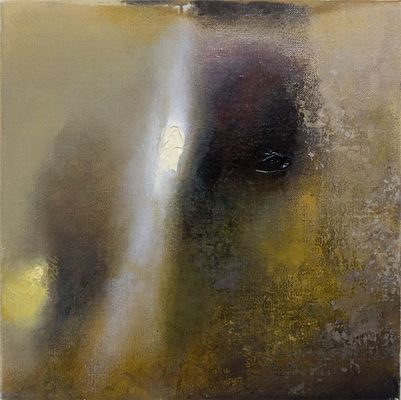
To return to Buckley’s fragment, the first two lines very much evoke how I paint nowadays. As you age, detail diminishes and patches of light become more luminous and float. I feel the most honest way of dealing with this is by smearing the oil paint on the canvas with the fingers and working close-up, blind. Only if the patches coalesce into an approaching image can the work gain a life.
-
Jonathan Walker was born in Melbourne, Australia and brought up on a dairy farm in Gippsland. In the 1970’s he studied painting at RMIT and won the Harold Wright Scholarship to the British Museum, London. During the 1980’s he exhibited at Pinacotheca Gallery, Richmond and had work shown at the NGV and Heidi City Art Gallery. Over the same period he designed the cover for the “Epigenesi” LP by Giancarlo Toniutti, Italy and conducted a mail exchange work with Achim Wollscheid, Germany. The work with artists through the post resulted in an article published in the bicentenary issue of Art and Australia 1988. He showed in artist run spaces such as WestSpace in the 90’s and 2000’s, and until 2012, taught painting at Victoria University, which is where we (Colleen Ahern and Lisa Radford) as organisers of the exhibition, among many others, had the privilege of being his student.
Walker’s knowledge was imparted to students through the careful selection of music, literature, and artists found in books that he himself had ordered for the library. Walker’s strategy was the generosity of sharing his vast knowledge with references specific to each student and their context.
Walker’s paintings share a similar focus and intimacy.
This exhibition presents a small selection of recent paintings alongside a publication that includes Walker’s writing. Observational and analytical, Walker’s work is a type of material notation — the time of day, colour and how it is blended, the both specific and fleeting location of a reflection on lino or the question of whether a chair leg should be included in a painting.
Please join us on Friday August 21 between 6-8pm to celebrate the opening of the exhibition.
Curated by Colleen Ahern and Lisa Radford.
B. Wurtz
Curated by Nic Tammens
March 26 - April 4, 2015
B.Wurtz works from a basement studio in his home on Manhattan’s Lower East Side.
This local fact is attested to by the plastic shopping bags and newsprint circulars that appear in his work. As formal objects, they don’t make loud claims about their origins but nonetheless transmit street addresses and places of business from the bottom of this long thin island. Like plenty of artists, Wurtz is affected by what is local and what is consumed. His work is underpinned by this ethic. It often speaks from a neighborhood or reads like the contents of a hamper:
“BLACK PLUMS $1.29 lb.”
“Food Bazaar”
“USDA Whole Pork Shoulder Picnic 99c lb.”
“RITE AID Pharmacy, with us it’s personal.”
“H. Brickman & Sons.”
“Sweet Yams 59c lb."
Most of the work in this exhibition was made while the artist was in residence at Dieu Donne, a workshop dedicated to paper craft in Midtown. Here Wurtz fabricated assemblages with paper and objects that are relatively lightweight, with the intention that they would be easily transportable to Australia. This consideration isn’t absolute in Wurtz’s work, but was prescriptive for making the current exhibition light and cheap. Packed in two boxes, these works were sent from a USPS post office on the Lower East Side and delivered to North Melbourne by Australia Post.
Wurtz appears courtesy of Metro Pictures, New York.
Thanks to Rob Halverson, Joshua Petherick, Sari de Mallory, Matt Hinkley, Helen Johnson, Fayen d'Evie, Ask Kilmartin, Lisa Radon, Ellena Savage, Yale Union, and "Elizabeth".
John Nixon
"Archive"
December 15 - January 20, 2014
The presentation of John Nixon's archive offered a rare showcase of this extensive collection of the artist's own publications, catalogues, posters, ephemera, editions and more, from the mid 1980s onwards, alongside a selection of his artworks.
Organized by John Nixon, Joshua Petherick and Matt Hinkley.
<a href=http://wfb.public-office.info/artist/john-nixon>All titles by John Nixon
"Habitat"
at Minerva, Sydney (organised by Joshua Petherick and Matt Hinkley)
November 15 - December 20, 2014
Lupo Borgonovo, Janet Burchill & Jennifer McCamley,
Lewis Fidock, HR Giger, Piero Gilardi, Veit Laurent Kurz,
Cinzia Ruggeri, Michael E. Smith, Lucie Stahl, Daniel Weil, Wols
Press Release:
“...It contained seven objects. The slender fluted bone, surely formed for flight, surely from the wing of some large bird. Three archaic circuitboards, faced with mazes of gold. A smooth white sphere of baked clay. An age-blackened fragment of lace. A fingerlength segment of what she assumed was bone from a human wrist, grayish white, inset smoothly with the silicon shaft of a small instrument that must once have ridden flush with the surface of the skin - but the thing’s face was seared and blackened.”
William Gibson, “Count Zero”, 1986
"Autumn Projects Archive"
Curated by Liza Vasiliou
March 6 - March 15, 2014
World Food Books, in conjunction with the Virgin Australia Melbourne Fashion Festival 2014, presented the Autumn Projects archive, consisting of a selection of early examples in Australian fashion with a particular interest in collecting designers and labels from the period beginning in the 1980’s, who significantly influenced the discourse of Australian Fashion.
Curated by Liza Vasiliou, the exhibition provided a unique opportunity to view pieces by designers Anthea Crawford, Barbara Vandenberg, Geoff Liddell and labels CR Australia, Covers, Jag along with early experimental collage pieces by Prue Acton and Sally Browne’s ‘Fragments’ collection, suspended throughout the functioning World Food Books shop in Melbourne.
H.B. Peace
presented by CENTRE FOR STYLE
November 14, 2013
"Hey Blinky, you say chic, I say same"
Anon 2013
H.B. Peace is a clothing collaboration between great friends Blake Barns and Hugh Egan Westland. Their pieces explore the divergences between 'character’ and ‘personality’ in garments....etc
Special Thanks to Joshua Petherick and Matt Hinkley of WFB and Gillian Mears
and a Very Special Thank you to Audrey Thomas Hayes for her shoe collaboration.
Janet Burchill & Jennifer McCamley
"Aesthetic Suicide"
May 10 - June 8, 2013
The first of our occasional exhibitions in the World Food Books office/shop space in Melbourne, "Aesthetic Suicide" presented a body of new and older works together by artists Janet Burchill & Jennifer McCamley, including videos, prints, a wall work, and publications.
During shop open hours videos played every hour, on the hour.
2015, English
Softcover, 256 pages, 21 x 29.7 cm
Published by
Sun Vision Press / New York
$50.00 - Out of stock
I Am the First Consciousness of Chaos collects the key noirs' (lithographs, etchings and charcoals) of Odilon Redon, perhaps the most enigmatic and esoteric figure in the artistic lineage that leads directly from Symbolism to Surrealism. Never previously available in a single trade volume, the majority of Redon’s noirs (over 250 illustrations) are finally collected here, including the illuminating excerpts from the decadent texts which inspired their creation. Authors featured include J-K Huysmans, Gustave Flaubert, Charles Baudelaire, Edgar Allan Poe and others.‘
2017, English
Softcover, 72 pages, 9.5 x 14.8 cm
Published by
Sternberg Press / Berlin
Moderna Museet / Stockholm
$27.00 $15.00 - Out of stock
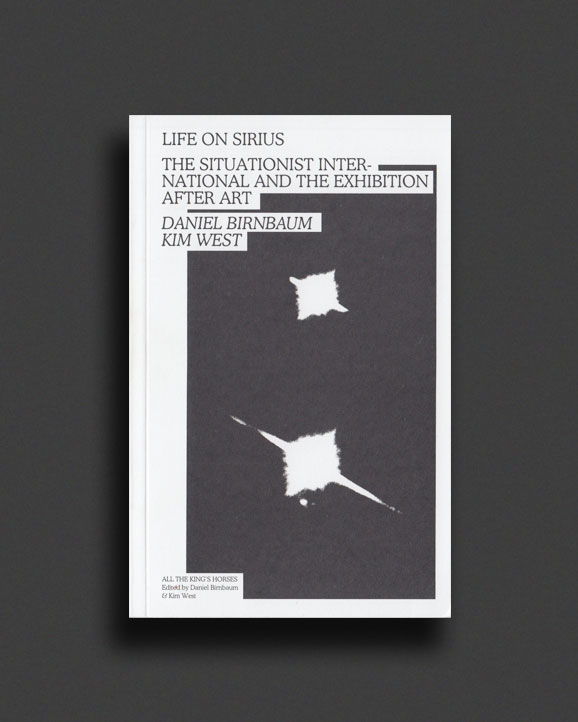
How did art escape the deadlock of the Situationists’ anti-art refusal? Did the relational artists, with their repetitions of Situationist slogans and techniques, outline a sustainable, micro-political alternative to Guy Debord’s dream of surpassing art and realizing philosophy? Looking back at some of the Situationists’ confrontations with the museum, this book traces a path beyond the tragedy of negativity and the litany of recuperation. At the center is the concept of play; originally adopted as the principle of reconciled life, it returns as the lever of instrumentalization. But in the extraterrestial wasteland of the present, spaces of ludic coexistence and experimentation may remain possible, provided that pessimism can be adequately organized.
All the King’s Horses Series, edited by Daniel Birnbaum and Kim West
Copublished with Moderna Museet, Stockholm
Design by Studio Christopher West
Now out of print.
1987, Japanese
Softcover, 36 pages, 22 x 29 cm
1st Edition, Out of print title / used / very good
Published by
Street Editorial Office / Tokyo
$55.00 - Out of stock
Very early 1987 issue of the iconic STREET magazine from Japan. No. 9 April 1987 shot in London.
Every issue of STREET is entirely comprised of photographs by legendary Japanese street style photographer Shoichi Aoki. Aoki, a wallflower of the most fashionable events, districts and gatherings, is celebrated for turning his camera away from the stage and into the crowd, documenting the incredible, fleeting outfits of the people in the markets, the streets, the catwalk audience, the after parties, amongst which are many familiar designers, models, editors, musicians, artists, and who knows who?... Aoki's Street (and later also Fruits) are essential style goldmines, creating valuable photographic documents of the times like no other magazine. A timeless reference.
Very Good copy, lightest of wear.
1990, Japanese
Softcover, 36 pages, 22 x 29 cm
1st Edition, Out of print title / used / very good
Published by
Street Editorial Office / Tokyo
$55.00 - Out of stock
1990 issue of the iconic STREET magazine from Japan. No. 26 February 1990, shot in London.
Every issue of STREET is entirely comprised of photographs by legendary Japanese street style photographer Shoichi Aoki. Aoki, a wallflower of the most fashionable events, districts and gatherings, is celebrated for turning his camera away from the stage and into the crowd, documenting the incredible, fleeting outfits of the people in the markets, the streets, the catwalk audience, the after parties, amongst which are many familiar designers, models, editors, musicians, artists, and who knows who?... Aoki's Street (and later also Fruits) are essential style goldmines, creating valuable photographic documents of the times like no other magazine. A timeless reference.
Very Good copy, lightest of wear.
2006, English / French
Softcover, 192 pages, 24.5 x 17.5 cm
1st Edition, Out of print title / as new
Published by
HYX / France
$480.00 - Out of stock
Almost non-existent first edition of this immediately out-of-print and only English-language monograph on Archizoom Associati, written and compiled by founding member Andrea Branzi.
Considered the leading antagonists of Italian Radical Design, Archizoom Associati was founded in 1966 in Florence, Italy by architecture students Andrea Branzi, Gilberto Corretti, Paolo Deganello and Massimo Morozzi. Archizoom organized their first exhibition, "Superarchitettura", in December 1966 along with the group Superstudio.
In 1969, the Archizoom group, while carrying out an experimental work in the field of design, also undertook a research on environment, mass culture and the city, which led to the project No-Stop City.
Gathering all the texts and drawings/models/documents, this book reveals to us the "Endless City" intertwining architecture with objects and the triumphant consumer society, giving an interpretation where the repetition of a single central element, a building or a group of objects makes up, through a play of mirrors, a catatonic environment, a boundless supermarket, a now reached future to be composed.
No-Stop City is a quality-less city in which the individual can achieve his own housing conditions as a creative, freed and personal activity. The theoretical project was first published in the review Casabella in 1970, under the title: "City, assembly line of social issues, ideology and theory of the metropolis". As Andrea Branzi puts it, this project implements "the idea of the fading away of architecture within metropolis".
No-Stop City is a critical Utopia, a model of global urbanization where design is the essential conceptual instrument used in the mutation of living patterns and territories.
As essential work in the history of radical architecture, this unbuilt project is here presented in its entirety through the original models, designs, collages, drawings and photographs, accompanied by the original texts by Archizoom Associati translated to English and French for the first time, and presented with introduction by editor Gloria Bianchino and a major illustrated essay by Andrea Branzi, all in English/French.
As New copy.
2020, English
Softcover, 128 pages, 14.8 × 21 cm
Published by
Mousse / Milan
K.M Kunstverein / Munich
$25.00 - Out of stock
This is a reprint of Pati Hill’s 1979 book published on occasion of her first posthumous solo exhibition, Something other than either, at Kunstverein München on view from March through August 2020. The book is composed of images and texts by Hill through which she intended to contextualize and explain her working methodology to Jill Kornblee, her New York gallerist. Untrained as an artist, Pati Hill began to use the photocopier as an artistic tool in the early 1970s, leaving behind an extensive oeuvre that oscillates between image and text. Besides this comprehensive body of xerographic work, she published four novels, a memoir, several short stories, wrote poetry, and made drawings. Instead of an exhibition catalog that would offer an interpretation of her work, this publication provides space for Hill’s own writing that interrogates and accompanies her visual work.
2020, English
Hardcover (w. dust jacket), 224 pages, 14 x 21 cm
Published by
Verso / London
$39.00 - Out of stock
If farce follows tragedy, what follows farce? Where does the double predicament of a post-truth and post-shame politics leave artists and critics on the left? How to demystify a hegemonic order that dismisses its own contradictions? How to belittle a political elite that cannot be embarrassed, or to mock party leaders who thrive on the absurd? How to out-dada President Ubu? And, in any event, why add outrage to a media economy that thrives on the same? What Comes After Farce? comments on shifts in art, criticism, and fiction in the face of the current regime of war, surveillance, extreme inequality, and media disruption. A first section focuses on the cultural politics of emergency since 9/11, including the use and abuse of trauma, paranoia, and kitsch.
A second reviews the neoliberal makeover of art institutions during the same period. Finally, a third section surveys transformations in media as reflected in recent art, film, and fiction. Among the phenomena explored here are “machine vision” (images produced by machines for other machines without a human interface),“operational images” (images that do not represent the world so much as intervene in it), and the algorithmic scripting of information so pervasive in our everyday lives.
Hal Foster is the author of numerous books, including The Art-Architecture Complex (Verso, 2011), The First Pop Age: Painting and Subjectivity in the Art of Hamilton, Lichtenstein, Warhol, Richter, and Ruscha (Princeton, 2012), Bad New Days: Art, Criticism, Emergency (Verso, 2015), and, with Richard Serra, Conversations about Sculpture (Yale, 2018). A member of the American Academy of Arts and Sciences, he delivered the 2018 Mellon Lectures at the National Gallery in Washington. He teaches at Princeton University, co-edits the journal October, and contributes regularly to the London Review of Books.
2017, English
Softcover, 208 pages, 14.2 x 21.3 cm
Published by
Verso / London
$35.00 - In stock -
One of the world’s leading art theorists dissects a quarter century of artistic practice.
Bad New Days examines the evolution of art and criticism in Western Europe and North America over the last twenty-five years, exploring their dynamic relation to the general condition of emergency instilled by neoliberalism and the war on terror.
Considering the work of artists such as Thomas Hirschhorn, Tacita Dean, and Isa Genzken, and the writing of thinkers like Jacques Rancière, Bruno Latour, and Giorgio Agamben, Hal Foster shows the ways in which art has anticipated this condition, at times resisting the collapse of the social contract or gesturing toward its repair; at other times burlesquing it.
Against the claim that art making has become so heterogeneous as to defy historical analysis, Foster argues that the critic must still articulate a clear account of the contemporary in all its complexity. To that end, he offers several paradigms for the art of recent years, which he terms “abject,” “archival,” “mimetic,” and “precarious.”
2020, English
Hardcover (w. dust jacket), 296 pages, 19.1 x 26 cm
Published by
Princeton University Press / New York
National Gallery of Art / Washington
$69.00 - Out of stock
How artists created an aesthetic of "positive barbarism" in a world devastated by World War II, the Holocaust, and the atomic bomb.
In Brutal Aesthetics, leading art historian Hal Foster explores how postwar artists and writers searched for a new foundation of culture after the massive devastation of World War II, the Holocaust, and the atomic bomb. Inspired by the notion that modernist art can teach us how to survive a civilization become barbaric, Foster examines the various ways that key figures from the early 1940s to the early 1960s sought to develop a "brutal aesthetics" adequate to the destruction around them.
With a focus on the philosopher Georges Bataille, the painters Jean Dubuffet and Asger Jorn, and the sculptors Eduardo Paolozzi and Claes Oldenburg, Foster investigates a manifold move to strip art down, or to reveal it as already bare, in order to begin again. What does Bataille seek in the prehistoric cave paintings of Lascaux? How does Dubuffet imagine an art brut, an art unscathed by culture? Why does Jorn populate his paintings with "human animals"? What does Paolozzi see in his monstrous figures assembled from industrial debris? And why does Oldenburg remake everyday products from urban scrap?
A study of artistic practices made desperate by a world in crisis, Brutal Aesthetics is an intriguing account of a difficult era in twentieth-century culture, one that has important implications for our own.
Published in association with the National Gallery of Art, Washington, DC.
2021, English
Softcover, 152 pages, 17.8 x 22.2 cm
Published by
Wesleyan University Press / US
$40.00 - Out of stock
2021 re-print of Simone Forti's classic, Handbook in Motion : An Account of an Ongoing Personal Discourse and Its Manifestations in Dance, originally published in 1974.
Tracing a period in her life from the 1969 Woodstock Festival through the following years living on the land, this singular dance artist's direct and poetic writings bring a turbulent transitional era to life.
Arriving in New York in the early 60's from California, she brought with her a series of pieces that proved to be a serious influence on the development of "postmodern" dance in years to come. Her "dance-constructions" were based on a concern with bodies in action, the movement not being stylized or presented for its visual line but rather as a physical fact. Combining drawings, "dance reports" (short descriptions of events whose movement made a deep impression on the author's memory), and documentary materials such as scores, descriptions, letters to colleagues, and photographic records of performances, Forti's eye toward creating idioms for exploring natural forms and behaviors is evident throughout.
Simone Forti shifted from painting in 1955 to study dance with Anna Halprin and went on to study composition with Robert Dunn at the Merce Cunningham Studio leading to her association with Judson Dance Theater in the '60s. Her work spans from early minimalist dance-constructions, through animal movement studies, news animations, land portraits, and currently, Logomotion, an improvisational form based on the resonance between movement and the spoken word. She performs and teaches worldwide.
1991, English / Dutch
Hardcover (cloth-bound), 47 pages, 24 x 34 cm
1st Edition, Out of print title / used / fine
Published by
The Renaissance Society / Chicago
Witte de With / Rotterdam
$60.00 - In stock -
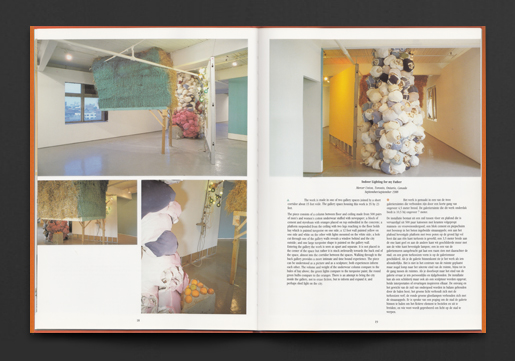
Approaching architectural space and scale with the formal inventiveness and speed common to gestural abstract painting, Stockholder took the art world by storm in the late 1980s.
The first half of the catalog chronicles Stockholder's installations from 1983–1991 in 35 beautiful color plates. Accompanying the reproductions are short descriptions, authored by the artist, addressing the architectural and material choices of each installation. The second half of the catalogue contains John Miller's essay "Formalism and Its Other", which keenly places Stockholder's activity somewhere between the rigorous formalism of Clement Greenberg's critical writing and the liberating potential of Allan Kaprow's Happenings.
Published in conjunction with the Witte de With Center for Contemporary Art, Rotterdam; text in Dutch and English
1974, English
Softcover, 152 pages, 17.8 x 22.2 cm
1st Edition, Out of print title / used / average
Published by
The Press of the Nova Scotia College of Art and Design / Halifax
$140.00 - Out of stock
Rare first 1974 edition of Simone Forti's first wonderful monograph/artist's book, Handbook in Motion : An Account of an Ongoing Personal Discourse and Its Manifestations in Dance.
Tracing a period in her life from the 1969 Woodstock Festival through the following years living on the land, this singular dance artist's direct and poetic writings bring a turbulent transitional era to life.
Arriving in New York in the early 60's from California, she brought with her a series of pieces that proved to be a serious influence on the development of "postmodern" dance in years to come. Her "dance-constructions" were based on a concern with bodies in action, the movement not being stylized or presented for its visual line but rather as a physical fact. Combining drawings, "dance reports" (short descriptions of events whose movement made a deep impression on the author's memory), and documentary materials such as scores, descriptions, letters to colleagues, and photographic records of performances, Forti's eye toward creating idioms for exploring natural forms and behaviors is evident throughout.
Simone Forti shifted from painting in 1955 to study dance with Anna Halprin and went on to study composition with Robert Dunn at the Merce Cunningham Studio leading to her association with Judson Dance Theater in the '60s. Her work spans from early minimalist dance-constructions, through animal movement studies, news animations, land portraits, and currently, Logomotion, an improvisational form based on the resonance between movement and the spoken word. She performs and teaches worldwide.
Good ex-libris copy but with few associated markings, including sticker to front cover and library return slip-pocket inside. Otherwise very clean throughout, no notes, light tanning to edges.
2011, English
Hardcover (w. dust jacket), 296 pages, 21 x 26 cm
Published by
Siglio Press / Los Angeles
$88.00 - Out of stock
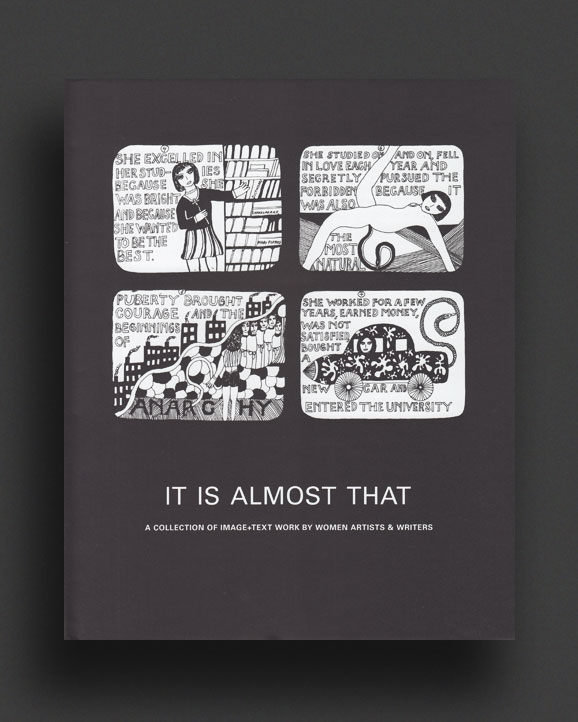
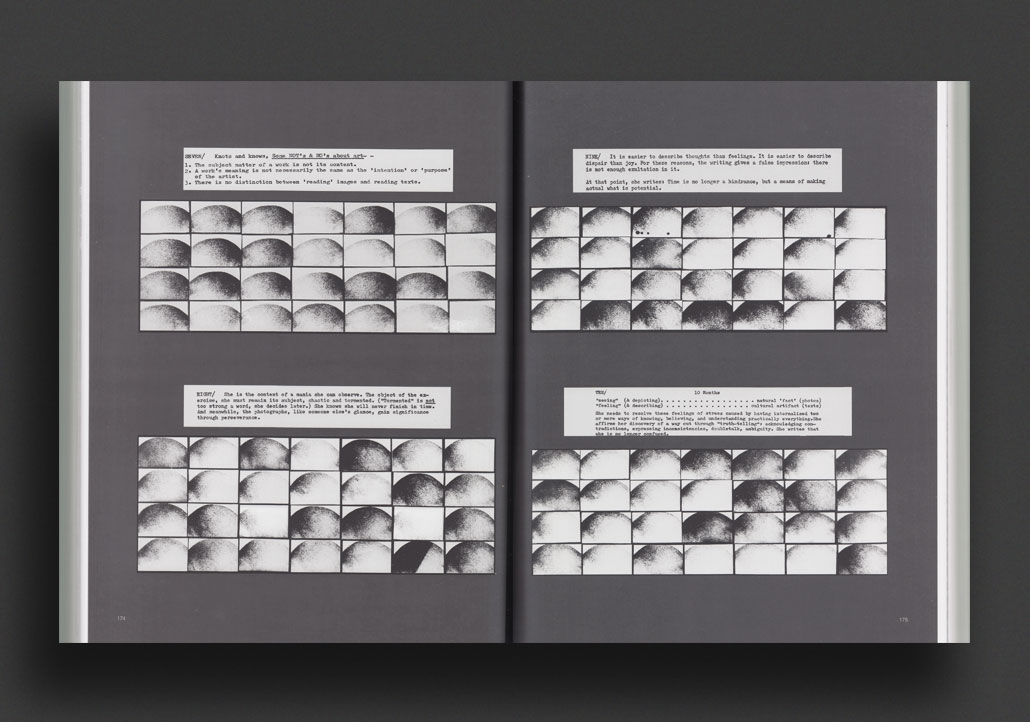
It Is Almost That collects is a phenomenal collection of twenty-six visionary image+text works by women artists and writers. Supremely imaginative in their use of word and image, these hybrid works are steeped in narrative play and subversion, inviting readers to engage in multiple modes of reading. It Is Almost That features substantial excerpts or the works in their entirety—many previously unpublished, difficult to find, or long out-of-print—by renown, little known, forgotten, and emerging artists.
The works include a painted autobiographical novel by a young artist who died in the Holocaust (Charlotte Salomon); the transformation of the front pages of newspapers into alchemical drawings (Suzanne Treister); a computer-generated chance operation that “imagines” houses and their inhabitants (Alison Knowles); the pseudo-scientific examination of mother-daughter conversations (Eleanor Antin); and drawings called “body maps,” inscribed with stories of HIV-positive South African women (Bambanani Women’s Group), among almost two dozen others.
Arranged as a constellation with various kinds of connective tissue, It Is Almost That eschews traditional categories in order to reorient the reader to see the works outside or beyond their recognizable affiliations. Both literary and art audiences will discover new works, new artists and writers, as well as new ways of reading.
"Because the frame is image+text, we’re reminded that all of us generally do more. Female artists don’t just stay in their disciplines; we experience, we forage, we play. Intuitively and practically speaking, It Is Almost That is, in effect, a handbook. It, by presenting female art history, shows us how to be an artist."—EILEEN MYLES, The Poetry Foundation
CONTRIBUTORS: Eleanor Antin, Bambanani Women’s Group, Fiona Banner, Louise Bourgeois, Theresa Hak Kyung Cha, Cozette de Charmoy, Ann Hamilton, Jane Hammond, Susan Hiller, Dorothy Iannone, Bhanu Kapil & Rohini Kapil, Helen Kim, Alison Knowles, Ketty La Rocca, Bernadette Mayer, Adrian Piper, Charlotte Salomon, Geneviéve Seillè, Molly Springfield, Cole Swensen & Shari DeGraw, Suzanne Treister, Erica Van Horn & Laurie Clark, Carrie Mae Weems, Hannah Weiner, Sue Williams, and Unica Zürn.
2014, English
Softcover, 54 pages, 14 x 20.1 cm
Published by
Tuumba Press / Berkeley
$32.00 - Out of stock
Third revised edition of Devotional Cinema by Nathaniel Dorsky, an exploration into the language of film, reprised from a lecture on religion and cinema delivered at Princeton University. Dorsky (b. New York City, 1943) is an American experimental filmmaker and film editor who has been making and exhibiting films within the avant-garde tradition since 1964. In his book Devotional Cinema (first published in 2003), Dorsky writes of the long-standing link between art and health as well as the transformative potential of watching film.
For film to have a devotional quality both absolute and relative time must be active and present — not only present but functioning simultaneously and invigorating one another. Transformative film rests in the present and respects the delicate details of its own unfolding.
Preface to the third edition: Since the publication of the second edition of Devotional Cinema in 2005, I had the opportunity to teach a semester-long seminar at Princeton University entitled The Character of Space / Space as Character. In examining closely Carl Theodor Dreyer’s The Passion of Joan of Arc in this seminar, aspects of it became visible to me for the first time. I also used this opportunity to clarify a number of small points in other sections of the book. The publisher and I agreed that these additions and changes warranted a revised edition.
2020, English
Hardcover box (2 vols), 224 pages, 27.9 x 20.3 cm
1st Edition, Out of print title / as new
Published by
Atelier Editions / Los Angeles
$200.00 - Out of stock
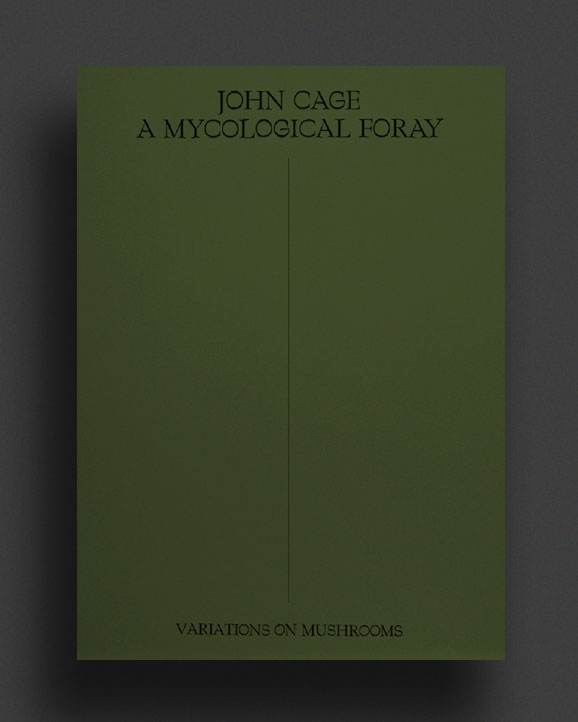
Sealed copy of this incredible, now out-of-print book, foraging for mushrooms with John Cage: writing, art, photography and ephemera from an idiosyncratic chapter in the composer's life.
Imagined as an extended mushroom-foraging expedition, John Cage: A Mycological Foray gathers together Cage’s mushroom-themed compositions, photographs, illustrations and ephemera. Indeterminacy Stories and other writings by Cage are interwoven throughout the first volume within a central essay examining Cage’s enduring relationship with mycology. Also included is a transcript of Cage’s 1983 performance, MUSHROOMS et Variationes. The second volume is the inaugural reproduction of Cage’s 1972 portfolio, Mushroom Book, authored in collaboration with illustrator Lois Long and botanist Alexander H. Smith. Readers are thus drawn through the landscape of Cage’s mycologically centred oeuvre and interests, discovering assorted works, images, compositions, philosophies and ephemera, as one might encounter assorted fungi and flora while foraging.
2011, English
Hardcover (w. dust jacket), 312 pages, 18.7 x 22 cm
Published by
Wesleyan University Press / US
$48.00 - Out of stock
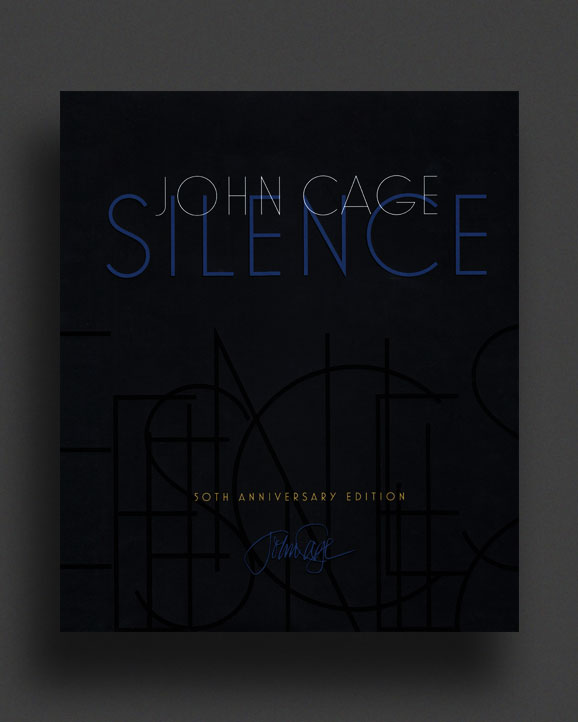
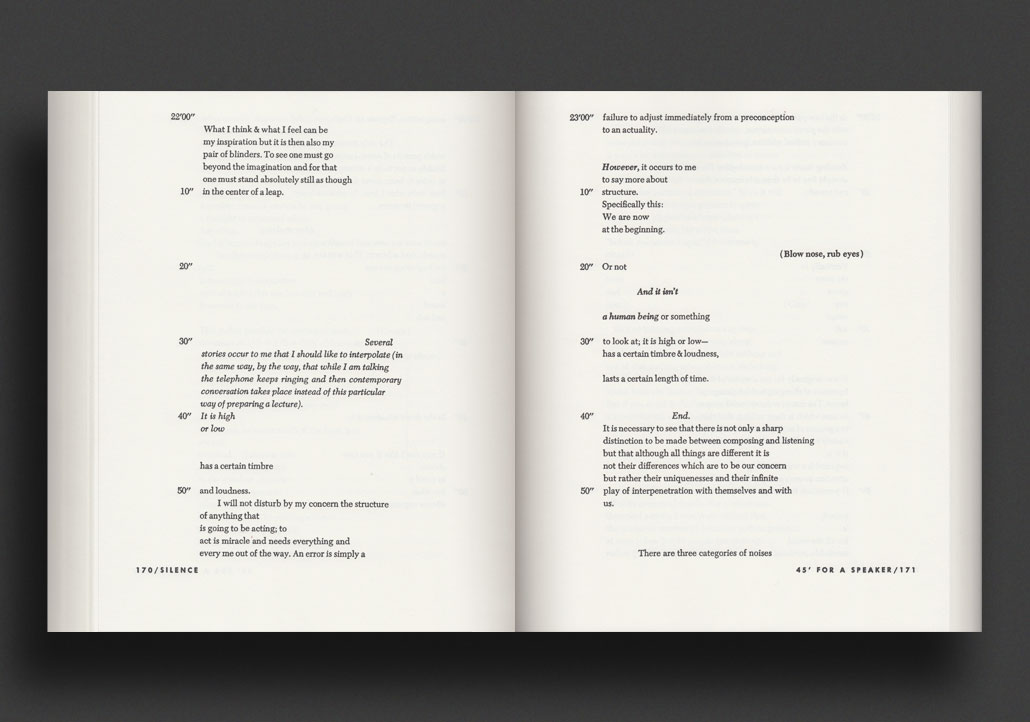
Silence, A Year from Monday, M, Empty Words and X (in this order) form the five parts of a series of books in which Cage tries, as he says, "to find a way of writing which comes from ideas, is not about them, but which produces them." Often these writings include mesostics and essays created by subjecting the work of other writers to chance procedures using the I Ching (what Cage called "writing through").
"There is no such thing as an empty space or an empty time. There is always something to see, something to hear. In fact, try as we may to make a silence, we cannot. Sounds occur whether intended or not; the psychological turning in direction of those not intended seems at first to be a giving up of everything that belongs to humanity. But one must see that humanity and nature, not separate, are in this world together, that nothing was lost when everything was given away."
John Cage is the outstanding composer of avant-garde music today. The Saturday Review said of him: "Cage possesses one of the rarest qualities of the true creator- that of an original mind- and whether that originality pleases, irritates, amuses or outrages is irrelevant." "He refuses to sermonize or pontificate. What John Cage offers is more refreshing, more spirited, much more fun-a kind of carefree skinny-dipping in the infinite. It's what's happening now." -The American Record Guide
2000, English
Hardcover (w. dust jacket), 72 pages, 24 x 21 cm
1st Edition, Out of print title / as new
Published by
Titan Books / London
$260.00 - Out of stock
Super collectible first, limited edition hardcover edition of the amazing "Blade Runner : The Inside Story," the first extensively illustrated book about the most influential sci-fi film ever made, published by the mighty Cinefex and Titan Books in 2000.
In 1982, to coincide with Blade Runner's original release, the highly respected movie magazine Cinefex devoted an entire, extended issue to the design and special effects of Ridley Scott's sci-fi masterpiece. Selling out immediately and in constant demand since, Cinefex and Titan Books brought this classic back into print, in an expanded, remastered hardcover edition in 2000. Not surprisingly, this first clothbound book edition, which was published in a limited edition, also went out of print quickly and has become a collectors item itself. It was later re-issued again in the more common 2003 edition.
Described as 'the single most comprehensive examination of Blade Runner's special effects', this must-have book contains scores of images not available elsewhere, as well as authoritative text, containing in-depth, exclusive interviews with director Ridley Scott, special effects supervisor Douglas Trumbull, legendary futurist/designer Syd Mead and dozens of other artists who contributed to this landmark film. This book is the definitive guide to the creation of Bladerunner's unsurpassed vision of the future, and a must for any fan.
Don Shay is the founder and publisher of Cinefex magazine.
Immaculate, unread, un-aged fine/as new copy.
2017, English
Softcover, 392 pages, 21 x 28 cm
Published by
Onomatopee / Eindhoven
$60.00 - Out of stock
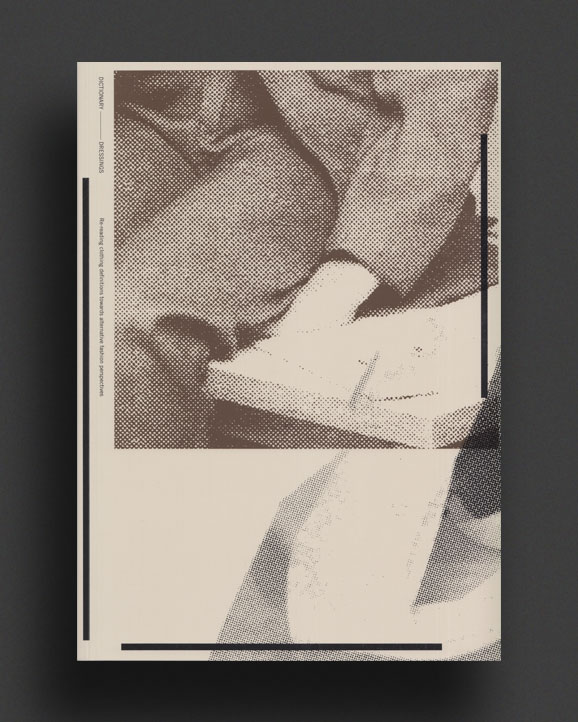
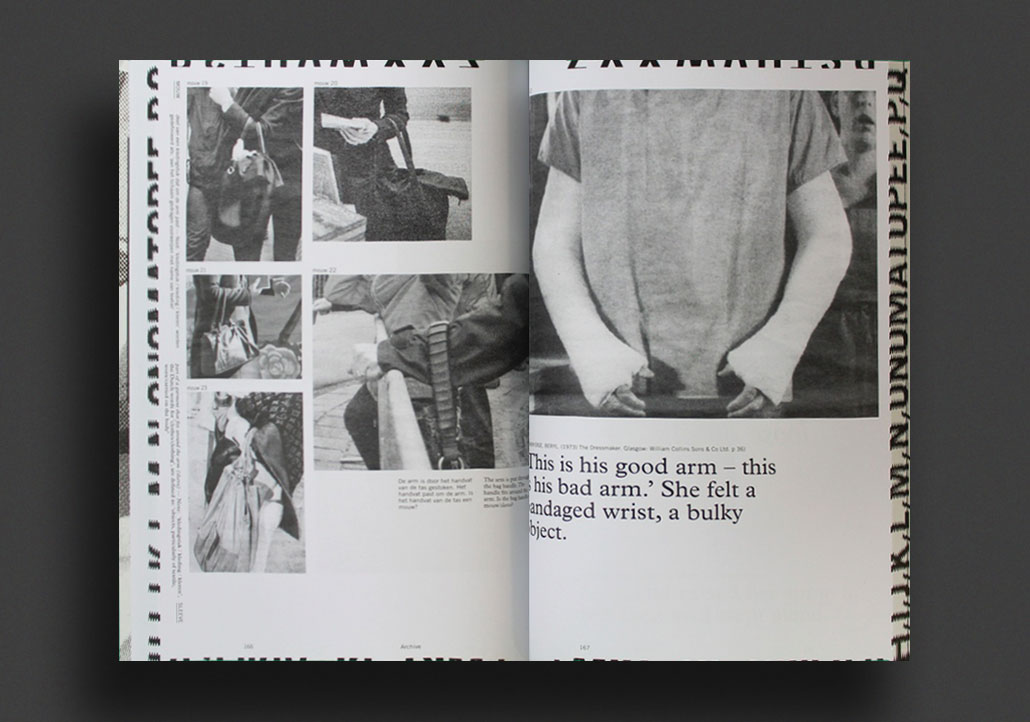
Dictionary Dressings is an ongoing research project by Femke de Vries that uses the nature of the dictionary definition as a "zero condition" for a piece of clothing to decode clothes and explore an alternative fashion vocabulary. Dictionary definitions are constructed to be factual and rational and as a consequence the entries for items of clothing show no reference to the ephemeral or immaterial character of fashion. They describe the characteristics of the items, their use and their relation to the body but never mention fashion or style. Take the Dutch definition of a glove for example: “Handschoen: bekleding van de hand” (literally translated into English as "Glove: covering of the hand"). Since a hand can be covered by putting it in a pocket, by bandaging it or by sitting on it, the definition allows a pair of trousers or a bandage to be interpreted as a glove – they cover the hand and so adhere to the definition. It is exactly this particular nature of the definitions of clothing that forms the foundation and very structure of Dictionary Dressings as a research project and an emerging design approach.
Designed by Hans Gremmen (of Fw:Books) and featuring Barbara Brownie, BLESS, Conny Groenewegen, Elisa van Joolen, Joke Robaard, Ruby Hoette and Students from the HKU (University of the Arts Utrecht) 2015–16.
2019, English
Softcover, 176 pages, 15.2 x 22.6 cm
Published by
Wonder / US
$39.00 - Out of stock
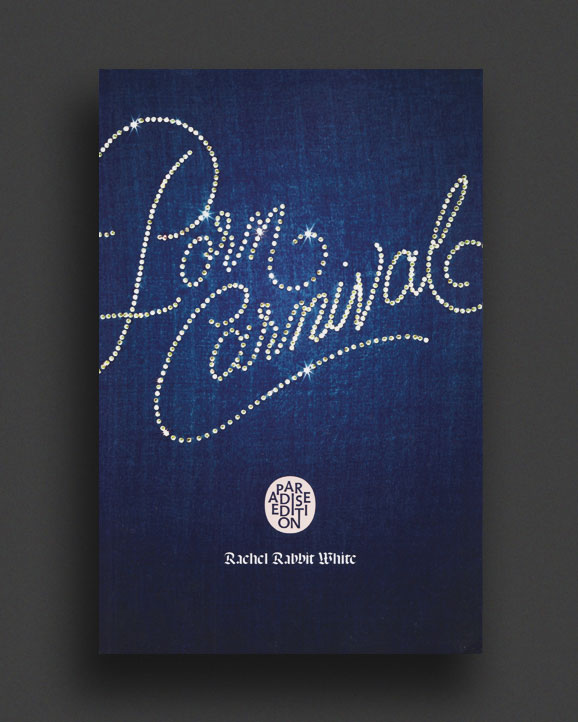
PORN CARNIVAL: PARADISE EDITION brings a new bonus series of love poems to Rachel Rabbit White's much-acclaimed debut collection, additional poems take readers through both the mournful distances of incarceration, overdoses, rehabs, sex and the blissed out quotidian dramas of falling in love.
In PORN CARNIVAL, the debut full-length collection by Rachel Rabbit White, hedonism and materialist critique join in an abject orgy of labor confessionals, group texts, and criminality. White's deliberate, dominating voice evokes a Plath-like dynamism turned on to queer pleasure and displeasure, indulgence and raison d'Ãatre, the bedevilments of a gay bitch on the pole.
Rachel Rabbit White is a state of being where beauty is crafted and exploded into new form of God. Vast violent ecstatic cumming Rachel has crafted a labyrinthine of poetic rumination resembling a heaven of sexy thorny sparking love.--Precious Okoyomon
Rachel Rabbit White's exquisite debut, PORN CARNIVAL, braids lumpen poetry and luxury communism into a delicate rope encircling its readers. Writing in the tradition of Edna St. Vincent Millay and Chelsey Minnis, White's poetics produce radical empathy for those who struggle in the margins and violently rejects the normalized oppression of status quo. Broken hearted but still turned on, PORN CARNIVAL is a book that keeps on going, bringing us a first collection that is truly 'poetry to impress the gods.'--Elaine Kahn
2021, English
Softcover, 200 pages, 11.4 x 17.8 cm
Published by
Semiotext(e) / Los Angeles
$32.00 - In stock -
Why we must reject the illusory consolations of technology and choose revolutiom over fascism.
We are living in apocalyptic times. In Capital Hates Everyone, famed sociologist Maurice Lazzarato points to a stark choice emerging from the magma of today's world events: fascism or revolution. Fascism now drives the course of democracies as they grow less and less liberal and increasingly subject to the law of capital. Since the 1970s, Lazzarato writes, capital has entered a logic of war. It has become, by the power conferred on it by financialization, a political force intent on destruction. Lazzarato urges us to reject the illusory consolations of a technology-abetted “new” kind of capitalism and choose revolution over fascism.
This offensive was made possible by the cycle of revolutions coming to an end. But while it was unfolding, critical thinking announced the suppression of social relations and the advent of a new capitalism, a milder one, more attentive to the comfort of workers. Today, the prophets of technology even boast of a solution to the climate crisis or an exit from capitalism by the very means of capital. In the face of these illusory consolations and the growing threat of fascism, Lazzarato argues it is urgent that we rediscover the meaning of strategic confrontations and the means of rebuilding a revolutionary war machine. Since capital hates everyone, everyone must hate capital.
Translated by Robert Hurley
Maurizio Lazzarato is a sociologist and philosopher in Paris. He is the author of Governing by Debt and Signs and Machines: Capitalism and the Production of Subjectivity, both published by Semiotext(e).
2021, English
Softcover, 96 pages, 15.2 x 20.5 cm
Published by
Afterall / London
The MIT Press / Massachusetts
$36.00 - Out of stock
Beverly Buchanan's Marsh Ruins (1981) are large, solid mounds of cement and shell-based tabby concrete, yet their presence has always been elusive. Hiding in the tall grasses and brackish waters of the Marshes of Glynn, on the southeast coast of Georgia, the Marsh Ruins merge with their surroundings as they enact a curious and delicate tension between destruction and endurance. This volume offers an illustrated examination of Buchanan's environmental sculpture, which exists in an ongoing state of ruination.
Amelia Groom illuminates Buchanan's vision of sculptural ruination, and probes her remarkable work in terms of ideas of witnessing, documentation, landscape, and cultural memory. Existing in dialogue with land art and postminimalist sculpture, the Marsh Ruins are nevertheless unique refusals of art world classifications and systems of value. Making abstract use of concrete forms, Buchanan's works embody their own stakes, from colonialism's legacies of fracture and dislocation, to the workings of weather and time. In the words of her own mother, Buchanan had always "seen things" in rocks that others didn't see.
Amelia Groom
Amelia Groom is an art historian and a postdoctoral Fellow at ICI Berlin Institute for Cultural Inquiry. Her writing on art has been published e-flux journal, Frieze, Art Agenda, and other publications. She edited Time, a volume in the Documents of Contemporary Art series (Whitechapel Gallery/MIT Press).
2019, English
Softcover, 221 pages, 23 x 18.2 cm
Published by
Sequence Press / New York
Radio Athènes / Greece
$65.00 - Out of stock
An encounter across time and space between Wols, a pioneering artist of the early twentieth century, and Eileen Quinlan, a contemporary American artist.
Wols (1913–1951) was celebrated posthumously as one of the pioneering artists of the Art Informel movement. His distinctive early photographic work of the 1930s is, however, very little known. In an unusual connection across time and space his work is discussed in relation to that of contemporary American artist Eileen Quinlan (b. 1972). This book, a companion to the exhibition Always Starts with an Encounter: Wols–Eileen Quinlan, curated by Helena Papadopoulos and organized by Radio Athènes at the Museum of Cycladic Art, Athens, in 2016, further explores the relationship between the work of the two artists.
Spectral and suggestive, but also precise and factual, through an indexical structure, a variety of textual forms and inflections, different registers of images and textures, this richly illustrated book reflects on a circular idea of time as it wanders in the abstruse physicality of the photographic. It includes texts by Olivier Berggruen, Quinn Latimer, Helena Papadopoulos, and Laura Preston, as well as two interviews with Eileen Quinlan.
2020, English
Softcover, 54 pages, 21.6 x 28 cm
Published by
Primary Information / New York
$44.00 - Out of stock
David Wojnarowicz’s In the Shadow of Forward Motion was originally published in 1989 as a limited-run zine/catalog to accompany an exhibition by the artist at P.P.O.W gallery.
Despite its meagre print run of just 50 copies, the publication has garnered a legendary status, and for good reason. In it we find Wojnarowicz’s writing and visual art—two mediums for which the artist is renowned—sitting side by side for the first time, playing off each other in equal measure. We glimpse the artist’s now-iconic mixed media works, with motifs of ants, locomotives, money, tornadoes, and dinosaurs, juxtaposed with journal entries and other texts that examine historical and global mechanisms of power symbolized through the technology of their times. Wojnarowicz uses the fractured experience of his day-to-day life (including dreams, which he recorded fastidiously) to expose these technologies as weapons of class, cultural, and racial oppression.
The artist’s experience living with HIV is a constant subject of the work, used to shed light on the political and social structures perpetuating discrimination against not only himself, but against women and people of color, who faced additional barriers in their efforts to receive treatment for the illness. Rooted in the maelstrom of 1980s art, politics, religion and civil rights, the book provides a startling glimpse into an American culture that we have not yet left behind.
Félix Guattari provides an introduction.
David Wojnarowicz (1954-1992) was born in Red Bank, New Jersey. Wojnarowicz channeled a vast accumulation of raw images, sounds, memories and lived experiences into a powerful voice that was an undeniable presence in the New York City art scene of the 1970s, 80s and early 90s. Through his several volumes of fiction, poetry, memoirs, painting, photography, installation, sculpture, film and performance, Wojnarowicz left a legacy, affirming art’s vivifying power in a society he viewed as alienating and corrosive. His use of blunt semiotics and graphic illustrations exposed what he felt the mainstream repressed: poverty, abuse of power, blind nationalism, greed, homophobia and the devastation of the AIDS epidemic. Wojnarowicz died of AIDS-related complications on July 22, 1992 at the age of 37.
2015, English / Spanish
Softcover, 267 pages, 13.2 x 20.1 cm
Published by
Sand Paper Press / Florida
$48.00 - Out of stock
As the Argentine economy went into freefall at the end of the last millennium, two young women—Fernanda Laguna and Cecilia Pavón—met and became friends. Fernanda, a painter and poet who also publishes fiction under the nom de plume Dalia Rosetti, and Cecilia, a poet and translator, soon forged the radically creative partnership now known as Belleza y Felicidad. As Belleza emerged into a movement and inspired a community, Fernanda and Cecilia broadcast its ethos—"a complete program of resistance," as César Aira once described it—through a prodigious output of poetry and fiction. Now a generous selection of this work is available in English for the first time. With an introduction by translator Stuart Krimko, this authoritative volume transmits the urgency and passionate feeling at the heart of one of the most exciting artistic and literary movements to emerge from South America in recent decades.
Translated from the Spanish by Stuart Krimko.
"BELLEZA Y FELICIDAD, both the place and the idea, live on in the irresistible pleasures of Cecilia's and Fernanda's poems and stories. Upon revisiting them now I find that they are in fact high-precision lenses for seeing the daily utopias of reality."—César Aira
"Fernanda Laguna and Cecilia Pavón are legendary writers, domesticating the world in order to make it the subject of their 'domestic' poetry. They are voracious and understand everything. Stuart Krimko's translations capture the totalizing effect of their writings beautifully."—Chris Kraus
"This book is a paradise of love. Eminent, charismatic, & frolicsome, it's also the magic transcription of a friendship, i.e. a romance (several!), the kind I spent my misspent youth envying in Montaigne & La Boetie. Ecstatics of childlike candor & polymorphous grace, Fernanda Laguna & Cecilia Pavón are absolute women, guileless dreamers, saints in sneakers, on sidewalks, in jail, in Zara, on buses, in nightclubs, in bed, about to turn 29, & 37, & 7. I can't wait for everyone in america to read this book & never be the same again."—Ariana Reines