World Food Books' programme is largely produced on Kulin Nation land. We acknowledge the Wurundjeri people of the Kulin Nation as the first and continuing custodians of this land, and pay respect to their Elders past, present, and emerging.
World Food Books is an arts and special interests bookshop in Naarm / Melbourne. Founded in 2010, World Food Books is devoted to the presentation of a rotating, hand-selection of international art, design, literary and counterculture publications with an emphasis on the anti-traditional, the experimental, the avant-garde, the heretic, the marginal.
Presenting new titles alongside rare and out-of-print books, catalogues and journals spanning the fields of modern and contemporary art, design, photography, illustration, film, literature, poetry, cultural theory, philosophy, sexuality, popular and underground culture in its many radical forms, World Food Books wishes to encourage adventurous, thoughtful and open-minded reading, looking, writing, and exchange of publishing and ideas, both current and historical.
As well as our bookshop, located in Melbourne's historical Nicholas Building, all of our inventory is available internationally via our online mail-order service.
World Food Books semi-regularly co-ordinates "Occasions", a programme of exhibits and events at the bookshop and in partnership with other hosts (such as museums and art galleries) that develop out of the activities, relationships and content of the bookshop itself.
World Food Books
The Nicholas Building
37 Swanston Street
Room 5, Level 6
Melbourne 3000
Australia
SHOP HOURS:
Thu–Fri 12–6, Sat 12–5
WEB-SHOP OPEN 24/7
World Food Books
Postal Address:
PO Box 435
Flinders Lane
Victoria 8009
Australia
Art
Theory / Essay
Architecture / Interior
Graphic Design / Typography
Photography
Fashion
Eros
LGBTQ+
Fiction / Poetry
Weird / Speculative / Science Fiction / Horror
Transgressive / Visceral / Abject
Symbolism / Decadence / Fin de siècle
Film / Video
Painting
Sculpture / Installation
Performance / Dance / Theater
Drawing
Sound / Music
Curatorial
Group Shows / Collections
Periodicals
Out-of-print / Rare
Posters / Ephemera / Discs
Signed Books
World Food Books Gift Voucher
World Food Book Bag
Australian Art
Australian Fiction
Australian Science Fiction / Speculative Fiction
Australian Poetry
Australian Photography
Japanese Photography
Conceptual Art
Minimal Art
Dada
'Pataphysics / Oulipo
Fluxus
Concrete Poetry
Pop Art
Surrealism
Arte Povera
Arte Informale / Haute Pâte / Tachism
Nouveau Réalisme / Zero / Kinetic
Situationism / Lettrism
Collage / Mail Art / Xerox Art
Art Brut / Folk / Visionary / Fantastic
Illustration / Graphic Art / Bandes Dessinées
Furniture
Italian Radical Design / Postmodernism
Textiles
Ceramics / Glass
Counterculture
Protest / Revolt
Philosophy
Psychoanalysis
Anthropology
Anarchism
Socialism / Anarchism / Communism / Capitalism
Literary Theory / Semiotics / Language
Feminism / Women's Studies
Gender Studies / Sexuality
Anthropology
Fetishism / BDSM
Drugs / Psychedelia
Crime / Violence
Animal Rights / Veganism
Occult / Esoterica
Ecology / Earth / Alternative Living
Whole Earth / Crafts
All prices in AUD (Australian dollars)
Pick-Ups
Pick-up orders can be collected in our bookshop during opening hours after order date. Please collect any Pick-up orders within 2 weeks of ordering as we have limited storage space. Orders will be released back into stock if not collected within this time. No refunds can be made for pick-ups left un-collected. If you cannot make it in to the bookshop in this time-frame, please choose postage option.
Return Policy
All sales are final. We do accept returns (for refund or exchange) for items received in error. All our orders are packed with special care using heavy-duty padding and cardboard book-mailers or bubble mailers (for smaller books), using reinforcement where required. We cannot take responsibility for any lost, stolen or damaged parcels.
Insurance
Should you wish to insure your package, please email us directly after placing your order and we can organise this at a small extra expense. Although all standard/express tracked packages are very safe and dependable, we cannot take responsibility for any lost, stolen or damaged parcels. We recommend insurance on valuable orders.
Interested in selling your old books, catalogues, journals, magazines, comics, fanzines, ephemera? We are always looking for interesting, unusual and out-of-print books to buy. We only buy books in our fields of interest and specialty, and that we feel we can resell.
We base these prices on desirability, market value, in-print prices, condition and our current stock levels. We offer cash, store credit, and can take stock on consignment. All
about 25% of the price we expect to get when we sell them, or 30% in store credit. We base these prices on desirability, market value, in-print prices, condition and our current stock levels.
Sell your books any day of the week. You can drop them off and return later. If you have a lot of books, we can visit your Sydney home.
We buy books that we feel we can resell. We offer about 25 % of the price we expect to get when we sell them, or 30% in store credit. We base these prices on desirability, market value, in-print prices, condition and our current stock levels.
Philadelphia Wireman
03 August - 01 September, 2018
World Food Books is proud to announce our next Occasion, the first presentation of sculptures by Philadelphia Wireman in Australia.
The Philadelphia Wireman sculptures were found abandoned in an alley off Philadelphia’s South Street on trash night in 1982. Their discovery in a rapidly-changing neighbourhood undergoing extensive renovation, compounded with the failure of all attempts to locate the artist, suggests that the works may have been discarded after the maker’s death. Dubbed the "Philadelphia Wireman" during the first exhibition of this work, in 1985, the maker’s name, age, ethnicity, and even gender remain uncertain. The entire collection totals approximately 1200 pieces, all intricately bound together with tightly-wound heavy-gauge wire (along with a few small, abstract marker drawings, reminiscent both of Mark Tobey and J.B. Murry). The dense construction of the work, despite a modest range of scale and materials, is singularly obsessive and disciplined in design: a wire armature or exoskeleton firmly binds a bricolage of found objects including plastic, glass, food packaging, umbrella parts, tape, rubber, batteries, pens, leather, reflectors, nuts and bolts, nails, foil, coins, toys, watches, eyeglasses, tools, and jewellery.
Heavy with associations—anthropomorphic, zoomorphic, and socio-cultural responses to wrapped detritus—the totemic sculptures by Philadelphia Wireman have been discussed in the context of work created to fulfil the shamanistic needs of alternative religions in American culture. Curators, collectors, and critics have variously compared certain pieces to sculpture from Classical antiquity, Native American medicine bundles, African-American memory jugs, and African fetish objects. Reflecting the artist’s prolific and incredibly focused scavenging impulse, and despite—or perhaps enhanced by—their anonymity, these enigmatic objects function as urban artefacts and arbiters of power, though their origin and purpose is unknown. Philadelphia Wireman, whatever their identity, possessed an astonishing ability to isolate and communicate the concepts of power and energy through the selection and transformation of ordinary materials. Over the course of the past two decades, this collection has come to be regarded as an important discovery in the field of self-taught art and vernacular art.
Presented in collaboration with Fleisher-Ollman Gallery, Philadelphia, and Robert Heald, Wellington.
Susan Te Kahurangi King
02 February - 10 March, 2018
Susan Te Kahurangi King (24 February 1951 - ) has been a confident and prolific artist since she was a young child, drawing with readily available materials - pencils, ballpoint pens and felt-tip markers, on whatever paper is at hand. Between the ages of four and six Susan slowly ceased verbal communication. Her grandparents William and Myrtle Murphy had developed a special bond with Susan so they took on caring responsibilities for extended periods. Myrtle began informally archiving her work, carefully collecting and storing the drawings and compiling scrapbooks. No drawing was insignificant; every scrap of paper was kept. The King family are now the custodians of a vast collection containing over 7000 individual works, from tiny scraps of paper through to 5 meter long rolls.
The scrapbooks and diaries reveal Myrtle to be a woman of great patience and compassion, seeking to understand a child who was not always behaving as expected. She encouraged Susan to be observant, to explore her environment and absorb all the sights and sounds. Myrtle would show Susan’s drawings to friends and people in her community that she had dealings with, such as shopkeepers and postal workers, but this was not simply a case of a grandmother’s bias. She recognised that Susan had developed a sophisticated and unique visual language and sincerely believed that her art deserved serious attention.
This was an unorthodox attitude for the time. To provide some context, Jean Dubuffet coined the term Art Brut in 1945 to describe work created by self-taught artists – specifically residents of psychiatric institutions and those he considered to be visionaries or eccentrics. In 1972 Roger Cardinal extended this concept by adopting the term Outsider Art to describe work made by non-academically trained artists operating outside of mainstream art networks through choice or circumstance. Susan was born in Te Aroha, New Zealand in 1951, far from the artistic hubs of Paris and London that Dubuffet and Cardinal operated in. That Myrtle fêted Susan as a self-taught artist who deserved to be taken seriously shows how progressive her attitudes were.
Susan’s parents Doug and Dawn were also progressive. Over the years they had consulted numerous health practitioners about Susan’s condition, as the medical establishment could not provide an explanation as to why she had lapsed into silence. Dawn educated herself in the field of homeopathy and went on to treat all twelve of her children using these principles – basing prescriptions on her observations of their physical, mental and emotional state.
Doug was a linguist with an interest in philosophy who devoted what little spare time he had to studying Maori language and culture. To some extent their willingness to explore the fringes of the mainstream made them outsiders too but it was their commitment to living with integrity and their respect for individuality that ensured Susan’s creativity was always encouraged.
Even though Susan’s family supported her artistic pursuits, some staff in schools and hospitals saw it as an impediment to her assimilation into the community and discouraged it in a variety of ways. Her family was not always aware of this and therefore did not fully understand why Susan stopped drawing in the early 1990s. However, rather than dwell on the challenges that Susan faced in pursuit of her artistic practice, they prefer to highlight her achievements. In 2008 Susan began drawing again in earnest, after an almost 20 year interruption, and her work is now shown in galleries around the world.
Susan grew up without television and has been heavily influenced by the comics she read as a child. She is absolutely fearless in the appropriation of recognizable characters, such as Donald Duck and Mickey Mouse, in her work. She twists their limbs, contorts their faces, compresses them together, blends them into complex patterned backgrounds - always imbuing them with an incredible energy. Although Susan often used pop culture characters in her work they are not naive or childlike. These are drawings by a brilliant self-taught artist who has been creating exceptional work for decades without an audience in mind.
Mladen Stilinović
"Various Works 1986 - 1999"
02 February 16 - September 10, 2016
Various works 1986 - 1999, from two houses, from the collections of John Nixon, Sue Cramer, Kerrie Poliness, Peter Haffenden and Phoebe Haffenden.
Including: Geometry of Cakes (various shelves), 1993; Poor People’s Law (black and white plate), 1993; White Absence (glasses, ruler, set square, silver spoon, silver ladel with skin photograph and wooden cubes), 1990-1996; Exploitation of the Dead (grey and red star painting, wooden painting, black spoon with red table, red plate), 1984-1990; Money and Zeros (zero tie, paintings made for friends in Australia (Sue, John, Kerrie), numbers painting), 1991-1992; Words - Slogans (various t-shirts) - “they talk about the death of art...help! someone is trying to kill me”, “my sweet little lamb”, “work is a disease - Karl Marx”; Various artist books, catalogues, monographs, videos; Poster from exhibition Insulting Anarchy; "Circular" Croatian - Australian edition; Artist book by Vlado Martek (Dostoyevsky); more.
Thanks to Mladen Stilinović and Branka Stipančić.
Jonathan Walker
Always Will Need To Wear Winter Shirt Blue + Ochre Small Check Pattern
21 August - 21 September, 2015
Untitled
I am not a great reader of poetry but I always return to the work of Melbourne poet, Vincent Buckley (1925- 1988). Perhaps I find his most tantalising piece to be not a finished poem but a fragment left on a scrap of paper discovered on his desk after the poet’s death.
The poetry gathers like oil
In the word-core, and spreads
It has its music meet,
Its music is in movement.
This fragment is more the shell left behind from a volatile thought than a finished poem. I find the last two lines honest but awkward whereas the first two lines work like an arrow. Most likely he could not find a resolution so it was left. Still, in its present form, it remains an eloquent testimony to the ultimate failure of a medium to express mobile thought and sensation, in Buckley’s case, through verbal language. It’s an important matter because this is something all artists have to deal with regardless of the medium.
I have never written a poem, however, I am forever copying fragments from books on paper scraps in a vain effort to fix certain notions in my head. At first, they function as bookmarks that are sometimes returned to when I open the book. But before long, as they accumulate, they fall out littering the table interspersed with A4 photocopies, bills, books and medications.
To return to Buckley’s fragment, the first two lines very much evoke how I paint nowadays. As you age, detail diminishes and patches of light become more luminous and float. I feel the most honest way of dealing with this is by smearing the oil paint on the canvas with the fingers and working close-up, blind. Only if the patches coalesce into an approaching image can the work gain a life.
-
Jonathan Walker was born in Melbourne, Australia and brought up on a dairy farm in Gippsland. In the 1970’s he studied painting at RMIT and won the Harold Wright Scholarship to the British Museum, London. During the 1980’s he exhibited at Pinacotheca Gallery, Richmond and had work shown at the NGV and Heidi City Art Gallery. Over the same period he designed the cover for the “Epigenesi” LP by Giancarlo Toniutti, Italy and conducted a mail exchange work with Achim Wollscheid, Germany. The work with artists through the post resulted in an article published in the bicentenary issue of Art and Australia 1988. He showed in artist run spaces such as WestSpace in the 90’s and 2000’s, and until 2012, taught painting at Victoria University, which is where we (Colleen Ahern and Lisa Radford) as organisers of the exhibition, among many others, had the privilege of being his student.
Walker’s knowledge was imparted to students through the careful selection of music, literature, and artists found in books that he himself had ordered for the library. Walker’s strategy was the generosity of sharing his vast knowledge with references specific to each student and their context.
Walker’s paintings share a similar focus and intimacy.
This exhibition presents a small selection of recent paintings alongside a publication that includes Walker’s writing. Observational and analytical, Walker’s work is a type of material notation — the time of day, colour and how it is blended, the both specific and fleeting location of a reflection on lino or the question of whether a chair leg should be included in a painting.
Please join us on Friday August 21 between 6-8pm to celebrate the opening of the exhibition.
Curated by Colleen Ahern and Lisa Radford.
B. Wurtz
Curated by Nic Tammens
March 26 - April 4, 2015
B.Wurtz works from a basement studio in his home on Manhattan’s Lower East Side.
This local fact is attested to by the plastic shopping bags and newsprint circulars that appear in his work. As formal objects, they don’t make loud claims about their origins but nonetheless transmit street addresses and places of business from the bottom of this long thin island. Like plenty of artists, Wurtz is affected by what is local and what is consumed. His work is underpinned by this ethic. It often speaks from a neighborhood or reads like the contents of a hamper:
“BLACK PLUMS $1.29 lb.”
“Food Bazaar”
“USDA Whole Pork Shoulder Picnic 99c lb.”
“RITE AID Pharmacy, with us it’s personal.”
“H. Brickman & Sons.”
“Sweet Yams 59c lb."
Most of the work in this exhibition was made while the artist was in residence at Dieu Donne, a workshop dedicated to paper craft in Midtown. Here Wurtz fabricated assemblages with paper and objects that are relatively lightweight, with the intention that they would be easily transportable to Australia. This consideration isn’t absolute in Wurtz’s work, but was prescriptive for making the current exhibition light and cheap. Packed in two boxes, these works were sent from a USPS post office on the Lower East Side and delivered to North Melbourne by Australia Post.
Wurtz appears courtesy of Metro Pictures, New York.
Thanks to Rob Halverson, Joshua Petherick, Sari de Mallory, Matt Hinkley, Helen Johnson, Fayen d'Evie, Ask Kilmartin, Lisa Radon, Ellena Savage, Yale Union, and "Elizabeth".
John Nixon
"Archive"
December 15 - January 20, 2014
The presentation of John Nixon's archive offered a rare showcase of this extensive collection of the artist's own publications, catalogues, posters, ephemera, editions and more, from the mid 1980s onwards, alongside a selection of his artworks.
Organized by John Nixon, Joshua Petherick and Matt Hinkley.
<a href=http://wfb.public-office.info/artist/john-nixon>All titles by John Nixon
"Habitat"
at Minerva, Sydney (organised by Joshua Petherick and Matt Hinkley)
November 15 - December 20, 2014
Lupo Borgonovo, Janet Burchill & Jennifer McCamley,
Lewis Fidock, HR Giger, Piero Gilardi, Veit Laurent Kurz,
Cinzia Ruggeri, Michael E. Smith, Lucie Stahl, Daniel Weil, Wols
Press Release:
“...It contained seven objects. The slender fluted bone, surely formed for flight, surely from the wing of some large bird. Three archaic circuitboards, faced with mazes of gold. A smooth white sphere of baked clay. An age-blackened fragment of lace. A fingerlength segment of what she assumed was bone from a human wrist, grayish white, inset smoothly with the silicon shaft of a small instrument that must once have ridden flush with the surface of the skin - but the thing’s face was seared and blackened.”
William Gibson, “Count Zero”, 1986
"Autumn Projects Archive"
Curated by Liza Vasiliou
March 6 - March 15, 2014
World Food Books, in conjunction with the Virgin Australia Melbourne Fashion Festival 2014, presented the Autumn Projects archive, consisting of a selection of early examples in Australian fashion with a particular interest in collecting designers and labels from the period beginning in the 1980’s, who significantly influenced the discourse of Australian Fashion.
Curated by Liza Vasiliou, the exhibition provided a unique opportunity to view pieces by designers Anthea Crawford, Barbara Vandenberg, Geoff Liddell and labels CR Australia, Covers, Jag along with early experimental collage pieces by Prue Acton and Sally Browne’s ‘Fragments’ collection, suspended throughout the functioning World Food Books shop in Melbourne.
H.B. Peace
presented by CENTRE FOR STYLE
November 14, 2013
"Hey Blinky, you say chic, I say same"
Anon 2013
H.B. Peace is a clothing collaboration between great friends Blake Barns and Hugh Egan Westland. Their pieces explore the divergences between 'character’ and ‘personality’ in garments....etc
Special Thanks to Joshua Petherick and Matt Hinkley of WFB and Gillian Mears
and a Very Special Thank you to Audrey Thomas Hayes for her shoe collaboration.
Janet Burchill & Jennifer McCamley
"Aesthetic Suicide"
May 10 - June 8, 2013
The first of our occasional exhibitions in the World Food Books office/shop space in Melbourne, "Aesthetic Suicide" presented a body of new and older works together by artists Janet Burchill & Jennifer McCamley, including videos, prints, a wall work, and publications.
During shop open hours videos played every hour, on the hour.
2019, English
Softcover (elastic band bound in bag), 176 loose-leaf pages, 20 x 14.5 cm
Ed. of 150,
Published by
Warehouse / Amsterdam
$23.00 - Out of stock
Published in a hand-numbered edition of 150 copies, A Magazine Reader is the result of a workshop in which a fashion magazine is dissected, critically analyzed from various perspectives and put together again in an alternative form. The material from the magazine is used to create a new zine that gives insight into the cultural power and forms of value production that's at the core of fashion media.
A Magazine Reader 02 dissects British Vogue November 2018
A Magazine Reader is a Warehouse production initiated by Hanka van der Voet and Femke de Vries as part of their individual researches into fashion media and language in fashion (Press&Fold magazine and Garment Grammar).
Hanka van der Voet is Head of the MA Fashion Strategy at ArtEZ in Arnhem, and works as an independent researcher, writer and curator. Her current research is focused on the editorial practices of niche/independent/alternative fashion magazines. She is the founder of Press & Fold magazine and one of the founders of Warehouse. www.pressandfoldmagazine.com
The content is developed by MA Fashion Strategy students of ArtEZ Gen#28; Emma Disbergen, Laura Lisa Fernandes Januario, Eva Kühn, Boris Kollar, Kartijn Krijger, Nicole Dekkers, Andrea Chehade, Denise Bernts, Bobbine Berden, Mariane Cortez Meirelles. With guest lectures by Elisa van Joolen and Chet Bugter.
This is a Warehouse production For ArtEZ Fashion Masters, MA Fashion Strategy
Designed by Corine van der Wal In collaboration with risowiso & WALTER books
1971, English
Softcover, 60 pages, 27.9 x 30 cm
1st Edition, Out of print title / used / very good
Published by
NGV (National Gallery of Victoria) / Victoria
$50.00 - Out of stock
Catalogue published on the occasion of the major Australian touring exhibition of Italian Painting staged by The Quadriennale Nazionale d'Arte di Roma. Features the work of Afro Basaldella, Renato Birolli, Alberto Burri, Corrado Cagli, Giuseppe Capogrossi, Bruno Cassinari, Leonardo Cremonini, Piero Dorazio, Lucio Fontana, Franco Gentilini, Giuseppe Guerreschi, Renato Guttuso, Osvaldo Licini, Alberto Magnelli, Mattia Moreni, Ennio Morlotti, Fausto Pirandello, Enrico Prampolini, Mauro Reggiani, Atanasio Soldati, Renzo Vespignani. Each artist profiled with multiple examples of their work in colour and b/w, biography, and large bibliography closing the catalogue.
Very Good copy. A few small scratches to cover, edge tanning.
2019, English
Softcover, 84 pages, 16.5 x 23.4 cm
Published by
Goldsmiths Press / London
$28.00 - Out of stock
Y'HUP presents items from the Ivor Cutler archive to accompany the exhibition Ivor Cutler: Good morning! How are you? Shut up! The Goldsmiths Centre for Contemporary Art exhibition pulls from the Cutler archive to present original musical scores, lyrics, sketches, artworks, letters, press cuttings, and posters, gathered to celebrate Cutler’s life and work, many of which have never been previously exhibited or published. Features an essay by Dan Fox, co-editor of frieze magazine and author of Pretentiousness: Why it Matters and Limbo, both published by Fitzcarraldo Editions, plus texts by Sarah McCrory and Robert Wyatt. Edited by Natasha Hoare.
Scottish poet, songwriter and humorist Ivor Cutler (1923–2006) was a singular force in popular culture. His oeuvre encompassed absurd songs and poems, surreal performances, and illustrated publications. These abstract the banal and everyday with warmth, occasional darkness, and quiet radicalism. Self-styled as an "Oblique Musical Philosopher", Cutler saw himself as having "….the effect of a very mild earthquake, one that nudges people into having a look around themselves, through all the rubbish that passes for convention". His whimsical performances gained him a cult following across generations, not least as part of 60s and 70s counterculture. Broadcasts on the Home Service in the 1950s lead to albums, later with Virgin Records and Rough Trade. TV appearances on the BBC caught Paul McCartney’s attention. Cutler appeared in the Beatles’ film Magical Mystery Tour (1967) and George Martin produced his album ‘Ludo’ (1967). Robert Wyatt of Soft Machine invited him to play on two of his tracks on the album Rock Bottom (1974). New generations were introduced to his work in the 1980s on TV for the Old Grey Whistle Test, and on radio for John Peel and later Andy Kershaw. Cutler also wrote many books for children and adults, and his wish to open adults up to their childish self (as counter to intellect and convention) was bolstered by his work as a teacher, at A. S. Neill’s Summerhill School and for inner-city schools in London for 30 years.
2017, English
Softcover, 292 pages, 14 x 21 cm
Published by
Sternberg Press / Berlin
$69.00 - Out of stock
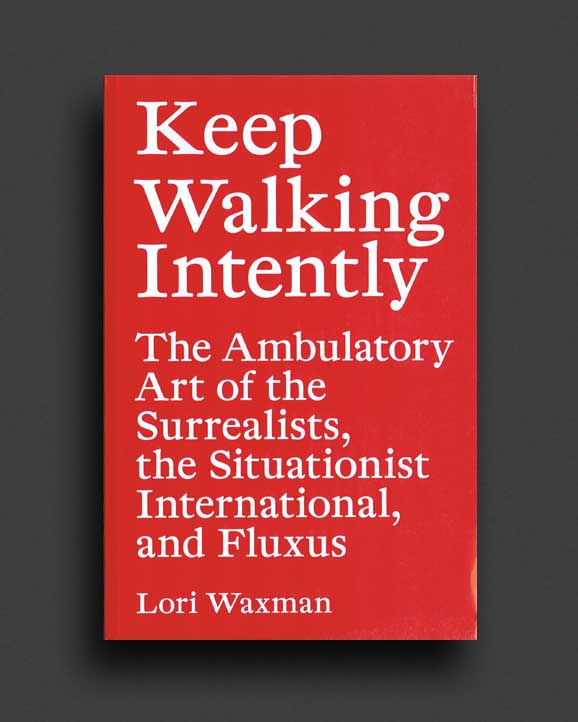
Walking, that most basic of human actions, was transformed in the twentieth century by Surrealism, the Situationist International, and Fluxus into a tactic for revolutionizing everyday life. Each group chose locations in the urban landscape as sites—from the flea markets and bars of Paris to the sidewalks of New York—and ambulation as the essential gesture. Keep Walking Intently traces the meandering and peculiar footsteps of these avant-garde artists as they moved through the city, encountering the marvelous, studying the environment, and re-enchanting the banal. Art historian Lori Waxman reveals the radical potential that walking holds for us all.
Lori Waxman lives in Chicago, where she is the art critic for the Chicago Tribune and a senior lecturer at the School of the Art Institute. She performs occasionally as the “60 wrd/min art critic.”
Design by Zak Group
2020, English
Softcover, 112 pages, 15.2 x 21.6 cm
Published by
Afterall / London
$44.00 - Out of stock
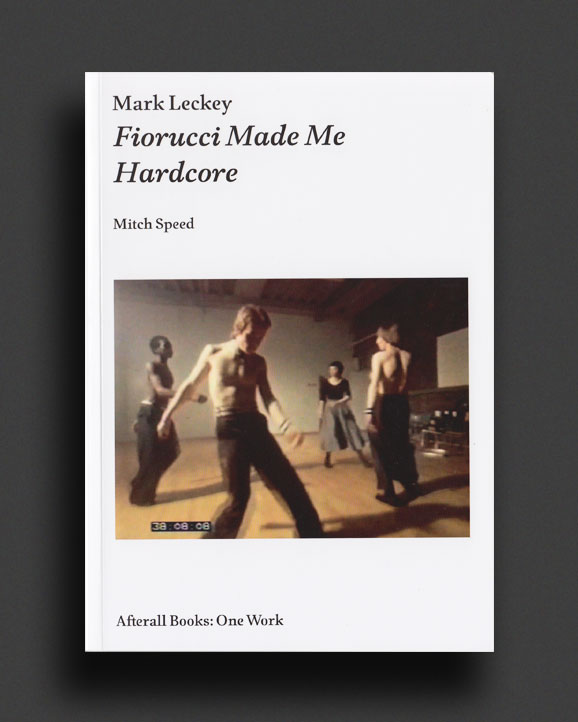
In 1999, the British artist Mark Leckey released his video-montage Fiorucci made me Hardcore, a dreamscape vignette that communes with the rapturous promises of youth. Putting archive material to use, Leckey entwined footage of underground dance and street culture in Britain with audio grifted and recorded in the artist's studio. In this illustrated study, the first comprehensive examination of the work, Mitch Speed argues that by interweaving personal and collective memory, this work gives voice to the complexities of class and cultural transformation during Britain's Thatcherite era. Oscillating between local and expansive resonances, Fiorucci made me Hardcore takes form as a homage, love letter, and work of criticism that eschews analysis, instead incanting the deeper implications of its subject.
2018, English
Softcover, 80 pages, 15.2 x 20.3 cm
Published by
Sequence Press / New York
$28.00 - In stock -
This short book takes a second look at distraction, extracting untold pleasures from its alleged dangers, defending and celebrating the unfocused life for the small and great wonders it can deliver. It tracks the paths of writers that built their works around non-linear thinking. Bergson called on distraction to sharpen our perceptions; Proust's greatest epiphany came from stumbling, not walking in a straight line; Nietzsche never trusted a thought that didn't come from perambulation. The wanderings documented in these pages carry none of the stigma of attention deficit. Quite the opposite. In Montaigne's words, there is a marvelous grace in letting thoughts be carried away at the pleasure of the wind. It is time to side with some of the great propagandists of so-called wasted time and cultivate controlled mental mayhem. Come join the ranks of the great hedonists of meandering thought.
Marina van Zuylen is Professor of French and Comparative Literature at Bard College. She was educated in France before receiving a B.A. in Russian Literature and a Ph.D. in Comparative Literature at Harvard. She is the author of Difficulty as an Aesthetic Principle: Realism and Unreadability in Stifter, Melville, and Flaubert (G. Narr, 1994) and Monomania: The Flight from Everyday Life in Literature and Art (Cornell University Press, 2005). She has taught at Harvard, Columbia, Princeton, and the University of Paris VII. She also serves as the national academic director of the Clemente Course in the Humanities.
This is a jewel of a book—an appropriately meandering reflection on the benefits of diversion, detour, boredom, and disorientation. In a culture wedded to attention and purposefulness, we have forgotten how valuable it can to be choose the indirect route, to allow ourselves to get lost. The Plenitude of Distraction ruminates on the links between creativity and openness. How might one wander willfully, or achieve a state of "disengaged engagement"? Marina Van Zuylen shows how creativity and insight come to those who are willing to turn away from the always-urgent demands of the task-oriented life. The volume is itself an associative flânerie through the minds of Montaigne, Nietzsche, Hume, Cervantès, Dickens, Eliot, and more. This book plucks a small pleasure from the talons of the relentless, reasonable demands of every day. - Scott Carpenter, Professor of French, Director of Cross Cultural Studies, Carleton College, Minnesota
Original artwork by Jimmy Raskin
1970, Japanese
Softcover, 149 pages, 25.8 x 18 cm
1st Edition, Out of print title / used / very good
Published by
Shashin Ichigun / Japan
$90.00 - Out of stock
First edition of this rare masterpiece of Japanese photojournalism. Okinawa 69-70 is a collection of photographs published by television presenter/photographer Osamu Yoshioka with volunteers in 1970 depicting the life and struggles on the Okinawa Island of Japan. A critical strategic location for the United States Armed Forces since the end of World War II, the presence of the US military in Okinawa has caused great social tension and political controversy in Japan and this book captures the anger, suffering and resistance to both the US and Japanese government.
Very Good copy with tanning to pages.
1969, German
Hardcover (w. dust jacket), 200 pages, 20.5 x 20.5 cm
1st Edition, Out of print title / used / very good
Published by
Büchergilde Gutenberg / Frankfurt
$200.00 - Out of stock
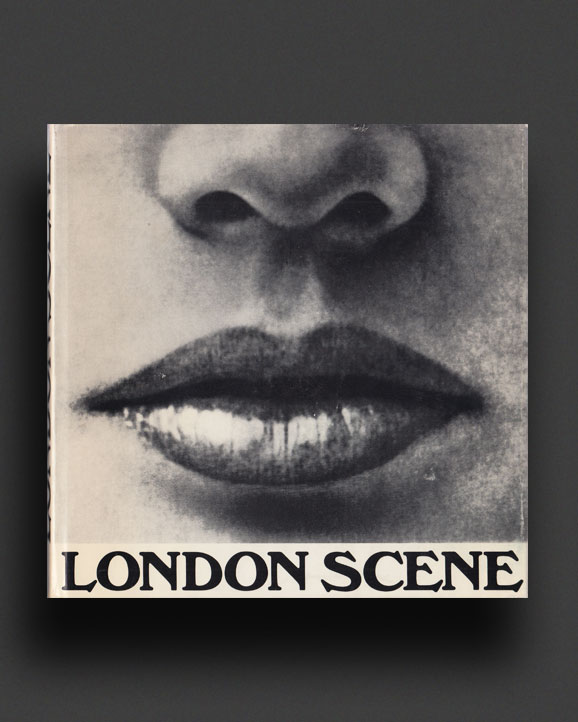
Scarce first hardcover edition of the cult "London Scene" photo-book from 1969. Beautifully documented through hundreds of black and white photographs, this German book captured the atmosphere, fashion, politics and day-to-day life of London's counterculture (from OZ to Yoko Ono to The UFO Club) in the radically changing climate of 1960s Britain. "The adventure of a new generation: long hair, short skirts, pearl necklaces and large-flowered shirts are not everything. The phenomenon of hippie subculture eludes scholarly generalizations" - from publisher's blurb. Includes quotes throughout from British alternative press, politicians, literary figures and pop stars alike (Lennon, John Peel, Churchill, Oscar Wilde, etc.), plus German introductory texts by the authors, and a glossary of terms, hippie slang, and clubs in London.
Very Good copy in Very Good dust jacket.
1994, English / Japanese
Softcover (staple-bound), 40 pages, 21 x 30 cm
1st Edition, Out of print title / Used*,
Published by
File Inc. / Kyoto
$190.00 - Out of stock
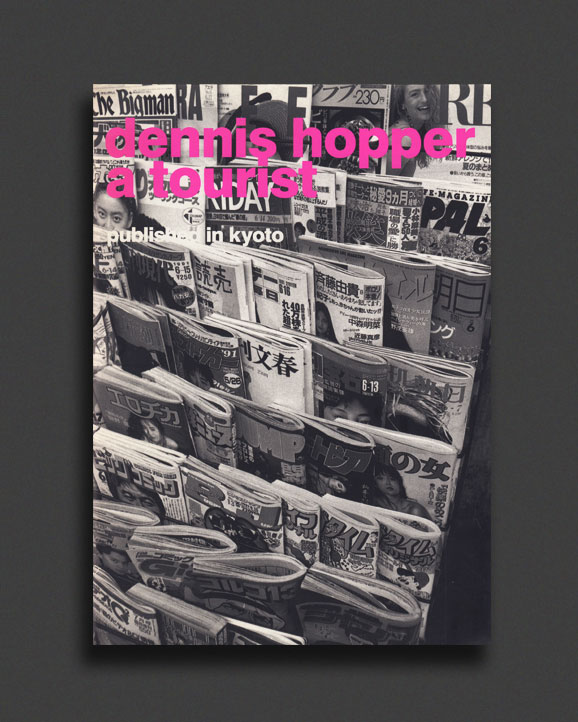
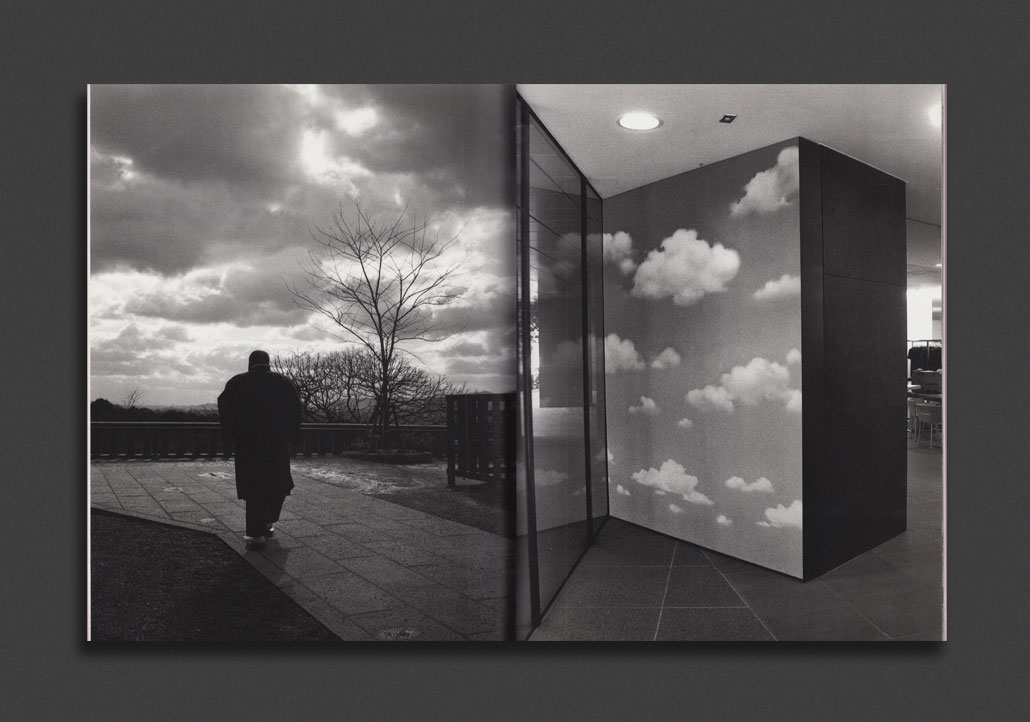
A very scarce publication of Director/Actor Dennis Hopper's photographs from a 1991 visit to Tokyo and a 1994 visit to Kyoto, published in Kyoto in 1994 by Takao Nakamura and File, Inc.
This is the first and only edition and to our knowledge these photographs have never appeared in book form since. A fine copy. Includes invitation card to Dennis Hopper "Photo Works II" exhibition in Japan, 1994.
"From 1961 on I carried my camera everywhere. All My friends teased me about being a tourist. I put my Nikon away in 1967 when I started writing and directing “Easy Rider.” Only on occasion did I use it, when friends who were camera shy asked me to photograph them—Sean Penn, Gary Oldman, Maria Mckee, Quentin Tarantino. Three years ago on my second trip to Japan, I took my Nikon with me for the first time since the 60’s and shot 30 rolls of film. In the states I had them developed, looked at the proof sheets vaguely and put them away. Six months ago I blew up 12 pictures to give to friends in Japan because they always give me presents. I was surprised how much I liked the pictures. Chihiro Narumi asked me to do a show in Kyoto and Tokyo. I bought a new Nikon 35Ti in Kyoto, and I am now carrying it everywhere. I feels good being a tourist again. My life seems very full suddenly. Thank you. - Dennis Hopper"
Very Good-Fine copy.
2006, English
Softcover, 224 pages, 14 x 21 cm
Published by
Verso / London
$35.00 - In stock -
One of the most provocative and controversial writers of his time, these essays comprise George Bataille's most incisive study of surrealism.
For Bataille, the absence of myth had itself become the myth of the modern age. In a world that had lost the secret of its cohesion, Bataille saw surrealism as both a symptom and a beginning of an attempt to address this loss. His writings on this theme are the result of a profound reflection in the wake of World War Two.
The Absence of Myth is the most incisive study yet made of surrealism, insisting on its importance as a cultural and social phenomenon with far-reaching consequences. Clarifying Bataille's links with the surrealist movement, and throwing revealing light on his complex and greatly misunderstood relationship with Andre Breton, The Absence of Myth shows Bataille to be a much more radical figure than his postmodernist devotees would have us believe: a man who continually tried to extend Marxist social theory; a pessimistic thinker, but one as far removed from nihilism as can be.
“One of the most original and unsettling of those thinkers who, in the wake of Sade and Nietzsche, have confronted the possibility of thought in a world that has lost its myth of transcendence.” – Peter Brooks, New York Times Book Review
“Bataille has survived the death of God.” – Jean-Paul Sartre
Translated by Michael Richardson
2014, English
Softcover, 77 pages, 12.9 x 17.8cm
Published by
Graywolf Press / Minneapolis
$28.00 - Out of stock
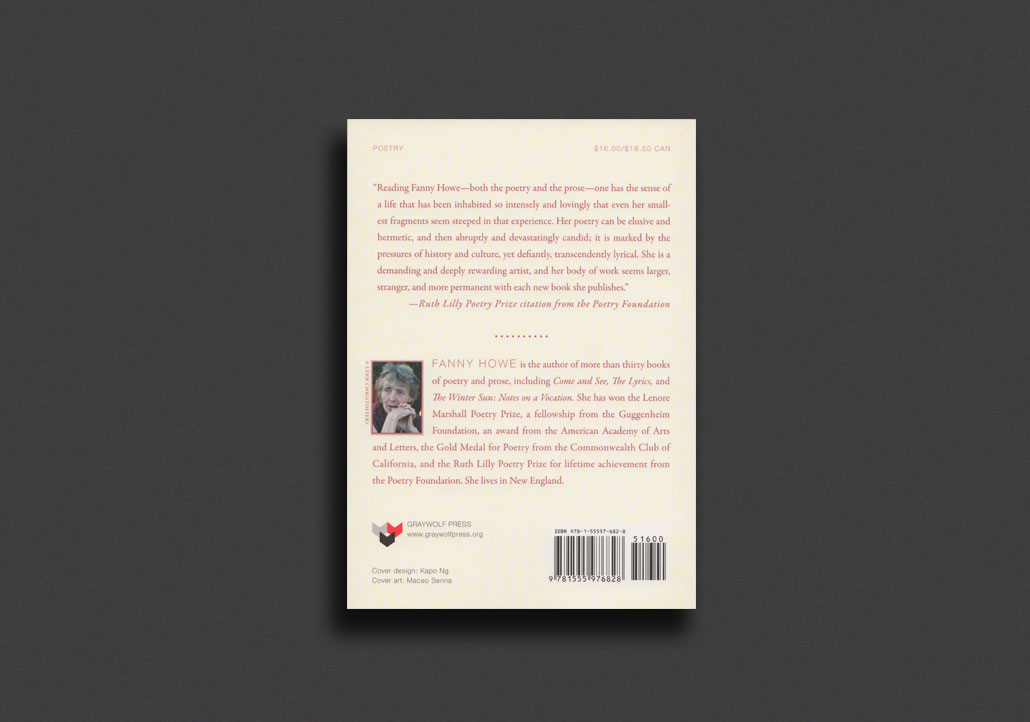
Second Childhood is the new poetry collection by Fanny Howe, whose "body of work seems larger, stranger, and more permanent with each new book she publishes" (Ruth Lilly Poetry Prize citation)
Fanny Howe (born October 15, 1940 in Buffalo, New York) is an American poet, novelist, and short story writer. Raised in Cambridge, Massachusetts, her mother Mary Manning was an Irish playwright, her father a lawyer, her sister Susan Howe a fellow poet. One of the most widely read of American experimental poets, Fanny Howe's writing career began during the 1960s with a series of paperback original novels she published under the pseudonym Della Field. Fanny Howe's poetry is known for its lyricism, fragmentation, experimentation, spiritual engagement, and commitment to social justice. In Second Childhood, the observing poet is an impersonal figure who accompanies Howe in her encounters with chance and mystery. She is not one age or the other, in one time or another. She writes, "The first question in the Catechism is: / What was humanity born for? / To be happy is the correct answer."
2019, English
Softcover, 294 pages, 19.2 x 12.9 cm
Published by
Verso / London
$28.00 - Out of stock
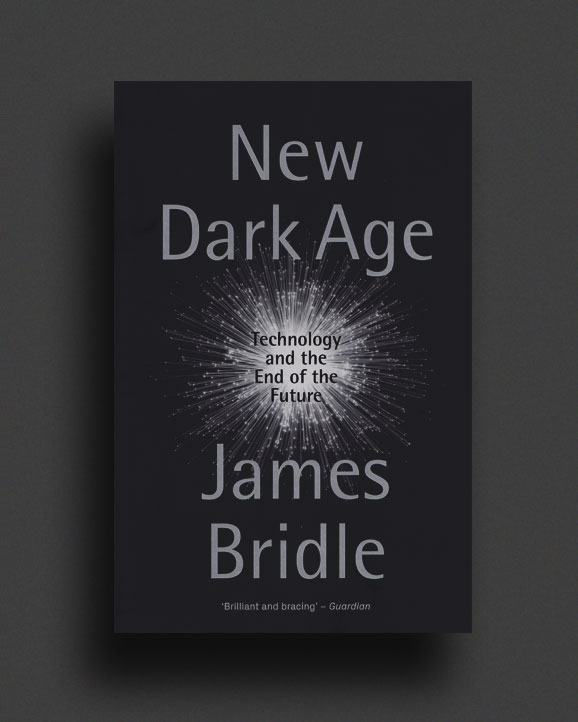
As the world around us increases in technological complexity, our understanding of it diminishes. Underlying this trend is a single idea: the belief that our existence is understandable through computation, and more data is enough to help us build a better world.
In reality, we are lost in a sea of information, increasingly divided by fundamentalism, simplistic narratives, conspiracy theories, and post-factual politics. Meanwhile, those in power use our lack of understanding to further their own interests. Despite the apparent accessibility of information, we’re living in a new Dark Age.
From rogue financial systems to shopping algorithms, from artificial intelligence to state secrecy, we no longer understand how our world is governed or presented to us. The media is filled with unverifiable speculation, much of it generated by anonymous software, while companies dominate their employees through surveillance and the threat of automation.
In his brilliant new work, leading artist and writer James Bridle surveys the history of art, technology, and information systems, and reveals the dark clouds that gather over our dreams of the digital sublime.
2019, English
Softcover, 244 pages, 12.9 x 19.5 cm
Published by
Verso / London
$30.00 - In stock -
What is the function of art in the era of digital gloablisation?
How can one think of art institutions in an age defined by planetary civil war, growing inequality, and proprietary digital technology? The boundaries of such institutions have grown fuzzy. They extend from a region where the audience is pumped for tweets to a future of “neurocurating,” in which paintings surveil their audience via facial recognition and eye tracking to assess their popularity and to scan for suspicious activity.
In Duty Free Art, filmmaker and writer Hito Steyerl wonders how we can appreciate, or even make art in the present age. What can we do when arms manufacturers sponsor museums and some of the world's most valuable artworks are used as a fictional currency in a global futures market that has nothing to do with the works themselves? Can we distinguish between creativity and the digital white noise that bombards our everyday lives? Exploring artifacts as diverse as video games, Wikileaks files, the proliferation of spam, and political actions, she exposes the paradoxes within globalization, political economies, visual culture, and the status of art production.
2009, English
Softcover, 197 pages, 20.9 x 13.1 cm
Published by
New Directions / New York
$25.00 - Out of stock
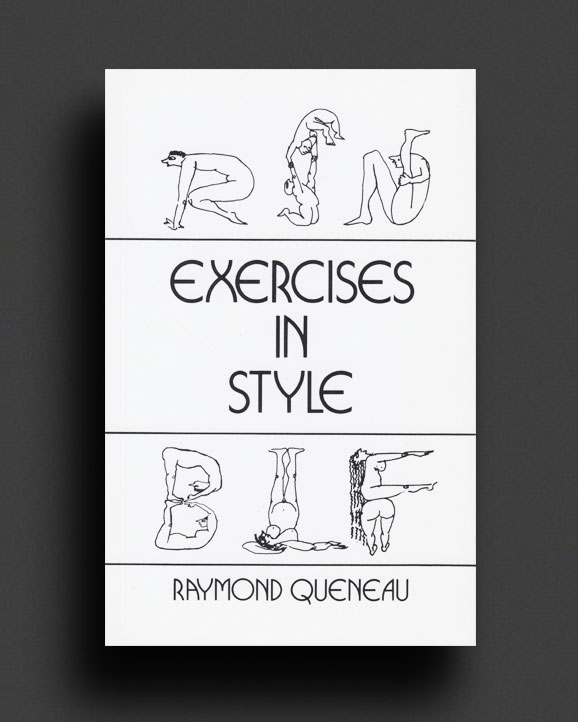
On a crowded bus at midday, Raymond Queneau observes one man accusing another of jostling him deliberately. When a seat is vacated, the first man appropriates it. Later, in another part of town, Queneau sees the man being advised by a friend to sew another button on his overcoat. Exercises in Style retells this unexceptional tale ninety-nine times, employing the sonnet and the alexandrine, “Ze Frrench” and “Cockney.” An “Abusive” chapter heartily deplores the events; “Opera English” lends them grandeur. In 1947, when Exercises in Style first appeared in French, it led to Queneau’s election to the highly prestigious Académie des Goncourt. He once told Barbara Wright that of all of his books, this was the one he most wished to see translated. He rendered her his “heartiest congratulations,” adding: “I have always thought that nothing is untranslatable. Here is new proof. And it is accomplished with all the intended humor. It has not only linguistic knowledge and ingenuity, it also has that.”
Raymond Queneau was a French novelist, poet, critic, editor and co-founder and president of Oulipo, notable for his wit and cynical humour. Born in Le Havre in 1903, Queneau went to Paris when he was 17. In 1924 Queneau met and briefly joined the Surrealists, but never fully shared their penchants for automatic writing or ultra-left politics. Like many surrealists, he entered psychoanalysis—however, not in order to stimulate his creative abilities, but for personal reasons, as with Leiris, Bataille, and Crevel. Now, seeing Queneau's work in retrospect, it seems inevitable. The Surrealists tried to achieve a sort of pure expression from the unconscious, without mediation of the author's self-aware "persona." Queneau's texts, on the contrary, are quite deliberate products of the author's conscious mind, of his memory, and his intentionality. Although Queneau's novels give an impression of enormous spontaneity, they were in fact painstakingly conceived in every small detail.
2019, English / Italian
Softcover, 124 pages , 11.7 x 18 cm
Published by
Public Space / New York
$26.00 - In stock -
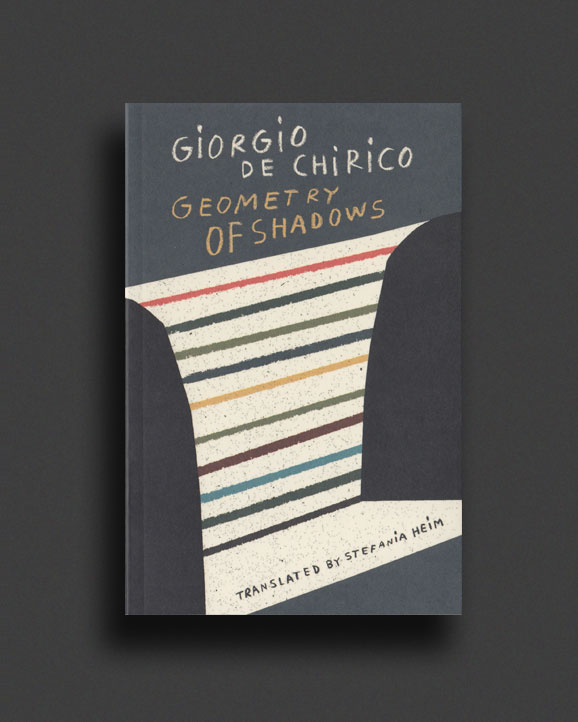
Gathered from early twentieth-century Italian magazines, manuscripts, correspondence, television recordings, and ephemeral art volumes, Geometry of Shadows is the first comprehensive collection of Giorgio de Chirico's Italian poems, with award-winning poet Stefania Heim's English translations presented alongside the Italian originals. A multifaceted artist who lived in multiple languages, de Chirico was just becoming famous in France for the paintings that inspired surrealism when he returned to Italy in 1916 to enlist for the First World War. Quickly determined unfit for the front line, de Chirico was assigned to desk duty and began to write poems in his native language. Translating his iconic visual imagination into literary form, Geometry of Shadows is a gorgeous document celebrating the elasticity and innate potential of language, by an artist ever in pursuit of deeper understanding.
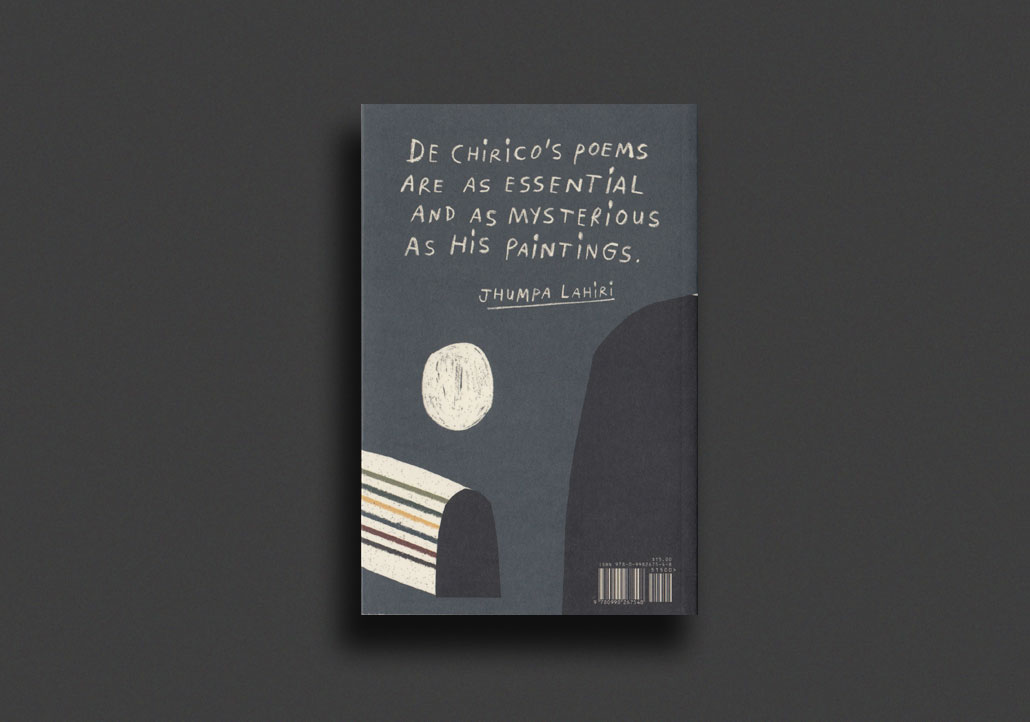
De Chirico's poems are as essential and as mysterious as his paintings. - Jhumpa Lahiri
Translated by Stefania Heim
2013, English
Softcover, 20 loose-leaf pages, 22 x 28 cm
Ed. of 500,
Published by
Yale Union (YU) / Portland
$60.00 - Out of stock
TOM TIT TOT is the first publication by YALE UNION in Portland, a chapbook of recent rectilinear poems by Susan Howe. This publication was printed in the YALE UNION printshop by Emily Johnson in an edition of 500 on a Miehle Vertical V-50 press, and was released to coincide with Howe's exhibition "TOM TIT TOT" and YALE UNION, October 5–December 1, 2013.
Susan Howe (born June 10, 1937) is an American poet, scholar, essayist and critic, who has been closely associated with the Language poets, among others poetry movements. Her work is often classified as Postmodern because it expands traditional notions of genre (fiction, essay, prose and poetry). Many of Howe's books are layered with historical, mythical, and other references, often presented in an unorthodox format. Her work contains lyrical echoes of sound, and yet is not pinned down by a consistent metrical pattern or a conventional poetic rhyme scheme.
2020, English
Softcover, 344 pages, 15.2 x 22.9 cm
Published by
Semiotext(e) / Los Angeles
$38.00 - Out of stock
Introduction by A. S. Hamrah
The third of Gary Indiana's famed crime trilogy tells a story inspired by the virtuoso con artistry of mother-and-son criminals Sante and Kenneth Kimes.
She collected future marks like lottery tickets. She operated by reflex. Any public room was a pristine harvest of human information. Not just business cards, phone numbers, fax numbers and the like, but weaknesses, quirks, character flaws, delusional ambitions, risky dreams, medical problems, shaky marriages. Everybody came equipped with a panel of invisible buttons.... If you had the right touch, if you knew how to press one button lightly and another button with a bit more force, you could make the emotional side of a person swing up and down as you wished.
--from Depraved Indifference
First published in 2001, Depraved Indifference is the third of Gary Indiana's famed crime trilogy now being reissued by Semiotext(e). Inspired by the virtuoso con artistry of mother-and-son criminals Sante and Kenneth Kimes, Depraved Indifference follows Evangeline Slote, a dead ringer for Elizabeth Taylor "so compulsive she grifts herself when she runs out of other people" through the circus of calamity that her compulsions invoke. Evangeline, or "Evelyn Carson, "Princess Shah Shah," among other pseudonyms, accompanied by her alcoholic husband Warren and fanatically devoted son Devin, moves from Las Vegas to Hawaii to Nassau in a maelstrom of forgery and fraud that constantly threatens to come undone. When Warren dies, Evangeline and her son embark upon an ever more brazen series of grifts, frauds, and crimes. Thriving on chaos, a master of manipulation and seduction, Evangeline concocts the scheme to end all schemes--which may take a murder to complete.
Reminiscent of Nathanael West's The Day of the Locust, Indiana's scathing, insightful prose is a mirror to the empty landscape of American culture.
2015, English
Softcover, 392 pages,15.2 x 22.9 cm
Published by
Semiotext(e) / Los Angeles
$39.00 - Out of stock
Afterword by Chris Kraus , Introduction by Patrick McGrath
In a novel capturing an era that seems at once familiar and grotesque, a New York writer lands in Los Angeles in 1994.
Originally published in 1997, Resentment was the first in Gary Indiana's now-classic trilogy (followed in 1999 by Three Month Fever: The Andrew Cunanan Story and in 2003 by Depraved Indifference) chronicling the more-or-less permanent state of "depraved indifference" that characterized American life at the millennium's end.
In Resentment, Seth, a New York-based writer arrives in Los Angeles (where he has history and friends) in mid-August, 1994, to observe what will become the marathon parricide trial of the wealthy, athletic, and troubled Martinez brothers, broadcast live every day on Court TV. Still reeling from the end of his obsessive courtship of a young SoHo artist/waiter, Seth moves between a room at the Chateau Marmont and a Mount Washington shack owned by his old cab-driving, ex-Marxist friend, Jack, while he writes a profile of Teddy Wade--one of the era's hottest young actors, who has "dared" to star as a gay character in a new Hollywood film. Studded throughout with scathing satirical portraits of media figures, other writers, and the Martinez trial teams, Resentment captures an era that seems, two decades later, at once grotesque, familiar, and a precursor to our own.
1992, English
Hardcover, 64 pages, 15 x 20 cm
Published by
Artspace Books / Sausalito
$29.00 - Out of stock
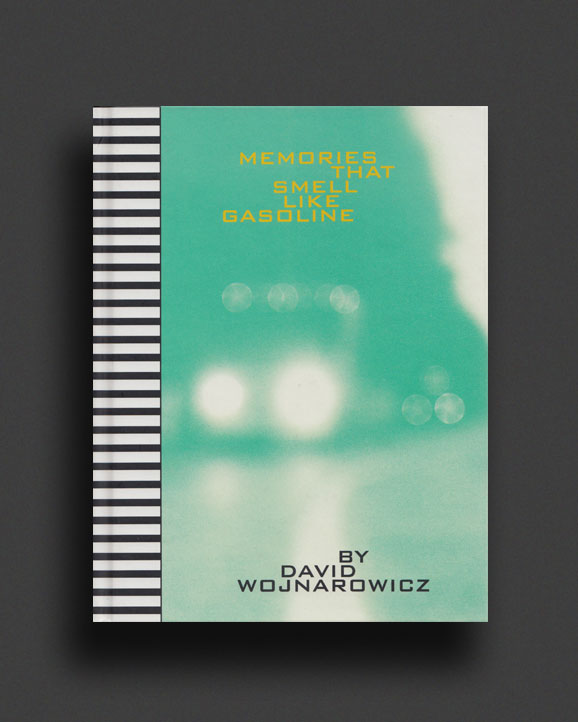
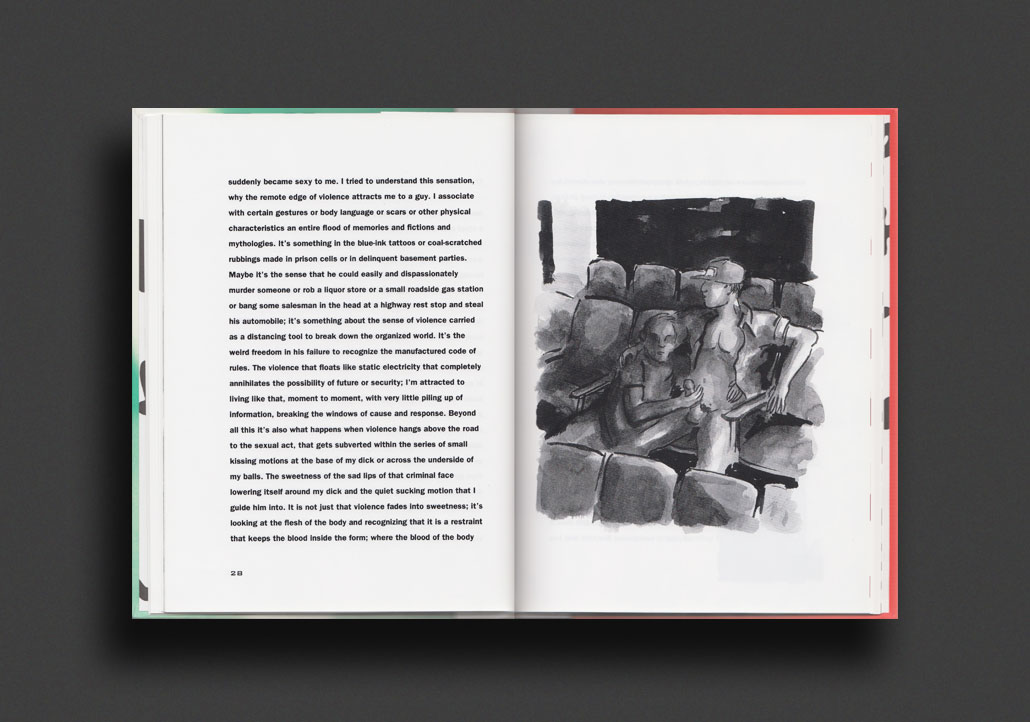
Not content to be a tremendous photographer, painter, filmmaker, performance artist and activist David Wojnarowicz (1954-92) was also the author of three classic books: Close to the Knives, The Waterfront Journals and Memories That Smell Like Gasoline, now back in print from Artspace. This volume collects four tales -- "Into the Drift and Sway," "Doing Time in a Disposable Body," "Spiral" and the title story -- interspersed with ink drawings by the artist. "Sometimes it gets dark in here behind these eyes I feel like the physical equivalent of a scream. The highway at night in the headlights of this speeding car speeding is the only motion that lets the heart unravel and in the wind of the road the two story framed houses appear one after the other like some cinematic stage set..." From these opening sentences of the book (in "Into the Drift and Sway"), Wojnarowicz lets loose a salvo of explicit gay sexual reverie harshly lit by the New York cityscape.
2017, English
Softcover, 196 pages Dimensions 16 x 23 cm
Published by
Soft Skull Press / New York
$30.00 - Out of stock
“Why can’t I live right now. Because I am not rich, I am not a saint. But I do know this: not all of us were sent here to work.”
The first published novel of legendary poet and performer Eileen Myles follows a queer female growing up in working-class Boston, straining against the institutions that hold her: family, Catholic school, jobs at a camp, at a nursing home, at a school for developmentally disabled adult males. Free-ranging and deadpan, tragic and joyful, this is a book about women, gender, class, bodies, escape, and what it means to be “inside.”
Never more relevant, and now with an introduction by Chris Kraus.
2019, English
Softcover, 148 pages, 11 x 16 cm
Published by
Surpllus / Melbourne
$15.00 - Out of stock
Brief, risible, finicky, the limerick is a form whose greatest successes never rise above the mildly embarrassing. Yet despite never having enjoyed unqualified approbation from critics or public, the form has its enthusiasts and eminent aficionados: there is no lack of literary luminaries who have lavished love on the limerick. This title continues this queer minor tradition, presenting seventy-seven limericks about writers and philosophers from St Thomas Aquinas to Simone Weil. Of all the grades of doggerel, the limerick is one of the lowest. Populist and participatory if not precisely popular, the limerick first becomes a hit in Victorian England with Edward Lear’s books of nonsense. It spreads at once across the English-speaking world like a highly contagious linguistic rash. Including a critical essay that delineates the limerick’s salient features, along with a dictionary that collects brief physiognomies of the subjects of the limericks, this book dares to descend into the maelstrom of mediocrity and to return, arms overflowing with mixed metaphors and mouldering microplastics.
2011, English
Softcover, 194 pages, 13 x 19 cm
Edition of 500,
Published by
Surpllus / Melbourne
$25.00 - Out of stock
Minimal Domination collects a selection of Justin Clemens’ art writings from the past decade. The title is drawn from contemporary mathematics: a minimally dominating set is the smallest set of points that neighbour all other points of a graph. A minimally dominating set is therefore a multiple and a structure which has privileged access to that which it is not. This is the secret of contemporary art: it creates discrete selections from which we can survey the whole.
Justin Clemens, former art critic for The Monthly, has written extensively on contemporary art. The essays in Minimal Domination discuss the work of Joseph Kosuth, Gordon Bennett, Juan Davila, Mike Parr, Ricky Swallow, Janet Burchill & Jennifer McCamley, Christian Capurro, Philip Hunter, and others.
2018, English
Softcover, 96 pages, 17 x 22 cm
Published by
Roma / Amsterdam
$40.00 - Out of stock
Looking at the play between memory and forgetfulness, 'Mike Kelley: Fortress of Solitude' brings together a range of key works from across the artist’s career. Whether using found stuffed animals as emotional effigies of long lost traumatic memories, or evoking the psychic existential homelessness of Superman in the form of his Kandor series, Mike Kelley explores the dark underbelly of post-war American culture. This publication accompanies the exhibition that took place at the Museum of Cycladic Art in Athens, Greece.
1963, Italian / English / French
Softcover, 8 loose-leaf pages in stiff card, 21.5 x 15.5 cm
1st Edition, Out of print title / used / very good
Published by
Gallerie Cadario / Milan
$45.00 - Out of stock
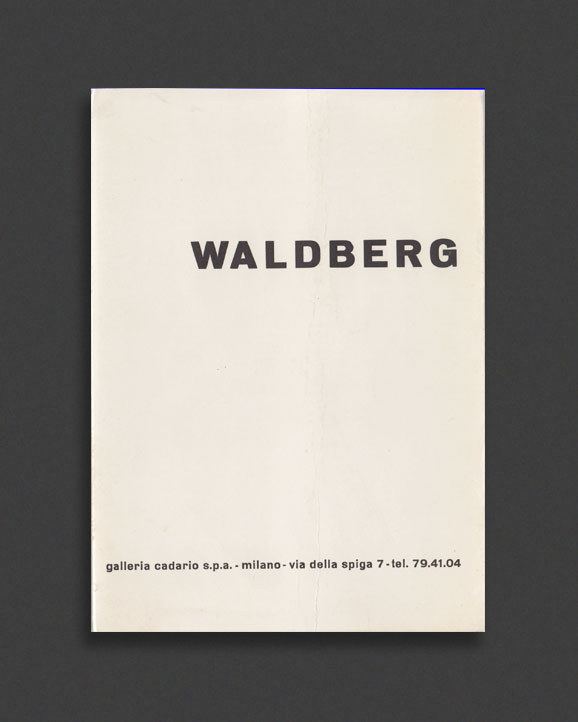
Scarce Isabelle Waldberg exhibition catalogue published in 1963 by Gallerie Cadario, Milan. Includes beautiful b/w reproductions of Waldberg's sculptures, portrait, a list of quoted critical responses to her work (each in their respective native language), biography and exhibition history in Italian, and list of exhibited works.
Isabelle Waldberg (1911–1990) was a French-Swiss sculptor associated with surrealism. Born in Oberstammheim, she studied sculpture in Zurich before moving to Paris and briefly Italy to continue her studies. Studying in Florence in 1937, she returned to Paris, where she came to know Alberto Giacometti, Georges Bataille, Andre Masson and her future husband Patrick Waldberg. From 1938 to 1940 she studied sociology and ethnography at the Ecole des Hautes Etudes. She also attended discussion of the sacred at the College of Sociology, and contributed to Bataille’s journal Acéphale. In 1941 she joined a group of Surrealist artists who were ‘in exile’ in New York. During this time she experimented further with Surrealism, but was increasingly drawn to the art of Eskimo and Native American communities. During this period she started working on "constructions" made of bound beech branches and held her first exhibition at The Art of This Century gallery in 1943. Returning to Paris in 1946, she worked in Duchamp’s old studio. From 1947 to 1948 she co-edited Da Costa Encyclopédique, a surrealist review, with the writer Robert Lebel. Her later work from the 1950s onwards saw her return to plaster, a material she used in her early-career. Waldberg’s reputation grew steadily and she exhibited frequently and widely until her death in 1990.
Very Good copy with only light wear.