World Food Books' programme is largely produced on Kulin Nation land. We acknowledge the Wurundjeri people of the Kulin Nation as the first and continuing custodians of this land, and pay respect to their Elders past, present, and emerging.
World Food Books is an arts and special interests bookshop in Naarm / Melbourne. Founded in 2010, World Food Books is devoted to the presentation of a rotating, hand-selection of international art, design, literary and counterculture publications with an emphasis on the anti-traditional, the experimental, the avant-garde, the heretic, the marginal.
Presenting new titles alongside rare and out-of-print books, catalogues and journals spanning the fields of modern and contemporary art, design, photography, illustration, film, literature, poetry, cultural theory, philosophy, sexuality, popular and underground culture in its many radical forms, World Food Books wishes to encourage adventurous, thoughtful and open-minded reading, looking, writing, and exchange of publishing and ideas, both current and historical.
As well as our bookshop, located in Melbourne's historical Nicholas Building, all of our inventory is available internationally via our online mail-order service.
World Food Books semi-regularly co-ordinates "Occasions", a programme of exhibits and events at the bookshop and in partnership with other hosts (such as museums and art galleries) that develop out of the activities, relationships and content of the bookshop itself.
World Food Books
The Nicholas Building
37 Swanston Street
Room 5, Level 6
Melbourne 3000
Australia
SHOP HOURS:
Thu–Fri 12–6
Sat 12–5
WEB-SHOP OPEN 24/7
World Food Books
Postal Address:
37 Swanston Street
Room 5, Level 6
Melbourne 3000
Australia
Art
Theory / Essay
Architecture / Interior
Graphic Design / Typography
Photography
Fashion
Eros
LGBTQ+
Fiction / Poetry
Weird / Speculative / Science Fiction / Horror
Transgressive / Visceral / Abject
Symbolism / Decadence / Fin de siècle
Film / Video
Painting
Sculpture / Installation
Performance / Dance / Theater
Drawing
Sound / Music
Curatorial
Group Shows / Collections
Periodicals
Out-of-print / Rare
Posters / Ephemera / Discs
Signed Books
World Food Books Gift Voucher
World Food Book Bag
Australian Art
Australian Fiction
Australian Science Fiction / Speculative Fiction
Australian Poetry
Australian Photography
Japanese Photography
Conceptual Art
Minimal Art
Dada
'Pataphysics / Oulipo
Fluxus
Concrete Poetry
Pop Art
Surrealism
Arte Povera
Arte Informale / Haute Pâte / Tachism
Nouveau Réalisme / Zero / Kinetic
Situationism / Lettrism
Collage / Mail Art / Xerox Art
Art Brut / Folk / Visionary / Fantastic
Illustration / Graphic Art / Bandes Dessinées
Furniture
Italian Radical Design / Postmodernism
Textiles
Ceramics / Glass
Counterculture
Protest / Revolt
Philosophy
Psychoanalysis
Anthropology
Anarchism
Socialism / Anarchism / Communism / Capitalism
Literary Theory / Semiotics / Language
Feminism / Women's Studies
Gender Studies / Sexuality
Anthropology
Fetishism / BDSM
Drugs / Psychedelia
Crime / Violence
Animal Rights / Veganism
Occult / Esoterica
Ecology / Earth / Alternative Living
Whole Earth / Crafts
All prices in AUD (Australian dollars)
Pick-Ups
Pick-up orders can be collected in our bookshop during opening hours after order date. Please collect any Pick-up orders within 2 weeks of ordering as we have limited storage space. Orders will be released back into stock if not collected within this time. No refunds can be made for pick-ups left un-collected. If you cannot make it in to the bookshop in this time-frame, please choose postage option.
Return Policy
All sales are final. We do accept returns (for refund or exchange) for items received in error. All our orders are packed with special care using heavy-duty padding and cardboard book-mailers or bubble mailers (for smaller books), using reinforcement where required. We cannot take responsibility for any lost, stolen or damaged parcels.
Insurance
Should you wish to insure your package, please email us directly after placing your order and we can organise this at a small extra expense. Although all standard/express tracked packages are very safe and dependable, we cannot take responsibility for any lost, stolen or damaged parcels. We recommend insurance on valuable orders.
Interested in selling your old books, catalogues, journals, magazines, comics, fanzines, ephemera? We are always looking for interesting, unusual and out-of-print books to buy. We only buy books in our fields of interest and specialty, and that we feel we can resell.
We base these prices on desirability, market value, in-print prices, condition and our current stock levels. We offer cash, store credit, and can take stock on consignment. All
about 25% of the price we expect to get when we sell them, or 30% in store credit. We base these prices on desirability, market value, in-print prices, condition and our current stock levels.
Sell your books any day of the week. You can drop them off and return later. If you have a lot of books, we can visit your Sydney home.
We buy books that we feel we can resell. We offer about 25 % of the price we expect to get when we sell them, or 30% in store credit. We base these prices on desirability, market value, in-print prices, condition and our current stock levels.
Philadelphia Wireman
03 August - 01 September, 2018
World Food Books is proud to announce our next Occasion, the first presentation of sculptures by Philadelphia Wireman in Australia.
The Philadelphia Wireman sculptures were found abandoned in an alley off Philadelphia’s South Street on trash night in 1982. Their discovery in a rapidly-changing neighbourhood undergoing extensive renovation, compounded with the failure of all attempts to locate the artist, suggests that the works may have been discarded after the maker’s death. Dubbed the "Philadelphia Wireman" during the first exhibition of this work, in 1985, the maker’s name, age, ethnicity, and even gender remain uncertain. The entire collection totals approximately 1200 pieces, all intricately bound together with tightly-wound heavy-gauge wire (along with a few small, abstract marker drawings, reminiscent both of Mark Tobey and J.B. Murry). The dense construction of the work, despite a modest range of scale and materials, is singularly obsessive and disciplined in design: a wire armature or exoskeleton firmly binds a bricolage of found objects including plastic, glass, food packaging, umbrella parts, tape, rubber, batteries, pens, leather, reflectors, nuts and bolts, nails, foil, coins, toys, watches, eyeglasses, tools, and jewellery.
Heavy with associations—anthropomorphic, zoomorphic, and socio-cultural responses to wrapped detritus—the totemic sculptures by Philadelphia Wireman have been discussed in the context of work created to fulfil the shamanistic needs of alternative religions in American culture. Curators, collectors, and critics have variously compared certain pieces to sculpture from Classical antiquity, Native American medicine bundles, African-American memory jugs, and African fetish objects. Reflecting the artist’s prolific and incredibly focused scavenging impulse, and despite—or perhaps enhanced by—their anonymity, these enigmatic objects function as urban artefacts and arbiters of power, though their origin and purpose is unknown. Philadelphia Wireman, whatever their identity, possessed an astonishing ability to isolate and communicate the concepts of power and energy through the selection and transformation of ordinary materials. Over the course of the past two decades, this collection has come to be regarded as an important discovery in the field of self-taught art and vernacular art.
Presented in collaboration with Fleisher-Ollman Gallery, Philadelphia, and Robert Heald, Wellington.
Susan Te Kahurangi King
02 February - 10 March, 2018
Susan Te Kahurangi King (24 February 1951 - ) has been a confident and prolific artist since she was a young child, drawing with readily available materials - pencils, ballpoint pens and felt-tip markers, on whatever paper is at hand. Between the ages of four and six Susan slowly ceased verbal communication. Her grandparents William and Myrtle Murphy had developed a special bond with Susan so they took on caring responsibilities for extended periods. Myrtle began informally archiving her work, carefully collecting and storing the drawings and compiling scrapbooks. No drawing was insignificant; every scrap of paper was kept. The King family are now the custodians of a vast collection containing over 7000 individual works, from tiny scraps of paper through to 5 meter long rolls.
The scrapbooks and diaries reveal Myrtle to be a woman of great patience and compassion, seeking to understand a child who was not always behaving as expected. She encouraged Susan to be observant, to explore her environment and absorb all the sights and sounds. Myrtle would show Susan’s drawings to friends and people in her community that she had dealings with, such as shopkeepers and postal workers, but this was not simply a case of a grandmother’s bias. She recognised that Susan had developed a sophisticated and unique visual language and sincerely believed that her art deserved serious attention.
This was an unorthodox attitude for the time. To provide some context, Jean Dubuffet coined the term Art Brut in 1945 to describe work created by self-taught artists – specifically residents of psychiatric institutions and those he considered to be visionaries or eccentrics. In 1972 Roger Cardinal extended this concept by adopting the term Outsider Art to describe work made by non-academically trained artists operating outside of mainstream art networks through choice or circumstance. Susan was born in Te Aroha, New Zealand in 1951, far from the artistic hubs of Paris and London that Dubuffet and Cardinal operated in. That Myrtle fêted Susan as a self-taught artist who deserved to be taken seriously shows how progressive her attitudes were.
Susan’s parents Doug and Dawn were also progressive. Over the years they had consulted numerous health practitioners about Susan’s condition, as the medical establishment could not provide an explanation as to why she had lapsed into silence. Dawn educated herself in the field of homeopathy and went on to treat all twelve of her children using these principles – basing prescriptions on her observations of their physical, mental and emotional state.
Doug was a linguist with an interest in philosophy who devoted what little spare time he had to studying Maori language and culture. To some extent their willingness to explore the fringes of the mainstream made them outsiders too but it was their commitment to living with integrity and their respect for individuality that ensured Susan’s creativity was always encouraged.
Even though Susan’s family supported her artistic pursuits, some staff in schools and hospitals saw it as an impediment to her assimilation into the community and discouraged it in a variety of ways. Her family was not always aware of this and therefore did not fully understand why Susan stopped drawing in the early 1990s. However, rather than dwell on the challenges that Susan faced in pursuit of her artistic practice, they prefer to highlight her achievements. In 2008 Susan began drawing again in earnest, after an almost 20 year interruption, and her work is now shown in galleries around the world.
Susan grew up without television and has been heavily influenced by the comics she read as a child. She is absolutely fearless in the appropriation of recognizable characters, such as Donald Duck and Mickey Mouse, in her work. She twists their limbs, contorts their faces, compresses them together, blends them into complex patterned backgrounds - always imbuing them with an incredible energy. Although Susan often used pop culture characters in her work they are not naive or childlike. These are drawings by a brilliant self-taught artist who has been creating exceptional work for decades without an audience in mind.
Mladen Stilinović
"Various Works 1986 - 1999"
02 February 16 - September 10, 2016
Various works 1986 - 1999, from two houses, from the collections of John Nixon, Sue Cramer, Kerrie Poliness, Peter Haffenden and Phoebe Haffenden.
Including: Geometry of Cakes (various shelves), 1993; Poor People’s Law (black and white plate), 1993; White Absence (glasses, ruler, set square, silver spoon, silver ladel with skin photograph and wooden cubes), 1990-1996; Exploitation of the Dead (grey and red star painting, wooden painting, black spoon with red table, red plate), 1984-1990; Money and Zeros (zero tie, paintings made for friends in Australia (Sue, John, Kerrie), numbers painting), 1991-1992; Words - Slogans (various t-shirts) - “they talk about the death of art...help! someone is trying to kill me”, “my sweet little lamb”, “work is a disease - Karl Marx”; Various artist books, catalogues, monographs, videos; Poster from exhibition Insulting Anarchy; "Circular" Croatian - Australian edition; Artist book by Vlado Martek (Dostoyevsky); more.
Thanks to Mladen Stilinović and Branka Stipančić.
Jonathan Walker
Always Will Need To Wear Winter Shirt Blue + Ochre Small Check Pattern
21 August - 21 September, 2015
Untitled
I am not a great reader of poetry but I always return to the work of Melbourne poet, Vincent Buckley (1925- 1988). Perhaps I find his most tantalising piece to be not a finished poem but a fragment left on a scrap of paper discovered on his desk after the poet’s death.
The poetry gathers like oil
In the word-core, and spreads
It has its music meet,
Its music is in movement.
This fragment is more the shell left behind from a volatile thought than a finished poem. I find the last two lines honest but awkward whereas the first two lines work like an arrow. Most likely he could not find a resolution so it was left. Still, in its present form, it remains an eloquent testimony to the ultimate failure of a medium to express mobile thought and sensation, in Buckley’s case, through verbal language. It’s an important matter because this is something all artists have to deal with regardless of the medium.
I have never written a poem, however, I am forever copying fragments from books on paper scraps in a vain effort to fix certain notions in my head. At first, they function as bookmarks that are sometimes returned to when I open the book. But before long, as they accumulate, they fall out littering the table interspersed with A4 photocopies, bills, books and medications.
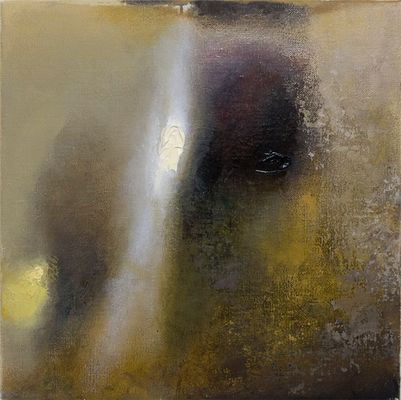
To return to Buckley’s fragment, the first two lines very much evoke how I paint nowadays. As you age, detail diminishes and patches of light become more luminous and float. I feel the most honest way of dealing with this is by smearing the oil paint on the canvas with the fingers and working close-up, blind. Only if the patches coalesce into an approaching image can the work gain a life.
-
Jonathan Walker was born in Melbourne, Australia and brought up on a dairy farm in Gippsland. In the 1970’s he studied painting at RMIT and won the Harold Wright Scholarship to the British Museum, London. During the 1980’s he exhibited at Pinacotheca Gallery, Richmond and had work shown at the NGV and Heidi City Art Gallery. Over the same period he designed the cover for the “Epigenesi” LP by Giancarlo Toniutti, Italy and conducted a mail exchange work with Achim Wollscheid, Germany. The work with artists through the post resulted in an article published in the bicentenary issue of Art and Australia 1988. He showed in artist run spaces such as WestSpace in the 90’s and 2000’s, and until 2012, taught painting at Victoria University, which is where we (Colleen Ahern and Lisa Radford) as organisers of the exhibition, among many others, had the privilege of being his student.
Walker’s knowledge was imparted to students through the careful selection of music, literature, and artists found in books that he himself had ordered for the library. Walker’s strategy was the generosity of sharing his vast knowledge with references specific to each student and their context.
Walker’s paintings share a similar focus and intimacy.
This exhibition presents a small selection of recent paintings alongside a publication that includes Walker’s writing. Observational and analytical, Walker’s work is a type of material notation — the time of day, colour and how it is blended, the both specific and fleeting location of a reflection on lino or the question of whether a chair leg should be included in a painting.
Please join us on Friday August 21 between 6-8pm to celebrate the opening of the exhibition.
Curated by Colleen Ahern and Lisa Radford.
B. Wurtz
Curated by Nic Tammens
March 26 - April 4, 2015
B.Wurtz works from a basement studio in his home on Manhattan’s Lower East Side.
This local fact is attested to by the plastic shopping bags and newsprint circulars that appear in his work. As formal objects, they don’t make loud claims about their origins but nonetheless transmit street addresses and places of business from the bottom of this long thin island. Like plenty of artists, Wurtz is affected by what is local and what is consumed. His work is underpinned by this ethic. It often speaks from a neighborhood or reads like the contents of a hamper:
“BLACK PLUMS $1.29 lb.”
“Food Bazaar”
“USDA Whole Pork Shoulder Picnic 99c lb.”
“RITE AID Pharmacy, with us it’s personal.”
“H. Brickman & Sons.”
“Sweet Yams 59c lb."
Most of the work in this exhibition was made while the artist was in residence at Dieu Donne, a workshop dedicated to paper craft in Midtown. Here Wurtz fabricated assemblages with paper and objects that are relatively lightweight, with the intention that they would be easily transportable to Australia. This consideration isn’t absolute in Wurtz’s work, but was prescriptive for making the current exhibition light and cheap. Packed in two boxes, these works were sent from a USPS post office on the Lower East Side and delivered to North Melbourne by Australia Post.
Wurtz appears courtesy of Metro Pictures, New York.
Thanks to Rob Halverson, Joshua Petherick, Sari de Mallory, Matt Hinkley, Helen Johnson, Fayen d'Evie, Ask Kilmartin, Lisa Radon, Ellena Savage, Yale Union, and "Elizabeth".
John Nixon
"Archive"
December 15 - January 20, 2014
The presentation of John Nixon's archive offered a rare showcase of this extensive collection of the artist's own publications, catalogues, posters, ephemera, editions and more, from the mid 1980s onwards, alongside a selection of his artworks.
Organized by John Nixon, Joshua Petherick and Matt Hinkley.
<a href=http://wfb.public-office.info/artist/john-nixon>All titles by John Nixon
"Habitat"
at Minerva, Sydney (organised by Joshua Petherick and Matt Hinkley)
November 15 - December 20, 2014
Lupo Borgonovo, Janet Burchill & Jennifer McCamley,
Lewis Fidock, HR Giger, Piero Gilardi, Veit Laurent Kurz,
Cinzia Ruggeri, Michael E. Smith, Lucie Stahl, Daniel Weil, Wols
Press Release:
“...It contained seven objects. The slender fluted bone, surely formed for flight, surely from the wing of some large bird. Three archaic circuitboards, faced with mazes of gold. A smooth white sphere of baked clay. An age-blackened fragment of lace. A fingerlength segment of what she assumed was bone from a human wrist, grayish white, inset smoothly with the silicon shaft of a small instrument that must once have ridden flush with the surface of the skin - but the thing’s face was seared and blackened.”
William Gibson, “Count Zero”, 1986
"Autumn Projects Archive"
Curated by Liza Vasiliou
March 6 - March 15, 2014
World Food Books, in conjunction with the Virgin Australia Melbourne Fashion Festival 2014, presented the Autumn Projects archive, consisting of a selection of early examples in Australian fashion with a particular interest in collecting designers and labels from the period beginning in the 1980’s, who significantly influenced the discourse of Australian Fashion.
Curated by Liza Vasiliou, the exhibition provided a unique opportunity to view pieces by designers Anthea Crawford, Barbara Vandenberg, Geoff Liddell and labels CR Australia, Covers, Jag along with early experimental collage pieces by Prue Acton and Sally Browne’s ‘Fragments’ collection, suspended throughout the functioning World Food Books shop in Melbourne.
H.B. Peace
presented by CENTRE FOR STYLE
November 14, 2013
"Hey Blinky, you say chic, I say same"
Anon 2013
H.B. Peace is a clothing collaboration between great friends Blake Barns and Hugh Egan Westland. Their pieces explore the divergences between 'character’ and ‘personality’ in garments....etc
Special Thanks to Joshua Petherick and Matt Hinkley of WFB and Gillian Mears
and a Very Special Thank you to Audrey Thomas Hayes for her shoe collaboration.
Janet Burchill & Jennifer McCamley
"Aesthetic Suicide"
May 10 - June 8, 2013
The first of our occasional exhibitions in the World Food Books office/shop space in Melbourne, "Aesthetic Suicide" presented a body of new and older works together by artists Janet Burchill & Jennifer McCamley, including videos, prints, a wall work, and publications.
During shop open hours videos played every hour, on the hour.
Published by World Food Books / Melbourne
$20.00 - In stock -
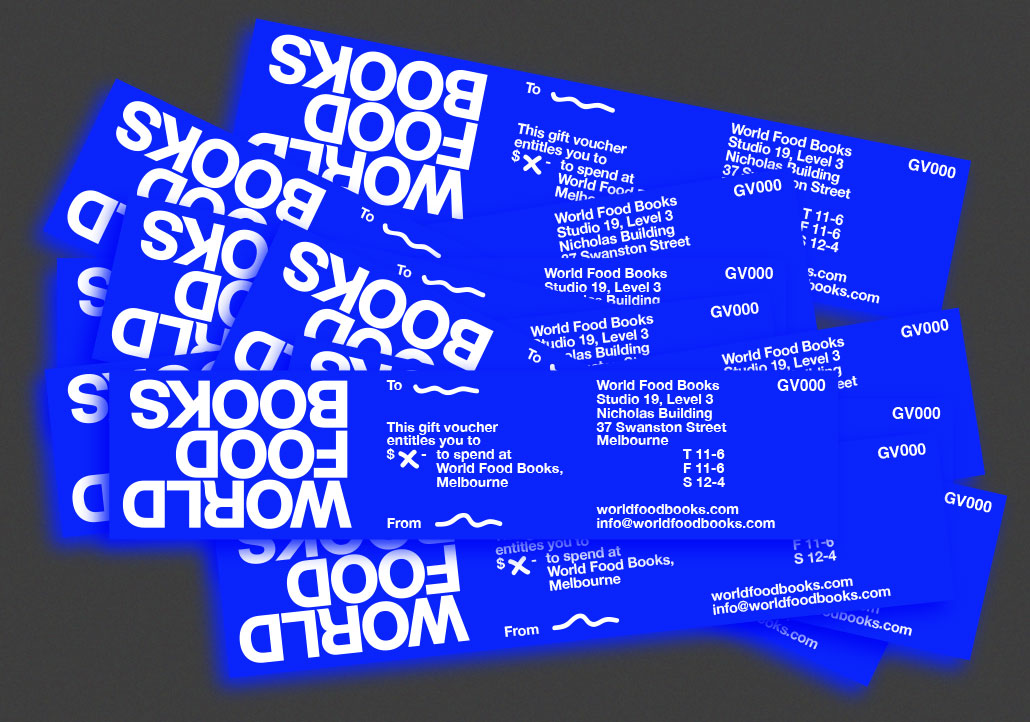
A World Food Books gift voucher is redeemable in our Melbourne bookshop or via our webshop (here). An e-voucher (printable pdf) will be sent to your purchase email address (please notify us if you wish to have the voucher sent to an alternate address and wish us to fill in the receiver's details on the card).
Gift vouchers can be purchased in increments of $20 (Australian Dollars) and the total amount can simply be added to by increasing the quantity in your shopping cart. eg. A quantity of 5 gift vouchers will result in an item total of $100 - a $100 gift voucher. Simply click "ADD TO CART" 5 times, or update your quantity in the shopping cart.
If you wish to purchase multiple, separate gift vouchers in one go, please just email us and we can personally prepare and email you a payment request.
Please note: Please select Pick-Up on gift voucher purchse to avoid any postage charges. Accidental postage charges will be refunded right away!
Thank you.
For any questions, please don't hesitate to email: [email protected]
2015, English / Japanese
Hardcover (w. dust jacket), 80 pages, 23.8 x 19.5 cm
1st Edition, Out of print title / used / fine
Published by
Pan-Exotica / Tokyo
$80.00 - In stock -
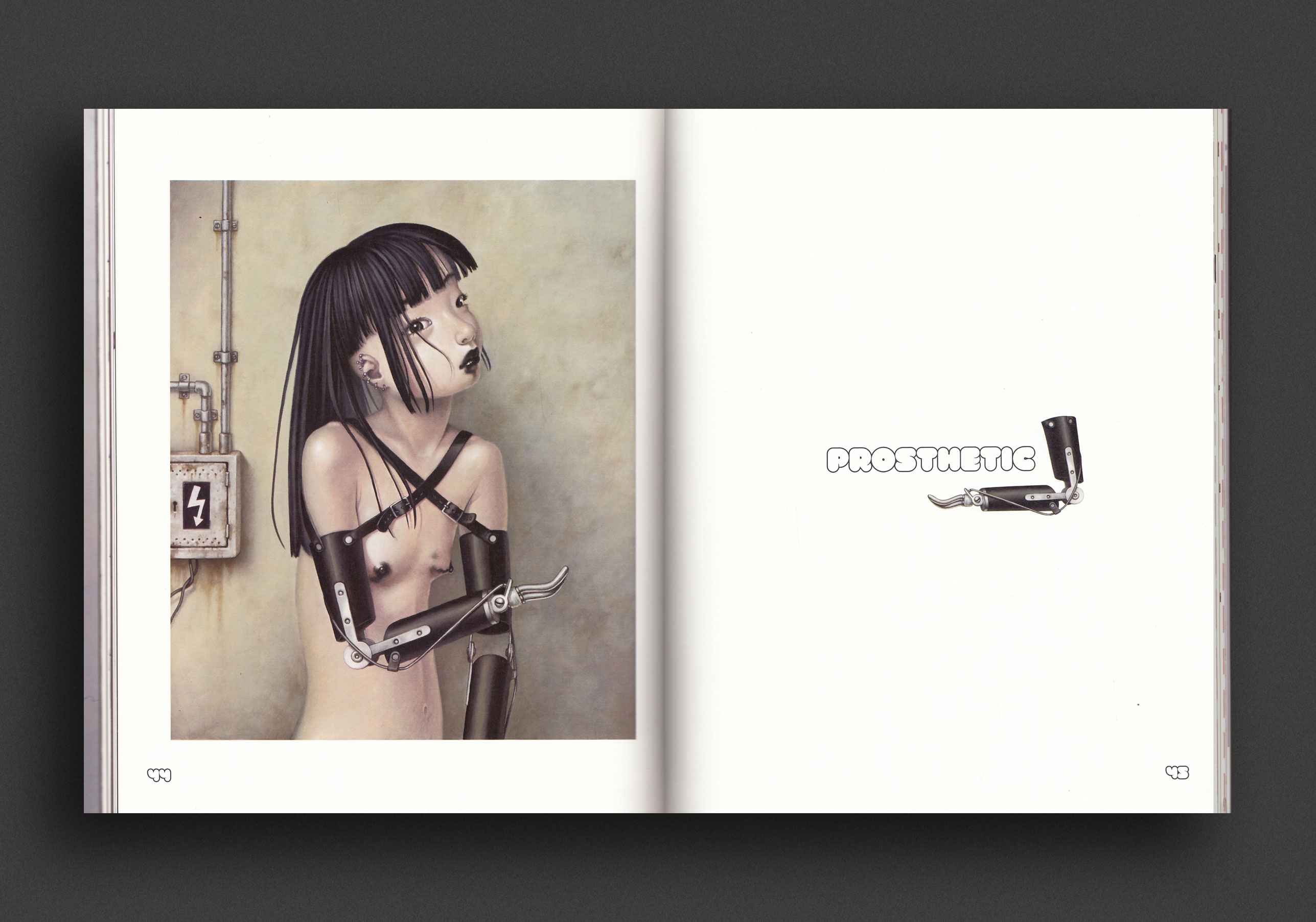
First 2015 hardcover edition of Trevor Brown's Pandora, a collection of uniquely cutesy/disturbing and now iconic paintings of girls and themes of "medical art", like his friend, Bazooka-artist and photographer, Romain Slocombe. Brown's lolita-esque girls and girl-dolls, however, dwell in the world of gothic horror and transgressive scenarios of fetishism, bondage, violence, body modification, etc. This series features artwork influenced by the art of Japanese doll–maker Etsuko Miura, whose book "Reincarnation" shares the same size and format and feature artworks from their joint exhibition at Bunkamura Gallery. Published only in Japan, where the English artist has resided since 1994.
Trevor Brown (b. 1959) is an illusive and prolific artist who's work explores paraphilias, such as lolicon, ero guro, BDSM, and other fetish themes. Innocence and violence collide in Brown's confronting images. Early features on his art appeared in Adam Parfrey's Apocalypse Culture II, Shade Rupe's Funeral Party 2, and in Jim Goad's ANSWER Me! zine, garnering him wide notoriety across the provocative underground publishing scene of the 1980s—90s. He's contributed artwork to many album covers of Whitehouse, Coil, John Zorn, and many more, illustrated for Coup de Grace, an edition of Friedrich Nietzsche's Der Antichrist, the covers of Timeless magazine, and more recently illustrated the cover of the Gothic & Lolita Bible (a subculture in which Brown has many dedicated fans) in Japan, where the the artist has lived since 1994 and where his work has been published in many art book editions.
NF in NF DJ.
1961 / 1973, English
Softcover, 184 pages, 20 x 14 cm
Out of print title / used / very good
Published by
City Lights Books / San Francisco
$30.00 - Out of stock
"This Book of Dreams is what Jack Kerouac saw in his sleep, not day-dreams or day reveries. It's his private dream-record, all his nights strung together. It's the poetic raw material of the Kerouac saga, the substrata of his novels and a commentary upon them. The characters who appear in the book are names who have appeared in "On the Road," "The Subterraneans," and "The Dharma Bums." From the Foreword by Kerouac: "The reader should know that this is just a collection of dreams that I scribbled after I woke up from my sleep - They were all written spontaneously, nonstop, just like dreams happen, sometimes written before I was even wide awake - The characters that I've written about in my novels reappear in these dreams in weird new dream situations and they continue the same story which is the one story that I always write about. The heroes of 'On the Road,' 'The Subterraneans,' etc. reappear here doing further strange things for no other particular reason than that the mind goes on, the brain ripples, the moon sinks, and everybody hides their heads under pillows with sleepingcaps."
Jack Kerouac (1922-1969) was a principal actor in the Beat Generation, a companion of Allen Ginsberg and Neal Cassady in that great adventure. His books include On the Road, The Dharma Bums, Mexico City Blues, Lonesome Traveler, Visions of Cody, Pomes All Sizes (City Lights), Scattered Poems (City Lights), and Scripture of the Golden Eternity (City Lights).
Very Good copy. 1973 print.
2025, English
Hardcover (w. dust jacket), 356 pages, 23 x 15.5 cm
1st Edition, Out of print title / used / fine
$45.00 - In stock -
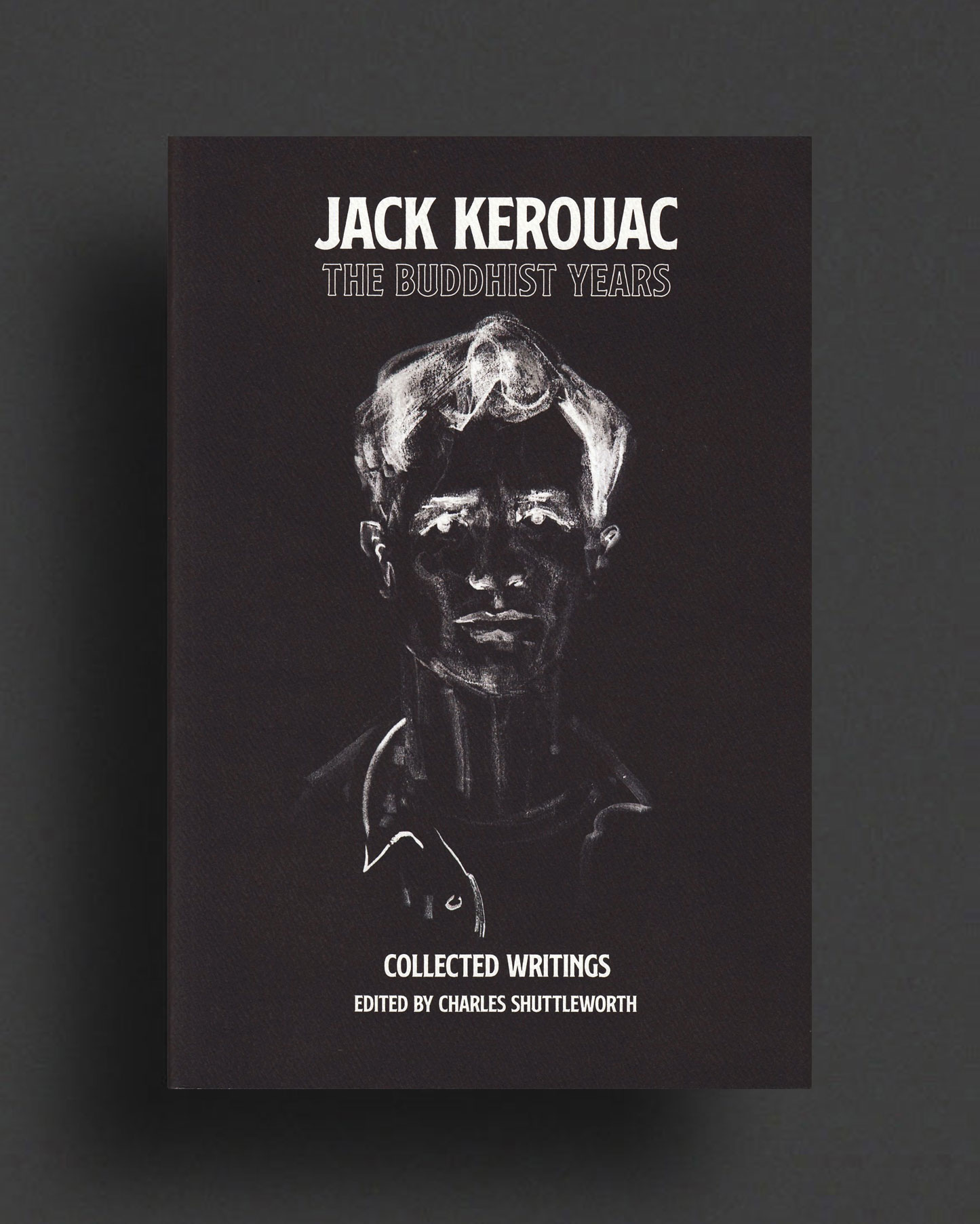
A brand new volume of previously unpublished writings from the archives reflecting Jack Kerouac's Buddhist thinking.
From a young age Kerouac was a spiritual thinker and questioner, and he always considered himself a spiritual writer. Buddhism gave more meaning to Jack's work as a writer: he was working not for personal accomplishment and glory but for human betterment. And Buddhism justified his lifestyle: with its vision of the material world as empty and illusory, he was free to do what he wanted. This collection shows Jack at his earnest, soulful best. The writing is consistently and wonderfully Kerouacian: it is honest, reflective, heartfelt, and revealing, with great characterizations amid his self-exploration as he wrestles with his consciousness, desperate for belief.
Jack Kerouac was born in Lowell, Massachusetts, in 1922, the youngest of three children in a Franco-American family. He attended local Catholic and public schools and won a scholarship to Columbia University in New York City, where he first met Neal Cassady, Allen Ginsberg, and William S. Burroughs. His first novel, The Town and the City, appeared in 1950, but it was On the Road, published in 1957 and memorializing his adventures with Neal Cassady, that epitomized to the world what became known as the "Beat generation" and made Kerouac one of the most best-known writers of his time. Publication of many other books followed, among them The Dharma Bums, The Subterraneans, and Big Sur. Kerouac considered all of his autobiographical fiction to be part of "one vast book," The Duluoz Legend. He died in St. Petersburg, Florida, in 1969, at the age of forty-seven.
1979, English
Softcover, 188 pages, 28 x 22 cm
1st US Edition, Out of print title / used / very good
Published by
St. Martin's Press / New York
$70.00 - In stock -
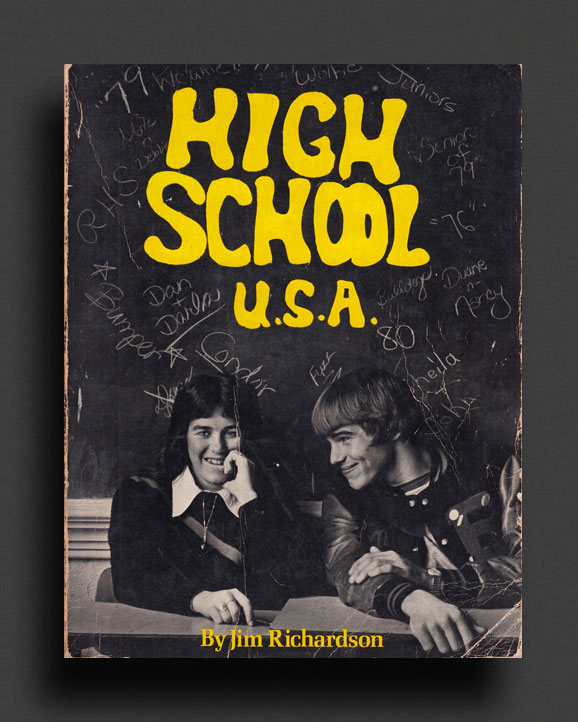
Softcover edition of the first (only) printing of cult photobook "High School U.S.A.", Jim Richardson's intimate 1979 portrait of American adolescence at Rossville High in Rossville, Kansas.
For three years in the late 1970's, Richardson photographed and documented the life of these high school teenagers, coming back every year to vicariously live through all of the life-altering events that high school presents to these young adults. Richardson's photographs of students, teachers, and coaches at Rossville High School in Rossville, Kansas, combined with the students' own words, capture the high school experience from football season to graduation and through identity struggles and romantic involvements that files perfectly alongside Joseph Szabo's great "Almost Grown".
Average–Good Copy throughout with decent cover wear to extremities/small creases (see picture). Internally g–VG with revious owner's name penned to title page.
2003, English / Japanese
Softcover (die-cut, embossed stiff slipcase w. internal illustrated card fold-out sleeve), 92 pages, 22 x 30 cm
Signed by artist,
1st Edition, Out of print title / used / very good
Published by
Treville / Tokyo
$350.00 - In stock -
First, deluxe edition of this rare Hajime Sorayama book published by Treville especially for the exhibition 'Hajime Sorayama - The Exhibition' at Ginza Graphic Gallery in 2003. Now out-of-print and collectible, this extra special copy is also signed by Sorayama himself on the cover "cleavage". Housed in an embossed, die-cut corset slipcase, with an illustrated, fold-out "pin-up" doubled-sided internal sleeve, both made from stiff card, this catalogue is profusely illustrated throughout with Japanese airbrush master Hajime Sorayama's erotic, futuristic, hyper-realistic illustrations with a heavy emphasis on latex and bondage mistresses. Includes his own commentary throughout (in English and Japanese), plus a special look inside his atelier.
Hajime Sorayama (b. 1947) is a Japanese illustrator famed for his precisely detailed, erotic portrayals of feminine robots and fetish pin-ups, and also well-known for his design work on the original Sony AIBO. He describes his highly detailed style as "superrealism", which he says "deals with the technical issue of how close one can get to one's object."
Very Good copy.
1967 / 1976, English
Hardcover (w. dust jacket), 96 pages, 25.5 x 19 cm
Out of print title / used / very good
Published by
Studio Vista / London
$35.00 - In stock -
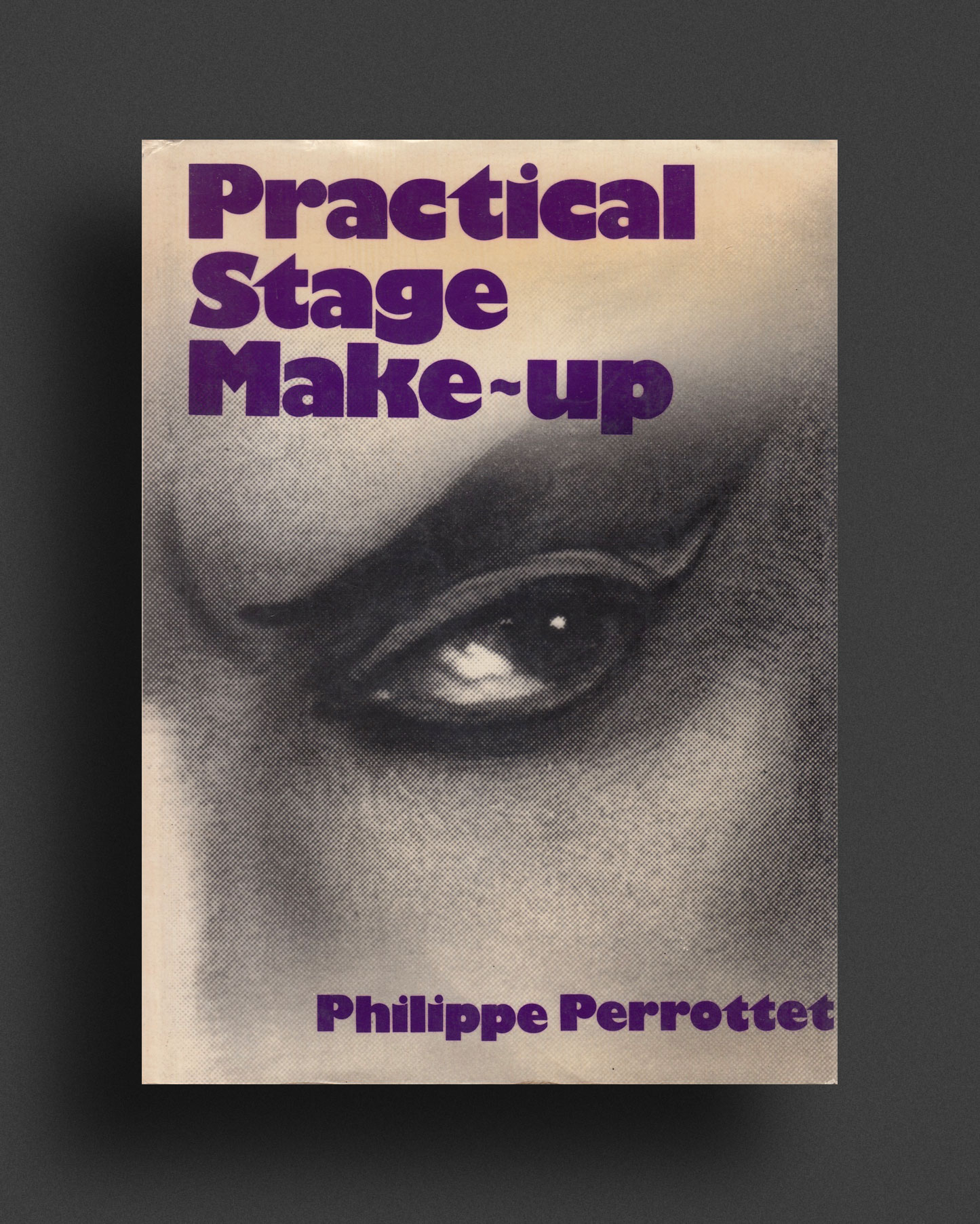
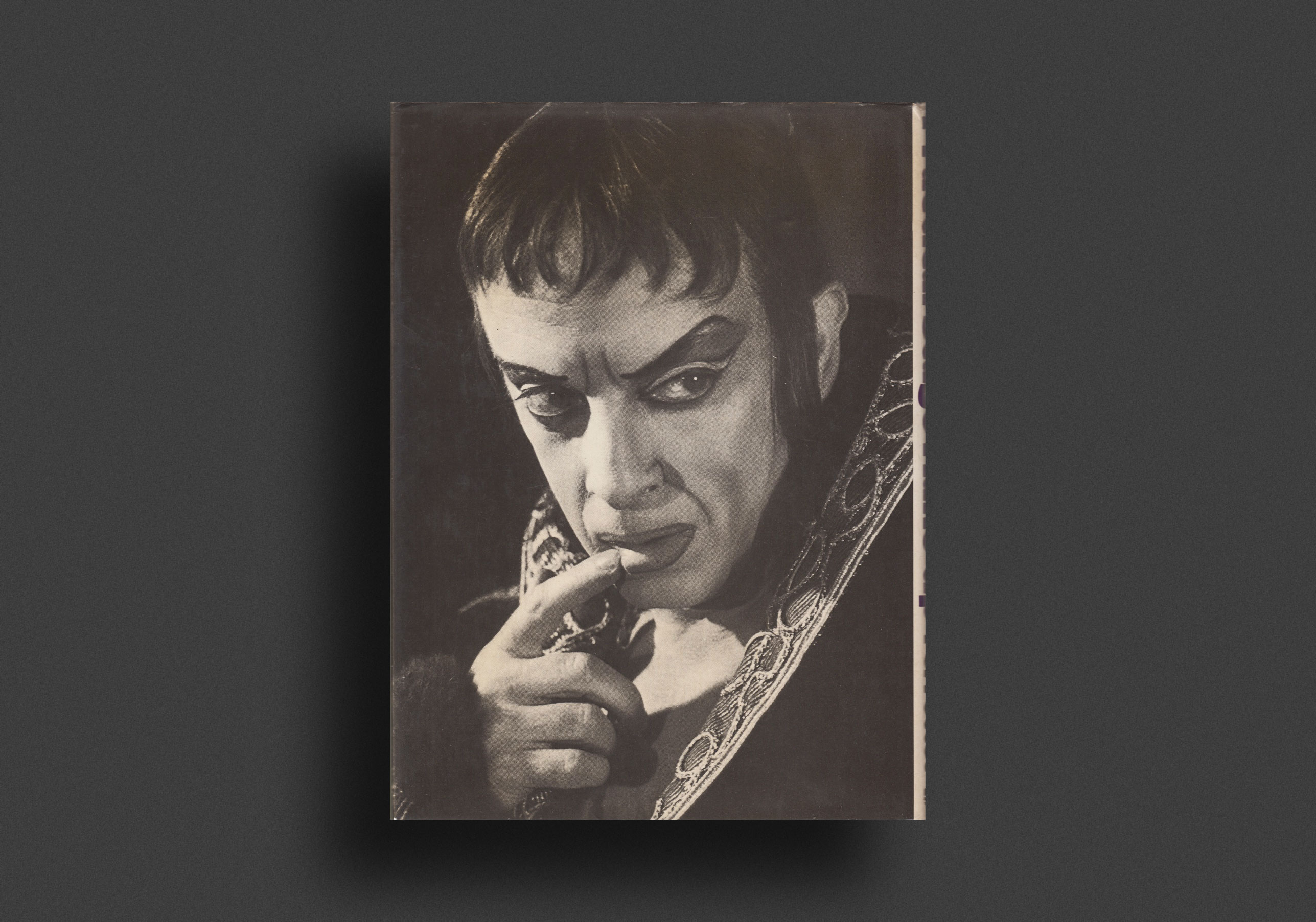
Published in 1967, and revised in this hardcover edition in 1975/1976 by Studio Vista, London, Practical Stage Make-Up by Australian dancer, choreographer, and act Philippe Perrottet. Heavily illustrated in colour and b/w with a wealth of practical information on make–up for theatre, from an expert in the field.
Philippe Louis Gaston Perrottet (1921–1982) was an Australian dancer, choreographer, and actor celebrated for his work in British theatre, opera, and television. Born in Kew, Melbourne, he served in the Royal Australian Air Force during World War II before training under dance luminaries like Anton Dolin and Edvard Borovansky. After performing with the Australian Ballet Society and Colonel de Basil’s Russian Ballet, he relocated to the UK in 1947. There, he danced in the classic film The Red Shoes (1948), appeared in London's West End, and spent a decade (1958–1968) as a prominent choreographer for Sadler's Wells Opera, alongside choreographing numerous British television productions until his death in Rome in 1982.
VG copy with some foxing in VG dust jacket (price–clipped), preserved in mylar wrap.
2019, English
Hardcover, 464 pages, 28.6 x 21.8 cm
1st Edition, Out of print title / as new
Published by
The MIT Press / Massachusetts
$80.00 - In stock -
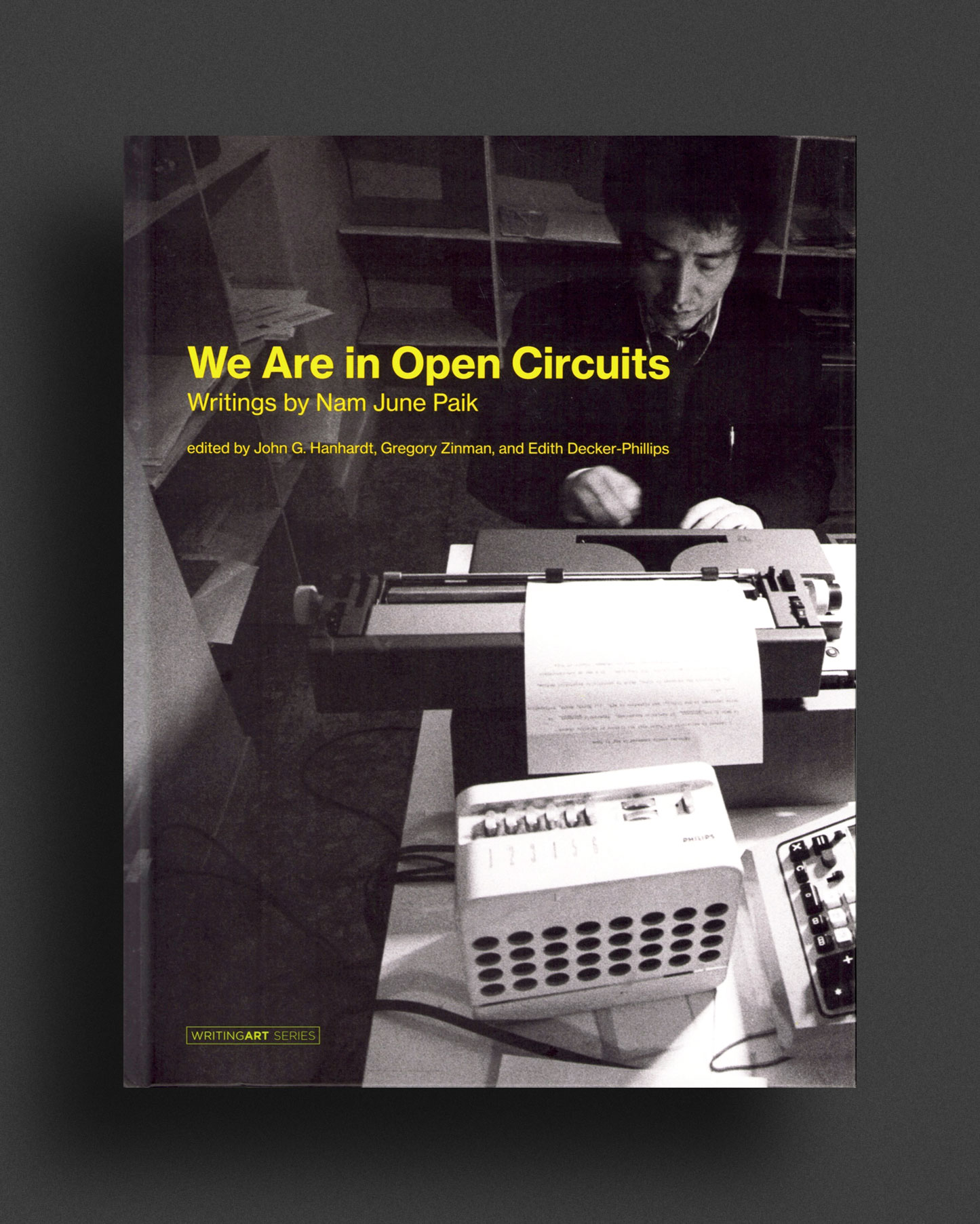
Edited by John G. Hanhardt, Gregory Zinman and Edith Decker-Phillips
Essays, project plans, and correspondence from across Nam Jun Paik's career, much of it previously out of print or unpublished.
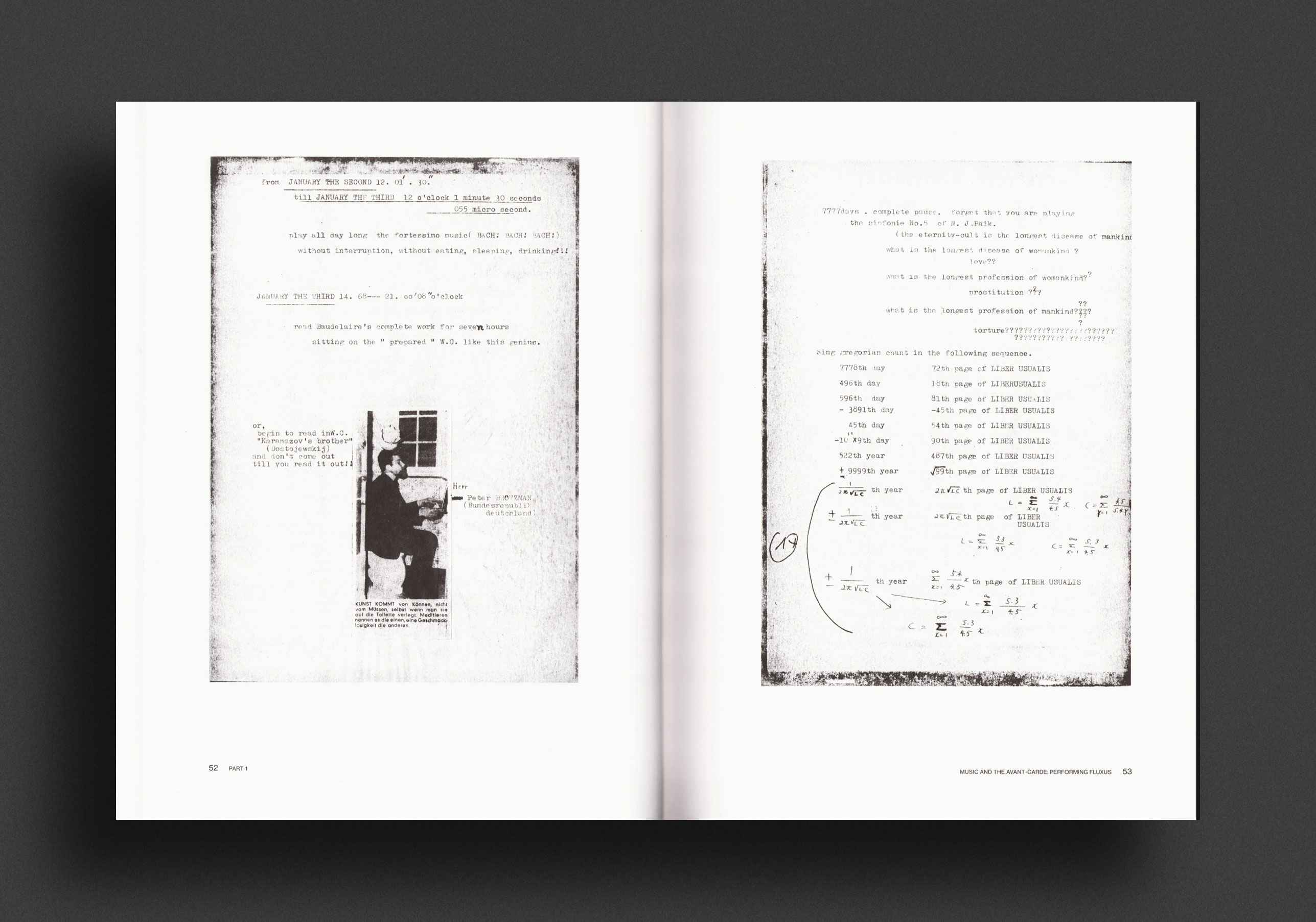
Nam June Paik (1932–2006) is a pivotal figure in the history of modern art. Arguably the most important video artist of all time, and certainly among the most influential and prolific, Paik was a legendary innovator who transformed the electronic moving image into an artist's medium. He wrote incessantly—corresponding with friends, composing performance scores, making production notes for television projects, drafting plans for video installations, writing essays and articles. Celebrated for his visionary development of new artistic tools and for his pioneering work in video and television, Paik often wrote to sharpen his thinking and hone his ideas. He used the typewriter to fashion sentences that broke apart and reassembled themselves as he wrote, producing both poetic texts and aesthetic objects on the page. This first extensive collection of Paik's writings includes many previously unpublished and out-of-print texts.
Drawing on materials from the Smithsonian American Art Museum's Nam June Paik Archive and from a range of international publications, We Are in Open Circuits offers important but long-unavailable essays, including “Global Groove and Video Common Market”; unpublished writings on such topics as his creative partnership with the cellist Charlotte Moorman and the role of public television; a substantial part of his compilation “Scrutable Chinese”; and detailed plans for some of his groundbreaking broadcast works, including the trio Good Morning, Mr. Orwell (1984), Bye Bye Kipling (1986), and Wrap Around the World (1988). It also includes nearly 150 pages that reproduce Paik's original typed and handwritten pages, letting readers see his writing in various stages of inspiration and execution.
John G. Hanhardt is an independent curator of film and the media arts and has curated Nam June Paik retrospectives at the Whitney Museum of American Art, Guggenheim Museum, and Smithsonian American Art Museum.
Gregory Zinman is Assistant Professor in the School of Literature, Media, and Communication at Georgia Tech.
Edith Decker-Phillips is an art historian and the author of Paik Video.
As New.
1986, Japanese
Softcover (w. dust jacket), 128 pages, 15 x 21 cm
1st Edition, Out of print title / used / very good
Published by
Bandai / Tokyo
$140.00 - In stock -
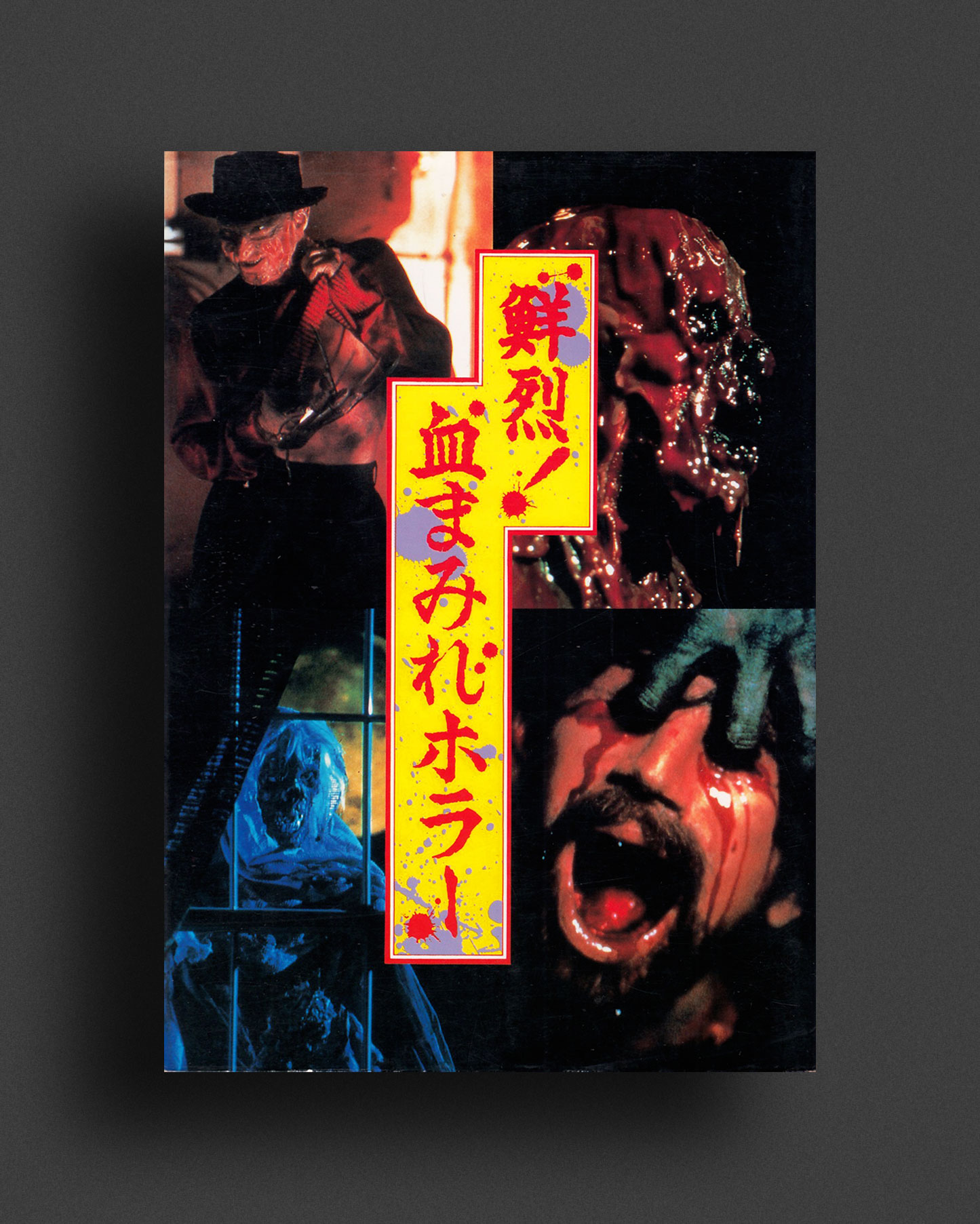
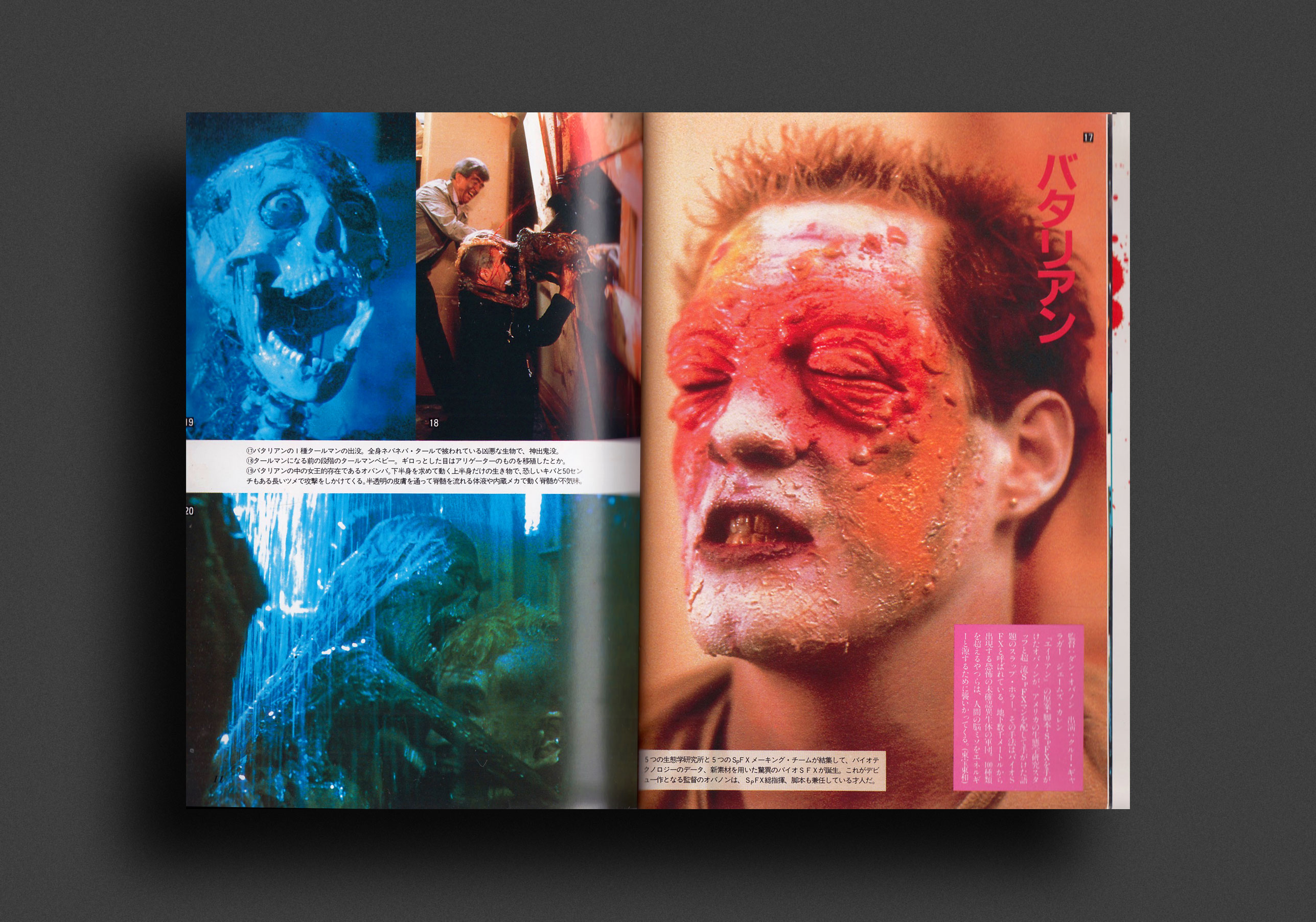
Rare copy of 1986's Vivid! Bloody Horror, the amazing Japanese book that collects articles and hundreds of stills, as well as poster art, from the bloodiest of horror film history. Profusely illustrated throughout in vivid gore-saturated colour and b/w with image features on the films of Dario Argento, Lucio Fulci, Tobe Hooper, David Cronenberg, George A. Romero, Herschell Gordon Lewis, Wes Craven, William Malone... Heavily illustrated articles document the horror films of South East Asia, pay tribute to Tobe Hooper and Herschell Gordon Lewis, survey of prop weaponry, and much more. Includes the "Blood-Stained Cathode-Ray Tube Horror Movie Collection" — the ultimate guide to horror on video. Too much in here to list. The ultimate ode to splatter, and a valuable resource. Texts in Japanese.
Very Good copy.
1973, English
Softcover (denim-bound, stitched and silk-screened), 96 pages, 24 x 22 cm
1st Edition, Out of print title / used / very good
Published by
NGV (National Gallery of Victoria) / Victoria
Art Gallery of New South Wales / Sydney
Art Gallery of South Australia / Adelaide
City of Auckland Art Gallery / Auckland
$180.00 - In stock -
The art catalogue wearing denim! Fantastic, scarce exhibition catalogue from 1973 for "Some Recent American Art", a major contemporary survey that toured Australia and New Zealand, organised under the auspices of the International Council of the Museum of Modern Art New York with the assistance of Graeme Sturgeon, David Sampietro, and Peter Cripps. Wrapped in jeans denim covers (screen-printed and stitched), and profusely illustrated throughout in colour and b/w with the work of exhibiting artists Vito Acconci, Carl Andre, John Baldessari, Lynda Benglis, Mel Bochner, Dan Flavin, Eva Hesse, Robery Irwin, Donald Judd, Joseph Kosuth, Sol LeWitt, Brice Marden, Agnes Martin, Robert Morris, Bruce Nauman, Dorothea Rockburne, Robert Ryman, Richard Serra, Keith Sonnier, William Wegman, and Lawrence Weiner. Each artist section includes a list of works, biographical information and text(s) from the artist. Opening text by curator Jennifer Licht, acknowledgments by NGV director Gordon Thomson, with further sections on exhibited Video Tapes, bibliography and artist index.
This special copy also includes the inserted National Gallery of Victoria director's announcement for Yvonne Rainer's "Performance around an unfinished film", February 13, 1974, 8:30 pm at National Gallery of Victoria, Melbourne, during the exhibition. The stapled, 4-page letterhead announcement includes information on the performance, list of performances, list of technical assistants, texts on Rainer, biography, chronology, and selected reading.
Very Good copy, well preserved.
1993, Japanese
Hardcover (w. dust jacket), 220 pages, 13.6 cm x 19.4 cm
1st Edition, Out of print title / used / fine
Published by
Seikyūsha / Tokyo
$110.00 - In stock -
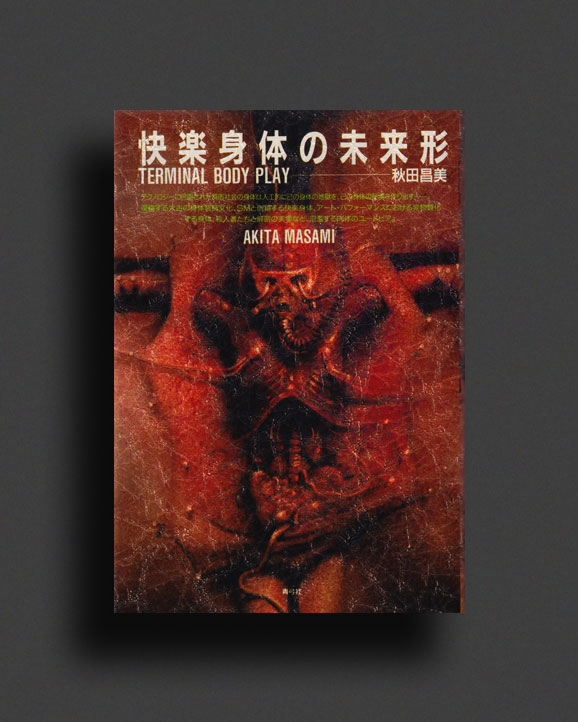
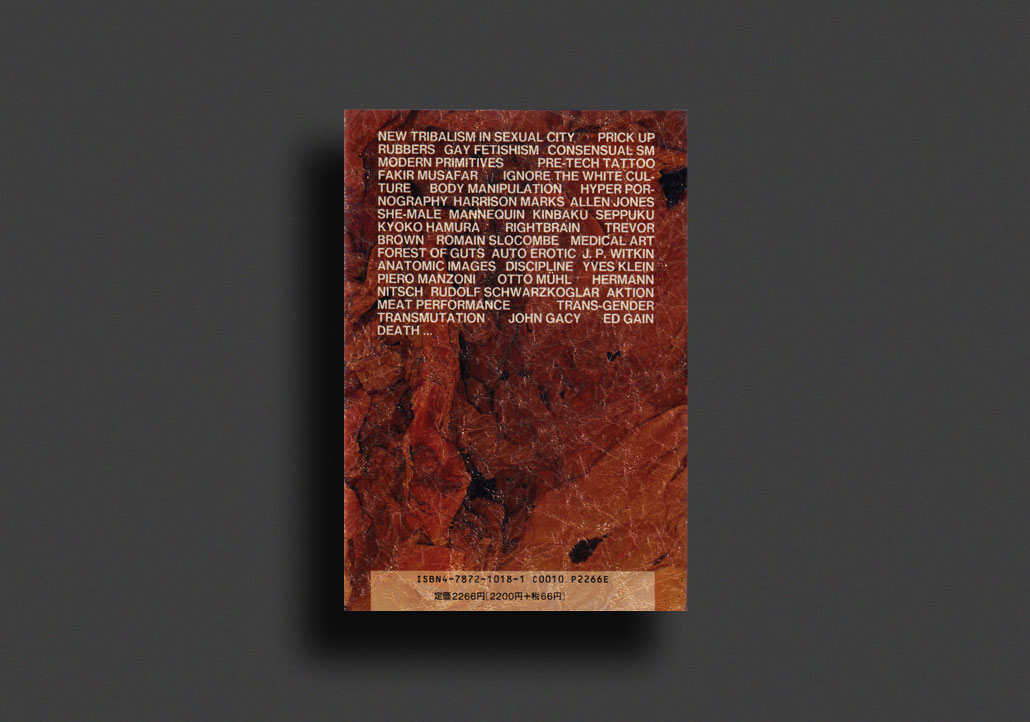
New Tribalism In Sexual City, Prick Up, Rubbers, Gay Fetishism, Consensual SM, Modern Primitives, Pre-Tech Tattoo, Fakir Musafar, Ignore the White Culture, Body Manipulation, Hyper Pornography, Harrison Marks, Allen Jones, She-Male, Mannequin, Kinbaku, Seppuku, Kyoko Hamura, Rightbrain, Trevor Brown, Roman Slocombe, Medical Art, Forest Of Guts, Auto Erotic, J. P. Witkin, Anatomic Images, Discipline, Yves Klein, Piero Manzoni, Otto Mühl, Hermann Nitsch, Rudolf Schwarzkoglar, Aktion, Meat Performance, Trans-Gender, Transmutation, John Gacy, Ed Gain, Death ...
First hardcover edition of "Terminal Body Play", written by Merzbow's Masami Akita and published only in Japan in 1993. Covering all the above subjects with b/w illustrations, "Terminal Body Play" explores a plethora of physical utopias, including a revived ancient culture of body decoration and manipulation, the pleasure of the body perverted by BDSM, the dematerialised body of performance art, the aesthetics of murder, medicine and anatomy, and so much more. Merzbow is a noise project created in Tokyo, Japan in 1979 under the direction of noise technician Masami Akita. As well as a legendary underground noise artist, Akita is a prolific writer in Japan and frequently writes on the arts, music, erotica, esoterica, modern architecture, and animal rights, with articles on emerging subcultures and underground extreme cultures appearing in publications like SM Sniper, Studio Voice and Fool's Mate. His development of the Merzbow aesthetic ran parallel with a series of investigative books in which he catalogued and introduced a vast amount of hermetic types of music, sexual practices and autonomous creativity to a fairly conservative (but not close-minded) Japanese audience. "Terminal Body Play" is one of these very books.
First edition, Japanese text, fine copy with fine "textured" and illustrated dust jacket.
1985, English
Softcover, 160 pages, 23 x 15.5 cm
1st Edition, Out of print title / used / very good
Published by
University of Minnesota Press / Minnesota
$45.00 - Out of stock
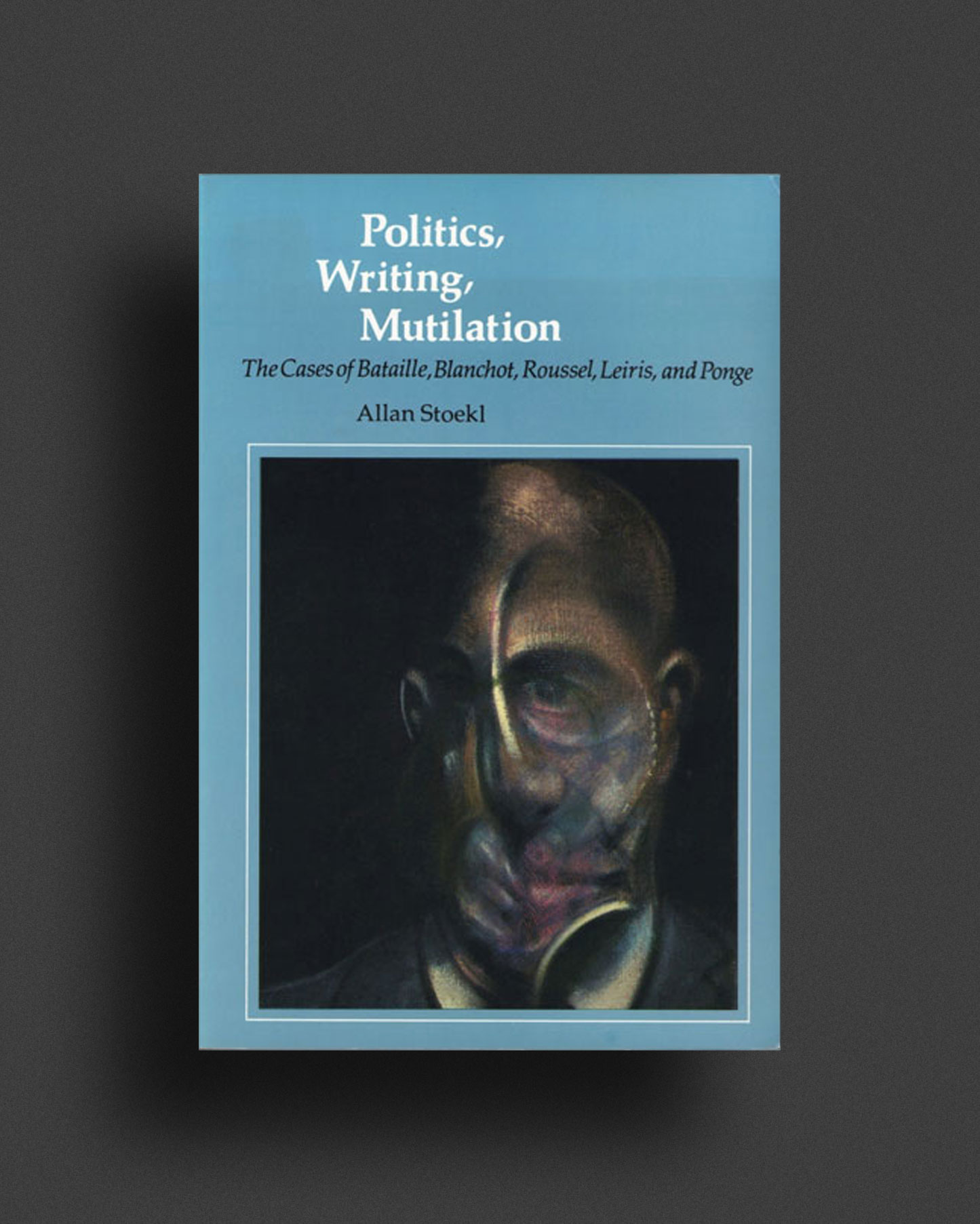
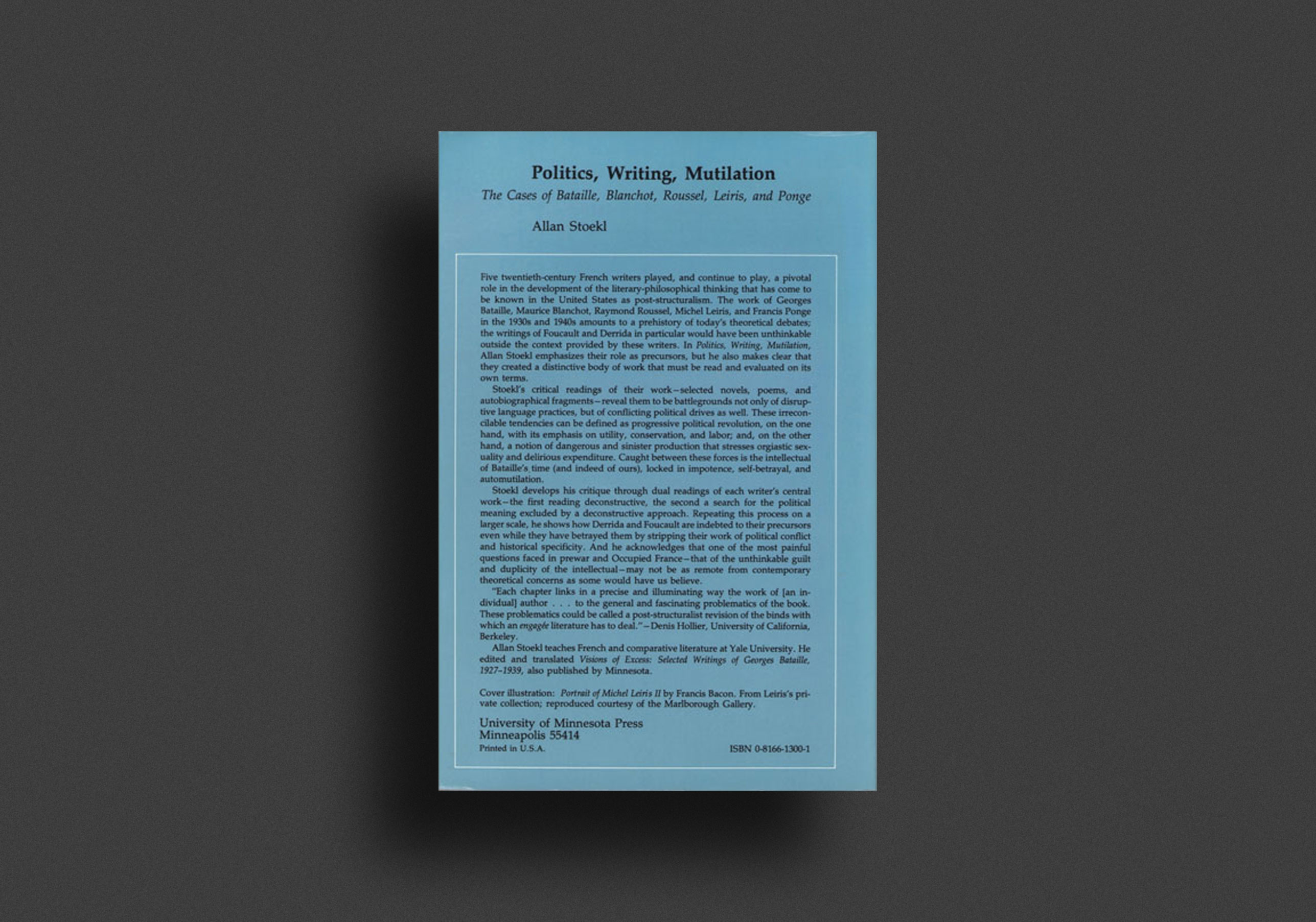
First edition of Allan Stoekl's Politics, Writing, Mutilation, published in 1985 by Minnesota Press.
Five twentieth-century French writers played, and continue to play, a pivotal role in the development of literary-philosophical thinking that has come to be known in the United States as post-structuralism. The work of Georges Bataille, Maurice Blanchot, Raymond Roussel, Michel Leiris, and Francis Ponge in the 1930s and 1940s amounts to a prehistory of today's theoretical debates; the writings of Foucault and Derrida in particular would have been unthinkable outside the context provided by these writers. In Politics, Writing, Mutilation, Allan Stoekl emphasizes their role as precursors, but he also makes clear that they created a distinctive body of work that must be read and evaluated on its own terms.
Stoekl's critical readings of their work-selected novels, poems, and autobiographical fragments-reveal them to be battlegrounds not only of disruptive language practices, but of conflicting political drives as well. These irreconcilable tendencies can be defined as progressive political revolution, on the one hand with its emphasis on utility, conservation, and labor; and, on the other hand, a notion of dangerous and sinister production that stresses orgiastic sexuality and delirious expenditure. Caught between these forces is the intellectual of Bataille's time (and indeed of ours), locked in impotence, self-betrayal, and automutilation.
Stoekl develops his critique through dual readings of each writer's central work-the first reading deconstructive, the second a search for the political meaning excluded by a deconstructive approach. Repeating this process on a larger scale, he shows how Derrida and Foucault are indebted to their precursors even while they have betrayed them by stripping their work of political conflict and historical specificity. And he acknowledges that one of the most painful questions faced in prewar and Occupied France-that of the unthinkable guilt and duplicity of the intellectual-may not be as remote from contemporary theoretical concerns as some would have us believe.
"Allan Stoekl teaches french and comparative literature at Yale University. He edited and translated Vision of Excess: Selected Writings of Georges Bataille, 1997-1939, also published by Minnesota. "
VG copy.
2026, English
Softcover, 139 pages, 20.7 x 14.8 cm
Ed. of 300 w. print,
Published by
Gallows Fruit / Thailand
$59.00 - In stock -
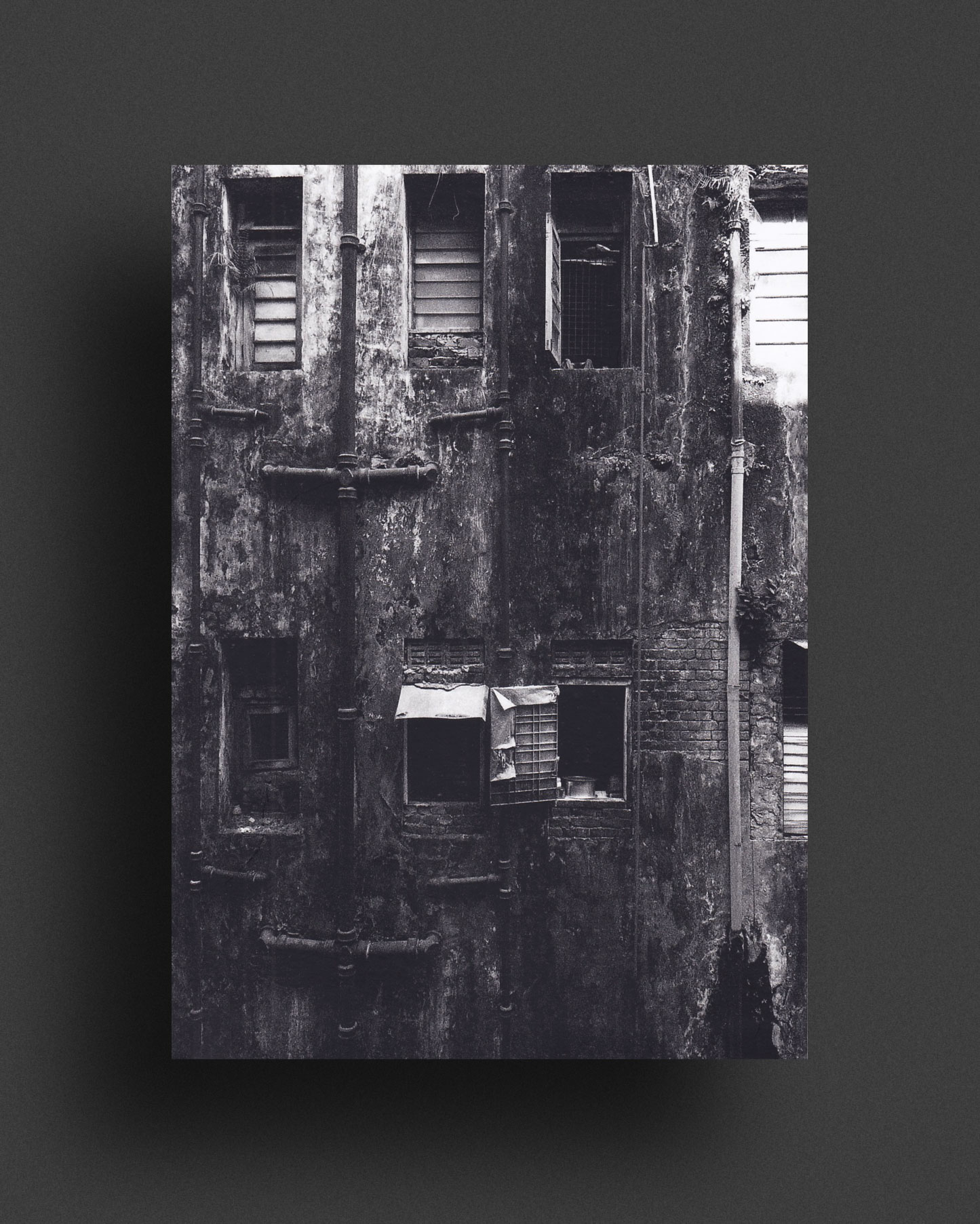
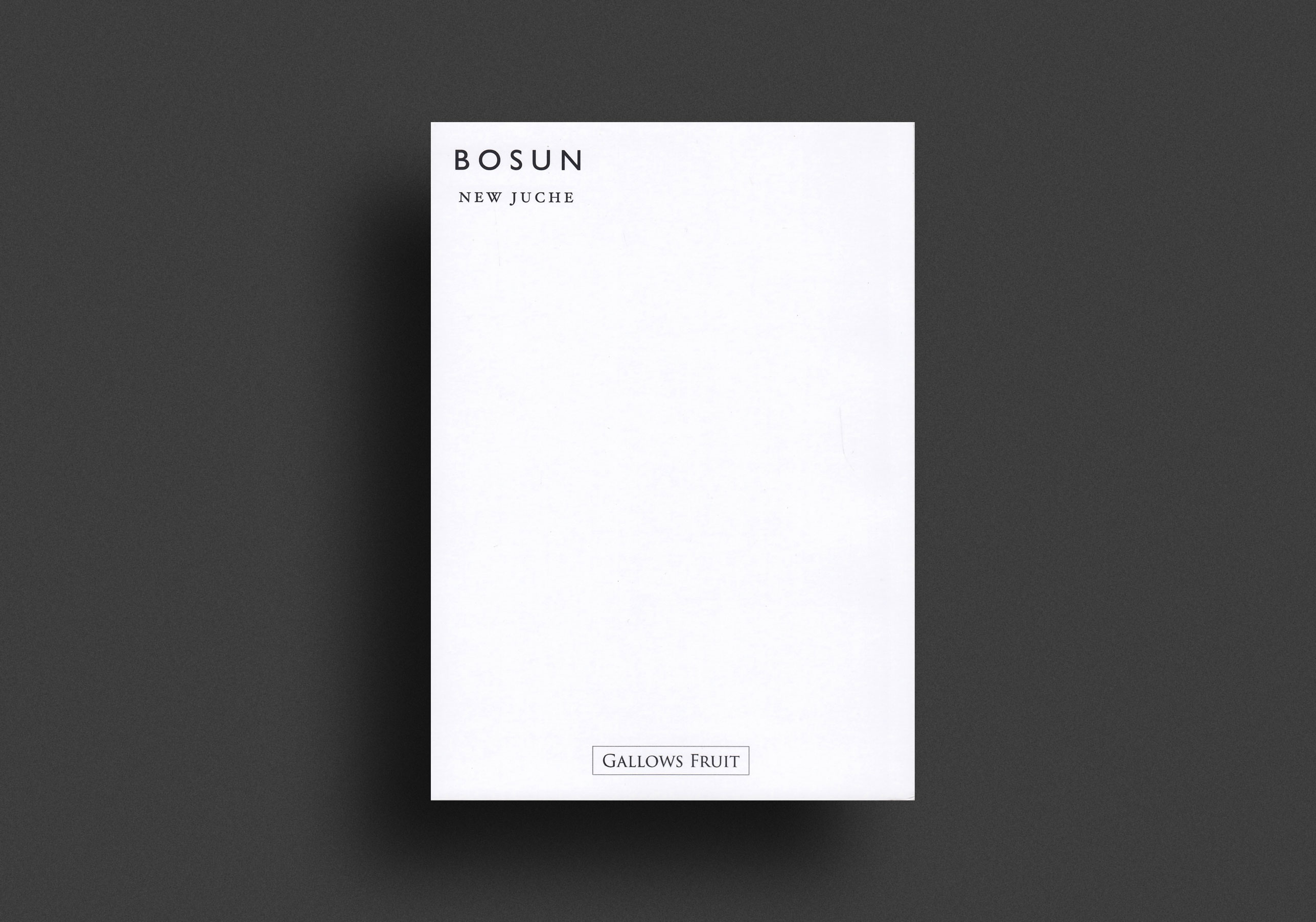
RANGOON; BURMA; ARCHITECTURE; BRITISH EMPIRE; COLONIALISM; CHILDHOOD; TOPOPHILIA; HOTELS; VIOLENCE; BEER; ORWELL; PHOTOGRAPHY; SOLITUDE; SUBLIMATION; CHOKE JERICHO; BOSUN
In this new edition of New Juche’s BOSUN, the author turns his formidable attention toward the architecture and spatial sensibilities of the city of Rangoon, which evoke for him the dereliction of Thatcher’s Britain and the dreamy trauma and abuse of his early institutional life. Sensual, redolent and deeply personal, BOSUN is a perversely lyrical rumination that will long remain with the reader, like shame or grief.
The text of this edition has been re-edited, and the photographic section greatly extended. The first 300 copies come with a print.
1989, English
Hardcover (w. dust jacket), 266 pages, 21.8 x 14.8 cm
1st Edition, Out of print title / used / very good
Published by
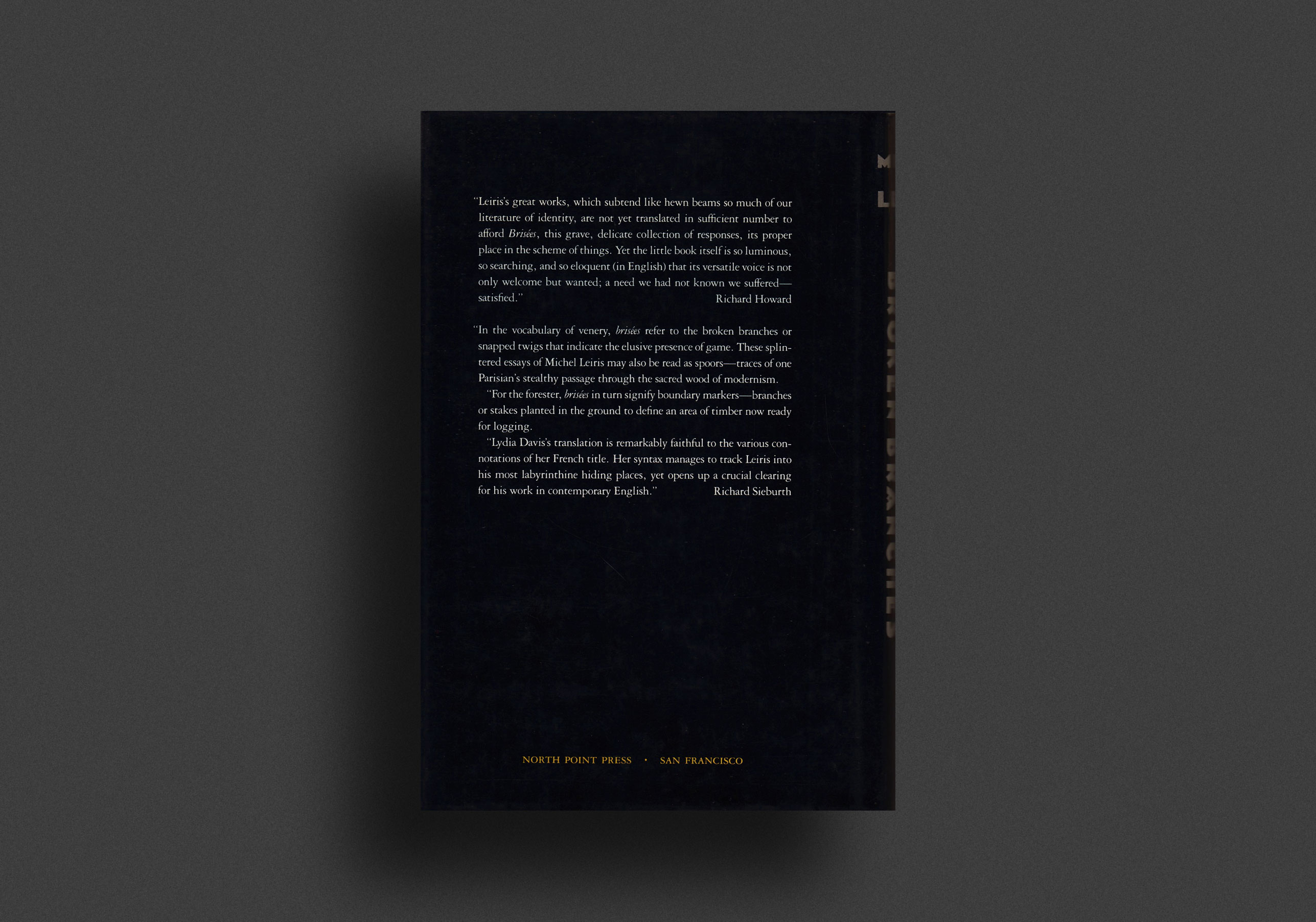
North Point Press / San Francisco
$35.00 - Out of stock
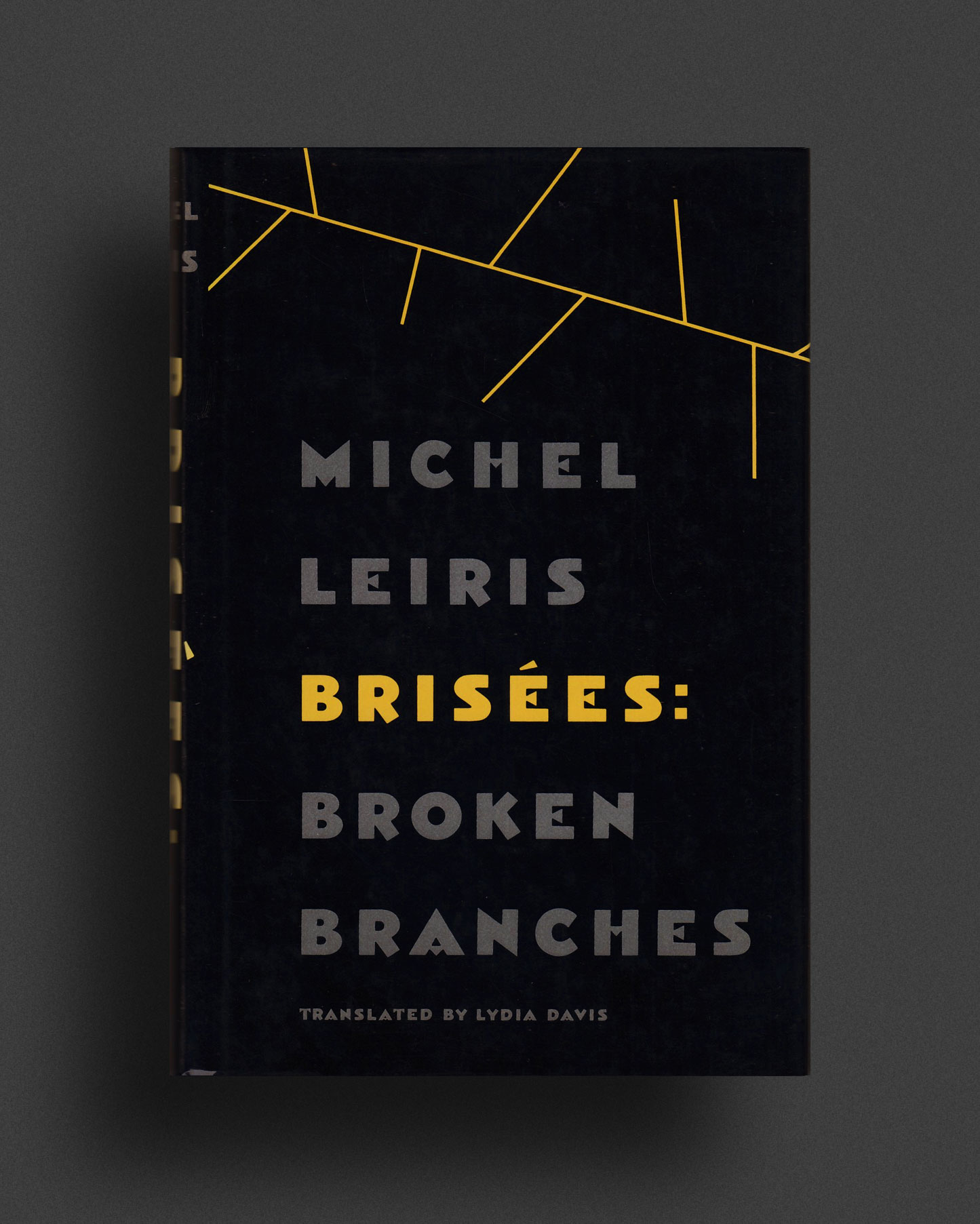
First hardcover edition.
Translated by Lydia Davis
"Leiris's great works, which subtend like hewn beams so much of our literature of identity, are not yet translated in sufficient number to afford Brisées, this grave, delicate collection of responses, its proper place in the scheme of things. Yet the little book itself is so luminous. so searching, and so eloquent (in English) that its versatile voice is not only welcome but wanted: a need we had not known we suffered–satisfied."
Richard Howard
"In the vocabulary of venery, brisées refer to the broken branches or snapped twigs that indicate che elusive presence of game. These splintered essays of Michel Leiris may also be read as spoors–traces of one Parisian's stealthy passage chrough the sacred wood of modernism.
"For the forester, brisées in turn signify boundarv markers–branches or stakes planted in the ground to define an area of timber now ready for logging.
"Lydia Davis's translation is remarkably faithful to the various connotations of her French title. Her syntax manages to track Leiris into his most labyrinthine hiding places, yet opens up a crucial clearing for his work in contemporary English."–Richard Sieburth
Fifty-one essays and shorter pieces collected from across the author's career; subjects include: Marcel Duchamp, The 1929 Fox Movietone Follies, Georges Bataille, The Marionette of Ubu, Arnold Schoenberg, 'Phantom Africa', Fred Astaire, Aimé Césaire, epilepsy, Hans Arp, Raymond Queneau, Stéphane Mallarmé, Spain 1934-1936, Eric Satie's humour, Voodoo, Michel Butor, Pierre Reverdy, Alberto Giacometti, Raymond Roussel, Arthur Rimbaud, talkies, Paul Éluard, two versions of 'Glossary: My Glosses Ossuary', and so much more.
VG–NF copy in VG–NF dust jacket, preserved in mylar wrap.
2018, English
Hardcover, 480 pages, 17.4 x 23.2 cm
Published by
Atlas Press / London
$74.00 - In stock -
Georges Bataille's secret society, long the stuff of legend, is now revealed in its texts, meditations, rules and prohibitions.
This book recounts what must be one of the most unusual intellectual journeys of modern times, in which the influential philosopher, cultural theorist and occasional pornographer Georges Bataille (1897-1962), having spent the early 1930s in far-left groups opposing the rise of fascism, abandoned that approach in order to transfer the struggle onto "the mythological plane."
In 1937, Bataille founded two groups in order to explore the combinations of power and the "sacred" at work in society. The first group, the College of Sociology, gave lectures that were intended to reveal the hidden undercurrents within a society on the verge of catastrophe. The second group was Acéphale, a genuine secret society and anti-religion whose emblem was a headless figure that, in part, represented the death of God. Until the discovery a few years ago of the group's internal papers (which include theoretical texts, meditations, minutes of meetings, rules and prohibitions and even a membership list), almost nothing was known of its activities.
This book is the first to collect a representative selection of the writings of Bataille, and of those close to him, in the years leading up to World War II. The texts published here comprise lectures given to the College of Sociology by Bataille, Roger Caillois and Michel Leiris, essays from the Acéphale journal and a large cache of the internal papers from the secret society. A desperate narrative unfolds, wherein Bataille risked all in a wholly unreasonable quest--with a few fellow travelers, he undertook what he later described as a "journey out of this world."
Additional texts by Roger Caillois, Pierre Klossowski, Michel Leiris, and by Georges Ambrosino, Pierre Andler, Michel Carrouges, Jacques Chavy, Jean Dautry, Henri Dobier, Henri Dussat, Imre Kelemen, Jean Rollin, Patrick Waldberg.
And with drawings by André Masson
Highest recommendation!
2026, English
Softcover (w. card dust jacket), 64 pages, 28 x 21 cm
Published by
Yanni Florence / Melbourne
$50.00 - In stock -
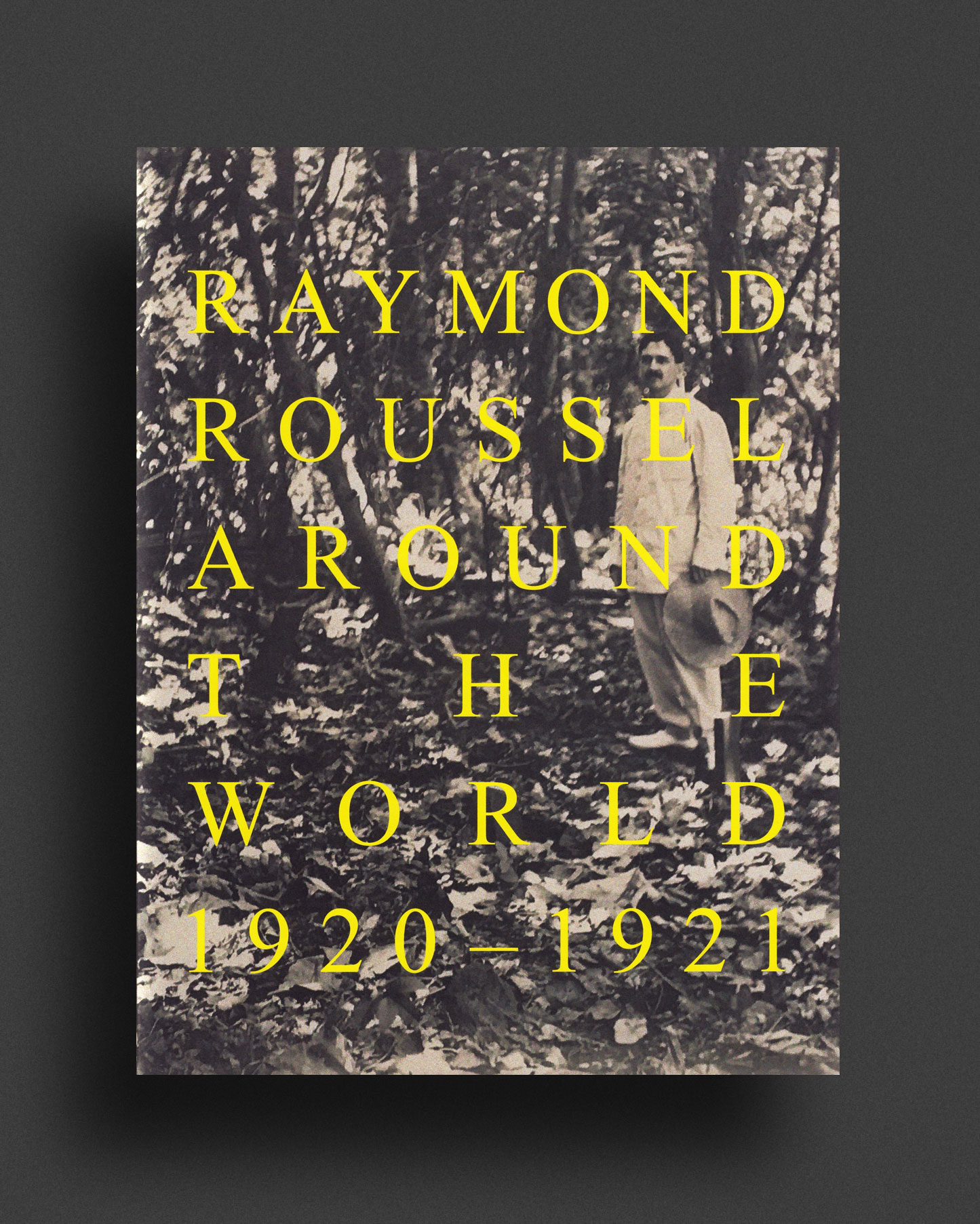
A 64-page illustrated book documenting Raymond Roussel's 1920–1921 journey around the world.
French writer Raymond Roussel (1877–1933) was one of the most original and enigmatic literary figures of the twentieth century. His novels, poetry and plays inspired writers and artists including Jean Cocteau, Salvador Dalí, Marcel Duchamp, Michel Leiris, Michel Foucault, John Ashbery and Georges Perec. This book, eight years in the making, documents Roussel's 1920–1921 journey around the world in unprecedented detail.
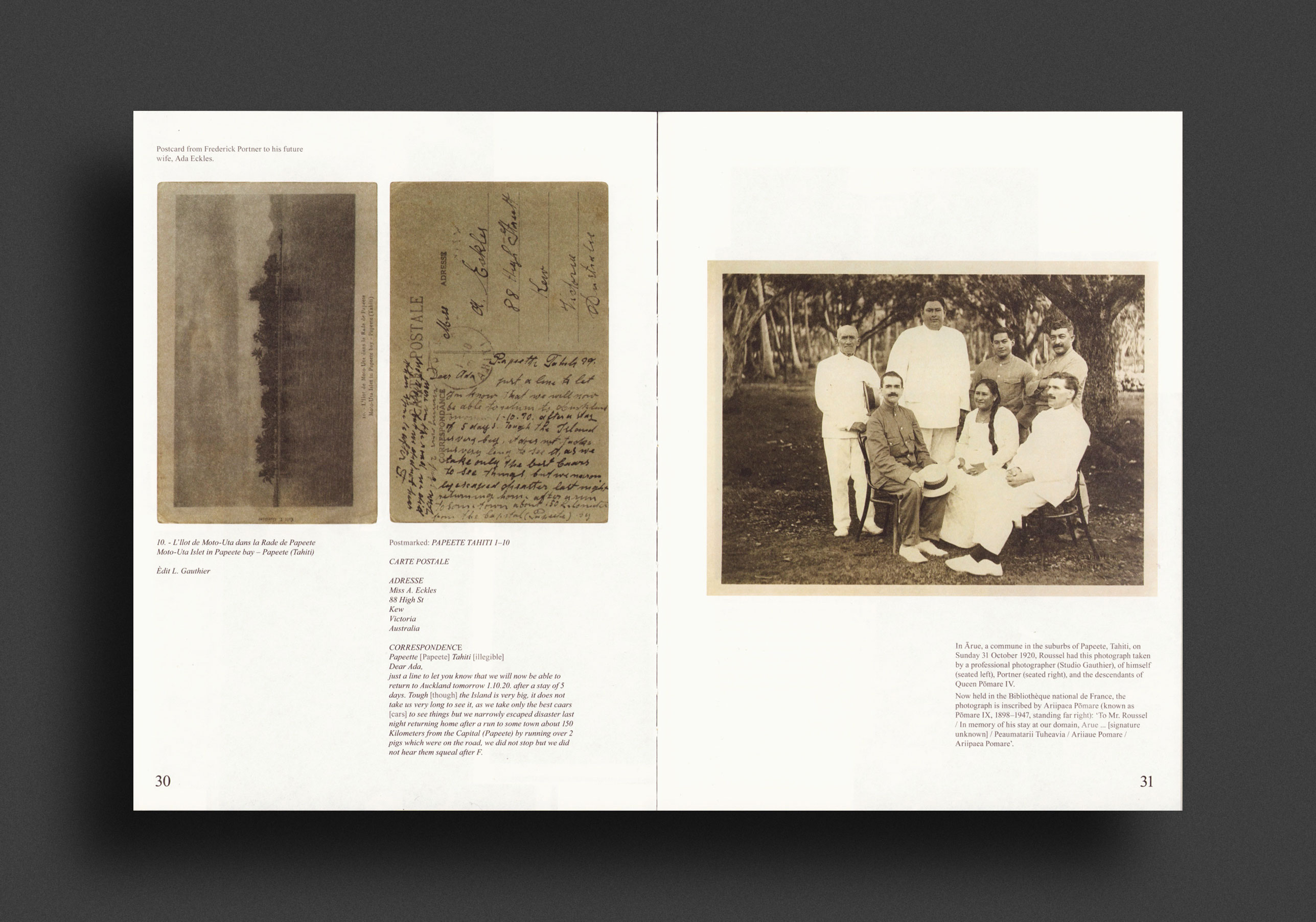
Working through archives in Australia and overseas, Yanni Florence uncovered a trail of evidence: shipping passenger lists, postcards, police records, hotel registers, receipts, handwritten notes, photographs, newspaper reports and unpublished archival material. Together, these fragments allowed Florence to reconstruct Roussel's journey, documenting the ships he travelled on, the hotels where he stayed, the people he met, and the route he followed across Europe, Australia, New Zealand, Tahiti, the Cook Islands, China, Japan and the United States.
On the face of it, the journey was a pilgrimage to Tahiti, the setting of his literary hero Pierre Loti's novel The Marriage of Loti. And perhaps it was yet another of Roussel's escapes from Paris and the blackmail threatening to expose his illicit lifestyle. It had long been believed that Roussel travelled alone and spent much of the voyage confined to his cabin. This view seemed to support Roussel's claim in his posthumously published How I Wrote Certain of My Books: "I travelled around the world by way of India, Australia, New Zealand, the Pacific archipelagos, China, Japan and America. Now from all these travels I never took anything for my books. It seems worth mentioning because it shows how much my imagination accounts for everything in my work."
But while examining passenger lists, Florence noticed another name repeatedly appearing beside his: Frederick Portner, a Swiss-born Australian whom Florence eventually discovered was the head valet at Melbourne's Menzies Hotel. Further research led Florence to Portner's family, and eventually to his 95-year-old daughter, Elise, who still remembered stories her father had told her about travelling for a year with Roussel, whom the family knew only as "the Frenchy". She presented Florence with an old suitcase filled with a treasure trove of postcards, photographs and newspaper clippings confirming that Portner had accompanied Roussel for most of the journey as his valet and interpreter and perhaps his Passepartout—an allusion to the character in another of Roussel's treasured books, Jules Verne's Around the World in Eighty Days (1872).
Raymond Roussel Around the World 1920–1921 presents an illustrated micro-documentation of the journey itself. Through original documents, postcards, shipping passenger lists, receipts, handwritten notes, photographs and archival discoveries, it traces Roussel's travels while revealing new insights into his life, literary obsessions, humour, and the paradox of a writer who travelled around the world yet seemed always to inhabit the landscape of his own imagination.
1967 / 1974, English
Softcover, 184 pages, 20.5 x 14 cm
1st Edition, Out of print title / used / very good
Published by
University of California / Berkeley
University of California Press / Berkley
$35.00 - In stock -
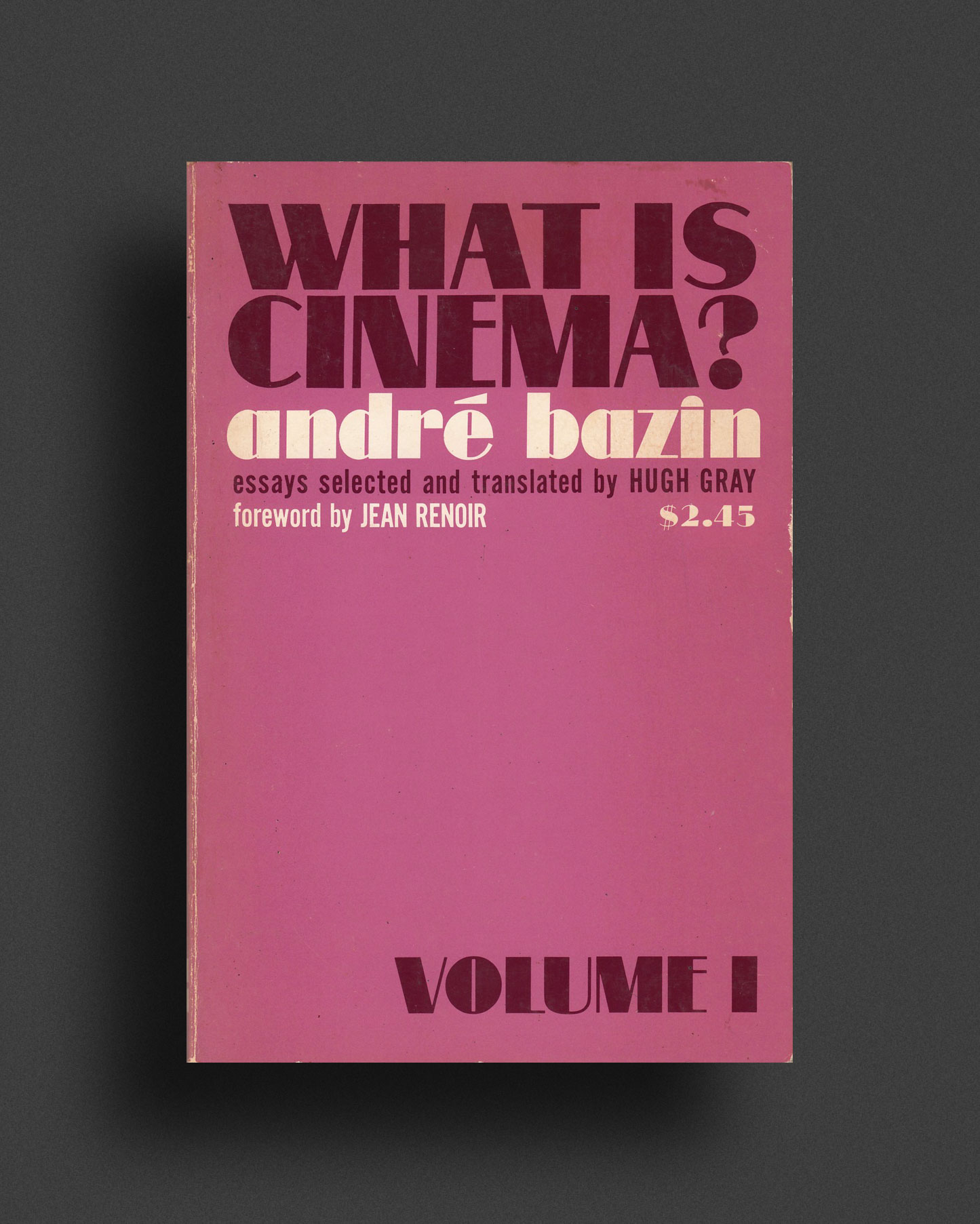
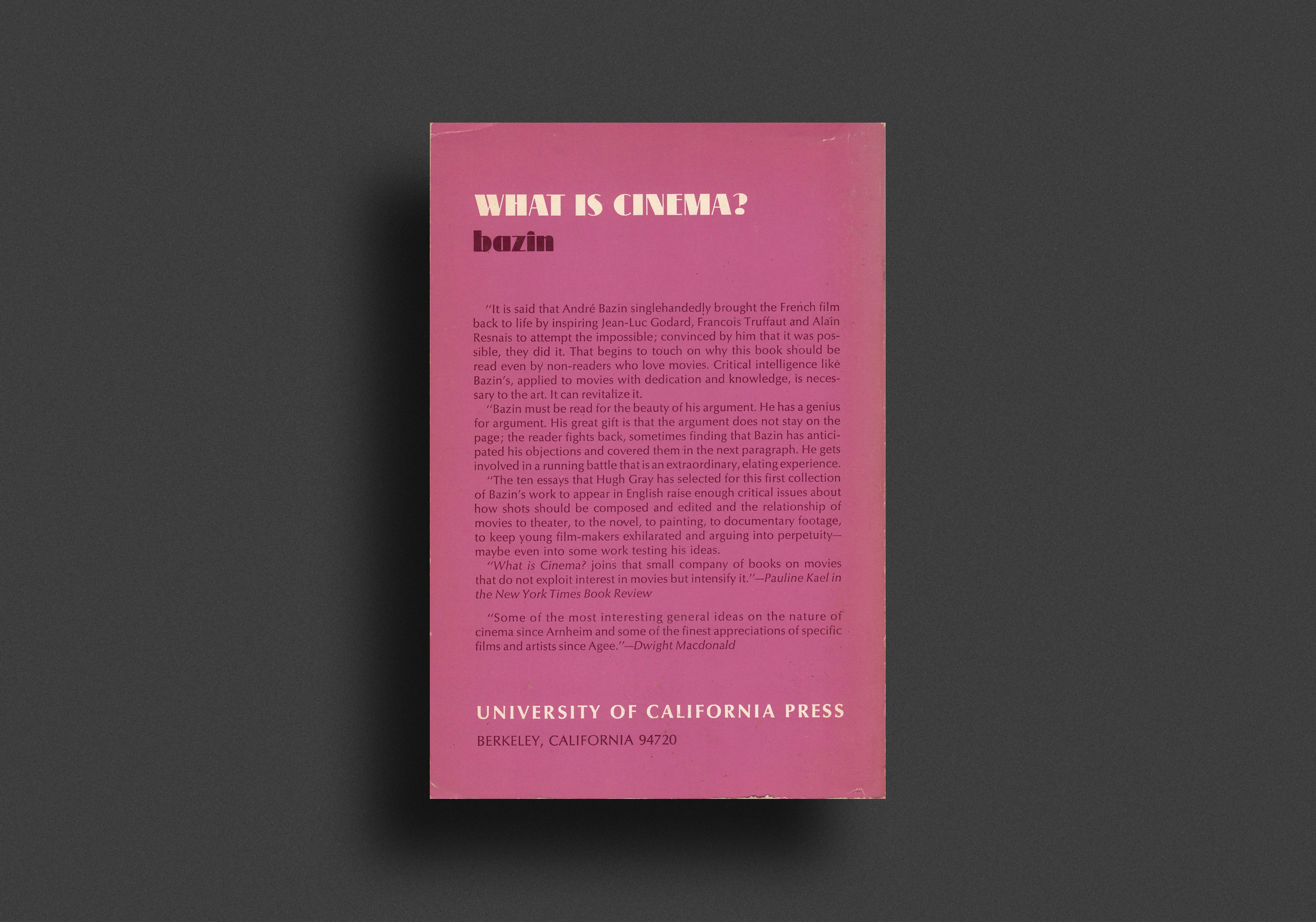
André Bazin's What Is Cinema?, first published in 1967, has been a classic of film studies for as long as it has been available, considered the gold standard in the field of film criticism. Although Bazin made no films, his name has been one of the most important in French cinema since World War II. He was co-founder of the influential Cahiers du Cinéma, which under his leadership became one of the world's most distinguished publications. Championing the films of Jean Renoir (who contributed a foreword to this original volume), Orson Welles, and Roberto Rossellini, he became the protégé of François Truffaut.
As Renoir puts it, the essays of Bazin "will survive even if the cinema does not."
It is said that André Bazin singlehandedly brought the French film back to life by inspiring Jean-Luc Godard, Francois Truffaut and Alain Resnais to attempt the impossible; convinced by him that it was possible, they did it. That begins to touch on why this book should be read even by non-readers who love movies. Critical intelligence like Bazin's, applied to movies with dedication and knowledge, is necessary to the art. It can revitalize it.
Bazin must be read for the beauty of his argument. He has a genius for argument. His great gift is that the argument does not stay on the page; the reader fights back, sometimes finding that Bazin has anticipated his objections and covered them in the next paragraph. He gets involved in a running battle that is an extraordinary, elating experience.
The ten essays that Hugh Gray has selected for this first collection of Bazin's work to appear in English raise enough critical issues about how shots should be composed and edited and the relationship of movies to theater, to the novel, to painting, to documentary footage, to keep young film-makers exhilarated and arguing into perpetuity-maybe even into some work testing his ideas.
"What is Cinema? joins that small company of books on movies that do not exploit interest in movies but intensify it."–Pauline Kael in the New York Times Book Review
"Some of the most interesting general ideas on the nature of cinema since Arnheim and some of the finest appreciations of specific films and artists since Agee."–Dwight Macdonald
VG copy with light tanning to spine/pages, moderate pencil noting (erasable). 1974 print of first ed.
2000, English
Hardcover (w. dust jacket), 508 pages, 23 x 15.3 cm
1st Edition, Out of print title / used / very good
Published by
Oxford University Press / New York
$50.00 - In stock -
First hardcover edition.
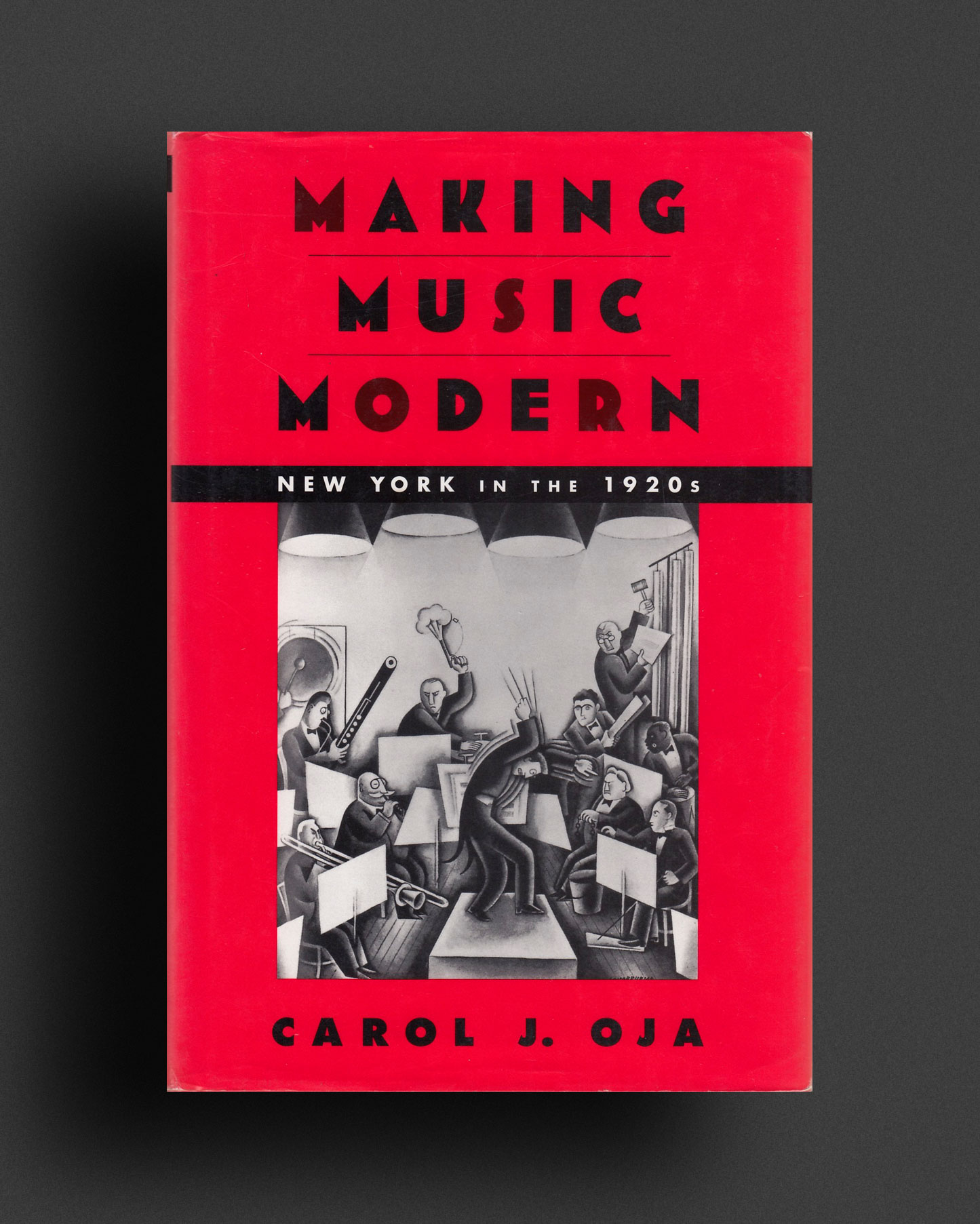
New York City witnessed a dazzling burst of creativity in the 1920s. In this pathbreaking study, Carol J. Oja explores this artistic renaissance from the perspective of composers of classical and modern music, who along with writers, painters, and jazz musicians, were at the heart of early modernism in America. She also illustrates how the aesthetic attitudes and institutional structures from the 1920s left a deep imprint on the arts over the 20th century.
Aaron Copland, George Gershwin, Ruth Crawford Seeger, Virgil Thomson, William Grant Still, Edgar Varèse, Henry Cowell, Leo Ornstein, Marion Bauer, George Antheil-these were the leaders of a talented new generation of American composers whose efforts made New York City the center of new music in the country. They founded composer societies—such as the International Composers' Guild, the League of Composers, the Pan American Association, and the Copland-Sessions Concerts—to promote the performance of their music, and they nimbly negotiated cultural boundaries, aiming for recognition in Western Europe as much as at home. They showed exceptional skill at marketing their work. Drawing on extensive archival material—including interviews, correspondence, popular periodicals, and little-known music manuscripts—Oja provides a new perspective on the period and a compelling collective portrait of the figures, puncturing many longstanding myths.
American composers active in New York during the 1920s are explored in relation to the "Machine Age" and American Dada; the impact of spirituality on American dissonance; the crucial, behind-the-scenes role of women as patrons and promoters of modernist music; cross-currents between jazz and concert music; the critical reception of modernist music (especially in the writings of Carl Van Vechten and Paul Rosenfeld); and the international impulse behind neoclassicism. The book also examines the persistent biases of the time, particularly anti-Semitisim, gender stereotyping, and longstanding racial attitudes.
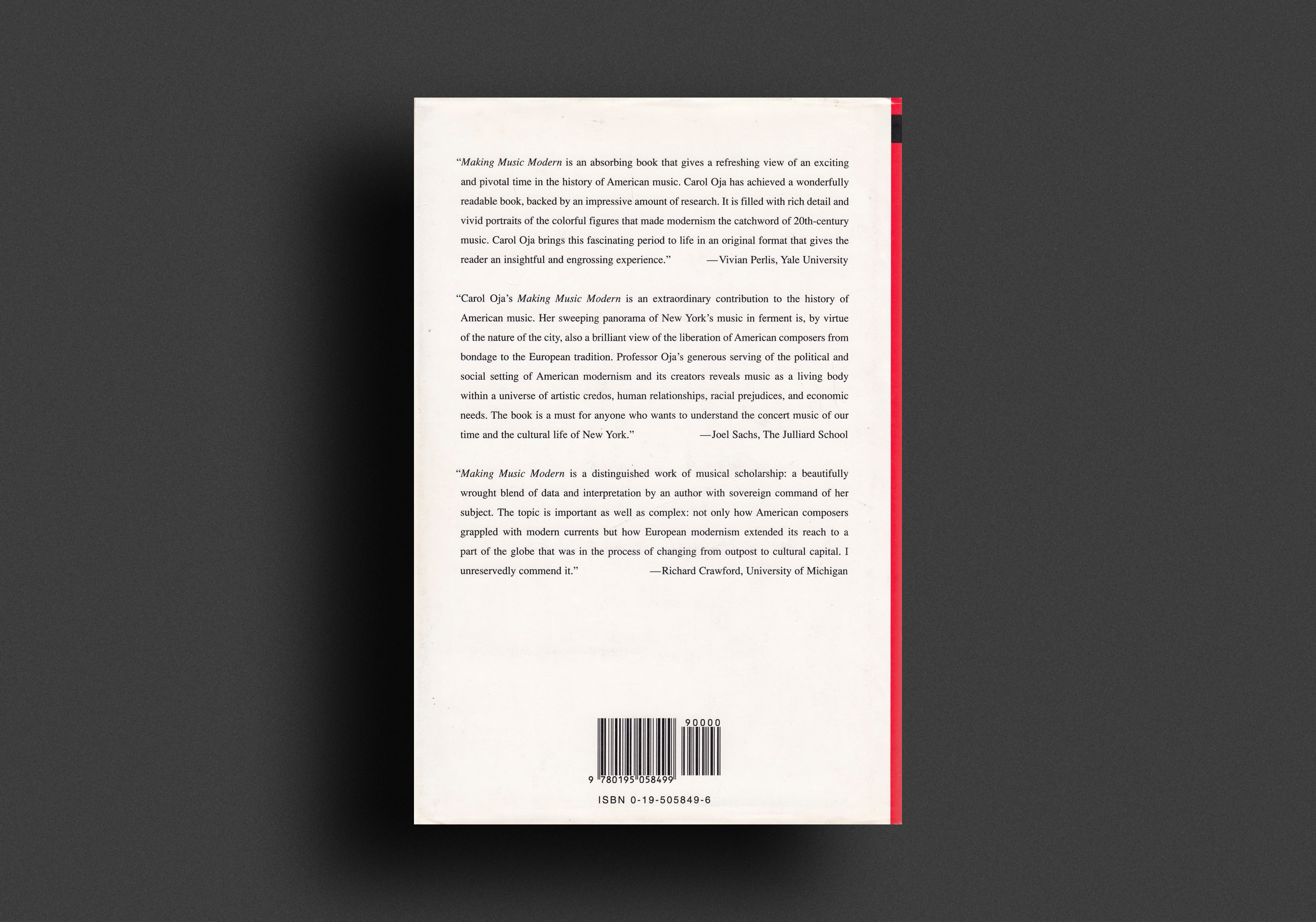
"Carol Oja's Making Music Modern is a rare achievement, at once on essential musicological study and major contribution to our general fund of knowledge on America in the twentieth century...Too much cultural history is written from a..."big man" perspective. This book fills in our map of the neighbourhood, giving us the lesser known musicians, patrons, critics, magazines, and new music societies, not to mention selected painters, philosophers, mystics and cranks...Her brief discussions of the artistic/intellectual climate surrounding her composers is superb, and will keep the non-specialist glued to the page."–Current Musicology
VG in VG DJ.
2023, Japanese
Softcover (w dust jacket), 448 pages, 14.8 x 10.5 x 2.4 cm
Published by
Seigensha Publishing / Kyoto
$55.00 - In stock -
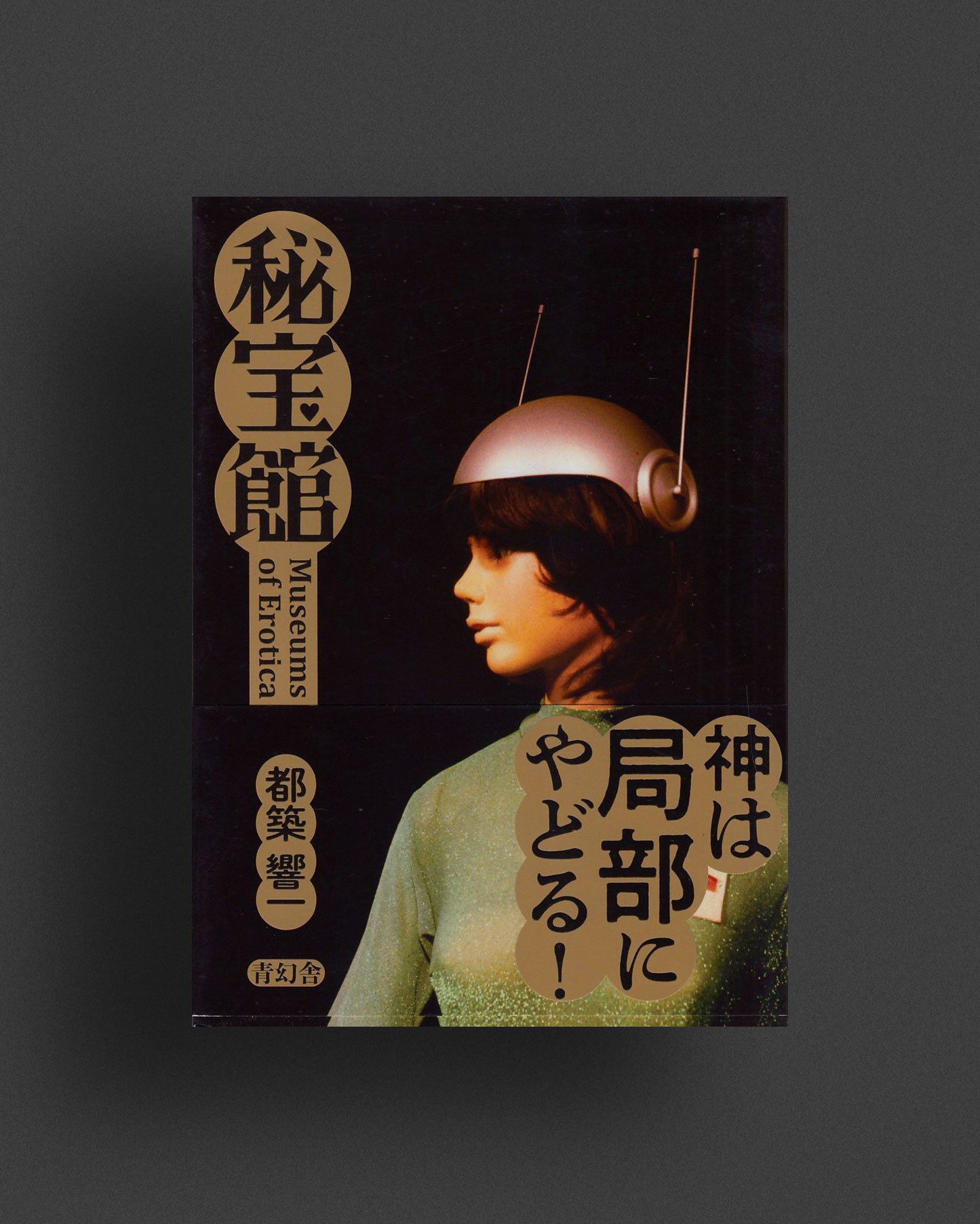
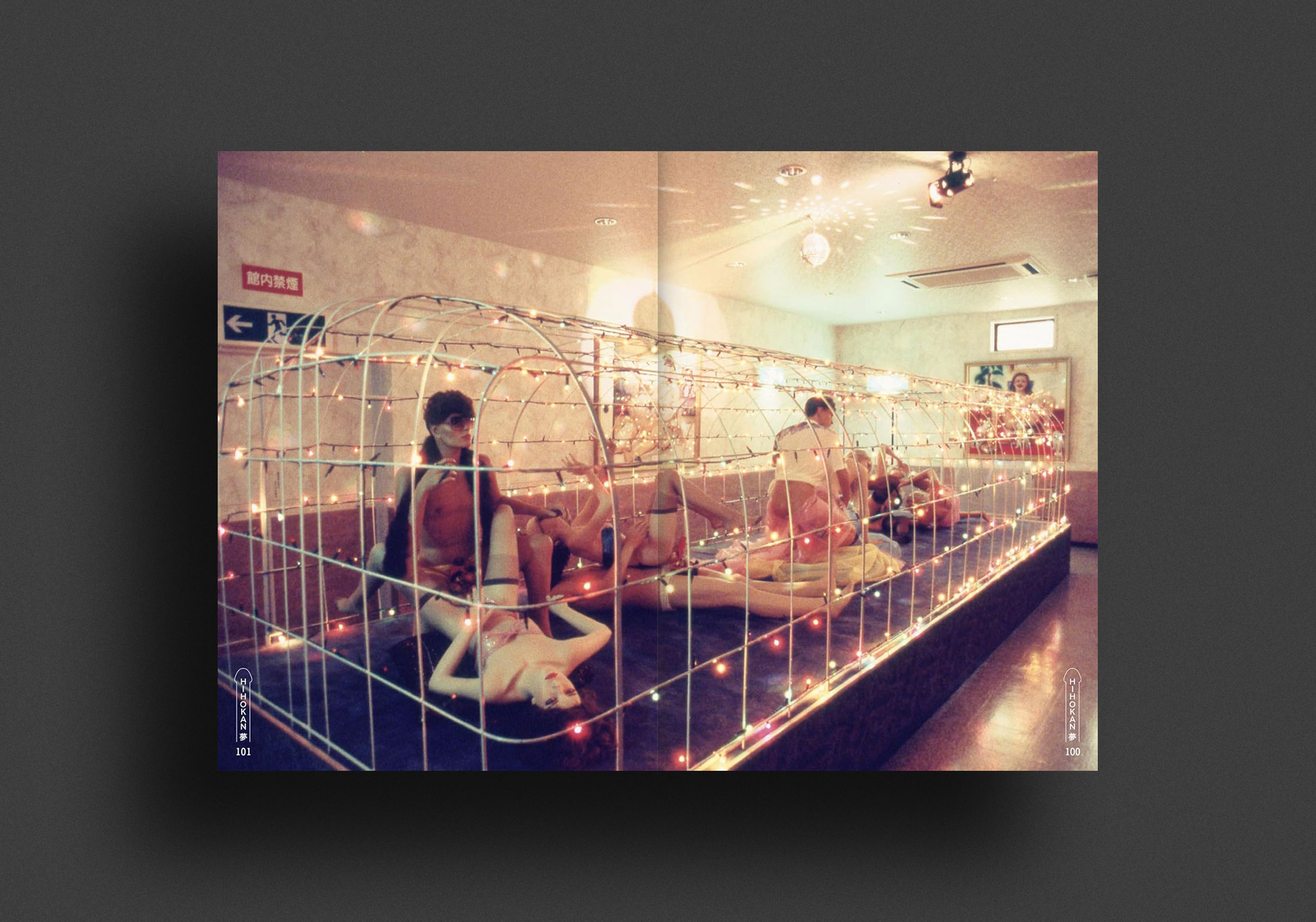
Another to–be classic from Japanese writer-photographer Kyoichi Tsuzuki (Tokyo Style, Roadside Japan, Happy Victims, etc.) An in–depth photographic journey into Japan's disappearing wonderland haunts of the erotic imagination, all passionately documented in comprehensive detail and vivid colour on gloss magazine stock the way Tsuzuki does so well.
The Hihokan (Museum of Erotica) was created in the 1960s as an entertainment facility for adults as tourism diversified with the unprecedented tourism boom in Japan. The erotic installations were staged in a variety of elaborate ways and could be enjoyed as visitors made their way around the exhibits. A unique type of amusement park from the Showa period like an art space. They were a treasure trove of ideas brimming with creativity. Kyoichi Tsuzuki has been following the museums over the years, and once again presents a documentary that examines its appeal.
1984, English
Softcover, 639 pages, 23 x 15 cm
1st Edition, Out of print title / used / good
Published by
Black Sparrow Press / Santa Rosa
$70.00 - In stock -
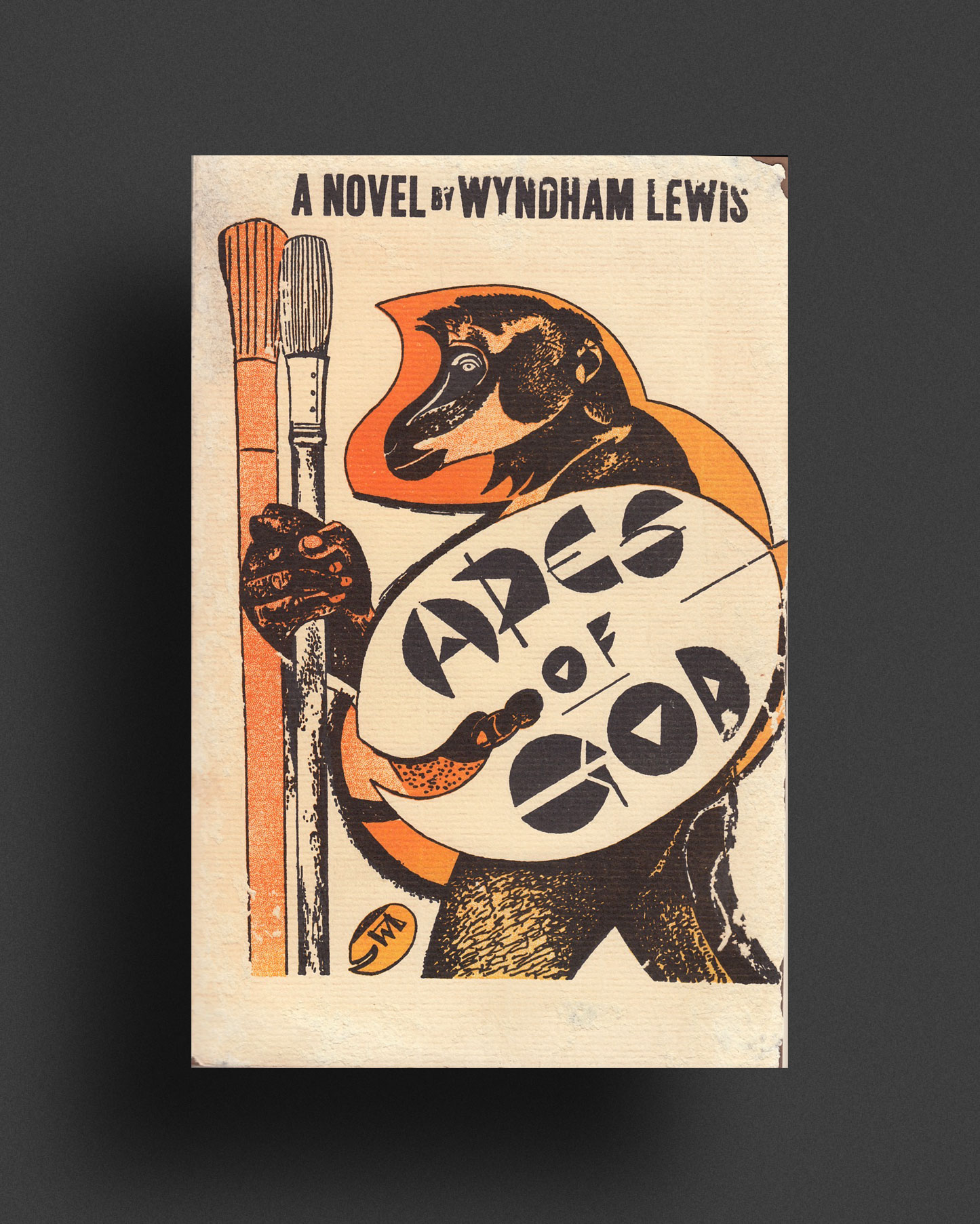
Rare first 1981 Black Sparrow Press paperback edition, 1984 printing, of Lewis' literary masterpiece, The Apes of God, a brutal roman-à-clef to attack contemporary London modernism first self–published by Lewis in a limited edition in June 1930. Wonderful cover art by Lewis.
Set in 1926 London on the brink of the General Strike, Wyndham Lewis’s 1930 satirical novel The Apes of God offers a blistering takedown of Britain’s elite literary and artistic circles. The story follows Horace Zagreus, a 60-year-old albino dilettante, as he guides a naive young Irishman named Dan Boleyn through the salons of fashionable bohemia. Along the way, Dan encounters a parade of pretentious pseudo-intellectuals and amateur copycats—whom Lewis labels the "Apes of God" for imitating true creative genius. Framed by Zagreus's mercenary scheme to marry the 96-year-old aristocrat Lady Fredigonde, the novel serves as a sharp, merciless caricature of real-life modernist figures like the Bloomsbury Group and the Sitwells.
"The Apes of God, though one of the cruelest, is also one of the most tremendous farces ever conceived in the mind of man. For comparisons one must fall back on Rabelais and Aristophanes.... My final feeling is that The Apes of God is the greatest piece of writing since Ulysses."–RICHARD ALDINGTON in The Referee
Equally talented as a writer and painter, Wyndham Lewis (1882–1957) was one of the most innovative and controversial artistic figures of twentieth-century Britain, renowned as the driving force behind Vorticism, the avant-garde movement that flourished in London before the First World War.
Good copy with wear to extremities/spine and buggery (insect nibbles) to board edges. VG interior.
1996, Englis / French
Softcover, 176 pages, 21.5 x 13.5 cm
1st Edition, Out of print title / used / fine
Published by
Anvil Press Poetry / London
$30.00 - Out of stock
Out-of-print 1976 Anvil Press Poetry collection of poetry by Guillaume Apollinaire (1880—1918), one of the foremost poets of the early 20th century, as well as one of the most impassioned defenders of Cubism and forefather of Surrealism. In bi-lingual French-English.
Apollinaire's poetry reflects the heady years of artistic and intellectual ferment before the First World War. The most dynamic modernist French poet, he is remembered as much for his more traditional lyric poems as for the typographical experiments of his 'calligrammes'. Apollinaire championed the Cubist painters, and his poetry is a literary counterpart to their innovative work. Subtle and complex, yet often direct, his poetry is still fresh, sharp and memorable.
Oliver Bernard's selection provides a representative cross-section of his poetry, while concentrating on his most famous collection, Alcools (1913). This is a revised and expanded edition of his 1965 Penguin selection, of which Edward Lucie-Smith wrote, "If the value of really inspired translation needs any stressing, Oliver Bernard's Apollinaire is there to prove the case. The French poet and his English interpreter are wonderfully well-matched." Christopher Ricks commented in the New Statesman that "Oliver Bernard's translations from Apollinaire are immediately engaging in their vividness and humour."
GUILLAUME APOLLINAIRE was born in Rome in 1880. Educated in Monaco and Nice, he became a French citizen only in 1916, after service in the artillery and infantry. He was badly wounded in the head in 1916, and died during the Paris flu epidemic in 1918. As prose writer and art critic as well as poet, Apollinaire was the moving spirit of French modernism.
OLIVER BERNARD has published three collections of poetry, most recently Poems (Samizdat, 1983) and Five Peace Poems (Five Seasons Press, 1985). His edition of Rimbaud's poetry is published by Penguin. He has lived in Norfolk for the past twenty years.
Fine copy.
2015, English
Softcover, 136 pages, 23.5 x 19 cm
Published by
The LedaTape Organisation / Melbourne
$55.00 - In stock -
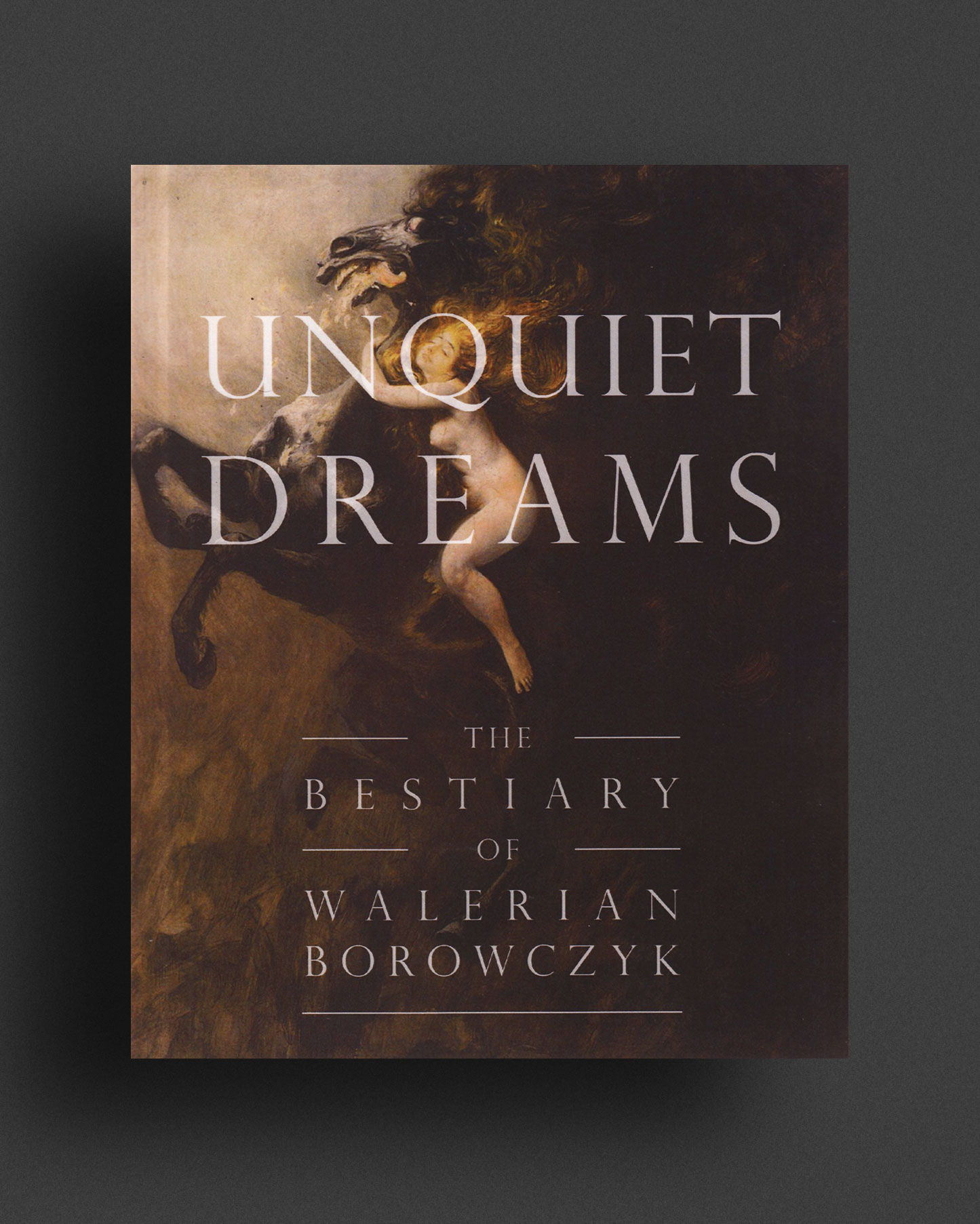
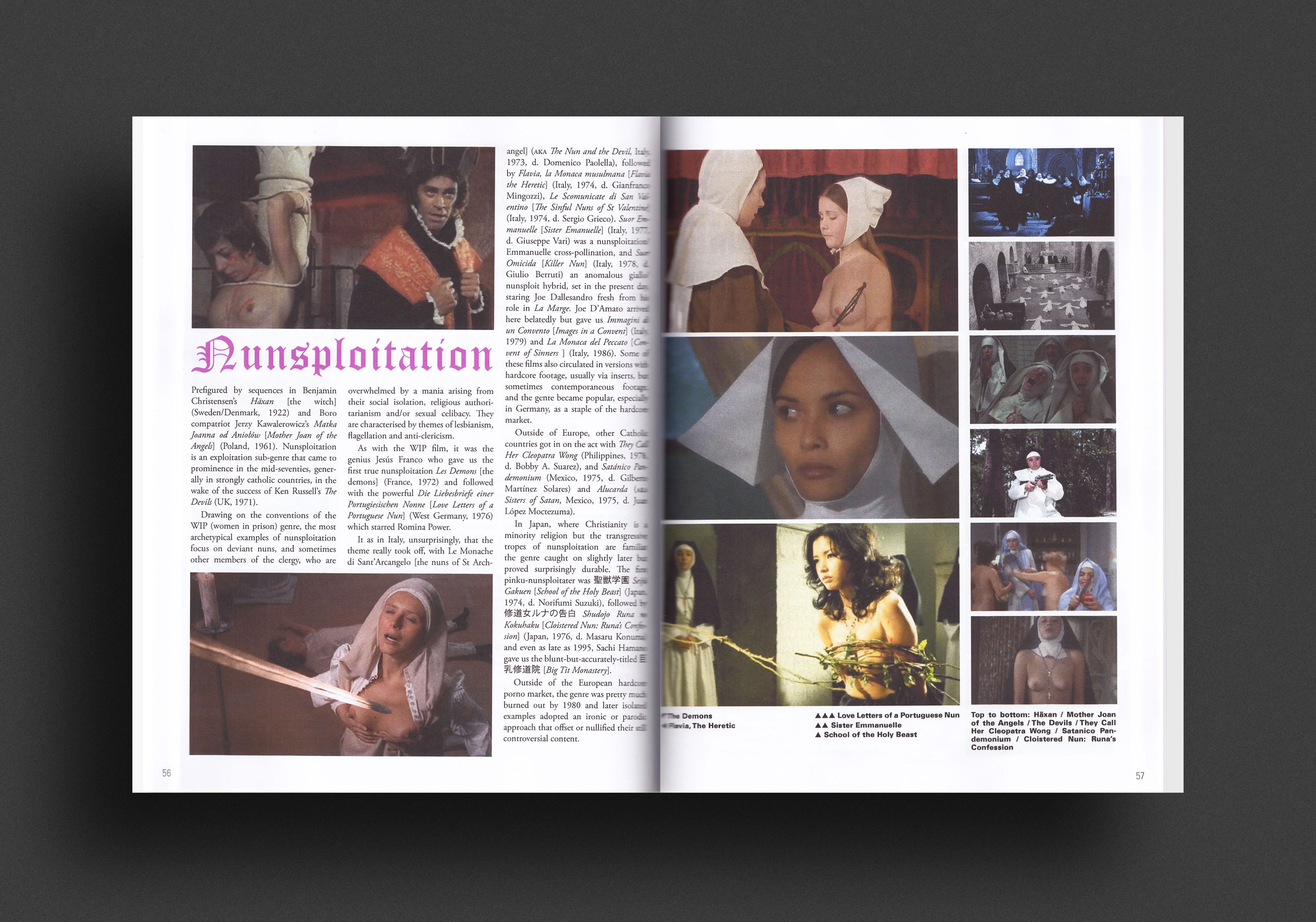
Walerian Borowczyk was far and away the classiest of sleazy film-makers, and the sleaziest of the classy ones. Starting as an animator and director of visually rich kafkaesque fantasies (Blanche, Goto, Island of Love) he divided audiences by moving into graphic erotica (Immoral Tales, The Beast) and subsequently worked his way through exploitation tropes (nunsploitation, Jeksploitation, togasploitation) before creatively imploding spectacularly with his bizarre contribution to the Emmanuelle series.
This volume is the first fully comprehensive review of Borowczyk’s career. With new contributions by leading Borowczyk experts, it includes a fully annotated and referenced filmography, profusely illustrated with rare stills. Much of the research is drawn from hitherto private and hidden sources, revealed here for the first time. This is surely the first and last word on this ground-breaking film-maker, shunned and neglected in his time and only now being recognised as an idiosyncratic genius.
In all honesty, it would have been nice if I could have used that last paragraph, but for some inexplicable reason there has been no serious study of Borowczyk as yet — and this certainly isn’t that.
Inspired in look and feel by seventies film and filth mags like Continental Film Review and Sex Stars System, the present author does not much value coherence or consistency. He is interested in contexts and connections, obscure minutiae, jokes (he will judge what is funny), and blurry screen grabs of topless women from seventies softcore flicks. Whilst not ideal, it’s better than nothing. Probably. You figure it out.
Includes: Tearful middle-aged recollections of a mis-spent youth -- Inadequate biographical details (i.e. of Borowczyk) -- Complete annotated filmography, sadly drawn from obsolete and contradictory sources. -- Full technical data on all Borowczyk’s features with inconsistent notes and comprehensive bibliographies of articles, albeit mostly in foreign languages. -- Background material on genres and personalities more or less (or not) relevant to Borowczyk’s films. -- A rigorous (for the reader) formal analysis and over-extended discussion about Borowczyk’s most famous film, The Beast. -- Interesting stuff about Alain Fleischer’s lost Rendez-vous en Foret. Pictures! -- Annotated filmography of simulated zoophilia lowlights in (not very) mainstream cinema. Bleeurgh. -- Puzzling but portentous conclusion. -- PLUS! -- Tedious shit about the Beast of Gévaudan -- Full text of stories by Marie le Prince de Beaumont and Prosper Mérimée that inspired Borowczyk’s film. -- INDEXES!!! YAY!
1983, English
Hardcover (clothbound), 180 pages, 23.5 x 15.5 cm
1st Edition, Out of print title / used / very good
Published by
UMI Research Press / Ann Arbor
$45.00 - Out of stock
First 1983 hardcover edition.
From the wonderful UMI Studies in the Fine Art – The Avant–Garde series, this essential art-historical study uncovers the transatlantic roots of the Dada movement, tracing its intellectual lineage from Alfred Stieglitz’s groundbreaking "291" gallery in New York to the explosive 1916 founding of Zurich's Cabaret Voltaire. Leavens illuminates how the radical ideas, publications, and avant-garde networks fostered in New York directly shaped the rebellious spirit of European Dadaism. Includes a thorough bibliography, making it a valuable resource to Dada researchers.
Very Good copy. No dust jacket.
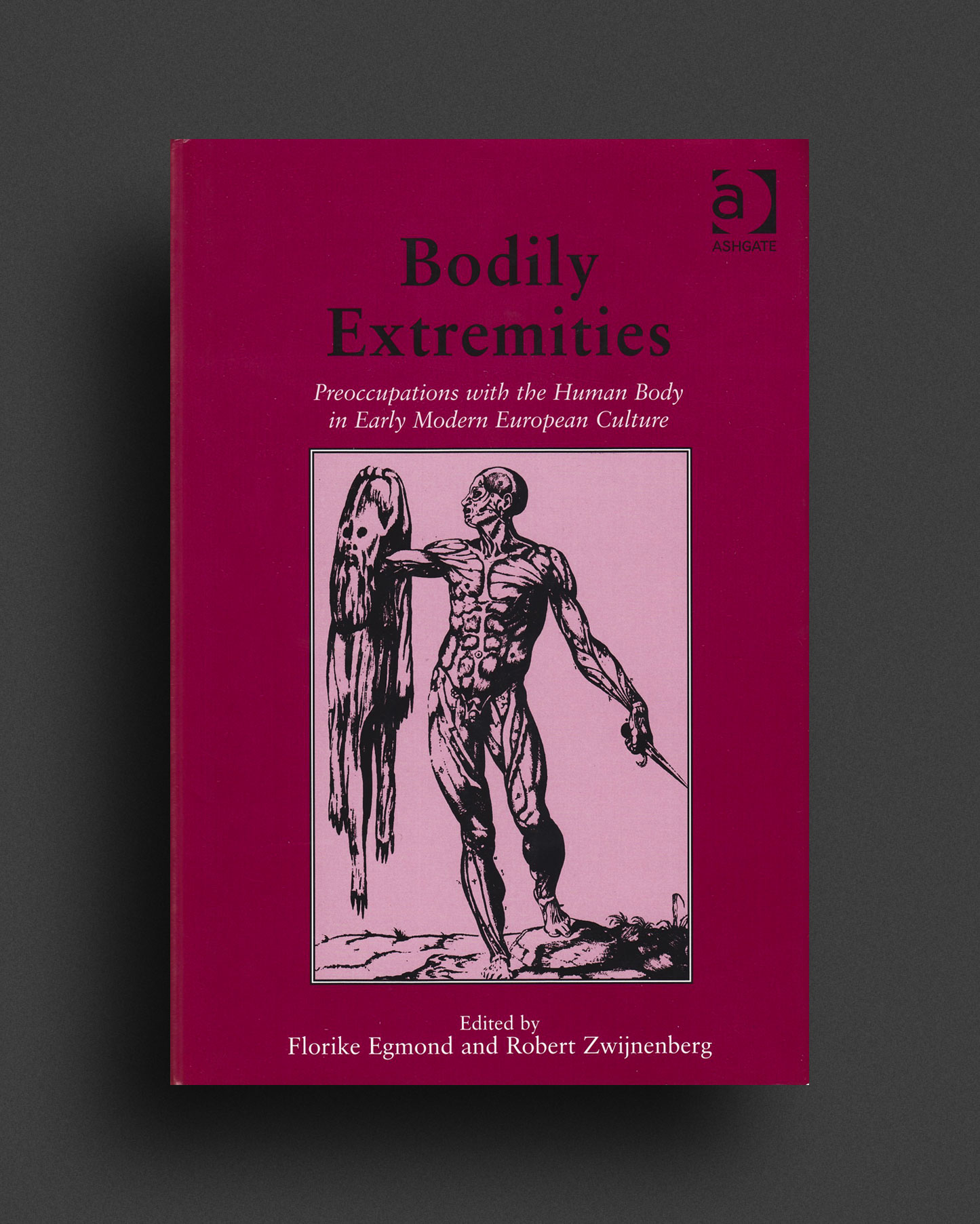
2003, English
Hardcover (w. dust jacket), 235 pages, 24 x 16.5 cm
1st Edition, Out of print title / used / fine
Published by
Ashgate / Hampshire
$300.00 - In stock -
First 2003 hardcover edition.
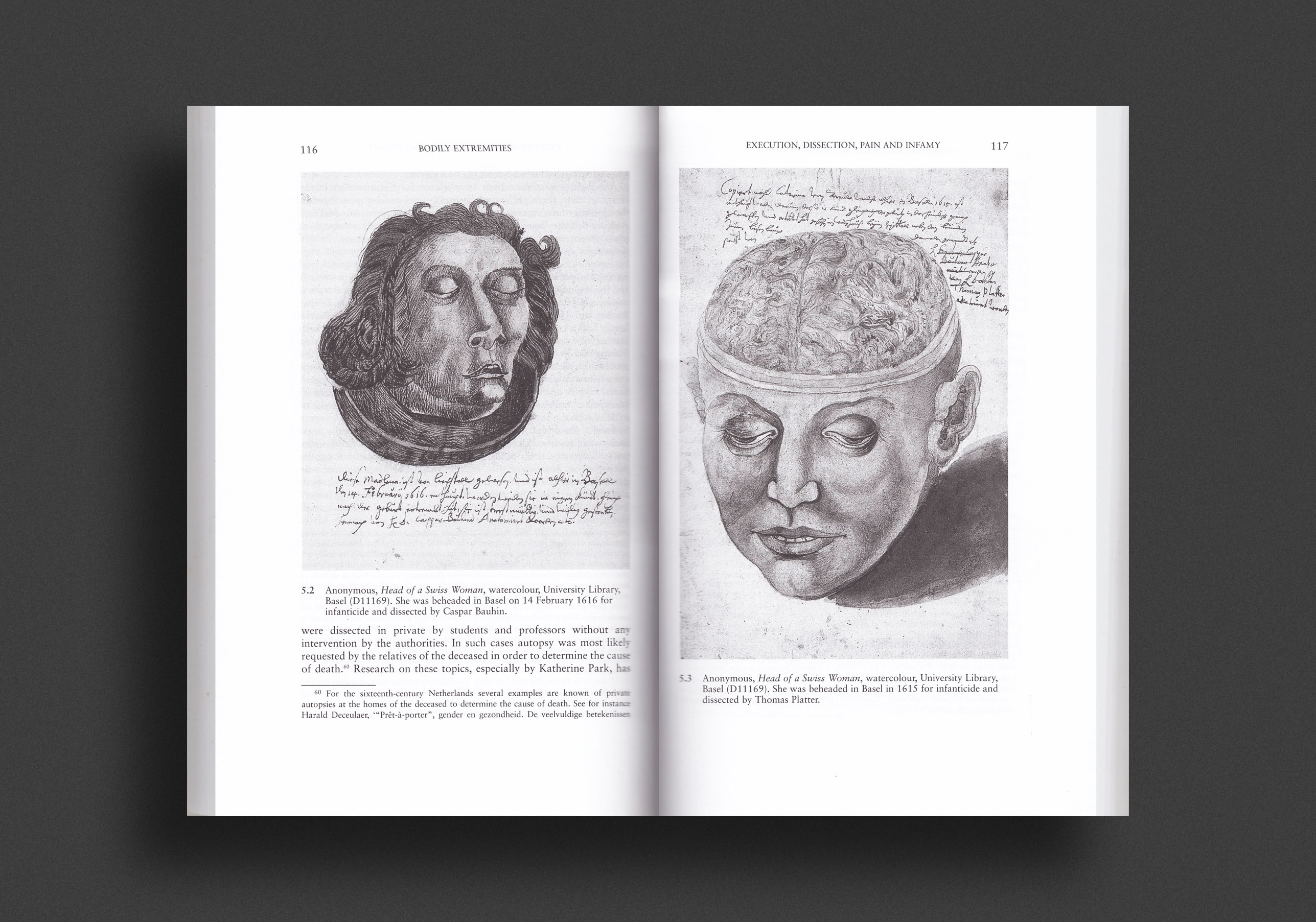
A strong preoccupation with the human body - often manifested in startling ways - is a characteristic shared by early modern Europeans and their present-day counterparts. Whilst modern manifestations of this interest include body piercing, tattoos, plastic surgery and eating disorders, early modern preoccupations encompassed such diverse phenomena as monstrous births and physical deformity, body snatching, public dissection, flagellation, judicial torture and public punishment. This volume explores such extreme manifestations of early modern bodily obsessions and fascinations, and their wider cultural significance.
Agreeing that an interest in physical boundaries, extreme physical manifestations and situations developed and grew stronger during the early modern period, the essays in this volume investigate whether this interest can be traced in a wider range of cultural phenomena, and should therefore be given a prominent place in any future characterization of the early modern period. Taken as a whole, the volume can be read as an attempt to create a new context in which to explore the cultural history of the human body, as well as the metaphors of research and investigation themselves.
Fine copy in Fine dust jacket preserved in mylar wrap.