World Food Books' programme is largely produced on Kulin Nation land. We acknowledge the Wurundjeri people of the Kulin Nation as the first and continuing custodians of this land, and pay respect to their Elders past, present, and emerging.
World Food Books is an arts and special interests bookshop in Naarm / Melbourne. Founded in 2010, World Food Books is devoted to the presentation of a rotating, hand-selection of international art, design, literary and counterculture publications with an emphasis on the anti-traditional, the experimental, the avant-garde, the heretic, the marginal.
Presenting new titles alongside rare and out-of-print books, catalogues and journals spanning the fields of modern and contemporary art, design, photography, illustration, film, literature, poetry, cultural theory, philosophy, sexuality, popular and underground culture in its many radical forms, World Food Books wishes to encourage adventurous, thoughtful and open-minded reading, looking, writing, and exchange of publishing and ideas, both current and historical.
As well as our bookshop, located in Melbourne's historical Nicholas Building, all of our inventory is available internationally via our online mail-order service.
World Food Books semi-regularly co-ordinates "Occasions", a programme of exhibits and events at the bookshop and in partnership with other hosts (such as museums and art galleries) that develop out of the activities, relationships and content of the bookshop itself.
World Food Books
The Nicholas Building
37 Swanston Street
Room 5, Level 6
Melbourne 3000
Australia
SHOP HOURS:
THU–SAT 12–6
WEB-SHOP OPEN 24/7
World Food Books
Postal Address:
PO Box 435
Flinders Lane
Victoria 8009
Australia
Art
Theory / Essay
Architecture / Interior
Graphic Design / Typography
Photography
Fashion
Eros
LGBTQ+
Fiction / Poetry
Weird / Speculative / Science Fiction / Horror
Transgressive / Visceral / Abject
Symbolism / Decadence / Fin de siècle
Film / Video
Painting
Sculpture / Installation
Performance / Dance / Theater
Drawing
Sound / Music
Curatorial
Group Shows / Collections
Periodicals
Out-of-print / Rare
Posters / Ephemera / Discs
Signed Books
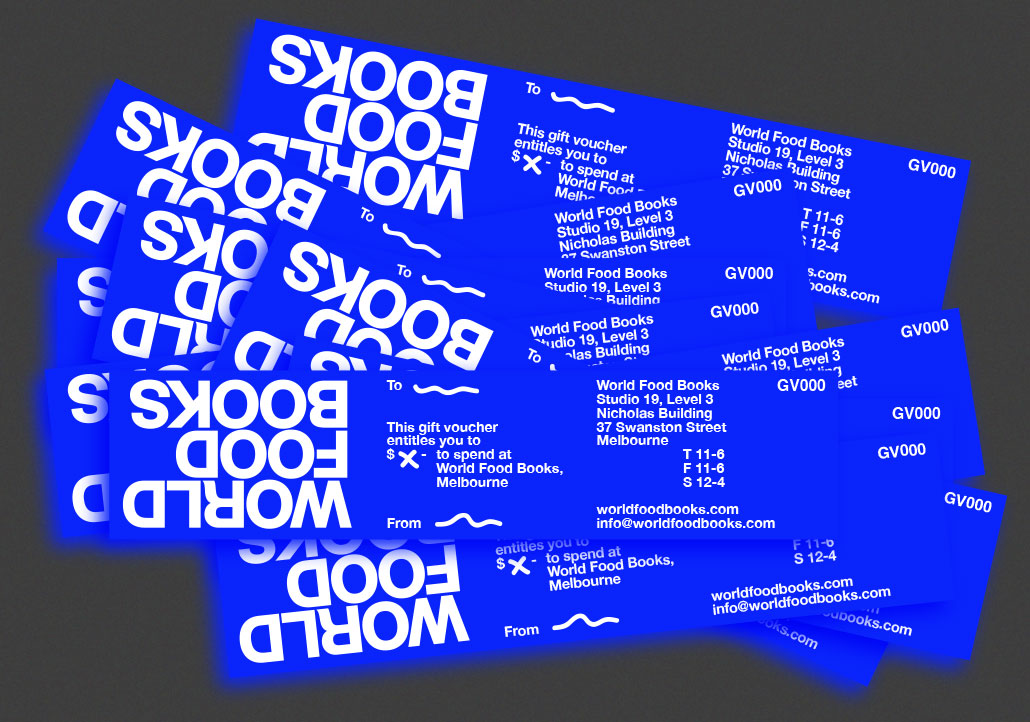
World Food Books Gift Voucher
World Food Book Bag
Australian Art
Australian Fiction
Australian Science Fiction / Speculative Fiction
Australian Poetry
Australian Photography
Japanese Photography
Conceptual Art
Minimal Art
Dada
'Pataphysics / Oulipo
Fluxus
Concrete Poetry
Pop Art
Surrealism
Arte Povera
Arte Informale / Haute Pâte / Tachism
Nouveau Réalisme / Zero / Kinetic
Situationism / Lettrism
Collage / Mail Art / Xerox Art
Art Brut / Folk / Visionary / Fantastic
Illustration / Graphic Art / Bandes Dessinées
Furniture
Italian Radical Design / Postmodernism
Textiles
Ceramics / Glass
Counterculture
Protest / Revolt
Philosophy
Psychoanalysis
Anthropology
Anarchism
Socialism / Anarchism / Communism / Capitalism
Literary Theory / Semiotics / Language
Feminism / Women's Studies
Gender Studies / Sexuality
Anthropology
Fetishism / BDSM
Drugs / Psychedelia
Crime / Violence
Animal Rights / Veganism
Occult / Esoterica
Ecology / Earth / Alternative Living
Whole Earth / Crafts
All prices in AUD (Australian dollars)
Pick-Ups
Pick-up orders can be collected in our bookshop during opening hours after order date. Please collect any Pick-up orders within 2 weeks of ordering as we have limited storage space. Orders will be released back into stock if not collected within this time. No refunds can be made for pick-ups left un-collected. If you cannot make it in to the bookshop in this time-frame, please choose postage option.
Return Policy
All sales are final. We do accept returns (for refund or exchange) for items received in error. All our orders are packed with special care using heavy-duty padding and cardboard book-mailers or bubble mailers (for smaller books), using reinforcement where required. We cannot take responsibility for any lost, stolen or damaged parcels.
Insurance
Should you wish to insure your package, please email us directly after placing your order and we can organise this at a small extra expense. Although all standard/express tracked packages are very safe and dependable, we cannot take responsibility for any lost, stolen or damaged parcels. We recommend insurance on valuable orders.
Interested in selling your old books, catalogues, journals, magazines, comics, fanzines, ephemera? We are always looking for interesting, unusual and out-of-print books to buy. We only buy books in our fields of interest and specialty, and that we feel we can resell.
We base these prices on desirability, market value, in-print prices, condition and our current stock levels. We offer cash, store credit, and can take stock on consignment. All
about 25% of the price we expect to get when we sell them, or 30% in store credit. We base these prices on desirability, market value, in-print prices, condition and our current stock levels.
Sell your books any day of the week. You can drop them off and return later. If you have a lot of books, we can visit your Sydney home.
We buy books that we feel we can resell. We offer about 25 % of the price we expect to get when we sell them, or 30% in store credit. We base these prices on desirability, market value, in-print prices, condition and our current stock levels.
Philadelphia Wireman
03 August - 01 September, 2018
World Food Books is proud to announce our next Occasion, the first presentation of sculptures by Philadelphia Wireman in Australia.
The Philadelphia Wireman sculptures were found abandoned in an alley off Philadelphia’s South Street on trash night in 1982. Their discovery in a rapidly-changing neighbourhood undergoing extensive renovation, compounded with the failure of all attempts to locate the artist, suggests that the works may have been discarded after the maker’s death. Dubbed the "Philadelphia Wireman" during the first exhibition of this work, in 1985, the maker’s name, age, ethnicity, and even gender remain uncertain. The entire collection totals approximately 1200 pieces, all intricately bound together with tightly-wound heavy-gauge wire (along with a few small, abstract marker drawings, reminiscent both of Mark Tobey and J.B. Murry). The dense construction of the work, despite a modest range of scale and materials, is singularly obsessive and disciplined in design: a wire armature or exoskeleton firmly binds a bricolage of found objects including plastic, glass, food packaging, umbrella parts, tape, rubber, batteries, pens, leather, reflectors, nuts and bolts, nails, foil, coins, toys, watches, eyeglasses, tools, and jewellery.
Heavy with associations—anthropomorphic, zoomorphic, and socio-cultural responses to wrapped detritus—the totemic sculptures by Philadelphia Wireman have been discussed in the context of work created to fulfil the shamanistic needs of alternative religions in American culture. Curators, collectors, and critics have variously compared certain pieces to sculpture from Classical antiquity, Native American medicine bundles, African-American memory jugs, and African fetish objects. Reflecting the artist’s prolific and incredibly focused scavenging impulse, and despite—or perhaps enhanced by—their anonymity, these enigmatic objects function as urban artefacts and arbiters of power, though their origin and purpose is unknown. Philadelphia Wireman, whatever their identity, possessed an astonishing ability to isolate and communicate the concepts of power and energy through the selection and transformation of ordinary materials. Over the course of the past two decades, this collection has come to be regarded as an important discovery in the field of self-taught art and vernacular art.
Presented in collaboration with Fleisher-Ollman Gallery, Philadelphia, and Robert Heald, Wellington.
Susan Te Kahurangi King
02 February - 10 March, 2018
Susan Te Kahurangi King (24 February 1951 - ) has been a confident and prolific artist since she was a young child, drawing with readily available materials - pencils, ballpoint pens and felt-tip markers, on whatever paper is at hand. Between the ages of four and six Susan slowly ceased verbal communication. Her grandparents William and Myrtle Murphy had developed a special bond with Susan so they took on caring responsibilities for extended periods. Myrtle began informally archiving her work, carefully collecting and storing the drawings and compiling scrapbooks. No drawing was insignificant; every scrap of paper was kept. The King family are now the custodians of a vast collection containing over 7000 individual works, from tiny scraps of paper through to 5 meter long rolls.
The scrapbooks and diaries reveal Myrtle to be a woman of great patience and compassion, seeking to understand a child who was not always behaving as expected. She encouraged Susan to be observant, to explore her environment and absorb all the sights and sounds. Myrtle would show Susan’s drawings to friends and people in her community that she had dealings with, such as shopkeepers and postal workers, but this was not simply a case of a grandmother’s bias. She recognised that Susan had developed a sophisticated and unique visual language and sincerely believed that her art deserved serious attention.
This was an unorthodox attitude for the time. To provide some context, Jean Dubuffet coined the term Art Brut in 1945 to describe work created by self-taught artists – specifically residents of psychiatric institutions and those he considered to be visionaries or eccentrics. In 1972 Roger Cardinal extended this concept by adopting the term Outsider Art to describe work made by non-academically trained artists operating outside of mainstream art networks through choice or circumstance. Susan was born in Te Aroha, New Zealand in 1951, far from the artistic hubs of Paris and London that Dubuffet and Cardinal operated in. That Myrtle fêted Susan as a self-taught artist who deserved to be taken seriously shows how progressive her attitudes were.
Susan’s parents Doug and Dawn were also progressive. Over the years they had consulted numerous health practitioners about Susan’s condition, as the medical establishment could not provide an explanation as to why she had lapsed into silence. Dawn educated herself in the field of homeopathy and went on to treat all twelve of her children using these principles – basing prescriptions on her observations of their physical, mental and emotional state.
Doug was a linguist with an interest in philosophy who devoted what little spare time he had to studying Maori language and culture. To some extent their willingness to explore the fringes of the mainstream made them outsiders too but it was their commitment to living with integrity and their respect for individuality that ensured Susan’s creativity was always encouraged.
Even though Susan’s family supported her artistic pursuits, some staff in schools and hospitals saw it as an impediment to her assimilation into the community and discouraged it in a variety of ways. Her family was not always aware of this and therefore did not fully understand why Susan stopped drawing in the early 1990s. However, rather than dwell on the challenges that Susan faced in pursuit of her artistic practice, they prefer to highlight her achievements. In 2008 Susan began drawing again in earnest, after an almost 20 year interruption, and her work is now shown in galleries around the world.
Susan grew up without television and has been heavily influenced by the comics she read as a child. She is absolutely fearless in the appropriation of recognizable characters, such as Donald Duck and Mickey Mouse, in her work. She twists their limbs, contorts their faces, compresses them together, blends them into complex patterned backgrounds - always imbuing them with an incredible energy. Although Susan often used pop culture characters in her work they are not naive or childlike. These are drawings by a brilliant self-taught artist who has been creating exceptional work for decades without an audience in mind.
Mladen Stilinović
"Various Works 1986 - 1999"
02 February 16 - September 10, 2016
Various works 1986 - 1999, from two houses, from the collections of John Nixon, Sue Cramer, Kerrie Poliness, Peter Haffenden and Phoebe Haffenden.
Including: Geometry of Cakes (various shelves), 1993; Poor People’s Law (black and white plate), 1993; White Absence (glasses, ruler, set square, silver spoon, silver ladel with skin photograph and wooden cubes), 1990-1996; Exploitation of the Dead (grey and red star painting, wooden painting, black spoon with red table, red plate), 1984-1990; Money and Zeros (zero tie, paintings made for friends in Australia (Sue, John, Kerrie), numbers painting), 1991-1992; Words - Slogans (various t-shirts) - “they talk about the death of art...help! someone is trying to kill me”, “my sweet little lamb”, “work is a disease - Karl Marx”; Various artist books, catalogues, monographs, videos; Poster from exhibition Insulting Anarchy; "Circular" Croatian - Australian edition; Artist book by Vlado Martek (Dostoyevsky); more.
Thanks to Mladen Stilinović and Branka Stipančić.
Jonathan Walker
Always Will Need To Wear Winter Shirt Blue + Ochre Small Check Pattern
21 August - 21 September, 2015
Untitled
I am not a great reader of poetry but I always return to the work of Melbourne poet, Vincent Buckley (1925- 1988). Perhaps I find his most tantalising piece to be not a finished poem but a fragment left on a scrap of paper discovered on his desk after the poet’s death.
The poetry gathers like oil
In the word-core, and spreads
It has its music meet,
Its music is in movement.
This fragment is more the shell left behind from a volatile thought than a finished poem. I find the last two lines honest but awkward whereas the first two lines work like an arrow. Most likely he could not find a resolution so it was left. Still, in its present form, it remains an eloquent testimony to the ultimate failure of a medium to express mobile thought and sensation, in Buckley’s case, through verbal language. It’s an important matter because this is something all artists have to deal with regardless of the medium.
I have never written a poem, however, I am forever copying fragments from books on paper scraps in a vain effort to fix certain notions in my head. At first, they function as bookmarks that are sometimes returned to when I open the book. But before long, as they accumulate, they fall out littering the table interspersed with A4 photocopies, bills, books and medications.
To return to Buckley’s fragment, the first two lines very much evoke how I paint nowadays. As you age, detail diminishes and patches of light become more luminous and float. I feel the most honest way of dealing with this is by smearing the oil paint on the canvas with the fingers and working close-up, blind. Only if the patches coalesce into an approaching image can the work gain a life.
-
Jonathan Walker was born in Melbourne, Australia and brought up on a dairy farm in Gippsland. In the 1970’s he studied painting at RMIT and won the Harold Wright Scholarship to the British Museum, London. During the 1980’s he exhibited at Pinacotheca Gallery, Richmond and had work shown at the NGV and Heidi City Art Gallery. Over the same period he designed the cover for the “Epigenesi” LP by Giancarlo Toniutti, Italy and conducted a mail exchange work with Achim Wollscheid, Germany. The work with artists through the post resulted in an article published in the bicentenary issue of Art and Australia 1988. He showed in artist run spaces such as WestSpace in the 90’s and 2000’s, and until 2012, taught painting at Victoria University, which is where we (Colleen Ahern and Lisa Radford) as organisers of the exhibition, among many others, had the privilege of being his student.
Walker’s knowledge was imparted to students through the careful selection of music, literature, and artists found in books that he himself had ordered for the library. Walker’s strategy was the generosity of sharing his vast knowledge with references specific to each student and their context.
Walker’s paintings share a similar focus and intimacy.
This exhibition presents a small selection of recent paintings alongside a publication that includes Walker’s writing. Observational and analytical, Walker’s work is a type of material notation — the time of day, colour and how it is blended, the both specific and fleeting location of a reflection on lino or the question of whether a chair leg should be included in a painting.
Please join us on Friday August 21 between 6-8pm to celebrate the opening of the exhibition.
Curated by Colleen Ahern and Lisa Radford.
B. Wurtz
Curated by Nic Tammens
March 26 - April 4, 2015
B.Wurtz works from a basement studio in his home on Manhattan’s Lower East Side.
This local fact is attested to by the plastic shopping bags and newsprint circulars that appear in his work. As formal objects, they don’t make loud claims about their origins but nonetheless transmit street addresses and places of business from the bottom of this long thin island. Like plenty of artists, Wurtz is affected by what is local and what is consumed. His work is underpinned by this ethic. It often speaks from a neighborhood or reads like the contents of a hamper:
“BLACK PLUMS $1.29 lb.”
“Food Bazaar”
“USDA Whole Pork Shoulder Picnic 99c lb.”
“RITE AID Pharmacy, with us it’s personal.”
“H. Brickman & Sons.”
“Sweet Yams 59c lb."
Most of the work in this exhibition was made while the artist was in residence at Dieu Donne, a workshop dedicated to paper craft in Midtown. Here Wurtz fabricated assemblages with paper and objects that are relatively lightweight, with the intention that they would be easily transportable to Australia. This consideration isn’t absolute in Wurtz’s work, but was prescriptive for making the current exhibition light and cheap. Packed in two boxes, these works were sent from a USPS post office on the Lower East Side and delivered to North Melbourne by Australia Post.
Wurtz appears courtesy of Metro Pictures, New York.
Thanks to Rob Halverson, Joshua Petherick, Sari de Mallory, Matt Hinkley, Helen Johnson, Fayen d'Evie, Ask Kilmartin, Lisa Radon, Ellena Savage, Yale Union, and "Elizabeth".
John Nixon
"Archive"
December 15 - January 20, 2014
The presentation of John Nixon's archive offered a rare showcase of this extensive collection of the artist's own publications, catalogues, posters, ephemera, editions and more, from the mid 1980s onwards, alongside a selection of his artworks.
Organized by John Nixon, Joshua Petherick and Matt Hinkley.
"Habitat"
at Minerva, Sydney (organised by Joshua Petherick and Matt Hinkley)
November 15 - December 20, 2014
Lupo Borgonovo, Janet Burchill & Jennifer McCamley,
Lewis Fidock, HR Giger, Piero Gilardi, Veit Laurent Kurz,
Cinzia Ruggeri, Michael E. Smith, Lucie Stahl, Daniel Weil, Wols
Press Release:
“...It contained seven objects. The slender fluted bone, surely formed for flight, surely from the wing of some large bird. Three archaic circuitboards, faced with mazes of gold. A smooth white sphere of baked clay. An age-blackened fragment of lace. A fingerlength segment of what she assumed was bone from a human wrist, grayish white, inset smoothly with the silicon shaft of a small instrument that must once have ridden flush with the surface of the skin - but the thing’s face was seared and blackened.”
William Gibson, “Count Zero”, 1986
"Autumn Projects Archive"
Curated by Liza Vasiliou
March 6 - March 15, 2014
World Food Books, in conjunction with the Virgin Australia Melbourne Fashion Festival 2014, presented the Autumn Projects archive, consisting of a selection of early examples in Australian fashion with a particular interest in collecting designers and labels from the period beginning in the 1980’s, who significantly influenced the discourse of Australian Fashion.
Curated by Liza Vasiliou, the exhibition provided a unique opportunity to view pieces by designers Anthea Crawford, Barbara Vandenberg, Geoff Liddell and labels CR Australia, Covers, Jag along with early experimental collage pieces by Prue Acton and Sally Browne’s ‘Fragments’ collection, suspended throughout the functioning World Food Books shop in Melbourne.
H.B. Peace
presented by CENTRE FOR STYLE
November 14, 2013
"Hey Blinky, you say chic, I say same"
Anon 2013
H.B. Peace is a clothing collaboration between great friends Blake Barns and Hugh Egan Westland. Their pieces explore the divergences between 'character’ and ‘personality’ in garments....etc
Special Thanks to Joshua Petherick and Matt Hinkley of WFB and Gillian Mears
and a Very Special Thank you to Audrey Thomas Hayes for her shoe collaboration.
Janet Burchill & Jennifer McCamley
"Aesthetic Suicide"
May 10 - June 8, 2013
The first of our occasional exhibitions in the World Food Books office/shop space in Melbourne, "Aesthetic Suicide" presented a body of new and older works together by artists Janet Burchill & Jennifer McCamley, including videos, prints, a wall work, and publications.
During shop open hours videos played every hour, on the hour.
$.00 - Out of stock
The eternal clean out! New items weekly.
https://worldfoodbooks.com/category/sale
Published by World Food Books / Melbourne
$20.00 - In stock -
A World Food Books gift voucher is redeemable in our Melbourne bookshop or via our webshop (here). An e-voucher (printable pdf) will be sent to your purchase email address (please notify us if you wish to have the voucher sent to an alternate address and wish us to fill in the receiver's details on the card).
Gift vouchers can be purchased in increments of $20 (Australian Dollars) and the total amount can simply be added to by increasing the quantity in your shopping cart. eg. A quantity of 5 gift vouchers will result in an item total of $100 - a $100 gift voucher. Simply click "ADD TO CART" 5 times, or update your quantity in the shopping cart.
If you wish to purchase multiple, separate gift vouchers in one go, please just email us and we can personally prepare and email you a payment request.
Please note: Please select Pick-Up on gift voucher purchse to avoid any postage charges. Accidental postage charges will be refunded right away!
Thank you.
For any questions, please don't hesitate to email: [email protected]
1972, English / German
Softcover, 32 pages, 22 x 22 cm
1st Edition, Out of print title / used / very good
Published by
Goethe-Institute / Münich
$180.00 - Out of stock
Extremely rare, early publication on the work of director, actor, playwright and catalyst for the New German Cinema movement, Rainer Werner Fassbinder (1945–1982), published in 1972 by Goethe-Institute, Münich. Illustrated throughout with chronology of his prolific work to date, with each feature including a full-page film image, full cast listing, production, camera and music credits, along with bi-lingual texts in German and English for each film, including Love Is Colder Than Death (1969), Katzelmacher (1969), Why Does Herr R. Run Amok? (1970), The American Soldier (1970), The Niklashausen Journey (1970), Whity (1971), Beware of a Holy Whore (1971), The Merchant of Four Seasons (1972), and more, ending with his latest feature, The Bitter Tears of Petra von Kant (1972). Ten years before his untimely death in 1982, this gorgeous publication celebrates and documents the early achievements of one of cinema's greatest directors.
""He is", said Henri Langlois, director of the Paris Cinematheque during an Hommage a Rainer Werner Fassbinder, "the beginning of German post-war cinema". Indeed, Fassbinder is one of the most talked about and honored — and productive — moviemakers in West Germany. Not only 12 features in three years, but also five plays, a number of drama-adaptations, radio-plays and an eight-part-family-serial for television have made the 27 year-old director a unique phenomenon in the German cultural scene." (Wolfgang Limmer, opening of the introduction)
"Fassbinder's unique position in Germany is first of all the result of his fearless breaking of crusted cultural traditions, but also the result of the strong impression his enormous productivity has made on Germany's cultural industrie. Quickly he was captioned "German Warhol", "Kid-Genius", "Wunderkind . He is certainly none of those. Goethe's remark would fit here better: "His genius is deligence."" (Wolfgang Limmer, closing of the introduction)
Rainer Werner Fassbinder (1945–1982) was a West German filmmaker, actor, playwright and theatre director, who was a catalyst of the New German Cinema movement. Although Fassbinder's career lasted less than fifteen years, he was extremely productive. By the time of his death, Fassbinder had completed over forty films, two television series, three short films, four video productions, and twenty-four plays, often acting as well as directing. Fassbinder was also a composer, cameraman, and film editor. Fassbinder died on 10 June 1982 at the age of 37 from a lethal cocktail of cocaine and barbiturates.
Very Good copy, only light corner and spine wear.
1993, Japanese
Hardcover (w. dust jacket), 100 pages, 31 x 23 cm
1st Edition, Out of print title / used / very good
Published by
Futami Shobo / Japan
$150.00 - In stock -
Fetish! from 1993, a rare over-sized hardcover photo collection published in Japan by Futami to celebrate a "new radical eros" compiling the work "five ultra-inspired fetish/bondage photographers from Europe and the United States". Cover-to-cover full-bleed photography of Wolfgang Eichler, Robert Chouraqui, Eric Kroll, Karo, John Morrison.
Very Good—Fine copy in Vey Good—Fine DJ with obi strip (some small tears, creases, tanning to obi)
2009, Catalan / Spanish / English
Hardcover, 230 pages, 24 x 17.3 cm
1st Edition, Out of print title / as new
Published by
Centre Picasso d'Horta de Sant Joan / Spain
$60.00 - In stock -
"I learnt everything I know in Horta"—Picasso
First 2009 hardcover edition of this out-of-print and scarcely seen look at Picasso's teenage years in Horta de Sant Joan and his friendships there. The first time Picasso stayed in Horta was in the Summer of 1898, at 16-17 years of age, when he was recovering from an illness. This heavily illustrated book traces his time there and the Catalan friends of Picasso's youth. With text by Eduard Vallès Pallarès in tri-lingual Catalan, Spanish and English, the book is made up of portrait photographs of his friends alongside the rarely seen drawn and painted portraits of these characters, information about them, and an expanded illustrated essay more broadly covering his time there and his life, artwork and writings from this time, making for an important study issued by Centre Picasso d'Horta de Sant Joan.
As New. Out-of-print.
1997, Japanese
Softcover, 32 pages, 25.5 x 18.2 cm
1st Edition, Out of print title / used / very good
Published by
G.I. Joe Collectors Club of Japan / Tokyo
$30.00 - In stock -
First issue of G.I. Joe Collector, the official fanzine of the G.I. Joe Collectors Club of Japan, a glossy newsletter published in 1997 for club members. All things devoted to the classic American action figure created by Hasbro in 1964, G.I. Joe Collector was the primary source of reference for collectors in Japan, with this issue launching the club, featuring a Joe convention report, illustrated articles on the history of many specific figures including G.I. Nurse and G.I. Jane, lots of uniform research, tripwire figures, G.I. Joe customs, and much more. Very heavily illustrated throughout in colour and b/w with texts in Japanese.
Very Good—Near Fine copy, light wear to edges, tightly bound and preserved.
1979, German
Softcover, unpaginated, 26 x 21 cm
1st Edition, Out of print title / used / average
Published by
Museum Bochum / Bochum
$65.00 - In stock -
One of the nicest, long long out-of-print catalogues on the work of self-taught German painter Ursula Schultze-Bluhm (1921—1999), also known as Ursula, for a major survey of her work that traveled through Germany in 1979—1980.
Introductory German text by Evelyn Weiss and Heinrich Heine, with a few pages missing from this section, followed by social portraits, with the rest of the book an abundance of works reproduced in colour and b/w (all gallery pages intact) including a fold-out section, followed by a full catalogue of works. A few plates are marked with an X by the previous owner. A truely wonderful selection of her works, mostly painting and ink on paper, but including some incredible sculptural works and installations.
A self-taught artist, Ursula worked intensively on painting and poetry and regularly travelled to Paris, where she met the painter Jean Dubuffet in 1954. Ursula's life and work offer an unconventional narrative of artistic independence. Her art exemplifies the idea that Surrealism is not a style, but an attitude. Ursula subverted reality and found the uncanny in the everyday, challenging the authorities of society and art by imagining new worlds in which old hierarchies are thrown overboard and new ways of life are conceivable. Ursula married fellow Cologne based artist, abstract painter, co-founder of the Quadriga group, Bernard Schultze (1915—2005).
Average—Good copy but with some missing text pages, previous owner's markings, general light wear, discolouration to top cover edge.
2023, English / German
Hardcover, 400 pages, 27 x 22 cm
Published by
Walther König / Köln
$90.00 - In stock -
This first comprehensive book ever published on the work and life of self-taught German painter Ursula Schultze-Bluhm (1921—1999), also known as Ursula. Ursula's life and work offer an unconventional narrative of artistic independence. Her art exemplifies the idea that Surrealism is not a style, but an attitude. Ursula subverted reality and found the uncanny in the everyday, challenging the authorities of society and art by imagining new worlds in which old hierarchies are thrown overboard and new ways of life are conceivable. Ursula shared this utopian imagination with artists such as Leonora Carrington, Leonor Fini, Dorothea Tanning, and Unica Zürn. The aim of this catalogue is to present Ursula's captivating and self-assured work to a new generation of art lovers. It reveals that it is the individuality of Ursula's work that allows it to touch on so many fundamental and topical issues, including female self-determination and the challenging of established gender identities, with a worldview in which everything is interconnected and mutually dependent.
Edited by Stephan Diederich.
Contributions by Stephan Diederich, Yilmaz Dziewior, Helena Kuhlmann, Chus Martinez, Elizabeth A. Povinell.
English and German text.
"Cologne Museum Dives Into German Artist’s Once-Lost Fantastical World: Ursula Schultze-Bluhm, painter of unearthly visions was largely overlooked by the art world…"—New York Times, by Andrew Russeth, 2023.
1991, Japanese
Softcover (w. dust jacket), 130 pages, 25.5 x 18 cm
1st Edition, Out of print title / used / very good
Published by
Haga Bookstore / Japan
$90.00 - In stock -
First edition published only in Japan in 19... 'Beautiful Boy: Angels of European Cinema', is centred around young Swedish actor Björn Andrésen (1955—2025) whose role as the "most beautiful boy", the fourteen-year-old Tadzio in Luchino Visconti's 1970 film adaptation of the 1912 Thomas Mann novella Death in Venice, led to his poster boy status in the Japanese "Bishōnen" (beautiful boy) aesthetic. Bishōnen is a Japanese term for a "beautiful boy" or "pretty boy," describing an androgynous aesthetic of a young man whose beauty transcends traditional gender boundaries. This deluxe "Cine Album" edited by Ikuko Ishihara, author of 'The Trans Sexual Movies,' is absolutely packed with full colour and b/w photographs and film stills of the "Angels of European Cinema", male child and adolescent actors, including Andrésen, Didier Haudepin (Delannoy's "This Special Friendship"...), John Moulder-Brown ("First Love"...), Mark Lester ("Oliver!"...), Leonard Whiting (Zeffirelli's "Romeo and Juliet"...), Bertil Guve (Bergman's "Fanny and Alexander"...), Mathieu Lacaille ("Bastien, Bastienne"), Adam Tønsberg, Edmund Moeschke (Rossellini's "Germany Year Zero"), Nikolai Burlyayev ( Tarkovsky's "Ivan's Childhood"...), Mathieu Carrière ("Young Törless"...), Dominic Guard ("The Go-Between..."), Stefano Colagrande ("Misunderstood"), Matthew Barry (Bertolucci's "Luna"), David Eberts ("Burning Secret"), Gaël Seguin ("Jeux d'artifices"), and many more. Includes illustrated essays on Truffaut, etc., plus portrait profiles and filmographies on all young actors featured.
Very Good copy.
Born: 26 January 1955, Stockholm, Sweden
Died: 25 October 2025
Edited by Ikuko Ishihara
Deluxe Color Cine Album 47
Beauty/Boy/Year
Angels of European Cinema Centered Around Bjorn Andresen
Editor-in-chief: Ikuko Ishihara
1998, English / Japanese
Softcover (in card slipcase), 130 pages, 26.8 x 19.8 cm
1st Edition, Out of print title / used / very good
Published by
Korinsha Press / Kyoto
$190.00 - In stock -
Rare first 1998 edition, first printing of one of the finest surveys of Nan Godin's photographic works, published only in Japan by Korinsha Press, Kyoto, and long out-of-print. Wrapped in illustrated card slipcase, designed by Hiroshi Ohmizo, this lavishly illustrated collection of striking photographs of couples, studies of friends, and nudes from the lens of the renowned photographer Nan Goldin, with text commentary from Goldin in English and Japanese, brings together images that span Goldin's career and reveals the social drama of alienation and the strange beauty that is at the heart of her vision. Edited by Nan Goldin and Taka Kawachi, Couples and Loneliness is wonderful array of her most moving images from her friendship circle of 1980's New York, The Ballad of Sexual Dependency, the AIDS crisis, the Cookie Mueller portfolio, Goldin's travels in Japan, Italy, Germany, Switzerland...
"My work is about letting life be what it is and not trying to make it more or less, or altered. What I'm interested in is capturing life as it's being lived, and the flavor of the smell of it, and maintaining that in pictures."—Nan Goldin
Very Good copy in VG slipcase, only light wear/toning. Rare in this 1998 first print. A larger second print run was produced in 1999.
1986, English
Hardcover (w. dust jacket), 144 pages, 22.9 x 25.1 cm
1st Edition, Out of print title / used / very good
Published by
Aperture / New York
$550.00 - In stock -
First 1986 hardcover edition of Nan Goldin’s classic photo book, The Ballad of Sexual Dependency, published by Aperture, New York. A landmark work in the field of raw sociological reportage, The Ballad of Sexual Dependency is a visual diary chronicling the struggles for intimacy and understanding among the friends and lovers whom Goldin describes as her “tribe.” These photographs described a lifestyle that was visceral, charged and seething with a raw appetite for living, and the book soon became the swan song for an era that reached its peak in the early 1980s. Through an accurate and detailed record of Goldin’s life, The Ballad of Sexual Dependency records a personal odyssey as well as a more universal understanding of the different languages men and women speak. All these years later, Goldin’s lush color photography and candid style still demand that the viewer encounter their profound intensity head-on. The book’s influence on photography and other aesthetic realms continues to grow, making it a classic of contemporary photography.
From Goldin's introduction: "I sometimes don't know how I feel about someone until I take his or her picture. I want the people in my pictures to stare back. I want to show exactly what my world looks like, without glamorization, without glorification."
"Nan Goldin’s Ballad of Sexual Dependency is a beggar’s opera of recent times. Here were real thieves and unexpected heroes, and a sense that some things in life might still be worth a brawl."—Artforum
Nan Goldin was born in Washington, D.C., in 1953, and grew up in Lexington, Massachusetts. Her first solo show was held in Boston in 1973. She moved to New York in 1979, where she began documenting the city’s gay and transvestite scenes and developed the informal snapshot aesthetic for which she is celebrated today. Goldin was the 2007 recipient of the Hasselblad Award.
Very Good—Near Fine copy with VG dust jacket. Definite 1986 first edition in the original unclipped ($39.95) dust jacket, designed by Keith Davis.
1983,
Offset poster, 69.7 x 46 cm
1st Edition, Out of print title / used / fine
Published by
A.C.C. and A.M. Poster / Spain
$200.00 - In stock -
Very rare 1983 poster of Tamburini and Liberatore's RanXerox, a graphic masterpiece of European underground comics. Offset printed in Spain, this very early original poster pre-dates the first appearance of 'RanXerox 2: Happy Birthday, Lubna' in Italy in 1985, and coincides with the landmark year Ranxerox was first published in English in an issue of Heavy Metal magazine! Vintage Ranx posters from the period are exceptionally rare. Dimensions: 69.7 x 46 cm.
RanXerox was an Italian science fiction graphic novel series created by the mighty Tanino (Gaetano) Liberatore and Stefano Tamburini, who worked together on the Italian magazines Combinazioni (1974), Cannibale (1977) and Frigidaire (1980). Conceived by Tamburini as a bizarre antihero, RanXerox was an ultra-violent mechanical cyborg-punk made from Xerox photocopier parts, navigating his way through a world of junkies, sleaze bags, art critics and corrupt industry moguls at the command of a 13 year old girl. Making his first appearances in Metal Hurlant and Heavy Metal magazines in the early 1980s, the character and the uniquely intense artistic style of Liberatore found instant cult status.
"RanXerox is a punk, futuristic Frankenstein monster, and with the under-aged Lubna, they are a bizarre Beauty and the Beast. This artist and writer team have turned a dark mirror to the depths of our Id and we see reflected the base part of ourselves that would take what it wants with no compromise, no apology – and woe to the person who would cross us. But it is all done with a black, wry, satirical sense of humor."—Richard Corbin
Tamburini, considered one of the most brilliant Italian comic creators from his generation, sadly died young in 1986 in Rome of a heroin overdose. Liberatore remains an author and illustrator of comic books and album sleeves, creating one of the most unique artistic styles through the use of Pantone and copic markers washed over coloured pencil.
VG—Near Fine copy with light original storage quarter folds.
1984, English
Softcover, 56 pages, 29 x 22 cm
1st US Edition, Out of print title / used / very good
Published by
Catalan Communications / New York
$70.00 - In stock -
Scarce first 1984 English-language edition of one of the great European comic-book stories of the 1980's. 1986 print. A graphic masterpiece!
RanXerox was an Italian science fiction graphic novel series created by the mighty Tanino (Gaetano) Liberatore and Stefano Tamburini, who worked together on the Italian magazines Combinazioni (1974), Cannibale (1977) and Frigidaire (1980). Conceived by Tamburini as a bizarre antihero, RanXerox was an ultra-violent mechanical cyborg-punk made from Xerox photocopier parts, navigating his way through a world of junkies, sleaze bags, art critics and corrupt industry moguls at the command of a 13 year old girl. Making his first appearances in Metal Hurlant and Heavy Metal magazines in the early 1980s, the character and the uniquely intense artistic style of Liberatore found instant cult status.
"RanXerox is a punk, futuristic Frankenstein monster, and with the under-aged Lubna, they are a bizarre Beauty and the Beast. This artist and writer team have turned a dark mirror to the depths of our Id and we see reflected the base part of ourselves that would take what it wants with no compromise, no apology – and woe to the person who would cross us. But it is all done with a black, wry, satirical sense of humor."—Richard Corbin
Tamburini, considered one of the most brilliant Italian comic creators from his generation, sadly died young in 1986 in Rome of a heroin overdose. Liberatore remains an author and illustrator of comic books and album sleeves, creating one of the most unique artistic styles through the use of Pantone and copic markers washed over coloured pencil.
Very Good copy with only light wear.
1987, English
Softcover, 56 pages, 29 x 22 cm
1st US Edition, Out of print title / used / very good
Published by
Catalan Communications / New York
$70.00 - Out of stock
Scarce first 1987 English-language edition of one of the great European comic-book stories of the 1980's. A graphic masterpiece!
RanXerox was an Italian science fiction graphic novel series created by the mighty Tanino (Gaetano) Liberatore and Stefano Tamburini, who worked together on the Italian magazines Combinazioni (1974), Cannibale (1977) and Frigidaire (1980). Conceived by Tamburini as a bizarre antihero, RanXerox was an ultra-violent mechanical cyborg-punk made from Xerox photocopier parts, navigating his way through a world of junkies, sleaze bags, art critics and corrupt industry moguls at the command of a 13 year old girl. Making his first appearances in Metal Hurlant and Heavy Metal magazines in the early 1980s, the character and the uniquely intense artistic style of Liberatore found instant cult status.
"RanXerox is a punk, futuristic Frankenstein monster, and with the under-aged Lubna, they are a bizarre Beauty and the Beast. This artist and writer team have turned a dark mirror to the depths of our Id and we see reflected the base part of ourselves that would take what it wants with no compromise, no apology – and woe to the person who would cross us. But it is all done with a black, wry, satirical sense of humor."—Richard Corbin
'Happy Birthday, Lubna' is the second provocative graphic-novel instalment in the larger RanXerox saga. Ranx tries to celebrate the birthday of Lubna, his troubled teenage master. Their attempt at a celebration quickly unravels as they move through a decaying, dystopian city where chaos follows them everywhere. Ranx’s childlike devotion and uncontrollable strength collide with a world already falling apart. Ultra-violent, erotic and rich with dark humor, social satire, and absurdity, 'Happy Birthday, Lubna,' under Tamburini’s script and Liberatore’s art, becomes a raw, unflinching commentary on decadence, desire, and despair. Though deeply unsettling at times, it holds a powerful, uncompromising vision that has made it a cult classic of underground comics.
Tamburini, considered one of the most brilliant Italian comic creators from his generation, sadly died young in 1986 in Rome of a heroin overdose. Liberatore remains an author and illustrator of comic books and album sleeves, creating one of the most unique artistic styles through the use of Pantone and copic markers washed over coloured pencil.
Very Good copy with only light wear.
1990, English
Softcover, 64 pages, 28 x 21cm
Out of print title / used / very good
Published by
Catalan Communications / New York
$50.00 - Out of stock
Second English-language edition of Video Clips, a collection by famed Italian comic book creator Tanino (Gaetano) Liberatore, published in 1990 by Catalan Communications. In this hard-edged anthology, renowned artist, Liberatore, lends his psychotic artistic talents to stories by himself, as well as the great Stefano Tamburini, Bruce Jones, and G. Setbon. Translated from the French by Tom Leighton. Printed in Spain.
Gaetano Liberatore (born April 12, 1953), better known as Tanino Liberatore, is an Italian comics author and illustrator. His best known fictional character is RanXerox, created with Stefano Tamburini, whom he met in 1978 through Tamburini's comics magazine Cannibale. In 1978 Rank Xerox was born, an ultra-violent mechanical cyborg-punk creature made from Xerox photocopier parts. Liberatore's work has been published in several international comics magazines (Transfert, Métal Hurlant, Heavy Metal, A Suivre, L'Écho des savanes, Chic) and he has created artwork for the cover of Frank Zappa's The Man from Utopia, amongst other musical projects.
Very Good copy with only light wear.
2020, English
Hardcover, 330 pages, 24 x 17 cm
Published by
Fundació Antoni Tàpies / Barcelona
Walther König / Köln
$98.00 - In stock -
An extensive survey of Antoni Tàpies’ work, focusing on the period the Catalan artist lived under Franco’s dictatorship, between 1946 and 1975.
In works that occupy a unique mid-ground between painting and sculpture, Catalan artist Antoni Tàpies (1923-2012) fused the material vocabulary of Arte Povera and the gestural energy of Abstract Expressionism with the mystical sensibility of Iberian Catholicism. Tàpies showed a preference for an austere palate and unconventional materials reflecting the limited resources of his political environment. He spent three decades of his long productive career in Barcelona, where he lived and died, under the dictatorship of Francisco Franco. In that time, Tàpies confronted many of the paradoxes a creative artist faces under an authoritarian and anti-intellectual regime. In painting, sculpture, writing and other mediums, his work existed in conversation with the currents of contemporary art in the West while within the strictures of an oppressive state.
Antoni Tàpies: Political Biography illuminates the artist’s responses to the conditions of his native Catalonia, reproducing documents such as letters, manifestoes and samples of the media reception Tàpies generated over the years alongside reproductions of works from across his career. Texts by artists, curators and critics discussing Tàpies and the context of his oeuvre, plus a comparative chronology, are also included.
Text by Xavier Antich, Glòria Domènech, Manel Guerrero, Núria Homs, María Dolores Jiménez Blanco, Xavier Montanyà, Javier Pérez Segura.
An incredible book!
2013, English
Hardcover, 348 pages, 27.5 x 20 cm
1st Edition, Out of print title / used / very good
Published by
Walther König / Köln
$550.00 - Out of stock
Now exceptionally rare and collectible, Phenotype is the first comprehensive monograph on the biologist Jochen Lempert, who has worked as a photographer since the early 1990s.
Since the early 1990s, the German photographer and biologist Jochen Lempert (born 1958) has used analogue, black-and-white photography to convey his gently reverential vision of nature and sentience—whether that of animals, plants or humans. Often grainy, sometimes verging on abstraction, and sometimes focusing minutely on the activity of some tiny creature, his photographs exude a simple pleasure in fleeting tranquility. Lempert has also taken a quietly particular stance on the presentation of his work: in exhibitions, his images are presented unframed and tacked up on walls, and his books (among them Recent Field Work and Coevolution) are always immediately identifiable for their modest but exquisite design, printing and paper. Continuing this tradition of gorgeous bookmaking, Jochen Lempert: Phenotype reproduces 450 of his works, most of them arranged in groups and sequences, from more than 20 years of artistic production.
Published on the occasion of the exhibition at Hamburger Kunsthalle Gallery of Contemporary Art, 22 June – 29 September 2013.
Very Good copy, light tanning to spine.
2016, English / Japanese
Hardcover, 32 pages, 15 x 19 cm
Published by
Izu Photo / Tokyo
$190.00 - Out of stock
Rare, long out-of-print hardcover book published in Japan on the occasion of German photographer Jochen Lempert's first solo exhibition in Japan, in 2016.
Jochen Lempert works with the expertise of a trained biologist, the eye of a photographer and the technique of a scientist.
His photography examines the friction between nature and culture, specifically the relationship between humans and animals: how mankind interprets animals anthropomorphically or uses them industrially, and how animals conquer new niches within urban spaces, unnoticed by their human neighbours.
In his earlier works he collected, archived and arranged the motifs in large groups, stimulating comparative viewing and throwing open multiple associative references.
Lempert’s latest groups of work focus more on formations, patterns, structures, conveying the aleatory potency of flocks of birds, water structures and cloud formations.
Fine—As New copy.
2024, English
Softcover, 272 pages, 27 x 20 cm
Published by
Walther König / Köln
$105.00 - In stock -
For more than 35 years, Jochen Lempert’s photographs have stood out as a singular oeuvre within contemporary art. The trained biologist’s gaze is marked by constant wonder. At first, and not without irony, at the history and forms (and warps) of our cultural fascination for the inexhaustible potential of plants and animals. He is increasingly interested in the phenomena of perception and how it is translated into images, to the life forms of flora and fauna and their analogies to his own creative process. For all their photographic minimalism - always captured with the simplest means of an analogue camera or light-sensitive paper – Jochen Lempert's pictures are full of poetic power and a profound knowledge of the Natural Sources of our existence. Along with the purist and reduced hanging of his works in exhibitions, artist's books are one of his favourite ways of presenting his work. Following the publication of "Phenotype" in 2013 by Verlag der Buchhandlung Walther König, "Natural Sources" is Jochen Lempert's second major artist's book.
English edition, with accompanying text book with essays by Claire Le Restif, Frédéric Paul, Kathrin Schönegg, Florian Ebner.
Jochen Lempert (1958, Moers, Germany) lives and works in Hamburg. He studied biology at the Friedrich-Wilhelms-Universität in Bonn (1980–1988), where he researched the fauna, ecology, and reproduction of dragonflies (Odonata) in rainforest waters in Liberia, West Africa. Between 1978 and 1989 he formed the experimental film collective Schmelzdahin with Jochen Müller and Jürgen Reble, examining the possibilities of combining celluloid film and chemical processes, including bacterial cultures. In 1990 he was awarded the Alfried Krupp von Bohlen und Halbach Foundation Grant for Contemporary Photography, one of Germany’s most prestigious prizes since 1982. He has also received the Ars Viva – Photography prize (1995) and the Camera Austria Award for Contemporary Photography (2017). His work has been exhibited internationally, including at the Centre Pompidou, Paris (2022); Portikus, Frankfurt (2022); Kunsthaus Wien, Vienna (2018); the Izu Photo Museum, Japan (2016–2017); Hamburger Kunsthalle, Hamburg (2013); the Rochester Art Center, Minneapolis (2012); and the Ludwig Museum, Cologne (2010).
2020, English
Hardcover, 400 pages, 24 x 29.6 cm
1st Edition, Out of print title / as new
Published by
Walther König / Köln
$220.00 - In stock -
First English edition, long out-of-print. An enormous and definitive hardcover appraisal of Michael Schmidt, Berlin’s greatest chronicler in the postwar period.
Author of now-classic photobooks such as Waffenruhe and Berlin-Wedding, Berlin-based photographer Michael Schmidt (1945-2014) was acclaimed in his lifetime for his black-and-white, documentary-style depictions of his native city. This is the first full appraisal of his work, featuring numerous images of working material such as work prints or book dummies, as well as archival material—invitation cards, posters and exhibition views. Essays by Ute Eskildsen, Janos Frecot, Peter Galassi, Heinz Liesbrock and Thomas Weski, who worked closely with Schmidt on various projects during his lifetime, complement these materials.
Schmidt was born on 6 October 1945 in East Berlin, five months after the German surrender. His family crossed to West Berlin before the construction of the Berlin Wall in 1961. His earliest series on Berlin, Stadtlandschaft (Urban Landscapes) (1974-75) and Berlin, Stadtbilder (Berlin, Urban Images) (1976-80), established the idiom he would pursue for the rest of his life.
As New copy.
2019, English / German
Softcover, 64 pages, 23 x 30 cm
Published by
Walther König / Köln
$120.00 - Out of stock
Grey pictures by Richter from the years 1965 to 1974 as well as Spiegel, Grau / Mirror, Grey from 1991 are juxtaposed with photos by Michael Schmidt of Waffenruhe (1985–1987) and Berlin Wedding (1976–1978). An exploration of the colour grey through both artists work.
Published on the occasion of the exhibition, Gerhard Richter and Michael Schmidt at Galerie Thomas Zander, Cologne (1 December 2018 – 8 March 2019).
English and German text.
2025, English
Softcover, 256 pages, 20.4 x 13.7 cm
Published by
Semiotext(e) / Los Angeles
$39.00 - In stock -
An almanac of every bad thing that happened in the film industry from March 2024 to March 2025.
From A. S. Hamrah, the film critic at n+1 and the author of The Earth Dies Streaming: Film Writing, 2002-2018, comes this unique archive of unfortunate movie bulletins, compiled for his weekly newsletter, Last Week in End Times Cinema, and presented here in digest form.
These customized batches of misfortune and upheaval record a full year of wrong thinking, bad decisions, and man-made disasters from the world of filmmaking. Set against the backdrop of the crazed push for AI, the wildfires in Los Angeles, and the reelection of Donald Trump, the general disaster of current commercial cinema in the age of streaming platforms, theater closures, and the dead-end reliance on IP franchising becomes apparent. As the Hollywood film industry plunged into near irrelevance, these weekly roundups tracked every passing mistake, every easily avoided blunder, every up-to-the-minute example of unnecessary garbage as it emerged from the content mills of our newly tech-based movie business.
Presented without commentary, footnotes, or links, inspired by Felix Feneon's Novels in Three Lines and the Coffee News, this compilation lists filmland items in naked form, stripped of any ameliorating showbiz happy talk. As Fred Allen once wrote about Hollywood, beneath all that phony tinsel there is real tinsel. Here it is, all the shiny nothingness of an industry gone astray.
1995, English
Softcover, 252 pages, 24.5 x 17 cm
1st Edition, Out of print title / used / very good
Published by
Creation Books / London
$80.00 - In stock -
First 1995 Creation edition of Deathtripping, the first illustrated history, account and critique of the "Cinema Of Transgression", providing a long-overdue and comprehensive documentation of this essential modern sub-cultural movement and its roots in the New York art/rock and underground film scenes. Including interviews with key transgressive film-makers, including Richard Kern, Nick Zedd, Casandra Stark, Beth B, Tommy Turner, Tessa Hughes-Freeland, plus collaborators Lydia Lunch, Joe Coleman and David Wojnarowicz; studies of more recent film-makers including Jeri Cain Rossi, Richard Baylor, Todd Phillips; a brief history of underground/trash cinema: Andy Warhol, Jack Smith, George and Mike Kuchar, John Waters; notes and essays on the philosophy and aesthetics of transgression; extensive film analysis; index and bibliography. Heavily illustrated with rare and often disturbing photographs, Deathtripping is a unique document, the definitive guide to the roots, philosophy and development of a style of film-making whose influence and impact can no longer be ignored.
WARNING: CONTAINS ADULT MATERIAL
G—VG copy with some wear to covers and 1996 inscription to inside front cover.
1995 / 1998, English
Softcover, 286 pages, 24.5 x 17 cm
1st Edition, Out of print title / used / very good
Published by
Creation Books / London
$80.00 - In stock -
From Peeping Tom to Videodrome, Mondo Cane to "shockumentaries", Faces of Death to live TV suicides.
The 1994 cult classic, in the updated and revised 1995 edition, Killing for Culture: Death Film from Mondo to Snuff by David Kerekes & David Slater, the definitive investigation into that controversial and inflammatory of all urban myths: the "snuff" movie. Including: Feature film, Mondo film, Death film, and a comprehensive filmography and index. Illustrated by rare and stunning photographs from cinema, documentary and real life, Killing for Culture is a vital book which examines and questions the human obsession with images of violence, dismemberment and death, and the way our society is coping with an increased profusion of these disturbing yet compelling images from all quarters.
G—VG copy with light wear to covers, previous owner's name to inside front cover. 1998 print of 1995 ed.