World Food Books' programme is largely produced on Kulin Nation land. We acknowledge the Wurundjeri people of the Kulin Nation as the first and continuing custodians of this land, and pay respect to their Elders past, present, and emerging.
World Food Books is an arts and special interests bookshop in Naarm / Melbourne. Founded in 2010, World Food Books is devoted to the presentation of a rotating, hand-selection of international art, design, literary and counterculture publications with an emphasis on the anti-traditional, the experimental, the avant-garde, the heretic, the marginal.
Presenting new titles alongside rare and out-of-print books, catalogues and journals spanning the fields of modern and contemporary art, design, photography, illustration, film, literature, poetry, cultural theory, philosophy, sexuality, popular and underground culture in its many radical forms, World Food Books wishes to encourage adventurous, thoughtful and open-minded reading, looking, writing, and exchange of publishing and ideas, both current and historical.
As well as our bookshop, located in Melbourne's historical Nicholas Building, all of our inventory is available internationally via our online mail-order service.
World Food Books semi-regularly co-ordinates "Occasions", a programme of exhibits and events at the bookshop and in partnership with other hosts (such as museums and art galleries) that develop out of the activities, relationships and content of the bookshop itself.
World Food Books
The Nicholas Building
37 Swanston Street
Room 5, Level 6
Melbourne 3000
Australia
SHOP HOURS:
Thu–Fri 12–6
Sat 12–5
WEB-SHOP OPEN 24/7
World Food Books
Postal Address:
37 Swanston Street
Room 5, Level 6
Melbourne 3000
Australia
Art
Theory / Essay
Architecture / Interior
Graphic Design / Typography
Photography
Fashion
Eros
LGBTQ+
Fiction / Poetry
Weird / Speculative / Science Fiction / Horror
Transgressive / Visceral / Abject
Symbolism / Decadence / Fin de siècle
Film / Video
Painting
Sculpture / Installation
Performance / Dance / Theater
Drawing
Sound / Music
Curatorial
Group Shows / Collections
Periodicals
Out-of-print / Rare
Posters / Ephemera / Discs
Signed Books
World Food Books Gift Voucher
World Food Book Bag
Australian Art
Australian Fiction
Australian Science Fiction / Speculative Fiction
Australian Poetry
Australian Photography
Japanese Photography
Conceptual Art
Minimal Art
Dada
'Pataphysics / Oulipo
Fluxus
Concrete Poetry
Pop Art
Surrealism
Arte Povera
Arte Informale / Haute Pâte / Tachism
Nouveau Réalisme / Zero / Kinetic
Situationism / Lettrism
Collage / Mail Art / Xerox Art
Art Brut / Folk / Visionary / Fantastic
Illustration / Graphic Art / Bandes Dessinées
Furniture
Italian Radical Design / Postmodernism
Textiles
Ceramics / Glass
Counterculture
Protest / Revolt
Philosophy
Psychoanalysis
Anthropology
Anarchism
Socialism / Anarchism / Communism / Capitalism
Literary Theory / Semiotics / Language
Feminism / Women's Studies
Gender Studies / Sexuality
Anthropology
Fetishism / BDSM
Drugs / Psychedelia
Crime / Violence
Animal Rights / Veganism
Occult / Esoterica
Ecology / Earth / Alternative Living
Whole Earth / Crafts
All prices in AUD (Australian dollars)
Pick-Ups
Pick-up orders can be collected in our bookshop during opening hours after order date. Please collect any Pick-up orders within 2 weeks of ordering as we have limited storage space. Orders will be released back into stock if not collected within this time. No refunds can be made for pick-ups left un-collected. If you cannot make it in to the bookshop in this time-frame, please choose postage option.
Return Policy
All sales are final. We do accept returns (for refund or exchange) for items received in error. All our orders are packed with special care using heavy-duty padding and cardboard book-mailers or bubble mailers (for smaller books), using reinforcement where required. We cannot take responsibility for any lost, stolen or damaged parcels.
Insurance
Should you wish to insure your package, please email us directly after placing your order and we can organise this at a small extra expense. Although all standard/express tracked packages are very safe and dependable, we cannot take responsibility for any lost, stolen or damaged parcels. We recommend insurance on valuable orders.
Interested in selling your old books, catalogues, journals, magazines, comics, fanzines, ephemera? We are always looking for interesting, unusual and out-of-print books to buy. We only buy books in our fields of interest and specialty, and that we feel we can resell.
We base these prices on desirability, market value, in-print prices, condition and our current stock levels. We offer cash, store credit, and can take stock on consignment. All
about 25% of the price we expect to get when we sell them, or 30% in store credit. We base these prices on desirability, market value, in-print prices, condition and our current stock levels.
Sell your books any day of the week. You can drop them off and return later. If you have a lot of books, we can visit your Sydney home.
We buy books that we feel we can resell. We offer about 25 % of the price we expect to get when we sell them, or 30% in store credit. We base these prices on desirability, market value, in-print prices, condition and our current stock levels.
Philadelphia Wireman
03 August - 01 September, 2018
World Food Books is proud to announce our next Occasion, the first presentation of sculptures by Philadelphia Wireman in Australia.
The Philadelphia Wireman sculptures were found abandoned in an alley off Philadelphia’s South Street on trash night in 1982. Their discovery in a rapidly-changing neighbourhood undergoing extensive renovation, compounded with the failure of all attempts to locate the artist, suggests that the works may have been discarded after the maker’s death. Dubbed the "Philadelphia Wireman" during the first exhibition of this work, in 1985, the maker’s name, age, ethnicity, and even gender remain uncertain. The entire collection totals approximately 1200 pieces, all intricately bound together with tightly-wound heavy-gauge wire (along with a few small, abstract marker drawings, reminiscent both of Mark Tobey and J.B. Murry). The dense construction of the work, despite a modest range of scale and materials, is singularly obsessive and disciplined in design: a wire armature or exoskeleton firmly binds a bricolage of found objects including plastic, glass, food packaging, umbrella parts, tape, rubber, batteries, pens, leather, reflectors, nuts and bolts, nails, foil, coins, toys, watches, eyeglasses, tools, and jewellery.
Heavy with associations—anthropomorphic, zoomorphic, and socio-cultural responses to wrapped detritus—the totemic sculptures by Philadelphia Wireman have been discussed in the context of work created to fulfil the shamanistic needs of alternative religions in American culture. Curators, collectors, and critics have variously compared certain pieces to sculpture from Classical antiquity, Native American medicine bundles, African-American memory jugs, and African fetish objects. Reflecting the artist’s prolific and incredibly focused scavenging impulse, and despite—or perhaps enhanced by—their anonymity, these enigmatic objects function as urban artefacts and arbiters of power, though their origin and purpose is unknown. Philadelphia Wireman, whatever their identity, possessed an astonishing ability to isolate and communicate the concepts of power and energy through the selection and transformation of ordinary materials. Over the course of the past two decades, this collection has come to be regarded as an important discovery in the field of self-taught art and vernacular art.
Presented in collaboration with Fleisher-Ollman Gallery, Philadelphia, and Robert Heald, Wellington.
Susan Te Kahurangi King
02 February - 10 March, 2018
Susan Te Kahurangi King (24 February 1951 - ) has been a confident and prolific artist since she was a young child, drawing with readily available materials - pencils, ballpoint pens and felt-tip markers, on whatever paper is at hand. Between the ages of four and six Susan slowly ceased verbal communication. Her grandparents William and Myrtle Murphy had developed a special bond with Susan so they took on caring responsibilities for extended periods. Myrtle began informally archiving her work, carefully collecting and storing the drawings and compiling scrapbooks. No drawing was insignificant; every scrap of paper was kept. The King family are now the custodians of a vast collection containing over 7000 individual works, from tiny scraps of paper through to 5 meter long rolls.
The scrapbooks and diaries reveal Myrtle to be a woman of great patience and compassion, seeking to understand a child who was not always behaving as expected. She encouraged Susan to be observant, to explore her environment and absorb all the sights and sounds. Myrtle would show Susan’s drawings to friends and people in her community that she had dealings with, such as shopkeepers and postal workers, but this was not simply a case of a grandmother’s bias. She recognised that Susan had developed a sophisticated and unique visual language and sincerely believed that her art deserved serious attention.
This was an unorthodox attitude for the time. To provide some context, Jean Dubuffet coined the term Art Brut in 1945 to describe work created by self-taught artists – specifically residents of psychiatric institutions and those he considered to be visionaries or eccentrics. In 1972 Roger Cardinal extended this concept by adopting the term Outsider Art to describe work made by non-academically trained artists operating outside of mainstream art networks through choice or circumstance. Susan was born in Te Aroha, New Zealand in 1951, far from the artistic hubs of Paris and London that Dubuffet and Cardinal operated in. That Myrtle fêted Susan as a self-taught artist who deserved to be taken seriously shows how progressive her attitudes were.
Susan’s parents Doug and Dawn were also progressive. Over the years they had consulted numerous health practitioners about Susan’s condition, as the medical establishment could not provide an explanation as to why she had lapsed into silence. Dawn educated herself in the field of homeopathy and went on to treat all twelve of her children using these principles – basing prescriptions on her observations of their physical, mental and emotional state.
Doug was a linguist with an interest in philosophy who devoted what little spare time he had to studying Maori language and culture. To some extent their willingness to explore the fringes of the mainstream made them outsiders too but it was their commitment to living with integrity and their respect for individuality that ensured Susan’s creativity was always encouraged.
Even though Susan’s family supported her artistic pursuits, some staff in schools and hospitals saw it as an impediment to her assimilation into the community and discouraged it in a variety of ways. Her family was not always aware of this and therefore did not fully understand why Susan stopped drawing in the early 1990s. However, rather than dwell on the challenges that Susan faced in pursuit of her artistic practice, they prefer to highlight her achievements. In 2008 Susan began drawing again in earnest, after an almost 20 year interruption, and her work is now shown in galleries around the world.
Susan grew up without television and has been heavily influenced by the comics she read as a child. She is absolutely fearless in the appropriation of recognizable characters, such as Donald Duck and Mickey Mouse, in her work. She twists their limbs, contorts their faces, compresses them together, blends them into complex patterned backgrounds - always imbuing them with an incredible energy. Although Susan often used pop culture characters in her work they are not naive or childlike. These are drawings by a brilliant self-taught artist who has been creating exceptional work for decades without an audience in mind.
Mladen Stilinović
"Various Works 1986 - 1999"
02 February 16 - September 10, 2016
Various works 1986 - 1999, from two houses, from the collections of John Nixon, Sue Cramer, Kerrie Poliness, Peter Haffenden and Phoebe Haffenden.
Including: Geometry of Cakes (various shelves), 1993; Poor People’s Law (black and white plate), 1993; White Absence (glasses, ruler, set square, silver spoon, silver ladel with skin photograph and wooden cubes), 1990-1996; Exploitation of the Dead (grey and red star painting, wooden painting, black spoon with red table, red plate), 1984-1990; Money and Zeros (zero tie, paintings made for friends in Australia (Sue, John, Kerrie), numbers painting), 1991-1992; Words - Slogans (various t-shirts) - “they talk about the death of art...help! someone is trying to kill me”, “my sweet little lamb”, “work is a disease - Karl Marx”; Various artist books, catalogues, monographs, videos; Poster from exhibition Insulting Anarchy; "Circular" Croatian - Australian edition; Artist book by Vlado Martek (Dostoyevsky); more.
Thanks to Mladen Stilinović and Branka Stipančić.
Jonathan Walker
Always Will Need To Wear Winter Shirt Blue + Ochre Small Check Pattern
21 August - 21 September, 2015
Untitled
I am not a great reader of poetry but I always return to the work of Melbourne poet, Vincent Buckley (1925- 1988). Perhaps I find his most tantalising piece to be not a finished poem but a fragment left on a scrap of paper discovered on his desk after the poet’s death.
The poetry gathers like oil
In the word-core, and spreads
It has its music meet,
Its music is in movement.
This fragment is more the shell left behind from a volatile thought than a finished poem. I find the last two lines honest but awkward whereas the first two lines work like an arrow. Most likely he could not find a resolution so it was left. Still, in its present form, it remains an eloquent testimony to the ultimate failure of a medium to express mobile thought and sensation, in Buckley’s case, through verbal language. It’s an important matter because this is something all artists have to deal with regardless of the medium.
I have never written a poem, however, I am forever copying fragments from books on paper scraps in a vain effort to fix certain notions in my head. At first, they function as bookmarks that are sometimes returned to when I open the book. But before long, as they accumulate, they fall out littering the table interspersed with A4 photocopies, bills, books and medications.
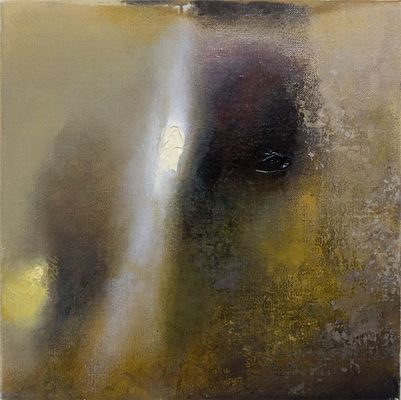
To return to Buckley’s fragment, the first two lines very much evoke how I paint nowadays. As you age, detail diminishes and patches of light become more luminous and float. I feel the most honest way of dealing with this is by smearing the oil paint on the canvas with the fingers and working close-up, blind. Only if the patches coalesce into an approaching image can the work gain a life.
-
Jonathan Walker was born in Melbourne, Australia and brought up on a dairy farm in Gippsland. In the 1970’s he studied painting at RMIT and won the Harold Wright Scholarship to the British Museum, London. During the 1980’s he exhibited at Pinacotheca Gallery, Richmond and had work shown at the NGV and Heidi City Art Gallery. Over the same period he designed the cover for the “Epigenesi” LP by Giancarlo Toniutti, Italy and conducted a mail exchange work with Achim Wollscheid, Germany. The work with artists through the post resulted in an article published in the bicentenary issue of Art and Australia 1988. He showed in artist run spaces such as WestSpace in the 90’s and 2000’s, and until 2012, taught painting at Victoria University, which is where we (Colleen Ahern and Lisa Radford) as organisers of the exhibition, among many others, had the privilege of being his student.
Walker’s knowledge was imparted to students through the careful selection of music, literature, and artists found in books that he himself had ordered for the library. Walker’s strategy was the generosity of sharing his vast knowledge with references specific to each student and their context.
Walker’s paintings share a similar focus and intimacy.
This exhibition presents a small selection of recent paintings alongside a publication that includes Walker’s writing. Observational and analytical, Walker’s work is a type of material notation — the time of day, colour and how it is blended, the both specific and fleeting location of a reflection on lino or the question of whether a chair leg should be included in a painting.
Please join us on Friday August 21 between 6-8pm to celebrate the opening of the exhibition.
Curated by Colleen Ahern and Lisa Radford.
B. Wurtz
Curated by Nic Tammens
March 26 - April 4, 2015
B.Wurtz works from a basement studio in his home on Manhattan’s Lower East Side.
This local fact is attested to by the plastic shopping bags and newsprint circulars that appear in his work. As formal objects, they don’t make loud claims about their origins but nonetheless transmit street addresses and places of business from the bottom of this long thin island. Like plenty of artists, Wurtz is affected by what is local and what is consumed. His work is underpinned by this ethic. It often speaks from a neighborhood or reads like the contents of a hamper:
“BLACK PLUMS $1.29 lb.”
“Food Bazaar”
“USDA Whole Pork Shoulder Picnic 99c lb.”
“RITE AID Pharmacy, with us it’s personal.”
“H. Brickman & Sons.”
“Sweet Yams 59c lb."
Most of the work in this exhibition was made while the artist was in residence at Dieu Donne, a workshop dedicated to paper craft in Midtown. Here Wurtz fabricated assemblages with paper and objects that are relatively lightweight, with the intention that they would be easily transportable to Australia. This consideration isn’t absolute in Wurtz’s work, but was prescriptive for making the current exhibition light and cheap. Packed in two boxes, these works were sent from a USPS post office on the Lower East Side and delivered to North Melbourne by Australia Post.
Wurtz appears courtesy of Metro Pictures, New York.
Thanks to Rob Halverson, Joshua Petherick, Sari de Mallory, Matt Hinkley, Helen Johnson, Fayen d'Evie, Ask Kilmartin, Lisa Radon, Ellena Savage, Yale Union, and "Elizabeth".
John Nixon
"Archive"
December 15 - January 20, 2014
The presentation of John Nixon's archive offered a rare showcase of this extensive collection of the artist's own publications, catalogues, posters, ephemera, editions and more, from the mid 1980s onwards, alongside a selection of his artworks.
Organized by John Nixon, Joshua Petherick and Matt Hinkley.
<a href=http://wfb.public-office.info/artist/john-nixon>All titles by John Nixon
"Habitat"
at Minerva, Sydney (organised by Joshua Petherick and Matt Hinkley)
November 15 - December 20, 2014
Lupo Borgonovo, Janet Burchill & Jennifer McCamley,
Lewis Fidock, HR Giger, Piero Gilardi, Veit Laurent Kurz,
Cinzia Ruggeri, Michael E. Smith, Lucie Stahl, Daniel Weil, Wols
Press Release:
“...It contained seven objects. The slender fluted bone, surely formed for flight, surely from the wing of some large bird. Three archaic circuitboards, faced with mazes of gold. A smooth white sphere of baked clay. An age-blackened fragment of lace. A fingerlength segment of what she assumed was bone from a human wrist, grayish white, inset smoothly with the silicon shaft of a small instrument that must once have ridden flush with the surface of the skin - but the thing’s face was seared and blackened.”
William Gibson, “Count Zero”, 1986
"Autumn Projects Archive"
Curated by Liza Vasiliou
March 6 - March 15, 2014
World Food Books, in conjunction with the Virgin Australia Melbourne Fashion Festival 2014, presented the Autumn Projects archive, consisting of a selection of early examples in Australian fashion with a particular interest in collecting designers and labels from the period beginning in the 1980’s, who significantly influenced the discourse of Australian Fashion.
Curated by Liza Vasiliou, the exhibition provided a unique opportunity to view pieces by designers Anthea Crawford, Barbara Vandenberg, Geoff Liddell and labels CR Australia, Covers, Jag along with early experimental collage pieces by Prue Acton and Sally Browne’s ‘Fragments’ collection, suspended throughout the functioning World Food Books shop in Melbourne.
H.B. Peace
presented by CENTRE FOR STYLE
November 14, 2013
"Hey Blinky, you say chic, I say same"
Anon 2013
H.B. Peace is a clothing collaboration between great friends Blake Barns and Hugh Egan Westland. Their pieces explore the divergences between 'character’ and ‘personality’ in garments....etc
Special Thanks to Joshua Petherick and Matt Hinkley of WFB and Gillian Mears
and a Very Special Thank you to Audrey Thomas Hayes for her shoe collaboration.
Janet Burchill & Jennifer McCamley
"Aesthetic Suicide"
May 10 - June 8, 2013
The first of our occasional exhibitions in the World Food Books office/shop space in Melbourne, "Aesthetic Suicide" presented a body of new and older works together by artists Janet Burchill & Jennifer McCamley, including videos, prints, a wall work, and publications.
During shop open hours videos played every hour, on the hour.
Published by World Food Books / Melbourne
$20.00 - In stock -
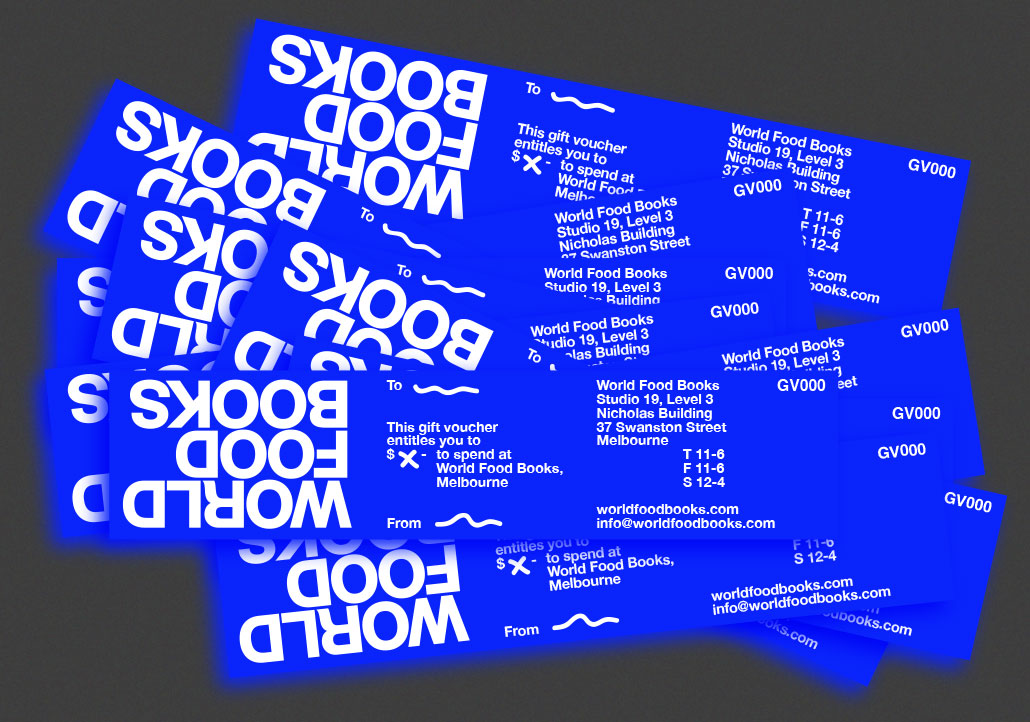
A World Food Books gift voucher is redeemable in our Melbourne bookshop or via our webshop (here). An e-voucher (printable pdf) will be sent to your purchase email address (please notify us if you wish to have the voucher sent to an alternate address and wish us to fill in the receiver's details on the card).
Gift vouchers can be purchased in increments of $20 (Australian Dollars) and the total amount can simply be added to by increasing the quantity in your shopping cart. eg. A quantity of 5 gift vouchers will result in an item total of $100 - a $100 gift voucher. Simply click "ADD TO CART" 5 times, or update your quantity in the shopping cart.
If you wish to purchase multiple, separate gift vouchers in one go, please just email us and we can personally prepare and email you a payment request.
Please note: Please select Pick-Up on gift voucher purchse to avoid any postage charges. Accidental postage charges will be refunded right away!
Thank you.
For any questions, please don't hesitate to email: [email protected]
1973, Japanese
Softcover, 114 pages, 26 x 18.5 cm
1st Edition, Out of print title / used / very good
Published by
Jazz People Sha / Tokyo
$120.00 - In stock -
Very rare copy of Tokyo's Jazz magazine, No. 20, Autumn 1973, with Don Cherry cover. At the forefront of the Jazz scene, edited by Japanese photojournalist and famous jazz critic Seiichi Sugita, Jazz is packed with rare gravure photography, interviews, scene reports, reviews, articles by leading artists, authors and critics, record labels and jazz coffee shop advertisements, this issue including special features on Sonny Rollins at the Village Vangaurd (photography by Seiichi Sugita), the Newport Jazz Festival New York — Archie Shepp, Milford Graves, Don Cherry, Lester Bowie, Joseph Jarman, Roscoe Mitchell, Ella Fitzgerald, Keith Jarrett, etc. (photography by Seiichi Sugita), Montreux Jazz Festival Summer 1973 (photography by Aoki), a message to Japanese music friends from Chick Corea (about Scientology!), articles on narcotics, improvisation, natural foods, extensive illustrated live and record reviews, and much more...
Very Good copy.
1974, Japanese
Softcover, 130 pages, 26 x 18.5 cm
1st Edition, Out of print title / used / very good
Published by
Jazz People Sha / Tokyo
$120.00 - In stock -
Very rare copy of Tokyo's Jazz magazine, No. 24, August 1974, a special John Coltrane issue. At the forefront of the Jazz scene, edited by Japanese photojournalist and famous jazz critic Seiichi Sugita, Jazz is packed with rare gravure photography, interviews, scene reports, reviews, articles by leading artists, authors and critics, record labels and jazz coffee shop advertisements, this issue including special feature and homage to John Coltrane with a huge Coltrane interview, rare photographs, articles, a complete illustrated discography, a photo-report and interview with Japanese saxophonist Kosuke Mine in New York (photography by Seiichi Sugita), Duke Ellington, Eric Dolphy, Celestial Music, extensive illustrated live and record reviews, and much more...
Very Good copy.
1974, Japanese
Softcover, 130 pages, 26 x 18.5 cm
1st Edition, Out of print title / used / very good
Published by
Jazz People Sha / Tokyo
$60.00 - In stock -
Very rare copy of Tokyo's Jazz magazine, September 1974. At the forefront of the Jazz scene, edited by Japanese photojournalist and famous jazz critic Seiichi Sugita, Jazz is packed with rare gravure photography, interviews, scene reports, reviews, articles by leading artists, authors and critics, record labels and jazz coffee shop advertisements, this issue including special features on Herbie Hancock with a full chronology and discography, Montreux Jazz Festival 1974 w. Sonny Rollins, Johm McLaughlin, Gil Evans, Lester Bowie, Joseph Jarman, Roscoe Mitchell, Jean-Luc Ponty, Rufus Harley, Don Moyer, Alphonse Mouzon, etc. (photography by Seiichi Sugita), interview with jazz pianist Mikio Masuda, Duke Ellington, Eric Dolphy, Celestial Music, extensive illustrated live and record reviews, and much more...
Very Good copy.
1975, Japanese
Softcover, 120 pages, 26 x 18.5 cm
1st Edition, Out of print title / used / very good
Published by
Jazz People Sha / Tokyo
$140.00 - In stock -
Very rare copy of Tokyo's Jazz magazine, January 1975. At the forefront of the Jazz scene, edited by Japanese photojournalist and famous jazz critic Seiichi Sugita, Jazz is packed with rare gravure photography, interviews, scene reports, reviews, articles by leading artists, authors and critics, record labels and jazz coffee shop advertisements, this issue including special features on Miles Davis with loads of rare photographs (inc. Miles Davis at the Newport Festival 1969 shot by Seiichi Sugita), article on Miles, complete Mile Davis discography, Japanese jazz pianist Toshiko Akiyoshi in New York (photography by Seiichi Sugita), European Jazz report, Eric Dolphy, Celestial Music, extensive illustrated live and record reviews, and much more...
Very Good copy.
2010, English / Croatian
Softcover (leporello fold), 11 x 166 cm
Artist's Ed. of 200,
Published by
Museum of Modern Art / Warsaw
$25.00 - In stock -
Mladen Stilinović's "Frizeri / Hairdressers" was first published in 1975, when Stilinović was making many photographs and photographic series which he bound in leporello (accordion) format. Frizeri (Hairdressers) was one of these many important published edition works of the late Croatian conceptual artist, and this Artist's edition was published in 2010 to accompany a major exhibition at the Museum of Modern Art in Warsaw.
This Artist's edition was published by Stilinović by pasting together photographs in an edition of 200 copies.
Mladen Stilinović (1947—2016) was one of the most significant representatives of neo-avant-garde art in Central and Eastern Europe. Stilinović was one of the leading figures of the so-called "New Art Practice" in Croatia and a founding member of the informal neo-avantgarde, Group of Six Artists (1975-1979), together with Vladimir Martek, Boris Demur, Željko Jerman, Sven Stilinović and Fedomir Vučemilović. His polymorphic approach finds varied manifestations from collages, installations, photographs, books, performances, actions in public space as well as participations in collective actions. Through his works, Stilinović explores ideological signs and their social aspects. Using devices such as irony, paradox, and manipulation, the artist criticizes the language of politics, institutional hierarchy within art, and the role of money and labor in society. Language is central to his aesthetics; he associates it with graphic signs and other visual references to historical movement, such as geometric abstraction. His work is deeply rooted in the rites that reveal the interdependence of private and public spheres. He is particularly interested in the interaction between visual and linguistic signs as well as in the mechanisms of deconstruction in language. Stilinović also ran the Extended Media Gallery from 1981-1991. He lived and worked in Zagreb, Croatia.
As New.
2009, English
Softcover (leporello fold), 15.5 x 97 cm
Artist's Ed. of 200,
Published by
Index / Stockholm
$25.00 - In stock -
Mladen Stilinović's "My Sweet Little Lamb" was first published as an artist's book in 1993. Produced with pen and rubber seal on printed paper, it is one of the many important published edition works of the late Croatian conceptual artist, and this recent Artist's edition was published in 2009 by Index, Stockholm, on the occasion of a major exhibition of the artist's books.
This Artist's edition was published by Stilinović in leporello format in an edition of 200 copies.
Mladen Stilinović (1947—2016) was one of the most significant representatives of neo-avant-garde art in Central and Eastern Europe. Stilinović was one of the leading figures of the so-called "New Art Practice" in Croatia and a founding member of the informal neo-avantgarde, Group of Six Artists (1975-1979), together with Vladimir Martek, Boris Demur, Željko Jerman, Sven Stilinović and Fedomir Vučemilović. His polymorphic approach finds varied manifestations from collages, installations, photographs, books, performances, actions in public space as well as participations in collective actions. Through his works, Stilinović explores ideological signs and their social aspects. Using devices such as irony, paradox, and manipulation, the artist criticizes the language of politics, institutional hierarchy within art, and the role of money and labor in society. Language is central to his aesthetics; he associates it with graphic signs and other visual references to historical movement, such as geometric abstraction. His work is deeply rooted in the rites that reveal the interdependence of private and public spheres. He is particularly interested in the interaction between visual and linguistic signs as well as in the mechanisms of deconstruction in language. Stilinović also ran the Extended Media Gallery from 1981-1991. He lived and worked in Zagreb, Croatia.
As New.
2006, English
Softcover (unbound), 3 leporello booklets, 16.5 x 16.5 cm
1st Edition, Out of print title / used / very good
Published by
Galerija Nova / Zagreb
$80.00 - In stock -
Copy of Mladen Stilinović's artist's book, designed by Mladen Stilinović and Dejan Kršić, published by Galerija Nova, Zagreb in 2006 on the occasion of the exhibition Vau - Vau (Wuff - Wuff). Printed by GIPA Zagreb, the book is made up of three leporello booklets, unbound and housed in an illustrated french fold cover. The booklets present the paintings, sculptural and photographic works of Stilinović, installation views of the exhibition, accompanying hand–written texts by Stilinović and an essay by Ana Dević, inc. quotes by Stilinović, Brecht, Canetti... Texts in English / Czech. Very scarce.
Mladen Stilinović (1947–2016) was one of the leading figures of the so-called "New Art Practice" in Croatia and a founding member of the informal neo-avantgarde, Group of Six Artists (1975-1979), together with Vladimir Martek, Boris Demur, Željko Jerman, Sven Stilinović and Fedomir Vučemilović. He lived and worked in Zagreb, Croatia.
As New, light wear to cover.
2008 / 2015, English
4 hand-sewn books in a plastic file (softcover books w. cut/folded coloured papers, white photocopy title sheet), each book 16 pages, 21 x 21 cm
Ed. of 32, numbered,
Published by
Alex Selenitsch / Melbourne
$320.00 - In stock -
Artist book edition published in an edition of 32 hand-numbered copies. Each edition is made up of 4 hand-sewn books in a plastic file. Each book comprises 16 pages of cut/folded coloured papers presenting a colour narrative: four pastel ‘primaries’ making colour tableaux, introduced and closed off by black and white covers.
The coloured pages are assembled from A3 sheets which have been halved: accurately in two cases (straight line orthogonal and straight line incline) or approximately (sinusoidal and horizontal tear). The cut-outs on the cover hint at the kind of division or halving that the coloured sheets have been subjected to. Both halves are used in the edition of each book, so that each edition of 32 copies with 4 folded sheets (giving 16 pages) uses 64 sheets. For the approximate cuts (sinusoidal and horizontal tear), there is some variation inside the edition.
2026, English
Softcover, 248 pages, 36.2 x 29.8 cm.
Published by
Little Big Man / Los Angeles
$180.00 - In stock -
Gravitating toward nocturnal spaces and marginalized communities, Kitajima uses the night as both subject and metaphor for identity, desire and transformation
Japanese photographer Keizo Kitajima's (born 1954) two series, Photographs of Okinawa (1975–79) and Tokyo 1979, share a deep continuity in spirit and approach, revealing the foundations of his raw, immersive photographic language. Both series emerge from Kitajima's direct participation in the worlds he depicts—whether amid the humid streets and bars of post-reversion Okinawa or the restless nightlife of Tokyo's underground. Shot in stark black and white with harsh flash, the images expose moments of vulnerability and intensity within Japan's shifting social landscape. Although each series was originally self-published separately, Kitajima later announced that their intentions and conclusions are the same. This publication collides the two series together in oversize format, with images as raw and fresh as when first photographed some 50 years ago.
Limited edition of 1000 copies.
1972, Italian / English
Softcover, 116 pages, 32.5 x 24 cm
1st Edition, Out of print title / used / good
Published by
Editoriale Domus / Milan
$50.00 - In stock -
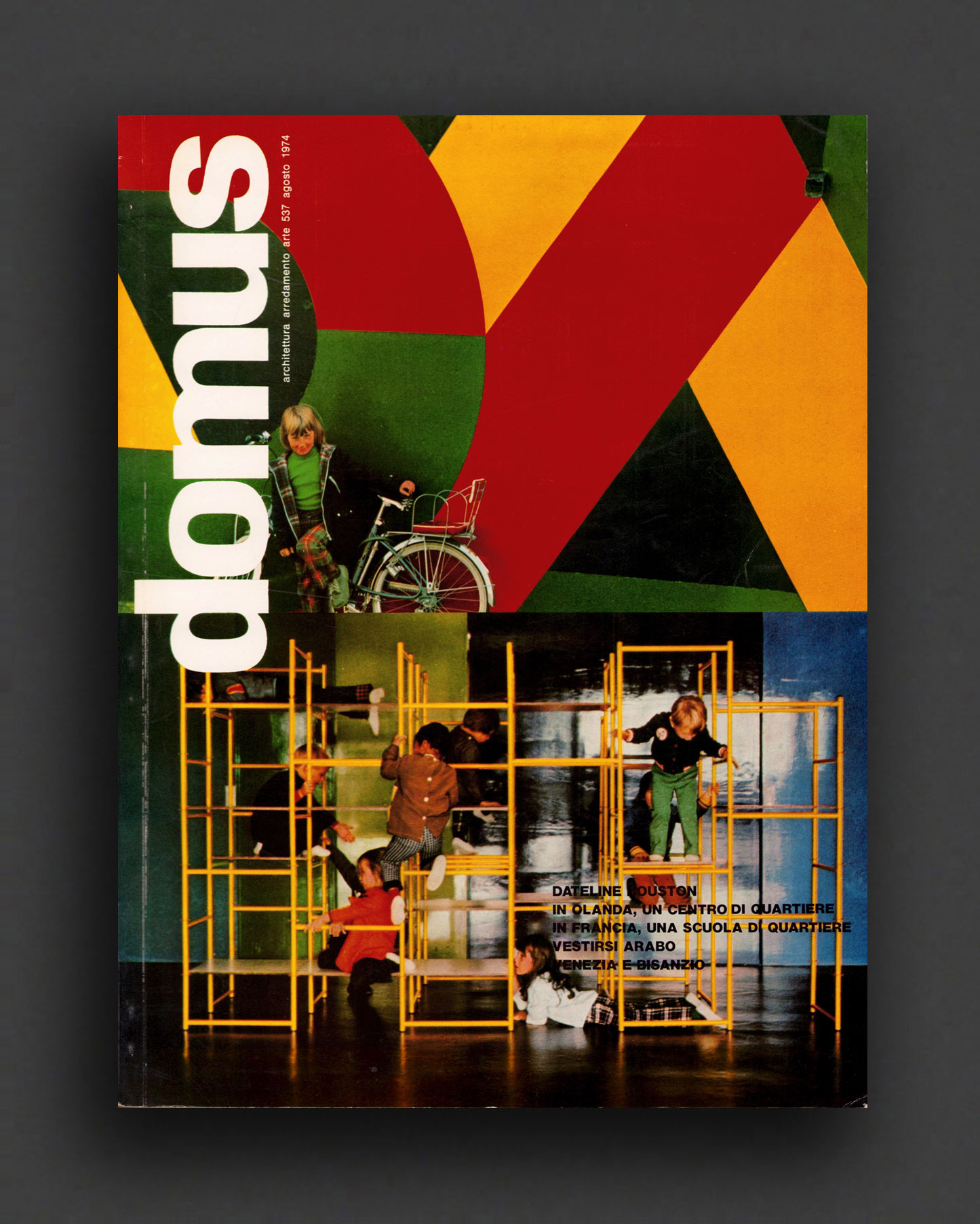
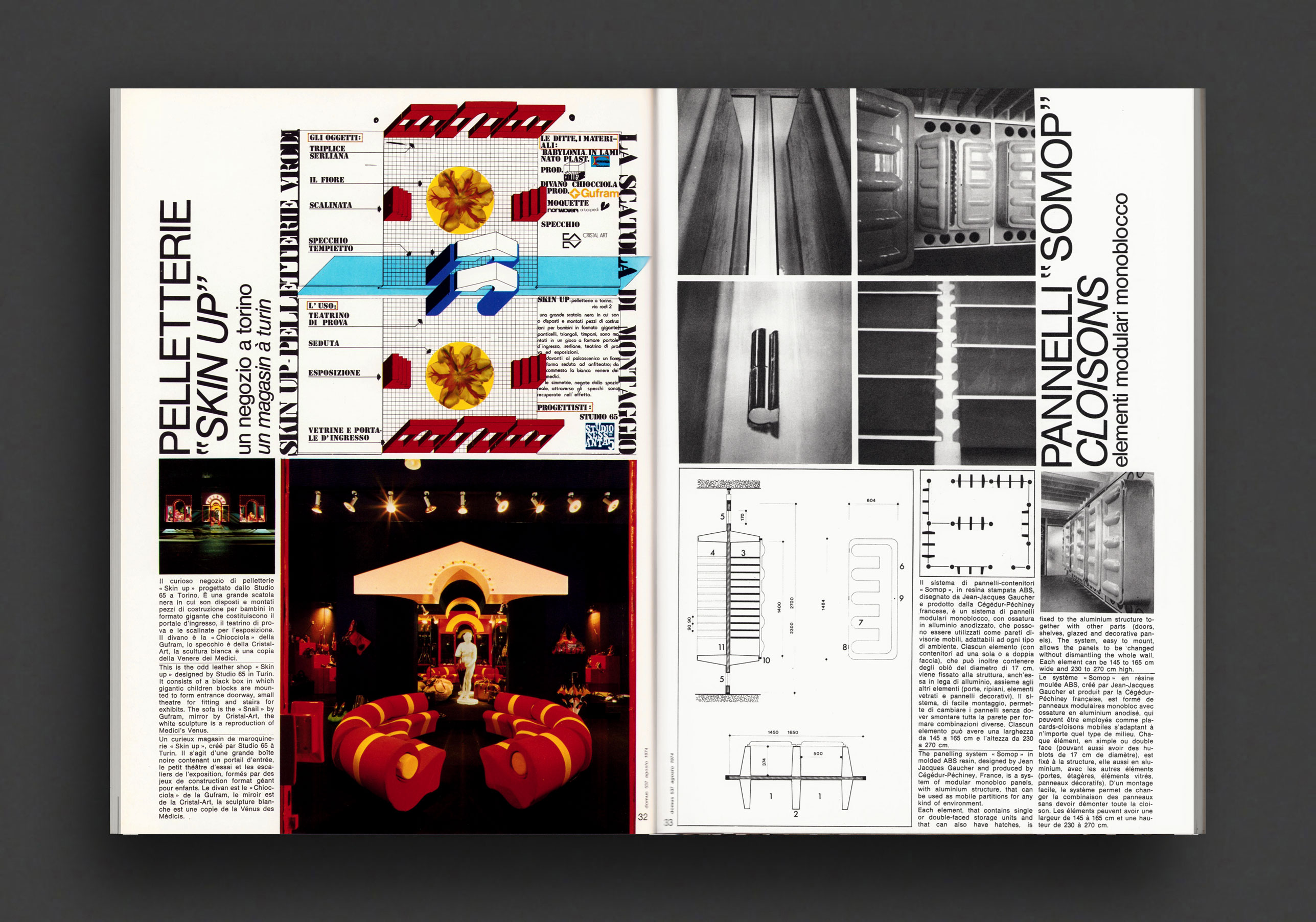
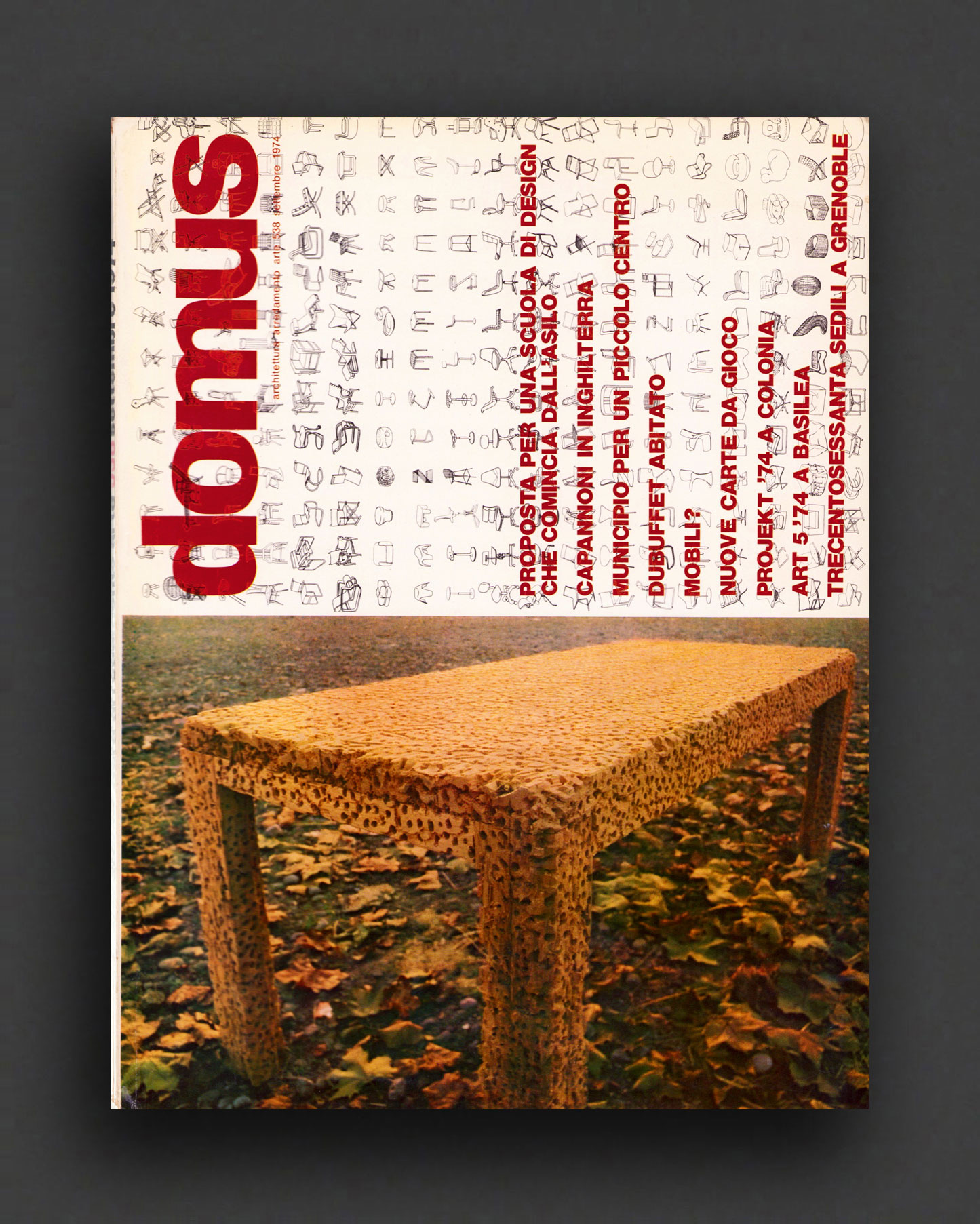
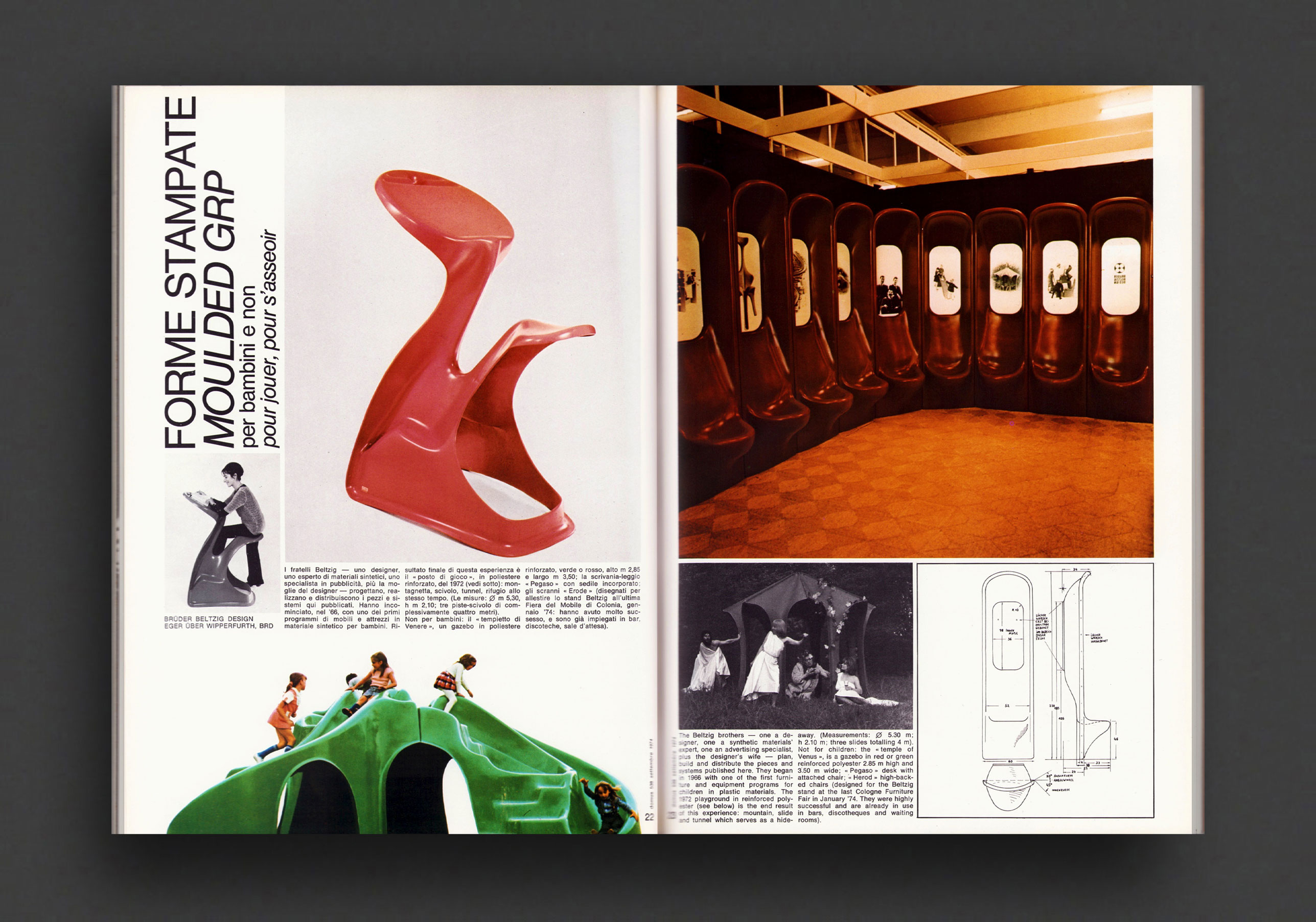
Founded in 1928 as a “living diary” by the great Milanese architect and designer Gio Ponti, domus has been hailed as the world’s most influential architecture and design journal, distributed in 89 countries. With exuberant style and rigor, it offered energetic up-to-date coverage and analysis of major themes, developments and stylistic movements in product, structure, interior, and industrial design. Called the "Mediterranean Megaphone," domus has always been considered the most concrete published expression of Italian style, documenting generations of radical, practical, and beautiful production, both local and across the world. Amongst a seemingly endless archive of contributions and features, domus frequently covered the works of the protagonists of the Anti and Radical Design movements, modern architecture, new experiments in environmental/spatial/commercial design, international product design, the activities of the Arte Povera, Pop art, Minimal Art and Nouveau Réalisme movements, and much more.
No. 506 Gennaio 1972
Editor : Gio Ponti
Editorial committee and contributors include : Cesare Casati, Pierre Restany, Agnoldomenico Pica, Pierre Restany, Carmela Haerdtl, Joseph Rykwert, Ettore Sottsass jr., Charles and Ray Eames, Kho Liang je, Bernard Rudofsky, George Nelson, Fausto Melotti, Tommaso Trini, Tapio Wirkkalaand, Rut Bryk, Hans Hollein, and more.
features :
architectural projects by Wolfgang Döring, Heinz Wilke, Filippo Alison, Adriana Baglloni and Luigi Moretti, Eliot Noyes; new furniture by Oscar Niemeyer, new interiors by Shigeru Uchida, Shoei Yoh, Gio Semprini, Ennio Chiggio; design objects from Zvi Hecker, De Pas/D'Urbino/Lomazzi, Kurt Ziehmer, a playground by Jean Michel Folon; projects/exhibitions by Studio 9999, Marisa Merz, Eva Hesse, Ugo La Pietra, Pier Paolo Calzolari, Agnes Denes, Adrian Piper, Dorothea Rockburne, Hanne Darboven; book reviews; and much more.
Beautifully printed in Italy and heavily illustrated throughout with vivid colour and black and white photography across multiple paper stocks, page crops and fold-out spreads.
Good copy with edge wear and tanning from age.
1972, Italian / English
Softcover, 116 pages, 32.5 x 24 cm
1st Edition, Out of print title / used / good
Published by
Editoriale Domus / Milan
$50.00 - In stock -
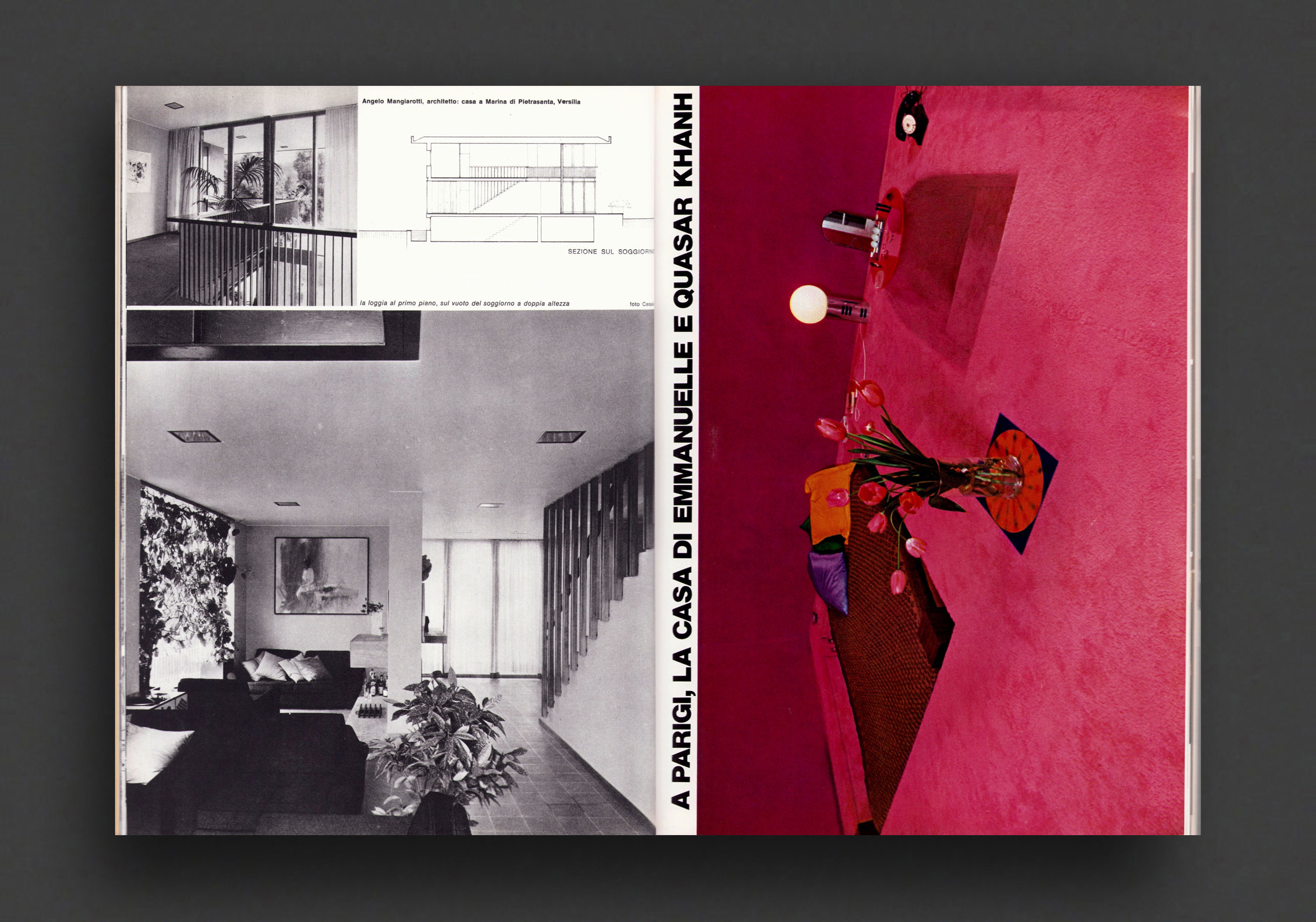
Founded in 1928 as a “living diary” by the great Milanese architect and designer Gio Ponti, domus has been hailed as the world’s most influential architecture and design journal, distributed in 89 countries. With exuberant style and rigor, it offered energetic up-to-date coverage and analysis of major themes, developments and stylistic movements in product, structure, interior, and industrial design. Called the "Mediterranean Megaphone," domus has always been considered the most concrete published expression of Italian style, documenting generations of radical, practical, and beautiful production, both local and across the world. Amongst a seemingly endless archive of contributions and features, domus frequently covered the works of the protagonists of the Anti and Radical Design movements, modern architecture, new experiments in environmental/spatial/commercial design, international product design, the activities of the Arte Povera, Pop art, Minimal Art and Nouveau Réalisme movements, and much more.
No. 510 Maggio 1972
Editor : Gio Ponti
Editorial committee and contributors include : Cesare Casati, Pierre Restany, Agnoldomenico Pica, Pierre Restany, Carmela Haerdtl, Joseph Rykwert, Ettore Sottsass jr., Charles and Ray Eames, Kho Liang je, Bernard Rudofsky, George Nelson, Fausto Melotti, Tommaso Trini, Tapio Wirkkalaand, Rut Bryk, Hans Hollein, and more.
features :
architectural projects by Angelo Mangiorotti, Marco Zanuso, Giulio Ballio, Giovanni Colombo, Alberto Vintani; interiors by Studio Zziggurat, Marc Held, Angelo Cortesi, Sergio Chiappa-Cattò, Franco Mazzucchelli, Takashi Sakaizawa, Alberto Breschi, Roberto Pecchioli, Franco Ferrari; new furniture by Tecno, Werner Kemp, Nanda Vigo, Lucio Fontana, Knoll, Gio Ponti; fashion design by Nanni Strada,; projects/exhibitions by Gae Aulenti, Ugo La Pietra, Joe Colombo, Gruppo Strum, Gaetano Pesce, Marco Zanuso, Superstudio, et al. (Ettore Sottsass, (Italy: The New Domestic Landscape"), Marino Marini, Filippo De Piis, Jean-Pierre Raynaud, Getulio Alviani; book reviews; and much more.
Beautifully printed in Italy and heavily illustrated throughout with vivid colour and black and white photography across multiple paper stocks, page crops and fold-out spreads.
Good copy with edge wear and tanning from age.
1972, Italian / English
Softcover, 116 pages, 32.5 x 24 cm
Published by
Editoriale Domus / Milan
$55.00 - Out of stock
Founded in 1928 as a “living diary” by the great Milanese architect and designer Gio Ponti, domus has been hailed as the world’s most influential architecture and design journal, distributed in 89 countries. With exuberant style and rigor, it offered energetic up-to-date coverage and analysis of major themes, developments and stylistic movements in product, structure, interior, and industrial design. Called the "Mediterranean Megaphone," domus has always been considered the most concrete published expression of Italian style, documenting generations of radical, practical, and beautiful production, both local and across the world. Amongst a seemingly endless archive of contributions and features, domus frequently covered the works of the protagonists of the Anti and Radical Design movements, modern architecture, new experiments in environmental/spatial/commercial design, international product design, the activities of the Arte Povera, Pop art, Minimal Art and Nouveau Réalisme movements, and much more.
No. 516 Novembre 1972
Editor : Gio Ponti
Editorial committee and contributors include : Cesare Casati, Pierre Restany, Agnoldomenico Pica, Pierre Restany, Carmela Haerdtl, Joseph Rykwert, Ettore Sottsass jr., Charles and Ray Eames, Kho Liang je, Bernard Rudofsky, George Nelson, Fausto Melotti, Tommaso Trini, Tapio Wirkkalaand, Rut Bryk, Hans Hollein, and more.
features :
architectural projects by James Stirling; New York, black and white by Douglas and Stephanie M. Kahn; a flat in Milan by Alberto Salvati and Ambrogio Tresoldi; furniture from the Milanese furniture show, 1967–72; art exhibitions all over the world; Robert Morris interviewed by Achille Bonito-Oliva; item perspective by Germano Celant; London’s Age of Neo-classicism by Joseph Rykwert; an off-season journey by Daniela Palazzoli; a conversation at Salt Lake City with Gianni Pettena; a huge feature on new furniture and interior objects of 1972 (everyone from Vico Magistretti to Meret Oppenheim); book reviews; and much more.
Beautifully printed in Italy and heavily illustrated throughout with vivid colour and black and white photography across multiple paper stocks, page crops and fold-out spreads.
Very Good copy with light wear.
1971, Italian / English
Softcover, 116 pages, 32.5 x 24 cm
1st Edition, Out of print title / used / very good
Published by
Editoriale Domus / Milan
$55.00 - Out of stock
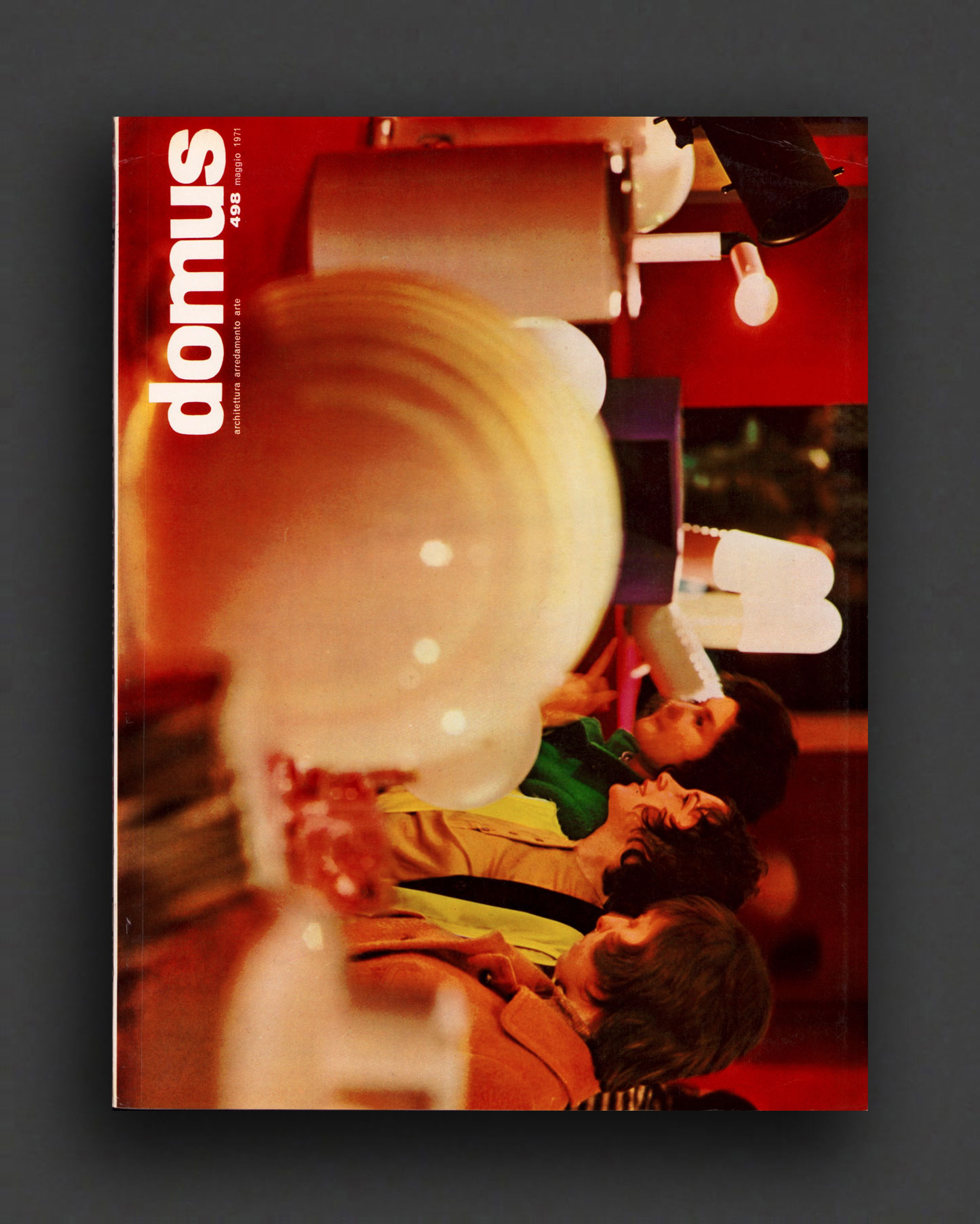
Founded in 1928 as a “living diary” by the great Milanese architect and designer Gio Ponti, domus has been hailed as the world’s most influential architecture and design journal, distributed in 89 countries. With exuberant style and rigor, it offered energetic up-to-date coverage and analysis of major themes, developments and stylistic movements in product, structure, interior, and industrial design. Called the "Mediterranean Megaphone," domus has always been considered the most concrete published expression of Italian style, documenting generations of radical, practical, and beautiful production, both local and across the world. Amongst a seemingly endless archive of contributions and features, domus frequently covered the works of the protagonists of the Anti and Radical Design movements, modern architecture, new experiments in environmental/spatial/commercial design, international product design, the activities of the Arte Povera, Pop art, Minimal Art and Nouveau Réalisme movements, and much more.
No. 499 Giugno 1971
Editor : Gio Ponti
Editorial committee and contributors include : Cesare Casati, Pierre Restany, Agnoldomenico Pica, Pierre Restany, Carmela Haerdtl, Joseph Rykwert, Ettore Sottsass jr., Charles and Ray Eames, Kho Liang je, Bernard Rudofsky, George Nelson, Fausto Melotti, Tommaso Trini, Tapio Wirkkalaand, Rut Bryk, Hans Hollein, and more.
features :
architectural and design projects by Franco Albini and Franca Helg, Guglielmo Ulrich and Herbert Rader, Mirco Ravanne, Gae Aulenti, Kazuhide Takahama, De Pas/D’Urbino/Lomazzi, and Fabrizio Cocchia; a competition for a hilltop project by Francesco and Teresa Gino; flowers over the world from Persia; an embassy in Islamabad and a resort on the Caspian; the reform of a convent and new “giardini all’italiana” by Gae Aulenti; knock-down shelves by De Pas/D’Urbino/Lomazzi; ideas by Ico and Luisa Parisi; a summer 1971 project; “Cover”, an exhibition by Haus-Rucker-Co.; Mario Merz by Germano Celant; exhibitions by Tomaso Trini; books; and much more.
Beautifully printed in Italy and heavily illustrated throughout with vivid colour and black and white photography across multiple paper stocks, page crops and fold-out spreads.
Very Good copy with light wear.
1971, Italian / English
Softcover, 116 pages, 32.5 x 24 cm
1st Edition, Out of print title / used / very good
Published by
Editoriale Domus / Milan
$55.00 - In stock -
Founded in 1928 as a “living diary” by the great Milanese architect and designer Gio Ponti, domus has been hailed as the world’s most influential architecture and design journal, distributed in 89 countries. With exuberant style and rigor, it offered energetic up-to-date coverage and analysis of major themes, developments and stylistic movements in product, structure, interior, and industrial design. Called the "Mediterranean Megaphone," domus has always been considered the most concrete published expression of Italian style, documenting generations of radical, practical, and beautiful production, both local and across the world. Amongst a seemingly endless archive of contributions and features, domus frequently covered the works of the protagonists of the Anti and Radical Design movements, modern architecture, new experiments in environmental/spatial/commercial design, international product design, the activities of the Arte Povera, Pop art, Minimal Art and Nouveau Réalisme movements, and much more.
No. 504 Novembre 1971
Editor : Gio Ponti
Editorial committee and contributors include : Cesare Casati, Pierre Restany, Agnoldomenico Pica, Pierre Restany, Carmela Haerdtl, Joseph Rykwert, Ettore Sottsass jr., Charles and Ray Eames, Kho Liang je, Bernard Rudofsky, George Nelson, Fausto Melotti, Tommaso Trini, Tapio Wirkkalaand, Rut Bryk, Hans Hollein, and more.
features :
architectural and industrial design projects; Agnoldomenico in Pica; Frei Otto; a new exhibition in New York; new housing quarters and a school in England; coloured concrete in Milan by Ernesto Giffoni and Dario Montagnani; In the Wood by Jeremy Scott Wood; a chronicle of the 1st Salone del Mobile of Milan; a competition at Pordenone; Sweet Dreams by Stan Pesket; sculptural furniture by Giuseppe Rivadossi; exhibitions in art galleries; art exhibitions all over the world; exhibitions by Tommaso Trini; Below the Horizon by Kengiro Azuma; book reviews by A.D. Pica and Laura Barile; and much more.
Beautifully printed in Italy and heavily illustrated throughout with vivid colour and black and white photography across multiple paper stocks, page crops and fold-out spreads.
Very Good copy with light wear.
2000, English
Softcover, 48 pages, 25.5 x 20.5 cm
1st Edition, Out of print title / used / very good
Published by
Granary Books / New York
$50.00 - In stock -
First edition, out–of–print.
A landmark first-time collaboration between poet Clark Coolidge and writer/scholar/artist Keith Waldrop, Bomb is a meditation on a book of photographs that documents the Manhattan Project. Coolidge's 30-page poem begins with epigraphs by Democritus, Gregory Corso and André Breton with Paul Eluard, and continues in an elliptical, glancing narrative style that lucidly investigates a subject often too traumatic to consider directly: the impact of the atomic bomb on our everday lives. As Coolidge puts it, the general tendency has been to "put the bomb in a glass vase/add dust and forget." Like all of Coolidge's work, Bomb is sharp, stark and rhythmic; the poet here tangles with the dreamlike oddness of the photographs at hand in fits and starts of highly textured language. Keith Waldrop's series of collages are literal reworkings of the original pictures: deep blacks and bright whites excavated from the book, remade here in the image of the poem.
Designed by Emily Y. Ho.
VG–NF copy. First ed. of 1500 copies.
1989, English
Hardcover (leather bound), 160 pages, 24 x 16.5 cm
Numbered Ed. of 2000,
1st Edition, Out of print title / used / very good
Published by
Glittering Images / Florence
$240.00 - Out of stock
Very rare copy of this deluxe, limited edition 1989 collection of John Willie's trailblazing fetish work, The Best of Bizarre, published by the mighty Glittering Images, Florence. Individually stamp–numbered (1573 of 2000) and bound in gold–gilded, illustration–plated red "leather"(?) hardcover, this beautifully designed and profusely illustrated book, edited by Riccardo Morrocchi, Stefano Piselli, and Marco Giovannini, features the iconic illustrations, photography and a wonderful selection of articles by John Willie (famous for Bizarre and The Adventures of Sweet Gwen), alongside an illustrated index of the original magazine issues. A stunning edition. English language throughout.
John Alexander Scott Coutts (1902–1962), better known by the pseudonym John Willie, was an artist, fetish photographer, cartoonist, specialty shoe designer, and the publisher and editor of the first 20 issues of the trail–blazing fetish magazine Bizarre. John Willie was not just a pivotal underground artist; he was a visionary who redefined the cultural boundaries of his time. Through Bizarre magazine and his creation of Sweet Gwendoline, he provided a space for people with unconventional desires to find community, expression, and acceptance in a society that often sought to repress them. His work balanced humor, fantasy, and artistry, pushing fetish culture into the limelight in a way that was both daring and sophisticated. His work has inspired countless artists ever since.
Very Good copy with foxing to block edges and light foxing to top of cover inlay.
1974, English
Hardcover, 150 pages, 29 x 22 cm
1st Edition, Out of print title / used / very good
Published by
Belier Press / New York
$160.00 - Out of stock
Rare 1974 hardcover volume published by Belier Press, New York, collecting in large format the illustrated comic strip stories of John Willie's iconic Sweet Gwendoline. A masterpiece of pioneering fetish illustration, Sweet Gwendoline follows a naïve, curvaceous blonde damsel in distress who repeatedly finds herself tied up, alongside Secret Agent U-89 and the villain Sir Dystic D'Arcy.Legacy, first serialized in Robert Harrison's girlie magazine Wink from June 1947 to February 1950, and became a cult classic and a major influence on modern fetish subculture and alternative comics. This first English edition was hugely popular and was later translated to French, German and Italian editions, and re–printed many times. The book opens with a foreword, biography, bibliography and John Willie correspondence, followed by the collected Sweet Gwendoline comic works, and a beautiful section to close of full–colour reproductions of John Willie's watercolour fetish works.
John Alexander Scott Coutts (1902–1962), better known by the pseudonym John Willie, was an artist, fetish photographer, cartoonist, specialty shoe designer, and the publisher and editor of the first 20 issues of the trail–blazing fetish magazine Bizarre. John Willie was not just a pivotal underground artist; he was a visionary who redefined the cultural boundaries of his time. Through Bizarre magazine and his creation of Sweet Gwendoline, he provided a space for people with unconventional desires to find community, expression, and acceptance in a society that often sought to repress them. His work balanced humor, fantasy, and artistry, pushing fetish culture into the limelight in a way that was both daring and sophisticated. His work has inspired countless artists ever since.
G–VG copy with tanning and foxing to block edges. First edition, fourth print.
2007, English
Hardcover, 528 pages, 25 x 28.9 cm
Published by
FAB Press / UK
$110.00 - Out of stock
Running to 528 large-format pages, Nightmare USA is a veritable encyclopedia of grindhouse cinema - it's one of the most acclaimed genre film books ever published, and after having Sold Out three times over already, it's finally back in print!
From Quentin Tarantino (Kill Bill) to Eli Roth (Hostel), the young guns of modern Hollywood just can't get enough of that exploitation film high. That's because, between 1970 and 1985, American Exploitation movies went berserk. With censorship relaxed, and the gate to excess wide open, horror offered a vibrant alternative to the mainstream of American cinema. Luridly titled wonders like The Headless Eyes, Scream Bloody Murder and Hitch Hike to Hell were everywhere, from the drive-ins of Texas to the grindhouses of New York. Massively popular around the world, American exploitation movies added immensely to the richness of the nation's cinema.
Built on five years of research, Nightmare USA explores the development of America's subterranean horror film industry, spotlighting some of the wildest films imaginable from an era unchecked by censorship or 'good taste.' Ranging from cult favourites like I Drink Your Blood to stylish mind-benders like Messiah of Evil and shockers like Don't Go in the House, Nightmare USA goes where no other in-depth study has gone before, revealing the fascinating true stories behind classics and obscurities alike. Author Stephen Thrower has explored the attics and cellars of American cinema, delved beneath the floorboards, peered between the walls, searching for the strangest, most exotic cine-lifeforms... Nightmare USA is the reader's guide to what lies beyond the mainstream of American horror, dispelling the shadows to meet the men and women behind fifteen years of screen terror: the Exploitation Independents!
This massive overview of the Horror genre's development through the 1970s and 1980s features: In-depth EXCLUSIVE interviews with twenty-five grindhouse movie makers, many of whom are discussing their work for the first time ever in print, including David Durston (I Drink Your Blood), Robert Endelson (Fight for Your Life), Frederick Friedel (Axe), Don Jones (Schoolgirls in Chains); and Joseph Ellison (Don't Go in the House). Over 175 individual films reviewed, with full cast and crew credits. Vast quantities of previously unpublished stills, posters, press-books, plus behind-the-scenes photographs from the filmmakers' own collections.
2025, English
Hardcover (w. dust jacket), 416 pages, 26 x 19.8 cm
Published by
FAB Press / UK
$110.00 - In stock -
Back in print at last! Exclusively re-issued in hardcover. First published in 2008, this is the Updated and Amended re-issue of Behind the Pink Curtain, the definitive study of Japan's pinku eiga film genre.
Behind the Pink Curtain takes the reader on a wild joy ride deep into the hinterlands of Japanese culture, society and radical politics by way of the weird and wonderful world of the country’s distinctive sex film movements.
Jasper Sharp’s definitive study focuses on one of the most notorious sectors of Japanese filmmaking, the erotic Pink Film, or pinku eiga genre, and the closely related Roman Porno films produced by Nikkatsu studios from 1971 to 1988. From the early ’60s onwards major Japanese film studios and independent producers alike have kept up a conveyor belt level of output of pornographic features intended purely for cinema release. Up until the 2010s, just short of 100 such titles were shot on 35mm every year intended for screening in a specialist network of adult cinemas across the nation. Many such films have been released on home video in the West or screened at international film festivals, while a significant number of Japan’s most noted filmmakers today cut their teeth in this industry.
Based on extensive interviews with many of the leading figures in the field, Behind the Pink Curtain is a colourful and exhaustive exposé of Japan’s most vibrant and prolific filmmaking sector.
Lavishly illustrated throughout in colour and black and white.
Jasper Sharp is a writer and filmmaker based in the UK and co-founder, with Tom Mes, of Midnight Eye (www.midnighteye.com), the first online resource on Japanese cinema in the English language. His other books include The Midnight Eye Guide to New Japanese Film (2003, with Mes), The Historical Dictionary of Japanese Cinema (2011) and The Creeping Garden: Irrational Encounters with Plasmodial Slime Moulds (Alchimia, 2015). His doctorate degree from the University of Sheffield was on the subject of 'Japanese Widescreen Cinema: Commerce, Technology and Aesthetics.'
2026, English
Softcover (w. dust jacket), 238 pages, 15 x 10.5 cm
Published by
Sternberg Press / Berlin
$36.00 - In stock -
A massive value shift for existing buildings, infrastructure, materials, unbuilt land, earth, and the labor that holds our world together.
To build is to destroy, writes Charlotte Malterre-Barthes. From steel bolts to concrete blocks to wood flooring to polyester insulation panels, every single component of the built environment is the product of extractive processes. Driven by greedy economies, the global enterprise of space production expands, impacting climate, earth, water, humans, and non-humans everywhere. However housing is both a human right and the mandate of design disciplines: How to navigate the need for housing versus the destructive practice of construction?
To pause new construction-even if momentarily, creates a radical thinking framework for alternatives to the current regime of space production and its suspect growth imperative. Engaging with unsettling questions, A Moratorium on New Construction envisions a massive value shift for our existing stock. From housing redistribution to reinviting value generation, from anti-extractive measures to profound structural changes, from curricula reforms to purging the exploitative culture of the office, an entire rewiring of design processes and construction lays ahead. Somewhere between a thought experiment and a call for action, A Moratorium on New Construction is a leap of faith to envision a less extractive future, made of what we have: Not demolishing, not building new, but building less, building with what exists, inhabiting it differently, and caring for it.
1998, English
Softcover, 408 pages, 31 x 22 cm
1st Edition, Out of print title / used / very good
Published by
Thames and Hudson / London
$55.00 - Out of stock
First edition of Out of Actions: Between Performance and the Object, 1949-1979, edited by Paul Schimmel, published in 1998. with essays by Kristine Stiles, Guy Brett, Hubert Klocker, Shinichiro Osaki, and Paul Schimmel.
Published to coincide with the first major museum exhibition to examine the complex relationship linking the creative process, action or performance, and works of art in the postwar period. Featuring nearly one hundred and fifty artists and collaboratives from approximately twenty countries in Eastern and Western Europe, the Middle East, Asia, Japan, and North and South America—including figures associated with the New York School, Nouveaux Realistes, Fluxus, Viennese Actionists, Hi Red Center, Arte Povera, the Gutai group, happenings, process art, and performance art—the exhibition centered on how the possibilities and implications of using time and process as elements of art were realized by a number of international movements during this influential thirty-year period.
Covering three decades of significant and original art, this lavishly illustrated book features work by more than one hundred artists from across the world who have had a profound impact on the relationship between visual and performance art in the postwar era.
Includes the work of: Marina Abramović, Vito Acconci, Genpei Akasegawa, Laurie Anderson, Eleanor Antin, Rasheed Araeen, Mowry Baden, Artur Barrio, Jerzy Beres, Joseph Beuys, Mark Boyle & Joan Hills, George Brecht, Stuart Brisley, Robert Delford Brown, Rhett Delford Brown, Günter Brus, Chris Burden, James Lee Byars, John Cage, Marc Camille Chaimowicz, Lygia Clark, Pinchas Cohen Gan, Collective Action Group, Houston Conwill, Paul Cotton, COUM Transmissions, Guy de Cointet, Jim Dine, John Duncan, Felipe Ehrenberg, Roberto Evangelista, VALIE EXPORT, Robert Filliou, Rose Finn-Kelcey, Sherman Fleming, Lucio Fontana, Terry Fox, Howard Fried, Gideon Gechtman, Jochen Gerz, Gilbert & George, Alberto Greco, Ion Grigorescu, Victor Grippo, Red Grooms, Guerrilla Art Action Group, David Hammons, Al Hansen, Maren Hassinger, Lynn Hershman Leeson, Dick Higgins, Tatsumi Hijikata, Susan Hiller, Hi Red Center, Rebecca Horn, Tehching Hsieh, Joan Jonas, Kim Jones, Michel Journiac, Akira Kanayama, Tadeusz Kantor, Allan Kaprow, Mike Kelley, Jürgen Klauke, Yves Klein, Milan Knížák, Alison Knowles, Komar & Melamid, Jannis Kounellis, Shigeko Kubota, Tetsumi Kudo, Yayoi Kusama, Leslie Labowitz, Suzanne Lacy, John Latham, Jean-Jacques Lebel, Lea Lublin, George Maciunas, Leopoldo Maler, Piero Manzoni, Tom Marioni, Cusi Masuda, Georges Mathieu, Gordon Matta-Clark, Paul McCarthy, Bruce McLean, David Medalla, Cildo Meireles, Ana Mendieta, Gustav Metzger, Marta Minujín, Jan Mlčoch, Linda Montano, Charlotte Moorman, Robert Morris, Otto Muehl, Saburo Murakami, Natsuyuki Nakanishi, Bruce Nauman, Paul Neagu, Senga Nengudi, Joshua Neustein, Hermann Nitsch, Hélio Oiticica, Claes Oldenburg, Yoko Ono, Orlan, Raphael Montañez Ortiz, Lorenzo Pace, Nam June Paik, Gina Pane, Lygia Pape, Giuseppe Pinot Gallizio, Adrian Piper, Michelangelo Pistoletto, Jackson Pollock, William Pope.L, Robert Rauschenberg, Carlyle Reedy, Klaus Rinke, Ulrike Rosenbach, Dieter Roth, Zorka Ságlová, Niki de Saint Phalle, Alfons Schilling, Tomas Schmit, Carolee Schneemann, Rudolf Schwarzkogler, Bonnie Ora Sherk, Shōzō Shimamoto, Ushio Shinohara, Kazuo Shiraga, Barbara T. Smith, Daniel Spoerri, Petr Štembera, Wolfgang Stöerchle, Jirō Takamatsu, Atsuko Tanaka, Mark Thompson, Jean Tinguely, Rasa Todosijević, Kerry Trengove, Ulay, Ben Vautier, Wolf Vostell, Franz Erhard Walther, Peter Weibel, Franz West, Hannah Wilke, Emmett Williams, Zaj.
Their work encompasses sculpture, artists' publications, drawings, photographs, and the ephemera that arises from the performance, as well as documentary film and video stills.
Published in conjunction with a major touring exhibition organized by The Museum of Contemporary Art, Los Angeles, Out of Actions illuminates the unique relationship between action, destruction, performance, and the creative process, in essays by acclaimed art historians. Covering an unprecedented range of material, the book offers the first critical comparisons of work that has previously been viewed as distinctly regional and unrelated.
With 450 illustrations, 200 in colour.
VG copy with light wear and "The Grid" written in red marker on the block side (?).
2020, English
Hardcover (w. dust jacket), 672 pages, 29 x 24 cm
Published by
Prestel / Munich
$125.00 - In stock -
Now available again in an expanded edition and featuring a variety of work from artists both well-known and under the radar, this volume explores the pioneering achievements of the Feminist Avant-Garde.
For art history, the 1970s represent the beginning of women subverting culturally and socially established constructions and traditional norms. Second-wave feminism, with its slogan "The personal is political", challenged the one-dimensional roles assigned to women--mother, housewife, and spouse. During this period, women artists radically questioned their duties and created a plurality of self-determined representations of themselves. Rejecting traditional male-dominated techniques, such as painting, these artists made use of new media, such as photography, film, video, and performance. The outcome was artwork which was radical, poetic, ironic, bitter, cynical, and heartfelt. This book features more than seventy international female artists, including works by Martha Rosler, Mary Beth Edelson, Ana Mendieta, Nil Yalter, and Ulrike Rosenbach. Editor Gabriele Schor used the term Feminist Avant-Garde in order to emphasize the role that these artists played in the last four decades. This new edition has been enriched with twenty-five new artists–Emma Amos, Dara Birnbaum, Rose English, Natalia LL, among others–as well as up-to-date research on feminist exhibitions, catalogues, and periodicals. Each artist is introduced by an essay and the book also includes fascinating texts by leading scholars.
Features the work of: Helena Almeida, Eleanor Antin, Annekke Barger, Lynda Benglis, Judith Bernstein, Renate Bertlmann, Teresa Burga, Marcella Campagnano, Judy Chicago, Linda Christanell, Lili Dujourie, Mary Beth Edelson, Renate Eisenegger, Valie Export, Esther Ferrer, Lynn Hershman Leeson, Alexis Hunter, Sanja Iveković, Birgit Jürgenssen, Kirsten Justesen, Ketty La Rocca, Leslie Labowitz, Katalin Ladik, Brigitte Lang, Suzanne Lacy, Suzy Lake, Karin Mack, Ana Mendieta, Rita Myers, Lorraine O’Grady, Orlan, Gina Pane, Letítia Parente, Ewa Partum, Friederike Pezold, Margot Pilz, Ulrike Rosenbach, Martha Rosler, Suzanne Santoro, Carolee Schneemann, Lydia Schouten, Cindy Sherman, Penny Slinger, Annegret Soltau, Hannah Wilke, Martha Wilson, Francesca Woodman, Nil Yalter...
2026, English
Softcover (staple-bound), 12 pages, 20 x 14 cm
Published by
Oriette Wood / Naarm
$40.00 - In stock -
‘Trashvestites’ is the zombified pursuit of femininity. Contextualised by the trans experience, this mini-zine is an overstuffed sociocultural projection of womanhood put through the apparatus of abjection, vulgarity, and the Monstrous. These collages are digitally torn from cross-dressing forums and soft core porn archives, then soiled and screen-printed in CMYK.