World Food Books' programme is largely produced on Kulin Nation land. We acknowledge the Wurundjeri people of the Kulin Nation as the first and continuing custodians of this land, and pay respect to their Elders past, present, and emerging.
World Food Books is an arts and special interests bookshop in Naarm / Melbourne. Founded in 2010, World Food Books is devoted to the presentation of a rotating, hand-selection of international art, design, literary and counterculture publications with an emphasis on the anti-traditional, the experimental, the avant-garde, the heretic, the marginal.
Presenting new titles alongside rare and out-of-print books, catalogues and journals spanning the fields of modern and contemporary art, design, photography, illustration, film, literature, poetry, cultural theory, philosophy, sexuality, popular and underground culture in its many radical forms, World Food Books wishes to encourage adventurous, thoughtful and open-minded reading, looking, writing, and exchange of publishing and ideas, both current and historical.
As well as our bookshop, located in Melbourne's historical Nicholas Building, all of our inventory is available internationally via our online mail-order service.
World Food Books semi-regularly co-ordinates "Occasions", a programme of exhibits and events at the bookshop and in partnership with other hosts (such as museums and art galleries) that develop out of the activities, relationships and content of the bookshop itself.
World Food Books
The Nicholas Building
37 Swanston Street
Room 5, Level 6
Melbourne 3000
Australia
SHOP HOURS:
Thu–Fri 12–6
Sat 12–5
WEB-SHOP OPEN 24/7
World Food Books
Postal Address:
37 Swanston Street
Room 5, Level 6
Melbourne 3000
Australia
Art
Theory / Essay
Architecture / Interior
Graphic Design / Typography
Photography
Fashion
Eros
LGBTQ+
Fiction / Poetry
Weird / Speculative / Science Fiction / Horror
Transgressive / Visceral / Abject
Symbolism / Decadence / Fin de siècle
Film / Video
Painting
Sculpture / Installation
Performance / Dance / Theater
Drawing
Sound / Music
Curatorial
Group Shows / Collections
Periodicals
Out-of-print / Rare
Posters / Ephemera / Discs
Signed Books
World Food Books Gift Voucher
World Food Book Bag
Australian Art
Australian Fiction
Australian Science Fiction / Speculative Fiction
Australian Poetry
Australian Photography
Japanese Photography
Conceptual Art
Minimal Art
Dada
'Pataphysics / Oulipo
Fluxus
Concrete Poetry
Pop Art
Surrealism
Arte Povera
Arte Informale / Haute Pâte / Tachism
Nouveau Réalisme / Zero / Kinetic
Situationism / Lettrism
Collage / Mail Art / Xerox Art
Art Brut / Folk / Visionary / Fantastic
Illustration / Graphic Art / Bandes Dessinées
Furniture
Italian Radical Design / Postmodernism
Textiles
Ceramics / Glass
Counterculture
Protest / Revolt
Philosophy
Psychoanalysis
Anthropology
Anarchism
Socialism / Anarchism / Communism / Capitalism
Literary Theory / Semiotics / Language
Feminism / Women's Studies
Gender Studies / Sexuality
Anthropology
Fetishism / BDSM
Drugs / Psychedelia
Crime / Violence
Animal Rights / Veganism
Occult / Esoterica
Ecology / Earth / Alternative Living
Whole Earth / Crafts
All prices in AUD (Australian dollars)
Pick-Ups
Pick-up orders can be collected in our bookshop during opening hours after order date. Please collect any Pick-up orders within 2 weeks of ordering as we have limited storage space. Orders will be released back into stock if not collected within this time. No refunds can be made for pick-ups left un-collected. If you cannot make it in to the bookshop in this time-frame, please choose postage option.
Return Policy
All sales are final. We do accept returns (for refund or exchange) for items received in error. All our orders are packed with special care using heavy-duty padding and cardboard book-mailers or bubble mailers (for smaller books), using reinforcement where required. We cannot take responsibility for any lost, stolen or damaged parcels.
Insurance
Should you wish to insure your package, please email us directly after placing your order and we can organise this at a small extra expense. Although all standard/express tracked packages are very safe and dependable, we cannot take responsibility for any lost, stolen or damaged parcels. We recommend insurance on valuable orders.
Interested in selling your old books, catalogues, journals, magazines, comics, fanzines, ephemera? We are always looking for interesting, unusual and out-of-print books to buy. We only buy books in our fields of interest and specialty, and that we feel we can resell.
We base these prices on desirability, market value, in-print prices, condition and our current stock levels. We offer cash, store credit, and can take stock on consignment. All
about 25% of the price we expect to get when we sell them, or 30% in store credit. We base these prices on desirability, market value, in-print prices, condition and our current stock levels.
Sell your books any day of the week. You can drop them off and return later. If you have a lot of books, we can visit your Sydney home.
We buy books that we feel we can resell. We offer about 25 % of the price we expect to get when we sell them, or 30% in store credit. We base these prices on desirability, market value, in-print prices, condition and our current stock levels.
Philadelphia Wireman
03 August - 01 September, 2018
World Food Books is proud to announce our next Occasion, the first presentation of sculptures by Philadelphia Wireman in Australia.
The Philadelphia Wireman sculptures were found abandoned in an alley off Philadelphia’s South Street on trash night in 1982. Their discovery in a rapidly-changing neighbourhood undergoing extensive renovation, compounded with the failure of all attempts to locate the artist, suggests that the works may have been discarded after the maker’s death. Dubbed the "Philadelphia Wireman" during the first exhibition of this work, in 1985, the maker’s name, age, ethnicity, and even gender remain uncertain. The entire collection totals approximately 1200 pieces, all intricately bound together with tightly-wound heavy-gauge wire (along with a few small, abstract marker drawings, reminiscent both of Mark Tobey and J.B. Murry). The dense construction of the work, despite a modest range of scale and materials, is singularly obsessive and disciplined in design: a wire armature or exoskeleton firmly binds a bricolage of found objects including plastic, glass, food packaging, umbrella parts, tape, rubber, batteries, pens, leather, reflectors, nuts and bolts, nails, foil, coins, toys, watches, eyeglasses, tools, and jewellery.
Heavy with associations—anthropomorphic, zoomorphic, and socio-cultural responses to wrapped detritus—the totemic sculptures by Philadelphia Wireman have been discussed in the context of work created to fulfil the shamanistic needs of alternative religions in American culture. Curators, collectors, and critics have variously compared certain pieces to sculpture from Classical antiquity, Native American medicine bundles, African-American memory jugs, and African fetish objects. Reflecting the artist’s prolific and incredibly focused scavenging impulse, and despite—or perhaps enhanced by—their anonymity, these enigmatic objects function as urban artefacts and arbiters of power, though their origin and purpose is unknown. Philadelphia Wireman, whatever their identity, possessed an astonishing ability to isolate and communicate the concepts of power and energy through the selection and transformation of ordinary materials. Over the course of the past two decades, this collection has come to be regarded as an important discovery in the field of self-taught art and vernacular art.
Presented in collaboration with Fleisher-Ollman Gallery, Philadelphia, and Robert Heald, Wellington.
Susan Te Kahurangi King
02 February - 10 March, 2018
Susan Te Kahurangi King (24 February 1951 - ) has been a confident and prolific artist since she was a young child, drawing with readily available materials - pencils, ballpoint pens and felt-tip markers, on whatever paper is at hand. Between the ages of four and six Susan slowly ceased verbal communication. Her grandparents William and Myrtle Murphy had developed a special bond with Susan so they took on caring responsibilities for extended periods. Myrtle began informally archiving her work, carefully collecting and storing the drawings and compiling scrapbooks. No drawing was insignificant; every scrap of paper was kept. The King family are now the custodians of a vast collection containing over 7000 individual works, from tiny scraps of paper through to 5 meter long rolls.
The scrapbooks and diaries reveal Myrtle to be a woman of great patience and compassion, seeking to understand a child who was not always behaving as expected. She encouraged Susan to be observant, to explore her environment and absorb all the sights and sounds. Myrtle would show Susan’s drawings to friends and people in her community that she had dealings with, such as shopkeepers and postal workers, but this was not simply a case of a grandmother’s bias. She recognised that Susan had developed a sophisticated and unique visual language and sincerely believed that her art deserved serious attention.
This was an unorthodox attitude for the time. To provide some context, Jean Dubuffet coined the term Art Brut in 1945 to describe work created by self-taught artists – specifically residents of psychiatric institutions and those he considered to be visionaries or eccentrics. In 1972 Roger Cardinal extended this concept by adopting the term Outsider Art to describe work made by non-academically trained artists operating outside of mainstream art networks through choice or circumstance. Susan was born in Te Aroha, New Zealand in 1951, far from the artistic hubs of Paris and London that Dubuffet and Cardinal operated in. That Myrtle fêted Susan as a self-taught artist who deserved to be taken seriously shows how progressive her attitudes were.
Susan’s parents Doug and Dawn were also progressive. Over the years they had consulted numerous health practitioners about Susan’s condition, as the medical establishment could not provide an explanation as to why she had lapsed into silence. Dawn educated herself in the field of homeopathy and went on to treat all twelve of her children using these principles – basing prescriptions on her observations of their physical, mental and emotional state.
Doug was a linguist with an interest in philosophy who devoted what little spare time he had to studying Maori language and culture. To some extent their willingness to explore the fringes of the mainstream made them outsiders too but it was their commitment to living with integrity and their respect for individuality that ensured Susan’s creativity was always encouraged.
Even though Susan’s family supported her artistic pursuits, some staff in schools and hospitals saw it as an impediment to her assimilation into the community and discouraged it in a variety of ways. Her family was not always aware of this and therefore did not fully understand why Susan stopped drawing in the early 1990s. However, rather than dwell on the challenges that Susan faced in pursuit of her artistic practice, they prefer to highlight her achievements. In 2008 Susan began drawing again in earnest, after an almost 20 year interruption, and her work is now shown in galleries around the world.
Susan grew up without television and has been heavily influenced by the comics she read as a child. She is absolutely fearless in the appropriation of recognizable characters, such as Donald Duck and Mickey Mouse, in her work. She twists their limbs, contorts their faces, compresses them together, blends them into complex patterned backgrounds - always imbuing them with an incredible energy. Although Susan often used pop culture characters in her work they are not naive or childlike. These are drawings by a brilliant self-taught artist who has been creating exceptional work for decades without an audience in mind.
Mladen Stilinović
"Various Works 1986 - 1999"
02 February 16 - September 10, 2016
Various works 1986 - 1999, from two houses, from the collections of John Nixon, Sue Cramer, Kerrie Poliness, Peter Haffenden and Phoebe Haffenden.
Including: Geometry of Cakes (various shelves), 1993; Poor People’s Law (black and white plate), 1993; White Absence (glasses, ruler, set square, silver spoon, silver ladel with skin photograph and wooden cubes), 1990-1996; Exploitation of the Dead (grey and red star painting, wooden painting, black spoon with red table, red plate), 1984-1990; Money and Zeros (zero tie, paintings made for friends in Australia (Sue, John, Kerrie), numbers painting), 1991-1992; Words - Slogans (various t-shirts) - “they talk about the death of art...help! someone is trying to kill me”, “my sweet little lamb”, “work is a disease - Karl Marx”; Various artist books, catalogues, monographs, videos; Poster from exhibition Insulting Anarchy; "Circular" Croatian - Australian edition; Artist book by Vlado Martek (Dostoyevsky); more.
Thanks to Mladen Stilinović and Branka Stipančić.
Jonathan Walker
Always Will Need To Wear Winter Shirt Blue + Ochre Small Check Pattern
21 August - 21 September, 2015
Untitled
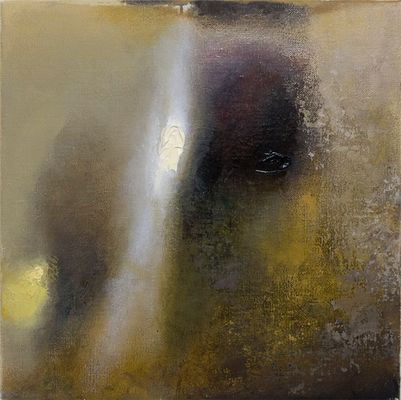
I am not a great reader of poetry but I always return to the work of Melbourne poet, Vincent Buckley (1925- 1988). Perhaps I find his most tantalising piece to be not a finished poem but a fragment left on a scrap of paper discovered on his desk after the poet’s death.
The poetry gathers like oil
In the word-core, and spreads
It has its music meet,
Its music is in movement.
This fragment is more the shell left behind from a volatile thought than a finished poem. I find the last two lines honest but awkward whereas the first two lines work like an arrow. Most likely he could not find a resolution so it was left. Still, in its present form, it remains an eloquent testimony to the ultimate failure of a medium to express mobile thought and sensation, in Buckley’s case, through verbal language. It’s an important matter because this is something all artists have to deal with regardless of the medium.
I have never written a poem, however, I am forever copying fragments from books on paper scraps in a vain effort to fix certain notions in my head. At first, they function as bookmarks that are sometimes returned to when I open the book. But before long, as they accumulate, they fall out littering the table interspersed with A4 photocopies, bills, books and medications.
To return to Buckley’s fragment, the first two lines very much evoke how I paint nowadays. As you age, detail diminishes and patches of light become more luminous and float. I feel the most honest way of dealing with this is by smearing the oil paint on the canvas with the fingers and working close-up, blind. Only if the patches coalesce into an approaching image can the work gain a life.
-
Jonathan Walker was born in Melbourne, Australia and brought up on a dairy farm in Gippsland. In the 1970’s he studied painting at RMIT and won the Harold Wright Scholarship to the British Museum, London. During the 1980’s he exhibited at Pinacotheca Gallery, Richmond and had work shown at the NGV and Heidi City Art Gallery. Over the same period he designed the cover for the “Epigenesi” LP by Giancarlo Toniutti, Italy and conducted a mail exchange work with Achim Wollscheid, Germany. The work with artists through the post resulted in an article published in the bicentenary issue of Art and Australia 1988. He showed in artist run spaces such as WestSpace in the 90’s and 2000’s, and until 2012, taught painting at Victoria University, which is where we (Colleen Ahern and Lisa Radford) as organisers of the exhibition, among many others, had the privilege of being his student.
Walker’s knowledge was imparted to students through the careful selection of music, literature, and artists found in books that he himself had ordered for the library. Walker’s strategy was the generosity of sharing his vast knowledge with references specific to each student and their context.
Walker’s paintings share a similar focus and intimacy.
This exhibition presents a small selection of recent paintings alongside a publication that includes Walker’s writing. Observational and analytical, Walker’s work is a type of material notation — the time of day, colour and how it is blended, the both specific and fleeting location of a reflection on lino or the question of whether a chair leg should be included in a painting.
Please join us on Friday August 21 between 6-8pm to celebrate the opening of the exhibition.
Curated by Colleen Ahern and Lisa Radford.
B. Wurtz
Curated by Nic Tammens
March 26 - April 4, 2015
B.Wurtz works from a basement studio in his home on Manhattan’s Lower East Side.
This local fact is attested to by the plastic shopping bags and newsprint circulars that appear in his work. As formal objects, they don’t make loud claims about their origins but nonetheless transmit street addresses and places of business from the bottom of this long thin island. Like plenty of artists, Wurtz is affected by what is local and what is consumed. His work is underpinned by this ethic. It often speaks from a neighborhood or reads like the contents of a hamper:
“BLACK PLUMS $1.29 lb.”
“Food Bazaar”
“USDA Whole Pork Shoulder Picnic 99c lb.”
“RITE AID Pharmacy, with us it’s personal.”
“H. Brickman & Sons.”
“Sweet Yams 59c lb."
Most of the work in this exhibition was made while the artist was in residence at Dieu Donne, a workshop dedicated to paper craft in Midtown. Here Wurtz fabricated assemblages with paper and objects that are relatively lightweight, with the intention that they would be easily transportable to Australia. This consideration isn’t absolute in Wurtz’s work, but was prescriptive for making the current exhibition light and cheap. Packed in two boxes, these works were sent from a USPS post office on the Lower East Side and delivered to North Melbourne by Australia Post.
Wurtz appears courtesy of Metro Pictures, New York.
Thanks to Rob Halverson, Joshua Petherick, Sari de Mallory, Matt Hinkley, Helen Johnson, Fayen d'Evie, Ask Kilmartin, Lisa Radon, Ellena Savage, Yale Union, and "Elizabeth".
John Nixon
"Archive"
December 15 - January 20, 2014
The presentation of John Nixon's archive offered a rare showcase of this extensive collection of the artist's own publications, catalogues, posters, ephemera, editions and more, from the mid 1980s onwards, alongside a selection of his artworks.
Organized by John Nixon, Joshua Petherick and Matt Hinkley.
<a href=http://wfb.public-office.info/artist/john-nixon>All titles by John Nixon
"Habitat"
at Minerva, Sydney (organised by Joshua Petherick and Matt Hinkley)
November 15 - December 20, 2014
Lupo Borgonovo, Janet Burchill & Jennifer McCamley,
Lewis Fidock, HR Giger, Piero Gilardi, Veit Laurent Kurz,
Cinzia Ruggeri, Michael E. Smith, Lucie Stahl, Daniel Weil, Wols
Press Release:
“...It contained seven objects. The slender fluted bone, surely formed for flight, surely from the wing of some large bird. Three archaic circuitboards, faced with mazes of gold. A smooth white sphere of baked clay. An age-blackened fragment of lace. A fingerlength segment of what she assumed was bone from a human wrist, grayish white, inset smoothly with the silicon shaft of a small instrument that must once have ridden flush with the surface of the skin - but the thing’s face was seared and blackened.”
William Gibson, “Count Zero”, 1986
"Autumn Projects Archive"
Curated by Liza Vasiliou
March 6 - March 15, 2014
World Food Books, in conjunction with the Virgin Australia Melbourne Fashion Festival 2014, presented the Autumn Projects archive, consisting of a selection of early examples in Australian fashion with a particular interest in collecting designers and labels from the period beginning in the 1980’s, who significantly influenced the discourse of Australian Fashion.
Curated by Liza Vasiliou, the exhibition provided a unique opportunity to view pieces by designers Anthea Crawford, Barbara Vandenberg, Geoff Liddell and labels CR Australia, Covers, Jag along with early experimental collage pieces by Prue Acton and Sally Browne’s ‘Fragments’ collection, suspended throughout the functioning World Food Books shop in Melbourne.
H.B. Peace
presented by CENTRE FOR STYLE
November 14, 2013
"Hey Blinky, you say chic, I say same"
Anon 2013
H.B. Peace is a clothing collaboration between great friends Blake Barns and Hugh Egan Westland. Their pieces explore the divergences between 'character’ and ‘personality’ in garments....etc
Special Thanks to Joshua Petherick and Matt Hinkley of WFB and Gillian Mears
and a Very Special Thank you to Audrey Thomas Hayes for her shoe collaboration.
Janet Burchill & Jennifer McCamley
"Aesthetic Suicide"
May 10 - June 8, 2013
The first of our occasional exhibitions in the World Food Books office/shop space in Melbourne, "Aesthetic Suicide" presented a body of new and older works together by artists Janet Burchill & Jennifer McCamley, including videos, prints, a wall work, and publications.
During shop open hours videos played every hour, on the hour.
2021, English
Softcover, 288 pages, 15.24 x 22.86 cm
Published by
University of Chicago Press / Chicago
$34.00 - In stock -
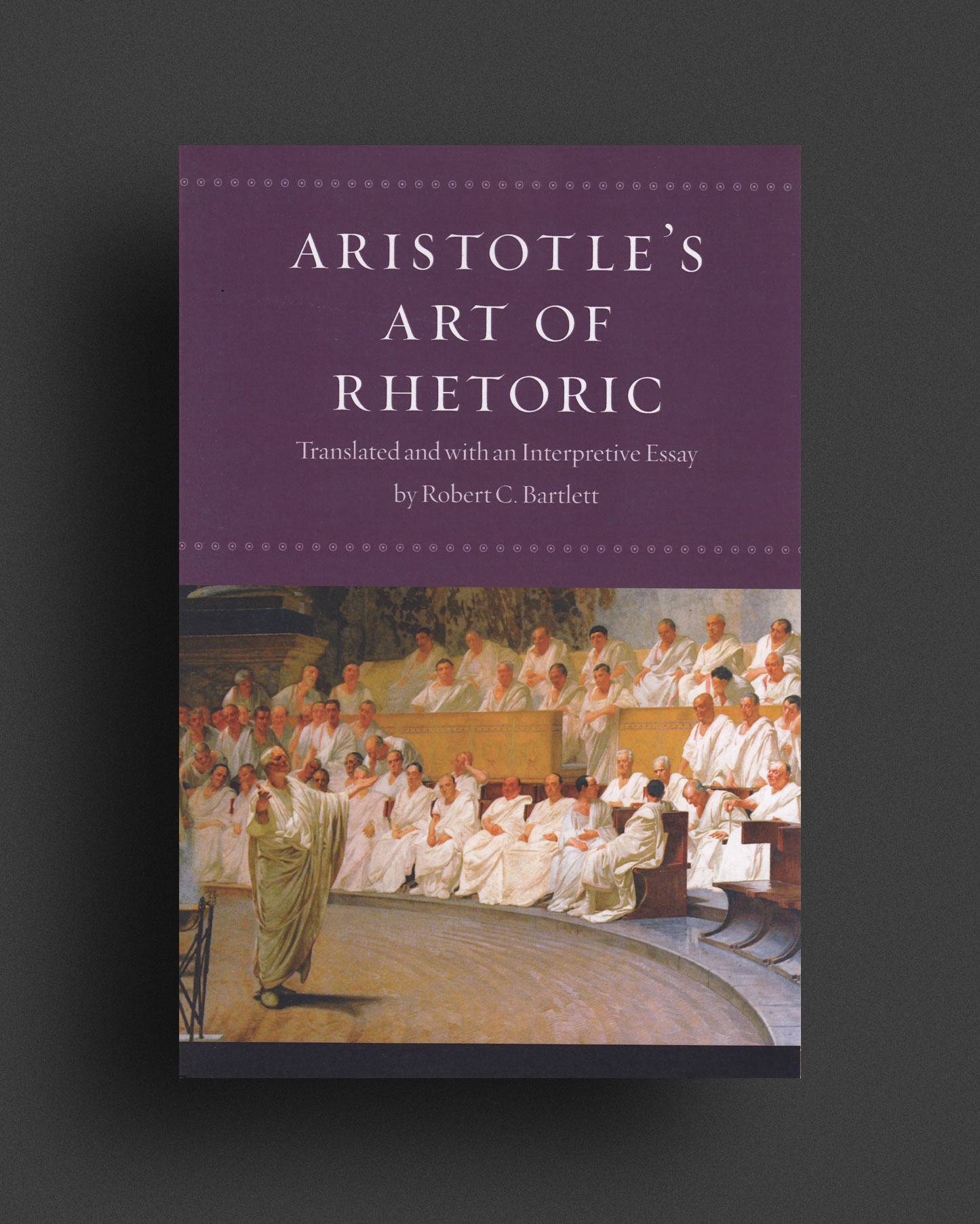
Translated and with an Interpretive Essay by Robert C. Bartlett
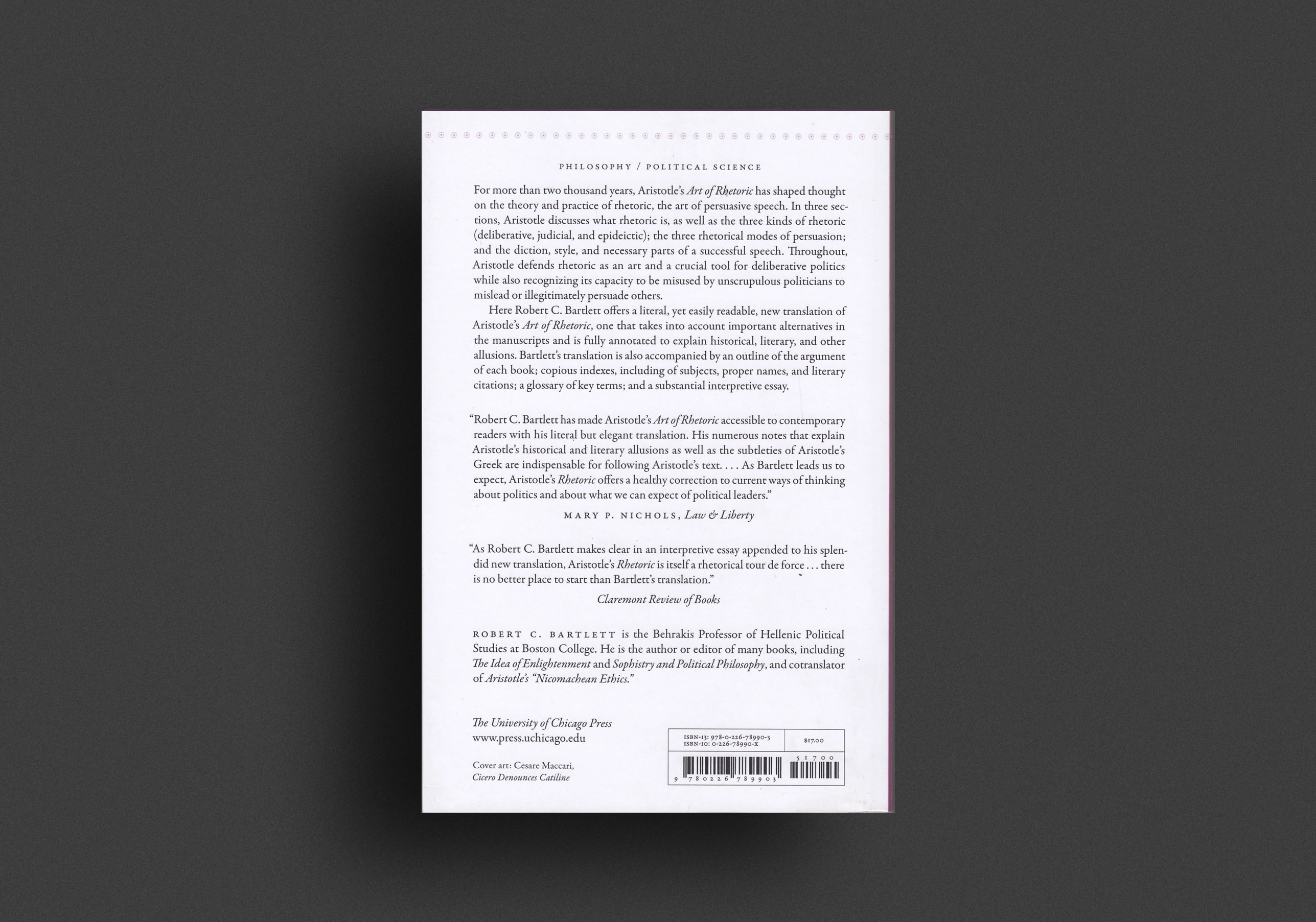
For more than two thousand years. Aristotle’s “Art of Rhetoric” has shaped thought on the theory and practice of rhetoric, the art of persuasive speech. In three sections, Aristotle discusses what rhetoric is, as well as the three kinds of rhetoric (deliberative, judicial, and epideictic), the three rhetorical modes of persuasion, and the diction, style, and necessary parts of a successful speech. Throughout, Aristotle defends rhetoric as an art and a crucial tool for deliberative politics while also recognizing its capacity to be misused by unscrupulous politicians to mislead or illegitimately persuade others.
Here Robert C. Bartlett offers a literal, yet easily readable, new translation of Aristotle’s “Art of Rhetoric,” one that takes into account important alternatives in the manuscript and is fully annotated to explain historical, literary, and other allusions. Bartlett’s translation is also accompanied by an outline of the argument of each book; copious indexes, including subjects, proper names, and literary citations; a glossary of key terms; and a substantial interpretive essay.
"Bartlett's translation is suited to classics and rhetoric but also courses in political science, law, and others where critical thinking and persuasive skill are crucial. Hopefully, this new translation of the Ars Rhetorica will help create rhetoric supporting what is true and not what only appears to be true."–Review of Biblical Literature
"[This] new translation... takes into account important alternatives in the manuscript and is fully annotated to explain historical, literary, and other allusions."–Pennsylvania Literary Journal
"As Robert C. Bartlett makes clear in an interpretive essay appended to his splendid new translation, Aristotle's Rhetoric is itself a rhetorical tour de force....there is no better place to start than Bartlett's translation of Aristotle's Rhetoric. "–Claremont Review of Books
"Robert C. Bartlett has made Aristotle's Art of Rhetoric accessible to contemporary readers with his literal but elegant translation. His numerous notes that explain Aristotle's historical and literary allusions as well as the subtleties of Aristotle's Greek are indispensable for following Aristotle's text...As Bartlett leads us to expect, Aristotle's Rhetoric offers a healthy correction to current ways of thinking about politics and about what we can expect of political leaders."–Mary P. Nichols "Law&Liberty\
Robert C. Bartlett is the Behrakis Professor in Hellenic Political Studies at Boston College. He is the author or editor of thirteen books, including Aristotle's Art of Rhetoric, also published by the University of Chicago Press.
2012, English
Softcover, 220 pages, 20.3 x 13.2 cm
Published by
New Directions / New York
$34.00 - In stock -
Translated from the Portuguese by Idra Novey
Edited by Benjamin Moser
Introduction by Caetano Veloso
The Passion According to G.H., Clarice Lispector's mystical novel of 1964, concerns a well-to-do Rio sculptress, G.H., who enters her maid’s room, which is as clear and white 'as in an insane asylum from which dangerous objects have been removed'. There she sees a cockroach - black, dusty, prehistoric - crawling out of the wardrobe and, panicking, slams the door on it. The sight of the dying insect provokes a spiritual crisis, in which she questions her place in the universe and her very identity, at the height which comes one of the most famous and most genuinely shocking scenes in Latin American literature. Clarice Lispector's spare, deeply disturbing yet luminous novel transforms language into something otherworldly, and is one of her most unsettling and compelling works. Lispector wrote that of all her works this novel was the one that “best corresponded to her demands as a writer.”
“One of the hidden geniuses of 20th-century literature” — Colm Tóibín
[Lispector] left behind an astounding body of work that has no real corollary inside literature or outside it. — Rachel Kushner
Clarice Lispector (1920—1977) was a Ukrainian-born Brazilian novelist and short story writer acclaimed internationally for her innovative novels and short stories. Born in 1920 to a Jewish family in western Ukraine. As a result of the anti-Semitic violence they endured, the family fled to Brazil in 1922, and Clarice Lispector grew up in Recife. Following the death of her mother when Clarice was nine, she moved to Rio de Janeiro with her father and two sisters, and she went on to study law. With her husband, who worked for the foreign service, she lived in Italy, Switzerland, England, and the United States, until they separated and she returned to Rio in 1959; she died there in 1977. Since her death, Clarice Lispector has earned universal recognition as Brazil’s greatest modern writer.
2018, English
Softcover, 704 pages, 20.5 x 13.7 cm
Published by
New Directions / New York
$49.00 - Out of stock
Translated by Katrina Dodson
Edited by Benjamin Moser
Here, gathered in one volume, are the stories that made Clarice a Brazilian legend. Originally a cloth edition of eighty-six stories, now we have eighty-nine stories in all, covering her whole amazing career, from her teenage years to her deathbed. In these 700 plus pages, we meet teenagers becoming aware of their sexual and artistic powers, humdrum housewives whose lives are shattered by unexpected epiphanies, old people who don’t know what to do with themselves. Lispector's stories take us through their lives - and ours. From one of the greatest modern writers, these 89 stories, gathered from all the collections published during her lifetime and translated to English for the first time, follow Clarice Lispector throughout her life.
“One of the hidden geniuses of 20th-century literature” — Colm Tóibín
Clarice Lispector (1920—1977) was a Ukrainian-born Brazilian novelist and short story writer acclaimed internationally for her innovative novels and short stories. Born in 1920 to a Jewish family in western Ukraine. As a result of the anti-Semitic violence they endured, the family fled to Brazil in 1922, and Clarice Lispector grew up in Recife. Following the death of her mother when Clarice was nine, she moved to Rio de Janeiro with her father and two sisters, and she went on to study law. With her husband, who worked for the foreign service, she lived in Italy, Switzerland, England, and the United States, until they separated and she returned to Rio in 1959; she died there in 1977. Since her death, Clarice Lispector has earned universal recognition as Brazil’s greatest modern writer.
2012, English
Softcover, 88 pages, 20.3 x 13.2 cm
Published by
New Directions / New York
$29.00 - Out of stock
Translated by Stefan Tobler
Preface by Benjamin Moser
A meditation on the nature of life and time, Agua Viva (1973) shows Lispector discovering a new means of writing about herself, more deeply transforming her individual experience into a universal poetry. In a body of work as emotionally powerful, formally innovative, and philosophically profound as Clarice Lispector's, Agua Viva stands out as a particular triumph.
“One of the hidden geniuses of 20th-century literature” — Colm Tóibín
[Lispector] left behind an astounding body of work that has no real corollary inside literature or outside it. — Rachel Kushner
Clarice Lispector (1920—1977) was a Ukrainian-born Brazilian novelist and short story writer acclaimed internationally for her innovative novels and short stories. Born in 1920 to a Jewish family in western Ukraine. As a result of the anti-Semitic violence they endured, the family fled to Brazil in 1922, and Clarice Lispector grew up in Recife. Following the death of her mother when Clarice was nine, she moved to Rio de Janeiro with her father and two sisters, and she went on to study law. With her husband, who worked for the foreign service, she lived in Italy, Switzerland, England, and the United States, until they separated and she returned to Rio in 1959; she died there in 1977. Since her death, Clarice Lispector has earned universal recognition as Brazil’s greatest modern writer.
2012, English
Softcover, 144 pages, 20.3 x 13.2 cm
Published by
New Directions / New York
$34.00 - In stock -
Translated from Portuguese by Johnny Lorenz
Edited by Benjamin Moser
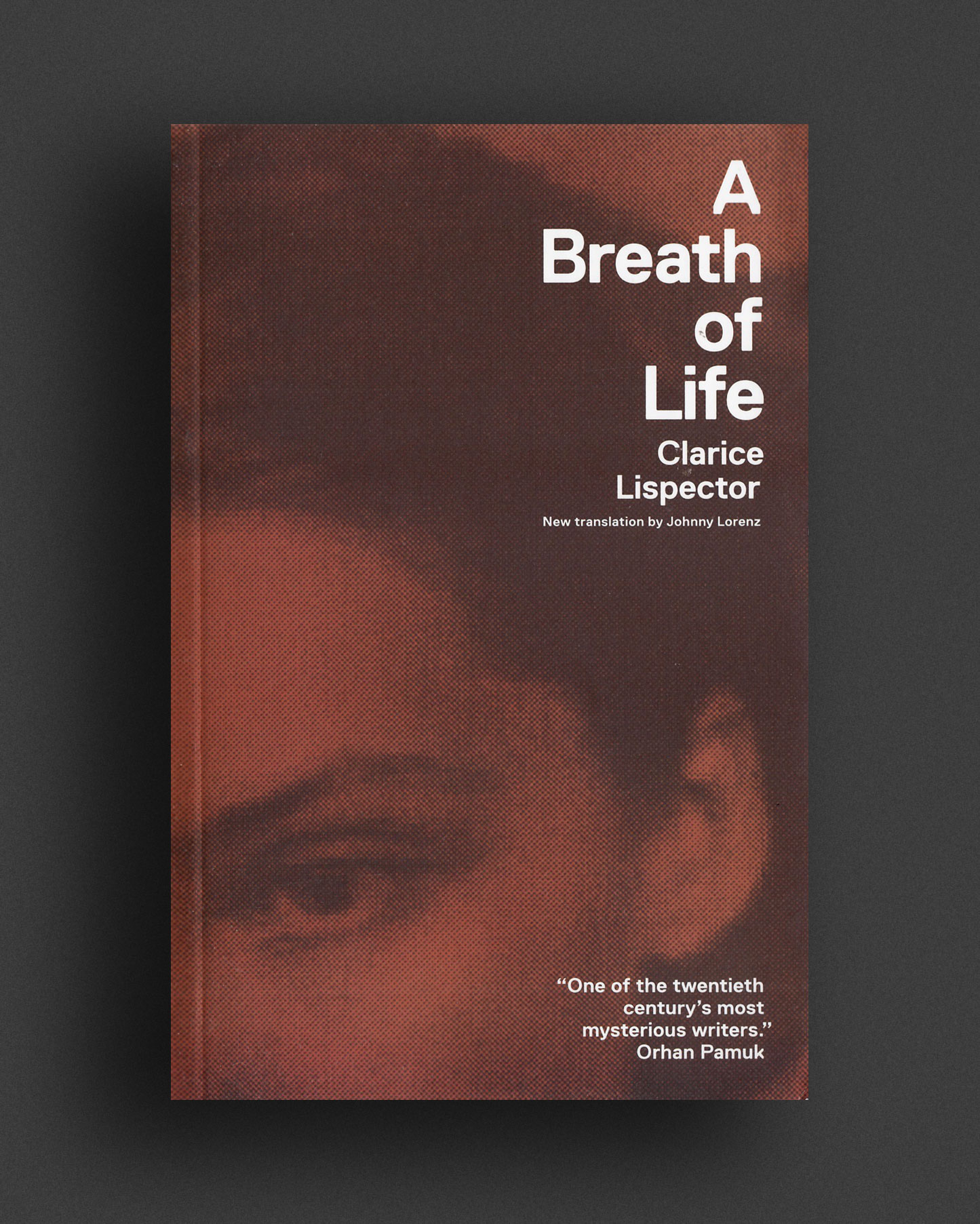
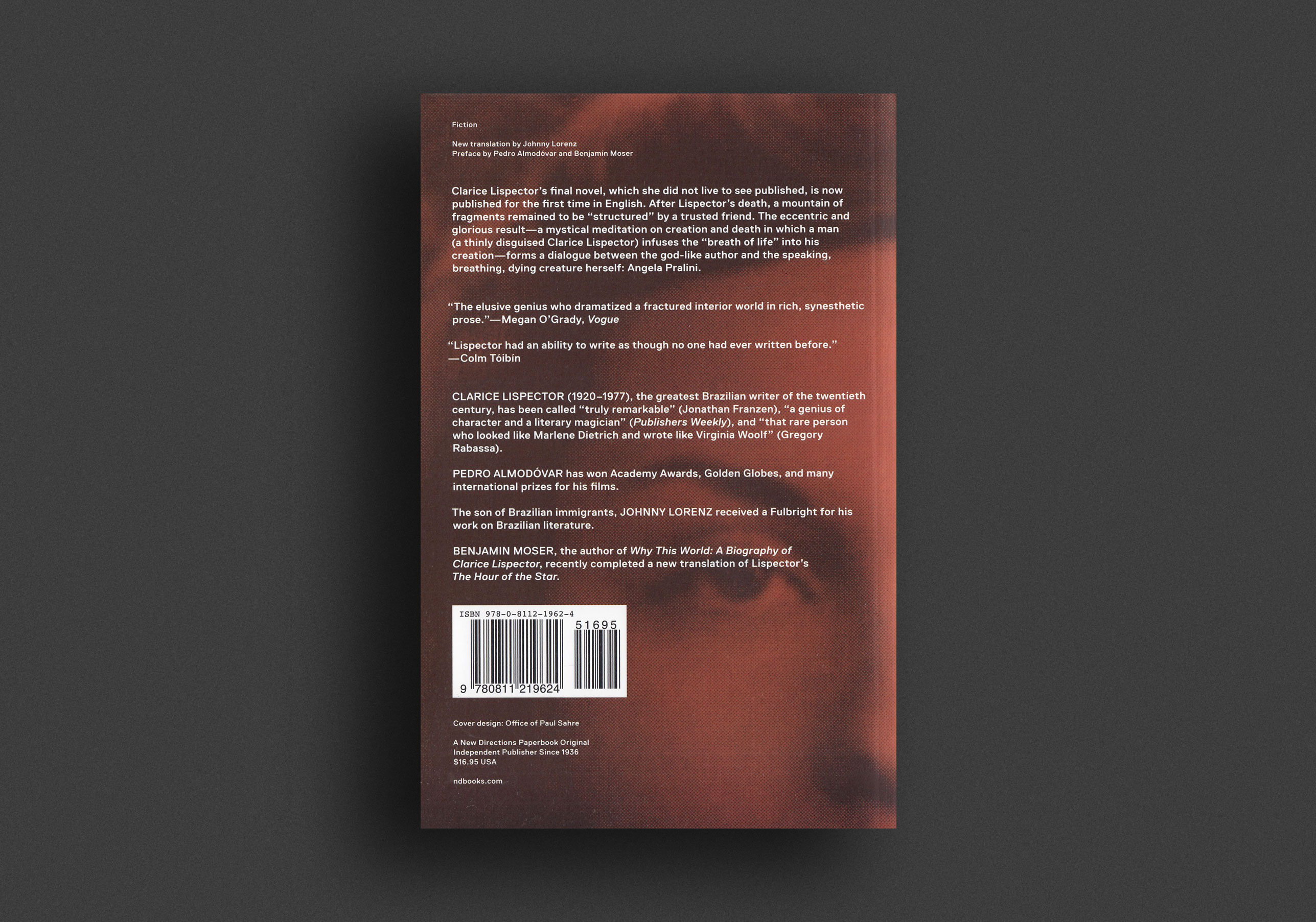
A mystical dialogue between a male author (a thinly disguised Clarice Lispector) and his/her creation, a woman named Angela, this posthumous work has never before been translated. Lispector did not even live to see it published. At her death, a mountain of fragments remained to be “structured” by a friend, Olga Borelli. These fragments form a dialogue between a god-like author who infuses the breath of life into his creation: the speaking, breathing, dying creation herself, Angela Pralini. The work’s almost occult appeal arises from the perception that if Angela dies, Clarice will have to die as well.
2006, English
Softcover, 402 pages, 23 x 18 cm
1st Edition, Out of print title / used / good
Published by
The MIT Press / Massachusetts
$20.00 - In stock -
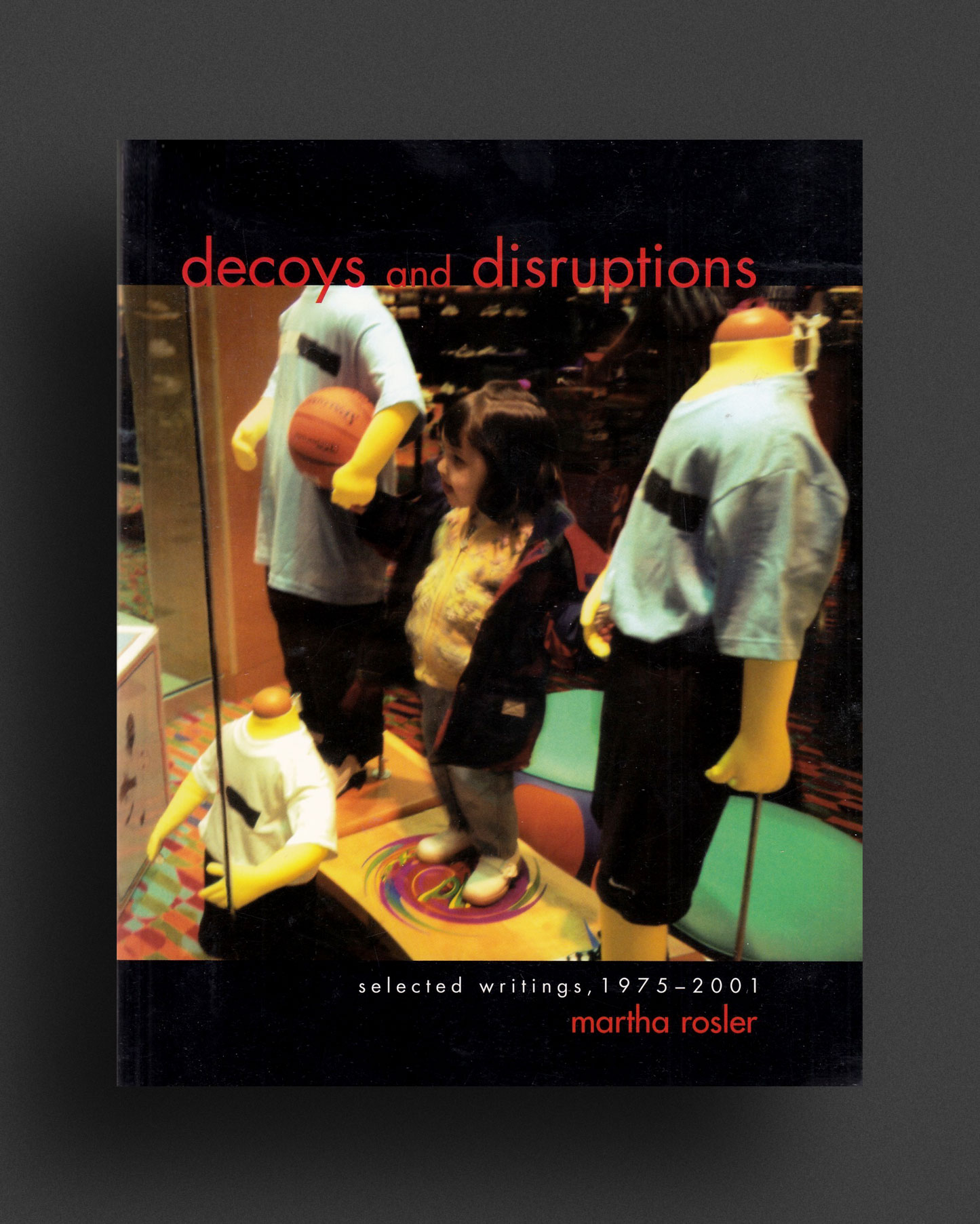
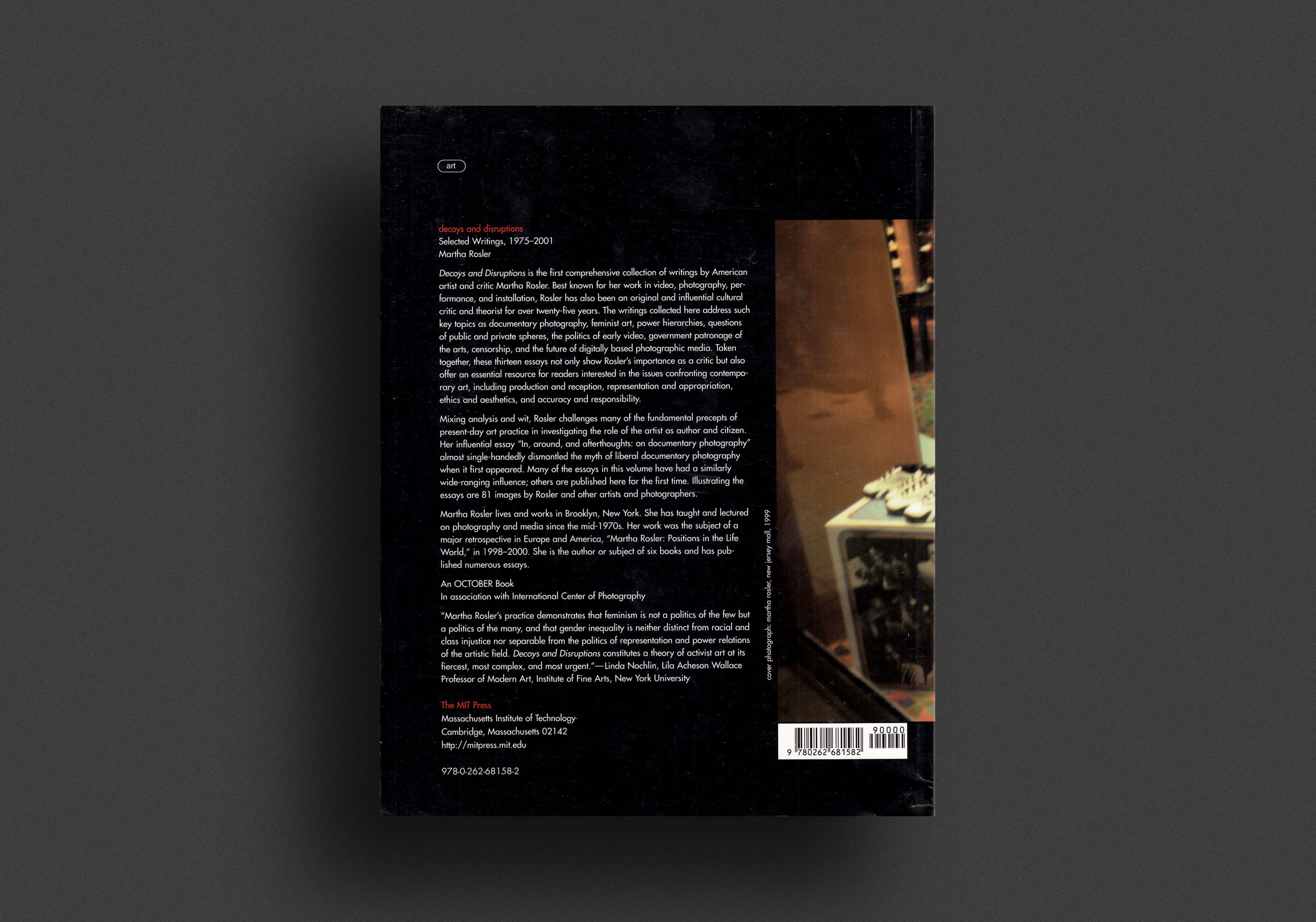
The first comprehensive collection of writings by Martha Rosler considers the intersection of art and politics, the operation of art systems, feminist art practices, and the media.
Decoys and Disruptions is the first comprehensive collection of writings by American artist and critic Martha Rosler. Best known for her videos and photography, Rosler has also been an original and influential cultural critic and theorist for over twenty-five years. The writings collected here address such key topics as documentary photography, feminist art, video, government patronage of the arts, censorship, and the future of digitally based photographic media. Taken together, these thirteen essays not only show Rosler's importance as a critic but also offer an essential resource for readers interested in the issues confronting contemporary art. The essays in this collection illustrate Rosler's ongoing investigation into means of exposing truth and provoking change, providing a retrospective of characteristic issues in her work.
Mixing analysis and wit, Rosler challenges many of the fundamental precepts of contemporary art practice. Her influential essay, "In, around, and afterthoughts: on documentary photography," almost single-handedly dismantled the myth of liberal documentary photography when it appeared. Many of the essays in this volume have had a similarly wide-ranging influence; others are published here for the first time. Illustrating the essays are 81 images by Rosler and other artists and photographers.
Good copy with a heavy bump to top corner, leser one to bottom back, otherwise light wear to boards.
2006, English
Softcover, 258 pages, 25 x 18 cm
1st Edition, Out of print title / used / very good
Published by
The MIT Press / Massachusetts
$20.00 - In stock -
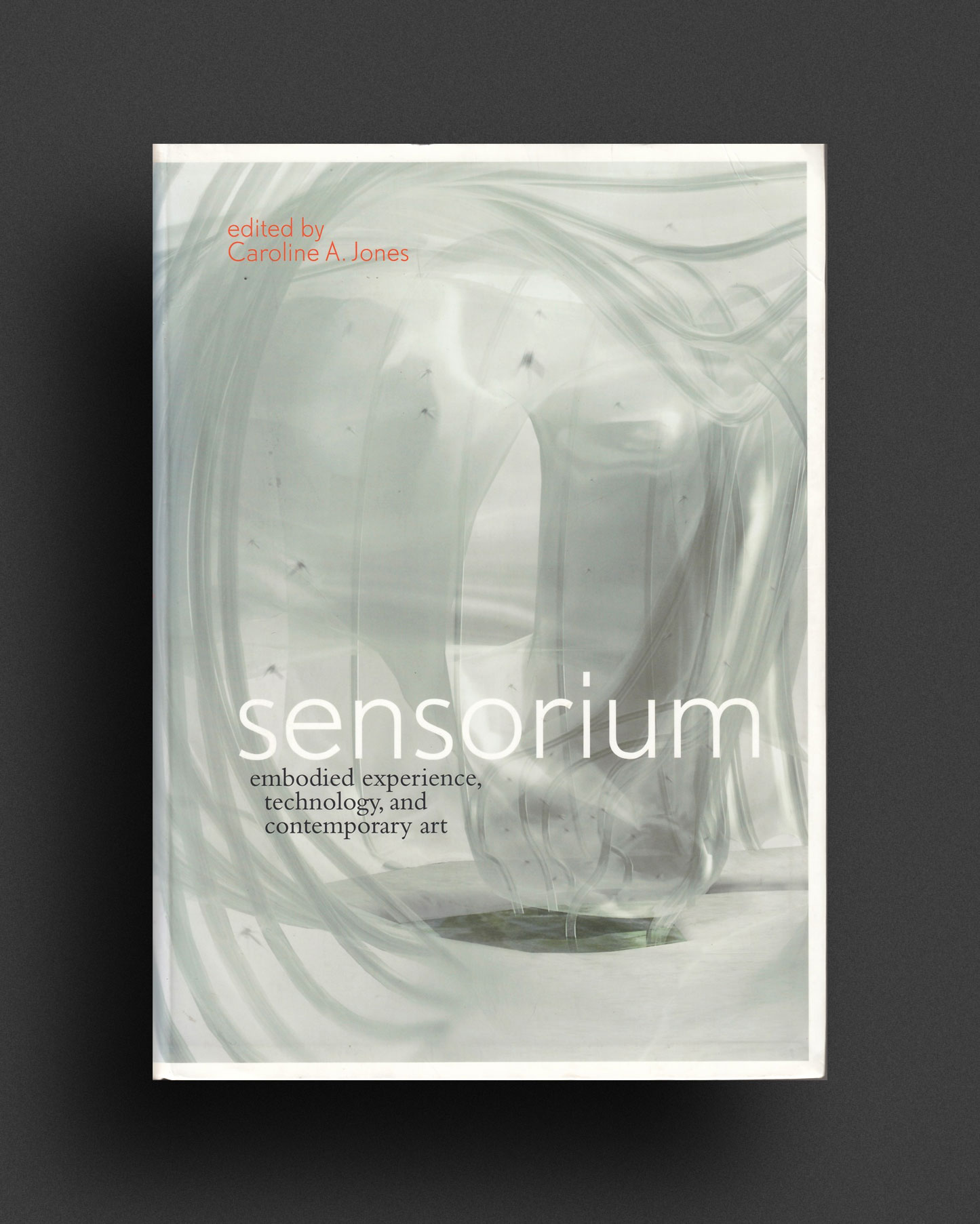
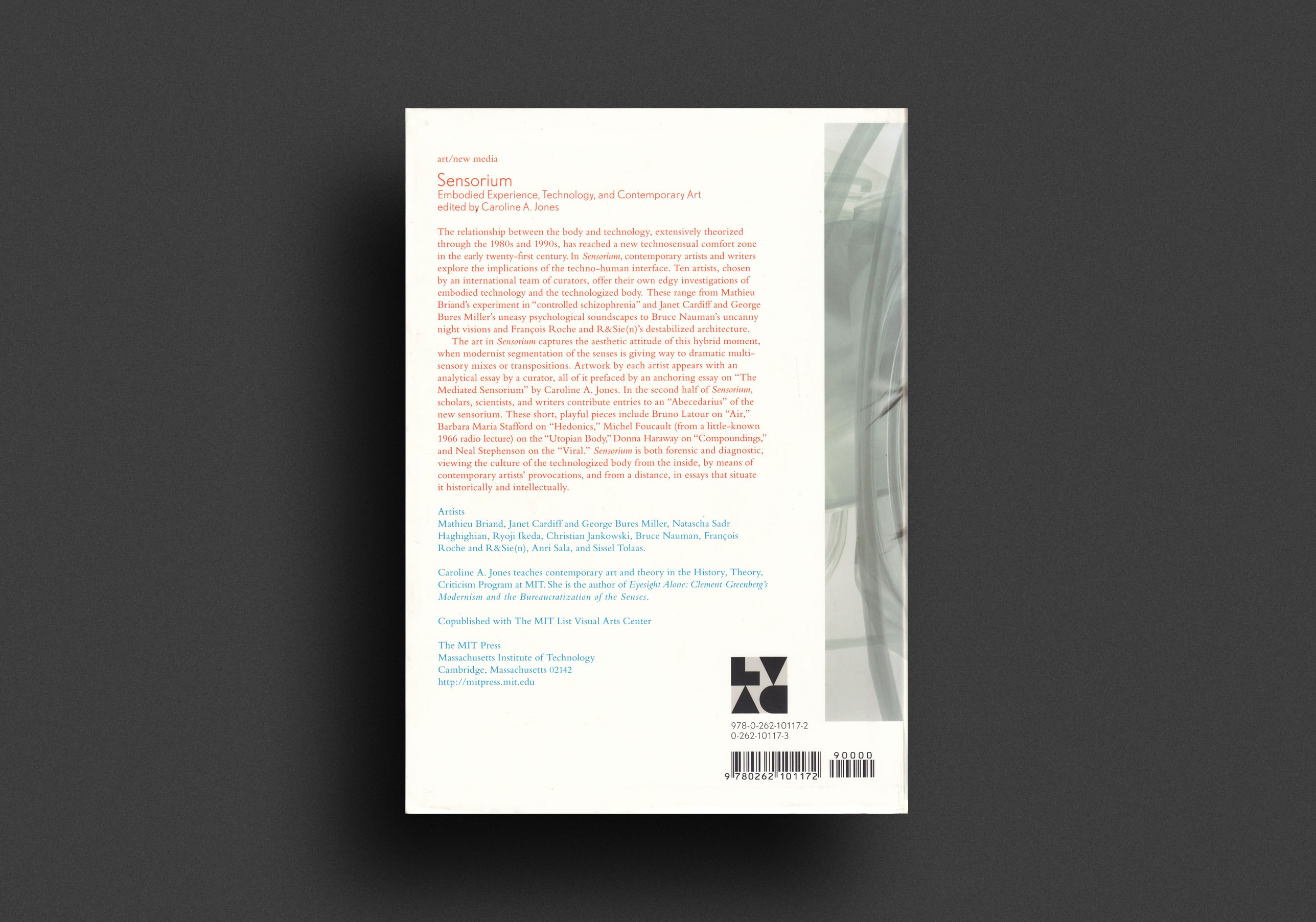
Artists and writers reconsider the relationship between the body and electronic technology in the twenty-first century through essays, artworks, and an encyclopedic "Abecedarius of the New Sensorium."
The relationship between the body and electronic technology, extensively theorized through the 1980s and 1990s, has reached a new technosensual comfort zone in the early twenty-first century. In Sensorium, contemporary artists and writers explore the implications of the techno-human interface. Ten artists, chosen by an international team of curators, offer their own edgy investigations of embodied technology and the technologized body. These range from Matthieu Briand's experiment in "controlled schizophrenia" and Janet Cardiff and Georges Bures Miller's uneasy psychological soundscapes to Bruce Nauman's uncanny night visions and François Roche's destabilized architecture. The art in Sensorium—which accompanies an exhibition at the MIT List Visual Arts Center—captures the aesthetic attitude of this hybrid moment, when modernist segmentation of the senses is giving way to dramatic multisensory mixes or transpositions. Artwork by each artist appears with an analytical essay by a curator, all of it prefaced by an anchoring essay on "The Mediated Sensorium" by Caroline Jones.
In the second half of Sensorium, scholars, scientists, and writers contribute entries to an "Abecedarius of the New Sensorium." These short, playful pieces include Bruno Latour on "Air," Barbara Maria Stafford on "Hedonics," Michel Foucault (from a little-known 1966 radio lecture) on the "Utopian Body," Donna Haraway on "Compoundings," and Neal Stephenson on the "Viral." Sensorium is both forensic and diagnostic, viewing the culture of the technologized body from the inside, by means of contemporary artists' provocations, and from a distance, in essays that situate it historically and intellectually.
Caroline A. Jones is an art historian, author, and curator and Professor in the History, Theory, and Criticism in the Department of Architecture at MIT. She is the author of, most recently, The Global Work of Art: World's Fairs, Biennials, and the Aesthetics of Experience.
Vg copy light edges wear to boards.
2000, German
Softcover, 506 pages, 23 x 17 cm
1st Edition, Out of print title / used / very good
Published by
Generali Foundation / Vienna
$25.00 - In stock -
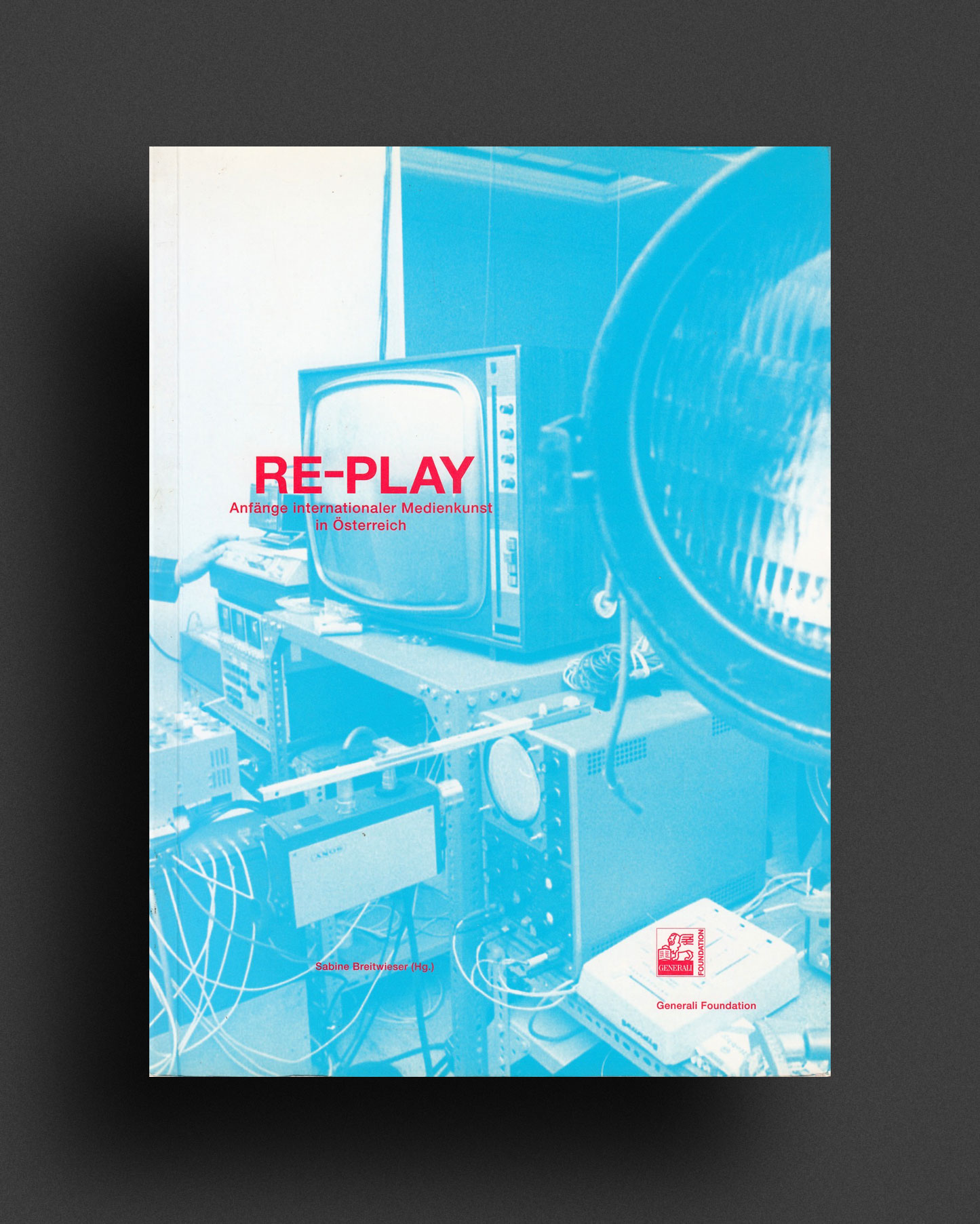
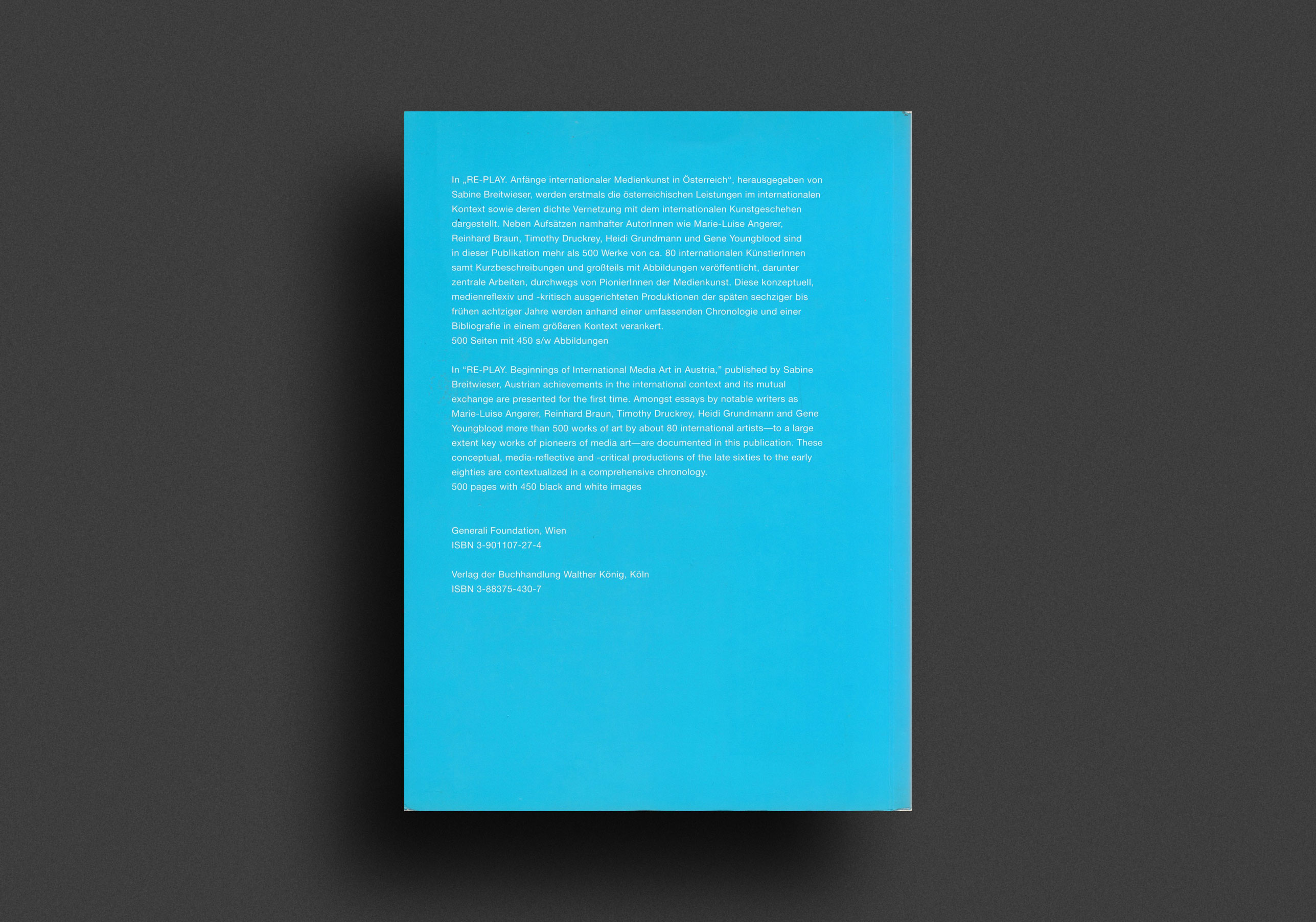
Edited by Sabine Breitwieser. Preface by Dietrich Karner. Texts by Sabine Breitwieser, Marie-Luise Angerer, Reinhard Braun, Timothey Druckrey, Heidi Grundmann and Gene Youngblood.
The development of communication and recording technologies after the Second World War awakened the interest of artists in the aesthetic, political and social influence of mass distribution and global communication. At the end of the sixties and beginning of the seventies, artists in Austria, partly coming from Actionism and Expanded Cinema, began to work with the audio-visual home technologies (video equipment, stereo magnetophone, tape cassette) that had just come onto the market. The Austrian pioneers of media art were fully integrated into the international flow of information about current developments in art and gained experience abroad themselves or contextualized their quite independent approaches with those of international artists, primarily from Germany and North America. Internationally top-class exhibitions and symposia focused on questions of a de-materialized, mediatized art as well as the redefinition of the concept of work and author. Feminist approaches and alternative models for the production and distribution of (media) art were also discussed. With a series of cross-border events on performance and media art, on theory and art, Vienna, Graz and Innsbruck became important stations for many of the now best-known international artists in the 1970s, while Austrian artists were increasingly invited to important events in the international art world.
In "RE-PLAY. Beginnings of International Media Art in Austria," Austrian achievements in an international context as well as their dense networking with the international art scene were presented for the first time. In addition to essays by renowned authors such as Marie-Luise Angerer, Reinhard Braun, Timothy Druckrey, Heidi Grundmann, and Gene Youngblood, this publication contains more than 500 works by approximately 80 international artists, including brief descriptions and mostly illustrations, among them central works by pioneers of media art. These conceptual, media-reflexive, and critically oriented productions from the late 1960s to the early 1980s are anchored in a larger context by means of a comprehensive chronology and a biography.
Vito Acconci/USA, Robert Adrian X/CAN/AT, Laurie Anderson/USA, John Baldessari/USA, Gottfried Bechtold/AT, Stephen Beck & Warner Jepson/USA. Lynda Benglis/USA, Trisha Brown/USA, Norbert Brunner/AT, Hank Bull/CAN, Peter Campus/USA, Ernst Caramelle/AT, Patrizia Caire/Günther Schrom/AT, CCMC (Peter Anson, Larry Dubin, Nobuo Kubota, Allan Mattes, Michael Snow, Casey Sokol)/CAN, Colette/Peter Gordon/USA, Francesco Agnetti/Gianni Colombo/IT, Axel Corti/AT , Merce Cunningham/USA , Douglas Davis/USA. Georg Decristel/AT, Peter Downsbrough/USA/BE, Ed Emshwiller/USA, Wolfgang Ernst/AT, VALIE EXPORT/AT, Flatz/AT/GER, Hermine Freed/USA, Terry Fox/USA, Dale Frank/AUS, Bill Furlong/GB, Ladislav Galeta/YU, Wilhelm Gaube/AT, Genera ldea/CAN, Bob George/USA, Jochen Gerz/GER, Tina Girouard/USA, Roland Goeschl /AT, Jack Goldstein/USA, Dan Graha /USA, Peter Grass/USA, Horst Gerhard Haberl/AT, Lotte HendrichHassmann/AT, Hermann Hendrich/AT, Gazi Herzog/AT, Julia Heyward/USA, Klaus Hoffer/AT, Dragan llic /AUS, Sanja lvekovic/Dalibor Martinis/CR, Joan Jonas/USA, Angelika Kaufmann/GER, Allan Kaprow/USA, Milan Knizak/CZ, kollektive Telekommunikationsprojekte, Renate Kowanz-Kocer/AT, Karl Kowanz/AT, Richard Kriesche/AT, Shigeko Kubota/USA, Richard Landry/USA, Charles Loeffler/Bob Gaglioni/USA, Herr Lugus/AT, Tom Marioni/USA, Albert Mayr/IT, Bruce McLean/GB, Robert Morris /USA, Antonio Muntadas/USA, lan Murray/CAN, Maurizio Nanucci/IT, Bruce Nauman/USA, Juan Navarra Baldeweg/ESP, Hermann Nitsch/AT, Muriel Olesen/CH, Yoko Ono/USA, Dennis Oppenheim/USA, Nam June Paik/J/USA, Friederike Pezold/AT, Arnulf Rainer/AT, Patrick Ready/CAN, Ulrike Rosenbach/GER, Dieter Roth/CH, Gerhard Rühm/AT, R. Murray Schafer/CAN, Michael Schuster/AT, Richard Serra/USA, Tom Sherman/USA/CAN, Katharina Sieverding/GER, Hartmut Skerbisch/AT, Michael Snow/USA, Throbbing Gristle/GB, Rasa Todosiewiz/YU, Goran Trbuljak/CR, David Troostwyk/GB, Ferry Unger/AT, Franco Vaccari/IT, Franz Vana/AT, William Wegman/USA, Peter Weibel/AT, Lawrence Weiner/USA , Norman T. White/CAN, Monsti (Ingrid ) Wiener/AT, Oswald Wiener/AT, Hannah Wilke/USA, Jana Wisniewski/AT, Otto M. Zykan/AT.
VG copy, light wear to boards.
1980, Japanese
Softcover, 134 pages, 21 x 15 cm
1st Edition, Out of print title / used / very good
Published by
Roman–Sha / Tokyo
$70.00 - In stock -
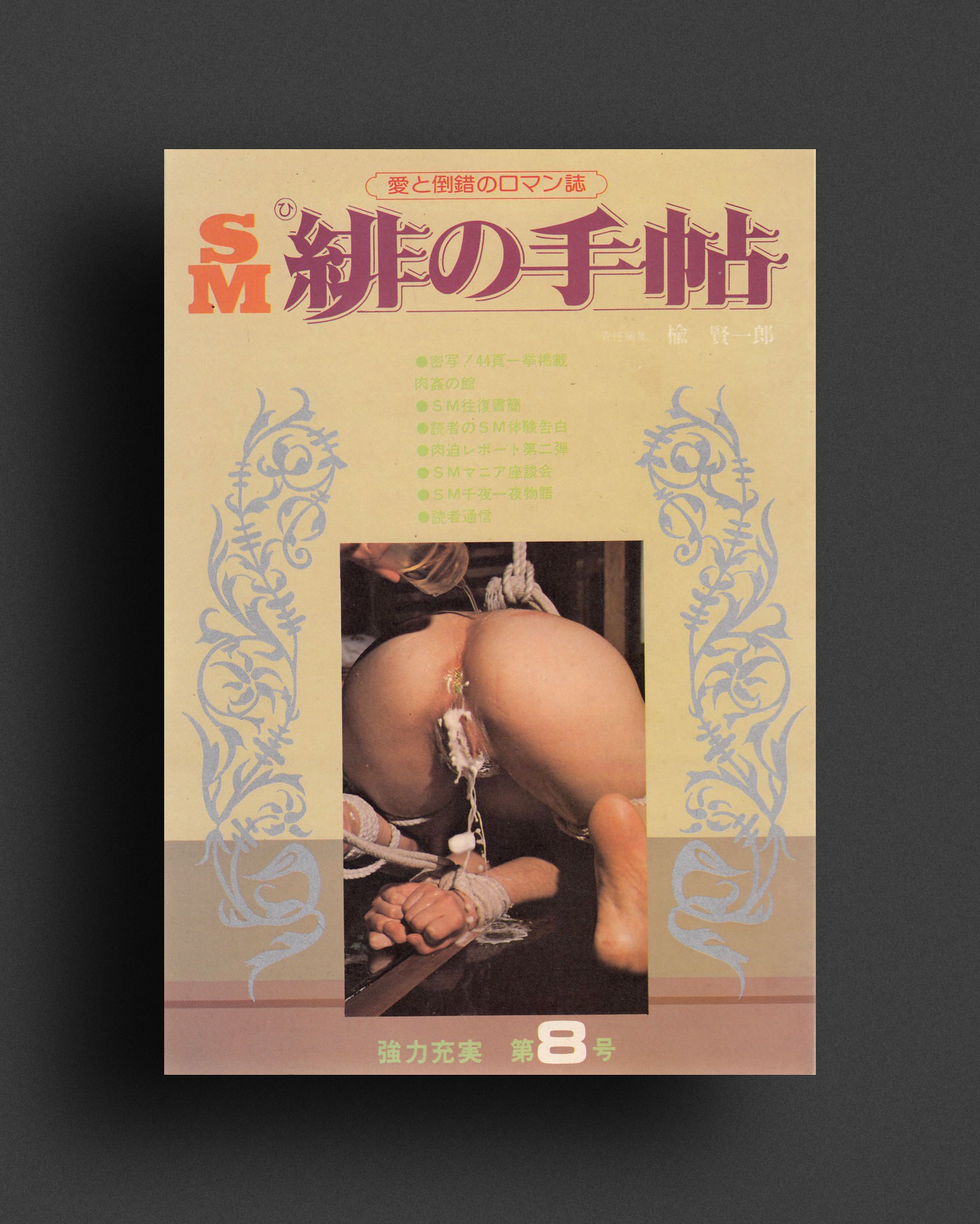
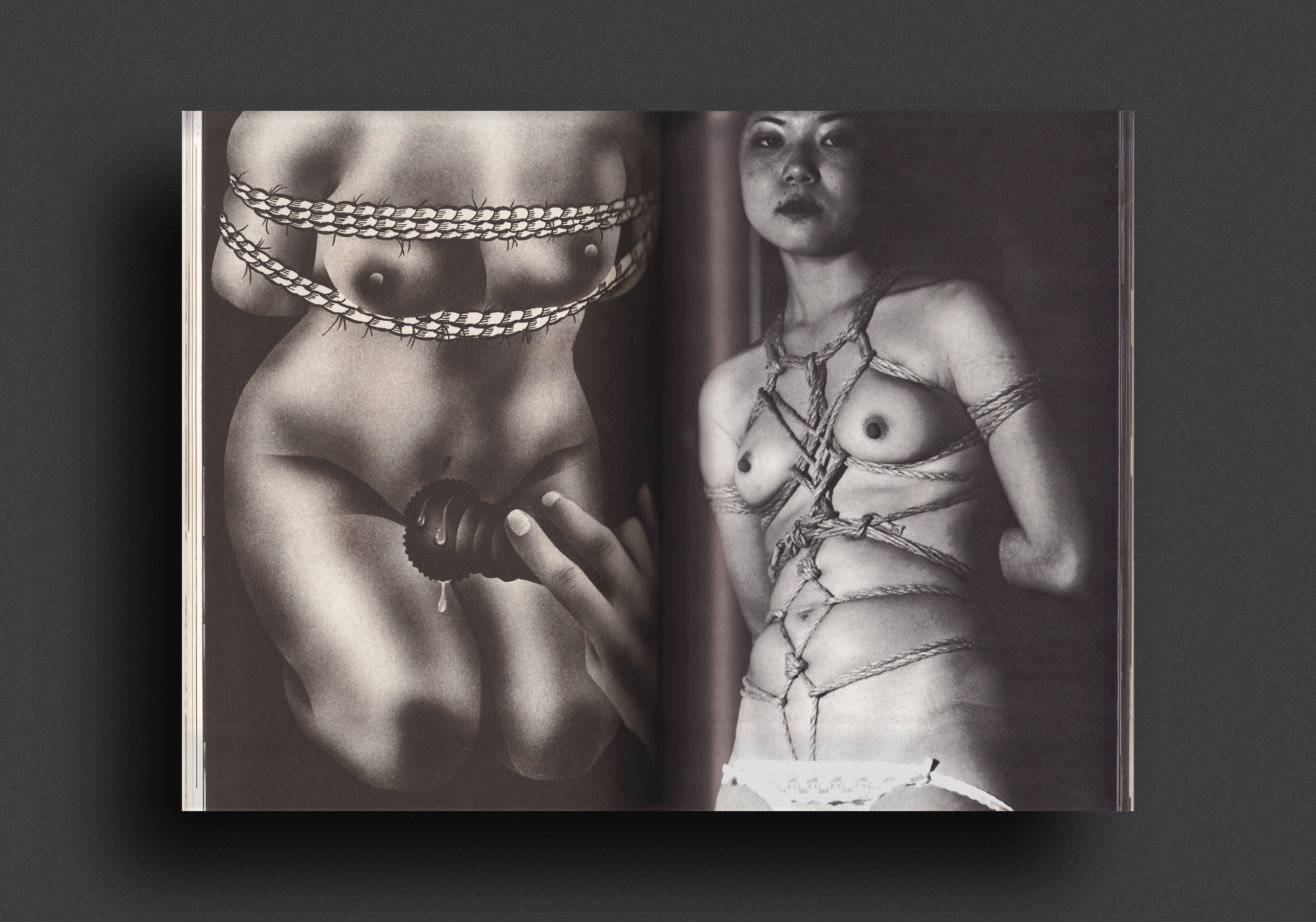
Very rare copy of SM Scarlet Notebook, "a romance magazine of love and perversion", launched in 1978 by Roman Publishing, Tokyo, and running until 1980. Full of high quality full–colour and b/w graveur bondage photo galleries, erotic stories and artworks, with contributions from leading artists such as Teizo Hayashi, Nureki Chimuo, and Kaoru Roppongi, who famously collaborated with Dan Oniroku and Naomi Tani.
Very Good copy.
1980, Japanese
Softcover, 164 pages, 21 x 15 cm
1st Edition, Out of print title / used / very good
Published by
Daikyosha / Tokyo
$80.00 - In stock -
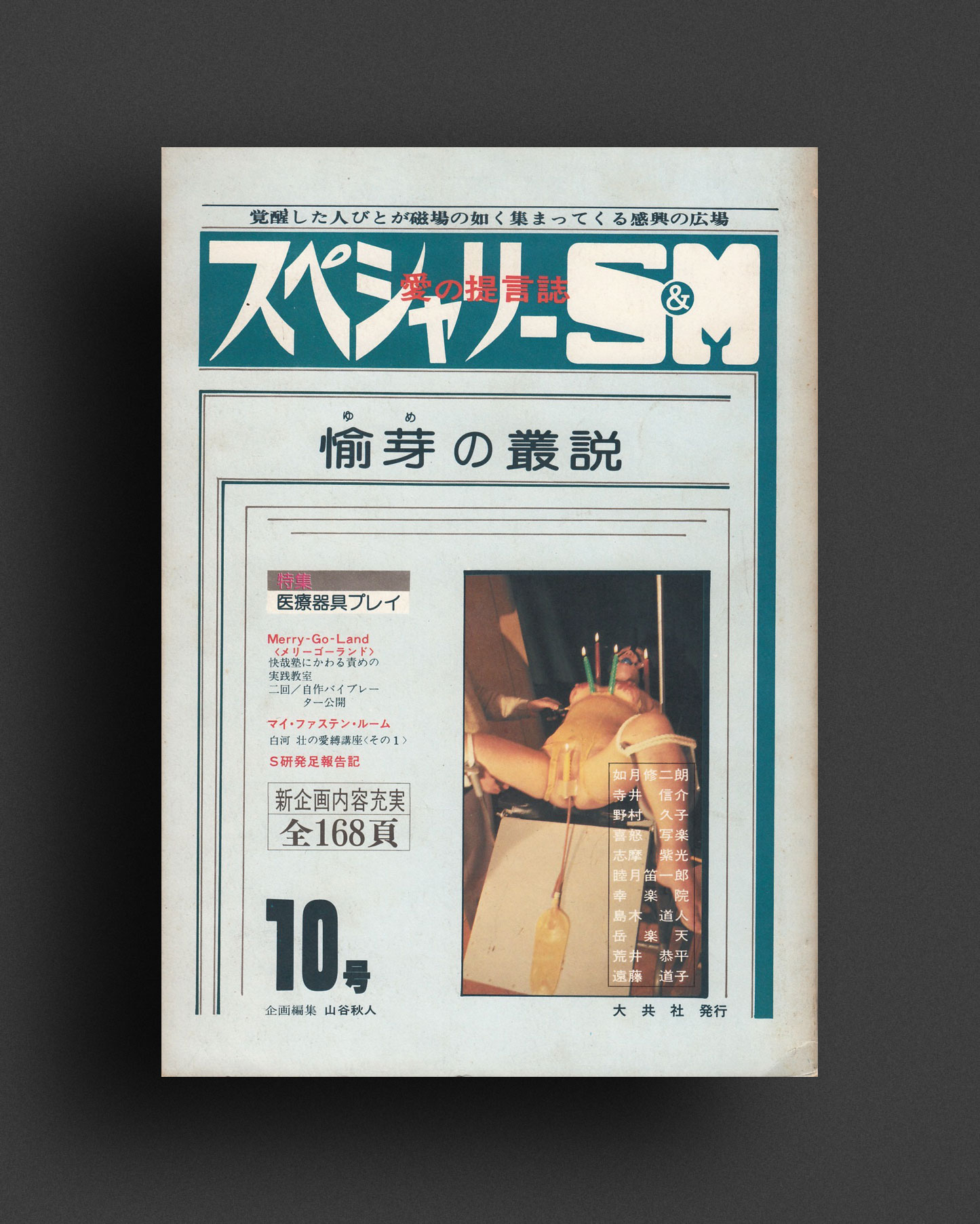
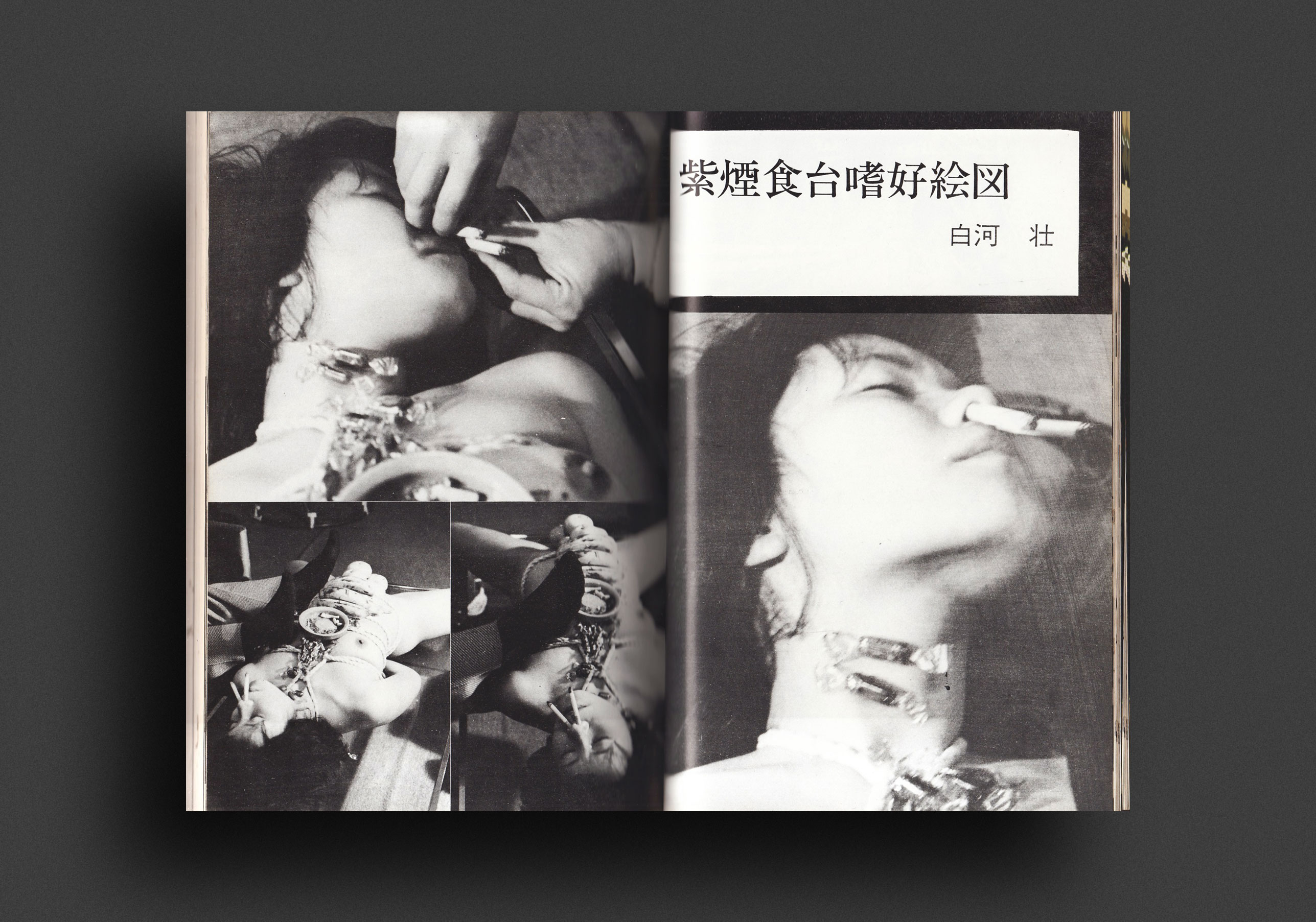
Rare copy of Special S&M, a niche BD magazine founded by SUN & MOON's Keiich Seta, who also contributed to Kitan Club and SM Mirage, and edited by bondage master Shima Shikou, who was extremely prolific editing roughly 10 SM magazines a month around this time. Contributors also included Kaoru Roppongi. Special S&M inherited the style of SUN & MOON as a practical and tutorial magazine for enthusiasts of deviant love, heavy in personal expression of niche fetishes and detail on methods and equipment. This issue features a huge special feature on medical fetish equipment and DIY servomotor information for homemade vibrators! It also pushes the boundries of SM under the supervision of Shima Shikou, who is well known for his experimental artistic extremes featured also in S&M Sniper, SM Spirits, Speculum, Spiral, etc., his prolific live actions, he also taught rope bondage and set up his own imprint... Profusely illustrated with full–colour photo galleries and b/w photography throughout. The magazine continued until 1983.
VG tanning to spine edges, light dustiness to top of block.
1952, English
Hardcover (w. dust jacket), 272 pages, 17.5 x 11.2 cm
Out of print title / used / very good
Published by
Dent / London
E P Dutton / New York
$35.00 - In stock -
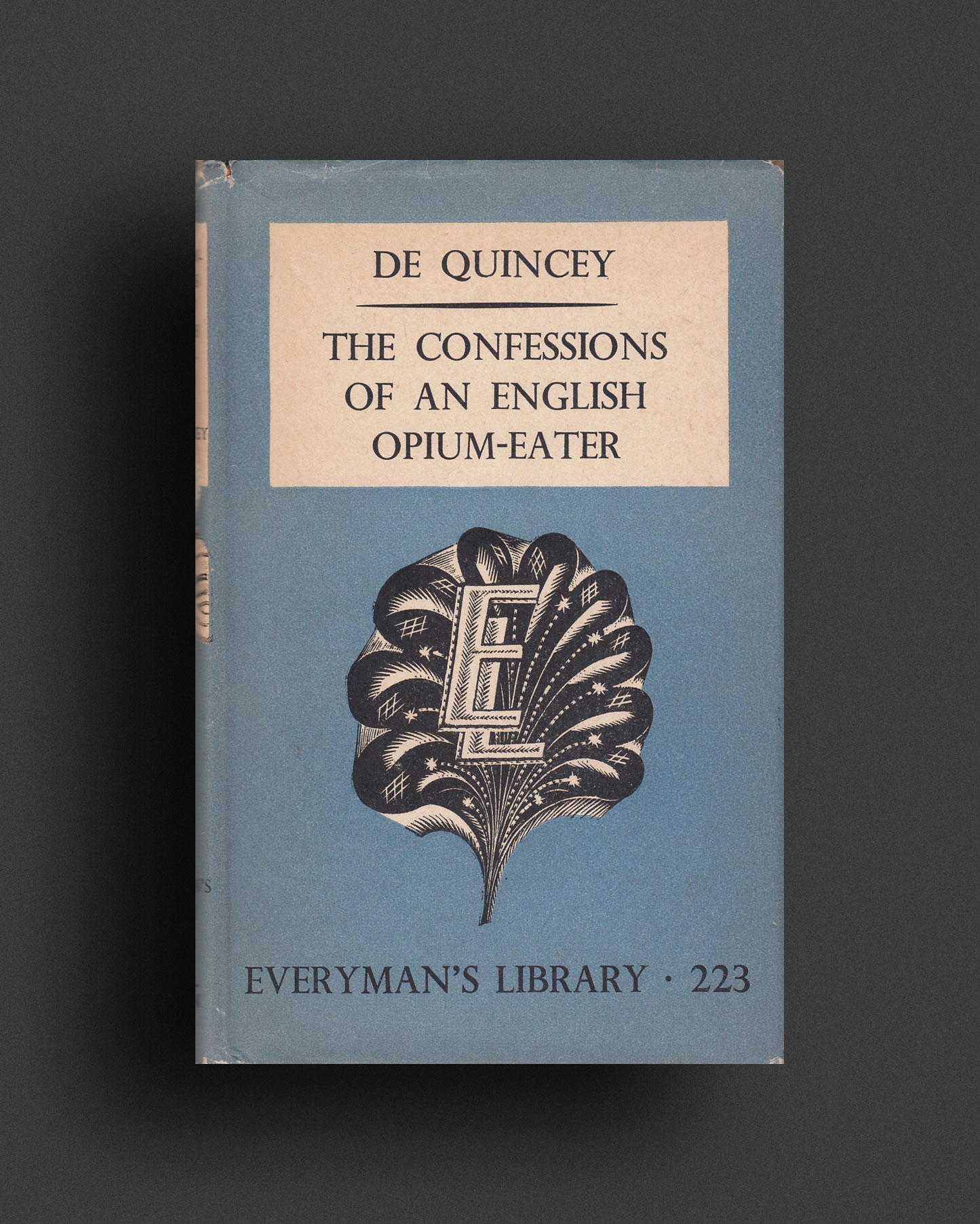
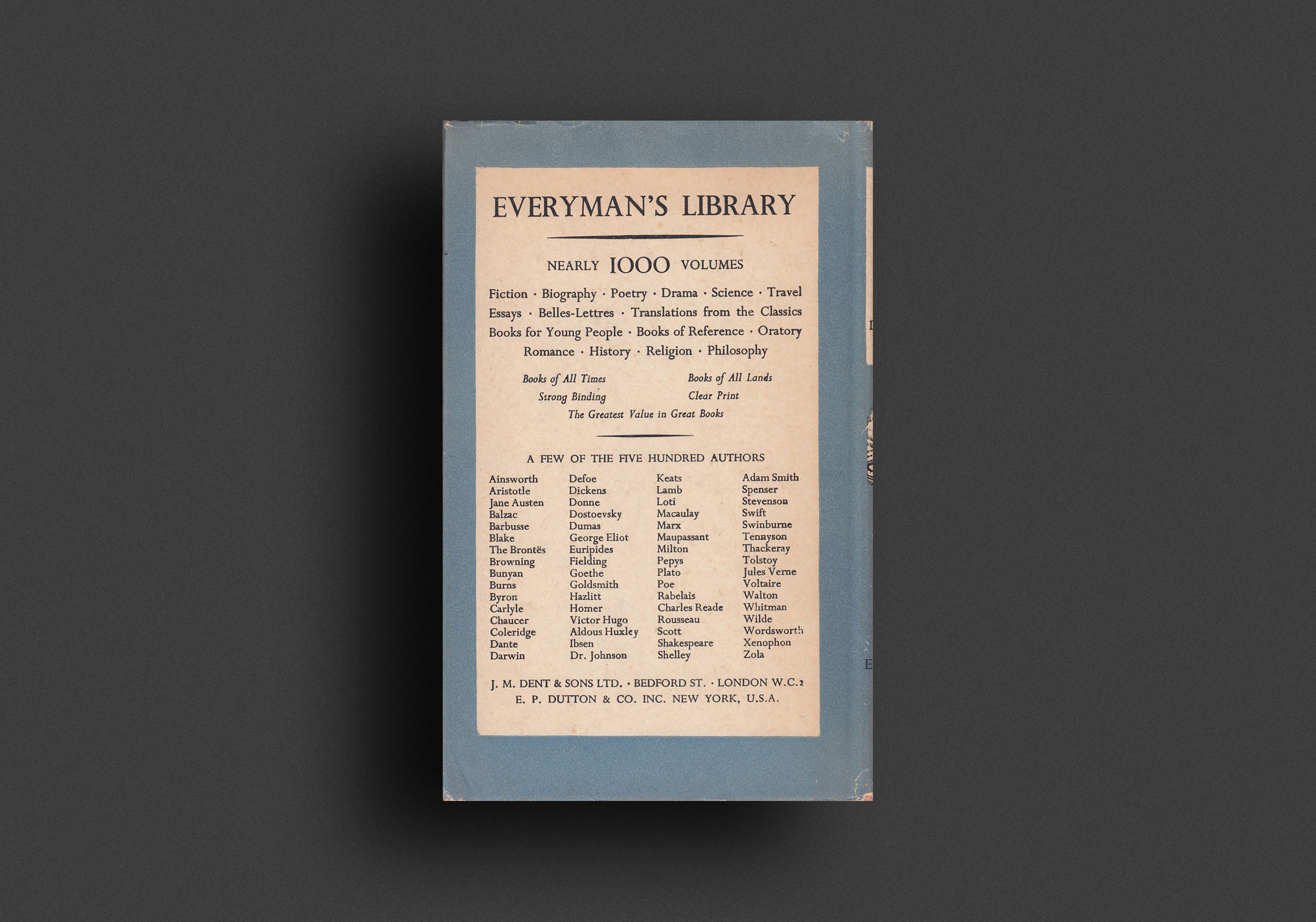
1952 Everyman's Library edition of Confessions of an English Opium-Eater, English essayist Thomas De Quincey's 1821 autobiographical memoir that launched a fascination with drug use and abuse that has continued from his day to ours. "Thou has the keys of Paradise, oh just, subtle, and mighty opium!" Determined to counter the lies about opium that had been told by travellers to the Orient and the medical profession, De Quincey describes his addiction, the consciousness altering properties of the drug, its pleasures and its pains. First published anonymously in The London Magazine in September and October 1821, then expanded into a book edition in 1822 and heavily revised in 1856. Confessions of an English Opium-Eater is De Quincey's most well–known book, regarded as the foundational text of modern "drug literature," it profoundly influenced later writers and artists such as Charles Baudelaire, Edgar Allan Poe, and William S. Burroughs while anticipating modern explorations of the unconscious mind.
Divided into Preliminary Confessions (covering his youth, school days, running away, and poverty-stricken homelessness on Oxford Street in London) and The Pleasures of Opium followed by The Pains of Opium (detailing his addiction, sublime mental visions, and the subsequent terrifying nightmares and withdrawal struggles). De Quincey first used laudanum in 1804 to treat severe toothache pain, which later escalated to manage chronic stomach distress stemming from childhood hunger.
VG copy in G–VG dust jacket with wear to extremities. Single library stamp to front endpaper, otherwise a clean copy.
2002, English
Softcover, 320 pages, 19.7 x 13.4 cm
Published by
New Directions / New York
$36.00 - In stock -
The Hungarian master’s first work to appear in English, and still one of the best. Translated from Hungarian by George Szirtes.
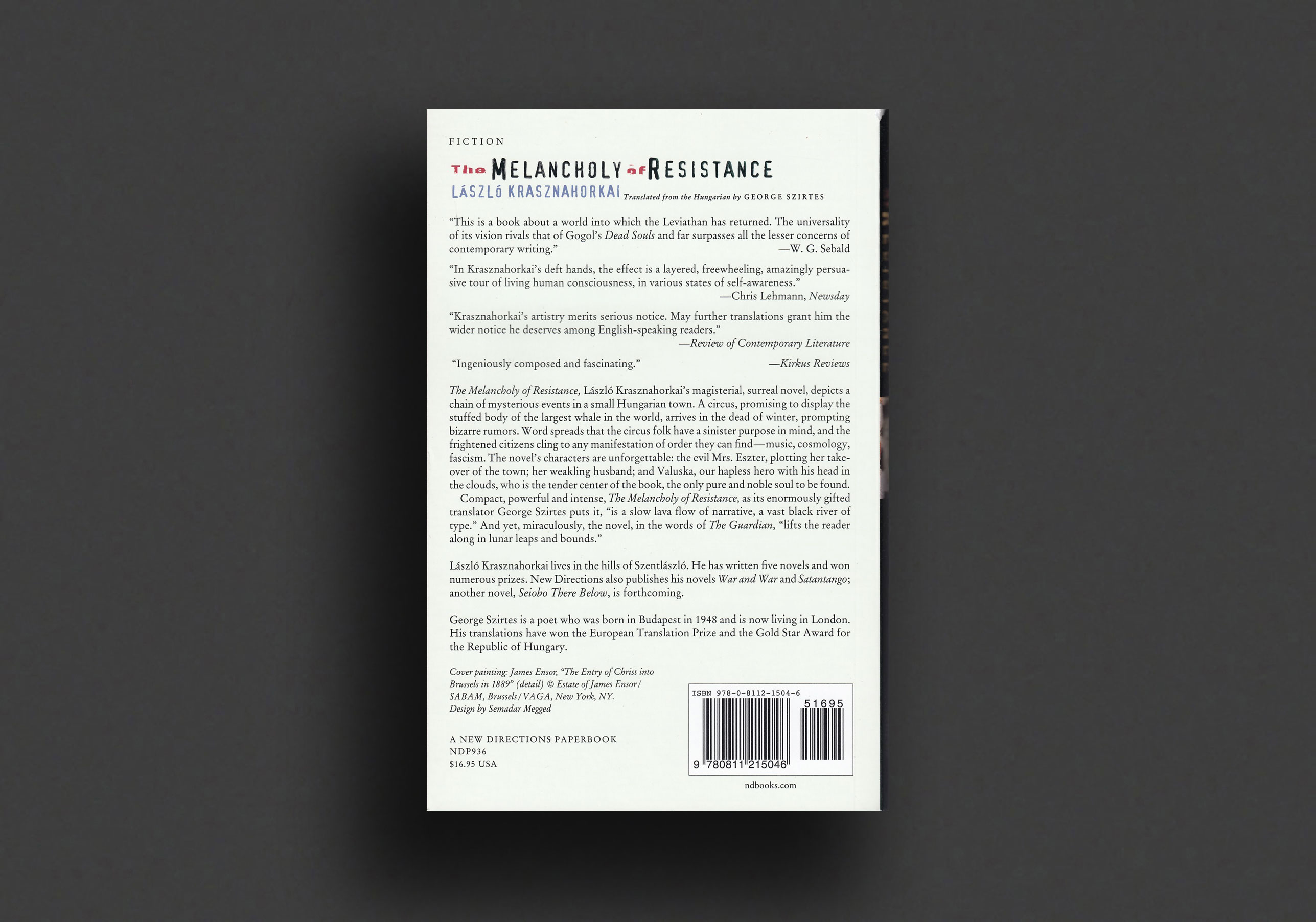
"This is a book about a world into which the Leviathan has returned. The universality of its vision rivals that of Gogol's Dead Souls and far surpasses all the lesser concerns of contemporary writing."—W. G. Sebald
"Satantango and The Melancholy of Resistance are irresistible, unforgettable and required reading."—Eileen Battersby, The Irish Times
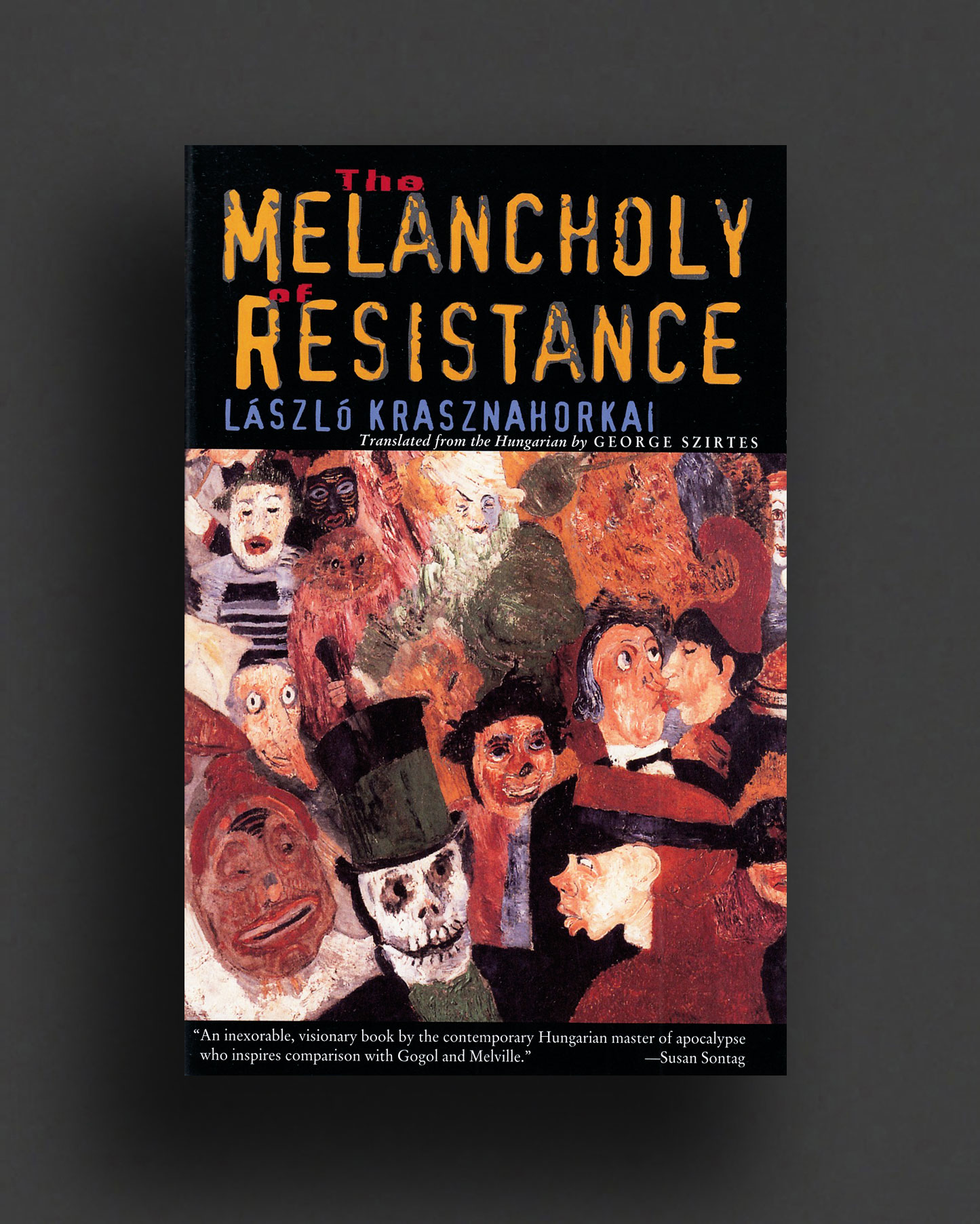
The Melancholy of Resistance, László Krasznahorkai's magisterial, surreal novel, depicts a chain of mysterious events in a small Hungarian town. A circus, promising to display the stuffed body of the largest whale in the world, arrives in the dead of winter, prompting bizarre rumors. Word spreads that the circus folk have a sinister purpose in mind, and the frightened citizens cling to any manifestation of order they can find —music, cosmology, fascism. The novel's characters are unforgettable: the evil Mrs. Eszter, plotting her takeover of the town; her weakling husband; and Valuska, our hapless hero with his head in the clouds, who is the tender center of the book, the only pure and noble soul to be found.
Compact, powerful and intense, The Melancholy of Resistance, as its enormously gifted translator George Szirtes puts it, "is a slow lava flow of narrative, a vast black river of type." And yet, miraculously, the novel, in the words of The Guardian, "lifts the reader along in lunar leaps and bounds."
László Krasznahorkai lives in the hills of Szentlászló. He has written five novels and won numerous prizes. New Directions also publishes his novels War and War and Satantango; another novel, Seiobo There Below, is forthcoming.
George Szirtes is a poet who was born in Budapest in 1948 and is now living in London.
His translations have won the European Translation Prize and the Gold Star Award for the Republic of Hungary.
Cover painting: James Ensor, "The Entry of Christ into Brussels in 1889" (detail)
2026, English
Softcover (bound by elastic band), 128 pages, 21 x 14.8 cm
Published by
UTS Gallery / Sydney
$30.00 - In stock -
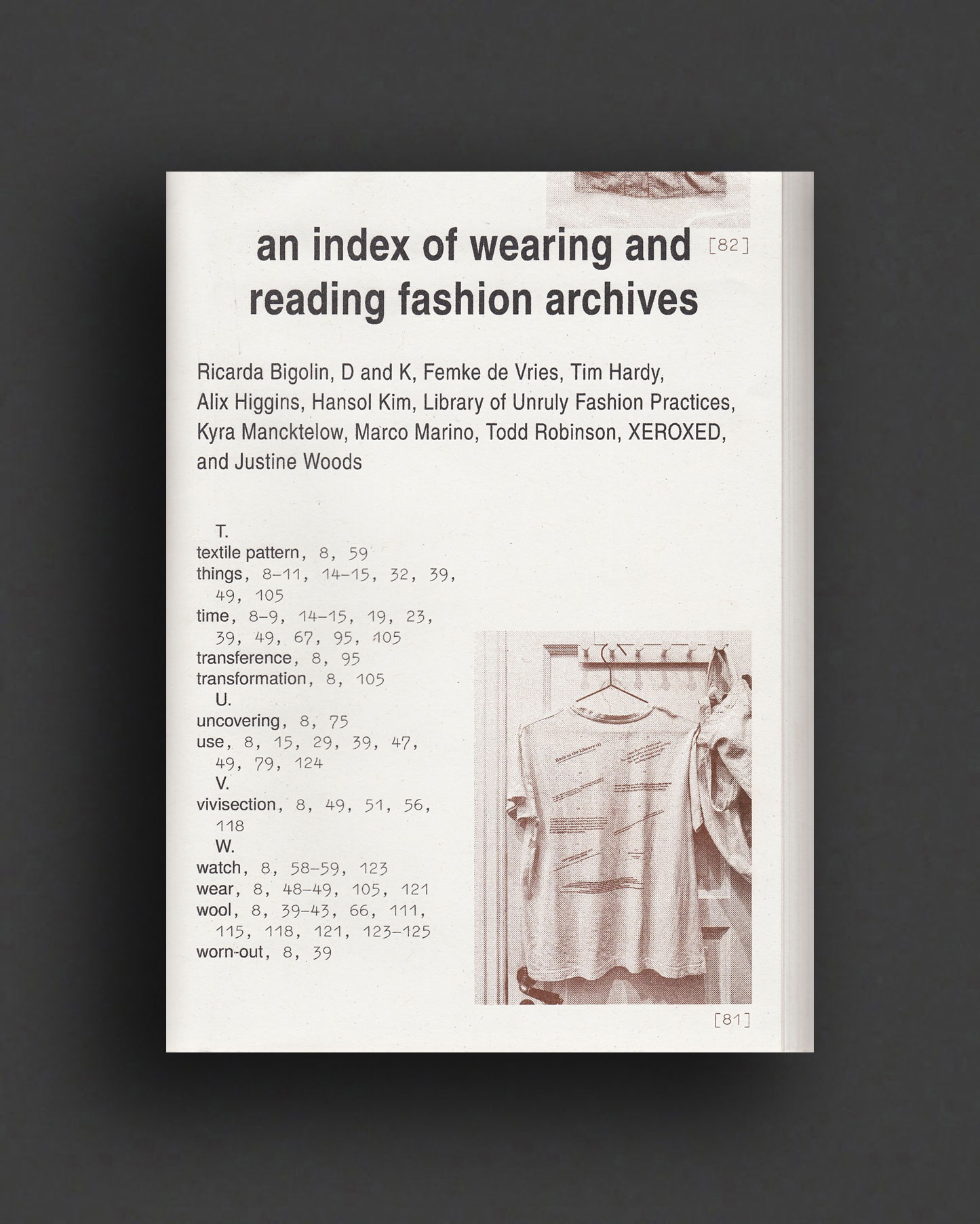
Published on the occasion of the exhibition “No Place for mannequins: Remaking the fashion archive" (UTS Gallery, 2026), An index of wearing and reading fashion archives gathers and presents a collection of artist responses on how to make or unmake an archive.
With introductory essays by curators Todd Robinson and Ricarda Bigolin, the volume collects material and written assemblages of creative and research-based processes, including photographs, sketches, references, and citations, along with garments and accessories from participating artist's personal wardrobes, into an index of living traces.
Contributors: Ricarda Bigolin, D and K, Femke de Vries, Tim Hardy, Alix Higgins, Hansol Kim, Library of Unruly Fashion Practices, Kyra Mancktelow, Marco Marino, Todd Robinson, XEROXED, and Justine Woods.
Copy Editors: Stella Rosa McDonald and Alice Rezende
Design: Zenobia Ahmed
2 colour risographed covers, bound by elastic band.
2023, English
Softcover, 288 pages, 20.9 x 13 cm
Published by
Verso / London
$34.00 - In stock -
A new collection of stories from the cult author of Terminal Boredom.
Izumi Suzuki had ideas about doing things differently, ideas that paid little attention to the laws of physics, or the laws of the land. In this new collection, her skewed imagination distorts and enhances some of the classic concepts of science fiction and fantasy.
A philandering husband receives a bestial punishment from a wife with her own secrets to keep; a music lover finds herself in a timeline both familiar and as wrong as can be; a misfit band of space pirates discover a mysterious baby among the stars; Emma, the Bovary-like character from one of Suzuki’s stories in Terminal Boredom, lands herself in a bizarre romantic pickle.
Wryly anarchic and deeply imaginative, Suzuki was a writer like no other. These eleven stories offer readers the opportunity to delve deeper in this singular writer's work.
Translated by Sam Bett, David Boyd, Daniel Joseph and Helen O'Horan
"Extraordinary. To use one of her own coolly illuminating formulations, Suzuki is steward of a new anxiety"—China Miéville
"Brilliant and often bleak … all shot through with a camp ethos, dark humour and kitchen-sink realism … in their brio and jagged urgency, these stories have, if anything, only gained in their alarming immediacy."— Times Literary Supplement
2021, English
Softcover, 208 pages, 20.9 x 13 cm
Published by
Verso / London
$34.00 - In stock -
The first English-language publication of the work of Izumi Suzuki, a legend of Japanese science fiction and a countercultural icon.
In a future where men are contained in ghettoised isolation, women enjoy the fruits of a queer matriarchal utopia—until a boy escapes and a young woman’s perception of the world is violently interrupted. The last family in a desolate city struggles to approximate twentieth- century life on Earth, lifting what notions they can from 1960s popular culture. But beneath these badly learned behaviours lies an atavistic appetite for destruction. Two new friends enjoy drinks on a holiday resort planet where all is not as it seems, and the air itself seems to carry a treacherously potent nostalgia. Back on Earth, Emma’s not certain if her emotionally abusive, green-haired boyfriend is in fact an intergalactic alien spy, or if she’s been hitting the bottles and baggies too hard. And in the title story, the tyranny of enforced screen-time and the mechanisation of labour foster a cold-hearted and ultimately tragic disaffection among the youth of Tokyo.
Nonchalantly hip and full of deranged prescience, Suzuki’s singular slant on speculative fiction would be echoed in countless later works, from Neuromancer to The Handmaid’s Tale. In these darkly playful and punky stories, the fantastical elements are always grounded in the universal pettiness of strife between the sexes, and the gritty reality of life on the lower rungs, whatever planet that ladder might be on.
Izumi Suzuki was born in 1949. After dropping out of high school she worked in a factory before finding success and infamy as a model and actress. She was a member of Shuji Terayama's independent underground theater troupe Tenjo Saijiki, and acted in both "pink" films and classics of 1970s Japanese cinema. Izumi was the subject of many of Nobuyoshi Araki's most famous photographs and this photobook is one of his most sought after.. When the father of her children, the jazz musician Kaoru Abe, died of an overdose, Suzuki’s creative output went into hyperdrive and she began producing the irreverent and punky short fiction, novels and essays that ensured her reputation would outstrip and outlast that of the men she had been associated with in her early career. She took her own life in 1986, leaving behind a decade’s worth of groundbreaking and influential writing.
2024, English
Softcover, 192 pages, 19.8 x 12.9
Published by
Verso / London
$34.00 - In stock -
Translated by Helen O'Horan
The first novel from Izumi Suzuki to be published in English: a candid, intimate exploration of passion, music and transgression.
Hope I’m in for a good time, I thought. Even if it’s just for tonight.
Set in the underground bar and club scene of 1970s Tokyo, Set My Heart On Fire tells the story of Izumi in her turbulent twenties. Through a series of disarmingly frank vignettes, author Izumi Suzuki presents an unforgettable portrait of a young woman encountering missteps and miscommunication, good music and unreliable men, powerful drugs and disorientating meds. Izumi usually keeps her relationships short but complicated, until she meets Jun.
Set My Heart on Fire is a visceral novel about mistaken relationships and the convolutions of desire, about regret and acceptance. Pulsing through the narration is the protagonist’s love of music, a vital soundtrack spanning the Zombies, T. Rex and the Rolling Stones as well as underground Japanese psychedelic-rock bands such as the Tigers and the Tempters.
"The work and messages of Ursula K. Le Guin, the author’s longer-lived contemporary, come to mind. Both Suzuki and Le Guin knew that gender roles are a matter of costume or control, affect or affliction. The terms we use to define humanity are often inhuman"—Catherine Lacey, New York Times
"Suzuki's unique sensibility, which combined a punk aesthetic with a taste for the absurd. Her work-populated by misfits, loners, and femmes fatales alongside extraterrestrial boyfriends, intergalactic animal traffickers, and murderous teen-agers with E.S.P.-wryly blurs the boundary between earthly delinquency and otherworldly phenomena."—New Yorker
"Wild and restless ... I can't think of anyone I'd rather read than this countercultural icon of the Japanese literary underground."—Frieze
2019, English
Softcover, 160 pages, 91.8 x 13 cm
Published by
And Other Stories / High Wycombe
$28.00 - In stock -
'A man called Berg, who changed his name to Greb, came to a seaside town intending to kill his father . . .'
So begins Ann Quin's madcap frolic with sinister undertones, her 1964 debut 'so staggeringly superior to most you'll never forget it' (The Guardian). Alistair Berg hears where his father, who has been absent from his life since his infancy, is living. Without revealing his identity, Berg takes a room next to the one where his father and father's mistress are lodging and he starts to plot his father's elimination. Seduction and violence follow, though not quite as Berg intends, with Quin lending the proceedings a delightful absurdist humour.
Anarchic, heady, dark, Berg is Quin's masterpiece, a classic of post-war avant-garde British writing, and now finally back in print after much demand.
Ann Quin (1936–1973) was a British writer noted for her experimental style. Born in Brighton, Sussex, in a family on the fringes of the working-class and lower-middle class, her father, former opera singer Nicholas Montague Quin, left the family, and she was raised by her mother Ann (née Reid) alone. Quin is associated with a loosely constituted circle of 'experimental' authors in Sixties Britain, headed by B. S. Johnson and including Stefan Themerson, Rayner Heppenstall, Alan Burns and Eva Figes, influenced by Samuel Beckett and recent French fiction (Marguerite Duras, Alain Robbe-Grillet). The author of Berg (1964), Three (1966), Passages (1969) and Tripticks (1972), she killed herself in 1973 at the age of 37.
2021, English
Softcover, 160 pages, 19.8 x 13 cm
Published by
And Other Stories / High Wycombe
$32.00 - In stock -
Introduction by Claire-Louise Bennett
A book of voices, landscapes and seasons, Ann Quin's newly republished novel mirrors the multiplicity of meanings of the very word 'passage'--of music, of time, and of life itself. A woman, accompanied by her lover, searches for her lost brother, who may have been a revolutionary, and who may have been tortured, imprisoned or killed. Roving through a Mediterranean landscape, they live out their entangled existences, reluctant to give up, afraid of the outcome.
Reflecting the schizophrenia of its characters, the novel splits into alternating passages, switching between the sister and her lover's perspective. The lover's passages are also fractured, taking the form of a diary with notes alongside the entries. An intricate system of repetition and relation builds across the passages. 'All seasons passed through before the pattern formed, collected in parts.'
Erotic and tense, in Quin's compelling third novel the author allowed her writing freer rein than before, and created a work ahead of its time: her most poetic, evocative and mysterious novel yet.
1979, English
Softcover (staple-bound), unpaginated, 28 x 21.5 cm
1st Edition, Out of print title / used / good
Published by
Belier Press / New York
$80.00 - Out of stock
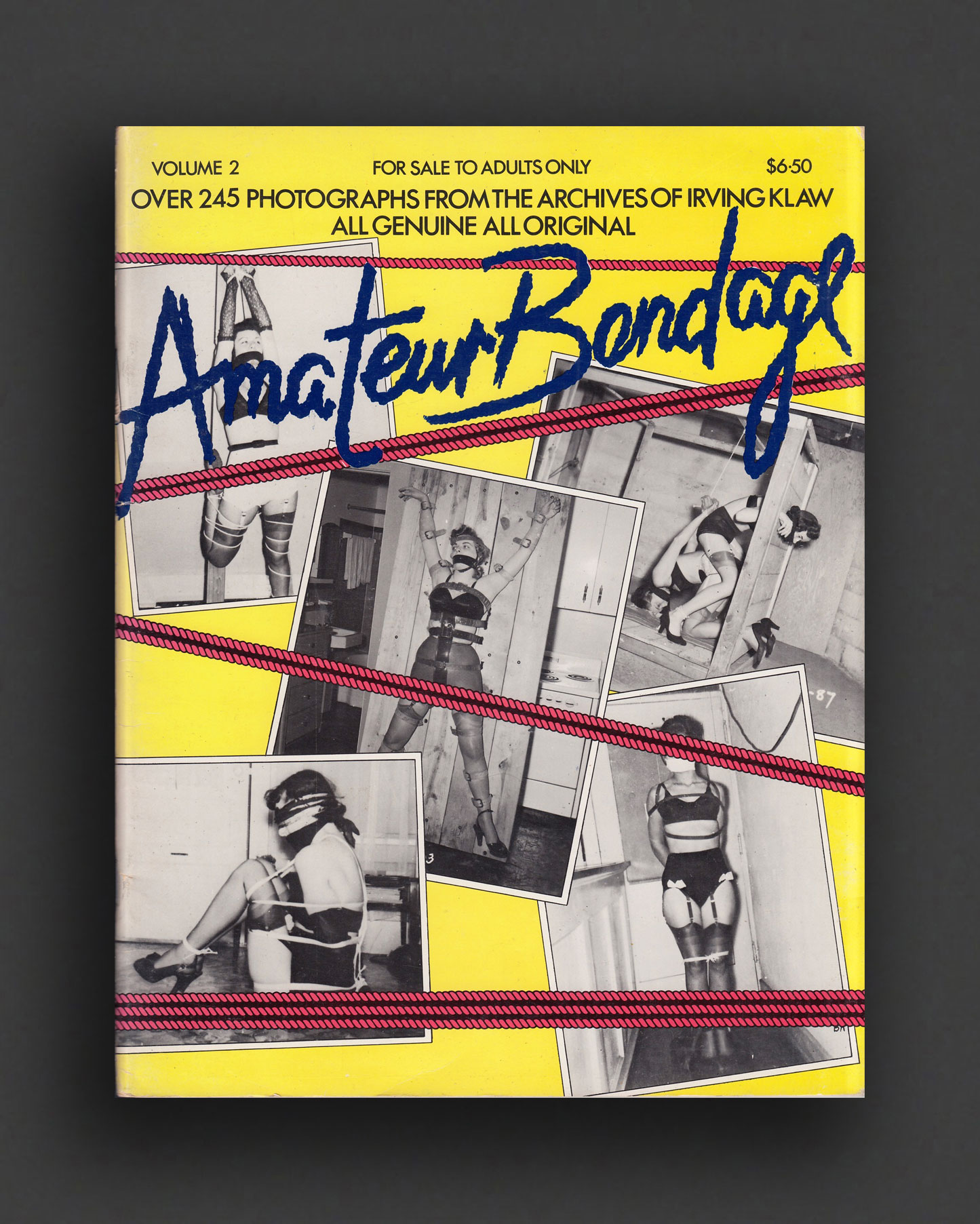
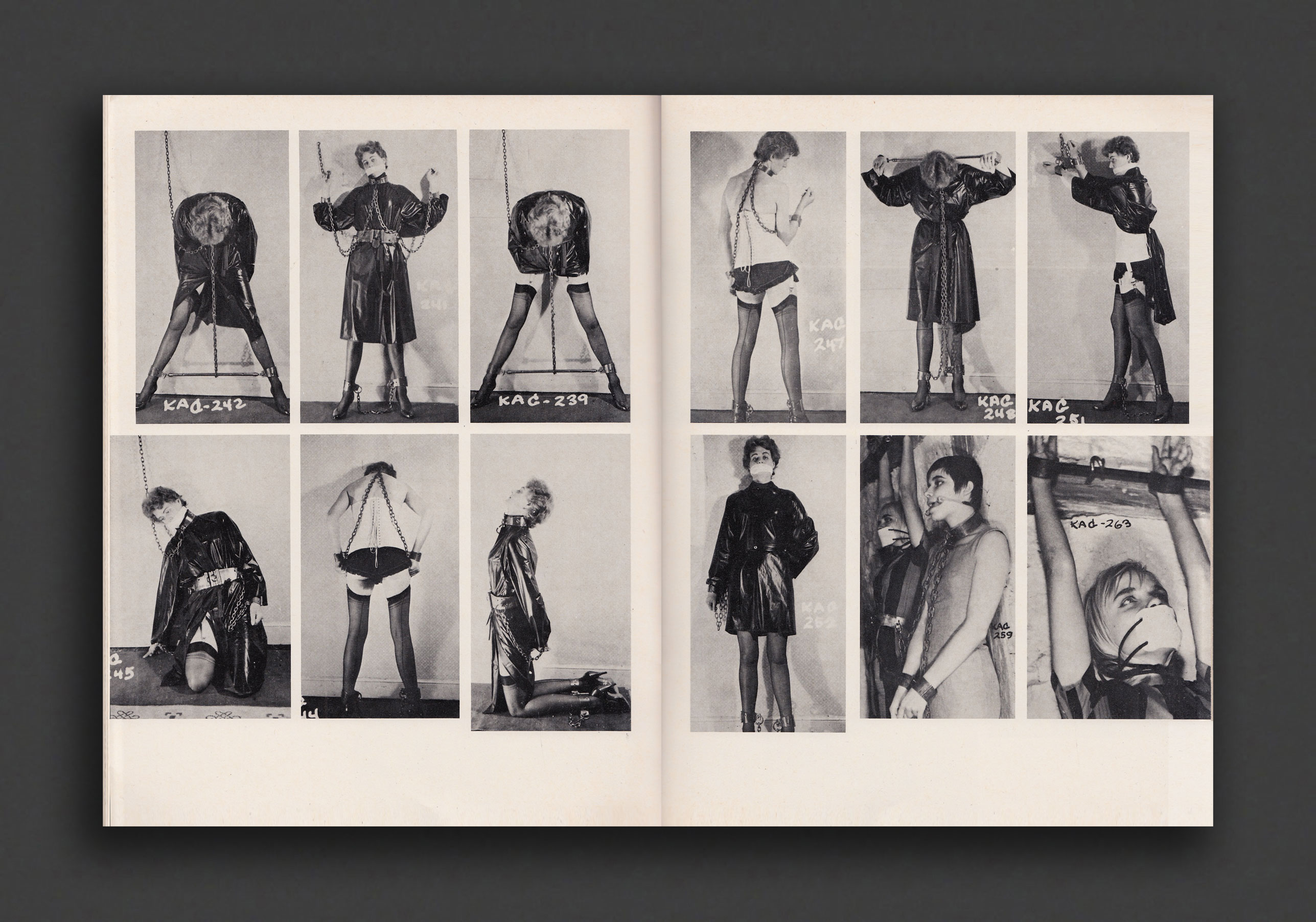
First 1979 edition of Amateur Bondage Vol. 2, collecting almost 250 photographs of women in bondage from the extensive photography archives of Irving Klaw. "All Genuine, all original"! Wildly creative image making by non-professional photographers, models and fetish enthusiasts, which were originally sold through mail-order c. 1950-1956 by the late Klaw.
Irving Klaw (1910-1966), self-named the "Pin-up King", was a hugely influential American merchant of sexploitation, fetish, and Hollywood glamour pin-up photographs and films. In the history of heterosexual BDSM in the 20th century, Klaw was a curious paradox. He was a non-kinky person who produced and sold arguably more BDSM imagery than anyone before or since. He became a symbol for the cause of sexual freedom, and a martyr to anti-sex initiatives by the Federal government, yet he was non-political, uninterested in activism and never intended to be a martyr for anything. He was a business man who came from humble, working-class beginnings. Klaw worked closely with models like Bettie Page, June King, Joan Rydell, Jackie Miller, et al. for his photography and films. Inspired by John Willie, Klaw also commissioned and distributed illustrated adventure/bondage chapter serials by fetish artists Eric Stanton, Gene Bilbrew, Adolfo Ruiz, and others. Irving Klaw is a central figure in what fetish art historian Richard Pérez Seves has designated as the "Bizarre Underground," the pre-1970 fetish art years.
Good–VG copy with only light wear, but back cover has some clipping to edges, most likely for a make–shift Roach/Crutch :).
1989, English
Softcover, 174 pages, 21.2 x 14.5 cm
1st Edition, Out of print title / used / good
Published by
Atlas Press / London
$90.00 - Out of stock
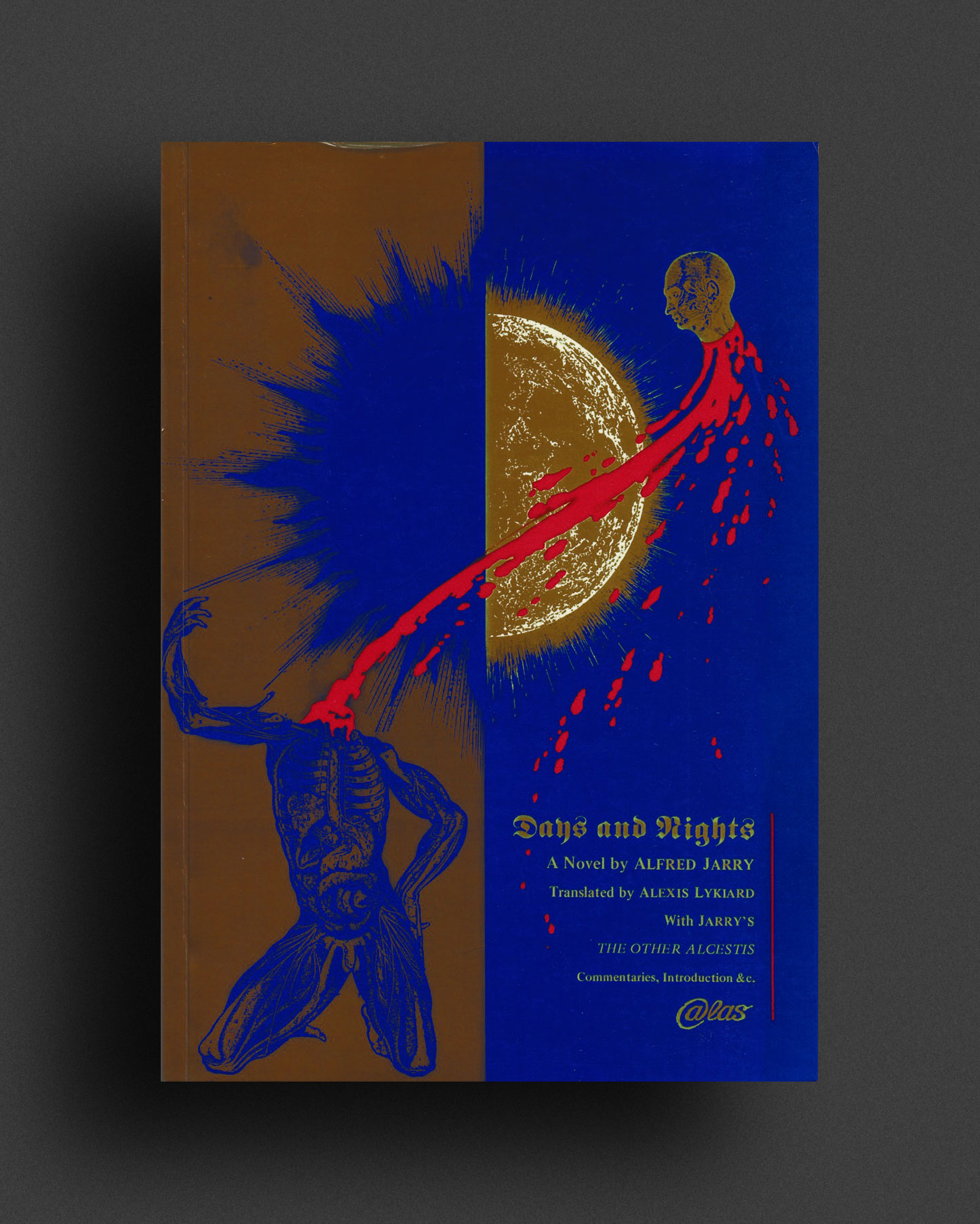
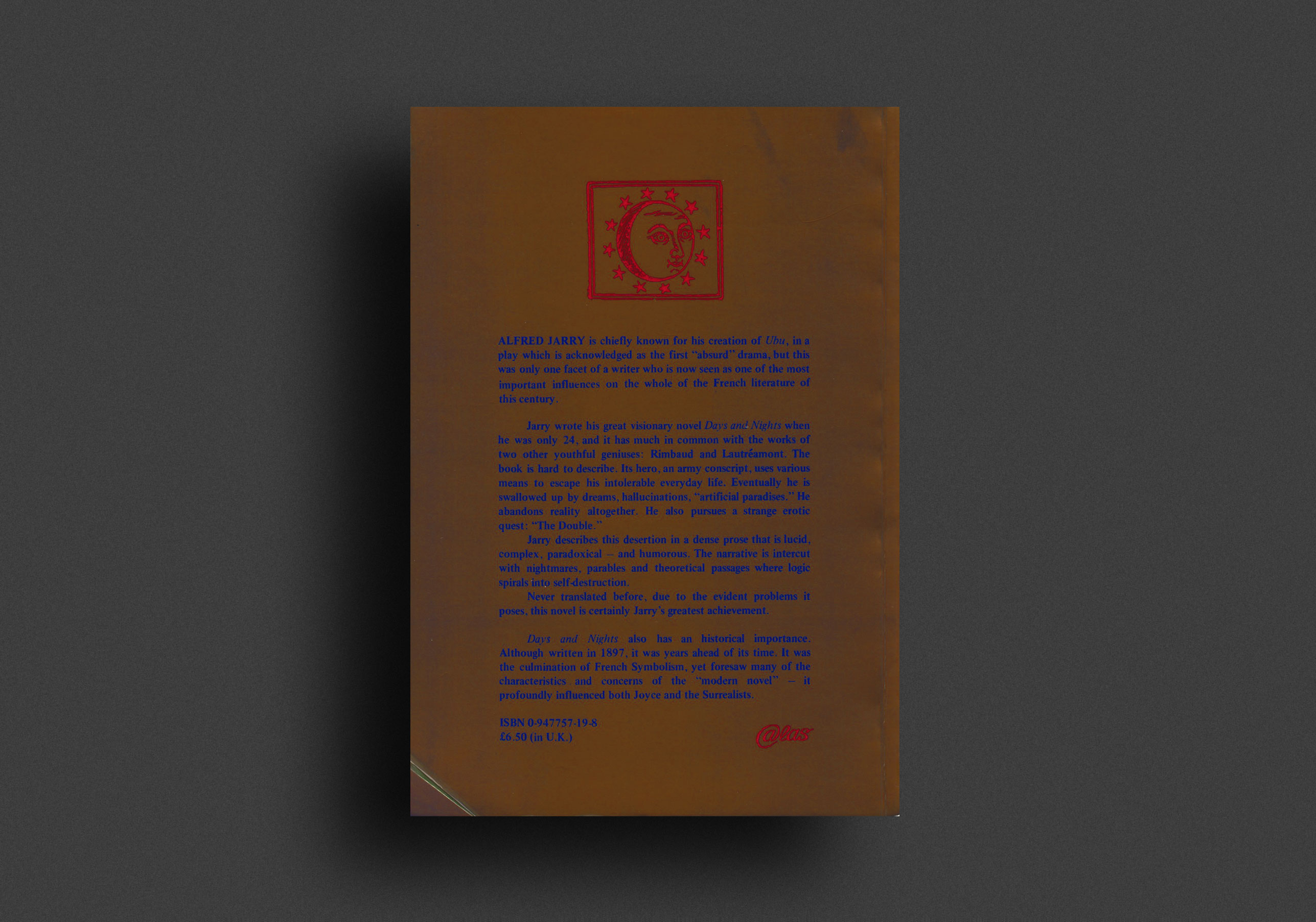
Rare first English translation of this 1897 novel by French symbolist writer and 'pataphysician Alfred Jarry (1873—1907). Translated by Alexis Lykiard, with introduction by Alastair Brotchie and additional verse translations by Stanley Chapman. Preceded by Alfred Jarry’s The Other Alcestis, translated by John Harman. Illustrated by Peter Blegvad, with an afterword by Alastair Brotchie.
Alfred Jarry is chiefly known for his creation of Ubu, in a play which is acknowledged as the first "absurd" drama, but this was only one facet of a writer who is now seen as one of the most important influences on the whole of the French literature of this century. Jarry wrote his great visionary novel Days and Nights when he was only 24, and it has much in common with the works of two other youthful geniuses: Rimbaud and Lautréamont. The book is hard to describe. Its hero, an army conscript, uses various means to escape his intolerable everyday life. Eventually he is swallowed up by dreams, hallucinations, "artificial paradises." He abandons reality altogether. He also pursues a strange erotic quest: "The Double." Jarry describes this desertion in a dense prose that is lucid, complex, paradoxical and humorous. The narrative is intercut with nightmares, parables and theoretical passages where logic spirals into self-destruction.
Never translated before, due to the evident problems it poses, this novel is certainly Jarry's greatest achievement.
Days and Nights also has an historical importance. Although written in 1897, it was years ahead of its time. It was the culmination of French Symbolism, yet foresaw many of the characteristics and concerns of the "modern novel" — it profoundly influenced both Joyce and the Surrealists.
Good–VG copy but with some board creasing/minor laminate peeling.
1993, English
Softcover, 112 pages, 21 x 13.5 cm
1st Edition, Out of print title / used / very good
Published by
Atlas Press / London
$80.00 - Out of stock
Introduced by Alastair Brotchie. Translated by Iain White.
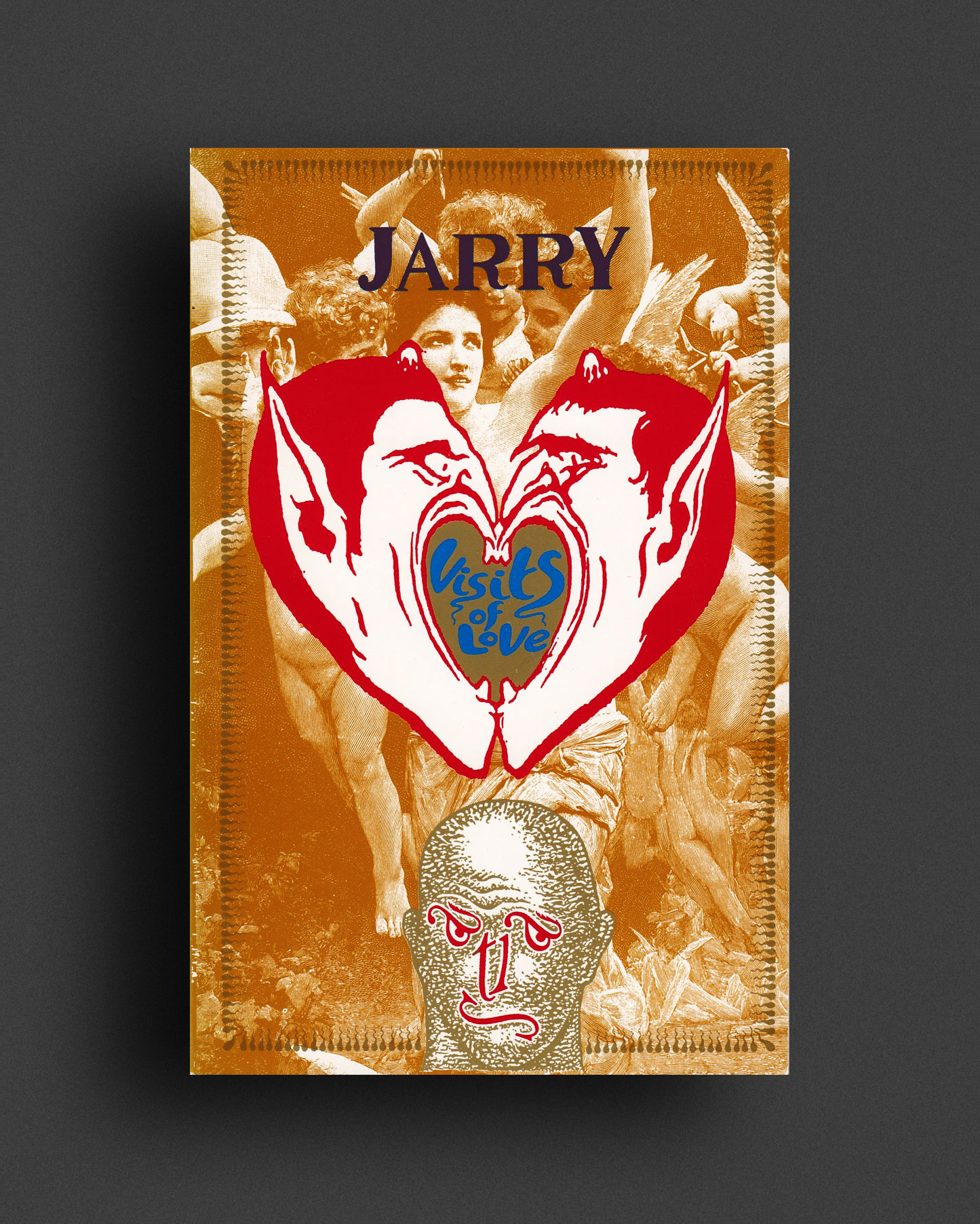
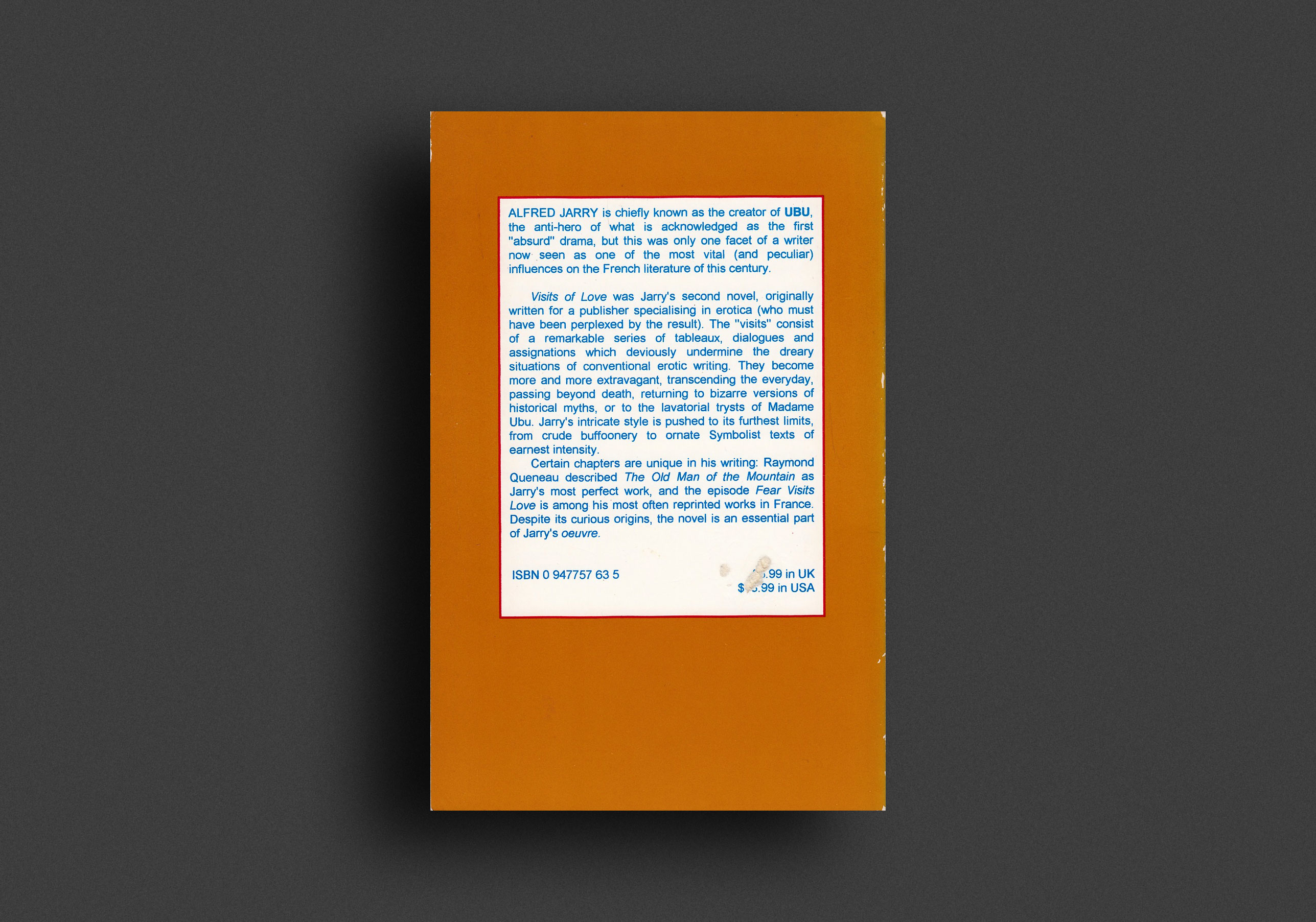
Visits of Love was Jarry’s second novel, originally written in 1898 for a publisher specialising in erotica (who must have been perplexed by the result). The “visits” consist of a remarkable series of tableaux, dialogues and assignations which deviously undermine the dreary situations of conventional erotic writing. They become more and more extravagant, transcending the present day, passing beyond death, returning to fabulous versions of historical myths, or to the lavatorial tryst of Madame Ubu. Jarry’s style is pushed to its furthest limits, from crude buffoonery to ornate Symbolist texts of earnest intensity.
Certain chapters are unique in his writing: Raymond Queneau described The Old Man of the Mountain as Jarry’s most perfect work, and the text Fear Visits Love is among his most often reprinted works in France.
Very Good copy, minor sticker damage to back cover.
1984, English
Softcover, 128 pages, 22 x 14 cm
1st Edition, Out of print title / used / very good
Published by
Panjandrum Press / Los Angeles
$45.00 - In stock -
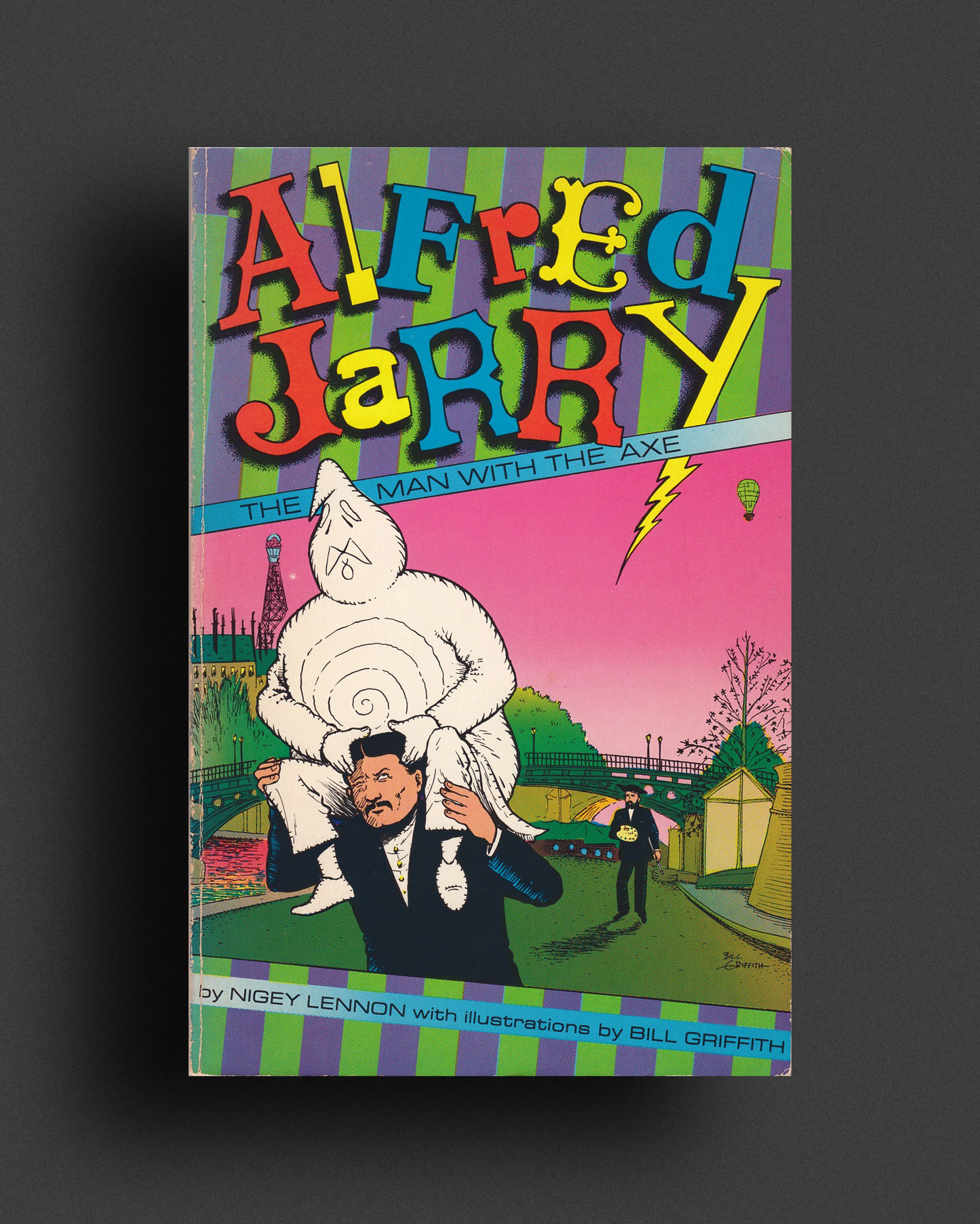
Scarce first 1984 Panjandrum Press edition.
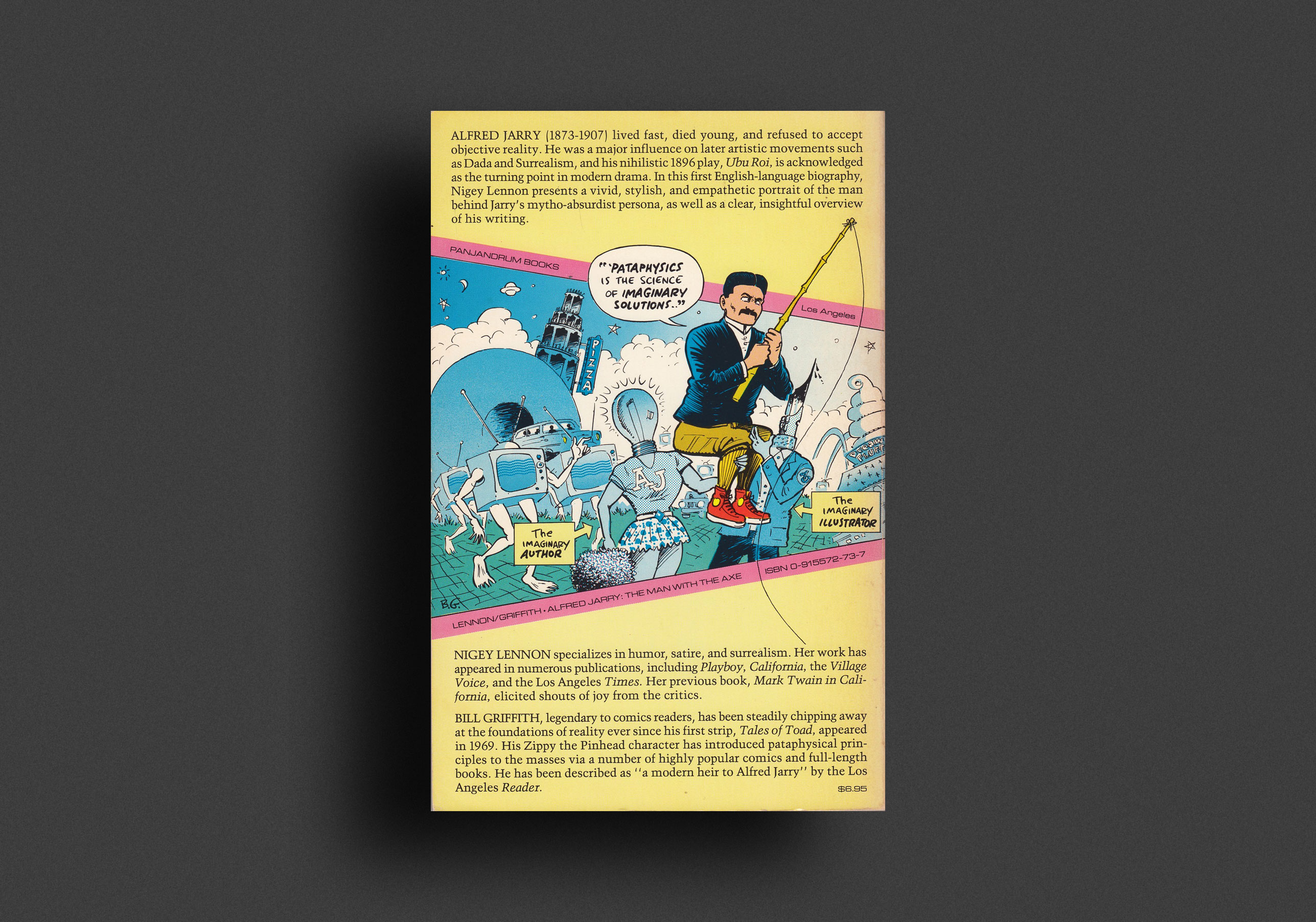
Alfred Jarry (1873-1907) lived fast, died young, and refused to accept objective reality. He was a major influence on artistic movements such as Dada and Surrealism, and his nihilistic 1896 play, "Ubu Roi", is acknowledged as the turning point in modern drama. In "The Man with the Axe", author Nigey Lennon and illustrator/underground comix legend Bill Griffith take an appropriately surrealistic graphic approach to chronicling the absurd life of this seminal figure. As the first-ever non-academic biography of Jarry, "The Man with the Axe" has been legendary since its initial publication in 1984. AirStream Books is proud to re-introduce it in e-book format to a new generation of readers. Features full-color cover art and numerous black-and-white illustrations by Bill Griffith, as well as a hilarious short story, "The Pataphysician", by Nigey Lennon.
VG copy with light wear to extremities.
1969, English
Softcover, 148 pages, 21 x 13.8 cm
1st Edition, Out of print title / used / very good
Published by
Grove Press / New York
$30.00 - In stock -
First 1969 Grove edition.
Translated from the French by Cyril Connolly and Simon Watson Taylor.
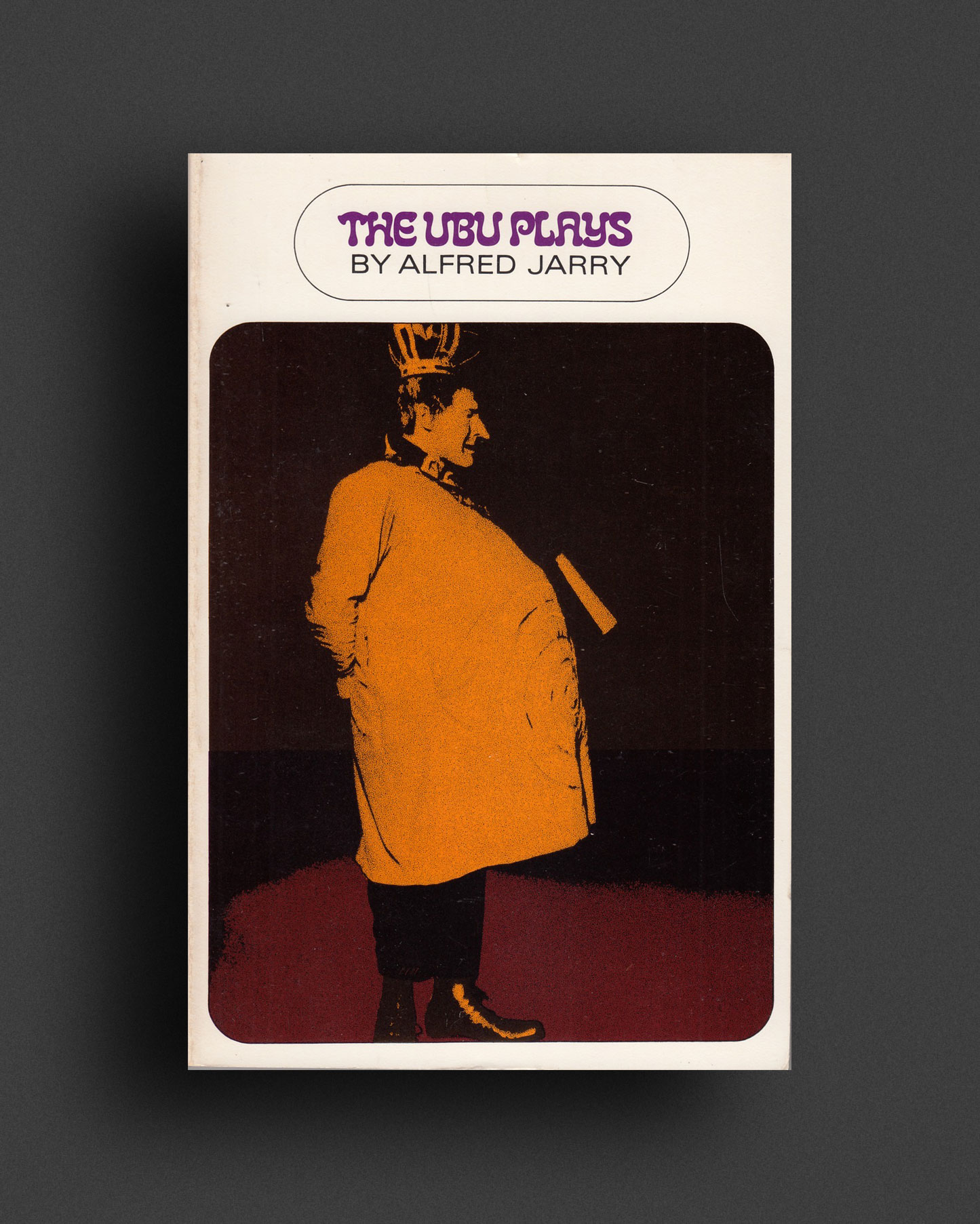
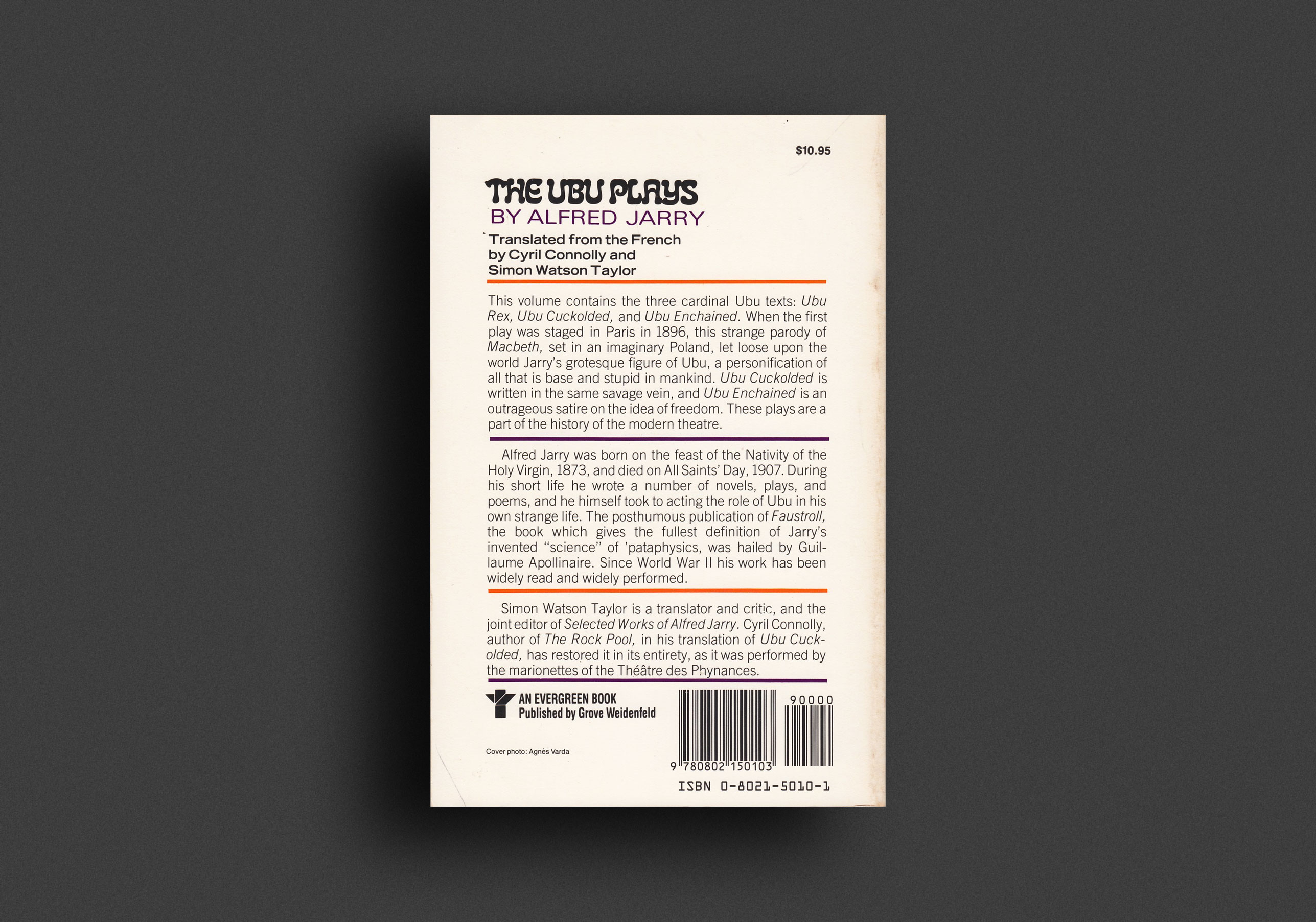
This volume contains the three cardinal Ubu texts: Ubu Rex, Ubu Cuckolded, and Ubu Enchained. When the first play was staged in Paris in 1896, this strange parody of Macbeth, set in an imaginary Poland, let loose upon the world Jarry's grotesque figure of Ubu, a personification of all that is base and stupid in mankind. Ubu Cuckolded is written in the same savage vein, and Ubu Enchained is an outrageous satire on the idea of freedom. These plays are a part of the history of the modern theatre.
Alfred Jarry was born on the feast of the Nativity of the Holy Virgin, 1873, and died on All Saints' Day, 1907. During his short life he wrote a number of novels, plays, and poems, and he himself took to acting the role of Ubu in his own strange life. The posthumous publication of Faustroll, the book which gives the fullest definition of Jarry's invented "science" of 'pataphysics, was hailed by Guillaume Apollinaire. Since World War Il his work has been widely read and widely performed.
Simon Watson Taylor is a translator and critic, and the joint editor of Selected Works of Alfred Jarry. Cyril Connolly, author of The Rock Pool, in his translation of Ubu Cuck-olded, has restored it in its entirety, as it was performed by the marionettes of the Théâtre des Phynances.
VG copy, light wear to extremities.
1998, English
Hardcover (w. dust jacket), 182 pages, 24 x 16.5 cm
1st Edition, Out of print title / used / fine
Published by
Verso / London
$45.00 - Out of stock
First 1998 hardcover edition.
“Elegant dissection of Brecht’s method, from estrangements to allegory and beyond.” —Modern Drama
The legacy of Bertolt Brecht is much contested, whether by those who wish to forget or to vilify his politics, but his stature as the outstanding political playwright and poet of the twentieth century is unforgettably established in this major critical work. Fredric Jameson elegantly dissects the intricate connections between Brecht’s drama and politics, demonstrating the way these combined to shape a unique and powerful influence on a profoundly troubled epoch.
Jameson sees Brecht’s method as a multi-layered process of reflection and self-reflection, reference and self-reference, which tears open a gap for individuals to situate themselves historically, to think about themselves in the third person, and to use that self-projection in history as a basis for judgment. Emphasizing the themes of separation, distance, multiplicity, choice and contradiction in Brecht’s entire corpus, Jameson’s study engages in a dialogue with a cryptic work, unpublished in Brecht’s lifetime, entitled Me-ti; Book of Twists and Turns. Jameson sees this text as key to understanding Brecht’s critical reflections on dialectics and his orientally informed fascination with flow and flux, change and the non-eternal.
For Jameson, Brecht is not prescriptive but performative. His plays do not provide answers but attempt to show people how to perform the act of thinking, how to begin to search for answers themselves. Brecht represents the ceaselessness of transformation while at the same time alienating it, interrupting it, making it comprehensible by making it strange. And thereby, in breaking it up by analysis, the possibility emerges of its reconstitution under a new law.
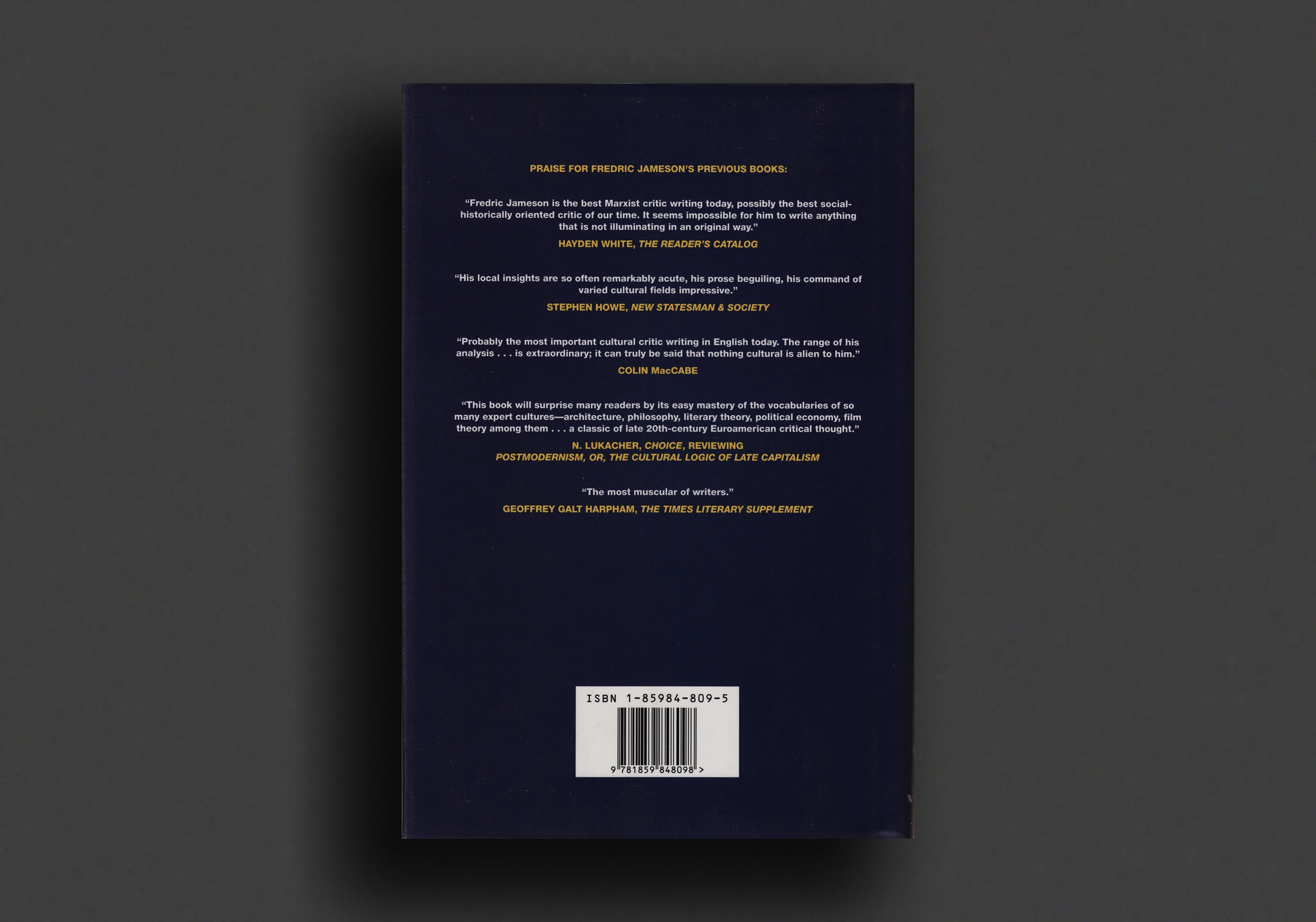
"Probably the most important cultural critic writing in English today ... it can truly be said that nothing cultural is alien to him."—Colin MacCabe
NF—F NF—F dust jacket.