World Food Books' programme is largely produced on Kulin Nation land. We acknowledge the Wurundjeri people of the Kulin Nation as the first and continuing custodians of this land, and pay respect to their Elders past, present, and emerging.
World Food Books is an arts and special interests bookshop in Naarm / Melbourne. Founded in 2010, World Food Books is devoted to the presentation of a rotating, hand-selection of international art, design, literary and counterculture publications with an emphasis on the anti-traditional, the experimental, the avant-garde, the heretic, the marginal.
Presenting new titles alongside rare and out-of-print books, catalogues and journals spanning the fields of modern and contemporary art, design, photography, illustration, film, literature, poetry, cultural theory, philosophy, sexuality, popular and underground culture in its many radical forms, World Food Books wishes to encourage adventurous, thoughtful and open-minded reading, looking, writing, and exchange of publishing and ideas, both current and historical.
As well as our bookshop, located in Melbourne's historical Nicholas Building, all of our inventory is available internationally via our online mail-order service.
World Food Books semi-regularly co-ordinates "Occasions", a programme of exhibits and events at the bookshop and in partnership with other hosts (such as museums and art galleries) that develop out of the activities, relationships and content of the bookshop itself.
World Food Books
The Nicholas Building
37 Swanston Street
Room 5, Level 6
Melbourne 3000
Australia
SHOP HOURS:
Thu–Fri 12–6, Sat 12–5
WEB-SHOP OPEN 24/7
World Food Books
Postal Address:
PO Box 435
Flinders Lane
Victoria 8009
Australia
Art
Theory / Essay
Architecture / Interior
Graphic Design / Typography
Photography
Fashion
Eros
LGBTQ+
Fiction / Poetry
Weird / Speculative / Science Fiction / Horror
Transgressive / Visceral / Abject
Symbolism / Decadence / Fin de siècle
Film / Video
Painting
Sculpture / Installation
Performance / Dance / Theater
Drawing
Sound / Music
Curatorial
Group Shows / Collections
Periodicals
Out-of-print / Rare
Posters / Ephemera / Discs
Signed Books
World Food Books Gift Voucher
World Food Book Bag
Australian Art
Australian Fiction
Australian Science Fiction / Speculative Fiction
Australian Poetry
Australian Photography
Japanese Photography
Conceptual Art
Minimal Art
Dada
'Pataphysics / Oulipo
Fluxus
Concrete Poetry
Pop Art
Surrealism
Arte Povera
Arte Informale / Haute Pâte / Tachism
Nouveau Réalisme / Zero / Kinetic
Situationism / Lettrism
Collage / Mail Art / Xerox Art
Art Brut / Folk / Visionary / Fantastic
Illustration / Graphic Art / Bandes Dessinées
Furniture
Italian Radical Design / Postmodernism
Textiles
Ceramics / Glass
Counterculture
Protest / Revolt
Philosophy
Psychoanalysis
Anthropology
Anarchism
Socialism / Anarchism / Communism / Capitalism
Literary Theory / Semiotics / Language
Feminism / Women's Studies
Gender Studies / Sexuality
Anthropology
Fetishism / BDSM
Drugs / Psychedelia
Crime / Violence
Animal Rights / Veganism
Occult / Esoterica
Ecology / Earth / Alternative Living
Whole Earth / Crafts
All prices in AUD (Australian dollars)
Pick-Ups
Pick-up orders can be collected in our bookshop during opening hours after order date. Please collect any Pick-up orders within 2 weeks of ordering as we have limited storage space. Orders will be released back into stock if not collected within this time. No refunds can be made for pick-ups left un-collected. If you cannot make it in to the bookshop in this time-frame, please choose postage option.
Return Policy
All sales are final. We do accept returns (for refund or exchange) for items received in error. All our orders are packed with special care using heavy-duty padding and cardboard book-mailers or bubble mailers (for smaller books), using reinforcement where required. We cannot take responsibility for any lost, stolen or damaged parcels.
Insurance
Should you wish to insure your package, please email us directly after placing your order and we can organise this at a small extra expense. Although all standard/express tracked packages are very safe and dependable, we cannot take responsibility for any lost, stolen or damaged parcels. We recommend insurance on valuable orders.
Interested in selling your old books, catalogues, journals, magazines, comics, fanzines, ephemera? We are always looking for interesting, unusual and out-of-print books to buy. We only buy books in our fields of interest and specialty, and that we feel we can resell.
We base these prices on desirability, market value, in-print prices, condition and our current stock levels. We offer cash, store credit, and can take stock on consignment. All
about 25% of the price we expect to get when we sell them, or 30% in store credit. We base these prices on desirability, market value, in-print prices, condition and our current stock levels.
Sell your books any day of the week. You can drop them off and return later. If you have a lot of books, we can visit your Sydney home.
We buy books that we feel we can resell. We offer about 25 % of the price we expect to get when we sell them, or 30% in store credit. We base these prices on desirability, market value, in-print prices, condition and our current stock levels.
Philadelphia Wireman
03 August - 01 September, 2018
World Food Books is proud to announce our next Occasion, the first presentation of sculptures by Philadelphia Wireman in Australia.
The Philadelphia Wireman sculptures were found abandoned in an alley off Philadelphia’s South Street on trash night in 1982. Their discovery in a rapidly-changing neighbourhood undergoing extensive renovation, compounded with the failure of all attempts to locate the artist, suggests that the works may have been discarded after the maker’s death. Dubbed the "Philadelphia Wireman" during the first exhibition of this work, in 1985, the maker’s name, age, ethnicity, and even gender remain uncertain. The entire collection totals approximately 1200 pieces, all intricately bound together with tightly-wound heavy-gauge wire (along with a few small, abstract marker drawings, reminiscent both of Mark Tobey and J.B. Murry). The dense construction of the work, despite a modest range of scale and materials, is singularly obsessive and disciplined in design: a wire armature or exoskeleton firmly binds a bricolage of found objects including plastic, glass, food packaging, umbrella parts, tape, rubber, batteries, pens, leather, reflectors, nuts and bolts, nails, foil, coins, toys, watches, eyeglasses, tools, and jewellery.
Heavy with associations—anthropomorphic, zoomorphic, and socio-cultural responses to wrapped detritus—the totemic sculptures by Philadelphia Wireman have been discussed in the context of work created to fulfil the shamanistic needs of alternative religions in American culture. Curators, collectors, and critics have variously compared certain pieces to sculpture from Classical antiquity, Native American medicine bundles, African-American memory jugs, and African fetish objects. Reflecting the artist’s prolific and incredibly focused scavenging impulse, and despite—or perhaps enhanced by—their anonymity, these enigmatic objects function as urban artefacts and arbiters of power, though their origin and purpose is unknown. Philadelphia Wireman, whatever their identity, possessed an astonishing ability to isolate and communicate the concepts of power and energy through the selection and transformation of ordinary materials. Over the course of the past two decades, this collection has come to be regarded as an important discovery in the field of self-taught art and vernacular art.
Presented in collaboration with Fleisher-Ollman Gallery, Philadelphia, and Robert Heald, Wellington.
Susan Te Kahurangi King
02 February - 10 March, 2018
Susan Te Kahurangi King (24 February 1951 - ) has been a confident and prolific artist since she was a young child, drawing with readily available materials - pencils, ballpoint pens and felt-tip markers, on whatever paper is at hand. Between the ages of four and six Susan slowly ceased verbal communication. Her grandparents William and Myrtle Murphy had developed a special bond with Susan so they took on caring responsibilities for extended periods. Myrtle began informally archiving her work, carefully collecting and storing the drawings and compiling scrapbooks. No drawing was insignificant; every scrap of paper was kept. The King family are now the custodians of a vast collection containing over 7000 individual works, from tiny scraps of paper through to 5 meter long rolls.
The scrapbooks and diaries reveal Myrtle to be a woman of great patience and compassion, seeking to understand a child who was not always behaving as expected. She encouraged Susan to be observant, to explore her environment and absorb all the sights and sounds. Myrtle would show Susan’s drawings to friends and people in her community that she had dealings with, such as shopkeepers and postal workers, but this was not simply a case of a grandmother’s bias. She recognised that Susan had developed a sophisticated and unique visual language and sincerely believed that her art deserved serious attention.
This was an unorthodox attitude for the time. To provide some context, Jean Dubuffet coined the term Art Brut in 1945 to describe work created by self-taught artists – specifically residents of psychiatric institutions and those he considered to be visionaries or eccentrics. In 1972 Roger Cardinal extended this concept by adopting the term Outsider Art to describe work made by non-academically trained artists operating outside of mainstream art networks through choice or circumstance. Susan was born in Te Aroha, New Zealand in 1951, far from the artistic hubs of Paris and London that Dubuffet and Cardinal operated in. That Myrtle fêted Susan as a self-taught artist who deserved to be taken seriously shows how progressive her attitudes were.
Susan’s parents Doug and Dawn were also progressive. Over the years they had consulted numerous health practitioners about Susan’s condition, as the medical establishment could not provide an explanation as to why she had lapsed into silence. Dawn educated herself in the field of homeopathy and went on to treat all twelve of her children using these principles – basing prescriptions on her observations of their physical, mental and emotional state.
Doug was a linguist with an interest in philosophy who devoted what little spare time he had to studying Maori language and culture. To some extent their willingness to explore the fringes of the mainstream made them outsiders too but it was their commitment to living with integrity and their respect for individuality that ensured Susan’s creativity was always encouraged.
Even though Susan’s family supported her artistic pursuits, some staff in schools and hospitals saw it as an impediment to her assimilation into the community and discouraged it in a variety of ways. Her family was not always aware of this and therefore did not fully understand why Susan stopped drawing in the early 1990s. However, rather than dwell on the challenges that Susan faced in pursuit of her artistic practice, they prefer to highlight her achievements. In 2008 Susan began drawing again in earnest, after an almost 20 year interruption, and her work is now shown in galleries around the world.
Susan grew up without television and has been heavily influenced by the comics she read as a child. She is absolutely fearless in the appropriation of recognizable characters, such as Donald Duck and Mickey Mouse, in her work. She twists their limbs, contorts their faces, compresses them together, blends them into complex patterned backgrounds - always imbuing them with an incredible energy. Although Susan often used pop culture characters in her work they are not naive or childlike. These are drawings by a brilliant self-taught artist who has been creating exceptional work for decades without an audience in mind.
Mladen Stilinović
"Various Works 1986 - 1999"
02 February 16 - September 10, 2016
Various works 1986 - 1999, from two houses, from the collections of John Nixon, Sue Cramer, Kerrie Poliness, Peter Haffenden and Phoebe Haffenden.
Including: Geometry of Cakes (various shelves), 1993; Poor People’s Law (black and white plate), 1993; White Absence (glasses, ruler, set square, silver spoon, silver ladel with skin photograph and wooden cubes), 1990-1996; Exploitation of the Dead (grey and red star painting, wooden painting, black spoon with red table, red plate), 1984-1990; Money and Zeros (zero tie, paintings made for friends in Australia (Sue, John, Kerrie), numbers painting), 1991-1992; Words - Slogans (various t-shirts) - “they talk about the death of art...help! someone is trying to kill me”, “my sweet little lamb”, “work is a disease - Karl Marx”; Various artist books, catalogues, monographs, videos; Poster from exhibition Insulting Anarchy; "Circular" Croatian - Australian edition; Artist book by Vlado Martek (Dostoyevsky); more.
Thanks to Mladen Stilinović and Branka Stipančić.
Jonathan Walker
Always Will Need To Wear Winter Shirt Blue + Ochre Small Check Pattern
21 August - 21 September, 2015
Untitled
I am not a great reader of poetry but I always return to the work of Melbourne poet, Vincent Buckley (1925- 1988). Perhaps I find his most tantalising piece to be not a finished poem but a fragment left on a scrap of paper discovered on his desk after the poet’s death.
The poetry gathers like oil
In the word-core, and spreads
It has its music meet,
Its music is in movement.
This fragment is more the shell left behind from a volatile thought than a finished poem. I find the last two lines honest but awkward whereas the first two lines work like an arrow. Most likely he could not find a resolution so it was left. Still, in its present form, it remains an eloquent testimony to the ultimate failure of a medium to express mobile thought and sensation, in Buckley’s case, through verbal language. It’s an important matter because this is something all artists have to deal with regardless of the medium.
I have never written a poem, however, I am forever copying fragments from books on paper scraps in a vain effort to fix certain notions in my head. At first, they function as bookmarks that are sometimes returned to when I open the book. But before long, as they accumulate, they fall out littering the table interspersed with A4 photocopies, bills, books and medications.
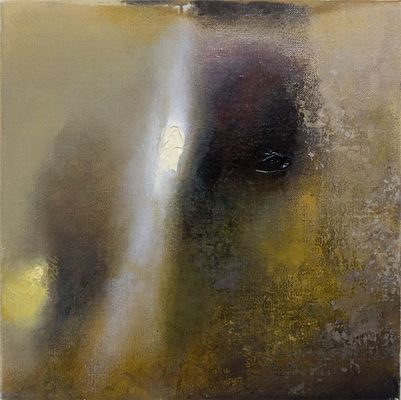
To return to Buckley’s fragment, the first two lines very much evoke how I paint nowadays. As you age, detail diminishes and patches of light become more luminous and float. I feel the most honest way of dealing with this is by smearing the oil paint on the canvas with the fingers and working close-up, blind. Only if the patches coalesce into an approaching image can the work gain a life.
-
Jonathan Walker was born in Melbourne, Australia and brought up on a dairy farm in Gippsland. In the 1970’s he studied painting at RMIT and won the Harold Wright Scholarship to the British Museum, London. During the 1980’s he exhibited at Pinacotheca Gallery, Richmond and had work shown at the NGV and Heidi City Art Gallery. Over the same period he designed the cover for the “Epigenesi” LP by Giancarlo Toniutti, Italy and conducted a mail exchange work with Achim Wollscheid, Germany. The work with artists through the post resulted in an article published in the bicentenary issue of Art and Australia 1988. He showed in artist run spaces such as WestSpace in the 90’s and 2000’s, and until 2012, taught painting at Victoria University, which is where we (Colleen Ahern and Lisa Radford) as organisers of the exhibition, among many others, had the privilege of being his student.
Walker’s knowledge was imparted to students through the careful selection of music, literature, and artists found in books that he himself had ordered for the library. Walker’s strategy was the generosity of sharing his vast knowledge with references specific to each student and their context.
Walker’s paintings share a similar focus and intimacy.
This exhibition presents a small selection of recent paintings alongside a publication that includes Walker’s writing. Observational and analytical, Walker’s work is a type of material notation — the time of day, colour and how it is blended, the both specific and fleeting location of a reflection on lino or the question of whether a chair leg should be included in a painting.
Please join us on Friday August 21 between 6-8pm to celebrate the opening of the exhibition.
Curated by Colleen Ahern and Lisa Radford.
B. Wurtz
Curated by Nic Tammens
March 26 - April 4, 2015
B.Wurtz works from a basement studio in his home on Manhattan’s Lower East Side.
This local fact is attested to by the plastic shopping bags and newsprint circulars that appear in his work. As formal objects, they don’t make loud claims about their origins but nonetheless transmit street addresses and places of business from the bottom of this long thin island. Like plenty of artists, Wurtz is affected by what is local and what is consumed. His work is underpinned by this ethic. It often speaks from a neighborhood or reads like the contents of a hamper:
“BLACK PLUMS $1.29 lb.”
“Food Bazaar”
“USDA Whole Pork Shoulder Picnic 99c lb.”
“RITE AID Pharmacy, with us it’s personal.”
“H. Brickman & Sons.”
“Sweet Yams 59c lb."
Most of the work in this exhibition was made while the artist was in residence at Dieu Donne, a workshop dedicated to paper craft in Midtown. Here Wurtz fabricated assemblages with paper and objects that are relatively lightweight, with the intention that they would be easily transportable to Australia. This consideration isn’t absolute in Wurtz’s work, but was prescriptive for making the current exhibition light and cheap. Packed in two boxes, these works were sent from a USPS post office on the Lower East Side and delivered to North Melbourne by Australia Post.
Wurtz appears courtesy of Metro Pictures, New York.
Thanks to Rob Halverson, Joshua Petherick, Sari de Mallory, Matt Hinkley, Helen Johnson, Fayen d'Evie, Ask Kilmartin, Lisa Radon, Ellena Savage, Yale Union, and "Elizabeth".
John Nixon
"Archive"
December 15 - January 20, 2014
The presentation of John Nixon's archive offered a rare showcase of this extensive collection of the artist's own publications, catalogues, posters, ephemera, editions and more, from the mid 1980s onwards, alongside a selection of his artworks.
Organized by John Nixon, Joshua Petherick and Matt Hinkley.
<a href=http://wfb.public-office.info/artist/john-nixon>All titles by John Nixon
"Habitat"
at Minerva, Sydney (organised by Joshua Petherick and Matt Hinkley)
November 15 - December 20, 2014
Lupo Borgonovo, Janet Burchill & Jennifer McCamley,
Lewis Fidock, HR Giger, Piero Gilardi, Veit Laurent Kurz,
Cinzia Ruggeri, Michael E. Smith, Lucie Stahl, Daniel Weil, Wols
Press Release:
“...It contained seven objects. The slender fluted bone, surely formed for flight, surely from the wing of some large bird. Three archaic circuitboards, faced with mazes of gold. A smooth white sphere of baked clay. An age-blackened fragment of lace. A fingerlength segment of what she assumed was bone from a human wrist, grayish white, inset smoothly with the silicon shaft of a small instrument that must once have ridden flush with the surface of the skin - but the thing’s face was seared and blackened.”
William Gibson, “Count Zero”, 1986
"Autumn Projects Archive"
Curated by Liza Vasiliou
March 6 - March 15, 2014
World Food Books, in conjunction with the Virgin Australia Melbourne Fashion Festival 2014, presented the Autumn Projects archive, consisting of a selection of early examples in Australian fashion with a particular interest in collecting designers and labels from the period beginning in the 1980’s, who significantly influenced the discourse of Australian Fashion.
Curated by Liza Vasiliou, the exhibition provided a unique opportunity to view pieces by designers Anthea Crawford, Barbara Vandenberg, Geoff Liddell and labels CR Australia, Covers, Jag along with early experimental collage pieces by Prue Acton and Sally Browne’s ‘Fragments’ collection, suspended throughout the functioning World Food Books shop in Melbourne.
H.B. Peace
presented by CENTRE FOR STYLE
November 14, 2013
"Hey Blinky, you say chic, I say same"
Anon 2013
H.B. Peace is a clothing collaboration between great friends Blake Barns and Hugh Egan Westland. Their pieces explore the divergences between 'character’ and ‘personality’ in garments....etc
Special Thanks to Joshua Petherick and Matt Hinkley of WFB and Gillian Mears
and a Very Special Thank you to Audrey Thomas Hayes for her shoe collaboration.
Janet Burchill & Jennifer McCamley
"Aesthetic Suicide"
May 10 - June 8, 2013
The first of our occasional exhibitions in the World Food Books office/shop space in Melbourne, "Aesthetic Suicide" presented a body of new and older works together by artists Janet Burchill & Jennifer McCamley, including videos, prints, a wall work, and publications.
During shop open hours videos played every hour, on the hour.
$.00 - Out of stock
The eternal clean out! New items weekly.
https://worldfoodbooks.com/category/sale
Published by World Food Books / Melbourne
$20.00 - In stock -
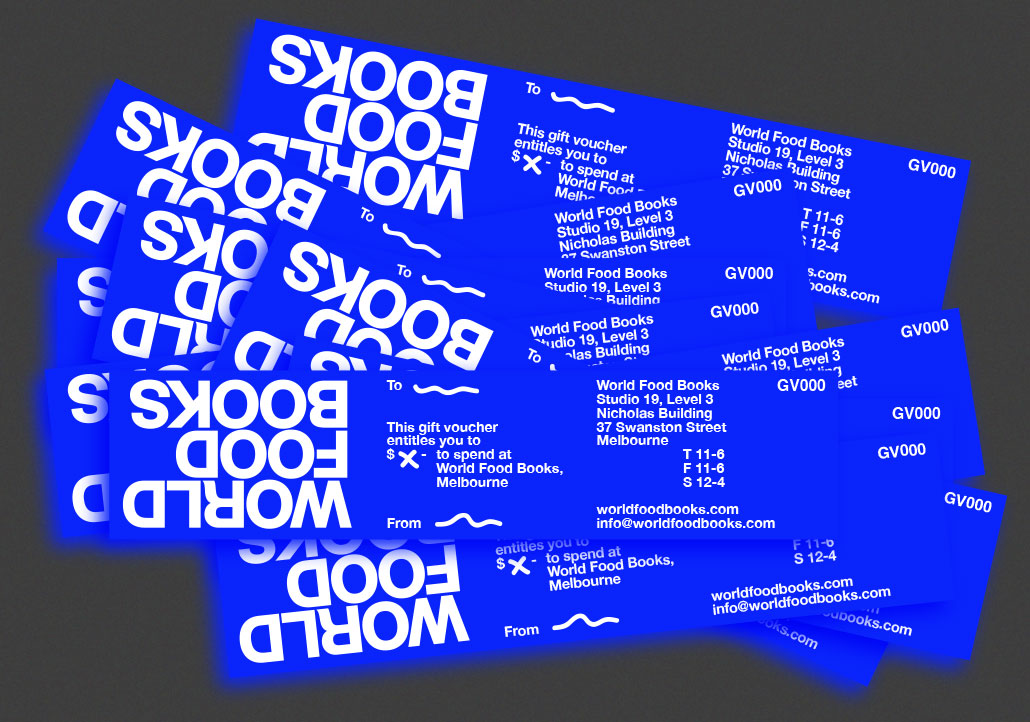
A World Food Books gift voucher is redeemable in our Melbourne bookshop or via our webshop (here). An e-voucher (printable pdf) will be sent to your purchase email address (please notify us if you wish to have the voucher sent to an alternate address and wish us to fill in the receiver's details on the card).
Gift vouchers can be purchased in increments of $20 (Australian Dollars) and the total amount can simply be added to by increasing the quantity in your shopping cart. eg. A quantity of 5 gift vouchers will result in an item total of $100 - a $100 gift voucher. Simply click "ADD TO CART" 5 times, or update your quantity in the shopping cart.
If you wish to purchase multiple, separate gift vouchers in one go, please just email us and we can personally prepare and email you a payment request.
Please note: Please select Pick-Up on gift voucher purchse to avoid any postage charges. Accidental postage charges will be refunded right away!
Thank you.
For any questions, please don't hesitate to email: [email protected]
1969, German
Softcover (staple–bound), unpaginated, 21 x 16.6 cm
1st Edition, Out of print title / used / very good
Published by
Kestner Gesellschaft / Hannover
$40.00 - In stock -
Lovely 1969 catalogue of Horst Egon Kalinowski, published on the occasion of his solo exhibition at the Kestner Gesellschaft, Hannover. Heavily illustrated with documentation of his sculptures throughout in colour and b/w, with accompanying texts in German.
Horst Egon Kalinowski (1924–2013) was a German artist who, after studying in Düsseldorf and Paris, abandoned abstract painting in the mid-1950s in favour of assemblages and collages made from wood, branches, boxes, saddles and other weathered materials, often unified by monochrome brown surfaces suggestive of leather. During the 1960s he established an international reputation through major exhibitions including L'art de montage at the Museum of Modern Art, New York (1963), Mythologies quotidiennes at the Musée d'Art Moderne de la Ville de Paris, the Carnegie International (1965, 1968), and exhibitions at the Fondation Maeght. He travelled extensively in Europe and the United States, received the Carl Einstein Prize (1966) and the Prix Burda for Sculpture (1967), began teaching at the Academy of Fine Arts in Karlsruhe in 1968, and was elected to the Prussian Academy of Arts in Berlin the same year. Alongside his sculptural assemblages, he also produced etchings throughout the decade, further developing a distinctive practice that merged abstraction, found materials, and evocative, tactile surfaces.
VG copy with some light wear to boards/tanning to edges.
2026, English
Softcover, 196 pages, 25 x 17.5 cm
Published by
Rab-Rab Press / Helsinki
$38.00 - In stock -
Edited by Michael Corris, the expanded edition of In the Belly of the Beast: Art & Language New York Project 1972-1978 is a survey of the tumultuous years of the political Conceptualism in the mid-seventies New York.
Artists have always experimented with politics, either by organizing themselves or uniting in support of a broader political movement. Today, "activist art" is taught in universities, supported by foundations, and featured in museums and international exhibitions. Is this the only possible way?
In the Belly of the Beast tells a different story, of the work of politically engaged artists and the conflicts they experienced. It is the history of artists wishing to continue working within the boundaries of the artworld and those who were intent on establishing new ideological and class relationships with activists to build a political party.
During the 1970s in New York, the Art & Language collective pioneered institutional critique; published a Marxist-influenced journal; agitated against racism and sexism in museums; challenged the cultural imperialism of international exhibitions; and forged a framework for a socialist organization of artists. This new edition includes previously unpublished documents illuminating the contradictions and disputes that lay at the center of the organization and practices of Art & Language and left-wing groups, such as the Anti-Imperialist Cultural Union and the Artists' Meeting for Cultural Change, mobilizing artists in New York at the time.
The new and expanded edition of In the Belly of the Beast features an extensive interview with Michael Corris, who annotated a collection of previously unavailable documents from the period, including manuscripts, pamphlets, transcripts, and letters.
Art & Language is the name of a group of English artists who choose to work collectively, and the title of a magazine that they founded in 1968. Proposing a critical analysis of the relations between art, society, and politics, Art & Language marks, even in its name, the importance of the “textual turning point” in the 1960s.
Since 1976, Art & Language's project has continued, through Mel Ramsden and Michael Baldwin, with the literary and theoretical collaboration of Charles Harrison. Working with very varied mediums, from painting to rock, these co-founders of Conceptual art remain, even today, attached to observing the consequences of what they themselves call the “depressing collapse of modernism.”
2025, English
Softcover, 24 pages + 8 page insert, 21 x 14 cm
Ed. of 300,
Published by
BlackMass Publishing / New York
$44.00 - In stock -
An intimate exploration and meditation on Melvin Edwards' work (a zine produced in limited print run in the Palais de Tokyo's risography micro-publishing workshop).
In dialogue with the retrospective dedicated to Melvin Edwards (from 22 October, 2025 to 15 February, 2026), the Palais de Tokyo invited the New York-based publishing house BlackMass Publishing to copublish a zine.
Entitled Melvin Edwards—Echoes of the Weld, this publication, conceived by artist and founder of BlackMass Publishing, Yusuf Hassan, takes the form of an intimate exploration and meditation on Melvin Edwards' work. Yusuf Hassan envisions this zine as a conversation between their respective mediums: sculpture and printed matter. He describes the poetic approach to Melvin Edwards' work that guided his creative process as follows: "Over the summer, as I developed this publication, I immersed myself in his philosophy. I took quiet trips to see his sculptures in New York—especially those that live outside the walls of institutions. The ones that live among people. The ones that weather. That gather dust, rust, fingerprints, and time."
This zine has been Risograph-printed in 300 copies and bound in the publishing workshop of the Palais de Tokyo.
BlackMass Publishing is a publishing house founded by artist Yusuf Hassan in 2019. By combining photographic archives, poetry, and jazz music, BlackMass Publishing revisits transdisciplinary American and transatlantic Black artistic narratives from the Black Arts Movement of the 1960s and 1970s to the present day.
Melvin Edwards (born 1937 in Houston) is a pioneering figure in the history of African American abstract art. He is best known for his use of metal in his sculptural work. His minimalist and abstract approach serves as a vessel for social histories and personal narratives, often addressing themes of violence and resistance from the perspective of Black experiences on both sides of the Atlantic.
2017, English
Softcover, 152 pages, 15 x 21 cm
Published by
Gavin Brown’s Enterprise / New York
Mousse / Milan
$44.00 - In stock -
Following the artists' previous series of life-size puppets in Die Schmutzigen Puppen von Pommern, this new publication presents a collection of one hundred sixty-four small puppets, each having a unique look.
In 2012, thirty life-size puppets were made from jute and straw.This number grew to fifty-four in the course of 2013. This series of puppets was called Die Schmutzigen Puppen von Pommern, after a region extending across northern Germany and Poland. In the spring of 2015 it was decided that a large number of small puppets were to be manufactured from the same material, providing that each should not exceed 35 cm and have a totally different character from one another. A team of six people worked on this series for about 3,000 hours in a small workshop at the canal in Brussels. The undertaking was completed on November 13, 2015. The result was one hundred sixty-four puppets. They were presented at Sant'Andrea de Scaphis, in Rome, and all of them are in this book. The title, I Piccoli Puppazzi Sporchi di Pruppà, is after a small hamlet in the southeast of Italy, not far from the town of Stilo.
Published following the eponymous exhibition, Sant'Andrea de Scaphis, Rome, from November 21, to December 19, 2015.
Jos de Gruyter & Harald Thys have been working together as an artist duo since the end of the 1980s. Their photographs, drawings, objects, and videos—steeped in black humor, critical (self)-reflection and overlapping reality, fiction and suppressed history—play with notions of the superficial and banal.
Jos de Gruyter & Harald Thys's art casts a merciless perspective on reality. Through their numerous artistic approaches, the artist duo visualize their imaginings of the parallel world inherent within the modern human psyche, along with how it manifests itself in the everyday aspects of life and civic conformity. Everything from work, leisure, and family, to social class, masculinity, and marginalization are envisaged through convening an unlikely cast of nonprofessional actors, family members, friends, beards, objects, and mannequins alike, often in banal, homespun settings rife with awkward power dynamics.
Published with Gavin Brown's enterprise, New York.
2023, English / French
Softcover, 416 pages, 28.5 x 21 cm
Ed. of 840,
Published by
Claude Balls Int. / France
$98.00 - In stock -
Paradis is a continuation of the eponymous exhibition conceived by artist Marie Angeletti in Marseilles in 2021. The exhibition brought together 56 artists of different origins and generations. More than just a transcription of this event, this catalogue brings together some one hundred contributions, combining critical texts, poetry, artists' writings and new translations, alongside an equally large number of visual contributions and ad hoc works, most of them previously unpublished.
Published following the exhibition Paradis, curated by Marie Angeletti at Maison R&C, Marseille, in 2021.
Works by Nicole-Antonia Spagnola, John Kelsey, Matthew Pang, Cathy Wilkes, Sarah Rapson, Gene Beery, Jacqueline Mesmaeker, Sara Dereadt, Kari Rittenbach, Maria Nordman, Olga Balema, Louise Lawler, Adrian Morris, John Miller, Enver Hadzijaj, Enzo Shalom, Bedros Yeretzian, Marie Angeletti, Morag Keil, Michael Callies, Gianna Surangkanjanajai, Hélène Fauquet, Andy Robert, El Hadji Sy, Henrik Olesen, Aurélien Potier, Peter Fend, Megan Francis Sullivan, Sturtevant, Tonio Kröner, Bernard Bazile, Gladys Clover, Jimmie Durham, Michael Asher, Camilla Wills, Matthew Langan-Peck, Dan Graham, Nina Könnemann, Win McCarthy, Anna Rubin, Heji Shin, Michèle Graf & Selina Grüter, Simone Forti, Morgan O'Hara, Ye Xe, Yuki Kumura, Lily van der Stokker, Eva Steinmetz, Michael Van den Abeele, Marc Kokopeli, Robert Grosvenor, Samuel Jeffery, Charlotte Houette, Bradley Kronz, Adam Martin, Wade Guyton, Chloe Truong-Jones.
Edited by Marie Angeletti with Gianmaria Andreetta and Camilla Wills.
Contributions by Georgia Sagri, Nick Irvin, Anne Dressen, Anne Pontégnie, Anne Rorimer, Kari Rittenbach, Julie Ault, Martin Beck, Matt Browning, John Miller, Helmut Draxler, Steve Cannon, Rae Armentrout, Zoe Hitzig, Lola Sinreich, Fanny Howe, Richard Hawkins, Alexander García Düttmann, Daniel Horn, Stéphane Barbier Bouvet, Jill Johnston, Maria Wutz, Pierre Bal-Blanc, Jérome Pantalacci, Anne Rorimer, Michael Asher, Steven Warwick, Dan Graham, Hans-Christian Dany & Valérie Knoll, Eleanor Ivory Weber, Inka Meißner, Simone Forti, Angharad Williams, Peter Wächtler, Michael Van den Abeele, Charlotte Houette, James Tiptree Jr.
Graphic design: Marie Angeletti and Marietta Eugster.
Published by Claude Balls Int.
Edition of 840 copies.
1971, Japanese
Rigid softcover (in illustrated slipcase), 64 pages, 30 cm x 21 cm
1st Edition, Out of print title / used / very good
Published by
Gakugei Shorinsha / Tokyo
$380.00 - Out of stock
Super rare and bookshop favourite early collection of artworks by ero-guro master Toshio Saeki (1945—2019), published in 1971 by Gakugeishorin. Stunning large-format softcover collection of exquisitely printed saturated full-bleed colour and b/w artworks on warm matte paper stock capturing this legendary underground artist at the height of his powers, housed in original publisher's cardboard slipcase. His third book collection featuring so many of his finest works. Postface by Hiraoka Masaaki in Japanese. A must!
Toshio Saeki (1945—2019) was an illusive Japanese illustrator and painter, and icon of 1970s Tokyo counterculture, known for combining Japanese folklore, Yōkai spirits and elements of Western art with his own sophisticated aesthetics to create a unique, sensational world of eros, dark humour, and horror. Given the title “Erotic Engineer” by Timothy Leary, Saeki's provocative art broke all sexual taboos, questioned Japanese ideology and traditional views on love, desire and gender roles. Saeki’s surgically-precise graphic work is closely related to the Japanese cultural phenomenon ‘Erotic, Grotesque, Nonsense’ (ero, guro, nansensu).
“Toshio Saeki conjures death with a pen”—Shūji Terayama, 1969.
Very Good copy. Very complete copy with slipcase and obi present. Some wear/marking to a VG slipcase.
2016, English
Softcover, 128 pages, 12.8 x 19.7 cm
Published by
Sternberg Press / Berlin
$42.00 - In stock -
This collection of essays by Martin Herbert considers various artists who have withdrawn from the art world or adopted an antagonistic position toward its mechanisms. A large part of the artist’s role in today’s professionalized art system is being present. Providing a counterargument to this concept of self-marketing, Herbert examines the nature of retreat, whether in protest, as a deliberate conceptual act, or out of necessity. By illuminating these motives, Tell Them I Said No offers a unique perspective on where and how the needs of the artist and the needs of the art world diverge. Essays on Lutz Bacher, Stanley Brouwn, Christopher D’Arcangelo, Trisha Donnelly, David Hammons, Agnes Martin, Cady Noland, Laurie Parsons, Charlotte Posenenske, and Albert York.
Martin Herbert is a writer and critic living in Berlin. He is associate editor of ArtReview and writes for international art journals. Previous books include The Uncertainty Principle (2014) and Mark Wallinger (2011).
Design by Fraser Muggeridge studio
2021, English
Softcover, 244 pages, 13 x 20 cm
1st Edition, Out of print title / as new
Published by
Mousse / Milan
$90.00 - In stock -
First edition, now out-of-print in all editions, Mike Kelley — Materialist Aesthetics and Memory Illusions is a critical appraisal of Mike Kelley’s politics of culture as expressed in his visual art and writings. An essay by Laura López Paniagua, with an introduction by John Miller.
American artist Mike Kelley (1954–2012) was the mastermind behind some of the most bizarre and instantly recognizable artistic projects of the 1990s. Dedicated as he was to visual art, Kelley was also an insightful theorist who wrote prolifically about his own creations as well as the historical context in which he worked. His writing reveals a matrix of deeply felt theories regarding the aesthetics of the 1980s, ’90s and 2000s, and his concern with victim culture and repressed memory syndrome.
This book presents a new perspective on the life and work of the artist, assessing his personal philosophy via art as well as writing. Art historian Laura López Paniagua places Kelley’s work in conversation with the theories of thinkers such as Georges Bataille, Walter Benjamin, Pierre Bourdieu, Sigmund Freud, Jacques Lacan and Maurice Merleau-Ponty. Through Paniagua’s transdisciplinary approach, Kelley’s oeuvre emerges as a stance based in materialist aesthetics.
As New.
2025, English
Softcover, 160 pages, 24 x 34 cm
Published by
Lenz Press / Milan
$68.00 - In stock -
To love and devour by Tolia Astakhishvili was published on the occasion of the inaugural exhibition at the new site of the Nicoletta Fiorucci Foundation in Venice, curated by Hans Ulrich Obrist.
The book, produced in close collaboration with the Lorenzo Mason Studio, brings together drawings, paintings, and archive images composed directly amid the cracks, wounds, and skin of a building located in the historic center of Venice, which served as the artist's studio for a number of months. Through processes of transformation of the space, addition and subtraction, expansion and contraction, Astakhishvili has created a project shot through with a deep sense of disruption, distortion and fragmentation—a feeling of uncertainty that is reflected in the way in which visitors to the installation are given the freedom to move around, without having to concentrate on a center or to follow a pre-set route. Appropriately, then, the book takes the form of a stream of images, in which the spaces and materials of the building (wood, glass, dust, mold, bricks, concrete, plaster …) enter into a dialog with the drawings, paintings, sculptures, collages, and photographs made by the artist herself and the other invited artists, including Ketuta Alexi-Meskhishvili, Zurab Astakhishvili, Thea Djordjadze, Heike Gallmeier, Rafik Greiss, Dylan Peirce, James Richards, and Maka Sanadze.
For Tolia Astakhishvili, architecture is the space of projection of ideas, which are developed in that space, generating actions that are separate but conducted simultaneously: alteration of structural elements, pictorial and graphic composition, and creation of perceptive ambiguities—of space, light, and sound. The book compiles the traces of this practice, serving as a sort of diachronic diary in the form of images, constituting a complete encapsulation of the artist's poetics.
The book also features a new interview with the artist by Hans Ulrich Obrist.
Tolia Astakhishvili (born 1974 in Tbilisi, Georgia) is an interdisciplinary artist whose work mainly takes the form of installations.
Edited by Tolia Astakhishvili and Hans Ulrich Obrist.
Texts by Tolia Astakhishvili and Hans Ulrich Obrist.
Graphic design: Lorenzo Mason Studio.
1969, English
Softcover, 240 pages, 21 x 22 cm
1st Edition, Out of print title / used / very good
Published by
Studio Vista / London
$280.00 - Out of stock
Rare first 1969 printing of the seminal "Art Povera", the phenomenal and now legendary critical/photographic book by the great Italian art historian, critic and curator Germano Celant (1940—2020) that internationally established the so-called Art Povera / Arte Povera movement (meaning "poor art", coined by Celant in 1967) and published by Studio Vista, London and printed in Italy.
Includes profiles of major artists of the movement, including a short text followed by pages of full-page photographs for each artist. Artists featured: Walter de Maria, Michelangelo Pisteletto, Stephen Kaltenbach, Richard Long, Mario Merz, Douglas Huebler, Joseph Beuys, Eva Hesse, Michael Heizer, Ger van Elk, Lawrence Weiner, Luciano Fabro, Bruce Nauman, Joseph Kosuth, Jan Dibbets, Giovanni Anselmo, Robert Barry, Pier Paolo Calzolari, Dennis Oppenheim, Barry Flanagan, Robert Smithson, Giulio Paolini, Reiner Ruthenbeck, Alighiero Boetti, Giuseppe Penone, Franz Erhard Walther, Hans Haacke, Gilberto Zorio, Robert Morris, Marinus Boezem, Carl Andre, Emilio Prini, Richard Serra.
"This book does not aim at being an objective and general analysis of the phenomenon of art or life, but is rather an attempt to flank (both art and life) as accomplices of the changes and attitudes in the development of their daily becoming. This book does not attempt to be objective since the awareness of objectivity is false consciousness. The book, made up of photographs and written documents, bases its critical and editorial assumptions on the knowledge that criticism and iconographic documents give limited vision and partial perception of artistic work. The book, when it reproduces the documents of artistic work, refutes the linguistic mediation of photography. The book, even though it wants to avoid the logic of consumption, is a consumer's item. ... This book produces a collection of already old material. ... In this book there is no need to reflect in order to seek a unitary and reassuring value, immediately refuted by the the authors themselves, rather there is the necessity to look into it for the changes, limits, precariousness and instability of artistic work." — text from Celant's introduction "Stating That."
A must.
Very Good copy, usual tanning.
1993, English / German
Softcover + invitation, unpaginated, 26.5 x 24 cm
1st Edition, Out of print title / used / very good
Published by
Hochschule für Angewandte Kunst / Vienna
$90.00 - In stock -
Exceptionally rare, incredible 1993 catalogue for this elusive group exhibition 'curated by' Robert "Bob" Nickas, at the Hochschule für Angewandte Kunst and Galerie Metropol, Vienna, 1993, featuring the work of Vito Acconci, John Armleder, Robert Barry, Bill Bitting, Gudrun Wolfgruber, Laurie Parsons, Steve DiBenedetto, Gretchen Faust, Robert Gober, Felix Gonzalez-Torres, Scott Grodesky, Peter Halley, Jon Kessler, Jutta Koether, Louise Lawler, Ken Lum, John Miller, Olivier Mosset, Chuck Nanney, Cady Noland, Steven Parrino, Raymond Pettibon, David Robbins, Lisa Ruyter, Sam Samore, Michael Scott, Rudolf Stingel, Joan Wallace, Dan Walsh. Profusely illustrated throughout in colour, accompanied by Nickas' introduction (in bi-lingual English and German), which alone makes the catalogue special.
Exhibition invitation card inserted.
Very Good copy.
2023, English
Softcover, 360 pages, 24 x 17 cm
Published by
At Last Books / Copenhagen
$79.00 - In stock -
Revenge publishing - a new genre or as old as writing itself? Isn’t all writing, to some extent, a way to avenge an oversight or rejection, aiming to set the record straight? Many pieces in this collection were commissioned, accepted, and paid for but never published - whether due to common mishaps or more devious reasons. 'Corrected Proofs' seeks to remedy this. Alongside previously unpublished works, this collection includes newly written essays and interviews on figures like Lutz Bacher, Charles Ray, and Arnold J. Kemp. Heroes and villains - John Wilkes Booth, Lee Harvey Oswald, Felix Gonzalez-Torres, Cady Noland, and Steven Parrino - share the stage with familiar names in unexpected contexts: Marcel Duchamp, Ed Ruscha, and Andy Warhol. Rediscovered artists like Bob Smith and Stephen Varble appear alongside Lee Lozano, the January 6 insurrection, and The Fall.
Foreword by Randy Kennedy.
Bob Nickas is a writer and curator based in New York, where he has lived since 1984. He is the author of four collections of essays and interviews, Live Free or Die, The Department of Corrections, Komplaint Dept., and Corrected Proofs: Previously Unpublished, Uncollected, Unwanted, as well as Yesterworld: 2019 Diary.
1989, English
Hardcover (w. dust jacket), 508 pages, 24 x 16 cm
1st Edition, Out of print title / used / very good
Published by
UMI Research Press / Ann Arbor
$55.00 - Out of stock
First 1989 hardcover edition.
Aubrey Beardsley, one of the most fascinating figures of turn-of-the-century European culture, was a prodigious master who continues to defy those who thought his art would remain a prisoner of the 1890s. His acute black and white drawings touched the work of Bakst, Toulouse-Lautrec, Klee, and Picasso, among others, and, a century after his death, he continues to capture the imagination of artists, scholars, and enthusiasts alike.
In Reconsidering Aubrey Beardsley, editor Robert Langenfeld and nine distinguished essayists from England and America — including Brian Reade, lan Fletcher, John Stokes, and Karl Beckson — reevaluate Beardsley's art and writing from a variety of viewpoints, testing new perceptions and qualifying established judgments. Departing from previous studies, Langenfeld and his colleagues offer a broad assessment of this controversial and exciting figure. Topics treated include Beardsley's use of paradox in both art and writing, his influence on modern theatrical style, his attitude toward women, and his view of the artist/illustrator as literary critic. In addi-tion, an annotated secondary bibliography with more than 1500 entries, compiled by Nicholas Salerno, provides for the first time a comprehensive record of the many responses — books, articles, letters — to Beardsley's life and work.
For nearly a century Aubrey Beardsley has eluded the sharpest descriptive and biographical skills of his critics and admirers. As his centennial approaches, Reconsidering Aubrey Beardsley will provide a well-documented, richly illustrated source of knowledge for those interested in literature, theatre, gender studies, as well as art of the fin de siècle.
Robert Langenfeld received his Ph.D. from Arizona State University and is currently an Assistant Professor at the University of North Carolina at Greensboro. Since 1983 he has served as editor of English Literature in Transition, 1880-1920, and in 1988, as co-publisher, he founded ELT Press and its 1880-1920 British Authors Series.
Dr. Langenfeld has published articles on George Moore, Shakespeare, and Hemingway, and co-authored, with David Eakin, George Moorés Correspondence with the Mysterious Countess. His George Moore: An Annotated Secondary Bibliography was published by AMS Press in 1987. He is also a major contributor to the Hardy and Shaw volumes in the Annotated Secondary Bibliography Series from Northern Illinois University Press. Dr. Langenfeld is currently working on George Mooré's Last Works: The Demise of an Iconoclast.
VG copy in VG dust jacket, preserved under mylar wrap.
2026, English
Softcover (screen–printed + staple–bound), various sized books bound together, overall 26.5 x 20 cm
Ed. of 15,
Published by
Oriette Wood / Naarm
$70.00 - In stock -
"Fist is a bad trip from the shopping mall of the mind. Beware each screen printed page more glib than the last."
Ed. of 15!
2025, English
Softcover, 16 silk-screened pages, 14 x 16 cm
Edition of 30,
Published by
Oriette Wood / Naarm
$70.00 - In stock -
"'Insect Smut' is a small edition graphic zine made up of 14 collages. These are made by abstracting references from my personal archive of smut, kink, and comics. It's a homage to the vibrant scene of French graphic zines in the 1980's to 90's. Printed and bound at Troppo Print Studio over a three week period."—Oriette Wood
Silkscreened edition of 30
2003, English
Hardcover (w. dust jacket), 235 pages, 24 x 16.5 cm
1st Edition, Out of print title / used / fine
Published by
Ashgate / Hampshire
$300.00 - In stock -
First 2003 hardcover edition.
A strong preoccupation with the human body - often manifested in startling ways - is a characteristic shared by early modern Europeans and their present-day counterparts. Whilst modern manifestations of this interest include body piercing, tattoos, plastic surgery and eating disorders, early modern preoccupations encompassed such diverse phenomena as monstrous births and physical deformity, body snatching, public dissection, flagellation, judicial torture and public punishment. This volume explores such extreme manifestations of early modern bodily obsessions and fascinations, and their wider cultural significance.
Agreeing that an interest in physical boundaries, extreme physical manifestations and situations developed and grew stronger during the early modern period, the essays in this volume investigate whether this interest can be traced in a wider range of cultural phenomena, and should therefore be given a prominent place in any future characterization of the early modern period. Taken as a whole, the volume can be read as an attempt to create a new context in which to explore the cultural history of the human body, as well as the metaphors of research and investigation themselves.
Fine copy in Fine dust jacket preserved in mylar wrap.
1986, Czech
Hardcover (w. dust jacket), 104 pages, 24.5 x 17 cm
1st Edition, Out of print title / used / very good
Published by
ČS filmový ústav / Prague
$80.00 - Out of stock
First edition of this 1986 hardcover monographic volume devoted to the inventive Czech film director, artist, production designer and animator, Karel Zeman (1910–1989), renowned for directing fantasy films that ingeniously combined live-action footage with animation, including Journey to the Beginning of Time (1955) and Invention for Destruction (1958). Because of his creative use of special effects and animation in his films, he has often been called the "Czech Méliès". This wonderful volume edited by Milada Hábová and Zdeněk Smejkal, collects many studies spanning his full filmography, lavishly illustrated throughout with films stills, drawings, photography (in lush colour and b/w), plus an extensive bibliography and references. With contributions by Jiři Purs, Jan Hořejší, Marie Benešová, Jaroslav Boček, Jaroslav Brož, Jørgen Vestergaard, Jan Kliment, Zdeněk Smejkal, Jiři Tvrznik, Elmar Klos.
VG copy in VG dust jacket with some minor wear to edges.
2017, Polish
Softcover, 124 pages, 23 x 16 cm
1st Edition, Out of print title / used / fine
Published by
Zachęta National Gallery of Art / Warsaw
$55.00 - In stock -
Publication on Polish painter Maria Anto (1936–2007), renowned for her metaphysical, dreamlike vision that merges figuration with elements of naïve art and poetic symbolism, published to accompany a major survey which took place in the Zachęta National Gallery of Art between 7 September 2017–4 February 2018, curated by Michał Jachuła with Katarzyna Kołodziej.
Maria Anto’s exhibition at the Zachęta was the first such extensive review of the artist’s paintings since her death in 2007. Focusing on her works in the 1960s and 1970s, it features about 60 paintings (individual and collective portraits, animal presentations, allegorical scenes and landscapes), as well as drawings and selected archival materials.
The artist’s work follows in the footsteps of the tradition of surrealism – metaphorical painting, naïve art, illustrative fantasy and fairy-tale characters – which have always been imbued with mystery and an atmosphere of uncanniness. As a professional painter, as far back as the beginning of her creative career, she consciously drew upon naïve art. She ignored current artistic tendencies as well as the principles of realistic imagery to the same degree, instead devoting herself to figurative art, combining imagination, memories, and everyday life. From today’s perspective, Maria Anto’s art from her most important and mature period seems to form an exceptionally original, separate position in art. Her paintings are an unprecedented presence on the Polish scene, and the artist created a huge collection of works, achieving an undisputed individualism as a painter.
The exhibition and this accompanying publication re-discovers not only Maria Anto’s art, but also present issues in the artistic practice of this woman-painter, who successfully worked in a male-dominated environment for several decades.
Essays by Michał Jachuła, Marcin Lachowski, Magdalena Uma and Karolina Zychowicz analyse the motifs and language of her painting, its reception and contexts, Agnieszka's Sketch. Maria Wasieczko and conversations with Zuzanna Janin, Olga Wolniak, Piotr Nowicki familiarise the figure of the artist and the time in which she created a stir.
Near Fine copy.
1991, English
Softcover, 366 pages, 22 x 14 cm
1st Edition, Out of print title / used / very good
Published by
Oxford University Press / New York
$45.00 - In stock -
First 1991 softcover edition of this 1989 interdisciplinary study of the debate surrounding crime and madness in France between 1880 and 1914. It argues that psychiatric theories of human behaviour and new sociological interpretations of crime combined to undermine the traditional foundations of the penal system, and helped to shape the new science of criminology.
The book focuses on a range of case-studies, covering many issues of contemporary concern: feminine hysteria and women's sexuality; male alcoholism, and racial degeneration; and crimes of passion, crowd violence, and revolutionary politics. Murders and Madness makes fascinating reading, and is a major contribution to our understanding of fin-de-siècle mentalités.
Ruth Harris is Fellow and Tutor in Modern History at New College, Oxford.
"[a] brilliant dive into the Parisian world of mayhem, murder and madness... her account is outstanding ... remarkably concise and well-written...
Harris' sensitivity to gender issues in these cases is exemplary ... her fine study shows that the "new medical history" is not a narrow specialism, but can be a potent agent of wider historical understanding?
French History
'Harris has written a useful, compendious, suggestive, often sensitive book.'–Times Literary Supplement
"This book represents a major contribution to the history of forensic medicine and the sexual stereotyping of men and women late in the nineteenth century ... the book's painstaking analysis of dozens of cases... gives it an authoritative tone that will not easily be challenged... fine scholarship."–Medical History
"Harris pushes beyond an analysis of existing scholarship to mine a rich vein of relevant but little-used primary source material... a fascinating and valuable book."–Journal of the British Society for the History of Science
VG copy with light wear to edges/spine.
1951, English
Hardcover (w. dust jacket), 286 pages, 21.6 x 14 cm
1st Edition, Out of print title / used / good
Published by
Spring Books / London
$140.00 - In stock -
Rare first 1951 British hardcover edition of Robert Eisler’s ground-breaking commentary on human violence. In Man into Wolf, basing his hypothesis on the writings of Carl Jung, Eisler proposes a prehistoric explanation for the origins of the werewolf and, more broadly, for violence itself. He suggests that primitive man had once been peaceful and vegetarian, until the Ice Age forced humans to kill in order to survive. According to Eisler, the traumatic necessity of eating meat to avoid starvation, coupled with wearing animal hides to avoid freezing, may have left a deep psychological imprint: a buried memory of becoming fur-covered beasts. From this, Eisler attempts to suggest the possibility of a historical—or rather prehistorical—evolutionist derivation of all crimes of violence, from the individual attack on life known as murder or manslaughter to the collective, organized killing we call war.
Eisler argues that evidence from prehistory can be made intelligible through Jung’s theory of archetypes surviving in the collective conscience and revealing themselves across the world in legends, myths, and rites. He also advances the provocative thesis that many contemporary serial killers were a particular breed of psychologically warped individuals who believed themselves to be werewolves. The book includes Eisler’s lecture given to the Royal Society of Medicine, together with extensive notes in which he discusses every possible aspect of the subject, ranging from the perverseness of the Marquis de Sade to the Grecian Bacchantes, from Green Men and agricultural ceremonies to a case study of John George Haigh.
Also included are chapters on Professor Jung’s archetypes and Neo-Lamarckism; the Roman Luperci and the Lupercalia ritual and their contemporary parallels; the flagellation of women in the Dionysian mysteries; a clear case of vampirism in the crimes of John George Haigh; and “Going Beserk.” The volume also contains many pages of Eisler’s notes, as well as appendices and an index. A remarkable and unusual work at the intersection of anthropology, psychology, mythology, and the study of violence, it will be of interest to students of anthropology, gender studies, psychology, and the history of ideas.
With an Introduction by Sir David K. Henderson.
VG copy with tanning and light wear/marking in G dust jacket with moisture shadowing to spine edge/back, price–clipped.
2015, English
Softcover, 464 pages, 19.5 x 13 cm
Published by
Penguin Books / London
$34.00 - Out of stock
The two story collections that established a master of supernatural horror, combined for the first time in one volume.
Thomas Ligotti's debut collection, Songs of a Dead Dreamer, and his second, Grimscribe, permanently inscribed a new name in the pantheon of horror fiction. Influenced by the strange terrors of Lovecraft and Poe and by the brutal absurdity of Kafka, Ligotti crafted his own brand of existential horror. In decaying cities and lurid dreamscapes tormented by the lunatic pageantry of masks, puppets, and obscure ritual, Ligotti's works lay bare the sickening madness of the human condition. From his dark imagination emerge stories like "The Frolic" and "The Last Feast of Harlequin," waking nightmares that splinter the schemes validating our existence. Ligotti bends reality until it cracks, opening fissures through which he invites us to gaze on the unsettling darkness below.
"The best-kept secret in contemporary horror fiction."–The Washington Post
"[Ligotti] is a dense, witty, and enormously inventive writer."–The Philadelphia Inquirer
1982, Japanese
Hardcover (clothbound in slipcase), unpaginated, 53 x 37.5 cm
Ed. of 1000,
1st Edition, Out of print title / used / very good
Published by
Nobel Shobo / Tokyo
$260.00 - Out of stock
Exquisite (and ENORMOUS) clothbound, slipcased collection of Japanese surrealist painter and illustrator Iwami Furusawa (1912–2000), devoted entirely to his female nudes, for which he was acclaimed, published in a limited edition of 1000 copies in 1982. Beautiful, full–page reproductions of his paintings, drawings and ink nudes throughout the entire clothbound book, housed in original publisher's thick cardboard shipping slipcase. Includes photo portrait on the artist in his studio with model.
Iwami Furusawa (1912–2000), born on the island of Kyushu, began his training as a painter in 1928 at the Hongô Institute in Tokyo. In 1936, Furusawa started publishing mangas under the name of Bonsuke Noro. After the end of his artistic studies, he relocated to Nagasaki and became a part of the so-called Ikebukuro Montparnasse, the area where many aspiring artists created their oeuvres. In 1943, the artist was drafted into the Second Sino-Japanese War and became a prisoner of war. Released only three years later, Furusawa went through a traumatic experience that would become an additional ground for his remarkable paintings. After the war, Furusawa made himself the first promoter of surrealism in Japan. The female nude (often the representation of nature in art) became a central figure in his works. One of the most remarkable works combining "Eros and Thanatos" is Nagasaki. In the image, we see a crucified nude wearing bloody thorns with a mushroom cloud in the background. The abbreviation AB2 signifies that this is the second atomic bombing (the first happened over Hiroshima). To some extent, we can compare these Japanese cities to the figure of Christ, regarding bombings as a disastrous atonement for the war crimes of the Japanese forces. The crucified nude may symbolize suffering nature itself. Furusawa was also a book illustrator and prominent printmaker who produced over 300 woodcut prints. He became enormously popular in Japan for his erotic prints. In 1960, he began to transfer his drawings from the 1940s using printmaking techniques. For more than thirty years he worked on the Shuragaki cycle (The bloody meeting with the hungry demon in hell), which he completed in 1993. Subjects like death, hunger, rape, looting and the landscape of China define his most powerful etchings and show the horrors of war. Goya's The Disasters Of War (1810s) was a significant influence on his print-making.
Near Fine copy, beautifully preserved in Very Good slipcase (only light tanning/wear/foxing to case).